REVIEW 4 major objections 5 minor 61 references
KITE: Kernelized and Information Theoretic Exemplars for In-Context Learning
T0 review · 4 major / 5 minor · reviewed 2026-08-15 · deepseek-v4-flash
Pith's one-line read KITE frames in-context example selection as a query-specific optimization problem, proves an approximate-submodularity guarantee for greedy selection, and reports the best accuracy in 13 of 15 dataset-model settings.
desk verdict KITE is a genuinely new ICL retrieval recipe with real empirical gains, but the paper's headline theoretical guarantee rests on a false lemma and should not be published as is. read the letter →
The pith
A machine-rendered reading of the paper's core claim, the machinery that carries it, and where it could break.
The reading
What carries the argument
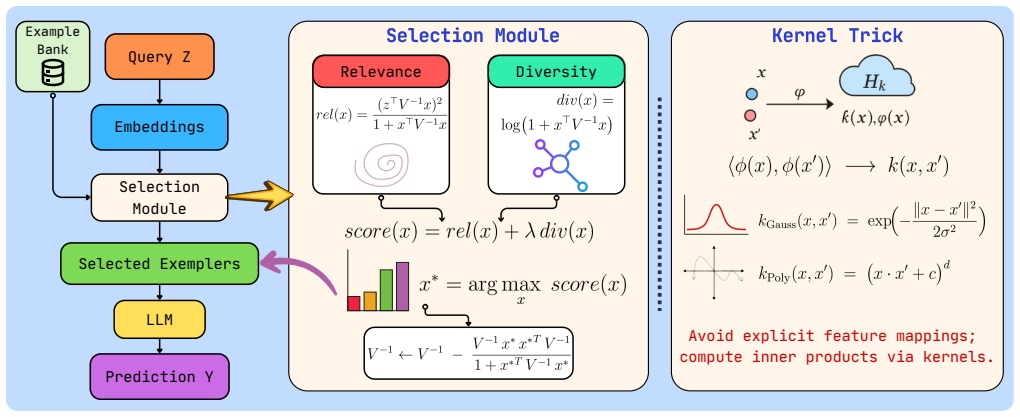
The central object is the design covariance matrix $V_S=\beta I+\sum_{i\in S}x_i x_i^\top$ and the greedy marginal gain it defines. For a candidate example $x$ given current set $S$, the relevance gain is $(z^\top V_S^{-1}x)^2/(1+x^\top V_S^{-1}x)$, and the Sherman-Morrison formula updates $V_S^{-1}$ in $O(d^2)$ per step. The kernel trick replaces every inner product with a kernel evaluation, turning the gain into $k_S(z,x)^2/(\beta+k_S(x,x))$, where $k_S$ is the residual kernel after projecting out the selected examples. Diversity enters through the D-optimal design gain $\log(1+x^\top V_S^{-1}x)$, and the algorithm maximizes the sum of the relevance and diversity gains with trade-off parameter $\lambda$. The proof machinery is the submodularity ratio $\gamma_k(f_z)$, lower-bounded by $1/(1+(k-1)\mu)$, which certifies near-optimality of the greedy selection.
What would settle it
A benchmark where the label depends on an XOR or parity function of embedding coordinates, with a fixed kernel chosen before seeing any validation labels, would settle the claim: if the linear version of KITE fails to beat dense kNN or DPP retrieval, or if kernel choices made without the evaluation split reverse the reported ranking, then the optimized quantity does not track actual prompt accuracy.
Extended reading notes
Core claim
Conditioned on a test query $z$, the paper claims that the LLM's response is generated as $y=\langle x,\theta\rangle+\eta$ with $\eta\sim N(0,1)$, so the best prompt subset is the one that minimizes the ridge prediction error at $z$. The paper bounds that error by $\|z\|_{V_S^{-1}}^2$ with $V_S=\beta I+\sum_{i\in S}x_i x_i^\top$ and proposes maximizing $f_z(S)=-z^\top V_S^{-1}z$. Because $f_z$ is only approximately submodular, the paper bounds its submodularity ratio below by $1/(1+(k-1)\mu)$ and proves greedy selection achieves a $1-e^{-1/(1+(k-1)\mu)}$ approximation factor. The kernel trick rewrites the greedy gain using only kernel evaluations, and the D-optimal term $\log\det(V_S)$ adds diversity. The empirical claim is that the combined algorithm, KITE, outperforms random, BM25, dense kNN, and DPP retrieval on most of the 15 dataset-model configurations.
Load-bearing premise
The load-bearing premise is that, conditioned on a test query, an LLM's in-context prediction is close enough to a linear function of the input embeddings that minimizing the ridge prediction error at that query also minimizes actual prompt error; if that approximation fails, the objective $f_z(S)$ no longer tracks the quantity the paper reports.
Editorial extensions
If this is right
- KITE can be deployed as a frozen retriever: it needs only embeddings and a kernel, no labels at selection time, no fine-tuning, and each greedy step costs $O(d^2)$.
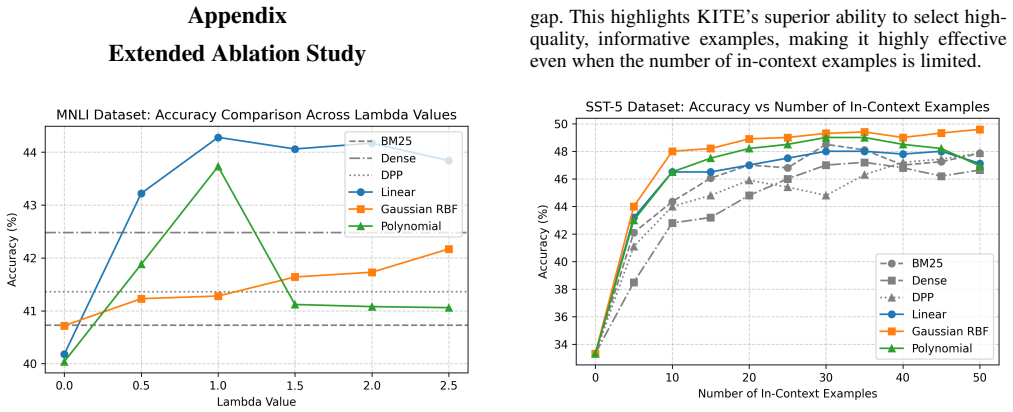
- The $\log\det(V_S)$ diversity term is not decorative: on the MNLI ablation, pure relevance selection ($\lambda=0$) underperforms a balanced $\lambda$, so large redundant banks require diversity.
- The best kernel is dataset-dependent; the reported gains come from picking among linear, polynomial, and Gaussian kernels, so kernel choice is part of the method's recipe.
- The greedy guarantee degrades gracefully with the submodularity ratio, and increasing $\beta$ pushes the ratio toward 1, making the selected set closer to the optimal one in the theory.
Reading between the lines
- A natural stress test would run KITE on tasks with known non-linear ICL behavior, such as parity or compositional reasoning; the theory predicts the linear version should lose its edge over nearest-neighbor retrieval there.
- The reported protocol selects the best kernel per dataset on the evaluation split; a deployment-oriented version would choose kernels without validation labels, and that version is what a user would actually run.
- The same query-specific ridge objective might double as a selection rule for other few-shot pipelines beyond LLMs, such as retrieval-augmented prediction, wherever the downstream predictor is approximately linear in the chosen representation.
Signed reviews
Editorial analysis
A structured set of objections, weighed in public.
Referee Report
Summary. The paper proposes KITE, an unsupervised exemplar-selection method for in-context learning (ICL). It models the LLM as a linear function of input embeddings (Eq. (1)) and selects k examples to minimize a ridge-regression prediction-error bound for a query z, yielding the surrogate objective f_z(S) = -z^T V_S^{-1} z (Eq. (4)). A D-optimal-design diversity term log det(V_S) is added, and the method is kernelized so that computations are done through kernel evaluations. The central theoretical claim is Lemma 3, which lower-bounds the submodularity ratio of f_z by 1/(1+(k-1)μ), leading to a 1-exp(-1/(1+(k-1)μ)) greedy approximation guarantee in Theorem 4. Empirically, KITE is evaluated on five classification datasets with three LLMs against Random, BM25, Dense, and DPP baselines, with Table 1 reporting accuracy for each setting.
Significance. If the theoretical guarantee were valid, the paper would make a useful contribution: it offers a query-specific, computationally efficient selection rule with a clean diversity regularizer and a clear departure from kNN-style retrieval. The algorithmic machinery (Sherman-Morrison updates, kernel trick, D-optimal design) is presented cleanly, and the synthetic experiments provide some evidence that the score is sensible under the stylized linear model. However, the central guarantee does not hold: Lemma 3 is false, and the appendix proof explicitly truncates a Neumann-series expansion and then treats the truncated expression as exact. The empirical comparison is also compromised by per-dataset kernel selection on the evaluation split and by the absence of error bars. As a result, the advertised provable near-optimality is unsupported, and the empirical claims are not established at the reported level of confidence.
major comments (4)
- [Lemma 3 and Appendix: Proof of Lemma 3] The claimed lower bound γ_k(f_z) ≥ 1/(1+(k-1)μ) is false. Consider d=2, β=1, S=∅, k=2, x1=(1,0), x2=(0.8,0.6), z=(0.6,-1.8). Then V_S=I, μ=0.4, Δ1=Δ2=0.18, and f_z(S∪L)-f_z(S)=0.6, so the submodularity ratio is γ=0.6, which is strictly less than the claimed bound 1/1.4≈0.714. The appendix proof replaces (I+D^{-1}N)^{-1} by a two-term Neumann expansion and then treats the result as exact; the omitted terms are essential, as this counterexample shows. Consequently Theorem 4's approximation guarantee is not established, and the abstract's claim of a principled greedy algorithm with an approximation guarantee is unsupported.
- [Section 5 (Implementation Details) and Table 1] The headline empirical claim 'KITE consistently outperforms all baselines' is weakened by reporting the best result across the three kernel choices for each dataset on the same validation split used for evaluation. Table 3 shows that the kernel choice changes accuracy by up to 8 percentage points (e.g., MRPC: 75.27 for the linear kernel vs. 67.15 for the Gaussian RBF). Selecting the best kernel per dataset on the evaluation split is a form of test-set tuning, and the comparison to baselines, which do not receive this per-dataset kernel selection, is therefore not a fair test of the method. In addition, Tables 1, 3, and 4 report no error bars or multiple-seed variances, so the significance of differences of 0.1-1.7 points is unclear.
- [Section 5 (Empirical validation of submodularity) and Table 2] The empirical validation does not compute the quantity in Definition 2. It samples a random triplet (S,L,z) with L selected by farthest-point sampling and reports the minimum observed ratio, but Definition 2 requires a minimum over all disjoint S,L with |L|≤k, with no restriction on how L is formed. The reported γ_min therefore cannot certify an approximate-submodularity ratio for f_z. Moreover, because Lemma 3 is false, the empirical table does not repair the theoretical guarantee and should not be presented as evidence that the greedy approximation bound holds.
- [Section 3, Eq. (1)] The modeling premise—that LLM in-context responses are generated by a fixed linear function in BERT embedding space—is not validated by any experiment that compares the surrogate f_z(S) with actual LLM accuracy. The synthetic experiments verify the linear model only, not the transfer to LLMs. A concrete test would be to compare, on a held-out subset of queries, the ridge prediction error of selected sets against the LLM's prompt accuracy; without such evidence, the connection between the objective being optimized and the accuracy metric reported in Tables 1 and 3 remains an untested assumption.
minor comments (5)
- [Throughout] There are several typos: 'emty set' in Algorithm 1, 'embddings' in the experiments section, and 'diagonmal' in the appendix proof should be 'empty set', 'embeddings', and 'diagonal', respectively.
- [Table 4] The right block of Table 4 appears to have a formatting or unit error: the reported LITE errors for μ_test=0,...,5 are in the range 67.8-84.0, which is inconsistent with the left block's scale (0.7-4.2) and with the text describing mean absolute prediction error.
- [Appendix, Proof of Lemma 3] The proof invokes the condition ∥D^{-1}N∥≪1 without stating or verifying it; if Lemma 3 is to be salvaged, the statement should be revised to include an explicit small-coherence or small-norm assumption and the Neumann expansion should be carried out with a rigorous error bound.
- [Sections 3 and 4] The symbol β is used both as the ridge regularization parameter in Eq. (2) and as the noise variance in the mutual-information derivation in Section 4; the two uses should be distinguished notationally.
- [Definition 2 and Table 2] The notation for the submodularity ratio is inconsistent: Definition 2 uses γ_k(f), the main text later uses γ, and Table 2 uses γ_min; these should be unified.
Circularity Check
No significant circularity: KITE's derivation is self-contained, with the surrogate objective grounded in external ridge-regression concentration bounds rather than in the empirical LLM accuracy it targets.
full rationale
The paper's central derivation chain is not circular. The query-specific objective f_z(S) = -z^T V_S^{-1} z is obtained from a standard concentration bound on ridge-regression prediction error (Eq. 3), credited to Lattimore and Szepesvári (2020), and the greedy selection rule is exactly the Sherman-Morrison marginal-gain decomposition of that objective. The approximate-submodularity guarantee (Theorem 4) is imported from Das and Kempe (2011) with the paper's claimed lower bound on the submodularity ratio; whether Lemma 3's bound is actually valid is a correctness question, not a circularity, because the bound is not assumed from the empirical LLM results. The diversity term is the classical D-optimal design objective, whose submodularity is proved in Lemma 5 from the matrix-determinant lemma. The kernelized selection rule follows from a stated operator identity (Lemma 6) and standard RKHS facts. The self-citations (Ghosal et al. 2025a,b) appear only in the related-work survey and are not load-bearing for any derivation. The one methodological weakness—reporting 'the best result across the three kernel choices' on the same evaluation split used to report accuracy—is test-set selection bias, not circularity: the validation accuracy is not used to define the selection objective and does not make the reported numbers equal to the objective by construction. Therefore the paper's theoretical and algorithmic claims are not circular, though the kernel-tuning protocol should be corrected for a fair comparison.
Assumptions & free parameters
free parameters (3)
- Diversity weight lambda =
0.5 (ablation suggests lambda near 1 on MNLI)
- Ridge regularization beta =
0.02
- Kernel choice and kernel hyperparameters =
Linear, Polynomial degree 3, Gaussian RBF sigma=1.0; best per dataset reported
assumptions (5)
- standard math Woodbury and Sherman-Morrison identities, plus the Das-Kempe greedy approximation theorem for approximately submodular functions
- standard math Chernoff concentration bound for ridge regression prediction error from Lattimore and Szepesvari, Chapter 20
- domain assumption LLM response is linear in input embeddings with a query-conditioned parameter theta
- domain assumption Gaussian prior theta ~ N(0, beta I) and Gaussian noise for the D-optimal design derivation
- ad hoc to paper Approximate submodularity ratio lower bound in Lemma 3
Cite this review
Pith. "Pith review of KITE: Kernelized and Information Theoretic Exemplars for In-Context Learning." pith.science (2026). https://pith.science/paper/SHKTRZNR
@misc{pith2026250915676,
  author       = {Pith},
  title        = {Pith review of: KITE: Kernelized and Information Theoretic Exemplars for In-Context Learning},
  year         = {2026},
  howpublished = {\url{https://pith.science/paper/SHKTRZNR}},
  note         = {Machine review of arXiv:2509.15676}
}
read the original abstract
In-context learning (ICL) has emerged as a powerful paradigm for adapting large language models (LLMs) to new and data-scarce tasks using only a few carefully selected task-specific examples presented in the prompt. However, given the limited context size of LLMs, a fundamental question arises: Which examples should be selected to maximize performance on a given user query? While nearest-neighbor-based methods like KATE have been widely adopted for this purpose, they suffer from well-known drawbacks in high-dimensional embedding spaces, including poor generalization and a lack of diversity. In this work, we study this problem of example selection in ICL from a principled, information theory-driven perspective. We first model an LLM as a linear function over input embeddings and frame the example selection task as a query-specific optimization problem: selecting a subset of exemplars from a larger example bank that minimizes the prediction error on a specific query. This formulation departs from traditional generalization-focused learning theoretic approaches by targeting accurate prediction for a specific query instance. We derive a principled surrogate objective that is approximately submodular, enabling the use of a greedy algorithm with an approximation guarantee. We further enhance our method by (i) incorporating the kernel trick to operate in high-dimensional feature spaces without explicit mappings, and (ii) introducing an optimal design-based regularizer to encourage diversity in the selected examples. Empirically, we demonstrate significant improvements over standard retrieval methods across a suite of classification tasks, highlighting the benefits of structure-aware, diverse example selection for ICL in real-world, label-scarce scenarios.
Figures
Reference graph
Works this paper leans on
-
[1]
R.; Hall, J.; Fiedel, N.; Thoppilan, R.; Yang, Z.; Kulshreshtha, A.; Nemade, G.; Lu, Y.; et al
Adiwardana, D.; Luong, M.-T.; So, D. R.; Hall, J.; Fiedel, N.; Thoppilan, R.; Yang, Z.; Kulshreshtha, A.; Nemade, G.; Lu, Y.; et al. 2020. Towards a human-like open-domain chatbot. arXiv preprint arXiv:2001.09977
arXiv 2020
-
[2]
Black, S.; Gao, L.; Wang, P.; Leahy, C.; and Biderman, S. 2021. GPT-Neo: Large Scale Autoregressive Language Modeling with Mesh-Tensorflow
work page 2021
-
[3]
Brown, T. B.; Mann, B.; Ryder, N.; Subbiah, M.; Kaplan, J.; Dhariwal, P.; Neelakantan, A.; Shyam, P.; Sastry, G.; and Amanda Askell, e. a. 2020 a . Language Models are Few-Shot Learners. arXiv:2005.14165
arXiv 2020
-
[4]
Brown, T. B.; Mann, B.; Ryder, N.; Subbiah, M.; Kaplan, J.; Dhariwal, P.; Neelakantan, A.; Shyam, P.; Sastry, G.; Askell, A.; and et al. 2020 b . Language Models are Few-Shot Learners. In Advances in Neural Information Processing Systems 33, 1877--1901
work page 2020
-
[5]
Chen, M.; Du, J.; Pasunuru, R.; Mihaylov, T.; Iyer, S.; Stoyanov, V.; and Kozareva, Z. 2022. Improving in-context few-shot learning via self-supervised training. arXiv preprint arXiv:2205.01703
arXiv 2022
-
[6]
Cover, T. M. 1999. Elements of information theory. John Wiley & Sons
1999
-
[7]
Dai, D.; Sun, Y.; Dong, L.; Hao, Y.; Ma, S.; Sui, Z.; and Wei, F. 2022. Why can gpt learn in-context? language models implicitly perform gradient descent as meta-optimizers. arXiv preprint arXiv:2212.10559
arXiv 2022
-
[8]
Das, A.; and Kempe, D. 2011. Submodular meets spectral: Greedy algorithms for subset selection, sparse approximation and dictionary selection. arXiv preprint arXiv:1102.3975
arXiv 2011
Show all 61 references
-
[9]
Devlin, J.; Chang, M.-W.; Lee, K.; and Toutanova, K. 2019. BERT: Pre-training of Deep Bidirectional Transformers for Language Understanding. arXiv:1810.04805
2019 arXiv
-
[10]
Dolan, B.; Quirk, C.; and Brockett, C. 2004. Unsupervised Construction of Large Paraphrase Corpora: Exploiting Massively Parallel News Sources. In COLING 2004: Proceedings of the 20th International Conference on Computational Linguistics , 350--356. Geneva, Switzerland: COLING
2004
-
[11]
Dong, Q.; Li, L.; Dai, D.; Zheng, C.; Ma, J.; Li, R.; Xia, H.; Xu, J.; Wu, Z.; Liu, T.; et al. 2022. A survey on in-context learning. arXiv preprint arXiv:2301.00234
2022 arXiv
-
[12]
Gehman, S.; Gururangan, S.; Sap, M.; Choi, Y.; and Smith, N. A. 2020. Realtoxicityprompts: Evaluating neural toxic degeneration in language models. arXiv preprint arXiv:2009.11462
2020 arXiv
-
[13]
S.; Pal, S.; Mukherjee, K.; and Manocha, D
Ghosal, S. S.; Pal, S.; Mukherjee, K.; and Manocha, D. 2025 a . PromptRefine: Enhancing Few-Shot Performance on Low-Resource Indic Languages with Example Selection from related Example Banks. In Proceedings of the 2025 Conference of the Nations of the Americas Chapter of the A...
2025
-
[14]
S.; Singh, V.; Ghosh, A.; Pal, S.; Baidya, S.; Saha, S.; and Manocha, D
Ghosal, S. S.; Singh, V.; Ghosh, A.; Pal, S.; Baidya, S.; Saha, S.; and Manocha, D. 2025 b . Relic: Enhancing Reward Model Generalization for Low-Resource Indic Languages with Few-Shot Examples. arXiv preprint arXiv:2506.16502
2025 arXiv
-
[15]
Gonen, H.; Hosking, J.; and Augenstein, I. 2023. Perplexity-Based Prompt Selection for Large Language Models. In Proceedings of the 2023 Conference of the Association for Computational Linguistics
2023
-
[16]
Grattafiori, A.; Dubey, A.; Jauhri, A.; Pandey, A.; Kadian, A.; Al-Dahle, A.; Letman, A.; Mathur, A.; Schelten, A.; and Alex Vaughan, e. a. 2024. The Llama 3 Herd of Models. arXiv:2407.21783
2024 arXiv
-
[17]
Hui, B.; Yang, J.; Cui, Z.; Yang, J.; Liu, D.; Zhang, L.; Liu, T.; Zhang, J.; Yu, B.; Lu, K.; Dang, K.; Fan, Y.; Zhang, Y.; Yang, A.; Men, R.; Huang, F.; Zheng, B.; Miao, Y.; Quan, S.; Feng, Y.; Ren, X.; Ren, X.; Zhou, J.; and Lin, J. 2024. Qwen2.5-Coder Technical Report. arXi...
2024 arXiv
-
[18]
K \"o ppen, M. 2000. The curse of dimensionality. In 5th online world conference on soft computing in industrial applications (WSC5), volume 1, 4--8
2000
-
[19]
J.; Clarke, C.; Lee, A.; Hill, P.; Kummerfeld, J
Larson, S.; Mahendran, A.; Peper, J. J.; Clarke, C.; Lee, A.; Hill, P.; Kummerfeld, J. K.; Leach, K.; Laurenzano, M. A.; Tang, L.; et al. 2019. An evaluation dataset for intent classification and out-of-scope prediction. arXiv preprint arXiv:1909.02027
2019 arXiv
-
[20]
Lattimore, T.; and Szepesv \'a ri, C. 2020. Bandit algorithms. Cambridge University Press
2020
-
[21]
Li, L.; and Qiu, M. 2023. In-Context Learning Demonstration Selection via Influence Analysis. arXiv:2402.11750
2023 arXiv
-
[22]
Li, X.; Lv, K.; Yan, H.; Lin, T.; Zhu, W.; Ni, Y.; Xie, G.; Wang, X.; and Qiu, X. 2023 a . Unified demonstration retriever for in-context learning. arXiv preprint arXiv:2305.04320
2023 arXiv
-
[23]
E.; Papailiopoulos, D.; and Oymak, S
Li, Y.; Ildiz, M. E.; Papailiopoulos, D.; and Oymak, S. 2023 b . Transformers as algorithms: Generalization and stability in in-context learning. In International Conference on Machine Learning, 19565--19594. PMLR
2023
-
[24]
Liu, J.; Shen, D.; Zhang, Y.; Dolan, B.; Carin, L.; and Chen, W. 2021. What Makes Good In-Context Examples for GPT- 3 ? arXiv preprint arXiv:2101.06804
2021 arXiv
-
[25]
Liu, J.; Shen, D.; Zhang, Y.; Dolan, B.; Carin, L.; and Chen, W. 2022. What Makes Good In-Context Examples for GPT-3? In Proceedings of the 3rd Workshop on Deep Learning for Low-Resource Natural Language Processing (DeepLo) at ACL, 100--114
2022
-
[26]
Luo, M.; Xu, X.; Dai, Z.; Pasupat, P.; Kazemi, M.; Baral, C.; Imbrasaite, V.; and Zhao, V. Y. 2023. Dr. icl: Demonstration-retrieved in-context learning. arXiv preprint arXiv:2305.14128
2023 arXiv
-
[27]
Luo, M.; Xu, X.; Liu, Y.; Pasupat, P.; and Kazemi, M. 2024. In-context learning with retrieved demonstrations for language models: A survey. arXiv preprint arXiv:2401.11624
2024 arXiv
-
[28]
Min, S.; Lewis, M.; Zettlemoyer, L.; and Hajishirzi, H. 2021. Metaicl: Learning to learn in context. arXiv preprint arXiv:2110.15943
2021 arXiv
-
[29]
Min, S.; Lyu, X.; Holtzman, A.; Artetxe, M.; Lewis, M.; Hajishirzi, H.; and Zettlemoyer, L. 2022. Rethinking the Role of Demonstrations: What Makes In-Context Learning Work? In Proceedings of the 2022 Conference on Empirical Methods in Natural Language Processing, 11048--11064
2022
-
[30]
Olsson, C.; Elhage, N.; Nanda, N.; Joseph, N.; DasSarma, N.; Henighan, T.; Mann, B.; Askell, A.; Bai, Y.; Chen, A.; et al. 2022. In-context learning and induction heads. arXiv preprint arXiv:2209.11895
2022 arXiv
-
[31]
Pan, J. 2023. What in-context learning “learns” in-context: Disentangling task recognition and task learning. Master's thesis, Princeton University
2023
-
[32]
Pukelsheim, F. 2006. Optimal design of experiments. SIAM
2006
-
[33]
Robertson, S.; Zaragoza, H.; et al. 2009. The probabilistic relevance framework: BM25 and beyond. Foundations and Trends in Information Retrieval , 3(4): 333--389
2009
-
[34]
Rubin, O.; Herzig, J.; and Berant, J. 2022. Learning to Retrieve Prompts for In-Context Learning. In Proceedings of the 2022 Conference of the North American Chapter of the Association for Computational Linguistics, 2655--2671
2022
-
[35]
Saunshi, N.; Malladi, S.; and Arora, S. 2020. A mathematical exploration of why language models help solve downstream tasks. arXiv preprint arXiv:2010.03648
2020 arXiv
-
[36]
Sch \"o lkopf, B.; and Smola, A. J. 2002. Learning with kernels: support vector machines, regularization, optimization, and beyond. MIT press
2002
-
[37]
Shin, S.; Lee, S.-W.; Ahn, H.; Kim, S.; Kim, H.; Kim, B.; Cho, K.; Lee, G.; Park, W.; Ha, J.-W.; et al. 2022. On the effect of pretraining corpora on in-context learning by a large-scale language model. arXiv preprint arXiv:2204.13509
2022 arXiv
-
[38]
D.; Ng, A.; and Potts, C
Socher, R.; Perelygin, A.; Wu, J.; Chuang, J.; Manning, C. D.; Ng, A.; and Potts, C. 2013. Recursive Deep Models for Semantic Compositionality Over a Sentiment Treebank. In Yarowsky, D.; Baldwin, T.; Korhonen, A.; Livescu, K.; and Bethard, S., eds., Proceedings of the 2013 Con...
2013
-
[39]
Sorensen, M.; Ding, N.; and Chang, M.-W. 2022. Information-Theoretic Demonstration Selection for Few-Shot Prompting. In Proceedings of the Findings of EMNLP
2022
-
[40]
Talmor, A.; Herzig, J.; Lourie, N.; and Berant, J. 2019. C ommonsense QA : A Question Answering Challenge Targeting Commonsense Knowledge. In Burstein, J.; Doran, C.; and Solorio, T., eds., Proceedings of the 2019 Conference of the North A merican Chapter of the Association fo...
2019
-
[41]
Wang, A.; Pruksachatkun, Y.; Nangia, N.; Singh, A.; Michael, J.; Hill, F.; Levy, O.; and Bowman, S. 2019. Superglue: A stickier benchmark for general-purpose language understanding systems. Advances in neural information processing systems, 32
2019
-
[42]
Wang, A.; Singh, A.; Michael, J.; Hill, F.; Levy, O.; and Bowman, S. 2018. GLUE : A Multi-Task Benchmark and Analysis Platform for Natural Language Understanding. In Linzen, T.; Chrupa a, G.; and Alishahi, A., eds., Proceedings of the 2018 EMNLP Workshop B lackbox NLP : Analyz...
2018
-
[43]
Wang, D.; Dou, L.; and Che, W. 2022. A survey on table-and-text hybridqa: Concepts, methods, challenges and future directions. arXiv preprint arXiv:2212.13465
2022 arXiv
-
[44]
Wang, L.; Chen, S.; Jiang, L.; Pan, S.; Cai, R.; Yang, S.; and Yang, F. 2025. Parameter-efficient fine-tuning in large language models: a survey of methodologies. Artificial Intelligence Review, 58(8): 227
2025
-
[45]
Wang, X.; Zhu, W.; Saxon, M.; Steyvers, M.; and Wang, W. Y. 2023. Large Language Models are Latent Variable Models: Explaining and Finding Good Demonstrations for In-Context Learning. In Advances in Neural Information Processing Systems 36
2023
-
[46]
Wei, J.; Hou, L.; Lampinen, A.; Chen, X.; Huang, D.; Tay, Y.; Chen, X.; Lu, Y.; Zhou, D.; Ma, T.; et al. 2023 a . Symbol tuning improves in-context learning in language models. arXiv preprint arXiv:2305.08298
2023 arXiv
-
[47]
Wei, J.; Tay, Y.; Bommasani, R.; Raffel, C.; Zoph, B.; Borgeaud, S.; Yogatama, D.; Bosma, M.; Zhou, D.; Metzler, D.; et al. 2022. Emergent abilities of large language models. arXiv preprint arXiv:2206.07682
2022 arXiv
-
[48]
Wei, J.; Wei, J.; Tay, Y.; Tran, D.; Webson, A.; Lu, Y.; Chen, X.; Liu, H.; Huang, D.; Zhou, D.; et al. 2023 b . Larger language models do in-context learning differently. arXiv preprint arXiv:2303.03846
2023 arXiv
-
[49]
Williams, A.; Nangia, N.; and Bowman, S. R. 2017. A broad-coverage challenge corpus for sentence understanding through inference. arXiv preprint arXiv:1704.05426
2017 arXiv
-
[50]
Wu, Z.; Wang, Y.; Ye, J.; and Kong, L. 2022. Self-adaptive in-context learning: An information compression perspective for in-context example selection and ordering. arXiv preprint arXiv:2212.10375
2022 arXiv
-
[51]
M.; Raghunathan, A.; Liang, P.; and Ma, T
Xie, S. M.; Raghunathan, A.; Liang, P.; and Ma, T. 2021. An explanation of in-context learning as implicit bayesian inference. arXiv preprint arXiv:2111.02080
2021 arXiv
-
[52]
Yang, Z.; Zhang, Y.; Sui, D.; Liu, C.; Zhao, J.; and Liu, K. 2023. Representative Demonstration Selection for In-Context Learning with Two-Stage Determinantal Point Process. In Proceedings of the 2023 Conference on Empirical Methods in Natural Language Processing, 5443--5456
2023
-
[53]
Ye, J.; Wu, Z.; Feng, J.; Yu, T.; and Kong, L. 2023 a . Compositional Exemplars for In-Context Learning. In Proceedings of the 40th International Conference on Machine Learning. ICML
2023
-
[54]
Ye, J.; Wu, Z.; Feng, J.; Yu, T.; and Kong, L. 2023 b . Compositional exemplars for in-context learning. In International Conference on Machine Learning, 39818--39833. PMLR
2023
-
[55]
M.; Kim, J.; Kim, H
Yoo, K. M.; Kim, J.; Kim, H. J.; Cho, H.; Jo, H.; Lee, S.-W.; Lee, S.-g.; and Kim, T. 2022. Ground-truth labels matter: A deeper look into input-label demonstrations. arXiv preprint arXiv:2205.12685
2022 arXiv
-
[56]
Zellers, R.; Holtzman, A.; Bisk, Y.; Farhadi, A.; and Choi, Y. 2019. H ella S wag: Can a Machine Really Finish Your Sentence? In Korhonen, A.; Traum, D.; and M \`a rquez, L., eds., Proceedings of the 57th Annual Meeting of the Association for Computational Linguistics, 4791--4...
2019
-
[57]
Zhang, Z.; Rudra, K.; and Anand, A. 2021. Explain and predict, and then predict again. In Proceedings of the 14th ACM international conference on web search and data mining, 418--426
2021
-
[58]
Zhao, Z.; Wallace, E.; Feng, S.; Klein, D.; and Singh, S. 2021. Calibrate before use: Improving few-shot performance of language models. In International conference on machine learning, 12697--12706. PMLR
2021
-
[59]
Zheng, L.; Chiang, W.-L.; Sheng, Y.; Zhuang, S.; Wu, Z.; Zhuang, Y.; Lin, Z.; Li, Z.; Li, D.; Xing, E.; et al. 2023. Judging llm-as-a-judge with mt-bench and chatbot arena. Advances in neural information processing systems, 36: 46595--46623
2023
-
[60]
, " * write output.state after.block = add.period write newline
ENTRY address archivePrefix author booktitle chapter edition editor eid eprint howpublished institution isbn journal key month note number organization pages publisher school series title type volume year label extra.label sort.label short.list INTEGERS output.state before.all...
-
[61]
write newline
" write newline "" before.all 'output.state := FUNCTION n.dashify 't := "" t empty not t #1 #1 substring "-" = t #1 #2 substring "--" = not "--" * t #2 global.max substring 't := t #1 #1 substring "-" = "-" * t #2 global.max substring 't := while if t #1 #1 substring * t #2 gl...
Reviewed August 15, 2026 · model on record in the stance chip above.
Discussion (0). Continue with ORCID to comment.