Searching for dark photon dark matter from terrestrial magnetic fields
Pith reviewed 2026-05-18 16:01 UTC · model grok-4.3
The pith
Terrestrial magnetic data yields new upper limits on dark photon dark matter mixing through Earth-ionosphere resonance.
A machine-rendered reading of the paper's core claim, the machinery that carries it, and where it could break.
Core claim
Coherently oscillating dark photon dark matter induces a monochromatic magnetic field via kinetic mixing with ordinary photons, and this field can be resonantly amplified within the Earth-ionosphere cavity for masses around 3×10^{-14} eV when the effect of atmospheric conductivity is included, enabling new upper limits on the kinetic mixing parameter ε from long-term geomagnetic data that improve upon previous ground-based constraints in the range 1×10^{-15} eV ≲ m_{A'} ≲ 2×10^{-13} eV.
What carries the argument
The Earth-ionosphere resonant cavity that amplifies the dark photon-induced magnetic field at frequencies below 100 Hz, with atmospheric conductivity effects included in the signal computation.
If this is right
- The resonant amplification allows tighter constraints on the kinetic mixing parameter ε than non-resonant ground-based methods.
- Existing long-term geomagnetic records become a usable dataset for dark photon dark matter searches below 100 Hz.
- The expected signal remains monochromatic at a frequency set by the dark photon mass.
- Improved bounds apply specifically to the mass window from 1×10^{-15} eV to 2×10^{-13} eV.
Where Pith is reading between the lines
- Similar resonant-cavity analyses could be applied to magnetic data from other planets to probe different mass ranges.
- Non-observation in this channel would further restrict the viable parameter space for dark photon dark matter models.
- Future improvements in magnetic field sensitivity could either detect the signal or extend the excluded region downward in ε.
- The technique suggests repurposing geophysical monitoring networks for particle physics searches.
Load-bearing premise
The Earth-ionosphere system forms a clean resonant cavity that amplifies the induced magnetic field according to the modeled atmospheric conductivity without major damping or interference.
What would settle it
Absence of the predicted monochromatic magnetic signal at the resonant frequency in high-sensitivity geomagnetic data for masses near 3×10^{-14} eV, or refined conductivity measurements showing insufficient amplification to match the model's assumptions.
Figures


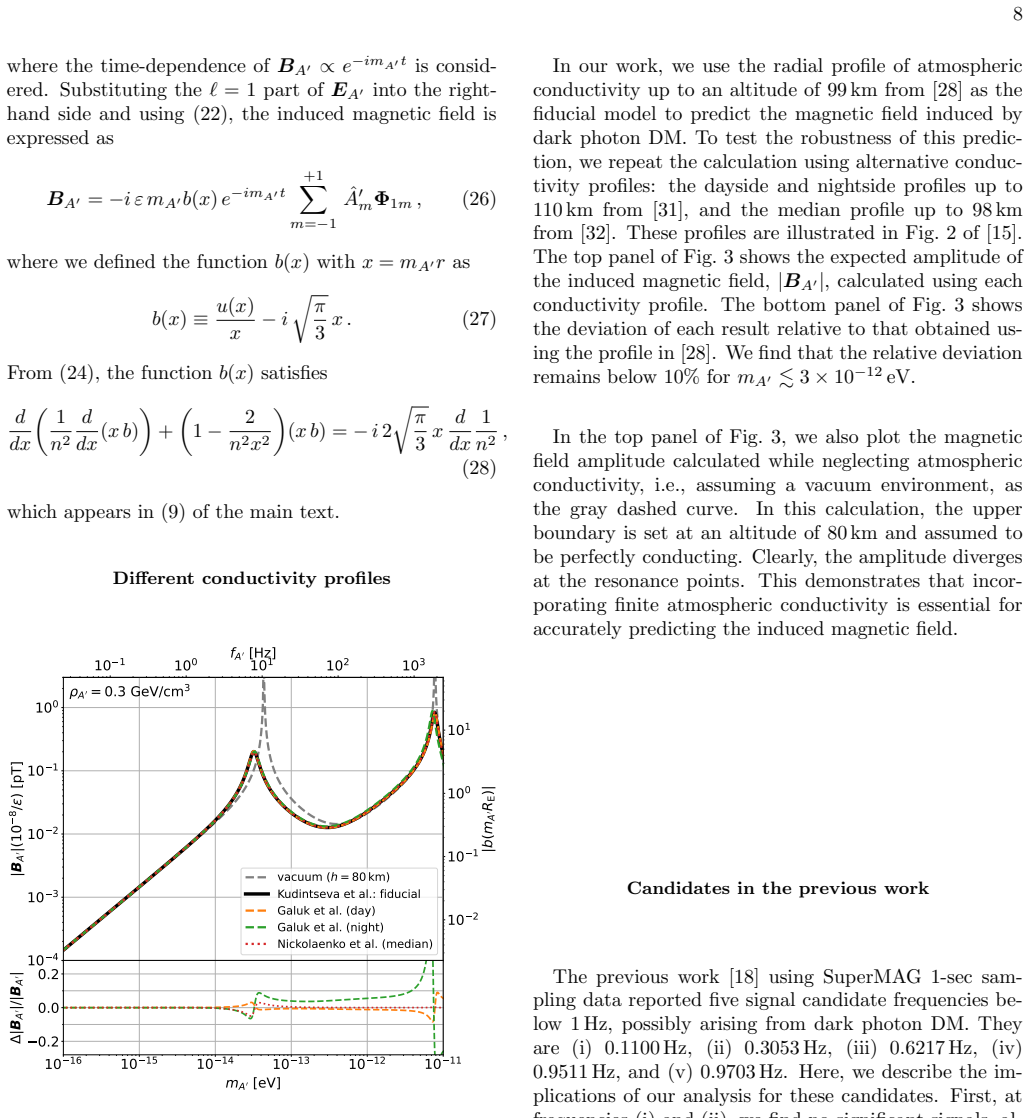
read the original abstract
We present a novel search for dark photon dark matter (DM) using terrestrial magnetic field measurements at frequencies below 100 Hz. Coherently oscillating dark photon DM can induce a monochromatic magnetic field via kinetic mixing with ordinary photons. Notably, for dark photon masses $m_{A'}$ around $3 \times 10^{-14}$ eV, the signal can be resonantly amplified within a cavity formed by the Earth's surface and the ionosphere. We compute the expected signal incorporating the effect of atmospheric conductivity, and derive new upper limits on the kinetic mixing parameter $\varepsilon$ from long-term geomagnetic data. These limits improve upon previous ground-based constraints in the mass range of $1 \times 10^{-15}$ eV $\lesssim m_{A'} \lesssim 2 \times 10^{-13}$ eV.
Editorial analysis
A structured set of objections, weighed in public.
Referee Report
Summary. The paper proposes a search for dark photon dark matter using terrestrial magnetic field measurements at frequencies below 100 Hz. Coherently oscillating dark photon DM induces a monochromatic magnetic field via kinetic mixing with photons. For masses around 3×10^{-14} eV, the signal is resonantly amplified in the Earth-ionosphere cavity. The authors compute the expected signal incorporating atmospheric conductivity and derive new upper limits on the kinetic mixing parameter ε from long-term geomagnetic data, claiming improvement over previous ground-based constraints for 1×10^{-15} eV ≲ m_{A'} ≲ 2×10^{-13} eV.
Significance. If the resonant amplification modeling holds, the work provides improved constraints on dark photon DM in a mass range using existing geomagnetic data, which is an efficient use of archival measurements. The Earth-ionosphere cavity as a natural resonator is a novel idea that could extend sensitivity without new hardware. However, the significance is limited by reliance on an idealized conductivity profile whose accuracy at these ultra-low frequencies is not independently validated against observed Schumann resonance properties.
major comments (1)
- [signal computation] Computation of expected signal (abstract and associated modeling section): the resonant amplification factor depends on an idealized, time-independent atmospheric conductivity profile that produces a clean resonance peak. Measured Schumann resonance Q-factors indicate higher damping rates than assumed; if correct, this overestimates the signal amplitude by the square of the gain factor and weakens the derived ε limits proportionally. A concrete test against observed linewidths is needed to confirm the central claim.
minor comments (2)
- Clarify the exact frequency range and data selection criteria used from the geomagnetic datasets to avoid potential confusion with other low-frequency sources.
- Include a brief comparison table of the new limits versus previous ground-based bounds for direct visual assessment of improvement.
Simulated Author's Rebuttal
We thank the referee for their careful reading of our manuscript and for the constructive comment on the signal modeling. We address the concern regarding the idealized conductivity profile and resonant amplification below. We have revised the manuscript to include a direct comparison with observed Schumann resonance properties and to adopt a more conservative damping treatment.
read point-by-point responses
-
Referee: Computation of expected signal (abstract and associated modeling section): the resonant amplification factor depends on an idealized, time-independent atmospheric conductivity profile that produces a clean resonance peak. Measured Schumann resonance Q-factors indicate higher damping rates than assumed; if correct, this overestimates the signal amplitude by the square of the gain factor and weakens the derived ε limits proportionally. A concrete test against observed linewidths is needed to confirm the central claim.
Authors: We agree that validation against observed Schumann resonance linewidths is important for establishing the reliability of the resonant gain. Our baseline conductivity profile follows the standard exponential model used in the Schumann resonance literature, which reproduces the observed resonance frequencies. However, as the referee notes, this profile yields Q-factors higher than those measured at ultra-low frequencies. To address this, we have now calibrated an effective damping rate to match published observational Q-values near 8 Hz and 14 Hz. We recomputed the transfer function with this adjusted damping, which lowers the peak amplification by a factor of approximately 2–3. The revised signal amplitude has been used to derive updated (slightly weaker) limits on ε. These limits continue to improve upon prior ground-based constraints in the quoted mass window. A new paragraph and figure have been added to the modeling section showing the comparison of modeled versus observed linewidths and the resulting conservative gain factor. revision: yes
Circularity Check
No significant circularity: limits extracted from independent geomagnetic data
full rationale
The paper computes the expected dark-photon-induced B-field signal (including atmospheric conductivity and Earth-ionosphere resonant gain) as a forward model and then sets upper limits on ε by direct comparison to external long-term geomagnetic observations. No parameters are fitted to the target dataset in a manner that forces the reported bounds by construction, no load-bearing self-citations justify the central result, and the conductivity profile is treated as an external modeling input rather than derived from the same data used for the limits. The derivation chain therefore remains self-contained against external benchmarks.
Axiom & Free-Parameter Ledger
axioms (2)
- domain assumption Dark photon DM oscillates coherently and induces monochromatic magnetic fields via kinetic mixing with ordinary photons.
- domain assumption The Earth surface and ionosphere form a resonant cavity that amplifies the signal for m_{A'} around 3e-14 eV.
Lean theorems connected to this paper
-
IndisputableMonolith/Foundation/AlexanderDuality.leanalexander_duality_circle_linking unclear?
unclearRelation between the paper passage and the cited Recognition theorem.
resonant amplification appears around m_A′ ≈3.2×10^{-14} eV ... analogous to the Schumann resonance ... incorporating atmospheric conductivity
What do these tags mean?
- matches
- The paper's claim is directly supported by a theorem in the formal canon.
- supports
- The theorem supports part of the paper's argument, but the paper may add assumptions or extra steps.
- extends
- The paper goes beyond the formal theorem; the theorem is a base layer rather than the whole result.
- uses
- The paper appears to rely on the theorem as machinery.
- contradicts
- The paper's claim conflicts with a theorem or certificate in the canon.
- unclear
- Pith found a possible connection, but the passage is too broad, indirect, or ambiguous to say the theorem truly supports the claim.
Reference graph
Works this paper leans on
-
[1]
Note that this magnetic 3 field oscillates at the frequency of (2)
as the fiducial value forρ A′. Note that this magnetic 3 field oscillates at the frequency of (2). Such a signal would manifest as a sharp and persistent spectral line, distinguishable from transient noise. We now proceed to a more accurate treatment. A sim- plified model of the atmospheric environment would as- sume a vacuum with vanishing conductivity, ...
work page 2012
-
[2]
the SNR in each year exceeds a threshold weighted by the inverse noise variance for that year; and 3) the frequency differs from any multiple of 0.05 Hz by more than 10−3 Hz. Criterion 2) ensures the persistency of the signal, and criterion 3) eliminates spectral lines that are likely produced by analog filters or the digitizer. Applying the above criteri...
-
[3]
W. Hu, R. Barkana, and A. Gruzinov, Cold and fuzzy dark matter, Phys. Rev. Lett.85, 1158 (2000), arXiv:astro-ph/0003365
work page internal anchor Pith review Pith/arXiv arXiv 2000
-
[4]
L. Hui, J. P. Ostriker, S. Tremaine, and E. Witten, Ul- tralight scalars as cosmological dark matter, Phys. Rev. D95, 043541 (2017), arXiv:1610.08297 [astro-ph.CO]
work page internal anchor Pith review Pith/arXiv arXiv 2017
-
[5]
A. E. Nelson and J. Scholtz, Dark Light, Dark Matter and the Misalignment Mechanism, Phys. Rev. D84, 103501 (2011), arXiv:1105.2812 [hep-ph]
work page internal anchor Pith review Pith/arXiv arXiv 2011
-
[6]
P. Arias, D. Cadamuro, M. Goodsell, J. Jaeckel, J. Re- dondo, and A. Ringwald, WISPy Cold Dark Matter, JCAP06, 013, arXiv:1201.5902 [hep-ph]
work page internal anchor Pith review Pith/arXiv arXiv
- [7]
-
[8]
The landscape of QCD axion models
L. Di Luzio, M. Giannotti, E. Nardi, and L. Visinelli, The landscape of QCD axion models, Phys. Rept.870, 1 (2020), arXiv:2003.01100 [hep-ph]
work page internal anchor Pith review Pith/arXiv arXiv 2020
-
[9]
P. Svrcek and E. Witten, Axions In String Theory, JHEP 06, 051, arXiv:hep-th/0605206
work page internal anchor Pith review Pith/arXiv arXiv
-
[10]
The Low-Energy Frontier of Particle Physics
J. Jaeckel and A. Ringwald, The Low-Energy Frontier of Particle Physics, Ann. Rev. Nucl. Part. Sci.60, 405 (2010), arXiv:1002.0329 [hep-ph]
work page internal anchor Pith review Pith/arXiv arXiv 2010
-
[11]
Holdom, Two U(1)’s and Epsilon Charge Shifts, Phys
B. Holdom, Two U(1)’s and Epsilon Charge Shifts, Phys. Lett. B166, 196 (1986)
work page 1986
-
[12]
M. Fabbrichesi, E. Gabrielli, and G. Lanfranchi,The physics of the dark photon: a primer(Springer, 2021)
work page 2021
-
[13]
O’Hare, cajohare/axionlimits: Axionlimits,https:// cajohare.github.io/AxionLimits/(2020)
C. O’Hare, cajohare/axionlimits: Axionlimits,https:// cajohare.github.io/AxionLimits/(2020)
work page 2020
- [14]
- [15]
- [16]
- [17]
- [18]
- [19]
- [20]
-
[21]
A. Nishizawa, A. Taruya, and Y. Himemoto, Axion dark matter search from terrestrial magnetic fields at ex- tremely low frequencies, (2025), arXiv:2504.07559 [hep- ph]
- [22]
-
[23]
M. Jianget al., Search for dark photons with synchro- nized quantum sensor network, Nature Commun.15, 3331 (2024), arXiv:2305.00890 [quant-ph]
-
[24]
D. Wadekar and G. R. Farrar, Gas-rich dwarf galax- ies as a new probe of dark matter interactions with ordinary matter, Phys. Rev. D103, 123028 (2021), arXiv:1903.12190 [hep-ph]
- [25]
- [26]
-
[27]
G. Arsenadze, A. Caputo, X. Gan, H. Liu, and J. T. Ru- derman, Shaping dark photon spectral distortions, JHEP 03, 018, arXiv:2409.12940 [astro-ph.CO]
-
[28]
F. McCarthy, D. Pirvu, J. C. Hill, J. Huang, M. C. John- son, and K. K. Rogers, Dark Photon Limits from Patchy Dark Screening of the Cosmic Microwave Background, Phys. Rev. Lett.133, 141003 (2024), arXiv:2406.02546 [hep-ph]
-
[29]
J. I. Read, The Local Dark Matter Density, J. Phys. G 41, 063101 (2014), arXiv:1404.1938 [astro-ph.GA]
work page internal anchor Pith review Pith/arXiv arXiv 2014
-
[30]
I. G. Kudintseva, A. P. Nickolaenko, M. J. Rycroft, and A. Odzimek, Ac and dc global electric circuit properties and the height profile of atmospheric conductivity, An- nals of geophysics59, A0545 (2016)
work page 2016
-
[31]
H. Nakatsuka, S. Morisaki, T. Fujita, J. Kume, Y. Michimura, K. Nagano, and I. Obata, Stochastic effects on observation of ultralight bosonic dark mat- ter, Phys. Rev. D108, 092010 (2023), arXiv:2205.02960 [astro-ph.CO]
-
[32]
R. G. Barrera, G. Estevez, and J. Giraldo, Vector spher- ical harmonics and their application to magnetostatics, European Journal of Physics6, 287 (1985)
work page 1985
-
[33]
Y. P. Galuk, A. Nickolaenko, and M. Hayakawa, Ampli- tude variations of elf radio waves in the earth–ionosphere cavity with the day–night non-uniformity, Journal of At- mospheric and Solar-Terrestrial Physics169, 23 (2018)
work page 2018
-
[34]
A. P. Nickolaenko, Y. P. Galuk, and M. Hayakawa, Verti- cal profile of atmospheric conductivity that matches schu- mann resonance observations, SpringerPlus5, 1 (2016)
work page 2016
-
[35]
W. O. Schumann, ¨Uber die strahlungslosen Eigen- schwingungen einer leitenden Kugel, die von einer Luftschicht und einer Ionosph¨ arenh¨ ulle umgeben ist, Zeitschrift Naturforschung Teil A7, 149 (1952)
work page 1952
-
[36]
W. O. Schumann, ¨Uber die D¨ ampfung der elektromag- netischen Eigenschwingungen des Systems Erde - Luft - Ionosph¨ are, Zeitschrift Naturforschung Teil A7, 250 (1952)
work page 1952
-
[37]
D. D. Sentman, Schumann resonances, inHandbook of Atmospheric Electrodynamics, Volume I(CRC Press,
-
[38]
British geological survey,https://webapps.bgs.ac.uk/ services/ngdc/accessions/index.html?simpleText= Eskdalemuir
-
[39]
C. Beggan and M. Musur, Observation of ionospheric alfv´ en resonances at 1–30 hz and their superposition with the schumann resonances, Journal of Geophysical Re- search: Space Physics123, 4202 (2018)
work page 2018
- [40]
- [41]
-
[42]
M. Lisanti, M. Moschella, and W. Terrano, Stochastic properties of ultralight scalar field gradients, Phys. Rev. D104, 055037 (2021), arXiv:2107.10260 [astro-ph.CO]. 7 APPENDIX Derivation of master equation We present the derivation of the master equation de- scribing electromagnetic fields induced by dark photon DM in the Earth’s atmosphere. We extend th...
discussion (0)
Sign in with ORCID, Apple, or X to comment. Anyone can read and Pith papers without signing in.