Tracing the high-z cosmic web with Quaia: catalogues of voids and clusters in the quasar distribution
Pith reviewed 2026-05-18 14:40 UTC · model grok-4.3
The pith
Quasars from Quaia trace 12,842 voids and 41,111 clusters in the high-redshift cosmic web.
A machine-rendered reading of the paper's core claim, the machinery that carries it, and where it could break.
Core claim
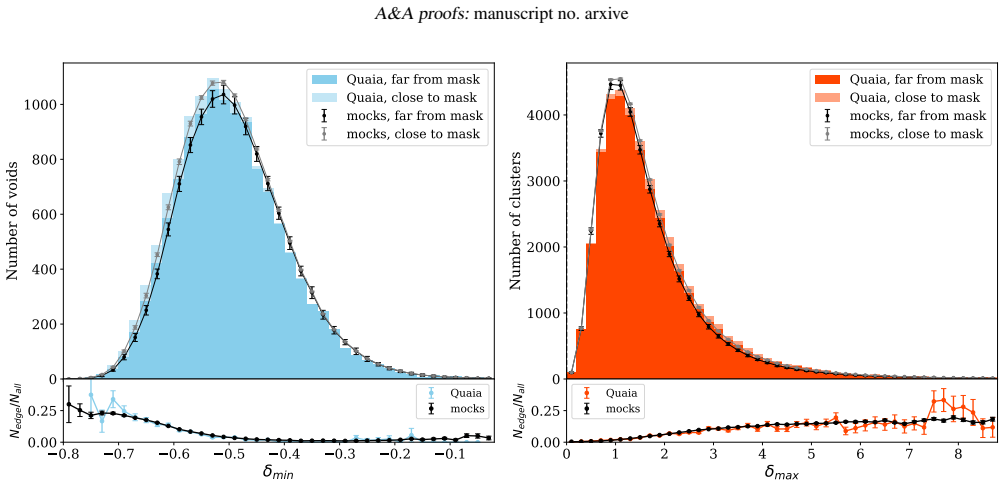
In the distribution of 708,483 Quaia quasars at 0.8 < z < 2.2 we identify 12,842 voids and 41,111 clusters by means of Voronoi tessellation density estimation followed by the REVOLVER algorithm. Void and cluster radii, average inner densities and density profiles on 100 inverse-h Mpc scales agree with measurements in 50 mock catalogues at the 5-10 percent level. The largest voids reach R_eff approximately 250 inverse-h Mpc and the largest clusters 150 inverse-h Mpc, without evidence for ultra-large structures beyond those present in the mocks. Survey-mask proximity effects are present but consistent between data and simulations. The estimated density field together with the void and cluster
What carries the argument
REVOLVER void and cluster finder applied to local densities obtained from Voronoi tessellation of quasar positions.
If this is right
- High-redshift large-scale structure can be traced with quasars at a precision comparable to lower-redshift galaxy surveys when the selection function is well known.
- Void and cluster statistics remain consistent with the standard cosmological model as realised in the mocks.
- Mask-edge effects influence detection but affect data and simulations in the same way.
- The released catalogues enable new cross-correlation analyses with other high-redshift tracers.
Where Pith is reading between the lines
- The same Voronoi-based approach could be applied to deeper or wider quasar samples to reach still higher redshifts.
- Cross-correlating the identified voids and clusters with CMB lensing maps could test for integrated Sachs-Wolfe signals at z approximately 1.
- Absence of ultra-large structures in both data and mocks supports homogeneity on the largest scales currently accessible at these redshifts.
Load-bearing premise
The selection function of the Quaia quasar sample is sufficiently well understood to allow accurate reconstruction of the underlying matter density field from QSO positions using Voronoi tessellation.
What would settle it
A discrepancy exceeding 10 percent in the distribution of void radii, cluster radii or inner densities between the Quaia observations and an independent set of mocks would show that the identification does not reliably recover the cosmic web.
Figures




read the original abstract
Understanding the formation and evolution of the cosmic web of galaxies is a fundamental goal of cosmology, using various tracers of the cosmic large-scale structure at an ever wider range of redshifts. Our principal aim is to advance the mapping of the cosmic web at high redshifts using observational and synthetic catalogues of quasars (QSOs), which offer a powerful probe of structure formation and the validity of the concordance cosmological model. In this analysis, we selected 708,483 QSOs at $0.8<z<2.2$ from the Quaia data set, allowing a reconstruction of the matter density field using 24,372 deg$^2$ sky area with a well-understood selection function, and thus going beyond previous studies. Using the REVOLVER method, we created catalogues of voids and clusters based on the estimation of the local density at QSO positions with Voronoi tessellation. We tested the consistency of Quaia data and 50 mock catalogues, including various parameters of the voids and clusters in data subsets, and also measurements of the density profiles of these cosmic super-structures at $100 h^{-1}$Mpc scales. We identified 12,842 voids and 41,111 clusters in the distribution of Quaia QSOs. The agreement between data and mocks is at a level of 5-10%, considering void and cluster radii, average inner density, and density profiles. In particular, we tested the role of survey mask proximity effects in the void and cluster detection, which albeit present, are consistent in simulations and observations. The largest voids and clusters reach $R_{eff} \approx 250 h^{-1}$Mpc and $150 h^{-1}$Mpc, respectively, but without evidence for ultra-large cosmic structures exceeding the dimensions of the largest structures in the mocks. As an important deliverable, we share our density field estimation, void catalogues, and cluster catalogues with the public, allowing various additional cross-correlation probes at high-z.
Editorial analysis
A structured set of objections, weighed in public.
Referee Report
Summary. The paper claims to have identified 12,842 voids and 41,111 clusters in the distribution of 708,483 Quaia QSOs at 0.8<z<2.2 over 24,372 deg² using Voronoi tessellation via the REVOLVER method to reconstruct the local density field. It reports 5-10% agreement with 50 mock catalogues in void/cluster radii, average inner densities, and 100 h^{-1}Mpc density profiles, includes tests for survey mask proximity effects, finds no evidence for ultra-large structures beyond mock expectations, and publicly releases the density field and catalogues.
Significance. If the results hold, this provides a valuable extension of cosmic web mapping to high redshifts using quasars as tracers, with the public release of the density field estimation, void catalogues, and cluster catalogues representing a clear strength for enabling further cross-correlation studies and reproducibility. The quantitative consistency checks with mocks at the 5-10% level, if robust, support the validity of standard cosmology at these epochs.
major comments (1)
- [Abstract] Abstract: The central claim of 5-10% agreement between data and mocks in void/cluster properties relies on the assertion of a 'well-understood selection function' that allows accurate reconstruction of the underlying matter density field from QSO positions via Voronoi tessellation. However, the manuscript provides no quantification of residual uncertainty after selection corrections nor an explicit null test with deliberately mis-specified selection function; any unmodeled redshift-, magnitude-, or position-dependent completeness variations would systematically bias the density percentiles, directly affecting the reported counts (12,842 voids, 41,111 clusters), effective radii, inner densities, and profiles.
minor comments (1)
- [Abstract] Abstract: The phrase 'various parameters of the voids and clusters in data subsets' is vague; specifying the exact parameters (e.g., radius distributions, density contrasts) and subsets (e.g., redshift bins) tested would improve clarity without altering the central results.
Simulated Author's Rebuttal
We thank the referee for their thorough review and constructive comments on our manuscript. We address the major concern regarding the selection function and residual uncertainties below, and we will revise the paper accordingly to strengthen the presentation of our results.
read point-by-point responses
-
Referee: [Abstract] Abstract: The central claim of 5-10% agreement between data and mocks in void/cluster properties relies on the assertion of a 'well-understood selection function' that allows accurate reconstruction of the underlying matter density field from QSO positions via Voronoi tessellation. However, the manuscript provides no quantification of residual uncertainty after selection corrections nor an explicit null test with deliberately mis-specified selection function; any unmodeled redshift-, magnitude-, or position-dependent completeness variations would systematically bias the density percentiles, directly affecting the reported counts (12,842 voids, 41,111 clusters), effective radii, inner densities, and profiles.
Authors: We thank the referee for this important observation. The selection function of the Quaia catalogue is described in detail in Storey-Fisher et al. (2024), and the 50 mock catalogues were generated to reproduce the observed redshift-, magnitude- and position-dependent completeness. The 5–10% agreement between data and mocks in void radii, inner densities and 100 h^{-1} Mpc profiles therefore provides an end-to-end consistency check on the density-field reconstruction. Nevertheless, we agree that an explicit quantification of residual uncertainty and a dedicated null test with a deliberately mis-specified selection function are not currently reported. In the revised manuscript we will add a new subsection (likely in Section 3 or 4) that (i) estimates the residual uncertainty by propagating plausible ±5% variations in completeness across redshift and magnitude bins through the Voronoi tessellation and void/cluster finding pipeline, and (ii) presents a null test in which the mocks are re-analysed after applying an intentionally incorrect selection function; the resulting shifts in void/cluster counts, radii and profiles will be quantified and compared with the observed data–mock differences. These additions will directly address the referee’s concern and will be included in the next version of the paper. revision: yes
Circularity Check
No circularity: void/cluster counts and profiles are direct outputs of applying Voronoi+REVOLVER to data and independent mocks
full rationale
The paper reconstructs the density field from 708k Quaia QSO positions via Voronoi tessellation after correcting for a modeled selection function, then runs the REVOLVER algorithm to define voids and clusters by density thresholds. The reported counts (12,842 voids, 41,111 clusters), effective radii, inner densities, and 100 h^{-1}Mpc profiles are measured on both the real catalogue and 50 independent mocks generated under standard cosmology; the 5-10% agreement is an empirical comparison rather than a self-referential prediction. No parameters are fitted to the target statistics, no self-citation supplies a uniqueness theorem or ansatz that forces the result, and the selection-function modeling is treated as an external input rather than derived from the same void/cluster analysis.
Axiom & Free-Parameter Ledger
axioms (1)
- domain assumption The concordance cosmological model underlies the mock catalogues used for comparison.
Lean theorems connected to this paper
-
IndisputableMonolith/Cost/FunctionalEquation.leanwashburn_uniqueness_aczel unclear?
unclearRelation between the paper passage and the cited Recognition theorem.
Using the REVOLVER method, we created catalogues of voids and clusters based on the estimation of the local density at QSO positions with Voronoi tessellation.
-
IndisputableMonolith/Foundation/RealityFromDistinction.leanreality_from_one_distinction unclear?
unclearRelation between the paper passage and the cited Recognition theorem.
We identified 12,842 voids and 41,111 clusters... agreement between data and mocks is at a level of 5-10%
What do these tags mean?
- matches
- The paper's claim is directly supported by a theorem in the formal canon.
- supports
- The theorem supports part of the paper's argument, but the paper may add assumptions or extra steps.
- extends
- The paper goes beyond the formal theorem; the theorem is a base layer rather than the whole result.
- uses
- The paper appears to rely on the theorem as machinery.
- contradicts
- The paper's claim conflicts with a theorem or certificate in the canon.
- unclear
- Pith found a possible connection, but the passage is too broad, indirect, or ambiguous to say the theorem truly supports the claim.
Reference graph
Works this paper leans on
-
[1]
2025, The Open Journal of Astrophysics, 8, 42
Alonso, D., Hetmantsev, O., Fabbian, G., Slosar, A., & Storey-Fisher, K. 2025, The Open Journal of Astrophysics, 8, 42
work page 2025
-
[2]
Alonso, D., Hill, J. C., Hložek, R., & Spergel, D. N. 2018, Phys. Rev. D, 97, 063514
work page 2018
-
[3]
2013, Living Reviews in Relativity, 16, 6
Amendola, L., Appleby, S., Bacon, D., et al. 2013, Living Reviews in Relativity, 16, 6
work page 2013
- [4]
-
[5]
2024, arXiv e-prints, arXiv:2411.19531
Arsenov, N., Frey, S., Kovács, A., & Slavcheva-Mihova, L. 2024, arXiv e-prints, arXiv:2411.19531
-
[6]
Aubert, M., Cousinou, M.-C., Escoffier, S., et al. 2022, MNRAS, 513, 186
work page 2022
-
[7]
Baker, T., Clampitt, J., Jain, B., & Trodden, M. 2018, Phys. Rev. D, 98, 023511
work page 2018
-
[8]
Bos, E. G. P., Kitaura, F.-S., & van de Weygaert, R. 2019, MNRAS, 488, 2573
work page 2019
-
[9]
2013, Technical report of the Department of Statistics, University of Pennsylvania
Cai, T., Fan, J., & Jiang, T. 2013, Technical report of the Department of Statistics, University of Pennsylvania
work page 2013
-
[10]
Cai, Y .-C., Cole, S., Jenkins, A., & Frenk, C. 2009, MNRAS, 396, 772
work page 2009
- [11]
-
[12]
Camacho-Ciurana, G., Lee, P., Arsenov, N., et al. 2024, A&A, 689, A171
work page 2024
-
[13]
Cautun, M., Paillas, E., Cai, Y .-C., et al. 2018, MNRAS, 476, 3195
work page 2018
- [14]
-
[15]
G., Raghunathan, S., Harris, K
Clowes, R. G., Raghunathan, S., Harris, K. A., et al. 2014, in Revista Mexicana de Astronomia y Astrofisica Conference Series, V ol. 44, Revista Mexicana de Astronomia y Astrofisica Conference Series, 201–201
work page 2014
-
[16]
Coloma-Nadal, J. M., Kitaura, F. S., García-Farieta, J. E., et al. 2024, J. Cosmol- ogy Astropart. Phys., 2024, 083 3 https://doi.org/10.5281/zenodo.10403370 4 https://github.com/seshnadathur/Revolver 5 https://doi.org/10.5281/zenodo.16359456
-
[17]
Contarini, S., Marulli, F., Moscardini, L., et al. 2021, MNRAS, 504, 5021–5038
work page 2021
-
[18]
T., Cautun, M., Giblin, B., et al
Davies, C. T., Cautun, M., Giblin, B., et al. 2021, MNRAS, 507, 2267
work page 2021
-
[19]
Delchambre, L., Bailer-Jones, C. A. L., Bellas-Velidis, I., et al. 2023, A&A, 674, A31
work page 2023
-
[20]
Douglass, K. A., Veyrat, D., & BenZvi, S. 2023, ApJS, 265, 7
work page 2023
-
[21]
Einasto, J., Hütsi, G., Suhhonenko, I., Liivamägi, L. J., & Einasto, M. 2021, A&A, 647, A17
work page 2021
-
[22]
2025, arXiv e-prints, arXiv:2504.20992
Fabbian, G., Alonso, D., Storey-Fisher, K., & Cornish, T. 2025, arXiv e-prints, arXiv:2504.20992
-
[23]
2019, MN- RAS, 490, 3573 Forero Sánchez, D., Kitaura, F
Fang, Y ., Hamaus, N., Jain, B., Pandey, S., & DES Collaboration. 2019, MN- RAS, 490, 3573 Forero Sánchez, D., Kitaura, F. S., Sinigaglia, F., Coloma-Nadal, J. M., & Kneib, J. P. 2024, J. Cosmology Astropart. Phys., 2024, 001 Gaia Collaboration, Bailer-Jones, C. A. L., Teyssier, D., et al. 2023a, A&A, 674, A41 Gaia Collaboration, Vallenari, A., Brown, A. ...
work page 2019
-
[24]
Gorski, K. M., Hivon, E., Banday, A. J., et al. 2005, The Astrophysical Journal, 622, 759
work page 2005
- [25]
-
[26]
Hamaus, N., Aubert, M., Pisani, A., et al. 2021, Euclid: Forecasts from redshift- space distortions and the Alcock-Paczynski test with cosmic voids
work page 2021
- [27]
- [28]
- [29]
- [30]
-
[31]
Kitaura, F. S. & Hess, S. 2013, MNRAS, 435, L78
work page 2013
-
[32]
Kitaura, F. S., Yepes, G., & Prada, F. 2014, MNRAS, 439, L21 Kovács, A., Beck, R., Smith, A., et al. 2022, MNRAS, 513, 15 Kovács, A., Jeffrey, N., Gatti, M., et al. 2022, MNRAS, 510, 216 Kovács, A., Sánchez, C., García-Bellido, J., & the DES collaboration. 2017, MN- RAS, 465, 4166 Kovács, A., Sánchez, C., García-Bellido, J., & the DES collaboration. 2019,...
work page 2014
-
[33]
Krause, E., Chang, T.-C., Doré, O., & Umetsu, K. 2013, ApJ, 762, L20
work page 2013
-
[34]
The DESI Experiment, a whitepaper for Snowmass 2013
Levi, M., Bebek, C., Beers, T., et al. 2013, ArXiv e-prints: 1308.0847 [arXiv:1308.0847]
work page internal anchor Pith review Pith/arXiv arXiv 2013
-
[35]
Li, G., Ma, Y .-Z., Tramonte, D., & Li, G.-L. 2024, MNRAS, 527, 2663
work page 2024
-
[36]
I., van de Weygaert, R., Cautun, M., et al
Libeskind, N. I., van de Weygaert, R., Cautun, M., et al. 2018, MNRAS, 473, 1195
work page 2018
- [37]
-
[38]
LSST Science Book, Version 2.0
Lopez, A. M., Clowes, R. G., & Williger, G. M. 2022, MNRAS, 516, 1557 LSST Science Collaboration, Abell, P. A., Allison, J., et al. 2009, ArXiv e-prints [arXiv:0912.0201]
work page internal anchor Pith review Pith/arXiv arXiv 2022
- [39]
- [40]
- [41]
-
[42]
Nadathur, S., Carter, P. M., Percival, W. J., Winther, H. A., & Bautista, J. E. 2019, Physical Review D, 100, 023504
work page 2019
- [43]
-
[44]
Nadathur, S., Lavinto, M., Hotchkiss, S., & Räsänen, S. 2014, Phys. Rev. D, 90, 103510
work page 2014
-
[45]
Naidoo, K., Whiteway, L., Massara, E., et al. 2020, MNRAS, 491, 1709
work page 2020
-
[46]
Neyrinck, M. C. 2008, MNRAS, 386, 2101
work page 2008
-
[47]
2015, Journal of Korean Astronomical Society, 48, 75
Park, C., Song, H., Einasto, M., Lietzen, H., & Heinamaki, P. 2015, Journal of Korean Astronomical Society, 48, 75
work page 2015
-
[48]
Piccirilli, G., Fabbian, G., Alonso, D., et al. 2024, J. Cosmology Astropart. Phys., 2024, 012
work page 2024
- [49]
-
[50]
Pisani, A., Sutter, P. M., Hamaus, N., et al. 2015, Phys. Rev. D, 92, 083531 Planck Collaboration, Aghanim, N., Akrami, Y ., et al. 2020, A&A, 641, A6
work page 2015
-
[51]
Potter, D., Stadel, J., & Teyssier, R. 2016, PKDGRA V3: Beyond Trillion Particle Cosmological Simulations for the Next Era of Galaxy Surveys Rácz, G., Kiessling, A., Csabai, I., & Szapudi, I. 2023, A&A, 672, A59
work page 2016
-
[52]
Raghunathan, S., Nadathur, S., Sherwin, B. D., & Whitehorn, N. 2020, ApJ, 890, 168
work page 2020
- [53]
-
[54]
Sachs, R. K. & Wolfe, A. M. 1967, ApJL, 147, 73 Sánchez, C., Clampitt, J., Kovács, A., & et al. 2017, MNRAS, 465, 746
work page 1967
-
[55]
2024, arXiv e-prints, arXiv:2412.02761
Sartori, S., Vielzeuf, P., Escoffier, S., et al. 2024, arXiv e-prints, arXiv:2412.02761
- [56]
-
[57]
Schaye, J., Kugel, R., Schaller, M., et al. 2023, MNRAS, 526, 4978
work page 2023
-
[58]
2019, Journal of Cosmology and Astroparticle Physics, 2019, 055–055
Schuster, N., Hamaus, N., Pisani, A., et al. 2019, Journal of Cosmology and Astroparticle Physics, 2019, 055–055
work page 2019
-
[59]
Sinigaglia, F. & Kitaura, F.-S. 2025, "In preparation" Article number, page 11 of 12 A&A proofs:manuscript no. arxive
work page 2025
-
[60]
Sinigaglia, F., Kitaura, F.-S., Balaguera-Antolínez, A., et al. 2022, ApJ, 927, 230
work page 2022
-
[61]
Fast and accurate Gaia-unWISE quasar mock catalogs from LPT and Eulerian bias
Sinigaglia, F., Kitaura, F.-S., Shiferaw, M., et al. 2025 [arXiv:2509.15890]
work page internal anchor Pith review Pith/arXiv arXiv 2025
-
[62]
Storey-Fisher, K., Hogg, D. W., Rix, H.-W., et al. 2024, ApJ, 964, 69
work page 2024
-
[63]
Takahashi, R., Hamana, T., Shirasaki, M., et al. 2017, ApJ, 850, 24 The Dark Energy Survey Collaboration. 2005, arXiv:astro-ph/0510346 [arXiv:astro-ph/0510346]
work page internal anchor Pith review Pith/arXiv arXiv 2017
-
[64]
Veronesi, N., van Velzen, S., Rossi, E. M., & Storey-Fisher, K. 2025, MNRAS, 536, 375
work page 2025
-
[65]
Vielzeuf, P., Calabrese, M., Carbone, C., Fabbian, G., & Baccigalupi, C. 2023, J. Cosmology Astropart. Phys., 2023, 010
work page 2023
- [66]
discussion (0)
Sign in with ORCID, Apple, or X to comment. Anyone can read and Pith papers without signing in.