REVIEW 4 major objections 4 minor 2 cited by
Early dark energy, tuned only by CMB data, reproduces JWST's surplus of bright, massive, disky galaxies at cosmic dawn, then fades back to standard cosmology by z≈3.
Reviewed by Pith at T0; open to challenge. T0 means a machine referee read the full paper against a public rubric. the ladder, T0–T4 →
T0 review · deepseek-v4-flash
2026-08-04 15:21 UTC pith:AWWVXAOQ
load-bearing objection First hydro sims of EDE show a robust EDE-vs-LCDM offset in high-z galaxies, but the absolute match to JWST is degenerate with star-formation efficiency and dust choices. the 4 major comments →
The Cosmic Rush Hour: Rapid Formation of Bright, Massive, Disky, Star-Forming Galaxies as Signatures of Early-Universe Physics
The pith
A machine-rendered reading of the paper's core claim, the machinery that carries it, and where it could break.
Core claim
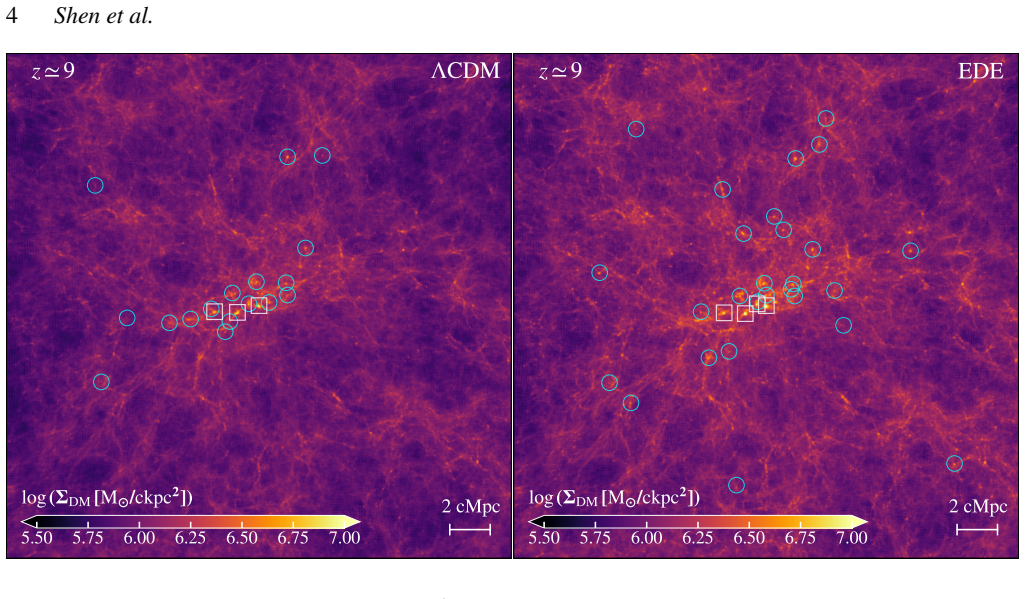
The central claim is that EDE's accelerated early structure formation, driven mainly by an enhanced small-scale matter power spectrum with higher spectral index, primordial amplitude, and matter density, boosts the abundance of bright and massive galaxies enough to remove the 0.5–1 dex shortfall that standard ΛCDM simulations show against JWST at z≳10. Because EDE decays after recombination, the same run converges back to ΛCDM predictions at z≲3 with ≲0.2 dex differences. The faster assembly of massive halos also makes stellar and gaseous disks appear earlier: number densities of disky galaxies are about half a dex larger at z≈6–7, while the disky fraction at fixed stellar mass is unchanged,
What carries the argument
The central object is early dark energy as a scalar field with an axion-like potential V(φ)≈[1−cos(φ/f)]³, with parameters taken from CMB fits that also yield H0≈74.8 km/s/Mpc. The field acts as a cosmological constant before recombination and then dilutes; its observable imprint is an enhanced small-scale linear power spectrum (higher n_s and A_s) that accelerates the collapse of the first halos. The simulations couple this cosmology to the IllustrisTNG galaxy formation model in the Arepo code, with identical subgrid physics in EDE and ΛCDM runs, so any galaxy differences come purely from the altered expansion history and power spectrum.
Load-bearing premise
The galaxy formation model, calibrated at low redshift, is assumed to stay accurate at z=4–14 with no recalibration; if real high-redshift star formation or feedback differs systematically, the EDE simulation's agreement with JWST could be coincidence rather than evidence for EDE.
What would settle it
Measure the UV luminosity function at z≈12–14 with a larger, purely spectroscopic sample: if the bright-end number density turns out to be roughly 0.5 dex lower than current JWST photometric estimates, the EDE match disappears. Conversely, a robust measurement of the clustering bias of bright galaxies at z≈6–8—EDE predicts lower bias than ΛCDM at fixed luminosity—would discriminate the two.
If this is right
- JWST's excess of UV-bright galaxies at z≈10–14 does not require exotic star-formation physics; a CMB-consistent EDE cosmology with standard galaxy formation reproduces the observed counts.
- Massive galaxy candidates in the COSMOS-Web field at z≈11–12, which appear as >3σ outliers in ΛCDM, fall within about 2–3σ of EDE predictions.
- Stellar and gaseous disks form earlier in EDE, so ALMA and JWST disk detections at z≈6–8 become expected rather than surprising, with gaseous disk number densities roughly a factor of three higher at z≈6–7.
- At z≲3 the EDE run converges to ΛCDM within ≲0.2 dex, preserving the established low-redshift successes of the standard model.
- The model predicts fewer massive quenched galaxies than ΛCDM at z≳3.5, supporting the paper's view that the early-quenching puzzle is likely a baryonic or black-hole-physics limitation, not a cosmological one.
Where Pith is reading between the lines
- Any beyond-ΛCDM model that increases the pre-recombination expansion rate generically tilts the small-scale power spectrum upward, so high-redshift galaxy abundance could serve as a broad probe of early-universe physics beyond EDE itself.
- The paper's reduced-bias prediction—bright galaxies less clustered in EDE at fixed luminosity—offers a direct observational test: galaxy clustering at z≈6–10 from JWST fields could distinguish EDE from baryonic solutions like feedback-free starbursts or top-heavy initial mass functions.
- If high-z star formation or feedback is later shown to be systematically different, the EDE match could be coincidental; the paper's own shortfall in quenched galaxies already signals that the subgrid black-hole model limits the comparison.
- Lyman-α forest and 21-cm observations, usually used to rule out suppressed small-scale power, could be turned around to constrain enhanced small-scale power of the kind EDE produces.
Editorial analysis
A structured set of objections, weighed in public.
Referee Report
Summary. This manuscript presents the first large-scale cosmological hydrodynamic simulations of an Early Dark Energy (EDE) cosmology using the IllustrisTNG galaxy formation model, alongside a matched ΛCDM simulation. EDE parameters are taken from a CMB fit (Smith et al. 2022) and are not adjusted to galaxy data. The central claim is that EDE, through an enhanced small-scale matter power spectrum, boosts the abundance of UV-bright and massive galaxies at z ≃ 4–14, bringing simulated UV luminosity functions and stellar mass functions into 'excellent agreement' with JWST measurements, while predictions converge to ΛCDM by z ≲ 3. The paper also reports earlier emergence of disky galaxies in EDE and a surprising delay in quenched galaxies due to the younger universe. The comparison is supported by an empirical model and by an appendix isolating the power-spectrum change from the H0 change.
Significance. If the headline claim holds, this is an important result: it demonstrates that modifications to pre-recombination cosmology can simultaneously ease several JWST 'too early, too massive, too disk-like' tensions without retuning the IllustrisTNG baryonic model. The controlled EDE-versus-ΛCDM comparison with identical subgrid physics is a genuine strength, as is the authors' use of an independent empirical model and the clear decomposition of the effect into power-spectrum versus H0 changes. The paper is also commendably transparent about the quenched-galaxy underprediction. However, the absolute 'excellent agreement with JWST' is less secure than the differential EDE-ΛCDM signal: it depends on post-processing choices (zero dust attenuation at z ≥ 10, empirically calibrated dust at z < 10) and on the IllustrisTNG star-formation efficiency at high redshift, which Fig. 4 shows is at the lower envelope of current models. These degeneracies do not invalidate the differential statement, but they weaken the inference that EDE is required by the JWST abundance data.
major comments (4)
- [§3.1, Fig. 5; §2.3–2.4] The claimed 'excellent agreement' at z ≥ 10 relies on setting dust attenuation to zero at z ≥ 10 while using empirically calibrated dust at lower redshifts. This is an upper-limit choice in brightness: simulated galaxies do contain dust, and the motivation 'observed blue UV slopes' is partly circular when the goal is to match observed UV luminosity functions. The EDE-ΛCDM differential remains robust, but the absolute normalization of the z = 12–14 UV LFs, which is a headline result, is not. Please show the intrinsic A_UV distribution of the simulated galaxies at z ≥ 10, or test the sensitivity of Fig. 5 to a small nonzero attenuation (e.g., A_UV = 0.2–0.5 mag).
- [§2.2, Fig. 4; §3.1] The inference that EDE is needed to match JWST is degenerate with the high-redshift star-formation efficiency. The IllustrisTNG SFE in Fig. 4 is nearly redshift-independent and lies at the lower envelope of published models; FIREbox, thesan-zoom, and the FFB scenario show SFEs 0.5–1 dex higher at M_halo ~ 10^10–10^11 M_sun. Because the EDE boost to the halo mass function is roughly 0.2–0.8 dex over the relevant range, a modest upward revision of TNG's high-z SFE in ΛCDM could produce the same UV LF and SMF as EDE+TNG. The 'essentially no additional calibration' claim is therefore relative to TNG, not to the space of plausible baryonic models. Please quantify this degeneracy—e.g., show what a ΛCDM run with a 0.3–0.5 dex higher SFE would predict—or identify an observable that breaks it (clustering, stellar mass functions at fixed UV luminosity, or [C II] kinematics).
- [§3.1, Fig. 5; Table 2] The conclusions at z = 9–14 are based on a single (100 cMpc)^3 simulation volume per cosmology. In Fig. 5 the shaded 'one galaxy per mag' region indicates that the bright-end bins at z = 12 and 14 contain very few galaxies, and the Poisson errors do not include cosmic variance. The empirical model and Eq. (4) provide a useful volume correction, but the claimed 'almost perfect' agreement at z ≳ 12 could be affected substantially by sample variance. Please quantify cosmic variance—for example, by using the empirical model to estimate the expected field-to-field scatter in the z = 12–14 UV LF bins, or by running a second realization of at least one cosmology.
- [Abstract; §3.4, Fig. 10] The abstract's phrase 'simultaneously reconcile multiple high-redshift challenges' is too broad in light of the paper's own finding that quenched galaxies at M* ≳ 10^10 M_sun are underpredicted by an order of magnitude at z ≳ 3 in both cosmologies, and that EDE delays rather than accelerates quenching. The authors are appropriately candid in §3.4 and §4, but the abstract and conclusions should explicitly state that EDE does not address the early-quenching tension and may worsen it. This does not undermine the UV LF and SMF results, but it does limit the 'multiple challenges' claim.
minor comments (4)
- [§2.4] The empirical-model parameter σ_UV = 0.75 mag is described as 'assumed' and 'purely for interpretation.' Since this scatter directly affects the LF shape and the stellar-mass-function derivation in Eq. (1), please state its source and the sensitivity of the empirical-model curves to it.
- [§2.1, Table 1] The adopted EDE parameters from Smith et al. (2022) are now less favored by Planck PR4+BAO and are more aggressive than the ACT DR6/DESI-based fits cited in §2.1. The paper discusses this, but the abstract and conclusions should more clearly present the simulations as a proof-of-principle for a broader class of early-universe models, not as evidence for the specific best-fit model.
- [§3.3] The disk thresholds (D/T)_* = 0.7 and (D/T)_gas = 0.8 are reasonable but somewhat arbitrary. A brief sensitivity test (e.g., varying the thresholds by ±0.1) would help confirm that the half-dex EDE-ΛCDM difference in disky-galaxy number density is not driven by the exact cut.
- [§3.2, Fig. 7] The Schechter-function fits at z ≥ 5 fix the break mass to 10^11 M_sun. This is justified, but the choice could affect the integrated stellar-mass-density comparison; a short statement of the resulting systematic uncertainty would be useful.
Circularity Check
Central EDE-vs-ΛCDM comparison is externally anchored by CMB fits and a fixed low-z-calibrated galaxy formation model; no circular reduction found.
full rationale
The paper's headline inference—that EDE improves agreement with JWST galaxy abundance measurements—rests on two external anchors, not on the target data. The EDE parameters are taken from Smith et al. (2022), a CMB fit independent of the JWST abundance data, and the IllustrisTNG galaxy formation model is an out-of-the-box model calibrated at low redshift (§2.2). Both the ΛCDM and EDE runs use identical subgrid physics, so the EDE-vs-ΛCDM differential comparison is not a fitted prediction: the baryonic model is common to both and the SFE is explicitly shown to be indistinguishable between runs (Fig. 4). The paper does not fit the UV luminosity function or stellar mass function to JWST data and then re-predict them. The only potentially load-bearing modeling choice for the high-redshift absolute comparison is the assumption of no dust attenuation at z≥10, justified by observed blue UV slopes of the same high-z galaxies (§2.3). This is an input assumption motivated by an independent observable (UV spectral slope), not a parameter fitted to the luminosity-function amplitude; it does not reduce the predicted LF to an observed LF by construction. The empirical model from the authors' prior work (Shen et al. 2023, 2024b) is used mainly for interpretation and volume corrections, not as the evidence for EDE. The paper also explicitly acknowledges the quenched-galaxy underprediction as a limitation of the SMBH subgrid model (§3.4), and it discusses degeneracies with baryonic alternatives (§4). Self-citations appear frequently but are not load-bearing for the central claim: the EDE model and its parameters are externally cited, and the IllustrisTNG model is externally defined. No uniqueness theorem is imported from the authors, and no ansatz is smuggled in via self-citation. Accordingly, there is no significant circularity; the score reflects only the minor use of author's prior empirical model as a comparison tool, which is not load-bearing.
Axiom & Free-Parameter Ledger
free parameters (4)
- UV variability scatter sigma_UV =
0.75 mag
- Dust attenuation constants C0, C1 =
C0 ~ 4.9, C1 ~ 2
- Disk selection thresholds =
(D/T)_star > 0.7, (D/T)_gas > 0.8
- sSFR quenched cut =
sSFR < 0.2 / t_H(z)
axioms (5)
- domain assumption EDE cosmology with Smith et al. (2022) best-fit parameters (f_EDE ~ 0.179, log10 z_c ~ -3.528, theta_i ~ -2.806, m ~ 4.38e-28 eV, etc.)
- domain assumption The IllustrisTNG subgrid physics, calibrated at low redshift, is valid at z=4-14 without recalibration
- standard math The linear matter power spectrum from CAMB's early-quintessence implementation, with adiabatic and Gaussian primordial perturbations, is correct
- domain assumption Empirical dust attenuation relations (Meurer et al. 1999; Bouwens et al. 2014; Cullen et al. 2023) apply to simulated galaxies at z<10
- standard math Halo mass function and halo accretion-rate fitting formulae (Press-Schechter/Sheth-Tormen, Rodriguez-Puebla et al. 2016) are accurate for EDE cosmologies
Cite this review
Pith. "Pith review of The Cosmic Rush Hour: Rapid Formation of Bright, Massive, Disky, Star-Forming Galaxies as Signatures of Early-Universe Physics." pith.science (2026). https://pith.science/paper/AWWVXAOQ
@misc{pith2026250919427,
  author       = {Pith},
  title        = {Pith review of: The Cosmic Rush Hour: Rapid Formation of Bright, Massive, Disky, Star-Forming Galaxies as Signatures of Early-Universe Physics},
  year         = {2026},
  howpublished = {\url{https://pith.science/paper/AWWVXAOQ}},
  note         = {Machine review of arXiv:2509.19427}
}
read the original abstract
Early JWST observations have revealed a high-redshift universe more vibrant than predicted by canonical galaxy-formation models within $\Lambda$CDM, showing an excess of ultraviolet(UV)-bright, massive, and morphologically mature galaxies. Departures from $\Lambda$CDM prior to recombination can imprint signatures on non-linear structure formation at high redshift. In this paper, we investigate one such scenario - Early Dark Energy, originally proposed to resolve the Hubble tension - and its implications for these high-redshift challenges. We present the first large-scale cosmological hydrodynamic simulations of these models. Modifications to the pre-recombination expansion history accelerate early structure formation and produce UV luminosity and stellar mass functions in excellent agreement with JWST measurements, requiring essentially no additional calibrations. Predictions converge to $\Lambda$CDM at lower redshifts ($z \lesssim 3$), thereby preserving all successes of $\Lambda$CDM. This model also accelerates the emergence of stellar and gaseous disks, increasing their number densities by $\sim 0.5$ dex at $z\simeq 6$-7, primarily due to the higher abundance of massive galaxies. Taken together, these results demonstrate how early-universe physics can simultaneously reconcile multiple high-redshift challenges and the Hubble tension while retaining the core achievements of $\Lambda$CDM. This opens a pathway to constraining a broad class of beyond-$\Lambda$CDM models with forthcoming observations.
Figures



Forward citations
Cited by 2 Pith papers
-
Resolving galaxy formation in the early Universe with BonFIRE and CampFIRE
BonFIRE and CampFIRE simulations show bursty clustered star formation in early galaxies and predict UV luminosity functions matching observations at faint magnitudes with a turnover at M_UV approx -14 but overpredicti...
-
Dark Secrets of Baryons: Illuminating Dark Matter-Baryon Interactions with JWST
JWST ultraviolet luminosity function data currently provide the strongest upper limits on velocity-dependent (∝v^{-2}) dark matter–proton scattering for sub-GeV dark matter.
Reference graph
Works this paper leans on
-
[1]
Abdalla E., et al., 2022, @doi [Journal of High Energy Astrophysics] 10.1016/j.jheap.2022.04.002 , https://ui.adsabs.harvard.edu/abs/2022JHEAp..34...49A 34, 49
-
[2]
Ach \'u carro A., et al., 2022, @doi [arXiv e-prints] 10.48550/arXiv.2203.08128 , https://ui.adsabs.harvard.edu/abs/2022arXiv220308128A p. arXiv:2203.08128
-
[3]
Adams N. J., et al., 2023, @doi [ ] 10.1093/mnras/stac3347 , https://ui.adsabs.harvard.edu/abs/2023MNRAS.518.4755A 518, 4755
-
[4]
Adams N. J., et al., 2024, @doi [ ] 10.3847/1538-4357/ad2a7b , https://ui.adsabs.harvard.edu/abs/2024ApJ...965..169A 965, 169
-
[5]
Akins H. B., et al., 2023, @doi [ ] 10.3847/1538-4357/acef21 , https://ui.adsabs.harvard.edu/abs/2023ApJ...956...61A 956, 61
-
[6]
Akins H. B., et al., 2024, @doi [arXiv e-prints] 10.48550/arXiv.2406.10341 , https://ui.adsabs.harvard.edu/abs/2024arXiv240610341A p. arXiv:2406.10341
-
[7]
Alberts S., et al., 2024, @doi [ ] 10.3847/1538-4357/ad66cc , https://ui.adsabs.harvard.edu/abs/2024ApJ...975...85A 975, 85
-
[8]
Aloni D., Berlin A., Joseph M., Schmaltz M., Weiner N., 2022, @doi [ ] 10.1103/PhysRevD.105.123516 , https://ui.adsabs.harvard.edu/abs/2022PhRvD.105l3516A 105, 123516
-
[9]
Arvanitaki A., Dimopoulos S., Dubovsky S., Kaloper N., March-Russell J., 2010, @doi [ ] 10.1103/PhysRevD.81.123530 , https://ui.adsabs.harvard.edu/abs/2010PhRvD..81l3530A 81, 123530
-
[10]
Atek H., et al., 2023, @doi [ ] 10.1093/mnras/stac3144 , https://ui.adsabs.harvard.edu/abs/2023MNRAS.519.1201A 519, 1201
-
[11]
Barnes J., Hut P., 1986, @doi [ ] 10.1038/324446a0 , https://ui.adsabs.harvard.edu/abs/1986Natur.324..446B 324, 446
doi:10.1038/324446a0 1986
-
[12]
Bashinsky S., Seljak U., 2004, @doi [ ] 10.1103/PhysRevD.69.083002 , https://ui.adsabs.harvard.edu/abs/2004PhRvD..69h3002B 69, 083002
-
[13]
Behroozi P. S., Wechsler R. H., Conroy C., 2013, @doi [ ] 10.1088/0004-637X/770/1/57 , https://ui.adsabs.harvard.edu/abs/2013ApJ...770...57B 770, 57
-
[14]
Behroozi P., Wechsler R. H., Hearin A. P., Conroy C., 2019, @doi [ ] 10.1093/mnras/stz1182 , https://ui.adsabs.harvard.edu/abs/2019MNRAS.488.3143B 488, 3143
-
[15]
Bell E. F., McIntosh D. H., Katz N., Weinberg M. D., 2003, @doi [ ] 10.1086/378847 , https://ui.adsabs.harvard.edu/abs/2003ApJS..149..289B 149, 289
doi:10.1086/378847 2003
-
[16]
Belokurov V., Kravtsov A., 2022, @doi [ ] 10.1093/mnras/stac1267 , https://ui.adsabs.harvard.edu/abs/2022MNRAS.514..689B 514, 689
-
[17]
Bland-Hawthorn J., Tepper-Garcia T., Agertz O., Freeman K., 2023, @doi [ ] 10.3847/1538-4357/acc469 , https://ui.adsabs.harvard.edu/abs/2023ApJ...947...80B 947, 80
-
[18]
Bond J. R., Cole S., Efstathiou G., Kaiser N., 1991, @doi [ ] 10.1086/170520 , https://ui.adsabs.harvard.edu/abs/1991ApJ...379..440B 379, 440
doi:10.1086/170520 1991
-
[19]
Bouwens R. J., et al., 2014, @doi [ ] 10.1088/0004-637X/793/2/115 , https://ui.adsabs.harvard.edu/abs/2014ApJ...793..115B 793, 115
-
[20]
Bouwens R. J., et al., 2021, @doi [ ] 10.3847/1538-3881/abf83e , https://ui.adsabs.harvard.edu/abs/2021AJ....162...47B 162, 47
-
[21]
Bouwens R. J., et al., 2022, @doi [ ] 10.3847/1538-4357/ac5a4a , https://ui.adsabs.harvard.edu/abs/2022ApJ...931..160B 931, 160
-
[22]
Bouwens R., Illingworth G., Oesch P., Stefanon M., Naidu R., van Leeuwen I., Magee D., 2023a, @doi [ ] 10.1093/mnras/stad1014 , https://ui.adsabs.harvard.edu/abs/2023MNRAS.523.1009B 523, 1009
-
[23]
Bouwens R. J., et al., 2023b, @doi [ ] 10.1093/mnras/stad1145 , https://ui.adsabs.harvard.edu/abs/2023MNRAS.523.1036B 523, 1036
-
[24]
Bowler R. A. A., Jarvis M. J., Dunlop J. S., McLure R. J., McLeod D. J., Adams N. J., Milvang-Jensen B., McCracken H. J., 2020, @doi [ ] 10.1093/mnras/staa313 , https://ui.adsabs.harvard.edu/abs/2020MNRAS.493.2059B 493, 2059
-
[25]
Bowler R. A. A., et al., 2024, @doi [ ] 10.1093/mnras/stad3578 , https://ui.adsabs.harvard.edu/abs/2024MNRAS.527.5808B 527, 5808
-
[26]
Boylan-Kolchin M., 2023, @doi [Nature Astronomy] 10.1038/s41550-023-01937-7 , https://ui.adsabs.harvard.edu/abs/2023NatAs...7..731B 7, 731
-
[27]
Boylan-Kolchin M., 2025, @doi [ ] 10.1093/mnras/staf471 , https://ui.adsabs.harvard.edu/abs/2025MNRAS.538.3210B 538, 3210
-
[28]
Boylan-Kolchin M., Weisz D. R., 2021, @doi [ ] 10.1093/mnras/stab1521 , https://ui.adsabs.harvard.edu/abs/2021MNRAS.505.2764B 505, 2764
-
[29]
Brout D., et al., 2022, @doi [ ] 10.3847/1538-4357/ac8e04 , https://ui.adsabs.harvard.edu/abs/2022ApJ...938..110B 938, 110
-
[30]
Bryan G. L., Norman M. L., 1998, @doi [ ] 10.1086/305262 , https://ui.adsabs.harvard.edu/abs/1998ApJ...495...80B 495, 80
doi:10.1086/305262 1998
-
[31]
Bullock J. S., Boylan-Kolchin M., 2017, @doi [ ] 10.1146/annurev-astro-091916-055313 , https://ui.adsabs.harvard.edu/abs/2017ARA&A..55..343B 55, 343
-
[32]
Calabr \`o A., et al., 2024, @doi [ ] 10.3847/1538-4357/ad7602 , https://ui.adsabs.harvard.edu/abs/2024ApJ...975..245C 975, 245
-
[33]
Carnall A. C., McLure R. J., Dunlop J. S., Dav \'e R., 2018, @doi [ ] 10.1093/mnras/sty2169 , https://ui.adsabs.harvard.edu/abs/2018MNRAS.480.4379C 480, 4379
-
[34]
Carnall A. C., et al., 2023a, @doi [ ] 10.1093/mnras/stad369 , https://ui.adsabs.harvard.edu/abs/2023MNRAS.520.3974C 520, 3974
-
[35]
Carnall A. C., et al., 2023b, @doi [ ] 10.1038/s41586-023-06158-6 , https://ui.adsabs.harvard.edu/abs/2023Natur.619..716C 619, 716
-
[36]
Carniani S., et al., 2024, @doi [ ] 10.1038/s41586-024-07860-9 , https://ui.adsabs.harvard.edu/abs/2024Natur.633..318C 633, 318
-
[37]
Casey C. M., et al., 2024, @doi [ ] 10.3847/1538-4357/ad2075 , https://ui.adsabs.harvard.edu/abs/2024ApJ...965...98C 965, 98
-
[38]
Castellano M., et al., 2022, @doi [ ] 10.3847/2041-8213/ac94d0 , https://ui.adsabs.harvard.edu/abs/2022ApJ...938L..15C 938, L15
-
[39]
Chabrier G., 2003, @doi [ ] 10.1086/376392 , https://ui.adsabs.harvard.edu/abs/2003PASP..115..763C 115, 763
doi:10.1086/376392 2003
-
[40]
Chandra V., et al., 2024, @doi [ ] 10.3847/1538-4357/ad5b60 , https://ui.adsabs.harvard.edu/abs/2024ApJ...972..112C 972, 112
-
[41]
Chatzikos M., et al., 2023, @doi [ ] 10.22201/ia.01851101p.2023.59.02.12 , https://ui.adsabs.harvard.edu/abs/2023RMxAA..59..327C 59, 327
-
[42]
Chen X., 2010, @doi [Advances in Astronomy] 10.1155/2010/638979 , https://ui.adsabs.harvard.edu/abs/2010AdAst2010E..72C 2010, 638979
-
[43]
Chittenden H. G., Glazebrook K., Nanayakkara T., Kawinwanichakij L., Lagos C., Kimmig L., Remus R.-S., 2025, @doi [arXiv e-prints] 10.48550/arXiv.2504.19696 , https://ui.adsabs.harvard.edu/abs/2025arXiv250419696C p. arXiv:2504.19696
work page internal anchor Pith review Pith/arXiv arXiv doi:10.48550/arxiv.2504.19696 2025
-
[44]
Clauwens B., Schaye J., Franx M., Bower R. G., 2018, @doi [ ] 10.1093/mnras/sty1229 , https://ui.adsabs.harvard.edu/abs/2018MNRAS.478.3994C 478, 3994
-
[45]
Hierarchical assembly impedes the inference of stellar mass growth histories for individual galaxies
Cochrane R. K., 2025, @doi [arXiv e-prints] 10.48550/arXiv.2509.02700 , https://ui.adsabs.harvard.edu/abs/2025arXiv250902700C p. arXiv:2509.02700
work page internal anchor Pith review Pith/arXiv arXiv doi:10.48550/arxiv.2509.02700 2025
-
[46]
Conroy C., et al., 2022, @doi [arXiv e-prints] 10.48550/arXiv.2204.02989 , https://ui.adsabs.harvard.edu/abs/2022arXiv220402989C p. arXiv:2204.02989
-
[47]
Cortese L., et al., 2016, @doi [ ] 10.1093/mnras/stw1891 , https://ui.adsabs.harvard.edu/abs/2016MNRAS.463..170C 463, 170
-
[48]
R., Hutter A., Dayal P., Gottl \"o ber S., Heintz K
Cueto E. R., Hutter A., Dayal P., Gottl \"o ber S., Heintz K. E., Mason C., Trebitsch M., Yepes G., 2024, @doi [ ] 10.1051/0004-6361/202349017 , https://ui.adsabs.harvard.edu/abs/2024A&A...686A.138C 686, A138
-
[49]
Cullen F., et al., 2023, @doi [ ] 10.1093/mnras/stad073 , https://ui.adsabs.harvard.edu/abs/2023MNRAS.520...14C 520, 14
-
[50]
Cullen F., et al., 2024, @doi [ ] 10.1093/mnras/stae1211 , https://ui.adsabs.harvard.edu/abs/2024MNRAS.531..997C 531, 997
-
[51]
Curtis-Lake E., et al., 2023, @doi [Nature Astronomy] 10.1038/s41550-023-01918-w , https://ui.adsabs.harvard.edu/abs/2023NatAs.tmp...66C
-
[52]
Cyr-Racine F.-Y., Sigurdson K., 2013, @doi [ ] 10.1103/PhysRevD.87.103515 , https://ui.adsabs.harvard.edu/abs/2013PhRvD..87j3515C 87, 103515
-
[53]
Danhaive A. L., et al., 2025, @doi [arXiv e-prints] 10.48550/arXiv.2503.21863 , https://ui.adsabs.harvard.edu/abs/2025arXiv250321863D p. arXiv:2503.21863
-
[54]
Davidzon I., et al., 2017, @doi [ ] 10.1051/0004-6361/201730419 , https://ui.adsabs.harvard.edu/abs/2017A&A...605A..70D 605, A70
-
[55]
Dekel A., Sarkar K. C., Birnboim Y., Mandelker N., Li Z., 2023, @doi [ ] 10.1093/mnras/stad1557 , https://ui.adsabs.harvard.edu/abs/2023MNRAS.523.3201D 523, 3201
-
[56]
Desprez G., et al., 2024, @doi [ ] 10.1093/mnras/stae1084 , https://ui.adsabs.harvard.edu/abs/2024MNRAS.530.2935D 530, 2935
-
[57]
Dong F., Zhao D., Han J., Li Z., Jing Y., Yang X., 2022, @doi [ ] 10.3847/1538-4357/ac5aaa , https://ui.adsabs.harvard.edu/abs/2022ApJ...929..120D 929, 120
-
[58]
Donnan C. T., et al., 2023, @doi [ ] 10.1093/mnras/stac3472 , https://ui.adsabs.harvard.edu/abs/2023MNRAS.518.6011D 518, 6011
-
[59]
Donnan C. T., et al., 2024, @doi [ ] 10.1093/mnras/stae2037 , https://ui.adsabs.harvard.edu/abs/2024MNRAS.533.3222D 533, 3222
-
[60]
Donnari M., et al., 2021, @doi [ ] 10.1093/mnras/staa3006 , https://ui.adsabs.harvard.edu/abs/2021MNRAS.500.4004D 500, 4004
-
[61]
Duncan K., et al., 2019, @doi [ ] 10.3847/1538-4357/ab148a , https://ui.adsabs.harvard.edu/abs/2019ApJ...876..110D 876, 110
-
[62]
Efstathiou G., Rosenberg E., Poulin V., 2024, @doi [ ] 10.1103/PhysRevLett.132.221002 , https://ui.adsabs.harvard.edu/abs/2024PhRvL.132v1002E 132, 221002
-
[63]
El-Badry K., et al., 2018, @doi [ ] 10.1093/mnras/stx2482 , https://ui.adsabs.harvard.edu/abs/2018MNRAS.473.1930E 473, 1930
-
[64]
Eldridge J. J., Stanway E. R., Xiao L., McClelland L. A. S., Taylor G., Ng M., Greis S. M. L., Bray J. C., 2017, @doi [ ] 10.1017/pasa.2017.51 , https://ui.adsabs.harvard.edu/abs/2017PASA...34...58E 34, e058
-
[65]
Emsellem E., et al., 2007, @doi [ ] 10.1111/j.1365-2966.2007.11752.x , https://ui.adsabs.harvard.edu/abs/2007MNRAS.379..401E 379, 401
arXiv 2007
-
[66]
Endsley R., Stark D. P., Whitler L., Topping M. W., Chen Z., Plat A., Chisholm J., Charlot S., 2023, @doi [ ] 10.1093/mnras/stad1919 , https://ui.adsabs.harvard.edu/abs/2023MNRAS.524.2312E 524, 2312
-
[67]
Faber S. M., et al., 2007, @doi [ ] 10.1086/519294 , https://ui.adsabs.harvard.edu/abs/2007ApJ...665..265F 665, 265
doi:10.1086/519294 2007
-
[68]
Fakhouri O., Ma C.-P., Boylan-Kolchin M., 2010, @doi [ ] 10.1111/j.1365-2966.2010.16859.x , https://ui.adsabs.harvard.edu/abs/2010MNRAS.406.2267F 406, 2267
arXiv 2010
-
[69]
Faucher-Gigu \`e re C.-A., Lidz A., Zaldarriaga M., Hernquist L., 2009, @doi [ ] 10.1088/0004-637X/703/2/1416 , https://ui.adsabs.harvard.edu/abs/2009ApJ...703.1416F 703, 1416
-
[70]
Feldmann R., et al., 2025, @doi [ ] 10.1093/mnras/stae2633 , https://ui.adsabs.harvard.edu/abs/2025MNRAS.536..988F 536, 988
-
[71]
Ferland G. J., Korista K. T., Verner D. A., Ferguson J. W., Kingdon J. B., Verner E. M., 1998, @doi [ ] 10.1086/316190 , https://ui.adsabs.harvard.edu/abs/1998PASP..110..761F 110, 761
doi:10.1086/316190 1998
-
[72]
Ferreira L., et al., 2023, @doi [ ] 10.3847/1538-4357/acec76 , https://ui.adsabs.harvard.edu/abs/2023ApJ...955...94F 955, 94
-
[73]
Finkelstein S. L., et al., 2022, @doi [ ] 10.3847/2041-8213/ac966e , https://ui.adsabs.harvard.edu/abs/2022ApJ...940L..55F 940, L55
-
[74]
Finkelstein S. L., et al., 2023, @doi [ ] 10.3847/2041-8213/acade4 , https://ui.adsabs.harvard.edu/abs/2023ApJ...946L..13F 946, L13
-
[75]
Finkelstein S. L., et al., 2024, @doi [ ] 10.3847/2041-8213/ad4495 , https://ui.adsabs.harvard.edu/abs/2024ApJ...969L...2F 969, L2
-
[76]
Franx M., van Dokkum P. G., F \"o rster Schreiber N. M., Wuyts S., Labb \'e I., Toft S., 2008, @doi [ ] 10.1086/592431 , https://ui.adsabs.harvard.edu/abs/2008ApJ...688..770F 688, 770
doi:10.1086/592431 2008
-
[77]
Freedman W. L., et al., 2019, @doi [ ] 10.3847/1538-4357/ab2f73 , https://ui.adsabs.harvard.edu/abs/2019ApJ...882...34F 882, 34
-
[78]
Freedman W. L., Madore B. F., Hoyt T. J., Jang I. S., Lee A. J., Owens K. A., 2025, @doi [ ] 10.3847/1538-4357/adce78 , https://ui.adsabs.harvard.edu/abs/2025ApJ...985..203F 985, 203
-
[79]
Fujimoto S., et al., 2024, @doi [arXiv e-prints] 10.48550/arXiv.2402.18543 , https://ui.adsabs.harvard.edu/abs/2024arXiv240218543F p. arXiv:2402.18543
-
[80]
F., Zibetti S., Brinchmann J., Kelson D
Gallazzi A., Bell E. F., Zibetti S., Brinchmann J., Kelson D. D., 2014, @doi [ ] 10.1088/0004-637X/788/1/72 , https://ui.adsabs.harvard.edu/abs/2014ApJ...788...72G 788, 72
discussion (0)
Sign in with ORCID, Apple, or X to comment. Anyone can read and Pith papers without signing in.