Resolving galaxy formation in the early Universe with BonFIRE and CampFIRE
Pith reviewed 2026-06-30 15:15 UTC · model grok-4.3
The pith
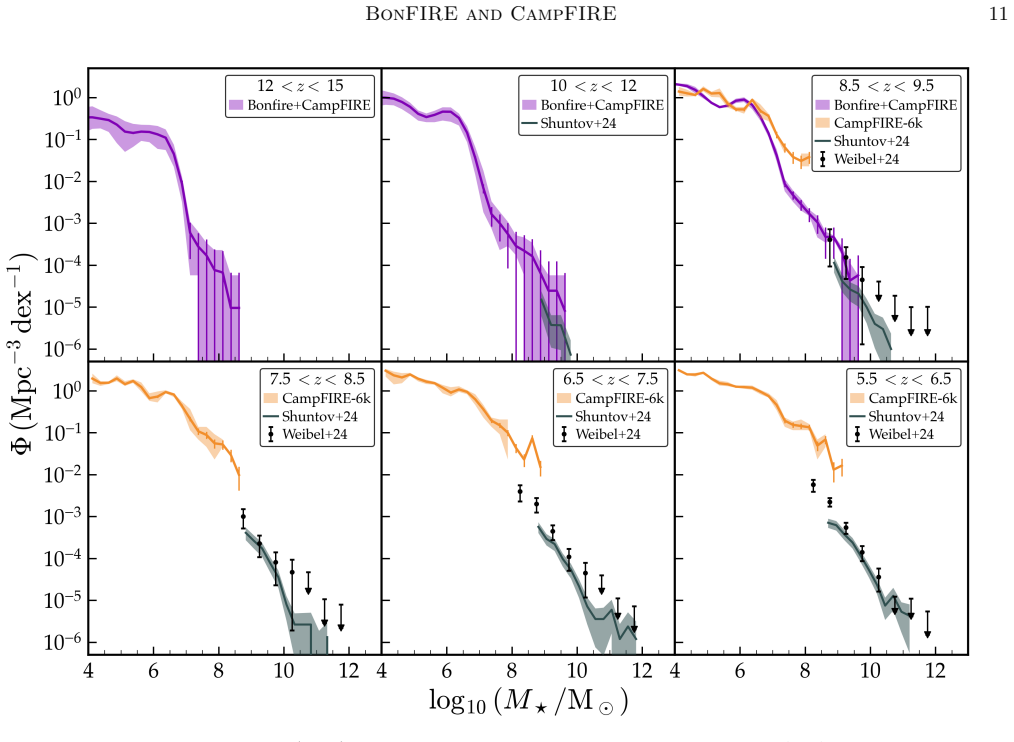
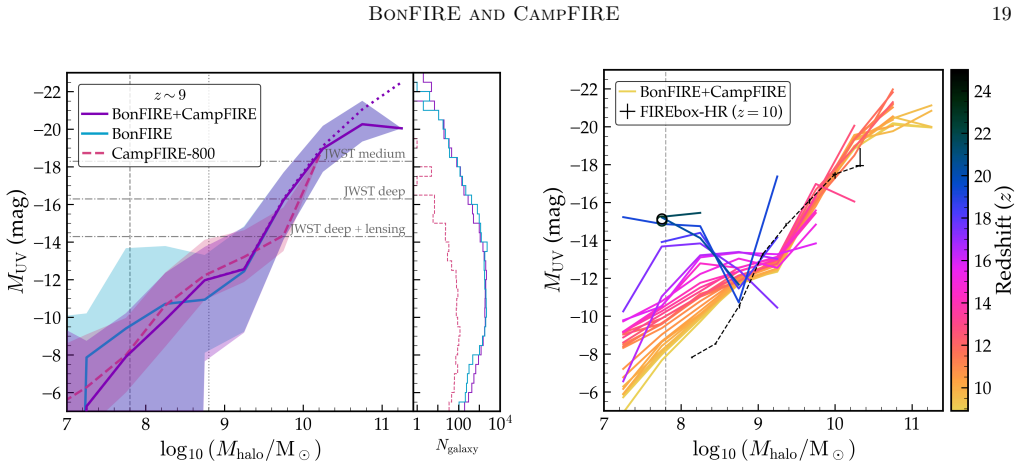
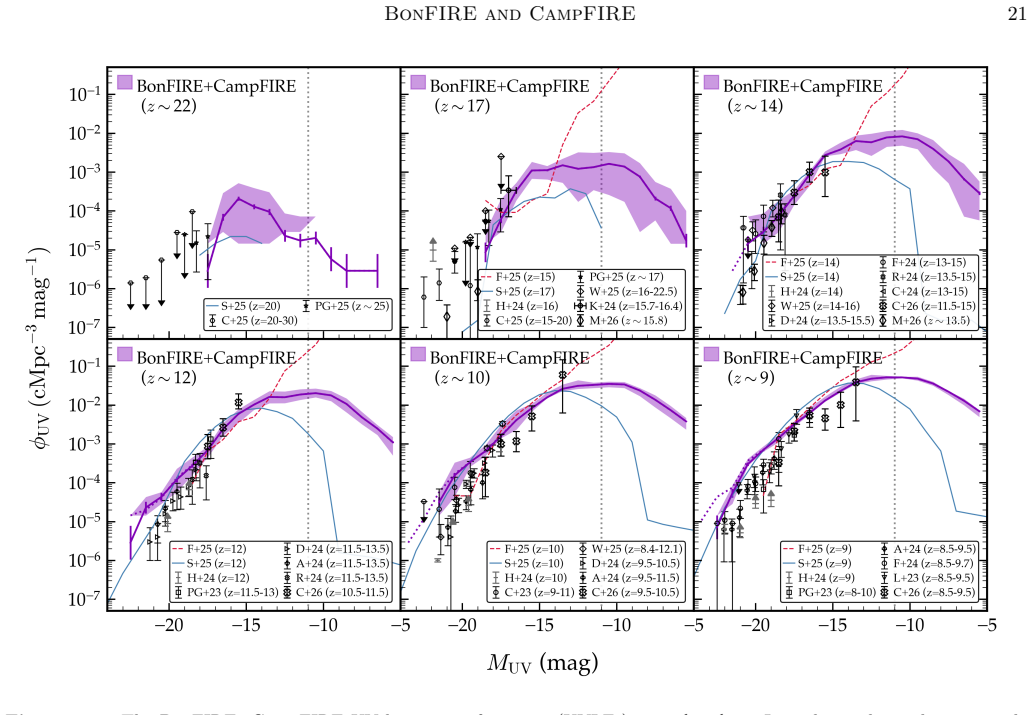
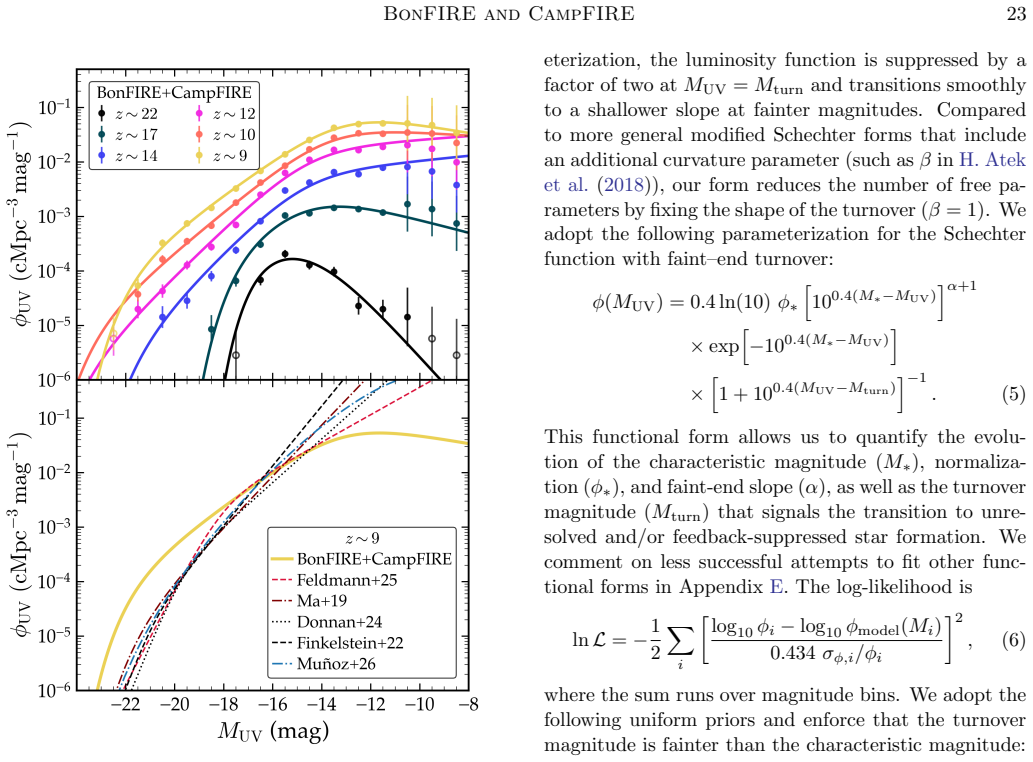
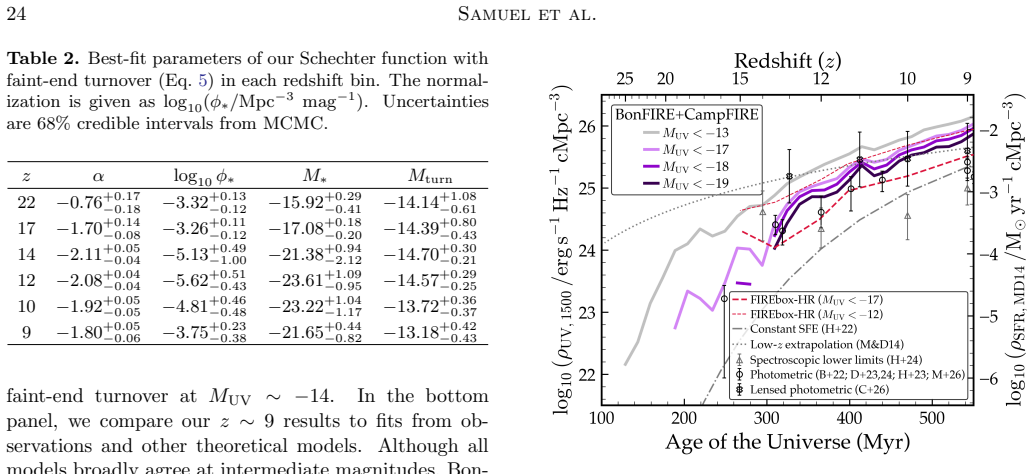
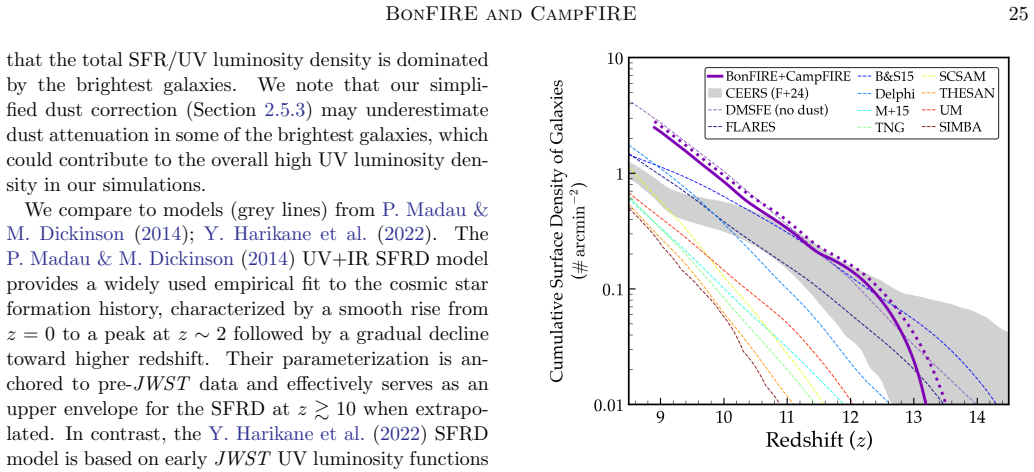
Simulations of early galaxy formation predict UV luminosity functions that match observations at faint magnitudes with a turnover at M_UV ≈ -14.
A machine-rendered reading of the paper's core claim, the machinery that carries it, and where it could break.
Core claim
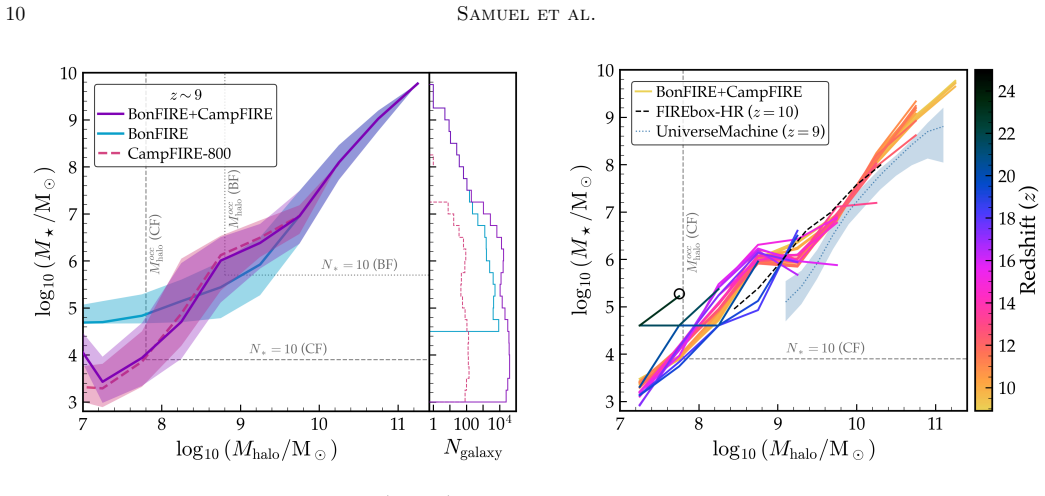
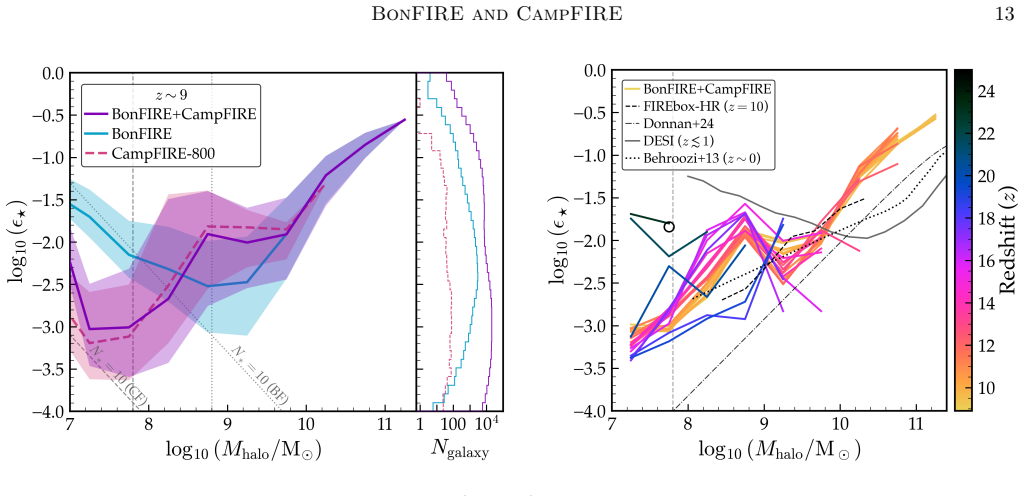
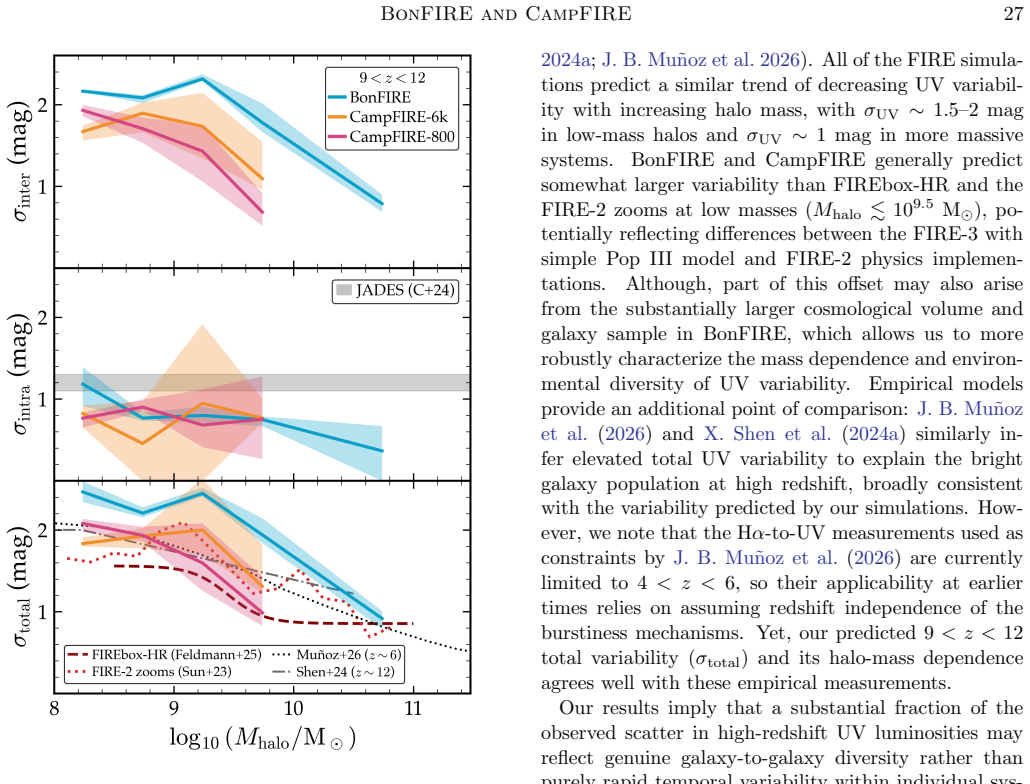
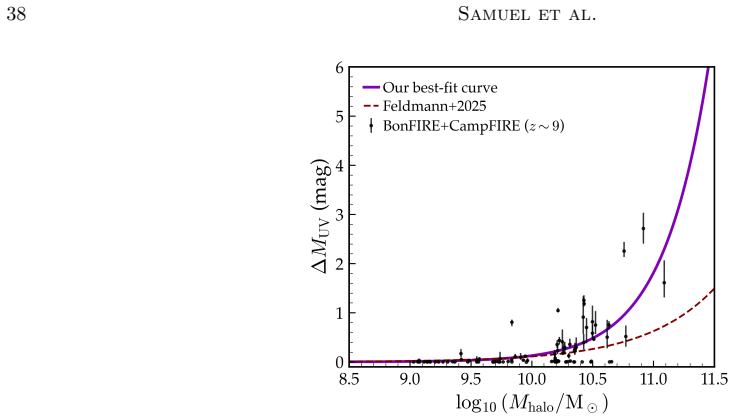
Galaxy formation in this suite emerges through clustered, bursty star formation, with halo-scale star formation efficiencies reaching 10-30% in high-mass halos. A subset of low-mass halos also have surprisingly high efficiencies of ≳1% and host ultra-compact galaxies with narrow age spreads. We predict galaxy UV luminosity functions at 9≲z≲25 in broad agreement with observations at M_UV≳−19, with a faint-end turnover at M_UV≈−14, but we slightly overpredict the abundance of brighter galaxies. We find that UV luminosity variability in early galaxies is strongly mass-dependent, with halo-to-halo scatter dominating at low masses and contributing comparably to rapid temporal burstiness at M_halo
What carries the argument
The resampling procedure that combines the large statistics of the BonFIRE simulation with the higher resolution of the CampFIRE simulation to predict galaxy properties over a wide dynamic range.
If this is right
- UV luminosity functions at 9≲z≲25 exhibit broad agreement with observations for M_UV≳−19 and a faint-end turnover at M_UV≈−14.
- Halo-scale star formation efficiencies reach 10-30% in high-mass halos and ≳1% in a subset of low-mass halos that form ultra-compact galaxies.
- UV luminosity variability is mass-dependent, with halo-to-halo scatter dominating at low masses and comparable to temporal burstiness at higher masses.
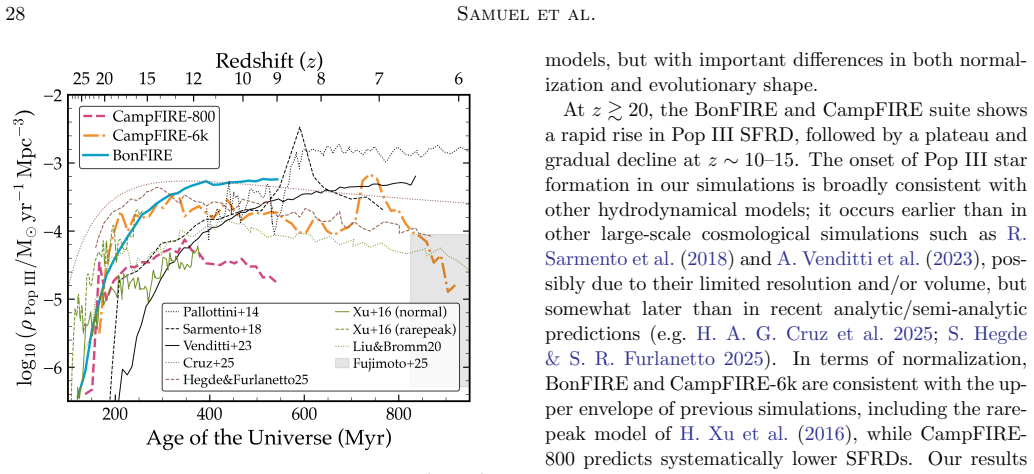
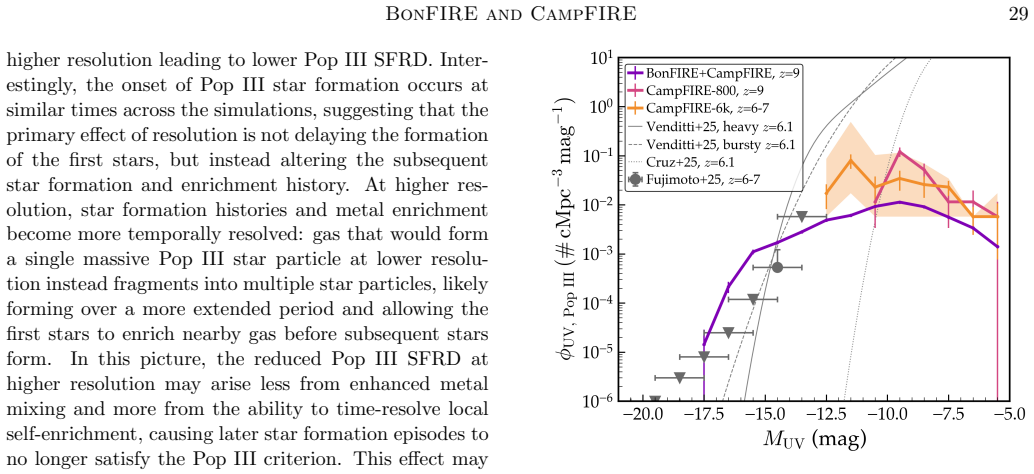
- A simple Pop III model with top-heavy IMF produces results in broad agreement with independent predictions and constraints.
Where Pith is reading between the lines
- The ability to span four orders of magnitude in galaxy mass with one consistent model allows direct comparison of low-mass and high-mass assembly pathways at the same epoch.
- The reported slight excess of bright galaxies at high redshift could be tested by varying feedback strength in follow-up runs to identify the minimal adjustment needed.
- The mass dependence of UV variability implies that single-epoch observations of individual high-redshift galaxies may not reflect the time-averaged population properties.
- The presence of ultra-compact galaxies in low-mass halos with narrow age spreads offers a possible observational signature for future high-resolution imaging.
Load-bearing premise
The resampling procedure to combine the large statistics of BonFIRE with the higher resolution of CampFIRE robustly predicts galaxy properties over a wide dynamic range.
What would settle it
Measurements of the UV luminosity function between redshifts 9 and 25 that show either no turnover near M_UV = -14 or a significantly lower abundance of galaxies brighter than M_UV = -19 than the simulations produce would settle whether the central predictions hold.
Figures
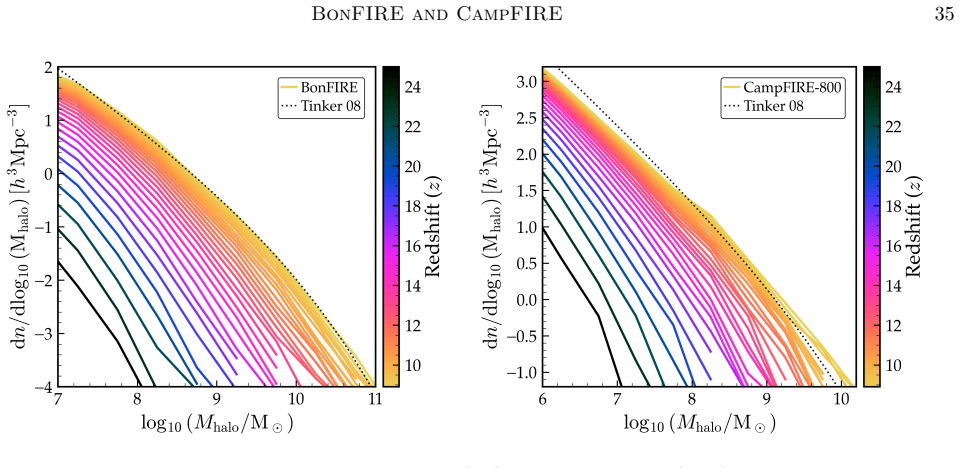
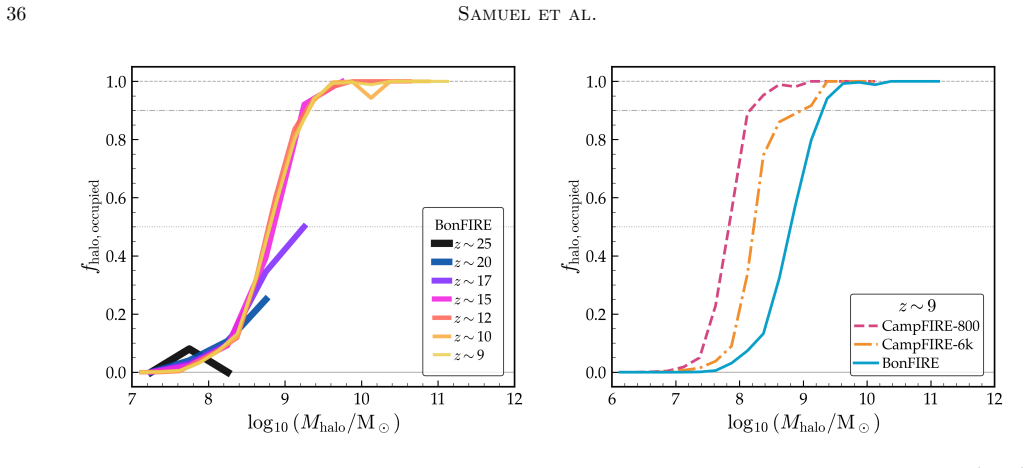
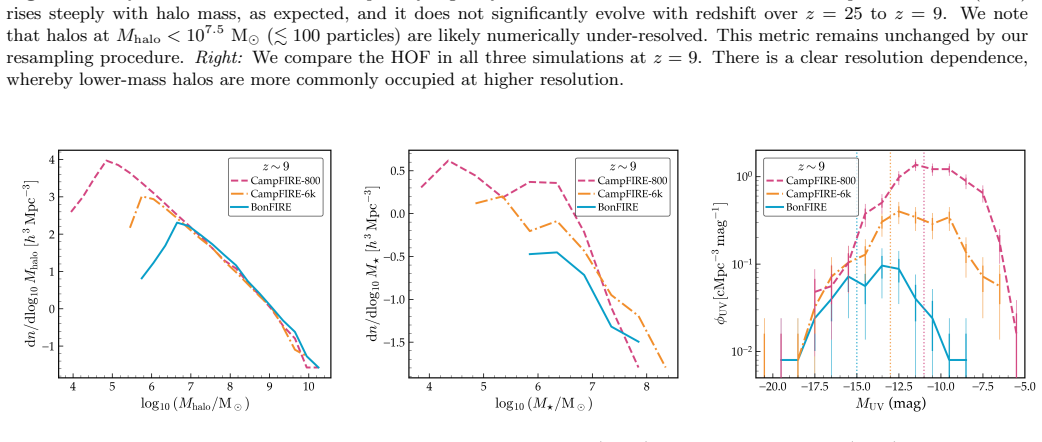
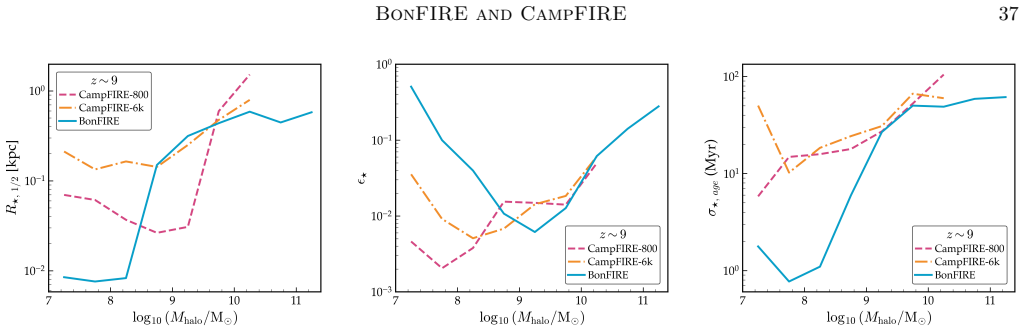
read the original abstract
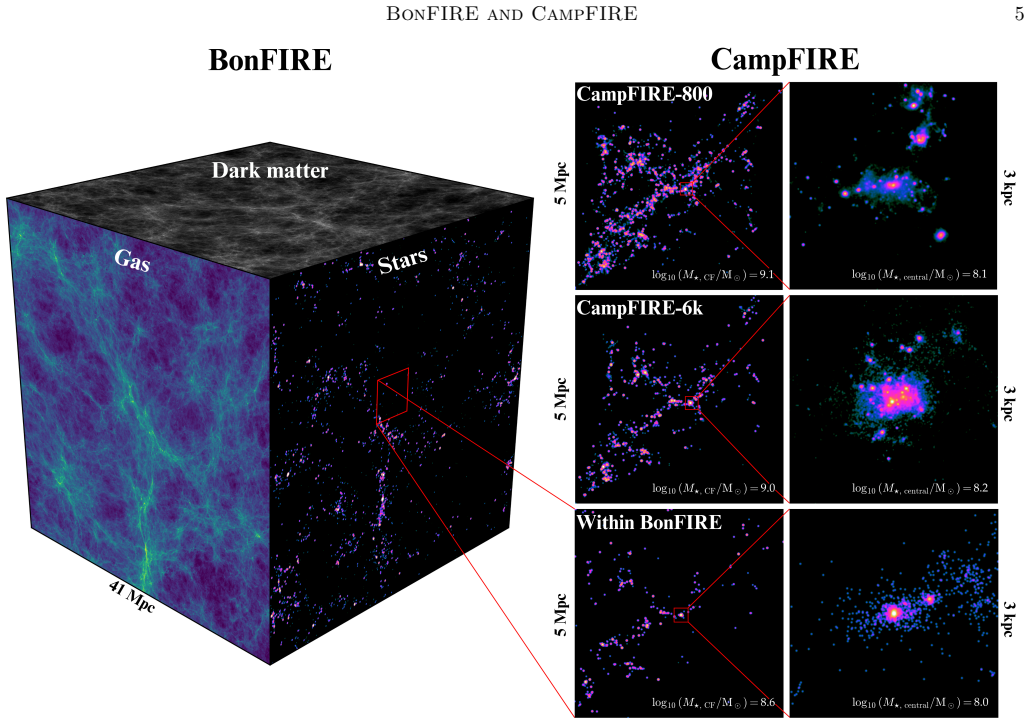
The abundance and rapid growth of galaxies at cosmic dawn revealed by the James Webb Space Telescope challenges models of galaxy formation, motivating new simulations to uncover the processes driving early galaxy assembly. We present the first results from BonFIRE ($L\approx40$ cMpc, $m_{\rm baryon}\approx5\times10^4~\rm{M}_{\odot}$) and CampFIRE ($L\approx5$ cMpc, at both $m_{\rm baryon}\approx800~\rm{M}_{\odot}$ and $\approx6\times10^3~\rm{M}_{\odot}$), a suite of cosmological hydrodynamic simulations of early galaxy formation ($z\gtrsim6$) from the Feedback In Realistic Environments (FIRE) project, using the FIRE-3 model. We use a resampling procedure to combine the large statistics of BonFIRE with the higher resolution of CampFIRE and robustly predict galaxy properties over a wide dynamic range ($M_{\star}\sim10^4-10^{10}~\rm{M}_{\odot}$). Galaxy formation in this suite emerges through clustered, bursty star formation, with halo-scale star formation efficiencies reaching $10-30\%$ in high-mass halos. A subset of low-mass halos also have surprisingly high efficiencies of $\gtrsim1\%$ and host ultra-compact galaxies with narrow age spreads. We predict galaxy UV luminosity functions at $9\lesssim~z\lesssim25$ in broad agreement with observations at $M_{\rm UV}\gtrsim-19$, with a faint-end turnover at $M_{\rm UV}\approx-14$, but we slightly overpredict the abundance of brighter galaxies. We find that UV luminosity variability in early galaxies is strongly mass-dependent, with halo-to-halo scatter dominating at low masses and contributing comparably to rapid temporal burstiness at $M_{\rm halo}\gtrsim10^{10}~\rm{M}_{\odot}$. We also present first results from a simple Pop~III model with a top-heavy IMF, demonstrating broad agreement with independent Pop~III predictions and observational constraints.
Editorial analysis
A structured set of objections, weighed in public.
Referee Report
Summary. The manuscript presents first results from the BonFIRE (L≈40 cMpc, m_baryon≈5×10^4 M_⊙) and CampFIRE (L≈5 cMpc, m_baryon≈800 and 6×10^3 M_⊙) cosmological hydrodynamic simulations using the FIRE-3 model. A resampling procedure merges BonFIRE's volume statistics with CampFIRE's resolution to predict galaxy properties over M_star∼10^4–10^10 M_⊙ at z≳6. Galaxy formation proceeds via clustered, bursty star formation with halo-scale efficiencies of 10–30% in high-mass halos (and ≳1% in some low-mass halos hosting ultra-compact galaxies). The predicted UV luminosity functions at 9≲z≲25 agree broadly with observations for M_UV≳−19, show a faint-end turnover at M_UV≈−14, and slightly overpredict brighter galaxies; UV variability is mass-dependent. A simple Pop III model with top-heavy IMF is also presented.
Significance. If the central predictions hold after validation of the resampling, the work would be significant for interpreting JWST observations of cosmic dawn, as it supplies forward-model predictions of UV LFs, star-formation efficiencies, and variability over a wide mass range using the established FIRE-3 physics. The combination of large-volume and high-resolution runs plus the Pop III extension are strengths.
major comments (2)
- [methods (resampling procedure)] The resampling procedure (described in the methods section on combining BonFIRE and CampFIRE) is load-bearing for all wide-dynamic-range claims, including the faint-end turnover location at M_UV≈−14 and the 10–30% efficiencies. No explicit validation tests are shown for how the procedure handles resolution-dependent burstiness, halo matching, or weighting in the overlap regime; if offsets arise there, both the turnover and the slight overprediction of bright galaxies become sensitive to this choice rather than to FIRE-3 physics alone.
- [UV luminosity functions section] § on UV luminosity functions: the statement of 'broad agreement' at M_UV≳−19 and 'slight overprediction' of brighter galaxies is presented without quantitative comparison (e.g., χ² values, direct overlay with specific observational datasets and their error bars, or exclusion criteria for the plotted points). This weakens the ability to assess whether the discrepancy is within expected model uncertainties.
minor comments (2)
- [figures] Figure captions for the UV LF plots should explicitly state the redshift bins, the observational references used for comparison, and any completeness cuts applied to the simulated galaxies.
- [results on efficiencies] The definition of 'halo-scale star formation efficiency' (used for the 10–30% and ≳1% values) should be given with an equation or clear reference to how it is computed from the simulation outputs.
Simulated Author's Rebuttal
We thank the referee for their detailed and constructive report. We address each major comment below. Both points identify areas where the manuscript can be strengthened with additional material, and we will incorporate revisions to address them.
read point-by-point responses
-
Referee: [methods (resampling procedure)] The resampling procedure (described in the methods section on combining BonFIRE and CampFIRE) is load-bearing for all wide-dynamic-range claims, including the faint-end turnover location at M_UV≈−14 and the 10–30% efficiencies. No explicit validation tests are shown for how the procedure handles resolution-dependent burstiness, halo matching, or weighting in the overlap regime; if offsets arise there, both the turnover and the slight overprediction of bright galaxies become sensitive to this choice rather than to FIRE-3 physics alone.
Authors: We agree that the resampling procedure is central to the wide-dynamic-range results and that explicit validation tests would strengthen the manuscript. In the revised version we will add a new subsection (or appendix) that presents validation tests in the overlap regime, including: (i) direct comparisons of star-formation histories and burstiness metrics between BonFIRE and CampFIRE at matched halo masses, (ii) halo-matching accuracy statistics, and (iii) sensitivity checks on the weighting scheme. These additions will demonstrate that the reported turnover at M_UV≈−14 and the efficiency trends are robust to the procedure rather than driven by resolution mismatches. revision: yes
-
Referee: [UV luminosity functions section] § on UV luminosity functions: the statement of 'broad agreement' at M_UV≳−19 and 'slight overprediction' of brighter galaxies is presented without quantitative comparison (e.g., χ² values, direct overlay with specific observational datasets and their error bars, or exclusion criteria for the plotted points). This weakens the ability to assess whether the discrepancy is within expected model uncertainties.
Authors: We accept that the current text relies on qualitative language without quantitative support. In the revision we will add quantitative comparisons to the UV luminosity function section, including χ² values (or equivalent metrics) against the primary observational datasets, explicit overlays that include observational error bars, and a clear statement of the selection/exclusion criteria used for the plotted points. This will allow readers to evaluate the significance of the slight overprediction at the bright end relative to model uncertainties. revision: yes
Circularity Check
No significant circularity; forward-modeling simulations with independent resampling step
full rationale
The paper presents results from cosmological hydrodynamic simulations (BonFIRE and CampFIRE) using the FIRE-3 model. Galaxy properties and UV luminosity functions are direct outputs of running the simulations from initial conditions, not defined in terms of the target observables or fitted to them. The resampling procedure merges volume and resolution statistics but is presented as a methodological choice for dynamic range, not a self-definitional fit or prediction that reduces to input data by construction. No self-citation load-bearing steps, ansatzes smuggled via citation, or renaming of known results appear in the load-bearing claims. The derivation chain is self-contained against external benchmarks.
Axiom & Free-Parameter Ledger
free parameters (2)
- BonFIRE baryon mass resolution
- CampFIRE baryon mass resolutions
axioms (2)
- domain assumption The FIRE-3 model accurately represents the relevant baryonic physics for galaxy formation at z greater than or equal to 6.
- domain assumption The resampling procedure preserves the statistical properties needed to predict galaxy UV luminosities across the full mass range.
Reference graph
Works this paper leans on
-
[1]
Adamo, A., Bradley, L. D., Vanzella, E., et al. 2024, Nature, 632, 513, doi: 10.1038/s41586-024-07703-7
-
[2]
Adams, N. J., Conselice, C. J., Ferreira, L., et al. 2023, MNRAS, 518, 4755, doi: 10.1093/mnras/stac3347
-
[3]
Adams, N. J., Conselice, C. J., Austin, D., et al. 2024, ApJ, 965, 169, doi: 10.3847/1538-4357/ad2a7b Angl´ es-Alc´ azar, D., Faucher-Gigu` ere, C.-A., Kereˇ s, D., et al. 2017a, MNRAS, 470, 4698, doi: 10.1093/mnras/stx1517 Angl´ es-Alc´ azar, D., Faucher-Gigu` ere, C.-A., Quataert, E., et al. 2017b, MNRAS, 472, L109, doi: 10.1093/mnrasl/slx161 Astropy Co...
-
[4]
2018, MNRAS, 479, 5184, doi: 10.1093/mnras/sty1820
Atek, H., Richard, J., Kneib, J.-P., & Schaerer, D. 2018, MNRAS, 479, 5184, doi: 10.1093/mnras/sty1820
-
[5]
Atek, H., Shuntov, M., Furtak, L. J., et al. 2023, MNRAS, 519, 1201, doi: 10.1093/mnras/stac3144
-
[6]
Atek, H., Chemerynska, I., Furtak, L. J., et al. 2026, arXiv e-prints, arXiv:2604.23823, doi: 10.48550/arXiv.2604.23823
work page internal anchor Pith review Pith/arXiv arXiv doi:10.48550/arxiv.2604.23823 2026
-
[7]
2018, MNRAS, 478, 1520, doi: 10.1093/mnras/sty1057
Baumgardt, H., & Hilker, M. 2018, MNRAS, 478, 1520, doi: 10.1093/mnras/sty1057
-
[8]
Behroozi, P., Wechsler, R. H., Hearin, A. P., & Conroy, C. 2019, MNRAS, 488, 3143, doi: 10.1093/mnras/stz1182
-
[9]
Behroozi, P. S., & Silk, J. 2015, ApJ, 799, 32, doi: 10.1088/0004-637X/799/1/32
-
[10]
Behroozi, P. S., Wechsler, R. H., & Conroy, C. 2013a, ApJL, 762, L31, doi: 10.1088/2041-8205/762/2/L31
-
[11]
Behroozi, P. S., Wechsler, R. H., & Wu, H.-Y. 2013b, ApJ, 762, 109, doi: 10.1088/0004-637X/762/2/109
work page internal anchor Pith review doi:10.1088/0004-637x/762/2/109
-
[12]
Behroozi, P. S., Wechsler, R. H., Wu, H.-Y., et al. 2013c, ApJ, 763, 18, doi: 10.1088/0004-637X/763/1/18
work page internal anchor Pith review doi:10.1088/0004-637x/763/1/18
-
[13]
2022, ApJ, 940, 55, doi: 10.3847/1538-4357/ac86d1
Stefanon, M. 2022, ApJ, 940, 55, doi: 10.3847/1538-4357/ac86d1
-
[14]
Bouwens, R. J., Oesch, P. A., Illingworth, G. D., Ellis, R. S., & Stefanon, M. 2017, ApJ, 843, 129, doi: 10.3847/1538-4357/aa70a4
-
[15]
J., Stefanon, M., Brammer, G., et al
Bouwens, R. J., Stefanon, M., Brammer, G., et al. 2023, MNRAS, 523, 1036, doi: 10.1093/mnras/stad1145 40Samuel et al
-
[16]
2023, Nature Astronomy, 7, 731, doi: 10.1038/s41550-023-01937-7
Boylan-Kolchin, M. 2023, Nature Astronomy, 7, 731, doi: 10.1038/s41550-023-01937-7
-
[17]
2025, MNRAS, 538, 3210, doi: 10.1093/mnras/staf471
Boylan-Kolchin, M. 2025, MNRAS, 538, 3210, doi: 10.1093/mnras/staf471
-
[18]
Boylan-Kolchin, M., Weisz, D. R., Johnson, B. D., et al. 2015, MNRAS, 453, 1503, doi: 10.1093/mnras/stv1736
-
[19]
2013, Reports on Progress in Physics, 76, 112901, doi: 10.1088/0034-4885/76/11/112901
Bromm, V. 2013, Reports on Progress in Physics, 76, 112901, doi: 10.1088/0034-4885/76/11/112901
-
[20]
Bromm, V., Kudritzki, R. P., & Loeb, A. 2001, ApJ, 552, 464, doi: 10.1086/320549
-
[21]
Bromm, V., & Larson, R. B. 2004, ARA&A, 42, 79, doi: 10.1146/annurev.astro.42.053102.134034
-
[22]
2011, ARA&A, 49, 373, doi: 10.1146/annurev-astro-081710-102608
Bromm, V., & Yoshida, N. 2011, ARA&A, 49, 373, doi: 10.1146/annurev-astro-081710-102608
-
[23]
2024, ApJ, 973, 149, doi: 10.3847/1538-4357/ad67ca
Byrne, L., Faucher-Gigu` ere, C.-A., Wellons, S., et al. 2024, ApJ, 973, 149, doi: 10.3847/1538-4357/ad67ca
-
[24]
Casey, C. M., Akins, H. B., Shuntov, M., et al. 2024, ApJ, 965, 98, doi: 10.3847/1538-4357/ad2075
-
[25]
2025, A&A, 704, A158, doi: 10.1051/0004-6361/202555082
Castellano, M., Fontana, A., Merlin, E., et al. 2025, A&A, 704, A158, doi: 10.1051/0004-6361/202555082
-
[26]
Chemerynska, I., Atek, H., Furtak, L. J., et al. 2026, MNRAS, 546, staf2267, doi: 10.1093/mnras/staf2267
-
[27]
Chworowsky, K., Finkelstein, S. L., Boylan-Kolchin, M., et al. 2024, AJ, 168, 113, doi: 10.3847/1538-3881/ad57c1
-
[28]
2024, A&A, 686, A128, doi: 10.1051/0004-6361/202348091
Ciesla, L., Elbaz, D., Ilbert, O., et al. 2024, A&A, 686, A128, doi: 10.1051/0004-6361/202348091
-
[29]
K., Angl´ es-Alc´ azar, D., Mercedes-Feliz, J., et al
Cochrane, R. K., Angl´ es-Alc´ azar, D., Mercedes-Feliz, J., et al. 2023, MNRAS, 523, 2409, doi: 10.1093/mnras/stad1528
-
[30]
Cruz, H. A. G., Mu˜ noz, J. B., Sabti, N., & Kamionkowski, M. 2025, PhRvD, 111, 083503, doi: 10.1103/PhysRevD.111.083503
-
[31]
L., Tacchella, S., ¨Ubler, H., et al
Danhaive, A. L., Tacchella, S., ¨Ubler, H., et al. 2025, MNRAS, 543, 3249, doi: 10.1093/mnras/staf1540 Dav´ e, R., Angl´ es-Alc´ azar, D., Narayanan, D., et al. 2019, MNRAS, 486, 2827, doi: 10.1093/mnras/stz937
-
[32]
Dayal, P., Choudhury, T. R., Bromm, V., & Pacucci, F. 2017, ApJ, 836, 16, doi: 10.3847/1538-4357/836/1/16
-
[33]
2018, PhR, 780, 1, doi: 10.1016/j.physrep.2018.10.002
Dayal, P., & Ferrara, A. 2018, PhR, 780, 1, doi: 10.1016/j.physrep.2018.10.002
-
[34]
2023, MNRAS, 523, 3201, doi: 10.1093/mnras/stad1557
Li, Z. 2023, MNRAS, 523, 3201, doi: 10.1093/mnras/stad1557
-
[35]
Donnan, C. T., McLeod, D. J., Dunlop, J. S., et al. 2023, MNRAS, 518, 6011, doi: 10.1093/mnras/stac3472
-
[36]
Donnan, C. T., McLure, R. J., Dunlop, J. S., et al. 2024, MNRAS, 533, 3222, doi: 10.1093/mnras/stae2037 Faucher-Gigu` ere, C.-A. 2020, MNRAS, 493, 1614, doi: 10.1093/mnras/staa302 Faucher-Gigu` ere, C.-A., Lidz, A., Zaldarriaga, M., &
-
[37]
2009, ApJ, 703, 1416, doi: 10.1088/0004-637X/703/2/1416
Hernquist, L. 2009, ApJ, 703, 1416, doi: 10.1088/0004-637X/703/2/1416
-
[38]
2023, MNRAS, 522, 3831, doi: 10.1093/mnras/stad1205
Feldmann, R., Quataert, E., Faucher-Gigu` ere, C.-A., et al. 2023, MNRAS, 522, 3831, doi: 10.1093/mnras/stad1205
-
[39]
Feldmann, R., Boylan-Kolchin, M., Bullock, J. S., et al. 2025, MNRAS, 536, 988, doi: 10.1093/mnras/stae2633
-
[40]
Finkelstein, S. L., & Bagley, M. B. 2022, ApJ, 938, 25, doi: 10.3847/1538-4357/ac89eb
-
[41]
Finkelstein, S. L., Bagley, M. B., Ferguson, H. C., et al. 2023, ApJL, 946, L13, doi: 10.3847/2041-8213/acade4
-
[42]
Finkelstein, S. L., Leung, G. C. K., Bagley, M. B., et al. 2024, ApJL, 969, L2, doi: 10.3847/2041-8213/ad4495 Flores Vel´ azquez, J. A., Gurvich, A. B., Faucher-Gigu` ere, C.-A., et al. 2021, MNRAS, 501, 4812, doi: 10.1093/mnras/staa3893
-
[43]
2024, dfm/emcee: v3.1.6, v3.1.6 Zenodo, doi: 10.5281/zenodo.10996751
Foreman-Mackey, D., Meierjurgen Farr, W., Archibald, A., et al. 2024, dfm/emcee: v3.1.6, v3.1.6 Zenodo, doi: 10.5281/zenodo.10996751
-
[44]
2025a, Nature Astronomy, doi: 10.1038/s41550-025-02592-w
Fujimoto, S., Ouchi, M., Kohno, K., et al. 2025a, Nature Astronomy, doi: 10.1038/s41550-025-02592-w
-
[45]
Fujimoto, S., Asada, Y., Naidu, R. P., et al. 2025b, arXiv e-prints, arXiv:2512.11790, doi: 10.48550/arXiv.2512.11790
-
[46]
1986, ApJ, 303, 336, doi: 10.1086/164079 Grudi´ c, M
Gehrels, N. 1986, ApJ, 303, 336, doi: 10.1086/164079 Grudi´ c, M. Y., Guszejnov, D., Offner, S. S. R., et al. 2022, MNRAS, 512, 216, doi: 10.1093/mnras/stac526 Grudi´ c, M. Y., & Hopkins, P. F. 2020, MNRAS, 495, 4306, doi: 10.1093/mnras/staa1453 Grudi´ c, M. Y., Hopkins, P. F., Quataert, E., & Murray, N. 2019, MNRAS, 483, 5548, doi: 10.1093/mnras/sty3386
-
[47]
B., Stern, J., Faucher-Gigu` ere, C.-A., et al
Gurvich, A. B., Stern, J., Faucher-Gigu` ere, C.-A., et al. 2023, MNRAS, 519, 2598, doi: 10.1093/mnras/stac3712
-
[48]
2011, MNRAS, 415, 2101, doi: 10.1111/j.1365-2966.2011.18820.x
Hahn, O., & Abel, T. 2011, MNRAS, 415, 2101, doi: 10.1111/j.1365-2966.2011.18820.x
-
[49]
Haiman, Z., Thoul, A. A., & Loeb, A. 1996, ApJ, 464, 523, doi: 10.1086/177343
-
[50]
2024, ApJ, 960, 56, doi: 10.3847/1538-4357/ad0b7e
Harikane, Y., Nakajima, K., Ouchi, M., et al. 2024, ApJ, 960, 56, doi: 10.3847/1538-4357/ad0b7e
-
[51]
2022, ApJS, 259, 20, doi: 10.3847/1538-4365/ac3dfc
Harikane, Y., Ono, Y., Ouchi, M., et al. 2022, ApJS, 259, 20, doi: 10.3847/1538-4365/ac3dfc
-
[52]
2023, ApJS, 265, 5, doi: 10.3847/1538-4365/acaaa9
Harikane, Y., Ouchi, M., Oguri, M., et al. 2023, ApJS, 265, 5, doi: 10.3847/1538-4365/acaaa9
-
[53]
Harikane, Y., Inoue, A. K., Ellis, R. S., et al. 2025, ApJ, 980, 138, doi: 10.3847/1538-4357/ad9b2c
-
[54]
Harris, C. R., Millman, K. J., van der Walt, S. J., et al. 2020, Nature, 585, 357, doi: 10.1038/s41586-020-2649-2
-
[55]
Hegde, S., & Furlanetto, S. R. 2025, The Open Journal of Astrophysics, 8, 147, doi: 10.33232/001c.145070 BonFIRE and CampFIRE41
-
[56]
Helton, J. M., Rieke, G. H., Alberts, S., et al. 2025, Nature Astronomy, 9, 729, doi: 10.1038/s41550-025-02503-z
-
[57]
2019, Frontiers in Astronomy and Space Sciences, 6, 5, doi: 10.3389/fspas.2019.00005
Hennebelle, P., & Inutsuka, S.-i. 2019, Frontiers in Astronomy and Space Sciences, 6, 5, doi: 10.3389/fspas.2019.00005
-
[58]
Hopkins, P. F. 2015, MNRAS, 450, 53, doi: 10.1093/mnras/stv195
-
[59]
F., Kereˇ s, D., O˜ norbe, J., et al
Hopkins, P. F., Kereˇ s, D., O˜ norbe, J., et al. 2014, MNRAS, 445, 581, doi: 10.1093/mnras/stu1738
work page internal anchor Pith review doi:10.1093/mnras/stu1738 2014
-
[60]
Hopkins, P. F., Nadler, E. O., Grudi´ c, M. Y., et al. 2023a, MNRAS, 525, 5951, doi: 10.1093/mnras/stad2548
-
[61]
F., Wetzel, A., Kereˇ s, D., et al
Hopkins, P. F., Wetzel, A., Kereˇ s, D., et al. 2018, MNRAS, 480, 800, doi: 10.1093/mnras/sty1690
work page internal anchor Pith review doi:10.1093/mnras/sty1690 2018
-
[62]
F., Wetzel, A., Wheeler, C., et al
Hopkins, P. F., Wetzel, A., Wheeler, C., et al. 2023b, MNRAS, 519, 3154, doi: 10.1093/mnras/stac3489
-
[63]
Hopkins, P. F., Gurvich, A. B., Shen, X., et al. 2023c, MNRAS, 525, 2241, doi: 10.1093/mnras/stad1902
-
[64]
Hunter, J. D. 2007, Computing in Science and Engineering, 9, 90, doi: 10.1109/MCSE.2007.55
-
[65]
Jaacks, J., Finkelstein, S. L., & Bromm, V. 2019, MNRAS, 488, 2202, doi: 10.1093/mnras/stz1529
-
[66]
Jaacks, J., Thompson, R., Finkelstein, S. L., & Bromm, V. 2018, MNRAS, 475, 4396, doi: 10.1093/mnras/sty062
-
[67]
B., Jeon, M., Song, H., & Bromm, V
Jeong, T. B., Jeon, M., Song, H., & Bromm, V. 2025, ApJ, 980, 10, doi: 10.3847/1538-4357/ada27d
-
[68]
2022, MNRAS, 511, 4005, doi: 10.1093/mnras/stab3710
Kannan, R., Garaldi, E., Smith, A., et al. 2022, MNRAS, 511, 4005, doi: 10.1093/mnras/stab3710
-
[69]
2013, Reviews of Modern Physics, 85, 809, doi: 10.1103/RevModPhys.85.809
Karlsson, T., Bromm, V., & Bland-Hawthorn, J. 2013, Reviews of Modern Physics, 85, 809, doi: 10.1103/RevModPhys.85.809
-
[70]
Kartaltepe, J. S., Rose, C., Vanderhoof, B. N., et al. 2023, ApJL, 946, L15, doi: 10.3847/2041-8213/acad01
-
[71]
Katz, H., Kimm, T., Ellis, R. S., Devriendt, J., & Slyz, A. 2023a, MNRAS, 524, 351, doi: 10.1093/mnras/stad1903
-
[72]
2023b, The Open Journal of Astrophysics, 6, 44, doi: 10.21105/astro.2309.03269
Katz, H., Rosdahl, J., Kimm, T., et al. 2023b, The Open Journal of Astrophysics, 6, 44, doi: 10.21105/astro.2309.03269
-
[73]
Katz, H., Rey, M. P., Cadiou, C., et al. 2025, arXiv e-prints, arXiv:2510.05201, doi: 10.48550/arXiv.2510.05201
-
[74]
W., Munshi, F., Trebitsch, M., & Tremmel, M
Keller, B. W., Munshi, F., Trebitsch, M., & Tremmel, M. 2023, ApJL, 943, L28, doi: 10.3847/2041-8213/acb148
-
[75]
Klein, C., Bullock, J. S., Moreno, J., et al. 2024, MNRAS, 532, 538, doi: 10.1093/mnras/stae1505
-
[76]
Klessen, R. S., & Glover, S. C. O. 2023, ARA&A, 61, 65, doi: 10.1146/annurev-astro-071221-053453
-
[77]
2025, ApJL, 983, L22, doi: 10.3847/2041-8213/adc458
Kokorev, V., Atek, H., Chisholm, J., et al. 2025, ApJL, 983, L22, doi: 10.3847/2041-8213/adc458
-
[78]
Kruijssen, J. M. D. 2026, in Encyclopedia of Astrophysics, Volume 4, Vol. 4, 500–534, doi: 10.1016/B978-0-443-21439-4.00078-X Labb´ e, I., van Dokkum, P., Nelson, E., et al. 2023, Nature, 616, 266, doi: 10.1038/s41586-023-05786-2
-
[79]
Leung, G. C. K., Bagley, M. B., Finkelstein, S. L., et al. 2023, ApJL, 954, L46, doi: 10.3847/2041-8213/acf365
-
[80]
Li, Z., Dekel, A., Sarkar, K. C., et al. 2024, A&A, 690, A108, doi: 10.1051/0004-6361/202348727
discussion (0)
Sign in with ORCID, Apple, or X to comment. Anyone can read and Pith papers without signing in.