Recognition: unknown
A GLIMPSE of the 99%: a census of the faintest galaxies during the epoch reionization and its implications for galaxy formation models
Pith reviewed 2026-05-08 05:49 UTC · model grok-4.3
The pith
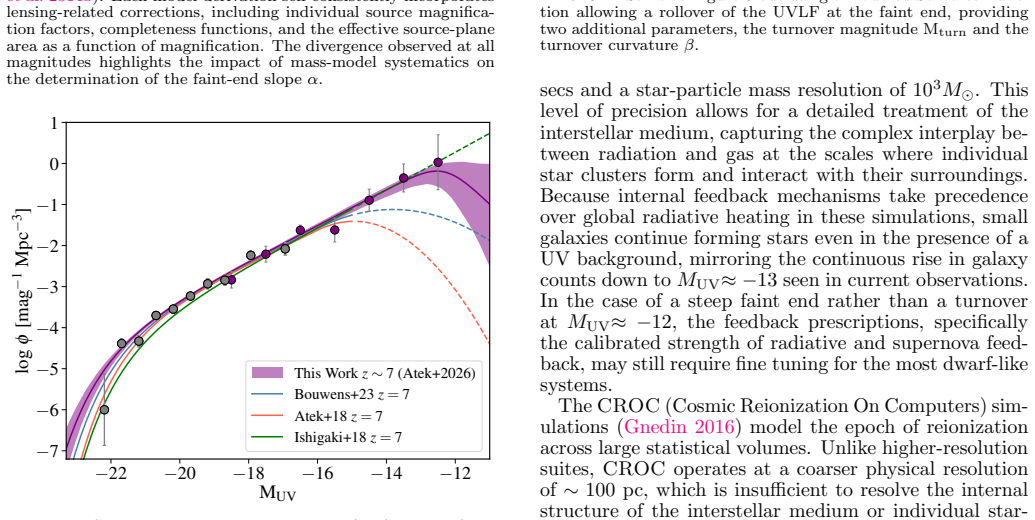
Faint galaxies at z~7 keep the UV luminosity function rising steeply to M_UV=-12.3 with no turnover.
A machine-rendered reading of the paper's core claim, the machinery that carries it, and where it could break.
Core claim
The z ~ 7 UVLF continues to rise steeply with a faint-end slope of α = -1.98_{-0.05}^{+0.06} with no clear evidence of a turnover down to M_UV = -12.3. This persistence of the faint population constrains galaxy formation models and cosmological simulations that predict early flattening. The derived comoving ionizing emissivity at z=7 is log(n_ion / s^{-1} Mpc^{-3}) ≈ 50.85, sufficient to maintain reionization even for a clumping factor C_HII = 5. Post-JWST models calibrated to the UV-bright excess at z > 10 generally fail to reproduce the observed evolution toward lower redshifts and fainter magnitudes.
What carries the argument
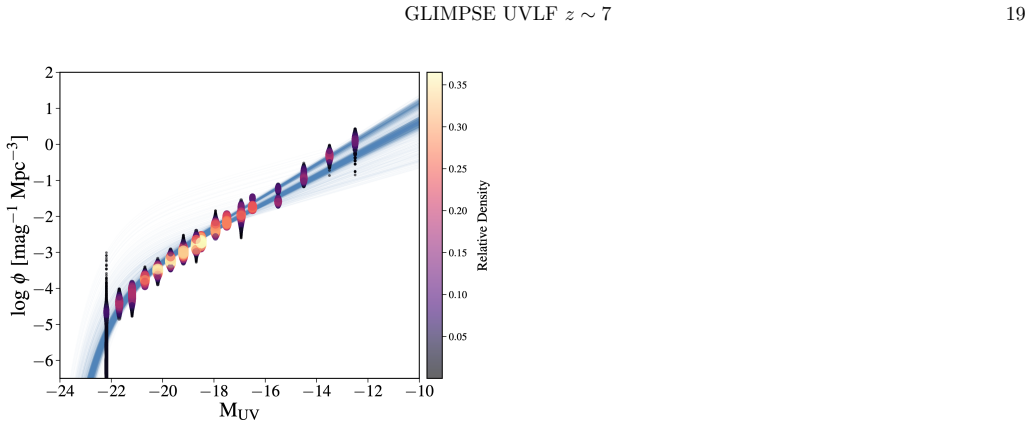
The end-to-end lensing magnification model with statistical and systematic uncertainties, applied to GLIMPSE JWST fields to construct the UV luminosity function and completeness corrections down to M_UV = -12.3.
If this is right
- Galaxy formation models must allow continued star formation in low-mass systems without early flattening from feedback at these faint luminosities.
- Models calibrated only to the bright excess at z > 10 cannot simultaneously match the faint-end evolution observed at z ~ 7.
- Faint galaxies supply the dominant share of ionizing photons at z=7, sufficient for reionization even with high IGM clumping.
- A luminosity-function truncation at M_UV >= -15 is ruled out, requiring either better characterization of low-mass galaxy ionizing properties or revised IGM clumping models.
Where Pith is reading between the lines
- Reionization calculations may need higher average escape fractions from the low-mass galaxy population than many current models assume.
- Wider or deeper lensed fields could test whether the steep slope persists below M_UV = -13, tightening the required photon budget.
- The mismatch with post-JWST models points to missing physics in how star-formation efficiency evolves in small halos across the reionization epoch.
Load-bearing premise
The gravitational lensing magnification estimates, completeness corrections, and assumed ionizing photon production efficiency plus escape fraction for faint galaxies are accurate enough not to artificially create the steep slope or remove a turnover.
What would settle it
A deeper independent survey or refined lensing model that detects a clear flattening or turnover in the UVLF below M_UV = -12.3 would falsify the no-turnover result.
Figures




read the original abstract
We present a comprehensive study of the galaxy UV luminosity function (UVLF) at $z=6-9$ leveraging deep JWST observations from the GLIMPSE survey. Thanks to gravitational lensing, we probe the UVLF to an unprecedented depth of $M_{\text{UV}} = -12$ mag, approximately three magnitudes deeper than previous robust constraints. Our UVLF determination incorporates a rigorous end-to-end uncertainty framework, including statistical and systematic lensing uncertainties. We find that the $z \sim 7$ UVLF continues to rise steeply with a faint-end slope of $\alpha = -1.98_{-0.05}^{+0.06}$. Crucially, our data show no clear evidence of a turnover down to \muv $= -12.3$. The persistence of this faint population provides stringent constraints on galaxy formation models and cosmological simulations that predict an early flattening of the luminosity function due to radiative feedback or star-formation thresholds. Furthermore, post-JWST models specifically calibrated to match the UV-bright excess at $z > 10$ generally fail to reproduce the observed evolution toward lower redshifts and fainter magnitudes, highlighting a significant tension in our current understanding of early galaxy assembly. We derive a comoving ionizing emissivity at $z=7$ of log($n_{\mathrm ion}$ / s$^{-1}$ Mpc$^{-3}$) $\approx 50.85$, which suggests that faint galaxies dominate the ionizing budget, providing enough photons to maintain reionization even in a highly clumped IGM ($C_{\text{HII}} = 5$). As our detection of faint galaxies effectively rules out a luminosity function truncation at $M_{\text{UV}} \geq -15$, these results emphasize the need to either accurately characterize the ionizing properties of the global, low-mass galaxy population at $z > 6$, or to refine physical models of intergalactic medium clumping and its redshift evolution to maintain consistency with the observed reionization timeline.
Editorial analysis
A structured set of objections, weighed in public.
Referee Report
Summary. The manuscript presents a UV luminosity function (UVLF) measurement at z=6-9 from the GLIMPSE JWST survey, exploiting gravitational lensing to reach M_UV=-12 (three magnitudes fainter than prior robust limits). It reports a steep faint-end slope α=-1.98_{-0.05}^{+0.06} at z~7 with no evidence of turnover to M_UV=-12.3, derives log(n_ion)≈50.85 at z=7, and concludes that faint galaxies dominate the ionizing photon budget even for C_HII=5 while ruling out LF truncations at M_UV≥-15 and highlighting tensions with post-JWST galaxy formation models.
Significance. If the central measurements hold, the result supplies strong constraints on galaxy formation models and simulations that predict early LF flattening from radiative feedback or star-formation thresholds, and it exposes inconsistencies with models tuned to the z>10 UV-bright excess. The high ionizing emissivity supports the dominance of faint galaxies in reionization, with direct implications for IGM clumping factors and the reionization timeline. The explicit inclusion of statistical and systematic lensing uncertainties in the error budget is a methodological strength.
major comments (2)
- [Abstract] Abstract: The steep slope α=-1.98 and absence of turnover to M_UV=-12.3 rest on the end-to-end lensing magnification model, source completeness, and volume corrections being unbiased at the highest magnifications. The text describes a rigorous uncertainty framework but supplies neither quantitative robustness tests against alternative lens models nor explicit checks for post-hoc selections, leaving open the possibility that the inferred number densities at the faint end are artificially inflated.
- [Abstract] Abstract (ionizing emissivity paragraph): The derived log(n_ion)≈50.85 is obtained by integrating the fitted LF under fixed assumptions for the ionizing photon production efficiency ξ_ion and escape fraction f_esc in the faint population. These parameters are not demonstrated to be independently constrained outside the LF fit itself, creating a circularity risk for the claim that faint galaxies dominate the ionizing budget and suffice for reionization at C_HII=5.
minor comments (1)
- [Abstract] Abstract: The notation “μv = -12.3” is evidently a typesetting error for M_UV; this should be corrected for clarity.
Simulated Author's Rebuttal
We thank the referee for their careful reading and constructive comments, which have helped us identify areas where the manuscript can be clarified and strengthened. We address each major comment below and outline the revisions we will make.
read point-by-point responses
-
Referee: [Abstract] Abstract: The steep slope α=-1.98 and absence of turnover to M_UV=-12.3 rest on the end-to-end lensing magnification model, source completeness, and volume corrections being unbiased at the highest magnifications. The text describes a rigorous uncertainty framework but supplies neither quantitative robustness tests against alternative lens models nor explicit checks for post-hoc selections, leaving open the possibility that the inferred number densities at the faint end are artificially inflated.
Authors: We agree that additional explicit robustness checks would strengthen the presentation. While our end-to-end framework already propagates statistical and systematic lensing uncertainties (including magnification map variations) into the final error budget, we will add a dedicated subsection with quantitative tests. This will include re-deriving the UVLF using two independent alternative lens models from the literature, recomputing completeness and volume corrections, and verifying that the faint-end slope and lack of turnover remain consistent within uncertainties. We will also include explicit checks for post-hoc selection effects by repeating the analysis with varied magnitude and color cuts. revision: yes
-
Referee: [Abstract] Abstract (ionizing emissivity paragraph): The derived log(n_ion)≈50.85 is obtained by integrating the fitted LF under fixed assumptions for the ionizing photon production efficiency ξ_ion and escape fraction f_esc in the faint population. These parameters are not demonstrated to be independently constrained outside the LF fit itself, creating a circularity risk for the claim that faint galaxies dominate the ionizing budget and suffice for reionization at C_HII=5.
Authors: We clarify that ξ_ion and f_esc are not fitted from the LF data but are instead adopted as fixed fiducial values drawn from independent observational constraints in the literature (e.g., recent JWST-based measurements of ξ_ion at z>6 and f_esc estimates from Lyman-continuum studies). The LF itself is measured independently of these parameters. To address the concern directly, we will revise the text to (i) explicitly state the literature sources and ranges used, (ii) show the integrated n_ion for a conservative grid of lower ξ_ion and f_esc values, and (iii) demonstrate that the conclusion that faint galaxies can sustain reionization at C_HII=5 holds even under these more pessimistic assumptions. This removes any appearance of circularity while preserving the core result. revision: yes
Circularity Check
No significant circularity in UVLF measurement or reionization calculation
full rationale
The central result is an observational determination of the UVLF at z=6-9 from JWST lensed fields, with the faint-end slope obtained by fitting binned number densities after applying lensing magnification, completeness, and volume corrections. These corrections are standard data-reduction steps whose validity is independent of the final slope value. The ionizing emissivity is computed post-facto by integrating the fitted LF multiplied by fixed literature values for ξ_ion and f_esc; no parameter in that integral is adjusted to force agreement with reionization timelines. No self-citations are invoked to justify uniqueness or to close the derivation loop, and the paper compares its LF to external simulations rather than deriving those simulations from its own data. The chain therefore remains self-contained against external benchmarks.
Axiom & Free-Parameter Ledger
free parameters (2)
- faint-end slope alpha =
-1.98
- ionizing emissivity log n_ion =
50.85
axioms (2)
- domain assumption Gravitational lensing magnification and uncertainty model is accurate
- domain assumption Galaxy selection completeness and contamination are correctly modeled across the faint end
Reference graph
Works this paper leans on
-
[1]
Abdul Karim, M., Aguilar, J., Ahlen, S., et al. 2025, Phys. Rev. D, 112, 083515, doi:10.1103/tr6y-kpc6
-
[2]
Adams, N. J., Conselice, C. J., Austin, D., et al. 2024, ApJ, 965, 169, doi:10.3847/1538-4357/ad2a7b
-
[3]
Schweitzer, A. 2001, ApJ, 556, 357, doi:10.1086/321547
-
[4]
2024, MNRAS, 527, 11372, doi:10.1093/mnras/stad3902
Asada, Y., Sawicki, M., Abraham, R., et al. 2024, MNRAS, 527, 11372, doi:10.1093/mnras/stad3902
-
[5]
Asthana, S., Kulkarni, G., Haehnelt, M. G., et al. 2025, MNRAS, 539, L18, doi:10.1093/mnrasl/slaf020
-
[6]
2018, MNRAS, 479, 5184, doi:10.1093/mnras/sty1820
Atek, H., Richard, J., Kneib, J.-P., & Schaerer, D. 2018, MNRAS, 479, 5184, doi:10.1093/mnras/sty1820
-
[7]
2023, arXiv e-prints, arXiv:2305.01793, doi:10.48550/arXiv.2305.01793
Atek, H., Chemerynska, I., Wang, B., et al. 2023, arXiv e-prints, arXiv:2305.01793, doi:10.48550/arXiv.2305.01793
-
[8]
Atek, H., Labb´ e, I., Furtak, L. J., et al. 2024, Nature, 626, 975, doi:10.1038/s41586-024-07043-6
-
[9]
JWST’s GLIMPSE: an overview of the deep- est probe of early galaxy formation and cosmic reionization
Atek, H., Chisholm, J., Kokorev, V., et al. 2025, arXiv e-prints, arXiv:2511.07542, doi:10.48550/arXiv.2511.07542 Ba˜ nados, E., Venemans, B. P., Mazzucchelli, C., et al. 2018, Nature, 553, 473, doi:10.1038/nature25180
-
[10]
Bagley, M. B., Finkelstein, S. L., Koekemoer, A. M., et al. 2023, ApJ, 946, L12, doi:10.3847/2041-8213/acbb08
-
[11]
B., Pirzkal , N., Finkelstein , S
Bagley, M. B., Pirzkal, N., Finkelstein, S. L., et al. 2024, ApJ, 965, L6, doi:10.3847/2041-8213/ad2f31
-
[12]
Baldry, I. K., Glazebrook, K., & Driver, S. P. 2008, MNRAS, 388, 945, doi:10.1111/j.1365-2966.2008.13348.x
-
[14]
2024, MNRAS, 527, 3246, doi: 10.1093/mnras/stad3308
Beauchesne, B., Cl´ ement, B., Hibon, P., et al. 2024, Monthly Notices of the Royal Astronomical Society, Volume 527, Issue 2, pp.3246-3275, 527, 3246, doi:10.1093/mnras/stad3308
-
[15]
Becker, G. D., Bolton, J. S., Zhu, Y., & Hashemi, S. 2024, arXiv e-prints, arXiv:2405.08885, doi:10.48550/arXiv.2405.08885
-
[16]
Benson, A. J., Bower, R. G., Frenk, C. S., et al. 2003, ApJ, 599, 38, doi:10.1086/379160
-
[17]
2019, A&A, 631, A130, doi: 10.1051/0004-6361/201935974
Bergamini, P., Rosati, P., Mercurio, A., et al. 2019, Astronomy & Astrophysics, Volume 631, id.A130, <NUMPAGES>16</NUMPAGES>pp., 631, A130, doi:10.1051/0004-6361/201935974
-
[18]
Bertin, E., & Arnouts, S. 1996, Astronomy and Astrophysics Supplement Series, 117, 393, doi:10.1051/aas:1996164 GLIMPSE UVLFz∼7 17
-
[19]
2007, MNRAS, 378, 910, doi: 10.1111/j.1365-2966.2007.11817.x
Bolton, J. S., & Haehnelt, M. G. 2007, MNRAS, 382, 325, doi:10.1111/j.1365-2966.2007.12372.x
-
[20]
Bosman, S. E. I., Davies, F. B., Becker, G. D., et al. 2022, MNRAS, 514, 55, doi:10.1093/mnras/stac1046
-
[21]
Bouwens, R., Illingworth, G., Oesch, P., et al. 2023, MNRAS, 523, 1009, doi:10.1093/mnras/stad1014
-
[22]
2022a, ApJ, 940, 55, doi:10.3847/1538-4357/ac86d1
Stefanon, M. 2022a, ApJ, 940, 55, doi:10.3847/1538-4357/ac86d1
-
[23]
Bouwens, R. J., Illingworth, G. D., Oesch, P. A., et al. 2016, ArXiv e-prints.https://arxiv.org/abs/1608.00966
-
[24]
2017, ApJ, 843, 129, doi:10.3847/1538-4357/aa70a4
Stefanon, M. 2017, ApJ, 843, 129, doi:10.3847/1538-4357/aa70a4
-
[25]
Bouwens, R. J., Illingworth, G. D., Oesch, P. A., et al. 2014, ArXiv e-prints.https://arxiv.org/abs/1403.4295 —. 2015, ApJ, 803, 34, doi:10.1088/0004-637X/803/1/34
-
[26]
Bouwens, R. J., Oesch, P. A., Stefanon, M., et al. 2021, AJ, 162, 47, doi:10.3847/1538-3881/abf83e
-
[27]
Bouwens, R. J., Smit, R., Schouws, S., et al. 2022b, ApJ, 931, 160, doi:10.3847/1538-4357/ac5a4a
-
[28]
2020, astropy/photutils: 1.0.0 , 1.0.0, Zenodo, 10.5281/zenodo.4044744
Bradley, L., Sip˝ ocz, B., Robitaille, T., et al. 2020, astropy/photutils: 1.0.0, 1.0.0, Zenodo, doi:10.5281/zenodo.4044744
-
[29]
EAZY: A Fast, Public Photometric Redshift Code
Brammer, G. B., van Dokkum, P. G., & Coppi, P. 2008, ApJ, 686, 1503, doi:10.1086/591786
-
[30]
2003, MNRAS, 339, 937, doi: 10.1046/j.1365-8711.2003.06241.x G¨ otberg, Y., de Mink, S
Bruzual, G., & Charlot, S. 2003, MNRAS, 344, 1000, doi:10.1046/j.1365-8711.2003.06897.x
-
[31]
2025, PASA, 42, e107, doi:10.1017/pasa.2025.10071
Cain, C., D’Aloisio, A., & Mu˜ noz, J. 2025, PASA, 42, e107, doi:10.1017/pasa.2025.10071
-
[32]
Calzetti, D., Armus, L., Bohlin, R. C., et al. 2000, ApJ, 533, 682, doi:10.1086/308692
-
[33]
B., Grillo, C., Rosati, P., et al
Caminha, G. B., Grillo, C., Rosati, P., et al. 2016, A&A, 587, A80, doi:10.1051/0004-6361/201527670
-
[34]
2022, arXiv e-prints, arXiv:2207.09436.https://arxiv.org/abs/2207.09436
Castellano, M., Fontana, A., Treu, T., et al. 2022, arXiv e-prints, arXiv:2207.09436.https://arxiv.org/abs/2207.09436
-
[35]
Ceverino, D., Glover, S. C. O., & Klessen, R. S. 2017, MNRAS, 470, 2791, doi:10.1093/mnras/stx1386
-
[36]
Chabrier, G. 2003, PASP, 115, 763, doi:10.1086/376392
-
[37]
2000, ApJ, 542, 464, doi: 10.1086/309513
Chabrier, G., Baraffe, I., Allard, F., & Hauschildt, P. 2000, ApJ, 542, 464, doi:10.1086/309513
-
[38]
Chemerynska, I., Atek, H., Furtak, L. J., et al. 2024, MNRAS, 531, 2615, doi:10.1093/mnras/stae1260 —. 2025, arXiv e-prints, arXiv:2509.24881, doi:10.48550/arXiv.2509.24881
-
[39]
2016, MNRAS, 462, 1415, doi: 10.1093/mnras/stw1756
Chevallard, J., & Charlot, S. 2016, MNRAS, 462, 1415, doi:10.1093/mnras/stw1756
-
[40]
Chisholm, J., Saldana-Lopez, A., Flury, S., et al. 2022, MNRAS, 517, 5104, doi:10.1093/mnras/stac2874
-
[41]
Davies, F. B., Bosman, S. E. I., & Furlanetto, S. R. 2024, arXiv e-prints, arXiv:2406.18186, doi:10.48550/arXiv.2406.18186
-
[42]
Davies, F. B., Hennawi, J. F., Ba˜ nados, E., et al. 2018, ApJ, 864, 142, doi:10.3847/1538-4357/aad6dc
-
[43]
Dawoodbhoy, T., Shapiro, P. R., Ocvirk, P., et al. 2023, MNRAS, 524, 6231, doi:10.1093/mnras/stad2331
-
[44]
2015, ApJ, 806, 67, doi:10.1088/0004-637X/806/1/67
Dayal, P., Mesinger, A., & Pacucci, F. 2015, ApJ, 806, 67, doi:10.1088/0004-637X/806/1/67
-
[45]
2009, Nature, 457, 451, doi: 10.1038/nature07648
Dekel, A., Birnboim, Y., Engel, G., et al. 2009, Nature, 457, 451, doi:10.1038/nature07648
-
[46]
Donnan, C. T., McLeod, D. J., Dunlop, J. S., et al. 2023, MNRAS, 518, 6011, doi:10.1093/mnras/stac3472
-
[47]
Eisenstein, D. J., Johnson, B. D., Robertson, B., et al. 2023, arXiv e-prints, arXiv:2310.12340, doi:10.48550/arXiv.2310.12340
-
[48]
2024, arXiv e-prints, arXiv:2410.01905, doi:10.48550/arXiv.2410.01905
Whitler, L. 2024, arXiv e-prints, arXiv:2410.01905, doi:10.48550/arXiv.2410.01905
-
[49]
Fan, X., Strauss, M. A., Becker, R. H., et al. 2006, AJ, 132, 117, doi:10.1086/504836
-
[50]
doi:10.1093/mnras/stad1205 , arxivId =
Feldmann, R., Quataert, E., Faucher-Gigu` ere, C.-A., et al. 2023, MNRAS, 522, 3831, doi:10.1093/mnras/stad1205
-
[51]
2024, A&A, 684, A207, doi:10.1051/0004-6361/202348321
Ferrara, A. 2024, A&A, 684, A207, doi:10.1051/0004-6361/202348321
-
[52]
2006, ApJS, 164, 334, doi:10.1086/501350
Ferrarese, L., Cˆ ot´ e, P., Jord´ an, A., et al. 2006, ApJS, 164, 334, doi:10.1086/501350
-
[53]
Finkelstein, S. L., Ryan, Jr., R. E., Papovich, C., et al. 2015, ApJ, 810, 71, doi:10.1088/0004-637X/810/1/71
-
[54]
Finkelstein, S. L., D’Aloisio, A., Paardekooper, J.-P., et al. 2019, ApJ, 879, 36, doi:10.3847/1538-4357/ab1ea8
-
[55]
Finkelstein, S. L., Bagley, M. B., Ferguson, H. C., et al. 2023, ApJ, 946, L13, doi:10.3847/2041-8213/acade4
-
[56]
2012, MNRAS, 423, 600, doi: 10.1111/j.1365-2966.2012.20901.x
Finlator, K., Oh, S. P., ¨Ozel, F., & Dav´ e, R. 2012, MNRAS, 427, 2464, doi:10.1111/j.1365-2966.2012.22114.x
-
[57]
Finlator, K., Prescott, M. K. M., Oppenheimer, B. D., et al. 2017, MNRAS, 464, 1633, doi:10.1093/mnras/stw2433
-
[58]
Flury, S. R., Jaskot, A. E., Ferguson, H. C., et al. 2022a, arXiv e-prints, arXiv:2201.11716. https://arxiv.org/abs/2201.11716 —. 2022b, ApJ, 930, 126, doi:10.3847/1538-4357/ac61e4
-
[59]
Furtak, L. J., Zitrin, A., Weaver, J. R., et al. 2023, MNRAS, 523, 4568, doi:10.1093/mnras/stad1627
-
[60]
Gaikwad, P., Haehnelt, M. G., Davies, F. B., et al. 2023, MNRAS, 525, 4093, doi:10.1093/mnras/stad2566
-
[61]
2017, MNRAS, 466, 1903, doi: 10.1093/mnras/stw3209
Gatto, A., Walch, S., Naab, T., et al. 2017, MNRAS, 466, 1903, doi:10.1093/mnras/stw3209
-
[62]
The Astrophysical Journal , author =
Gehrels, N. 1986, ApJ, 303, 336, doi:10.1086/164079
-
[63]
Gnedin, N. Y. 2016, ApJ, 825, L17, doi:10.3847/2041-8205/825/2/L17
-
[64]
2012, A&A, 547, A51, doi:10.1051/0004-6361/201219669
Grazian, A., Castellano, M., Fontana, A., et al. 2012, A&A, 547, A51, doi:10.1051/0004-6361/201219669
-
[65]
Greig, B., & Mesinger, A. 2017, MNRAS, 465, 4838, doi:10.1093/mnras/stw3026
-
[66]
2018, Monthly Notices of the Royal Astronomical Society, 477, 3217, doi:10.1093/mnras/sty735
Greig, B., & Mesinger, A. 2018, Monthly Notices of the Royal Astronomical Society, 477, 3217, doi:10.1093/mnras/sty735
-
[67]
2022, ApJS, 259, 20, doi:10.3847/1538-4365/ac3dfc
Harikane, Y., Ono, Y., Ouchi, M., et al. 2022, ApJS, 259, 20, doi:10.3847/1538-4365/ac3dfc
-
[68]
Harikane, Y., Ouchi, M., Oguri, M., et al. 2023, ApJS, 265, 5, doi:10.3847/1538-4365/acaaa9
-
[69]
Hoag, A., Bradaˇ c, M., Huang, K., et al. 2019, ApJ, 878, 12, doi:10.3847/1538-4357/ab1de7
-
[70]
Huang, K.-H., Ferguson, H. C., Ravindranath, S., & Su, J. 2013, ApJ, 765, 68, doi:10.1088/0004-637X/765/1/68
-
[71]
Hutter, A., Dayal, P., Yepes, G., et al. 2021, MNRAS, 503, 3698, doi:10.1093/mnras/stab602
-
[72]
Ishigaki, M., Kawamata, R., Ouchi, M., et al. 2018, ApJ, 854, 73, doi:10.3847/1538-4357/aaa544
-
[73]
C., Chisholm, J., Atek, H., et al
Jecmen, M. C., Chisholm, J., Atek, H., et al. 2026, arXiv e-prints, arXiv:2601.19995, doi:10.48550/arXiv.2601.19995
-
[74]
2007, New Journal of Physics, 9, 447, doi:10.1088/1367-2630/9/12/447
Jullo, E., Kneib, J.-P., Limousin, M., et al. 2007, New Journal of Physics, 9, 447, doi:10.1088/1367-2630/9/12/447
-
[75]
Kannan, R., Garaldi, E., Smith, A., et al. 2022, MNRAS, 511, 4005, doi:10.1093/mnras/stab3710
-
[76]
2020, MNRAS, 494, 2200, doi:10.1093/mnras/staa639 Kereˇ s, D., Katz, N., Weinberg, D
Katz, H., Ramsoy, M., Rosdahl, J., et al. 2020, MNRAS, 494, 2200, doi:10.1093/mnras/staa639 Kereˇ s, D., Katz, N., Weinberg, D. H., & Dav´ e, R. 2005, MNRAS, 363, 2, doi:10.1111/j.1365-2966.2005.09451.x
-
[77]
Kneib, J. P., Ellis, R. S., Smail, I., Couch, W. J., & Sharples, R. M. 1996, ApJ, 471, 643, doi:10.1086/177995
-
[78]
Li, Z., Dekel, A., Sarkar, K. C., et al. 2024, A&A, 690, A108, doi:10.1051/0004-6361/202348727
-
[79]
Liu, C., Mutch, S. J., Angel, P. W., et al. 2016, MNRAS, 462, 235, doi:10.1093/mnras/stw1015
-
[80]
2025, A&A, 698, A302, doi:10.1051/0004-6361/202453251
Llerena, M., Pentericci, L., Napolitano, L., et al. 2025, A&A, 698, A302, doi:10.1051/0004-6361/202453251
-
[81]
M., Koekemoer, A., Coe, D., et al
Lotz, J. M., Koekemoer, A., Coe, D., et al. 2017, ApJ, 837, 97, doi:10.3847/1538-4357/837/1/97
discussion (0)
Sign in with ORCID, Apple, or X to comment. Anyone can read and Pith papers without signing in.