REVIEW 4 major objections 5 minor 38 references
This paper proposes that LLM activations decompose into sparse, uniquely recoverable 'atoms' under a non-Euclidean inner product, reporting 99.9% reconstruction fidelity and 99.8% stability across three models.
Reviewed by Pith at T0; open to challenge. T0 means a machine referee read the full paper against a public rubric. the ladder, T0–T4 →
2026-08-04 15:13 UTC pith:ESDVNHHS
load-bearing objection The atom concept is circular: the metric S is built from the dictionary D it certifies, so the low coherence is generic after whitening; the empirical SAE reconstruction is plausible but doesn't bear the theoretical weight. the 4 major comments →
Towards Atoms of Large Language Models
The pith
A machine-rendered reading of the paper's core claim, the machinery that carries it, and where it could break.
Core claim
Atoms Theory asserts that each LLM representation is a sparse, nonnegative combination of a shared set of atoms, and that this decomposition is identifiable and stable. The central discovery is that there exists a non-Euclidean inner product — the atomic inner product, ⟨x,y⟩_S = x^T S y with S = (DD^T)^{-1} — under which these atoms are approximately orthogonal, making them mutually distinguishable. The paper proves that a dictionary of atoms satisfying a coherence condition µ < 1/(2K−1) guarantees unique sparse coefficients and exact ℓ1 recovery, and that a single-layer sparse autoencoder with threshold (JumpReLU) activation provably recovers the atom set. Empirical results on three open mo
What carries the argument
The atomic inner product (AIP): a symmetric positive-definite bilinear form ⟨x,y⟩_S = x^T S y with S = (DD^T)^{-1}, defined from the atom dictionary D, which the paper shows corrects the representation shift caused by softmax and makes distinct atoms approximately orthogonal. The companion mechanism is the threshold-activated sparse autoencoder (TSAE), a single-layer linear–nonlinear encoder whose JumpReLU activation with a support-separating threshold provably identifies the atom set; the proof leverages the coherence upper bound of the Restricted Isometry Property, µ ≤ ε, and the uniqueness condition µ < 1/(2K−1).
Load-bearing premise
The load-bearing premise is that the atomic inner product S=(DD^T)^{-1}, computed from the dictionary D that the paper labels as atoms, is the true geometry of LLM representations; the near-orthogonality that defines atoms is measured under a metric derived from those same atoms, so the definition is self-consistent rather than independently validated.
What would settle it
Compute the atomic inner product matrix S from a dictionary learned on one half of the activations, then test the near-orthogonality of atoms on the other half; if the NAIP distribution broadens substantially, the reported atomicity depends on fitting S to the same data and is not a property of the representation geometry.
If this is right
- Atoms give the first formally defined fundamental unit for LLM representations, with uniqueness and recoverability guarantees that neurons and features lack.
- Threshold-activated SAEs (not ReLU or TopK) are the appropriate architecture for atom identification, providing a practical design rule for interpretability tools.
- Representation shift correction via AIP should be applied before any geometric analysis of activations, since Euclidean inner products distort the underlying geometry.
- Reliable atom recovery requires SAE capacity to match the scale of the data; beyond a critical capacity threshold, reconstruction stabilizes, suggesting a scaling law for interpretability.
- If atoms are universal across layers and models, they could serve as a common vocabulary for cross-model and cross-layer comparisons of knowledge.
Where Pith is reading between the lines
- A testable extension: the same atom set should be recoverable from held-out activations and from different random seeds; if it is not, atomicity may be an artifact of fitting S to D.
- The AIP metric could be applied to knowledge editing and circuit analysis, where Euclidean cosine similarity is currently standard; the corrected geometry may change localisation results.
- The comparison against features uses open-source dictionaries trained on continuous-text MLP activations, whereas atoms are trained on entity-knowledge activations; a matched training setup would be needed to attribute the stability gap to the atoms themselves.
- If atom stability holds across domains, atoms could enable interpretability of factual knowledge storage, connecting atom identities to specific entity clusters as the case studies suggest.
Editorial analysis
A structured set of objections, weighed in public.
Referee Report
Summary. The paper introduces 'Atom Theory,' proposing that LLM internal representations decompose into 'atoms' defined by near-orthogonality under a non-Euclidean atomic inner product (AIP), S=(DD^T)^{-1}. It proves coherence-based RIP, uniqueness and exact l1 recoverability (Thms 8-9), and an identifiability result for threshold-activated sparse autoencoders (Thm 10). Empirically, TSAEs trained on CounterFact entity activations achieve ~99.9% R^2, learned dictionaries show low NAIP coherence, and up to 99.9% of atoms pass the proposed quantile criterion, compared with 0.5% for neurons and 68.2% for GemmaScope/LlamaScope features.
Significance. If the central claims held, the framework would be a substantial contribution: formal representational units with recovery guarantees and a practical identification method. The paper's scale of experiments and public code are assets, and the compressed-sensing arguments in Thms 8-9 are standard and appear correct. However, the main empirical validation is undermined by the circular definition of the metric used to certify atomicity, the identifiability theorem does not prove the stated equality, and the comparison against neurons/features is confounded. The theoretical results cannot, as presented, support the paper's central claim that atoms are fundamental representational units of LLMs.
major comments (4)
- [§4.2 / Def. 6 / Eq. (4.4)] The atomicity test is circular. The atom set D is partly defined by near-orthogonality under S=(DD^T)^{-1}, and the same S is then used to compute the NAIP coherence matrix G. For any full-rank square D, G=I exactly; for an overcomplete random D, G is a projection and its normalized off-diagonal coherence is typically O(1/sqrt(H)), matching the values in Table 1 and Figure 6. Thus the reported atomicity is a generic property of whitening a full-rank dictionary, not evidence that learned directions are special. A null model using a random D of the same shape should be reported before any claim of atomicity can be accepted.
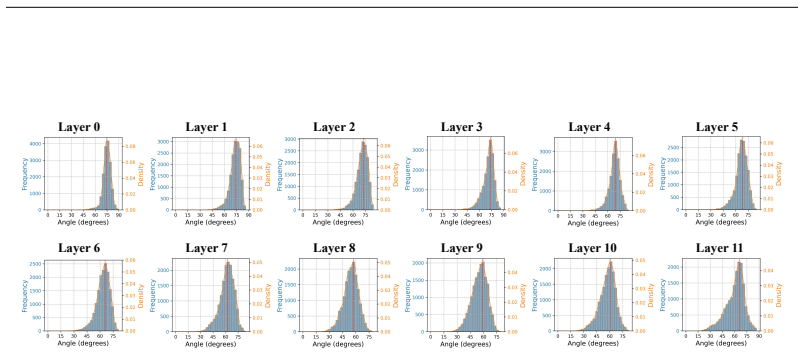
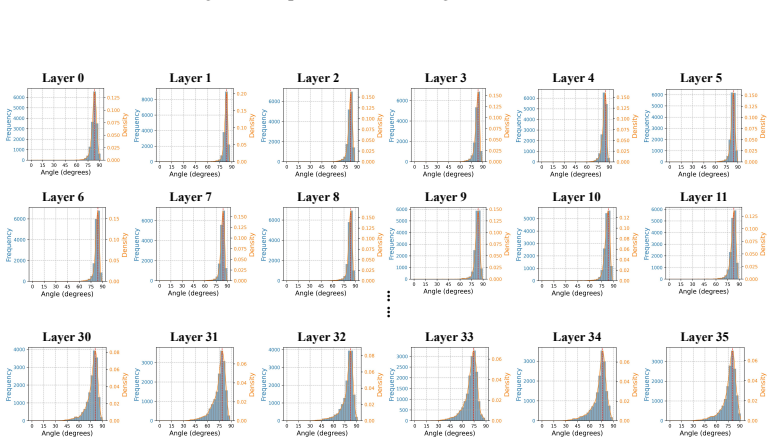
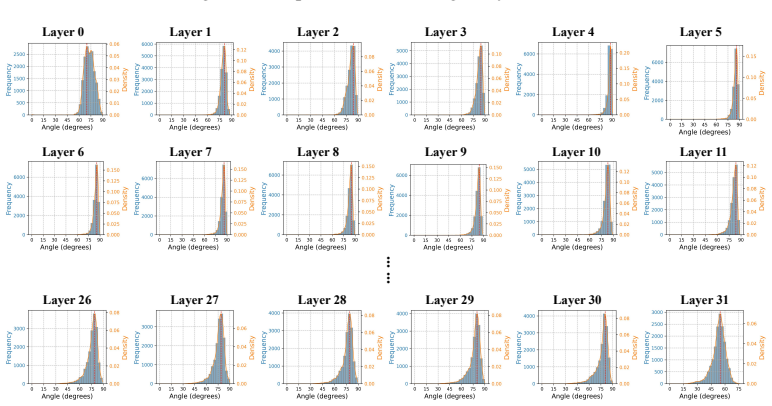
- [Appendix B / §3.1] The representation-shift correction is also self-fulfilling. When S is estimated as (M M^T)^{-1} from the same activation matrix M used to produce the angle distributions, the transform whitens those samples and forces pairwise angles toward 90° in high dimensions. Figures 3 and 21-32 therefore do not reveal an underlying intrinsic geometry unless S is estimated on held-out data and the observed distribution is compared against a whitening null. The current presentation overstates the geometric discovery.
- [A.6 / Theorem 10] The threshold condition in the proof guarantees only support separation, not exact coefficient recovery. After thresholding, the active coordinates are z_ik = δ_ik + e_ik, and the proof shows E[e_ik]=0. But D e_i is nonzero with positive variance; expectation zero does not imply that D σ(D^T S m_i) converges to m_i in probability or almost surely. The 'probabilistic sense' is never formalized, and the additional assumption that off-diagonal G_kj are approximately N(0,s^2) is an unproved, ad hoc input. The theorem therefore does not establish the exact identifiability stated in (3.8), and §4.1's attribution of the 99.9% R^2 to Theorem 10 is not justified by the proof.
- [§4.3 / C.4 / C.5] The comparison against neurons and features is confounded in two ways. First, neurons and features are evaluated under the Euclidean metric while atoms are evaluated under the AIP derived from their own dictionary. Second, GemmaScope/LlamaScope features are trained on general text corpora, whereas atoms are trained on CounterFact entity activations; any q* gap may reflect training-set mismatch rather than unit quality. In addition, C.5 states that for features the quantile q is only an 'ideal upper bound' because they fail to satisfy the reconstruction equality required by Theorem 9, yet the abstract and §4.3 report 68.2% as a feature stability value. These issues must be resolved before the claimed superiority of atoms is established.
minor comments (5)
- [§3] Typo: 'embeded' should be 'embedded.' Some sentences are awkwardly phrased, e.g., 'representational distinguishability' and 'the centroid of the angle distribution between representations deviates significantly from 90°.'
- [Figure 4 / C.3] The omission of layers 30 and 31 for Llama3.1-8B is reported only in Appendix C.3; it should be stated in the main-text figure caption and in the reported averages.
- [Abstract / §4.3] The abstract reports q*=99.8%, while §4.3 reports per-model averages 99.74%, 99.88%, and 99.95%. These should be reconciled or the rounding should be described explicitly.
- [Definition 5 / Remark] The remark asserts that off-diagonal values follow N(0,s^2). This is an assumption, not a theorem; it should be labeled as such, and its role in Theorem 10 should be stated explicitly.
- [C.5] The quantile definitions mix continuous quantiles with the discrete integer-valued sparsity K. Explain how K_alpha is computed from integer counts and how the binary search handles the discrete nature of K.
Circularity Check
Atomicity and q* are by construction: the AIP metric is computed from the atom set it certifies, and the representation-shift 'correction' is a whitening artifact.
specific steps
-
self definitional
[Section 3.1 (Definition 1, Theorem 2), Section 3.2 (Definition 6), Section 4.2 Eq. (4.4)]
"Definition 1: In the atom space D, the atomic inner product ⟨·,·⟩_S satisfies ⟨d_i,d_j⟩_S=0 for any pair of distinct atoms... Theorem 2: If the columns of D ... form a set of atoms ... then S=c^2(DD^⊤)^{-1}. ... Definition 6: Furthermore, for all i≠j, |⟨\tilde d_i,\tilde d_j⟩|≤ϵ, where \tilde d_i:=S^{1/2}d_i ... and \tilde S:=(DD^⊤)^{-1}."
The atomicity test uses the very metric built from the dictionary being certified. Definition 1 defines the AIP as the inner product making distinct atoms orthogonal; Theorem 2 then solves S=(DD^⊤)^{-1} from D; Definition 6 accepts D as atoms only if its columns are near-orthogonal under this same S. The paper's own remark concedes the square case is trivial: when |D|=H, D^⊤\tilde S D=I exactly, so every full-rank square dictionary is perfectly atomic. For overcomplete D, the NAIP matrix is the projection D^⊤(DD^⊤)^{-1}D, whose off-diagonals for generic high-dimensional D are O(1/√H), matching the reported μ≈0.03–0.06. The reported atomicity is therefore a whitening artifact, not evidence that learned directions are special.
-
fitted input called prediction
[Appendix B (Representation Shifting), used in Section 3; Eq. (C.4)]
"To address it, we estimate an appropriate inner product as prescribed by Theorem 2 and Corollary 3 using 100,000 Wikipedia activation samples (Meng et al., 2022). Recomputing the angle distribution yields a centroid concentrated around 90°, which accords closely with the theoretical expectation."
The inner product S=(MM^⊤)^{-1} is estimated from the same activation distribution whose angle distribution is then reported as validation of the AIP. Applying S^{1/2} is Mahalanobis whitening: the transformed sample covariance becomes the identity (or a rank-H projection), which mathematically forces the mean pairwise angle toward 90° in high dimension. Thus the 'correction' of representation shifting is a generic property of whitening any full-rank dataset, not a discovered geometry of LLMs; the agreement with the 'theoretical expectation' is a self-consistency check of the fitted transform, not a prediction.
full rationale
The central q* stability/atomicity result is substantially circular. Definition 1 + Theorem 2 define the metric S=(DD^⊤)^{-1} from the same D that Definition 6 then certifies as atoms, so the atomicity criterion is self-referential; for square D it is an identity, and for overcomplete D the off-diagonal coherence is a generic whitened-frame property. Similarly, Appendix B's demonstration that AIP moves angle centroids to 90° is a mathematical consequence of estimating S from the measured activations, not an empirical discovery. The R^2=99.9% sparse reconstruction result is a genuine independent measurement, and the case studies are descriptive, which prevents a score of 10; however, the headline claim of 'ideal atoms statistically' rests on the by-construction q* and atomicity criteria, so the central claim is largely forced by the definitional setup. The atoms-vs-features comparison is additionally confounded by different training distributions (CounterFact entity activations vs. general-corpus SAEs) and by the paper's own caveat that the features' q* is only an upper bound because features do not reconstruct; this is a measurement concern beyond the main circularity.
Axiom & Free-Parameter Ledger
free parameters (4)
- SAE hidden size (capacity) =
16k/65k for Gemma2, 8x/32x for Llama3.1 (main results); scaling experiments vary capacity
- Threshold initialization tau =
0.001 or 0.0001
- Sparsity coefficient lambda =
0.1 (main), with 0.01/1 robustness checks
- Quantile level q in the uniqueness test =
binary search up to 0.999999
axioms (4)
- domain assumption Assumption 4 (Sparsity): every representation is K-sparse in the atom dictionary with K much less than |D|
- standard math Softmax invariance gives a global invertible linear ambiguity in representations (Eq. 3.1)
- ad hoc to paper The off-diagonal entries G_{kj} are approximately N(0,s^2) with mean zero, invoked in the proof of Theorem 10
- domain assumption A threshold exists satisfying delta_min > epsilon(2K-1)delta_max (support separation)
invented entities (2)
-
Atoms
no independent evidence
-
Atomic inner product (AIP)
no independent evidence
Cite this review
Pith. "Pith review of Towards Atoms of Large Language Models." pith.science (2026). https://pith.science/paper/ESDVNHHS
@misc{pith2026250920784,
  author       = {Pith},
  title        = {Pith review of: Towards Atoms of Large Language Models},
  year         = {2026},
  howpublished = {\url{https://pith.science/paper/ESDVNHHS}},
  note         = {Machine review of arXiv:2509.20784}
}
read the original abstract
The fundamental representational units (FRUs) of large language models (LLMs) remain undefined, limiting further understanding of their underlying mechanisms. In this paper, we introduce Atom Theory to systematically define, evaluate, and identify such FRUs, which we term atoms. Building on the atomic inner product (AIP), a non-Euclidean metric that captures the underlying geometry of LLM representations, we formally define atoms and propose two key criteria for ideal atoms: faithfulness ($R^2$) and stability ($q^*$). We further prove that atoms are identifiable under threshold-activated sparse autoencoders (TSAEs). Empirically, we uncover a pervasive representation shift in LLMs and demonstrate that the AIP corrects this shift to capture the underlying representational geometry. We find that two widely used units, neurons and features, fail to qualify as ideal atoms: neurons are faithful ($R^2=1$) but unstable ($q^*=0.5\%$), while features are more stable ($q^*=68.2\%$) but unfaithful ($R^2=48.8\%$). To find atoms of LLMs, leveraging atom identifiability under TSAEs, we show via large-scale experiments that reliable atom identification occurs only when the TSAE capacity matches the data scale. Guided by this insight, we identify FRUs with near-perfect faithfulness ($R^2=99.9\%$) and stability ($q^*=99.8\%$) across layers of Gemma2-2B, Gemma2-9B, and Llama3.1-8B, satisfying the criteria of ideal atoms statistically. Further analysis confirms that these atoms align with theoretical expectations and exhibit substantially higher monosemanticity. Overall, we propose and validate Atom Theory as a foundation for understanding the internal representations of LLMs. Code available at https://github.com/ChenhuiHu/towards_atoms.
Figures






Reference graph
Works this paper leans on
-
[1]
Josh Achiam, Steven Adler, Sandhini Agarwal, Lama Ahmad, Ilge Akkaya, Florencia Leoni Aleman, Diogo Almeida, Janko Altenschmidt, Sam Altman, Shyamal Anadkat, et al. Gpt-4 technical report. arXiv preprint arXiv:2303.08774, 2023
Pith/arXiv arXiv 2023
-
[2]
Language models can explain neurons in language models
Steven Bills, Nick Cammarata, Dan Mossing, Henk Tillman, Leo Gao, Gabriel Goh, Ilya Sutskever, Jan Leike, Jeff Wu, and William Saunders. Language models can explain neurons in language models. https://openaipublic.blob.core.windows.net/neuron-explainer/paper/index.html, 2023
2023
-
[3]
Towards monosemanticity: Decomposing language models with dictionary learning
Trenton Bricken, Adly Templeton, Joshua Batson, Brian Chen, Adam Jermyn, Tom Conerly, Nick Turner, Cem Anil, Carson Denison, Amanda Askell, Robert Lasenby, Yifan Wu, Shauna Kravec, Nicholas Schiefer, Tim Maxwell, Nicholas Joseph, Zac Hatfield-Dodds, Alex Tamkin, Karina Nguyen, Brayden McLean, Josiah E Burke, Tristan Hume, Shan Carter, Tom Henighan, and Ch...
2023
-
[4]
Language models are few-shot learners
Tom Brown, Benjamin Mann, Nick Ryder, Melanie Subbiah, Jared D Kaplan, Prafulla Dhariwal, Arvind Neelakantan, Pranav Shyam, Girish Sastry, Amanda Askell, et al. Language models are few-shot learners. Advances in neural information processing systems, 33: 0 1877--1901, 2020
1901
-
[5]
Learning multi-level features with matryoshka sparse autoencoders
Bart Bussmann, Noa Nabeshima, Adam Karvonen, and Neel Nanda. Learning multi-level features with matryoshka sparse autoencoders. arXiv preprint arXiv:2503.17547, 2025
Pith/arXiv arXiv 2025
-
[6]
Robust uncertainty principles: Exact signal reconstruction from highly incomplete frequency information
Emmanuel J Cand \`e s, Justin Romberg, and Terence Tao. Robust uncertainty principles: Exact signal reconstruction from highly incomplete frequency information. IEEE Transactions on information theory, 52 0 (2): 0 489--509, 2006
2006
-
[7]
Feature hedging: Correlated features break narrow sparse autoencoders
David Chanin, Tom \'a s Dulka, and Adri \`a Garriga-Alonso. Feature hedging: Correlated features break narrow sparse autoencoders. arXiv preprint arXiv:2505.11756, 2025
arXiv 2025
-
[8]
The knowledge microscope: Features as better analytical lenses than neurons
Yuheng Chen, Pengfei Cao, Kang Liu, and Jun Zhao. The knowledge microscope: Features as better analytical lenses than neurons. arXiv preprint arXiv:2502.12483, 2025
Pith/arXiv arXiv 2025
-
[9]
Sparse autoencoders find highly interpretable features in language models
Hoagy Cunningham, Aidan Ewart, Logan Riggs, Robert Huben, and Lee Sharkey. Sparse autoencoders find highly interpretable features in language models. arXiv preprint arXiv:2309.08600, 2023
Pith/arXiv arXiv 2023
-
[10]
Compressed sensing
David L Donoho. Compressed sensing. IEEE Transactions on information theory, 52 0 (4): 0 1289--1306, 2006
2006
-
[11]
The llama 3 herd of models
Abhimanyu Dubey, Abhinav Jauhri, Abhinav Pandey, Abhishek Kadian, Ahmad Al-Dahle, Aiesha Letman, Akhil Mathur, Alan Schelten, Amy Yang, Angela Fan, et al. The llama 3 herd of models. arXiv e-prints, pp.\ arXiv--2407, 2024
2024
-
[12]
A mathematical framework for transformer circuits
Nelson Elhage, Neel Nanda, Catherine Olsson, Tom Henighan, Nicholas Joseph, Ben Mann, Amanda Askell, Yuntao Bai, Anna Chen, Tom Conerly, et al. A mathematical framework for transformer circuits. Transformer Circuits Thread, 1 0 (1): 0 12, 2021
2021
-
[13]
Nelson Elhage, Tristan Hume, Catherine Olsson, Nicholas Schiefer, Tom Henighan, Shauna Kravec, Zac Hatfield-Dodds, Robert Lasenby, Dawn Drain, Carol Chen, et al. Toy models of superposition. arXiv preprint arXiv:2209.10652, 2022
Pith/arXiv arXiv 2022
-
[14]
Decomposing the dark matter of sparse autoencoders
Joshua Engels, Logan Riggs, and Max Tegmark. Decomposing the dark matter of sparse autoencoders. arXiv preprint arXiv:2410.14670, 2024
Pith/arXiv arXiv 2024
-
[15]
Scaling and evaluating sparse autoencoders
Leo Gao, Tom Dupr \'e la Tour, Henk Tillman, Gabriel Goh, Rajan Troll, Alec Radford, Ilya Sutskever, Jan Leike, and Jeffrey Wu. Scaling and evaluating sparse autoencoders. arXiv preprint arXiv:2406.04093, 2024
Pith/arXiv arXiv 2024
-
[16]
Transformer feed-forward layers are key-value memories
Mor Geva, Roei Schuster, Jonathan Berant, and Omer Levy. Transformer feed-forward layers are key-value memories. arXiv preprint arXiv:2012.14913, 2020
Pith/arXiv arXiv 2012
-
[17]
Finding neurons in a haystack: Case studies with sparse probing
Wes Gurnee, Neel Nanda, Matthew Pauly, Katherine Harvey, Dmitrii Troitskii, and Dimitris Bertsimas. Finding neurons in a haystack: Case studies with sparse probing. arXiv preprint arXiv:2305.01610, 2023
Pith/arXiv arXiv 2023
-
[18]
Llama scope: Extracting millions of features from llama-3.1-8b with sparse autoencoders
Zhengfu He, Wentao Shu, Xuyang Ge, Lingjie Chen, Junxuan Wang, Yunhua Zhou, Frances Liu, Qipeng Guo, Xuanjing Huang, Zuxuan Wu, et al. Llama scope: Extracting millions of features from llama-3.1-8b with sparse autoencoders. arXiv preprint arXiv:2410.20526, 2024
Pith/arXiv arXiv 2024
-
[19]
A structural probe for finding syntax in word representations
John Hewitt and Christopher D Manning. A structural probe for finding syntax in word representations. In Proceedings of the 2019 Conference of the North American Chapter of the Association for Computational Linguistics: Human Language Technologies, Volume 1 (Long and Short Papers), pp.\ 4129--4138, 2019
2019
-
[20]
Knowledge in superposition: Unveiling the failures of lifelong knowledge editing for large language models
Chenhui Hu, Pengfei Cao, Yubo Chen, Kang Liu, and Jun Zhao. Knowledge in superposition: Unveiling the failures of lifelong knowledge editing for large language models. In Proceedings of the AAAI Conference on Artificial Intelligence, volume 39, pp.\ 24086--24094, 2025
2025
-
[21]
Gemma scope: Open sparse autoencoders everywhere all at once on gemma 2
Tom Lieberum, Senthooran Rajamanoharan, Arthur Conmy, Lewis Smith, Nicolas Sonnerat, Vikrant Varma, J \'a nos Kram \'a r, Anca Dragan, Rohin Shah, and Neel Nanda. Gemma scope: Open sparse autoencoders everywhere all at once on gemma 2. arXiv preprint arXiv:2408.05147, 2024
Pith/arXiv arXiv 2024
-
[22]
Locating and editing factual associations in gpt
Kevin Meng, David Bau, Alex Andonian, and Yonatan Belinkov. Locating and editing factual associations in gpt. Advances in neural information processing systems, 35: 0 17359--17372, 2022
2022
-
[23]
Emergent linear representations in world models of self-supervised sequence models
Neel Nanda, Andrew Lee, and Martin Wattenberg. Emergent linear representations in world models of self-supervised sequence models. arXiv preprint arXiv:2309.00941, 2023
Pith/arXiv arXiv 2023
-
[24]
Chris Olah, Alexander Mordvintsev, and Ludwig Schubert. Feature visualization. Distill, 2017. doi:10.23915/distill.00007. https://distill.pub/2017/feature-visualization
-
[25]
Zoom in: An introduction to circuits
Chris Olah, Nick Cammarata, Ludwig Schubert, Gabriel Goh, Michael Petrov, and Shan Carter. Zoom in: An introduction to circuits. Distill, 5 0 (3): 0 e00024--001, 2020
2020
-
[26]
Compute optimal inference and provable amortisation gap in sparse autoencoders
Charles O'Neill, Alim Gumran, and David Klindt. Compute optimal inference and provable amortisation gap in sparse autoencoders. arXiv preprint arXiv:2411.13117, 2024
Pith/arXiv arXiv 2024
-
[27]
The linear representation hypothesis and the geometry of large language models
Kiho Park, Yo Joong Choe, and Victor Veitch. The linear representation hypothesis and the geometry of large language models. arXiv preprint arXiv:2311.03658, 2023
Pith/arXiv arXiv 2023
-
[28]
Language models as knowledge bases? arXiv preprint arXiv:1909.01066, 2019
Fabio Petroni, Tim Rockt \"a schel, Patrick Lewis, Anton Bakhtin, Yuxiang Wu, Alexander H Miller, and Sebastian Riedel. Language models as knowledge bases? arXiv preprint arXiv:1909.01066, 2019
Pith/arXiv arXiv 1909
-
[29]
Improving dictionary learning with gated sparse autoencoders
Senthooran Rajamanoharan, Arthur Conmy, Lewis Smith, Tom Lieberum, Vikrant Varma, J \'a nos Kram \'a r, Rohin Shah, and Neel Nanda. Improving dictionary learning with gated sparse autoencoders. arXiv preprint arXiv:2404.16014, 2024 a
Pith/arXiv arXiv 2024
-
[30]
Jumping ahead: Improving reconstruction fidelity with jumprelu sparse autoencoders
Senthooran Rajamanoharan, Tom Lieberum, Nicolas Sonnerat, Arthur Conmy, Vikrant Varma, J \'a nos Kram \'a r, and Neel Nanda. Jumping ahead: Improving reconstruction fidelity with jumprelu sparse autoencoders. arXiv preprint arXiv:2407.14435, 2024 b
Pith/arXiv arXiv 2024
-
[31]
Gemma 2: Improving open language models at a practical size
Gemma Team, Morgane Riviere, Shreya Pathak, Pier Giuseppe Sessa, Cassidy Hardin, Surya Bhupatiraju, L \'e onard Hussenot, Thomas Mesnard, Bobak Shahriari, Alexandre Ram \'e , et al. Gemma 2: Improving open language models at a practical size. arXiv preprint arXiv:2408.00118, 2024
Pith/arXiv arXiv 2024
-
[32]
Daniel Freeman, Theodore R
Adly Templeton, Tom Conerly, Jonathan Marcus, Jack Lindsey, Trenton Bricken, Brian Chen, Adam Pearce, Craig Citro, Emmanuel Ameisen, Andy Jones, Hoagy Cunningham, Nicholas L Turner, Callum McDougall, Monte MacDiarmid, C. Daniel Freeman, Theodore R. Sumers, Edward Rees, Joshua Batson, Adam Jermyn, Shan Carter, Chris Olah, and Tom Henighan. Scaling monosema...
2024
-
[33]
Wikidata: a free collaborative knowledgebase
Denny Vrande c i \'c and Markus Kr \"o tzsch. Wikidata: a free collaborative knowledgebase. Communications of the ACM, 57 0 (10): 0 78--85, 2014
2014
-
[34]
Addressing feature suppression in saes
Benjamin Wright and Lee Sharkey. Addressing feature suppression in saes. In AI Alignment Forum, volume 6, 2024
2024
-
[35]
write newline
" write newline "" before.all 'output.state := FUNCTION n.dashify 't := "" t empty not t #1 #1 substring "-" = t #1 #2 substring "--" = not "--" * t #2 global.max substring 't := t #1 #1 substring "-" = "-" * t #2 global.max substring 't := while if t #1 #1 substring * t #2 global.max substring 't := if while FUNCTION format.date year duplicate empty "emp...
-
[36]
@esa (Ref
\@ifxundefined[1] #1\@undefined \@firstoftwo \@secondoftwo \@ifnum[1] #1 \@firstoftwo \@secondoftwo \@ifx[1] #1 \@firstoftwo \@secondoftwo [2] @ #1 \@temptokena #2 #1 @ \@temptokena \@ifclassloaded agu2001 natbib The agu2001 class already includes natbib coding, so you should not add it explicitly Type <Return> for now, but then later remove the command n...
-
[37]
\@lbibitem[] @bibitem@first@sw\@secondoftwo \@lbibitem[#1]#2 \@extra@b@citeb \@ifundefined br@#2\@extra@b@citeb \@namedef br@#2 \@nameuse br@#2\@extra@b@citeb \@ifundefined b@#2\@extra@b@citeb @num @parse #2 @tmp #1 NAT@b@open@#2 NAT@b@shut@#2 \@ifnum @merge>\@ne @bibitem@first@sw \@firstoftwo \@ifundefined NAT@b*@#2 \@firstoftwo @num @NAT@ctr \@secondoft...
-
[38]
@open @close @open @close and [1] URL: #1 \@ifundefined chapter * \@mkboth \@ifxundefined @sectionbib * \@mkboth * \@mkboth\@gobbletwo \@ifclassloaded amsart * \@ifclassloaded amsbook * \@ifxundefined @heading @heading NAT@ctr thebibliography [1] @ \@biblabel @NAT@ctr \@bibsetup #1 @NAT@ctr @ @openbib .11em \@plus.33em \@minus.07em 4000 4000 `\.\@m @bibit...
This paper was first reviewed by deepseek-v4-flash on August 4, 2026.
discussion (0)
Sign in with ORCID, Apple, or X to comment. Anyone can read and Pith papers without signing in.