REVIEW 4 major objections 5 minor 1 cited by
Beyond Embeddings: Interpretable Feature Extraction for Binary Code Similarity
T0 review · 4 major / 5 minor · reviewed 2026-08-04 · deepseek-v4-flash
Pith's one-line read Training-free LLM-generated features match trained embeddings in binary code similarity detection, and combining the two beats both.
desk verdict Genuinely new training-free BCSD design point with a strong hybrid result, but the standalone headline numbers rest on a contamination check that isn't there. read the letter →
The pith
A machine-rendered reading of the paper's core claim, the machinery that carries it, and where it could break.
The reading
What carries the argument
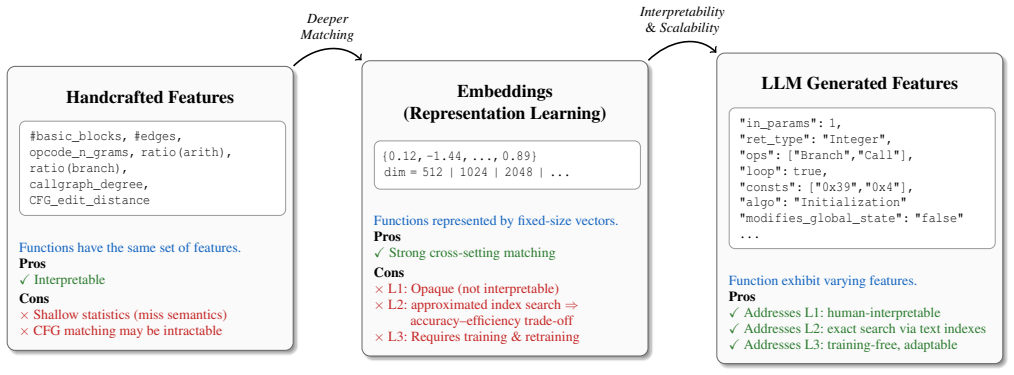
The mechanism is a structured prompting pipeline that converts raw disassembly into a JSON document of hand-specified semantic features (type signature, logic/operations, notable constants, side effects, inferred category). Similarity is then computed as Jaccard overlap over the flattened field–value pairs, which can be indexed by an inverted index or relational DB, avoiding approximate nearest-neighbor search. The schema design makes the feature set extensible without retraining, and the LLM's broad pretraining supplies the cross-architecture knowledge that specialized embedding models must learn from corpora.
What would settle it
Take a set of assembly functions that are provably absent from the LLM's training data—for example, routines generated by a custom compiler or from an obscure, newer instruction set—compile them under multiple optimization levels, and run the same retrieval experiment; if recall drops to near-random levels, the reported cross-setting performance is an artifact of memorization rather than reasoning.
Extended reading notes
Core claim
The central claim is that a pretrained LLM, prompted with a structured JSON schema and a few examples, can act as a general-purpose semantic feature extractor for assembly functions, and that the resulting features—effective parameter types, loop indicators, notable constants, side effects, and an inferred algorithmic category—are sufficiently discriminative for clone retrieval. In the paper's own experiment, this training-free method achieves recall@1 of 0.436–0.531 across ARM/PPC/MIPS-to-x86-64 architectures and 0.485–0.758 across optimization levels, versus 0.334–0.443 for the best trained baseline (CLAP) in the same settings. The paper further claims that averaging the Jaccard similarity
Load-bearing premise
The paper assumes the LLM's feature extraction reflects general assembly understanding rather than memorization of the specific test binaries; the dataset is built from popular open-source projects (BusyBox, coreutils, OpenSSL, etc.) that are almost certainly present in commercial LLM training corpora, and no control is made for the LLM having seen the exact functions.
Editorial extensions
If this is right
- If the central claim holds, BCSD databases can be built and updated without any training or fine-tuning, simply by prompting a general-purpose LLM on each new function.
- The textual features allow analysts to inspect why two functions are judged similar, enabling verification and debugging that opaque embeddings cannot provide.
- The hybrid scoring rule—average of Jaccard and cosine similarity—shows a concrete path to combine interpretable features with existing embedding models, improving accuracy without retraining the embeddings.
- Inverted-index search over text features offers an exact-search alternative to approximate nearest neighbors, removing a known accuracy–efficiency trade-off at scale.
- The method's performance scales with LLM size, implying that future improvements in base models will directly translate to better binary similarity detection without changes to the pipeline.
Reading between the lines
- The reported cross-architecture recall may be inflated if the LLM has memorized the specific open-source functions (e.g., MD5Init) during pretraining; a strong test would be to evaluate on freshly authored or intentionally novel assembly routines.
- The schema's coarse type system (only Integer/Pointer) and category list may limit the approach on niche domains, but the paper's extensible design suggests an incremental path to richer features without regenerating the database.
- The combined method's success hints that LLM features primarily capture high-level algorithmic intent while embeddings capture low-level structural detail; this complementarity could guide research into hybrid representations beyond BCSD, such as decompiler-aided vulnerability search.
- The retry-on-failure mechanism and few-shot prompting make the pipeline practical on small open-weight models, but the compute cost per function (seconds per query on a 7B model) may favor cloud APIs for large databases, raising privacy concerns the paper itself acknowledges.
Editorial analysis
A structured set of objections, weighed in public.
Referee Report
Summary. This paper proposes replacing learned embeddings in binary code similarity detection (BCSD) with structured, human-readable features generated by an LLM. The method prompts an LLM to analyze raw assembly functions and output JSON fields covering type signatures, logic/operation categories, notable constants, side effects, and an inferred algorithmic category. Similarity is computed as Jaccard overlap over flattened field–value pairs, which the authors argue can be indexed with inverted or relational indexes. The evaluation compares the method against Order Matters, SAFE, PalmTree, Asm2Vec, and CLAP on pools of 1,000 functions. Gemini 2.5 Flash reaches 42.2% average cross-architecture recall@1 versus CLAP's 39.7%, and 61.7% average cross-optimization recall@1 versus CLAP's 33.9%. Ablations examine LLM size, few-shot example count, prompt sections, and a hybrid combination with Qwen3-Embedding 4B, which yields large recall gains.
Significance. If verified, the central claim is significant: an LLM-based, training-free feature extractor can produce interpretable features competitive with trained embedding models on cross-architecture and cross-optimization retrieval, and can complement embeddings. The paper is generally well written, the artifact is said to be public, and the ablations on model size, few-shot prompting, and prompt sections are informative. The main value is in demonstrating that a non-embedding representation can be both semantically rich and usable for matching. However, the headline results depend on two untested assumptions: that the LLM has not effectively memorized the specific test functions, and that the proposed representation scales beyond the 1,000-function pools used in the experiments. Both are flagged in the manuscript as limitations or unaddressed risks, so the significance is conditional on additional evidence.
major comments (4)
- [§3.3, §3 (dataset construction), Table 1] The central 'training-free generalization' claim is not yet supported because the dataset consists entirely of extremely popular open-source projects (OpenSSL, SQLite, BusyBox, coreutils, etc.) that are almost certainly present in LLM pretraining corpora. Section 3.3 notes that the LLM 'has extensively seen' mainstream CPU architectures, but that only concerns instruction dialects, not these exact functions. Since the most discriminative features are `inferred_algo` and `int_consts` (§3.6), a model that recognizes, say, MD5Init from either compiled variant could emit identical feature sets and inflate the reported cross-optimization and cross-architecture recall@1. The paper should add a contamination check: for example, evaluate on functions added after the model's training cutoff, or on less popular/held-out projects, and report whether performance is maintained. Without this, the 42%
- [§5 (Conclusion), §3.2 (evaluation setup)] The scalability claim is load-bearing for the abstract's statement that accuracy, scalability, and interpretability can coexist, but it is not empirically tested. All retrieval experiments use pools of 1,000 functions (Tables 4–6), and the conclusion explicitly concedes that performance 'may not be the case when comparing millions of feature sets.' No indexing time, query latency, memory usage, or exact-search-versus-ANN comparison is reported. Please add a small-scale scalability study (e.g., 10k–100k functions using an inverted index) or clearly restrict the scalability claim to the qualitative design.
- [Table 5, §3.2 (baseline comparison)] The comparison against embedding baselines is not fully controlled. The baselines are evaluated off-the-shelf, and at least CLAP was trained on x86-64/gcc only; cross-optimization on ARM (Table 5) is likely out-of-distribution for CLAP, while other baselines were also trained on restricted architecture sets. The paper's explanation that low baseline scores are due to 'overfitting' (§3.2) is speculative without reporting the exact preprocessing, tokenization, and evaluation protocol used for each baseline. Please specify how each baseline was instantiated, and either include baselines evaluated under their native conditions or add a discussion of this limitation in the comparison.
- [§3.1, §3.5, §3.7] The 'training-free' claim is narrower than stated because several free parameters are selected using the same benchmark tasks: the backbone LLM was chosen through a pilot on a subset of the same tasks (§3.1), the three few-shot examples were chosen after ablations on those tasks (§3.5), and the hybrid weight in §3.7 is fixed at 0.5 without sensitivity analysis. No gradient training is performed, but task-specific selection does influence the reported numbers. Please report robustness to these choices (e.g., different few-shot examples, weights of 0.2/0.8) or explicitly acknowledge this selection procedure as a limitation.
minor comments (5)
- [Throughout] Several typos: 'adverserial' (Section 2), 'dissassembled' (Section 3 dataset description), 'similiarity' (§3.7), 'oportunities' (§5.1), 'Exampe' (Figure 2 caption), 'our its stability' (§3.2), and 'Beneficience' (Ethical Considerations).
- [Figure 5] The baseline models are placed at arbitrary positions on the 'Model Size' axis even though their parameter counts are not LLM parameter counts. This is visually confusing; consider using a separate axis or explicit annotations.
- [Table 6] The column header 'Qwen' should name the exact model, Qwen3-Embedding 4B, for reproducibility and consistency with the text.
- [§2.7] The Jaccard similarity over flattened field–value pairs is underspecified: it is unclear how array fields are tokenized, whether booleans and missing fields are included, and whether any field weighting is applied. Specify the exact tokenization and matching procedure.
- [References] Reference [8] contains a corrupted author name ('Buciluundefined'). The GPT-4 reference [38] is cited for GPT 4.1 Mini; a more specific model card citation would be appropriate.
Circularity Check
No definitional circularity; minor selection-on-evaluation-set choices and non-load-bearing self-citations keep the paper in the 0–2 range.
-
other
[Section 3.1, Pilot Testing for LLM Selection; Tables 2–3; also Section 3.5, Figure 6]
"We selected a small set of tasks that are representative of the extensive experiments conducted against the baselines."
The backbone LLM is chosen by MRR on the same cross-optimization and cross-architecture retrieval settings that later appear as headline results (e.g., O0–O3, O2–O3, ARM–x86-64 in Tables 4–5). Similarly, the three few-shot examples are validated by ablation on those same retrieval tasks (Figure 6). Thus the reported 'training-free' accuracy is not produced by a fixed, a priori configuration; the model and prompt configuration were selected on the evaluation distribution. This creates selection pressure rather than a definitional reduction: no reported recall value is forced by construction, so this is scored at the low end.
full rationale
The central claim—that LLM-generated structured features achieve competitive cross-architecture and cross-optimization recall without BCSD training—is an empirical measurement, not a derivation. No equation in the paper reduces a predicted quantity to a fitted parameter; the Jaccard similarity on extracted features is computed directly from measured outputs. The main design choices (LLM backbone, few-shot count, equal-weight hybrid combination) were selected using the same task distribution, which is a mild form of selection bias, but it does not amount to the reported results being true by definition. The self-citations to Asm2Vec [14] and Kam1n0 [15], which share authors with the present paper, are used only as comparative baselines and related work; they are not load-bearing for the central claim. The more serious threat—LLM pretraining contamination on popular functions like MD5Init from BusyBox/OpenSSL—is an empirical confound rather than a circularity, because it concerns whether the features reflect general assembly understanding or memorization; it cannot be established from the paper's equations and therefore does not raise the circularity score. Overall, the paper is self-contained as an experimental evaluation, with no significant circular derivation.
Assumptions & free parameters
free parameters (3)
- few_shot_examples =
3
- hybrid_weight =
0.5
- context_truncation =
4096 tokens input / 128 instructions (Gemini) / 512 output tokens
assumptions (4)
- domain assumption Pretrained LLMs encode sufficient assembly semantics to extract stable features across architectures and optimization levels without fine-tuning.
- domain assumption Jaccard overlap over flattened JSON field-value pairs is a valid similarity measure for BCSD retrieval.
- domain assumption The ground truth assumption that functions compiled from the same source are semantic matches and functions from different sources are non-matches is correct for evaluation.
- domain assumption The LLM has not memorized the specific test binaries from its pretraining corpus.
Cite this review
Pith. "Pith review of Beyond Embeddings: Interpretable Feature Extraction for Binary Code Similarity." pith.science (2026). https://pith.science/paper/YXNZBO35
@misc{pith2026250923449,
  author       = {Pith},
  title        = {Pith review of: Beyond Embeddings: Interpretable Feature Extraction for Binary Code Similarity},
  year         = {2026},
  howpublished = {\url{https://pith.science/paper/YXNZBO35}},
  note         = {Machine review of arXiv:2509.23449}
}
read the original abstract
Binary code similarity detection is a core task in reverse engineering. It supports malware analysis and vulnerability discovery by identifying semantically similar code in different contexts. Modern methods have progressed from manually engineered features to vector representations. Hand-crafted statistics (e.g., operation ratios) are interpretable, but shallow and fail to generalize. Embedding-based methods overcome this by learning robust cross-setting representations, but these representations are opaque vectors that prevent rapid verification. They also face a scalability-accuracy trade-off, since high-dimensional nearest-neighbor search requires approximations that reduce precision. Current approaches thus force a compromise between interpretability, generalizability, and scalability. We bridge these gaps using a language model-based agent to conduct structured reasoning analysis of assembly code and generate features such as input/output types, side effects, notable constants, and algorithmic intent. Unlike hand-crafted features, they are richer and adaptive. Unlike embeddings, they are human-readable, maintainable, and directly searchable with inverted or relational indexes. Without any matching training, our method respectively achieves 42% and 62% for recall@1 in cross-architecture and cross-optimization tasks, comparable to embedding methods with training (39% and 34%). Combined with embeddings, it significantly outperforms the state-of-the-art, demonstrating that accuracy, scalability, and interpretability can coexist.
Figures


Figures from the paper (4 more)


Forward citations
Cited by 1 Pith paper
-
Practical Source Code Recovery from Binary Functions Using Anchor-Based Retrieval and LLM Reasoning
Anchor-based retrieval plus LLM re-ranking recovers source functions for 95.2% of instructions in a stripped tcpdump binary against a curated database, but only 35.5% average coverage via GitHub search.
Reference graph
Works this paper leans on
-
[1]
Ghidra software reverse engineering framework, 2025-07-31
National Security Agency. Ghidra software reverse engineering framework, 2025-07-31. URL: https:// github.com/NationalSecurityAgency/ghidra
2025
-
[2]
Farouq Al-Omari, Iman Keivanloo, Chanchal K. Roy, and Juergen Rilling. Detecting clones across microsoft .net programming languages. In2012 19th Working Conference on Reverse Engineering, pages 405–414, 2012.doi:10.1109/WCRE.2012.50
-
[3]
Beyond embeddings: Interpretable feature extraction for binary code similarity – artifact, 2025-08-
Anonymous. Beyond embeddings: Interpretable feature extraction for binary code similarity – artifact, 2025-08-
2025
-
[4]
Fuzzing BusyBox: Leveraging LLM and crash reuse for em- bedded bug unearthing
Asmita, Yaroslav Oliinyk, Michael Scott, Ryan Tsang, Chongzhou Fang, and Houman Homayoun. Fuzzing BusyBox: Leveraging LLM and crash reuse for em- bedded bug unearthing. In33rd USENIX Secu- rity Symposium (USENIX Security 24), pages 883– 900, Philadelphia, PA, August 2024. USENIX Associa- tion. URL: https://www.usenix.org/conference/ usenixsecurity24/prese...
2024
-
[5]
Max Beninger, Philippe Charland, Steven H. H. Ding, and Benjamin C. M. Fung. ERS0: enhancing military cybersecurity with ai-driven SBOM for firmware vulnerability detection and asset management. In Claire Kwan, Lauri Lindström, Davide Giovannelli, Karlis Podins, and Damjan Strucl, editors,16th International Conference on Cyber Conflict: Over the Horizon, ...
arXiv 2024
-
[6]
On the way to sboms: Investigating design issues and solutions in practice.ACM Trans
Tingting Bi, Boming Xia, Zhenchang Xing, Qinghua Lu, and Liming Zhu. On the way to sboms: Investigating design issues and solutions in practice.ACM Trans. Softw. Eng. Methodol., 33(6), June 2024.doi:10.1145/ 3654442
2024
-
[7]
Tom B. Brown, Benjamin Mann, Nick Ryder, Melanie Subbiah, Jared Kaplan, Prafulla Dhariwal, Arvind Neelakantan, Pranav Shyam, Girish Sastry, Amanda Askell, Sandhini Agarwal, Ariel Herbert-V oss, Gretchen Krueger, Tom Henighan, Rewon Child, Aditya Ramesh, Daniel M. Ziegler, Jeffrey Wu, Clemens Winter, Christo- pher Hesse, Mark Chen, Eric Sigler, Mateusz Lit...
arXiv 2020
-
[8]
Cristian Buciluundefined, Rich Caruana, and Alexandru Niculescu-Mizil. Model compression. InProceedings of the 12th ACM SIGKDD International Conference on Knowledge Discovery and Data Mining, KDD ’06, page 535–541, New York, NY , USA, 2006. Association for Computing Machinery. doi:10.1145/1150402. 1150464
doi:10.1145/1150402 2006
Show all 68 references
-
[9]
Openssl, 2025-08-05
Mark Cox, Ralf Engelschall, Stephen Henson, Ben Lau- rie, and Paul Sutton. Openssl, 2025-08-05. URL: https://www.openssl.org/
2025
-
[10]
Mastering digital image alchemy, 2025-07-
John Cristy. Mastering digital image alchemy, 2025-07-
2025
-
[11]
Firmup: Precise static detection of common vulnerabilities in firmware.SIGPLAN Not., 53(2):392–404, March 2018
Yaniv David, Nimrod Partush, and Eran Yahav. Firmup: Precise static detection of common vulnerabilities in firmware.SIGPLAN Not., 53(2):392–404, March 2018. doi:10.1145/3296957.3177157
2018
-
[12]
Bert: Pre-training of deep bidi- rectional transformers for language understanding,
Jacob Devlin, Ming-Wei Chang, Kenton Lee, and Kristina Toutanova. Bert: Pre-training of deep bidi- rectional transformers for language understanding,
-
[13]
URL:https://imagemagick.org/. 14
-
[14]
Steven H. H. Ding, Benjamin C. M. Fung, and Philippe Charland. Asm2vec: Boosting static representation ro- bustness for binary clone search against code obfusca- tion and compiler optimization. In2019 IEEE Sym- posium on Security and Privacy (SP), pages 472–489, 2019.doi:10.11...
2019
-
[15]
Ding, Benjamin C.M
Steven H.H. Ding, Benjamin C.M. Fung, and Philippe Charland. Kam1n0: Mapreduce-based assembly clone search for reverse engineering. InProceedings of the 22nd ACM SIGKDD International Conference on Knowledge Discovery and Data Mining, KDD ’16, page 461–470, New York, NY , USA, ...
2016 doi
-
[16]
Coreutils - gnu core utilities, 2025-04-09
Alex Deymo, Jim Meyering, Paul Eggert, Padraig Brady, Bernhard V oelker, and Collin Funk. Coreutils - gnu core utilities, 2025-04-09. URL: https://www.gnu.org/ software/coreutils/
2025
-
[17]
Blanket execution: Dynamic similarity testing for program binaries and components
Manuel Egele, Maverick Woo, Peter Chapman, and David Brumley. Blanket execution: Dynamic similarity testing for program binaries and components. In 23rd USENIX Security Symposium (USENIX Secu- rity 14), pages 303–317, San Diego, CA, August
-
[18]
Large language models for code analysis: Do LLMs really do their job? In33rd USENIX Secu- rity Symposium (USENIX Security 24), pages 829– 846, Philadelphia, PA, August 2024
Chongzhou Fang, Ning Miao, Shaurya Srivastav, Jialin Liu, Ruoyu Zhang, Ruijie Fang, Asmita, Ryan Tsang, Najmeh Nazari, Han Wang, and Houman Homay- oun. Large language models for code analysis: Do LLMs really do their job? In33rd USENIX Secu- rity Symposium (USENIX Security 24)...
2024
-
[19]
Graph-based comparison of ex- ecutable objects
Thomas Dullien. Graph-based comparison of ex- ecutable objects. 2005. URL: https://api. semanticscholar.org/CorpusID:2001486
2005
-
[20]
Cross- language binary-source code matching with intermedi- ate representations, 2022
Yi Gui, Yao Wan, Hongyu Zhang, Huifang Huang, Yulei Sui, Guandong Xu, Zhiyuan Shao, and Hai Jin. Cross- language binary-source code matching with intermedi- ate representations, 2022. URL: https://arxiv.org/ abs/2201.07420,arXiv:2201.07420
2022 arXiv
-
[21]
Funcvul: An effective function level vul- nerability detection model using llm and code chunk,
Sajal Halder, Muhammad Ejaz Ahmed, and Seyit Camtepe. Funcvul: An effective function level vul- nerability detection model using llm and code chunk,
-
[22]
Code is not natural language: Unlock the power of Semantics-Oriented graph representation for binary code similarity detection
Haojie He, Xingwei Lin, Ziang Weng, Ruijie Zhao, Shuitao Gan, Libo Chen, Yuede Ji, Jiashui Wang, and Zhi Xue. Code is not natural language: Unlock the power of Semantics-Oriented graph representation for binary code similarity detection. In33rd USENIX Se- curity Symposium (USE...
2024
-
[23]
Extracting condi- tional formulas for cross-platform bug search
Qian Feng, Minghua Wang, Mu Zhang, Rundong Zhou, Andrew Henderson, and Heng Yin. Extracting condi- tional formulas for cross-platform bug search. InPro- ceedings of the 2017 ACM on Asia Conference on Com- puter and Communications Security, ASIA CCS ’17, page 346–359, New York,...
2017 doi
-
[24]
Richard Hipp
D. Richard Hipp. Sqlite, 2025-07-30. URL: https: //sqlite.org/
2025
-
[25]
Qwen2.5- coder technical report, 2024
Binyuan Hui, Jian Yang, Zeyu Cui, Jiaxi Yang, Dayi- heng Liu, Lei Zhang, Tianyu Liu, Jiajun Zhang, Bowen Yu, Keming Lu, Kai Dang, Yang Fan, Yichang Zhang, An Yang, Rui Men, Fei Huang, Bo Zheng, Yibo Miao, Shanghaoran Quan, Yunlong Feng, Xingzhang Ren, Xu- ancheng Ren, Jingren ...
2024 arXiv
-
[26]
URL: https://anonymous.4open.science/r/ asm-feature-extraction-894E/README.md
-
[27]
Scalable malware forensics using phy- logenetic analysis
Steven Jilcott. Scalable malware forensics using phy- logenetic analysis. In2015 IEEE International Sym- posium on Technologies for Homeland Security (HST), pages 1–6, 2015.doi:10.1109/THS.2015.7225311. 15
2015
-
[28]
Ida pro, 2025-02-28
hex rays. Ida pro, 2025-02-28. URL: https:// hex-rays.com/ida-pro
2025
-
[29]
Le and Tomas Mikolov
Quoc V . Le and Tomas Mikolov. Distributed representa- tions of sentences and documents, 2014. URL: https: //arxiv.org/abs/1405.4053,arXiv:1405.4053
2014 arXiv
-
[30]
Understanding security risks of embedded devices through fine-grained firmware fingerprinting
Qiang Li, Dawei Tan, Xin Ge, Haining Wang, Zhi Li, and Jiqiang Liu. Understanding security risks of embedded devices through fine-grained firmware fingerprinting. IEEE Transactions on Dependable and Secure Com- puting, 19(6):4099–4112, 2022. doi:10.1109/TDSC. 2021.3119970
2022
-
[31]
International Organization for Standardization, Geneva, Switzerland, February 2012
ISO.ISO/IEC 14882:2011 Information tech- nology — Programming languages — C++. International Organization for Standardization, Geneva, Switzerland, February 2012. URL: http: //www.iso.org/iso/iso_catalogue/catalogue_ tc/catalogue_detail.htm?csnumber=50372
2011
-
[32]
A structured self-attentive sentence embedding,
Zhouhan Lin, Minwei Feng, Cicero Nogueira dos San- tos, Mo Yu, Bing Xiang, Bowen Zhou, and Yoshua Ben- gio. A structured self-attentive sentence embedding,
-
[33]
Brown, Benjamin Chess, Rewon Child, Scott Gray, Alec Radford, Jeffrey Wu, and Dario Amodei
Jared Kaplan, Sam McCandlish, Tom Henighan, Tom B. Brown, Benjamin Chess, Rewon Child, Scott Gray, Alec Radford, Jeffrey Wu, and Dario Amodei. Scaling laws for neural language models, 2020. URL: https:// arxiv.org/abs/2001.08361,arXiv:2001.08361
2020 arXiv
-
[34]
Binary code similarity detection
Zian Liu. Binary code similarity detection. In2021 36th IEEE/ACM International Conference on Automated Software Engineering (ASE), pages 1056–1060, 2021. doi:10.1109/ASE51524.2021.9678518
2021
-
[35]
How machine learning is solving the binary function similarity problem
Andrea Marcelli, Mariano Graziano, Xabier Ugarte- Pedrero, Yanick Fratantonio, Mohamad Mansouri, and Davide Balzarotti. How machine learning is solving the binary function similarity problem. In31st USENIX Security Symposium (USENIX Security 22), pages 2099– 2116, Boston, MA, ...
-
[36]
Palmtree: Learn- ing an assembly language model for instruction em- bedding
Xuezixiang Li, Yu Qu, and Heng Yin. Palmtree: Learn- ing an assembly language model for instruction em- bedding. InProceedings of the 2021 ACM SIGSAC Conference on Computer and Communications Secu- rity, CCS ’21, page 3236–3251, New York, NY , USA,
2021
-
[37]
Distributed representations of words and phrases and their compositionality, 2013
Tomas Mikolov, Ilya Sutskever, Kai Chen, Greg Cor- rado, and Jeffrey Dean. Distributed representations of words and phrases and their compositionality, 2013. URL: https://arxiv.org/abs/1310.4546, arXiv: 1310.4546
2013 arXiv
-
[38]
Gpt-4 technical report, 2024
OpenAI. Gpt-4 technical report, 2024. URL: https:// arxiv.org/abs/2303.08774,arXiv:2303.08774
2024 arXiv
-
[39]
Malware detection by exploiting deep learning over bi- nary programs
Panpan Qi, Zhaoqi Zhang, Wei Wang, and Chang Yao. Malware detection by exploiting deep learning over bi- nary programs. In2020 25th International Conference on Pattern Recognition (ICPR), pages 9068–9075, 2021. doi:10.1109/ICPR48806.2021.9412227
2021
-
[40]
Roberta: A robustly optimized bert pretraining approach,
Yinhan Liu, Myle Ott, Naman Goyal, Jingfei Du, Mandar Joshi, Danqi Chen, Omer Levy, Mike Lewis, Luke Zettlemoyer, and Veselin Stoyanov. Roberta: A robustly optimized bert pretraining approach,
-
[41]
URL: https://arxiv.org/abs/1907.11692, arXiv:1907.11692
1907 arXiv
-
[42]
Penya, Borja Sanz, Carlos Laorden, and Pablo G
Igor Santos, Felix Brezo, Javier Nieves, Yoseba K. Penya, Borja Sanz, Carlos Laorden, and Pablo G. Bringas. Idea: opcode-sequence-based malware detec- tion. InProceedings of the Second International Confer- ence on Engineering Secure Software and Systems, ES- SoS’10, page 35–4...
2010 doi
-
[43]
Binary similarity detection using machine learning
Noam Shalev and Nimrod Partush. Binary similarity detection using machine learning. InProceedings of the 13th Workshop on Programming Languages and Analysis for Security, PLAS ’18, page 42–47, New York, NY , USA, 2018. Association for Computing Machinery. doi:10.1145/3264820.3264821
2018
-
[44]
Safe: Self-attentive function embeddings for binary similarity,
Luca Massarelli, Giuseppe Antonio Di Luna, Fabio Petroni, Leonardo Querzoni, and Roberto Baldoni. Safe: Self-attentive function embeddings for binary similarity,
-
[45]
URL: https://arxiv.org/abs/1811.05296, arXiv:1811.05296
-
[46]
Putty, 2025-02-08
Simon Tatham. Putty, 2025-02-08. URL:https://www. chiark.greenend.org.uk/~sgtatham/putty/
2025
-
[47]
Gemini 2.5: Pushing the frontier with ad- vanced reasoning, multimodality, long context, and next generation agentic capabilities, 2025
Google Team. Gemini 2.5: Pushing the frontier with ad- vanced reasoning, multimodality, long context, and next generation agentic capabilities, 2025. URL: https:// arxiv.org/abs/2507.06261,arXiv:2507.06261
2025 arXiv
-
[48]
Gemma 3 technical report, 2025
Google Team. Gemma 3 technical report, 2025. URL: https://arxiv.org/abs/2503.19786, arXiv:2503.19786
2025 arXiv
-
[49]
Nicholas
Edward Raff, Jon Barker, Jared Sylvester, Robert Brandon, Bryan Catanzaro, and Charles K. Nicholas. Malware detection by eating a whole EXE. In The Workshops of the The Thirty-Second AAAI Conference on Artificial Intelligence, New Orleans, Louisiana, USA, February 2-7, 2018, v...
2018
-
[50]
VenkataKeerthy, Soumya Banerjee, Sayan Dey, Yashas Andaluri, Raghul PS, Subrahmanyam Kalyana- sundaram, Fernando Magno Quintão Pereira, and Ra- makrishna Upadrasta
S. VenkataKeerthy, Soumya Banerjee, Sayan Dey, Yashas Andaluri, Raghul PS, Subrahmanyam Kalyana- sundaram, Fernando Magno Quintão Pereira, and Ra- makrishna Upadrasta. Vexir2vec: An architecture- neutral embedding framework for binary similarity. ACM Trans. Softw. Eng. Methodo...
2025 doi
-
[51]
A survey of binary code sim- ilarity detection techniques.Electronics, 13(9),
Liting Ruan, Qizhen Xu, Shunzhi Zhu, Xujing Huang, and Xinyang Lin. A survey of binary code sim- ilarity detection techniques.Electronics, 13(9),
-
[52]
Clap: Learning transferable binary code representations with natural language su- pervision
Hao Wang, Zeyu Gao, Chao Zhang, Zihan Sha, Mingyang Sun, Yuchen Zhou, Wenyu Zhu, Wenju Sun, Han Qiu, and Xi Xiao. Clap: Learning transferable binary code representations with natural language su- pervision. InProceedings of the 33rd ACM SIG- SOFT International Symposium on Sof...
2024
-
[53]
Improving ML-based binary function sim- ilarity detection by assessing and deprioritizing con- trol flow graph features
Jialai Wang, Chao Zhang, Longfei Chen, Yi Rong, Yuxiao Wu, Hao Wang, Wende Tan, Qi Li, and Zong- peng Li. Improving ML-based binary function sim- ilarity detection by assessing and deprioritizing con- trol flow graph features. In33rd USENIX Secu- rity Symposium (USENIX Securit...
2024
-
[54]
Enhancing machine learning based malware detection model by reinforcement learning
Cangshuai Wu, Jiangyong Shi, Yuexiang Yang, and Wen- hua Li. Enhancing machine learning based malware detection model by reinforcement learning. InProceed- ings of the 8th International Conference on Communi- cation and Network Security, ICCNS ’18, page 74–78, New York, NY , U...
2018
-
[55]
curl - command line tool and library for transferring data with urls, 2025-07-16
Daniel Stenberg. curl - command line tool and library for transferring data with urls, 2025-07-16. URL: https: //curl.se/
2025
-
[56]
LLM4Decompile: Decompiling binary code with large language models
Hanzhuo Tan, Qi Luo, Jing Li, and Yuqun Zhang. LLM4Decompile: Decompiling binary code with large language models. In Yaser Al-Onaizan, Mohit Bansal, and Yun-Nung Chen, editors,Proceedings of the 2024 Conference on Empirical Methods in Natural Language Processing, pages 3473–34...
2024 doi
-
[57]
Semantic understanding of source and bi- nary code based on natural language processing
Zhongtang Zhang, Shengli Liu, Qichao Yang, and Shichen Guo. Semantic understanding of source and bi- nary code based on natural language processing. In 2021 IEEE 4th Advanced Information Management, Communicates, Electronic and Automation Control Con- ference (IMCEC), volume 4...
2021
-
[60]
Qwen3 technical report, 2025
Qwen Team. Qwen3 technical report, 2025. URL: https://arxiv.org/abs/2505.09388, arXiv:2505.09388
2025 arXiv
-
[62]
Busybox, 2024-09-27
Denys Vlasenko, Bernhard Reutner-Fischer, and Rob Landley. Busybox, 2024-09-27. URL: https:// busybox.net/
2024
-
[66]
Spain: Security patch anal- ysis for binaries towards understanding the pain and pills
Zhengzi Xu, Bihuan Chen, Mahinthan Chandramohan, Yang Liu, and Fu Song. Spain: Security patch anal- ysis for binaries towards understanding the pain and pills. In2017 IEEE/ACM 39th International Conference on Software Engineering (ICSE), pages 462–472, 2017. doi:10.1109/ICSE.2017.49
2017 doi
-
[67]
Order matters: Semantic- aware neural networks for binary code similar- ity detection.Proceedings of the AAAI Con- ference on Artificial Intelligence, 34(01):1145– 1152, Apr
Zeping Yu, Rui Cao, Qiyi Tang, Sen Nie, Junzhou Huang, and Shi Wu. Order matters: Semantic- aware neural networks for binary code similar- ity detection.Proceedings of the AAAI Con- ference on Artificial Intelligence, 34(01):1145– 1152, Apr. 2020. URL: https://ojs.aaai. org/in...
2020 doi
-
[2014]
URL: https://www
USENIX Association. URL: https://www. usenix.org/conference/usenixsecurity14/ technical-sessions/presentation/egele
-
[2017]
URL: https://arxiv.org/abs/1703.03130, arXiv:1703.03130
-
[2018]
URL: https://aaai.org/ocs/index.php/ WS/AAAIW18/paper/view/16422
-
[2019]
URL: https://arxiv.org/abs/1810.04805, arXiv:1810.04805
-
[2021]
doi: 10.1145/3460120.3484587
Association for Computing Machinery. doi: 10.1145/3460120.3484587
-
[2024]
URL: https://www.mdpi.com/2079-9292/ 13/9/1715,doi:10.3390/electronics13091715
-
[2025]
URL: https://arxiv.org/abs/2506.19453, arXiv:2506.19453
Reviewed August 4, 2026 · model on record in the stance chip above.
Discussion (0). Sign in to comment.