REVIEW 4 major objections 5 minor 62 references
A two-part score picks the most valuable fine-grained images to label, beating eight active-learning baselines on seven datasets.
Reviewed by Pith at T0; open to challenge. T0 means a machine referee read the full paper against a public rubric. the ladder, T0–T4 →
T0 review · deepseek-v4-flash
2026-08-04 14:37 UTC pith:EBHLPJ34
load-bearing objection Genuinely new AL method with broad experiments, but the 'superior performance' claim outruns the statistics—wins are mostly <1pt and within noise. the 4 major comments →
Combining Discrepancy-Confusion Uncertainty and Calibration Diversity for Active Fine-Grained Image Classification
The pith
A machine-rendered reading of the paper's core claim, the machinery that carries it, and where it could break.
Core claim
On its own terms, the paper claims that the annotation value of a fine-grained unlabeled image can be read from how its feature representation reacts to controlled local feature fusion. Images whose predictions scatter when fused lightly toward non-confident categories (poor category directionality) or whose predictions collapse when fused strongly toward a confident category (poor structural stability) are exactly the samples whose labels sharpen the decision boundaries. The paper operationalizes this into a discrepancy-confusion uncertainty score, then applies uncertainty-weighted clustering and a calibration-diversity selection rule that picks, from each cluster, the sample closest to the
What carries the argument
The central object is the discrepancy-confusion uncertainty score S (Eqs. 8–9), which combines entropy and cross-entropy between original, blended, weighted, and fusion-mixed prediction probabilities after locally mixing each unlabeled feature with per-category anchors through a gradient-derived binary mask. The mixing strength per category is set by the unlabeled sample's predicted probability for that category, and a cosine-similarity beta weight modulates each category's contribution. A dynamic threshold selects high-uncertainty candidates; these are then clustered with uncertainty-weighted K-Means, and a calibration-diversity objective selects one sample per cluster to maximize proximity
Load-bearing premise
The paper assumes that the discrepancy-confusion uncertainty score S orders unlabeled samples by how much their labels would improve the model, but no derivation connects the entropy and cross-entropy of feature-fused predictions to annotation value; if that ordering fails on some dataset, the method degenerates to uncertainty-weighted K-Means with essentially random selection within clusters.
What would settle it
A concrete check: run DECERN on a fine-grained dataset but replace the final within-cluster selection with uniform random sampling among candidates that pass the dynamic threshold, while keeping the uncertainty-weighted clustering. If final accuracy stays within noise, the discrepancy-confusion ranking is not contributing; a more surgical test would select deliberately low-S samples that are far from anchors and see whether they produce gains comparable to high-S selections.
If this is right
- Under a fixed annotation budget, DECERN yields higher final accuracy than uncertainty-only, diversity-only, and prior hybrid baselines on fine-grained datasets, with gains that grow over consecutive active-learning rounds.
- The method's dynamic threshold adapts candidate selection as the model improves, and the selected labeled set has higher class-distribution entropy (lower imbalance) than several baselines, which the paper cites as a reason for its stronger performance.
- Selection time per cycle stays near the fastest baselines, so the accuracy gains are achieved without disproportionate computational cost.
- Ablations show that removing either uncertainty component or either diversity component degrades accuracy, so the two-part structure of the informativeness measure is load-bearing for the reported results.
Where Pith is reading between the lines
- If the uncertainty ranking truly reflects annotation value, the same two-term score could transfer to other low-budget, high-similarity domains such as medical or archaeological imagery, and potentially to dense tasks like segmentation where anchors can be defined per region; the authors state this efficacy is unproven.
- A direct test of the core ordering assumption would compare DECERN against a variant that draws candidates randomly from within the high-uncertainty clusters; if accuracy does not drop, the discrepancy-confusion ranking itself is not the active ingredient and the gains come from clustering and diversity.
- The beta weighting and the (1-R), R, 1 mixing coefficients in Eq. 9 are heuristics; a principled derivation of which fusion perturbations best expose label value could replace the current grid-free but still hand-designed score.
- The dynamic threshold depends on the skewness of uncertainty scores, a choice that could be studied systematically or replaced with a learned schedule as model capacity and dataset size vary.
Editorial analysis
A structured set of objections, weighed in public.
Referee Report
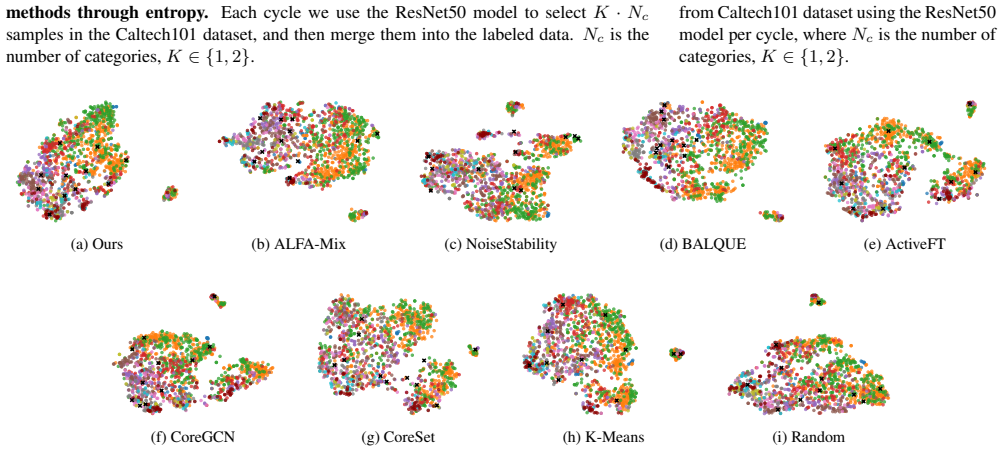
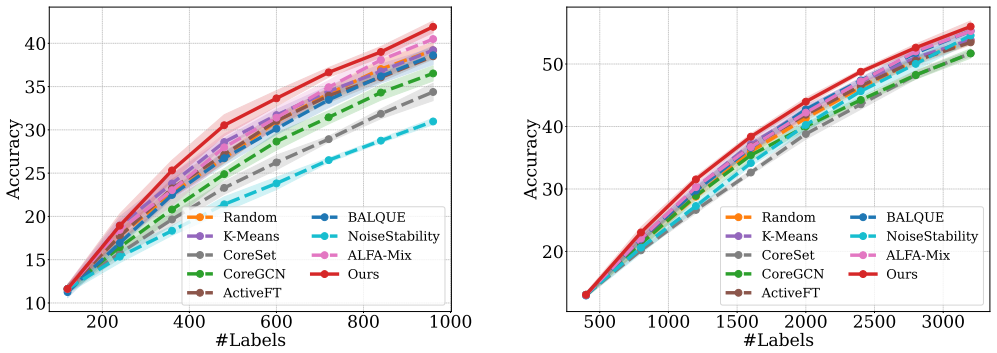
Summary. The paper proposes DECERN, an active learning method for fine-grained image classification. It scores unlabeled samples by a discrepancy-confusion uncertainty measure (Eqs. 8-10), which combines entropy and cross-entropy of predictions after local feature fusion with class anchors, and then selects a batch by uncertainty-weighted K-Means clustering followed by a calibration-diversity objective (Eq. 11) that balances closeness to cluster centroids and distance from labeled-data anchors. The method is evaluated on 7 fine-grained datasets, two backbones (ResNet50 and ViT-Small), and two annotation budgets per cycle, with 5 seeds, reporting final accuracies (Table 1) and per-cycle curves. The authors claim the method outperforms existing active learning baselines and achieves 'superior performance' and 'significant performance gains.' The supplementary material contains pseudocode, dataset settings, full per-cycle results, and t-SNE visualizations.
Significance. If the empirical claims hold, DECERN would be a practical and relatively lightweight sampling strategy for fine-grained classification under small annotation budgets. The paper has strengths: broad benchmark coverage (7 datasets, two architectures, two budget settings, 5 seeds), component ablations, per-cycle curves, and a clearly structured algorithm with pseudocode. The proposed uncertainty score is heuristic rather than derived from first principles, but that is not by itself a flaw; active learning methods are often validated empirically. The main value of the paper therefore hinges on whether the reported accuracy gains are statistically reliable and the method is reproducible. The current evidence does not yet establish the headline superiority claim.
major comments (4)
- [§4.2, Table 1] The central claim of 'superior performance' rests on mean accuracy differences that are often within one standard deviation. Examples: Flowers102/ResNet50/B=1Nc, DECERN 93.46±0.34 vs CoreSet 93.40±0.28; Food101/ResNet50/B=1Nc, DECERN 39.27±0.86 vs Random 39.25±0.98; OxfordIIITPet/ResNet50/B=1Nc, ALFA-Mix 65.65±1.49 beats DECERN 65.11±0.85. With n=5 seeds and no significance tests or effect sizes reported in Section 4 or Appendix E, the abstract's assertion of 'superior performance' and the contributions' 'significant performance gains' are not supported by the presented evidence. Please add per-setting significance tests (or paired tests across seeds/cycles) and temper the claims accordingly.
- [§3.3, Eq. (10)] λ is called 'the moderator of uncertainty sampling intensity' and is said to be 'a dynamic parameter λ, which is obtained by calculating the skewness of the scores,' but no formula, algorithm, or ablation is given for computing λ from skewness. Since ζ = S̄ + λσ determines which samples enter the candidate set, the method is not reproducible without this specification. Please provide the exact mapping from skewness (or another statistic) to λ and a sensitivity analysis; alternatively, state λ as a fixed hyperparameter and give its chosen value.
- [§3.2, Eq. (3)] The binary mask M is said to be formed by 'observing the backpropagation gradient of the unlabeled data feature representation and selecting the positions with the largest gradient.' For unlabeled data there is no supervised loss, and the objective whose gradient is used is never defined. The local feature fusion operation in Eq. (3), and therefore the entire uncertainty score, depends on M. Please define the gradient target (e.g., prediction entropy or a self-supervised loss) and specify how the number of mask positions relates to R in Eq. (7).
- [§4.3, Fig. 6b] The ablation of ζ changes its meaning. In Eq. (10), ζ is a threshold on the uncertainty score S, but Fig. 6b and its accompanying text describe fixing ζ and 'selecting the percentage ζ of the unlabeled data as candidates.' A percentage is not the same quantity as a score threshold, so the comparison between 'Dynamic' and the fixed values does not isolate the effect of the dynamic threshold mechanism. Please reconcile the definitions or run the fixed-threshold ablation directly on the Eq. (10) threshold.
minor comments (5)
- [Abstract / §1 / §4.1 / Table 3] The abstract states '39 distinct experimental settings,' while the introduction, experiments section, Table 3, and conclusion state 26 distinct settings. This numerical inconsistency should be corrected.
- [Table 1] The column header 'ViT-Samll' is a typo for 'ViT-Small.'
- [Appendix A, Algorithm 1] Lines 7-8 compute the instance-level score S inside the loop over j, but Eq. (9) sums over all categories. The computation of S should be moved outside the inner loop, once the category-level terms are accumulated.
- [§4.3, Fig. 6b] The x-axis lists 'Dynamic' alongside numeric values 0.2-1.0, mixing a categorical condition with a numeric scale. This should be clarified, e.g., by plotting the dynamic condition as a separate point or horizontal line with a clear label.
- [§5] The concluding limitation—that DECERN's efficacy is unproven for semantic segmentation and object detection—is appropriately scoped and does not affect the classification claim. It should be retained.
Circularity Check
No significant circularity: the scoring heuristic is empirical and the central claim is validated against external baselines.
full rationale
The paper does not present DECERN as a first-principles derivation; the discrepancy-confusion uncertainty (Eqs. 8-9) is an explicit informativeness heuristic built from entropy and cross-entropy of fusion-perturbed predictions, and the calibration diversity step (Eq. 11) is a stated combination of uncertainty-weighted clustering and anchor-distance diversity. No equation in the paper reduces a 'prediction' to a fitted parameter by construction, and no load-bearing result is imported from a self-citation. Reference [60] is the authors' own BronzeDing dataset, but a dataset is an external benchmark, not a theoretical premise; the claim of superiority rests on Table 1, which compares against eight independent baselines across seven datasets with five-seed means and standard deviations. The paper's own Conclusion honestly limits scope to fine-grained classification and says efficacy on segmentation/detection is unproven. Separate evaluation weaknesses exist—hyperparameters R, xi, and the dynamic threshold are tuned on Caltech101 (Sec. 4.3, Fig. 6) while Caltech101 also appears in the headline results, and many accuracy margins are within one standard deviation without significance testing—but these are external-validity and statistical-conclusion concerns, not logical circularity in the derivation chain. Under the stated rules, this is a normal non-circular empirical paper.
Axiom & Free-Parameter Ledger
free parameters (3)
- R =
0.1
- xi =
0.8
- lambda =
unspecified
axioms (3)
- domain assumption Gradient magnitude identifies discriminative local features suitable for mixing
- domain assumption High entropy and cross-entropy of fusion-perturbed predictions measure annotation value
- domain assumption Early-cycle anchors computed from very few labeled samples are reliable prototypes
read the original abstract
Active learning (AL) aims to build high-quality labeled datasets by iteratively selecting the most informative samples from an unlabeled pool under limited annotation budgets. However, in fine-grained image classification, assessing this informativeness reliably is especially challenging due to subtle differences between classes. In this paper, we introduce a novel active learning method, combining discrepancy-confusion uncertainty and calibration diversity for active fine-grained image classification (DECERN), to effectively perceive the distinctiveness between fine-grained images and evaluate the sample value. DECERN introduces a multifaceted informativeness measure that combines discrepancy-confusion uncertainty and calibration diversity. The discrepancy-confusion uncertainty quantifies the structural stability and category directionality of fine-grained unlabeled data during local feature fusion. Subsequently, uncertainty-weighted clustering is performed to diversify the uncertainty samples. Then we calibrate the diversity to maximize the global diversity of the selected sample while maintaining its local representativeness. Extensive experiments conducted on 7 fine-grained image datasets across 39 distinct experimental settings demonstrate that our method achieves superior performance compared to state-of-the-art methods.
Figures






Reference graph
Works this paper leans on
-
[1]
Contextual diversity for active learning
Sharat Agarwal, Himanshu Arora, Saket Anand, and Chetan Arora. Contextual diversity for active learning. InEuropean Conference on Computer Vision, pages 137–153. Springer,
-
[2]
Active learning: A sur- vey
Charu C Aggarwal, Xiangnan Kong, Quanquan Gu, Ji- awei Han, and Philip S Yu. Active learning: A sur- vey. InData classification, pages 599–634. Chapman and Hall/CRC, 2014. 1
2014
-
[3]
Jordan T Ash, Chicheng Zhang, Akshay Krishnamurthy, John Langford, and Alekh Agarwal. Deep batch active learning by diverse, uncertain gradient lower bounds.arXiv preprint arXiv:1906.03671, 2019. 3
Pith/arXiv arXiv 1906
-
[4]
Training con- nectionist networks with queries and selective sampling.Ad- vances in neural information processing systems, 2, 1989
Les Atlas, David Cohn, and Richard Ladner. Training con- nectionist networks with queries and selective sampling.Ad- vances in neural information processing systems, 2, 1989. 1
1989
-
[5]
Gener- alized coverage for more robust low-budget active learning
Wonho Bae, Junhyug Noh, and Danica J Sutherland. Gener- alized coverage for more robust low-budget active learning. InEuropean Conference on Computer Vision, pages 318–
-
[6]
Wonho Bae, Gabriel L Oliveira, and Danica J Sutherland. Uncertainty herding: One active learning method for all label budgets.arXiv preprint arXiv:2412.20644, 2024. 3
Pith/arXiv arXiv 2024
-
[7]
Mar- gin based active learning
Maria-Florina Balcan, Andrei Broder, and Tong Zhang. Mar- gin based active learning. InInternational Conference on Computational Learning Theory, pages 35–50. Springer,
-
[8]
Food-101–mining discriminative components with random forests
Lukas Bossard, Matthieu Guillaumin, and Luc Van Gool. Food-101–mining discriminative components with random forests. InEuropean conference on computer vision, pages 446–461. Springer, 2014. 5, 2
2014
-
[9]
Se- quential graph convolutional network for active learning
Razvan Caramalau, Binod Bhattarai, and Tae-Kyun Kim. Se- quential graph convolutional network for active learning. In Proceedings of the IEEE/CVF conference on computer vi- sion and pattern recognition, pages 9583–9592, 2021. 1, 3, 5, 6, 2
2021
-
[10]
Emerg- ing properties in self-supervised vision transformers
Mathilde Caron, Hugo Touvron, Ishan Misra, Herv ´e J´egou, Julien Mairal, Piotr Bojanowski, and Armand Joulin. Emerg- ing properties in self-supervised vision transformers. InPro- ceedings of the IEEE/CVF international conference on com- puter vision, pages 9650–9660, 2021. 5
2021
-
[11]
Debiased active learning with variational gradient rectifier
Weiguo Chen, Changjian Wang, Shijun Li, Kele Xu, Yanru Bai, Wei Chen, and Shanshan Li. Debiased active learning with variational gradient rectifier. InProceedings of the AAAI Conference on Artificial Intelligence, pages 15884–15894,
-
[12]
A novel plug-in module for fine-grained visual classification
Po-Yung Chou, Cheng-Hung Lin, and Wen-Chung Kao. A novel plug-in module for fine-grained visual classification. arXiv preprint arXiv:2202.03822, 2022. 1
Pith/arXiv arXiv 2022
-
[13]
Alexey Dosovitskiy, Lucas Beyer, Alexander Kolesnikov, Dirk Weissenborn, Xiaohua Zhai, Thomas Unterthiner, Mostafa Dehghani, Matthias Minderer, Georg Heigold, Syl- vain Gelly, et al. An image is worth 16x16 words: Trans- formers for image recognition at scale.arXiv preprint arXiv:2010.11929, 2020. 5, 6
Pith/arXiv arXiv 2010
-
[14]
Patchup: A feature-space block-level regularization technique for convo- lutional neural networks
Mojtaba Faramarzi, Mohammad Amini, Akilesh Badri- naaraayanan, Vikas Verma, and Sarath Chandar. Patchup: A feature-space block-level regularization technique for convo- lutional neural networks. InProceedings of the AAAI confer- ence on artificial intelligence, pages 589–597, 2022. 4
2022
-
[15]
Learning gener- ative visual models from few training examples: An incre- mental bayesian approach tested on 101 object categories
Li Fei-Fei, Rob Fergus, and Pietro Perona. Learning gener- ative visual models from few training examples: An incre- mental bayesian approach tested on 101 object categories. In 2004 conference on computer vision and pattern recognition workshop, pages 178–178. IEEE, 2004. 5, 2
2004
-
[16]
Deep bayesian active learning with image data
Yarin Gal, Riashat Islam, and Zoubin Ghahramani. Deep bayesian active learning with image data. InInternational conference on machine learning, pages 1183–1192. PMLR,
-
[17]
Feature mixing-based active learn- ing for multi-label text classification
Xue Han, Qing Wang, Yitong Wang, Jiahui Wang, Chao Deng, and Junlan Feng. Feature mixing-based active learn- ing for multi-label text classification. InICASSP 2024-2024 IEEE International Conference on Acoustics, Speech and Signal Processing (ICASSP), pages 10551–10555. IEEE,
2024
-
[18]
Balque: Batch active learning by querying unstable examples with calibrated confidence.Pattern Recognition, 151:110385,
Yincheng Han, Dajiang Liu, Jiaxing Shang, Linjiang Zheng, Jiang Zhong, Weiwei Cao, Hong Sun, and Wu Xie. Balque: Batch active learning by querying unstable examples with calibrated confidence.Pattern Recognition, 151:110385,
-
[19]
Deep residual learning for image recognition
Kaiming He, Xiangyu Zhang, Shaoqing Ren, and Jian Sun. Deep residual learning for image recognition. InProceed- ings of the IEEE conference on computer vision and pattern recognition, pages 770–778, 2016. 5, 6
2016
-
[20]
Multi-class active learning for image classification
Ajay J Joshi, Fatih Porikli, and Nikolaos Papanikolopoulos. Multi-class active learning for image classification. In2009 ieee conference on computer vision and pattern recognition, pages 2372–2379. IEEE, 2009. 3
2009
-
[21]
Novel dataset for fine-grained image categorization: Stanford dogs
Aditya Khosla, Nityananda Jayadevaprakash, Bangpeng Yao, and Fei-Fei Li. Novel dataset for fine-grained image categorization: Stanford dogs. InProc. CVPR workshop on fine-grained visual categorization (FGVC), 2011. 5, 2
2011
-
[22]
Task-aware variational adversarial active learning
Kwanyoung Kim, Dongwon Park, Kwang In Kim, and Se Young Chun. Task-aware variational adversarial active learning. InProceedings of the IEEE/CVF conference on computer vision and pattern recognition, pages 8166–8175,
-
[23]
Adam: A method for stochastic optimization.arXiv preprint arXiv:1412.6980,
Diederik P Kingma and Jimmy Ba. Adam: A method for stochastic optimization.arXiv preprint arXiv:1412.6980,
-
[24]
Learning active learning from data.Advances in neural in- formation processing systems, 30, 2017
Ksenia Konyushkova, Raphael Sznitman, and Pascal Fua. Learning active learning from data.Advances in neural in- formation processing systems, 30, 2017. 1
2017
-
[25]
Tidal: Learning training dynamics for active learning
Seong Min Kye, Kwanghee Choi, Hyeongmin Byun, and Buru Chang. Tidal: Learning training dynamics for active learning. InProceedings of the IEEE/CVF international con- ference on computer vision, pages 22335–22345, 2023. 3
2023
-
[26]
A survey on deep active learning: Recent advances and new frontiers.IEEE Trans- actions on Neural Networks and Learning Systems, 36(4): 5879–5899, 2024
Dongyuan Li, Zhen Wang, Yankai Chen, Renhe Jiang, Weip- ing Ding, and Manabu Okumura. A survey on deep active learning: Recent advances and new frontiers.IEEE Trans- actions on Neural Networks and Learning Systems, 36(4): 5879–5899, 2024. 1
2024
-
[27]
Deep active 9 learning with noise stability
Xingjian Li, Pengkun Yang, Yangcheng Gu, Xueying Zhan, Tianyang Wang, Min Xu, and Chengzhong Xu. Deep active 9 learning with noise stability. InProceedings of the AAAI Conference on Artificial Intelligence, pages 13655–13663,
-
[28]
A survey on active deep learning: From model driven to data driven.ACM Computing Surveys (CSUR), 54(10s): 1–34, 2022
Peng Liu, Lizhe Wang, Rajiv Ranjan, Guojin He, and Lei Zhao. A survey on active deep learning: From model driven to data driven.ACM Computing Surveys (CSUR), 54(10s): 1–34, 2022. 1
2022
-
[29]
Influence selection for active learning
Zhuoming Liu, Hao Ding, Huaping Zhong, Weijia Li, Jifeng Dai, and Conghui He. Influence selection for active learning. InProceedings of the IEEE/CVF international conference on computer vision, pages 9274–9283, 2021. 3
2021
-
[30]
Zeyi Liu, Jingfei Zhang, and Xiao He. A discrimination- guided active learning method based on marginal representa- tions for industrial compound fault diagnosis.IEEE Transac- tions on Automation Science and Engineering, 21(4):6411– 6422, 2023. 3
2023
-
[31]
Visualizing data using t-sne.Journal of machine learning research, 9 (Nov):2579–2605, 2008
Laurens van der Maaten and Geoffrey Hinton. Visualizing data using t-sne.Journal of machine learning research, 9 (Nov):2579–2605, 2008. 6, 2
2008
-
[32]
Instance-wise supervision- level optimization in active learning
Shinnosuke Matsuo, Riku Togashi, Ryoma Bise, Seiichi Uchida, and Masahiro Nomura. Instance-wise supervision- level optimization in active learning. InProceedings of the Computer Vision and Pattern Recognition Conference, pages 4939–4947, 2025. 1
2025
-
[33]
Deep deterministic un- certainty: A new simple baseline
Jishnu Mukhoti, Andreas Kirsch, Joost Van Amersfoort, Philip HS Torr, and Yarin Gal. Deep deterministic un- certainty: A new simple baseline. InProceedings of the IEEE/CVF Conference on Computer Vision and Pattern Recognition, pages 24384–24394, 2023. 3
2023
-
[34]
Automated flower classification over a large number of classes
Maria-Elena Nilsback and Andrew Zisserman. Automated flower classification over a large number of classes. In2008 Sixth Indian conference on computer vision, graphics & im- age processing, pages 722–729. IEEE, 2008. 5, 2
2008
-
[35]
Cats and dogs
Omkar M Parkhi, Andrea Vedaldi, Andrew Zisserman, and CV Jawahar. Cats and dogs. In2012 IEEE conference on computer vision and pattern recognition, pages 3498–3505. IEEE, 2012. 5, 2
2012
-
[36]
Active learning by feature mixing
Amin Parvaneh, Ehsan Abbasnejad, Damien Teney, Gholam- reza Reza Haffari, Anton Van Den Hengel, and Javen Qin- feng Shi. Active learning by feature mixing. InProceedings of the IEEE/CVF conference on computer vision and pattern recognition, pages 12237–12246, 2022. 1, 3, 4, 5, 6, 2
2022
-
[37]
Automatic differentiation in pytorch
Adam Paszke, Sam Gross, Soumith Chintala, Gregory Chanan, Edward Yang, Zachary DeVito, Zeming Lin, Al- ban Desmaison, Luca Antiga, and Adam Lerer. Automatic differentiation in pytorch. 2017. 5
2017
-
[38]
A survey of deep active learning.ACM computing surveys (CSUR), 54(9):1–40, 2021
Pengzhen Ren, Yun Xiao, Xiaojun Chang, Po-Yao Huang, Zhihui Li, Brij B Gupta, Xiaojiang Chen, and Xin Wang. A survey of deep active learning.ACM computing surveys (CSUR), 54(9):1–40, 2021. 1, 3
2021
-
[39]
Margin-based active learning for structured output spaces
Dan Roth and Kevin Small. Margin-based active learning for structured output spaces. InEuropean conference on ma- chine learning, pages 413–424. Springer, 2006. 3
2006
-
[40]
Active learning for vision- language models
Bardia Safaei and Vishal M Patel. Active learning for vision- language models. In2025 IEEE/CVF Winter Conference on Applications of Computer Vision (WACV), pages 4902–4912. IEEE, 2025. 5
2025
-
[41]
Entropic open-set active learning
Bardia Safaei, VS Vibashan, Celso M De Melo, and Vishal M Patel. Entropic open-set active learning. InPro- ceedings of the AAAI conference on artificial intelligence, pages 4686–4694, 2024. 3
2024
-
[42]
Ozan Sener and Silvio Savarese. Active learning for convolu- tional neural networks: A core-set approach.arXiv preprint arXiv:1708.00489, 2017. 1, 3, 5, 6, 2
Pith/arXiv arXiv 2017
-
[43]
Active learning literature survey
Burr Settles. Active learning literature survey. 2009. 1
2009
-
[44]
Vari- ational adversarial active learning
Samarth Sinha, Sayna Ebrahimi, and Trevor Darrell. Vari- ational adversarial active learning. InProceedings of the IEEE/CVF international conference on computer vision, pages 5972–5981, 2019. 3
2019
-
[45]
The caltech-ucsd birds-200-2011 dataset
Catherine Wah, Steve Branson, Peter Welinder, Pietro Per- ona, and Serge Belongie. The caltech-ucsd birds-200-2011 dataset. 2011. 5, 2
2011
-
[46]
Mul- tiple instance differentiation learning for active object detec- tion.IEEE Transactions on Pattern Analysis and Machine Intelligence, 45(10):12133–12147, 2023
Fang Wan, Qixiang Ye, Tianning Yuan, Songcen Xu, Jianzhuang Liu, Xiangyang Ji, and Qingming Huang. Mul- tiple instance differentiation learning for active object detec- tion.IEEE Transactions on Pattern Analysis and Machine Intelligence, 45(10):12133–12147, 2023. 3
2023
-
[47]
A survey of dataset refinement for problems in com- puter vision datasets.ACM computing surveys, 56(7):1–34,
Zhijing Wan, Zhixiang Wang, Cheukting Chung, and Zheng Wang. A survey of dataset refinement for problems in com- puter vision datasets.ACM computing surveys, 56(7):1–34,
-
[48]
A new active labeling method for deep learning
Dan Wang and Yi Shang. A new active labeling method for deep learning. In2014 International joint conference on neu- ral networks (IJCNN), pages 112–119. IEEE, 2014. 3
2014
-
[49]
Jae Oh Woo. Active learning in bayesian neural networks with balanced entropy learning principle.arXiv preprint arXiv:2105.14559, 2021. 3
Pith/arXiv arXiv 2021
-
[50]
Covid-al: The diagnosis of covid-19 with deep ac- tive learning.Medical Image Analysis, 68:101913, 2021
Xing Wu, Cheng Chen, Mingyu Zhong, Jianjia Wang, and Jun Shi. Covid-al: The diagnosis of covid-19 with deep ac- tive learning.Medical Image Analysis, 68:101913, 2021. 3
2021
-
[51]
Active learning for domain adaptation: An energy-based approach
Binhui Xie, Longhui Yuan, Shuang Li, Chi Harold Liu, Xin- jing Cheng, and Guoren Wang. Active learning for domain adaptation: An energy-based approach. InProceedings of the AAAI conference on artificial intelligence, pages 8708– 8716, 2022. 3
2022
-
[52]
Active finetuning: Exploiting an- notation budget in the pretraining-finetuning paradigm
Yichen Xie, Han Lu, Junchi Yan, Xiaokang Yang, Masayoshi Tomizuka, and Wei Zhan. Active finetuning: Exploiting an- notation budget in the pretraining-finetuning paradigm. In Proceedings of the IEEE/CVF Conference on Computer Vi- sion and Pattern Recognition, pages 23715–23724, 2023. 1, 3, 5, 6, 2
2023
-
[53]
Active learning through a covering lens.Ad- vances in Neural Information Processing Systems, 35: 22354–22367, 2022
Ofer Yehuda, Avihu Dekel, Guy Hacohen, and Daphna Weinshall. Active learning through a covering lens.Ad- vances in Neural Information Processing Systems, 35: 22354–22367, 2022. 3
2022
-
[54]
Learning loss for ac- tive learning
Donggeun Yoo and In So Kweon. Learning loss for ac- tive learning. InProceedings of the IEEE/CVF conference on computer vision and pattern recognition, pages 93–102,
-
[55]
Data- centric artificial intelligence: A survey.ACM Computing Surveys, 57(5):1–42, 2025
Daochen Zha, Zaid Pervaiz Bhat, Kwei-Herng Lai, Fan Yang, Zhimeng Jiang, Shaochen Zhong, and Xia Hu. Data- centric artificial intelligence: A survey.ACM Computing Surveys, 57(5):1–42, 2025. 1 10
2025
-
[56]
A compar- ative survey of deep active learning.arXiv preprint arXiv:2203.13450, 2022
Xueying Zhan, Qingzhong Wang, Kuan-hao Huang, Haoyi Xiong, Dejing Dou, and Antoni B Chan. A compar- ative survey of deep active learning.arXiv preprint arXiv:2203.13450, 2022. 1
Pith/arXiv arXiv 2022
-
[57]
State-relabeling adversar- ial active learning
Beichen Zhang, Liang Li, Shijie Yang, Shuhui Wang, Zheng- Jun Zha, and Qingming Huang. State-relabeling adversar- ial active learning. InProceedings of the IEEE/CVF con- ference on computer vision and pattern recognition, pages 8756–8765, 2020. 3
2020
-
[58]
Downstream-pretext domain knowledge traceback for active learning.IEEE Transactions on Multi- media, 26:10585–10596, 2024
Beichen Zhang, Liang Li, Zheng-Jun Zha, Jiebo Luo, and Qingming Huang. Downstream-pretext domain knowledge traceback for active learning.IEEE Transactions on Multi- media, 26:10585–10596, 2024. 1
2024
-
[59]
Employing feature mixture for active learning of object detection.Neurocomputing, 594:127883, 2024
Licheng Zhang, Siew-Kei Lam, Dingsheng Luo, and Xihong Wu. Employing feature mixture for active learning of object detection.Neurocomputing, 594:127883, 2024. 3
2024
-
[60]
Multi-granularity archaeological dating of chinese bronze dings based on a knowledge-guided re- lation graph
Rixin Zhou, Jiafu Wei, Qian Zhang, Ruihua Qi, Xi Yang, and Chuntao Li. Multi-granularity archaeological dating of chinese bronze dings based on a knowledge-guided re- lation graph. InProceedings of the IEEE/CVF Conference on Computer Vision and Pattern Recognition, pages 3103– 3113, 2023. 5, 2
2023
-
[61]
Rethinking epis- temic and aleatoric uncertainty for active open-set annota- tion: An energy-based approach
Chen-Chen Zong and Sheng-Jun Huang. Rethinking epis- temic and aleatoric uncertainty for active open-set annota- tion: An energy-based approach. InProceedings of the Computer Vision and Pattern Recognition Conference, pages 10153–10162, 2025. 1
2025
-
[62]
w/o Weighted
Chen-Chen Zong, Ye-Wen Wang, Kun-Peng Ning, Hai-Bo Ye, and Sheng-Jun Huang. Bidirectional uncertainty-based active learning for open-set annotation. InEuropean Con- ference on Computer Vision, pages 127–143. Springer, 2024. 3 11 Combining Discrepancy-Confusion Uncertainty and Calibration Diversity for Active Fine-Grained Image Classification Supplementary...
2024
discussion (0)
Sign in with ORCID, Apple, or X to comment. Anyone can read and Pith papers without signing in.