Robustness of classical nucleation theory to chemical heterogeneity of crystal nucleating substrates
Pith reviewed 2026-05-18 10:07 UTC · model grok-4.3
The pith
Nucleation rates on chemically mixed surfaces retain the temperature dependence predicted by classical nucleation theory
A machine-rendered reading of the paper's core claim, the machinery that carries it, and where it could break.
Core claim
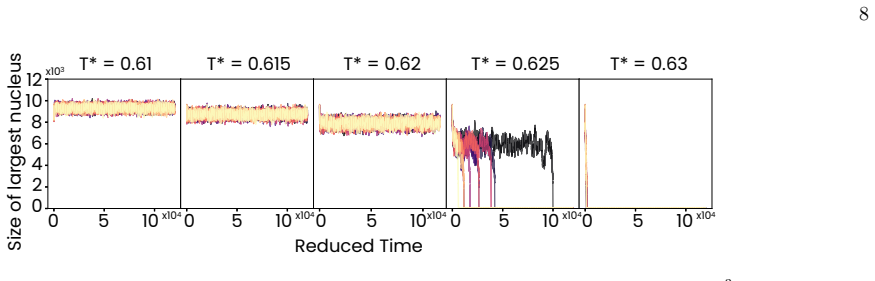
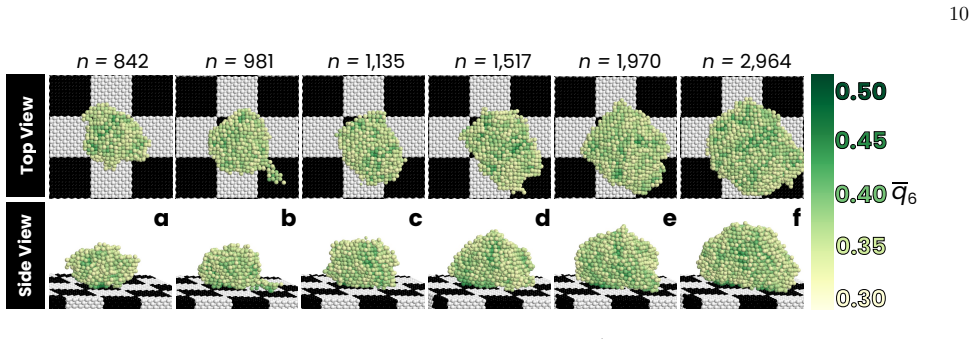
In molecular dynamics simulations of heterogeneous crystal nucleation in a model atomic liquid on a chemically uniform weakly attractive surface and on a checkerboard surface of alternating liquiphilic and liquiphobic patches, the nucleation rate retains its canonical temperature dependence predicted by classical nucleation theory. The contact angles of crystalline nuclei exhibit negligible dependence on nucleus size and temperature. On the checkerboard surface, nuclei maintain a fixed contact angle through pinning at patch boundaries and vertical growth into the bulk.
What carries the argument
Jumpy forward flux sampling in molecular dynamics simulations that computes nucleation rates and tracks the geometry and contact angles of nuclei on chemically patterned substrates.
If this is right
- Standard classical nucleation theory formulas can be used to predict nucleation kinetics on chemically non-uniform surfaces without major adjustments.
- Nucleus contact angles remain stable, allowing the spherical-cap description to hold even when the surface chemistry varies at small scales.
- Pinning at patch boundaries on checkerboard patterns enforces constant contact angles by directing growth away from the surface.
- The dominance of active patches over surrounding inert regions explains why nucleation still occurs at expected rates.
Where Pith is reading between the lines
- The same pinning mechanism may allow control of nucleation directionality on engineered surfaces with designed patch sizes.
- Robustness to chemical heterogeneity suggests classical nucleation theory could also tolerate moderate topographic roughness in many practical cases.
- If critical nucleus size is smaller than patch spacing, nucleation should localize on the most attractive patches, simplifying surface design for selective crystallization.
Load-bearing premise
The chosen model atomic liquid and the interaction potentials assigned to the liquiphilic and liquiphobic patches represent the behavior of real chemically heterogeneous nucleating substrates.
What would settle it
An experiment that measures nucleation rates on a surface with alternating attractive and repulsive chemical patches and finds a temperature dependence that deviates from the form expected by classical nucleation theory would falsify the reported robustness.
Figures





read the original abstract
Heterogeneous nucleation is a process wherein extrinsic impurities facilitate freezing by lowering nucleation barriers and constitutes the dominant mechanism for crystallization in most systems. Classical nucleation theory (\textsc{Cnt}) has been remarkably successful in predicting the kinetics of heterogeneous nucleation, even on chemically and topographically non-uniform surfaces, despite its reliance on several restrictive assumptions, such as the idealized spherical-cap geometry of the crystalline nuclei. Here, we employ molecular dynamics simulations and jumpy forward flux sampling to investigate the kinetics and mechanism of heterogeneous crystal nucleation in a model atomic liquid. We examine both a chemically uniform, weakly attractive liquiphilic surface and a checkerboard surface comprised of alternating liquiphilic and liquiphobic patches. We find the nucleation rate to retain its canonical temperature dependence predicted by \textsc{Cnt} in both systems. Moreover, the contact angles of crystalline nuclei exhibit negligible dependence on nucleus size and temperature. On the checkerboard surface, nuclei maintain a fixed contact angle through pinning at patch boundaries and vertical growth into the bulk. These findings offer insights into the robustness of \textsc{Cnt} in experimental scenarios, where nucleating surfaces often feature active hotspots surrounded by inert or liquiphobic domains.
Editorial analysis
A structured set of objections, weighed in public.
Referee Report
Summary. The manuscript uses molecular dynamics simulations and jumpy forward flux sampling to study heterogeneous crystal nucleation in a model atomic liquid on a chemically uniform liquiphilic surface and a checkerboard surface with alternating liquiphilic and liquiphobic patches. It reports that the nucleation rate retains the canonical temperature dependence predicted by classical nucleation theory (CNT) in both systems, and that contact angles of crystalline nuclei exhibit negligible dependence on nucleus size and temperature, with nuclei on the checkerboard maintaining a fixed angle through pinning at patch boundaries and vertical growth into the bulk.
Significance. If the central claims hold, the work supplies direct simulation support for the robustness of CNT geometric and kinetic assumptions under chemical heterogeneity, a common feature of experimental nucleating substrates. The combination of advanced sampling with explicit checks on size and temperature dependence of contact angles strengthens the evidence that CNT can remain predictive even when idealized spherical-cap geometry is only approximately realized.
major comments (2)
- [§4.2] §4.2 (contact-angle extraction): The claim of negligible size and temperature dependence of contact angles is load-bearing for the assertion that CNT geometry assumptions survive heterogeneity. For sub-critical nuclei only a few molecular diameters across, any spherical-cap fit to a density isosurface will couple the apparent angle to the instantaneous radius because the solid-liquid interface has a diffuse width of ~2-3 particle diameters. The manuscript must specify the precise protocol (density threshold, averaging over contact line, or alternative definition) and demonstrate that the reported independence is insensitive to reasonable variations in that protocol.
- [§3.1] §3.1 and Table 1 (nucleation-rate temperature dependence): The statement that rates retain the canonical CNT form is central, yet the text does not report error bars on the rates, finite-size scaling checks, or explicit convergence diagnostics for the forward-flux sampling. Without these, it is impossible to judge whether the observed temperature dependence is robust or influenced by sampling limitations.
minor comments (2)
- [Abstract] The abstract introduces 'jumpy forward flux sampling' without a one-sentence definition; a brief parenthetical description would help readers outside the immediate subfield.
- [Figure 3] Figure 3 (checkerboard snapshots): The visual distinction between pinned and unpinned nuclei would be clearer if the patch boundaries were overlaid as dashed lines and the contact-line atoms highlighted.
Simulated Author's Rebuttal
We thank the referee for the careful reading of our manuscript and the constructive comments, which help strengthen the methodological transparency and support for our conclusions regarding the robustness of classical nucleation theory. We have revised the manuscript to address both major points by adding the requested details and checks. Our point-by-point responses follow.
read point-by-point responses
-
Referee: [§4.2] §4.2 (contact-angle extraction): The claim of negligible size and temperature dependence of contact angles is load-bearing for the assertion that CNT geometry assumptions survive heterogeneity. For sub-critical nuclei only a few molecular diameters across, any spherical-cap fit to a density isosurface will couple the apparent angle to the instantaneous radius because the solid-liquid interface has a diffuse width of ~2-3 particle diameters. The manuscript must specify the precise protocol (density threshold, averaging over contact line, or alternative definition) and demonstrate that the reported independence is insensitive to reasonable variations in that protocol.
Authors: We agree that a clear specification of the contact-angle protocol and tests of its sensitivity are necessary to substantiate the claim. In the revised manuscript we have expanded §4.2 with an explicit description of the procedure: spherical caps are fitted to the 50 % bulk-density isosurface of the crystalline nucleus after averaging the density field over 100 ps windows; the contact angle is then extracted from the average slope at the three-phase contact line. We have added a sensitivity analysis (new Supplementary Figure S5) in which the density threshold is varied between 0.4ρ_bulk and 0.6ρ_bulk and an alternative Gibbs-dividing-surface definition is used. The negligible size and temperature dependence of the contact angle, as well as the pinning-induced constancy on the checkerboard surface, remains unchanged across these choices. These additions directly address the referee’s concern without altering the original conclusions. revision: yes
-
Referee: [§3.1] §3.1 and Table 1 (nucleation-rate temperature dependence): The statement that rates retain the canonical CNT form is central, yet the text does not report error bars on the rates, finite-size scaling checks, or explicit convergence diagnostics for the forward-flux sampling. Without these, it is impossible to judge whether the observed temperature dependence is robust or influenced by sampling limitations.
Authors: We acknowledge that the original text omitted quantitative uncertainties and convergence diagnostics. In the revised version we have updated Table 1 to include statistical error bars obtained from eight independent jumpy-forward-flux-sampling trajectories per temperature. A new paragraph in §3.1 now reports convergence tests with respect to the number of FFS interfaces and the flux-collection window length, demonstrating that the reported rates change by less than 10 % once the interface count exceeds the value used in the production runs. We have also performed a finite-size check by repeating the entire temperature series in a laterally doubled simulation cell; the Arrhenius slope and the overall temperature dependence remain identical within the reported uncertainties. These revisions allow the reader to assess the robustness of the canonical CNT temperature dependence. revision: yes
Circularity Check
No circularity: simulation-based empirical validation against known CNT form
full rationale
The manuscript reports molecular dynamics simulations combined with jumpy forward flux sampling to measure nucleation rates and contact angles on uniform and checkerboard surfaces. These quantities are computed directly from the trajectories and compared to the pre-existing functional form of classical nucleation theory; no parameter is fitted to a subset of the data and then re-labeled as a prediction, and no analytic derivation is performed that could loop back to its own inputs. The contact-angle measurements are obtained from the simulated nuclei via standard geometric protocols, with no self-referential definition or uniqueness theorem imported from prior work by the same authors. The study is therefore self-contained against external benchmarks and exhibits no load-bearing circular steps.
Axiom & Free-Parameter Ledger
free parameters (1)
- liquiphilic and liquiphobic interaction strengths
axioms (2)
- domain assumption The model atomic liquid and pairwise potentials accurately represent real heterogeneous nucleation substrates.
- standard math Jumpy forward flux sampling correctly computes nucleation rates without bias from the chosen order parameter.
Lean theorems connected to this paper
-
IndisputableMonolith/Cost/FunctionalEquation.leanwashburn_uniqueness_aczel unclear?
unclearRelation between the paper passage and the cited Recognition theorem.
the contact angles of crystalline nuclei exhibit negligible dependence on nucleus size and temperature. On the checkerboard surface, nuclei maintain a fixed contact angle through pinning at patch boundaries and vertical growth into the bulk.
-
IndisputableMonolith/Foundation/AbsoluteFloorClosure.leanreality_from_one_distinction unclear?
unclearRelation between the paper passage and the cited Recognition theorem.
lnRhet = lnAhet + Chet / T(T−Tm)² with Chet = fc(θc)Chom
What do these tags mean?
- matches
- The paper's claim is directly supported by a theorem in the formal canon.
- supports
- The theorem supports part of the paper's argument, but the paper may add assumptions or extra steps.
- extends
- The paper goes beyond the formal theorem; the theorem is a base layer rather than the whole result.
- uses
- The paper appears to rely on the theorem as machinery.
- contradicts
- The paper's claim conflicts with a theorem or certificate in the canon.
- unclear
- Pith found a possible connection, but the passage is too broad, indirect, or ambiguous to say the theorem truly supports the claim.
Reference graph
Works this paper leans on
-
[1]
Baker, M. B. Cloud Microphysics and Climate.Science 1997,276, 1072–1078
work page 1997
-
[2]
Veis, A.; Dorvee, J. R. Biomineralization mechanisms: a new paradigm for crystal nucleation in organic matrices. Calcif. Tissue Int.2013,93, 307–315
work page 2013
-
[3]
L.; Van Anders, G.; Banin, U.; Baranov, D.; Chen, Q.; Dijkstra, M.; Dimitriyev, M
Bassani, C. L.; Van Anders, G.; Banin, U.; Baranov, D.; Chen, Q.; Dijkstra, M.; Dimitriyev, M. S.; Efrati, E.; Faraudo, J.; Gang, O., et al. Nanocrystal Assemblies: Current Advances and Open Problems.ACS nano2024, 18, 14791–14840
-
[4]
Sharma, M.; Panigrahi, J.; Komarala, V. K. Nanocrys- talline silicon thin film growth and application for silicon heterojunction solar cells: a short review.Nanoscale Ad- vances2021,3, 3373–3383
-
[5]
Lee, J.; Yang, J.; Kwon, S. G.; Hyeon, T. Nonclassical nucleation and growth of inorganic nanoparticles.Nat. Rev. Mater.2016,1, 1–16
work page 2016
-
[6]
Chen, J.; Sarma, B.; Evans, J. M. B.; Myerson, A. S. Pharmaceutical Crystallization.Cryst. Growth Des.2011, 11, 887–895
work page 2011
-
[7]
Oxtoby, D. W. Homogeneous nucleation: theory and experiment.J. Phys. Condens. Mat.1992,4, 7627
work page 1992
-
[8]
Artusio, F.; Gavira, J. A.; Pisano, R. Self-Assembled Monolayers As a Tool to Investigate the Effect of Surface Chemistry on Protein Nucleation.Cryst. Growth Des. 2023,23, 3195–3201
work page 2023
-
[9]
Aizenberg, J.; Black, A. J.; Whitesides, G. M. Control of crystal nucleation by patterned self-assembled monolayers. Nature1999,398, 495–498
-
[10]
Guan, Y. F.; Hong, X. Y.; Karanikola, V.; Wang, Z.; Pan, W.; Wu, H. A.; Wang, F. C.; Yu, H. Q.; Elimelech, M. Gypsum heterogenous nucleation pathways regulated by surface functional groups and hydrophobicity.Nat. Comm. 2025,16, 1–12
work page 2025
-
[11]
Cox, J. R.; Ferris, L. A.; Thalladi, V. R. Selective Growth of a Stable Drug Polymorph by Suppressing the Nucle- ation of Corresponding Metastable Polymorphs.Angew. Chem. Int. Edit.2007,46, 4333–4336
work page 2007
-
[12]
Nordquist, K. A.; Schaab, K. M.; Sha, J.; Bond, A. H. Crystal Nucleation Using Surface-Energy-Modified Glass Substrates.Cryst. Growth Des.2025,17, 4049–4055
work page 2025
-
[13]
K.; Hsu, M.; Bhate, N.; Yang, W.; Deng, T
Varanasi, K. K.; Hsu, M.; Bhate, N.; Yang, W.; Deng, T. Spatial control in the heterogeneous nucleation of water. Appl. Phys. Lett.2009,95, 94101
work page 2009
-
[14]
Karthika, S.; Radhakrishnan, T. K.; Kalaichelvi, P. A Review of Classical and Nonclassical Nucleation Theories. Cryst. Growth Des.2016,16, 6663–6681
work page 2016
-
[15]
Keibildung in ´’ubers´’attigten Gebilden.Z
Volmer, M.; Weber, I. Keibildung in ´’ubers´’attigten Gebilden.Z. Phys. Chem.1926,119U, 277–301
work page 1926
-
[16]
Kinetische Behandlung der Ke- imbildung in ¨ ubers¨ attigten D¨ ampfen.Ann
Becker, R.; D¨ oring, W. Kinetische Behandlung der Ke- imbildung in ¨ ubers¨ attigten D¨ ampfen.Ann. Phys.–Berlin 1935,416, 719–752
work page 1935
-
[17]
Turnbull, D.; Fisher, J. C. Rate of Nucleation in Con- densed Systems.J. Chem. Phys.1949,17, 71–73
work page 1949
-
[18]
Kinetics of heterogeneous nucleation.J
Turnbull, D. Kinetics of heterogeneous nucleation.J. Chem. Phys.1950,18, 198–203
work page 1950
-
[19]
Ice nucleation on carbon surface supports the classical theory for heterogeneous nucleation
Cabriolu, R.; Li, T. Ice nucleation on carbon surface supports the classical theory for heterogeneous nucleation. Phys. Rev. E2015,91, 052402
-
[20]
Alpert, P. A.; Aller, J. Y.; Knopf, D. A. Initiation of the ice phase by marine biogenic surfaces in supersaturated gas and supercooled aqueous phases.Phys. Chem. Chem. Phys.2011,13, 19882–19894
work page 2011
-
[21]
Karlsson, J.; Cravalho, E. G.; Rinkes, I. B.; Tomp- kins, R. G.; Yarmush, M. L.; Toner, M. Nucleation and growth of ice crystals inside cultured hepatocytes during freezing in the presence of dimethyl sulfoxide.Biophys. J. 1993,65, 2524–2536
work page 1993
-
[22]
Conrad, P.; Ewing, G. E.; Karlinsey, R. L.; Sadtchenko, V. Ice nucleation on BaF2 (111).J. Chem. Phys.2005,122, 064709
work page 2005
-
[23]
Wang, B.; Wen, T.; Zhang, X.; Tercjak, A.; Dong, X.; M¨ uller, A. J.; Wang, D.; Cavallo, D. Nucleation of Poly (lactide) on the Surface of Different Fibers.Macro- molecules2019,52, 6274–6284
-
[24]
Line tension controls wall-induced crystal nucleation in hard-sphere colloids.Phys
Auer, S.; Frenkel, D. Line tension controls wall-induced crystal nucleation in hard-sphere colloids.Phys. Rev. Lett. 2003,91, 015703
work page 2003
-
[25]
How size and aggrega- tion of ice-binding proteins control their ice nucleation efficiency.J
Qiu, Y.; Hudait, A.; Molinero, V. How size and aggrega- tion of ice-binding proteins control their ice nucleation efficiency.J. Am. Chem. Soc.2019,141, 7439–7452
work page 2019
-
[26]
Role of Nanoscale Interfacial Proximity in Contact Freezing in Water.J
Hussain, S.; Haji-Akbari, A. Role of Nanoscale Interfacial Proximity in Contact Freezing in Water.J. Am. Chem. Soc.2021,143, 2272–2284
work page 2021
-
[27]
Forward-flux sampling with jumpy order parameters.J
Haji-Akbari, A. Forward-flux sampling with jumpy order parameters.J. Chem. Phys.2018,149, 072303
work page 2018
-
[28]
On the determination of molecular fields.—I
Lennard, J.; Jones, I. On the determination of molecular fields.—I. From the variation of the viscosity of a gas with temperature.P. Roy. Soc. A- Math. Phys.1924,106, 441–462
work page 1924
-
[29]
Thompson, A. P.; Aktulga, H. M.; Berger, R.; Bolin- tineanu, D. S.; Brown, W. M.; Crozier, P. S.; in ’t Veld, P. J.; Kohlmeyer, A.; Moore, S. G.; Nguyen, T. D.; Shan, R.; Stevens, M. J.; Tranchida, J.; Trott, C.; Plimp- ton, S. J. LAMMPS - a flexible simulation tool for particle- based materials modeling at the atomic, meso, and contin- uum scales.Comput....
work page 2022
-
[30]
Weeks, J. D.; Chandler, D.; Andersen, H. C. Role of Re- pulsive Forces in Determining the Equilibrium Structure of Simple Liquids.J. Chem. Phys.1971,54, 5237–5247
work page 1971
-
[31]
Hussain, S.; Haji-Akbari, A. How to quantify and avoid finite size effects in computational studies of crystal nu- cleation: The case of homogeneous crystal nucleation.J. 12 Chem. Phys.2022,156, 54503
work page 2022
-
[32]
Sosso, G. C.; Tribello, G. A.; Zen, A.; Pedevilla, P.; Michaelides, A. Ice formation on kaolinite: Insights from molecular dynamics simulations.J. Chem. Phys.2016, 145, 211927
work page 2016
-
[33]
Bi, Y.; Cabriolu, R.; Li, T. Heterogeneous ice nucleation controlled by the coupling of surface crystallinity and surface hydrophilicity.J. Phys. Chem. C2016,120, 1507– 1514
-
[34]
A molecular dynamics method for simulations in the canonical ensemble.Mol
Nos´ e, S. A molecular dynamics method for simulations in the canonical ensemble.Mol. Phys.1984,52, 255–268
work page 1984
-
[35]
Hoover, W. G. Canonical dynamics: Equilibrium phase- space distributions.Phys. Rev. A1985,31, 1695–1697
-
[36]
Polymorphic transitions in single crystals: A new molecular dynamics method.J
Parrinello, M.; Rahman, A. Polymorphic transitions in single crystals: A new molecular dynamics method.J. Appl. Phys.1981,52, 7182–7190
work page 1981
-
[37]
Allen, R. J.; Frenkel, D.; ten Wolde, P. R. Simulating rare events in equilibrium or nonequilibrium stochastic systems.J. Chem. Phys.2006,124, 024102
work page 2006
-
[38]
Lechner, W.; Dellago, C. Accurate determination of crys- tal structures based on averaged local bond order param- eters.Journal of Chemical Physics2008,129
-
[39]
Steinhardt, P. J.; Nelson, D. R.; Ronchetti, M. Bond- orientational order in liquids and glasses.Phys. Rev. B 1983,28, 784–805
work page 1983
-
[40]
S.; Hussain, S.; Haji-Akbari, A
Domingues, T. S.; Hussain, S.; Haji-Akbari, A. Diver- gence among Local Structure, Dynamics, and Nucleation Outcome in Heterogeneous Nucleation of Close-Packed Crystals.J. Phys. Chem. Lett.2024,15, 1279–1287
work page 2024
-
[41]
Sinaeian, K.; Haji-Akbari, A. The impact of hydration shell inclusion and chain exclusion in the efficacy of reac- tion coordinates for homogeneous and heterogeneous ice nucleation.J. Chem. Phys.2025,162, 164102
work page 2025
-
[42]
Hussain, S.; Haji-Akbari, A. How to Quantify and Avoid Finite Size Effects in Computational Studies of Crystal Nucleation: The Case of Heterogeneous Ice Nucleation. J. Chem. Phys.2021,154, 014108
work page 2021
-
[43]
New method to analyze simulations of activated processes.J
Wedekind, J.; Strey, R.; Reguera, D. New method to analyze simulations of activated processes.J. Chem. Phys. 2007,126, 134103
work page 2007
-
[44]
Giovambattista, N.; Debenedetti, P. G.; Rossky, P. J. Effect of surface polarity on water contact angle and interfacial hydration structure.J. Phys. Chem. B2007, 111, 9581–9587
-
[45]
Phase diagrams of Lennard-Jones fluids.J
Smit, B. Phase diagrams of Lennard-Jones fluids.J. Chem. Phys.1992,96, 8639–8640
work page 1992
-
[46]
Frenkel, D.; Ladd, A. J. New Monte Carlo method to compute the free energy of arbitrary solids. Application to the fcc and hcp phases of hard spheres.J. Chem. Phys. 1984,81, 3188–3193
work page 1984
-
[47]
Haji-Akbari, A.; Engel, M.; Glotzer, S. C. Phase Diagram of Hard Tetrahedra.J. Chem. Phys.2011,135
work page 2011
-
[48]
Martyna, G. J.; Klein, M. L.; Tuckerman, M. Nos´ e–Hoover chains: The canonical ensemble via continuous dynamics. J. Chem. Phys.1992,97, 2635–2643
work page 1992
-
[49]
Agrawal, R.; Kofke, D. A. Thermodynamic and structural properties of model systems at solid-fluid coexistence.Mol. Phys.1995,85, 43–59
work page 1995
-
[50]
Studying rare events using forward-flux sampling: Recent breakthroughs and future outlook.J
Hussain, S.; Haji-Akbari, A. Studying rare events using forward-flux sampling: Recent breakthroughs and future outlook.J. Chem. Phys.2020,152
work page 2020
-
[51]
Breakdown of classical nucleation theory near isostructural phase transitions
Cacciuto, A.; Auer, S.; Frenkel, D. Breakdown of classical nucleation theory near isostructural phase transitions. Phys. Rev. Lett.2004,93, 166105
work page 2004
-
[52]
Baidakov, V. G.; Protsenko, K. R. Spontaneous crystal- lization of a supercooled Lennard-Jones liquid: Molecular dynamics simulation.J. Phys. Chem. B2019,123, 8103– 8112
discussion (0)
Sign in with ORCID, Apple, or X to comment. Anyone can read and Pith papers without signing in.