REVIEW 3 major objections 5 minor 3 cited by
Deterministic single-photon nonlinearities lift photonic fault-tolerance thresholds to 11.5–15.1%.
Reviewed by Pith at T0; open to challenge. T0 means a machine referee read the full paper against a public rubric. the ladder, T0–T4 →
A photonic fault-tolerance architecture using deterministic single-photon nonlinearities maintains surface-code loss thresholds of up to 15.1% with QPC-encoded 2-chain resource states.
T0 review reviewed 2026-08-04 challenge →
load-bearing objection Conditional but credible design study: the loss thresholds are real upper bounds under an ideal π-nonlinearity, and the paper says so only at the end. the 3 major comments →
Nonlinear photonic architecture for fault-tolerant quantum computing
The pith
A machine-rendered reading of the paper's core claim, the machinery that carries it, and where it could break.
The reading
Core claim
On its own terms, the paper's central claim is that a deterministic single-photon nonlinearity—a self-Kerr interaction that applies a π phase to the two-photon component—turns the probabilistic Bell measurements used to implement 4-GHZ measurements in a GHZ-measurement-based architecture into near-deterministic operations. The eigenvalue return probability for the ZZ-type measurement then changes from a loss-plus-intrinsic-failure expression (Eq. 4) to a loss-only form (Eq. 5). In the foliated surface code (RHG lattice) built from QPC(n,m)-encoded 2-chain resource states, this change yields single-photon loss thresholds of 11.5% (32 photons) and 15.1% (96 photons), with resource-state genera
What carries the argument
The load-bearing component is the deterministic nonlinear photonic CZ gate, implemented via an ideal π single-photon nonlinearity (a nonlinear sign-shift). The same module generates small entangled seed states (Bell and three-qubit GHZ states) and performs the deterministic Bell measurements that implement the 4-GHZ measurements of the foliated surface code. Its importance is that it removes the factor-of-one-half intrinsic failure that exists even in lossless linear-optical Bell measurements, reducing the eigenvalue return probability to a loss-only expression.
Load-bearing premise
The results depend on an ideal, loss-free, deterministic π single-photon nonlinearity, so that photon loss is the only mechanism that can reduce the success probability of measurements; any intrinsic loss, strong-drive requirement, or probabilistic behaviour in the gate erodes the threshold advantage.
What would settle it
Measure the per-gate loss and success probability of a real single-photon π-nonlinearity (e.g., a single atom or quantum dot coupled to a cavity/waveguide); if the gate's success probability is significantly below 1, the loss-only eigenvalue-return formula of Eq. (5) fails and the Table I thresholds are not achievable.
If this is right
- Single-photon loss thresholds of 11.5% and 15.1% for 32- and 96-photon resource states, achieved without adaptivity and comparable to or better than linear-optical schemes that do use adaptivity.
- Resource-state generation becomes near-deterministic with one multiplexing stage, versus roughly six in linear-optical designs, with fewer than 10,000 nonlinear sources per logical qubit.
- Most optical circuitry can operate at room temperature; only a modest number of photon detectors need cryogenic cooling, reducing system footprint.
- The architecture supports magic state injection for universality and can accommodate non-π nonlinearities, giving hardware flexibility.
Where Pith is reading between the lines
- A natural next step the paper leaves open is computing how much intrinsic loss in the nonlinear gate itself can be tolerated before the threshold advantage vanishes; that calculation would bound the hardware requirements.
- Because the same deterministic nonlinear Bell measurement enables networking, the approach could also solve the probabilistic-interconnect bottleneck in modular matter-qubit platforms if the nonlinearity can be integrated with them.
- Applying the same loss-only eigenvalue-return formula to other fusion-based or measurement-based codes would likely raise their loss thresholds as well, since the improvement is not specific to the foliated surface code.
- A direct experimental benchmark—measuring the loss and success probability of the nonlinear CZ gate—would be a decisive test: if gate-level loss is non-negligible, the predicted thresholds must be revised downward.
Editorial analysis
A structured set of objections, weighed in public.
Referee Report
Summary. The paper proposes a photonic fault-tolerant quantum computing architecture that combines deterministic single-photon nonlinearities with the GHZ-measurement-based MBQC framework of Ref. [33]. The authors replace probabilistic linear-optical Bell measurements with deterministic nonlinear Bell measurements, giving eigenvalue-return probabilities in Eq. (5) that approach 1 in the lossless limit. Using QPC(n,m)-encoded 2-chain resource states and a foliated surface code, they report single-photon loss thresholds of 11.5% for a 32-photon resource state and 15.1% for a 96-photon resource state, and claim that one stage of multiplexing suffices to make resource-state generation near-deterministic. The paper also argues for large reductions in component count, switching layers, and cryogenic footprint relative to linear-optical architectures.
Significance. If the central assumption of an ideal, lossless deterministic π-nonlinearity is met, the paper gives a transparent, parameter-free route to substantially higher photonic loss thresholds than linear-optical fusion architectures: Eqs. (4) and (5) are simple and interpretable, and the Monte Carlo study covers several QPC encodings. The concrete 32-photon/11.5% resource-state choice is a useful engineering target, and the comparison with linear-optical thresholds in Fig. 6 is a strength. However, the significance is currently conditional: the thresholds are upper bounds under an idealized nonlinear primitive, and the resource-overhead estimates are not derived.
major comments (3)
- [Section III.B and VI, Eq. (5)] The central loss-tolerance claim rests on the step from Eq. (4) to Eq. (5), which assumes that 'loss is the only mechanism that reduces the success probability' of the nonlinear entangling circuit. The conclusion (Sec. VI) acknowledges 'We have assumed ideal π-nonlinearities in this study', but no sensitivity analysis is provided. A realistic nonlinearity will have intrinsic loss and a non-unit gate success probability; a failed nonlinear interaction contributes either additional loss or a Pauli-type error that is not an erasure. Such terms enter Eq. (5) in the same way the factor 1/2 appears in Eq. (4), and the Table I thresholds (11.5% and 15.1%) would move toward the linear-optical values. The abstract's claim of 'dramatically' improved loss tolerance is therefore not yet demonstrated for a concrete device. Please add a parametric model, e.g., gate success probability q and added loss
- [Section IV, Table I] The threshold extraction is under-specified. The text gives only 50k Monte Carlo samples, a lattice geometry d×d×(2d+1), and d∈{11,13,15}; it does not specify the decoder implementation (MWPM vs union-find), the exact mapping from photon loss to erased eigenvalues and supercheck construction, or the finite-size extrapolation used to obtain the quoted two-digit thresholds. No error bars are reported. With 50k samples, threshold estimates typically carry a statistical uncertainty of order 0.1 percentage point, which is enough to affect the ordering in Fig. 6 and the comparison in Table I. For reproducibility, the authors should provide these details or release the simulation code.
- [Section III.B] The resource-overhead advantage relies on the claim that 'just a single stage of multiplexing is sufficient to make the overall nonlinear resource state generation near-deterministic', compared with six stages for linear optics [40]. No derivation, numerical simulation, or success-probability budget is given for the nonlinear resource-state generator. Since the RSG success probability depends on the number of nonlinear gates, their loss, and the seed-state generation probability, this one-stage claim cannot be checked from the manuscript. The abstract's statement that nonlinearities 'substantially reduce resource overheads' needs quantitative backing, or the claim should be explicitly labelled as an assumption.
minor comments (5)
- [Section VI] Typo: 'out analysis' should read 'our analysis'.
- [Section V] The estimate of 'fewer than 10k nonlinear single-photon sources' for a logical qubit is given without stating the underlying assumptions (e.g., per-source efficiency, multiplexing depth, number of RSG attempts per logical qubit). Please specify the resource model or remove the quantitative claim.
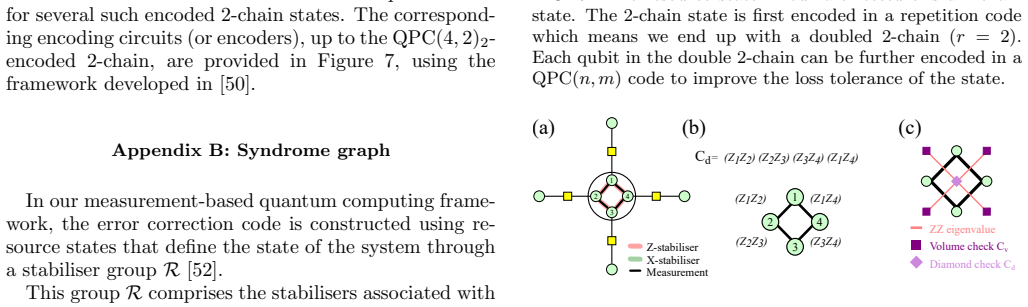
- [Section III.C and Appendix B] The derivation of Eq. (5) is not shown. Even if the assumption of ideal nonlinearities is accepted, the passage from 'loss is the only mechanism' to the exact algebraic form of P_zz and P_xx should be sketched, and the treatment of losses inside the entangled resource branch vs. the measurement branch should be clarified.
- [Figure 6] The legend says the nonlinear threshold uses 'no adaptivity' but the reader must infer which symbols are which. Please define the filled square and triangle explicitly in the caption.
- [Appendix A] The rotated QPC convention in Eqs. (A3)-(A4) is terse; a sentence explaining how the rotated basis is used in the Bell-measurement syndrome graph would help.
Circularity Check
No significant circularity: the loss thresholds are conditional Monte Carlo simulations from an explicitly stated ideal-nonlinearity model, not fitted parameters or self-imported results.
full rationale
The paper's central quantitative claims are the single-photon loss thresholds in Table I, obtained from Monte Carlo simulations over the foliated surface code using the analytic eigenvalue return probabilities in Eq. (5). These formulas are introduced as the model for a deterministic nonlinear Bell measurement, in contrast to the linear-optical Eq. (4), and they are not fitted to any data nor taken from a prior paper. The improved P_zz in Eq. (5) follows directly from the stated assumption that the nonlinear sign-shift gate and CZ gate are deterministic, so that 'loss is the only mechanism that reduces the success probability' (Section III.B). This is a model assumption, not a circular derivation: the thresholds are conditional predictions from that assumption. The paper explicitly flags the idealization in Section VI ('We have assumed ideal pi-nonlinearities in this study'), which is a limitation of scope and a validity concern for real hardware, but it does not make the derivation circular. The only notable self-citation is Ref. [33] (co-authored by Ostmann), used to adopt the GHZ-measurement-based architecture and as a comparison point for the linear-optical case. This is a standard incremental use of prior work; the loss-threshold calculations and the nonlinear formulas are developed in this paper and are not imported from the cited architecture paper. No step in the claimed derivation reduces by construction to its own inputs, and no load-bearing conclusion rests on an unverified self-citation. The central results are therefore best assessed as an idealized performance estimate rather than a circular argument.
Axiom & Free-Parameter Ledger
axioms (6)
- ad hoc to paper Deterministic single-photon π-phase nonlinearity (ideal nonlinear sign-shift gate) with negligible intrinsic loss.
- domain assumption Deterministic single-photon sources.
- domain assumption Loss is the only error mechanism; photon distinguishability and gate infidelity are neglected.
- standard math The GHZ-measurement-based architecture and its syndrome construction from Ref [33].
- domain assumption Eigenvalue return probability formula Eq. (5) for QPC-encoded nonlinear Bell measurements.
- ad hoc to paper A single stage of multiplexing is sufficient for near-deterministic resource state generation.
Cite this review
Pith. "Pith review of Nonlinear photonic architecture for fault-tolerant quantum computing." pith.science (2026). https://pith.science/paper/MIBEBBZ7
@misc{pith2026251006890,
  author       = {Pith},
  title        = {Pith review of: Nonlinear photonic architecture for fault-tolerant quantum computing},
  year         = {2026},
  howpublished = {\url{https://pith.science/paper/MIBEBBZ7}},
  note         = {Machine review of arXiv:2510.06890}
}
abstract
We propose a novel architecture for fault-tolerant quantum computing that incorporates strong single-photon nonlinearities into a photonic GHZ-measurement-based architecture. The nonlinearities substantially reduce resource overheads compared to conventional linear-optics-based architectures, which require significant redundancy to accommodate probabilistic photon generation and probabilistic entangling operations. By removing linear-optical failure modes, our nonlinear architecture can also tolerate much higher optical losses than linear approaches, with a baseline loss tolerance of $\sim$12\% using a 32-photon resource state and a foliated surface code. Nonlinear photonic architectures provide a route to dramatically improving practical implementations of fault-tolerant quantum computing.
Figures




Forward citations
Cited by 3 Pith papers
-
Manipulating Excitation Dynamics in Structured Waveguide Quantum Electrodynamics
Structured wQED with locally patterned coupling directionalities yields four distinct excitation dynamics from subradiant eigenmode interferences, with tunable localization-delocalization via spacing and chirality tha...
-
Photon Sorting with a Quantum Emitter
A quantum emitter in a waveguide sorts single- and two-photon light with 62% success, enabling Bell state measurements at 57% post-selected probability that exceeds the 50% linear-optics limit.
-
Towards Quantum Optimised Malware Containment
A hybrid quantum approach is proposed to achieve quadratic speedups in influence estimation and edge removal optimization for malware containment modeled as a network influence minimisation problem.
Reference graph
Works this paper leans on
-
[1]
N. P. Breuckmann and J. N. Eberhardt, PRX Quantum 2, 040101 (2021)
2021
- [2]
-
[3]
Google Quantum AI and Collaborators, Nature638, 920 (2025)
2025
-
[4]
M. Zhao, M. Singh, A. Singh, H. Thoreen, R. J. DeAn- gelo, D. Dominguez, A. Leenheer, F. Peyskens, A. Lukin, D. Englund, M. Eichenfield, N. Gemelke, and N. H. Wan, arXiv:2508.09920 (2025)
Pith/arXiv arXiv 2025
-
[5]
R. D. Delaney, L. R. Sletten, M. J. Cich, B. Estey, M. I. Fabrikant, D. Hayes, I. M. Hoffman, J. Hostet- ter, C. Langer, S. A. Moses, A. R. Perry, T. A. Peterson, A. Schaffer, C. Volin, G. Vittorini, and W. C. Burton, Physical Review X14, 041028 (2024)
2024
-
[6]
Carrera Vazquez, C
A. Carrera Vazquez, C. Tornow, D. Rist` e, S. Woerner, M. Takita, and D. J. Egger, Nature636, 75 (2024)
2024
-
[7]
Gidney, How to factor 2048 bit RSA integers with less than a million noisy qubits (2025)
C. Gidney, How to factor 2048 bit RSA integers with less than a million noisy qubits (2025)
2048
-
[8]
Mohseni, A
M. Mohseni, A. Scherer, K. G. Johnson, O. Wertheim, M. Otten, N. A. Aadit, Y. Alexeev, K. M. Bresniker, K. Y. Camsari, B. Chapman, S. Chatterjee, G. A. Dag- new, A. Esposito, F. Fahim, M. Fiorentino, A. Gajjar, A. Khalid, X. Kong, B. Kulchytskyy, E. Kyoseva, R. Li, P. A. Lott, I. L. Markov, R. F. McDermott, G. Pe- dretti, P. Rao, E. Rieffel, A. Silva, J. ...
2025
-
[9]
Litinski, How to compute a 256-bit elliptic curve pri- vate key with only 50 million Toffoli gates (2023)
D. Litinski, How to compute a 256-bit elliptic curve pri- vate key with only 50 million Toffoli gates (2023)
2023
-
[10]
Photonic Inc., arXiv:2406.01704 (2024)
Pith/arXiv arXiv 2024
-
[11]
de Gliniasty, P
G. de Gliniasty, P. Hilaire, P.-E. Emeriau, S. C. Wein, A. Salavrakos, and S. Mansfield, Quantum8, 1423 (2024)
2024
-
[12]
Riedel, T
D. Riedel, T. Graziosi, Z. Wang, C. De-Eknamkul, A. Abulnaga, J. Dietz, A. Mucchietto, M. Haas, M. Sutula, P. Barral, M. Pompili, C. Robens, J. Ha, D. Sukachev, D. Levonian, M. Bhaskar, M. Markham, and B. Machielse, A scalable photonic quantum inter- connect platform (2025)
2025
-
[13]
M. J. Weaver, P. Duivestein, A. C. Bernasconi, S. Scharmer, M. Lemang, T. C. v. Thiel, F. Hijazi, B. Hensen, S. Gr¨ oblacher, and R. Stockill, Nature nan- otechnology19, 166 (2024)
2024
-
[14]
M. Slysz, P. Rydlichowski, K. Kurowski, O. Bacarezza, E. C. Gomez, Z. Chandani, B. Heim, P. Khalate, W. R. Clements, and J. Fletcher, arXiv:2508.16297 (2025)
Pith/arXiv arXiv 2025
-
[15]
H. A. Rad, T. Ainsworth, R. N. Alexander, B. Altieri, M. F. Askarani, R. Baby, L. Banchi, B. Q. Baragiola, J. E. Bourassa, R. S. Chadwick,et al., Nature638, 912 (2025). 7
2025
-
[16]
R. Kailasanathan, W. R. Clements, M. R. Boskabadi, S. M. Gibford, E. Papadakis, C. J. Savoie, and S. S. Man- souri, arXiv:2508.21438 (2025)
arXiv 2025
-
[17]
Larsen, J
M. Larsen, J. Bourassa, S. Kocsis, J. Tasker, R. Chad- wick, C. Gonz´ alez-Arciniegas, J. Hastrup, C. Lopetegui- Gonz´ alez, F. Miatto, A. Motamedi,et al., Nature , 1 (2025)
2025
-
[18]
Bartolucci, P
S. Bartolucci, P. M. Birchall, M. Gimeno-Segovia, E. Johnston, K. Kieling, M. Pant, T. Rudolph, J. Smith, C. Sparrow, and M. D. Vidrighin, Creation of entangled photonic states using linear optics (2021)
2021
-
[19]
Bartolucci, P
S. Bartolucci, P. Birchall, D. Bonneau, H. Ca- ble, M. Gimeno-Segovia, K. Kieling, N. Nickerson, T. Rudolph, and C. Sparrow, Switch networks for pho- tonic fusion-based quantum computing (2021)
2021
-
[20]
Zektzer, X
R. Zektzer, X. Lu, K. T. Hoang, R. Shrestha, S. Austin, F. Zhou, A. Chanana, G. Holland, D. Westly, P. Lett, A. V. Gorshkov, and K. Srinivasan, Optica11, 1376 (2024)
2024
-
[21]
Bechler, A
O. Bechler, A. Borne, S. Rosenblum, G. Guendelman, O. E. Mor, M. Netser, T. Ohana, Z. Aqua, N. Drucker, R. Finkelstein,et al., Nature Physics14, 996 (2018)
2018
-
[22]
Maring, A
N. Maring, A. Fyrillas, M. Pont, E. Ivanov, P. Stepanov, et al., Nature Photonics18, 603 (2024)
2024
-
[23]
M. L. Chan, A. A. Capatos, P. Lodahl, A. S. Sørensen, and S. Paesani, Practical blueprint for low-depth pho- tonic quantum computing with quantum dots (2025)
2025
-
[24]
Simmons, PRX Quantum5, 010102 (2024)
S. Simmons, PRX Quantum5, 010102 (2024)
2024
-
[25]
Canteri, Z
M. Canteri, Z. X. Koong, J. Bate, A. Winkler, V. Krutyanskiy, and B. P. Lanyon, Physical Review Let- ters135, 080801 (2025)
2025
-
[26]
Stephenson, D
L. Stephenson, D. Nadlinger, B. Nichol, S. An, P. Dr- mota, T. G. Ballance, K. Thirumalai, J. F. Goodwin, D. M. Lucas, and C. Ballance, Physical Review Letters 124, 110501 (2020)
2020
-
[27]
Krutyanskiy, M
V. Krutyanskiy, M. Galli, V. Krcmarsky, S. Baier, D. Fioretto, Y. Pu, A. Mazloom, P. Sekatski, M. Canteri, M. Teller,et al., Physical Review Letters130, 050803 (2023)
2023
-
[28]
DeAbreu, C
A. DeAbreu, C. Bowness, A. Alizadeh, C. Chartrand, N. Brunelle, E. MacQuarrie, N. Lee-Hone, M. Ruether, M. Kazemi, A. Kurkjian,et al., Optics Express31, 15045 (2023)
2023
-
[29]
Lodahl, S
P. Lodahl, S. Mahmoodian, and S. Stobbe, Reviews of Modern Physics87, 347 (2015)
2015
-
[30]
H. J. Briegel, D. E. Browne, W. D¨ ur, R. Raussendorf, and M. Van den Nest, Nature Physics5, 19 (2009)
2009
-
[31]
Raussendorf and H
R. Raussendorf and H. J. Briegel, Physical Review Let- ters86, 5188 (2001)
2001
-
[32]
Bartolucci, P
S. Bartolucci, P. Birchall, H. Bomb ´ ın, H. Cable, C. Daw- son, M. Gimeno-Segovia, E. Johnston, K. Kieling, N. Nickerson, M. Pant, F. Pastawski, T. Rudolph, and C. Sparrow, Nature Communications14, 912 (2023)
2023
-
[33]
Pankovich, A
B. Pankovich, A. Kan, K. H. Wan, M. Ostmann, A. Neville, S. Omkar, A. Sohbi, and K. Br´ adler, Phys- ical Review Letters133, 050604 (2024)
2024
-
[34]
Knill, R
E. Knill, R. Laflamme, and G. J. Milburn, Nature409, 46 (2001)
2001
-
[35]
Thomas, L
P. Thomas, L. Ruscio, O. Morin, and G. Rempe, Nature 608, 677 (2022)
2022
-
[36]
K. H. Nielsen, Y. Wang, E. Deacon, P. I. Sund, Z. Liu, S. Scholz, A. D. Wieck, A. Ludwig, L. Midolo, A. S. Sørensen, S. Paesani, and P. Lodahl, Programmable non- linear quantum photonic circuits (2024)
2024
-
[37]
R. Uppu, F. T. Pedersen, Y. Wang, C. T. Olesen, C. Pa- pon, X. Zhou, L. Midolo, S. Scholz, A. D. Wieck, A. Lud- wig, and P. Lodahl, Science Advances6, eabc8268 (2020)
2020
-
[38]
A. Pick, E. Matekole, Z. Aqua, G. Guendelman, O. Firstenberg, J. Dowling, and B. Dayan, Physical Re- view Applied15, 054054 (2021)
2021
-
[39]
Witthaut, M
D. Witthaut, M. D. Lukin, and A. S. Sørensen, Euro- physics Letters97, 50007 (2012)
2012
-
[40]
S. C. Wein, T. G. de Brugi` ere, L. Music, P. Senellart, B. Bourdoncle, and S. Mansfield, Minimizing resource overhead in fusion-based quantum computation using hy- brid spin-photon devices (2024)
2024
-
[41]
et al., Nature617, 265 (2023)
Storz, S., Sch¨ ar, J., Kulikov, A. et al., Nature617, 265 (2023)
2023
-
[42]
A. Bolt, G. Duclos-Cianci, D. Poulin, and T. M. Stace, Physical Review Letters117, 070501 (2016)
2016
-
[43]
Raussendorf, J
R. Raussendorf, J. Harrington, and K. Goyal, New Jour- nal of Physics9, 199 (2007)
2007
-
[44]
Bartolucci, T
S. Bartolucci, T. Bell, H. Bombin, P. Birchall, J. Bul- mer, C. Dawson, T. Farrelly, S. Gartenstein, M. Gimeno- Segovia, D. Litinski, Y. Liu, R. Knegjens, N. Nickerson, A. Olivo, M. Pant, A. Patil, S. Roberts, T. Rudolph, C. Sparrow, D. Tuckett, and A. Veitia, Comparison of schemes for highly loss tolerant photonic fusion based quantum computing (2025)
2025
-
[45]
Bravyi and A
S. Bravyi and A. Kitaev, Physical Review A71, 022316 (2005)
2005
-
[46]
Bombin, I
H. Bombin, I. H. Kim, D. Litinski, N. Nickerson, M. Pant, F. Pastawski, S. Roberts, and T. Rudolph, Interleaving: Modular architectures for fault-tolerant photonic quan- tum computing (2021)
2021
-
[47]
Linde Engineering to deliver large cryo- genic plant to PsiQuantum in Australia, https://www.linde-engineering.com/news-and- events/press-releases/2025/linde-engineering-to-deliver- large-cryogenic-plant-to-psiquantum-in-australia (2025)
2025
-
[48]
J. Steinmetz, M. Ostmann, A. Neville, B. Pankovich, and A. Sohbi, arXiv:2412.13330 (2024)
Pith/arXiv arXiv 2024
-
[49]
D. Bacon and A. Casaccino, Quantum error correcting subsystem codes from two classical linear codes (2006), arXiv:quant-ph/0610088
Pith/arXiv arXiv 2006
-
[50]
Pankovich, A
B. Pankovich, A. Neville, A. Kan, S. Omkar, K. H. Wan, and K. Br´ adler, Physical Review A110, 032402 (2024)
2024
-
[51]
Bombin, D
H. Bombin, D. Litinski, N. Nickerson, F. Pastawski, and S. Roberts, Quantum8, 1379 (2024)
2024
-
[52]
Gottesman,Stabilizer codes and quantum error cor- rection(California Institute of Technology, 1997)
D. Gottesman,Stabilizer codes and quantum error cor- rection(California Institute of Technology, 1997)
1997
-
[53]
B. J. Brown and S. Roberts, Physical Review Research 2, 033305 (2020)
2020
-
[54]
Coecke and R
B. Coecke and R. Duncan, New Journal of Physics13, 043016 (2011)
2011
-
[55]
J. M. Auger, H. Anwar, M. Gimeno-Segovia, T. M. Stace, and D. E. Browne, Physical Review A97, 030301 (2018)
2018
-
[56]
S. D. Barrett and T. M. Stace, Physical Review Letters 105, 200502 (2010)
2010
- [57]
-
[58]
Delfosse and N
N. Delfosse and N. H. Nickerson, Quantum5, 595 (2021). Appendix A: Resource state encoding The resource states used in our quantum computing architecture are minimal in size, consisting of 2-qubit 8 graph states, referred to as 2-chain states. To implement GHZ measurements using Bell measurements, we apply a 2-qubit repetition code to each qubit, an appro...
2021
-
[59]
or union-find decoding [58]
This paper was first reviewed by deepseek-v4-flash on August 4, 2026.
discussion (0)
Sign in with ORCID, Apple, or X to comment. Anyone can read and Pith papers without signing in.