REVIEW 4 major objections 5 minor 6 cited by
Natural videos obey a probability-flow invariant that AI-generated videos, including Sora, measurably violate; the NSG ratio turns this violation into a reliable video detector.
Reviewed by Pith at T0; open to challenge. T0 means a machine referee read the full paper against a public rubric. the ladder, T0–T4 →
2026-08-04 10:48 UTC pith:642QPUQD
load-bearing objection A fresh physics-based video detector with strong empirical results, but the central theorem overclaims—the upper bound doesn't establish the MMD ordering. the 4 major comments →
Physics-Driven Spatiotemporal Modeling for AI-Generated Video Detection
The pith
A machine-rendered reading of the paper's core claim, the machinery that carries it, and where it could break.
Core claim
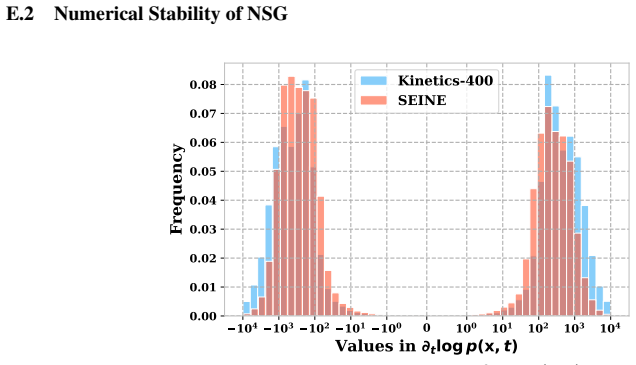
The central claim is that real-video spatiotemporal dynamics can be characterized by the invariant v(x,t)·g(x,t)≈1, where v is the probability-flow velocity and g is the Normalized Spatiotemporal Gradient. Generated videos come from a shifted distribution and break this invariant, which NSG amplifies. Under Gaussian assumptions, the paper shows the squared distance between NSG features of real and generated videos is bounded by a quantity that grows with the shift φ=∥μ∥²/σ(t)², so larger distributional shifts produce larger NSG discrepancies. Because the MMD between NSG features of real videos is therefore smaller than that between real and generated videos, NSG-VD separates real from synthe
What carries the argument
The Normalized Spatiotemporal Gradient (NSG), defined as g(x,t)=∇x log p(x,t)/(−∂t log p(x,t)+λ), is the ratio that carries the argument. It is estimated without explicit motion decomposition: the spatial gradient comes from the score function sθ of a pre-trained diffusion model, and the temporal derivative comes from the brightness-constancy assumption p(x+Δx,t+Δt)≈p(x,t), which yields ∂t log p≈−∇x log p·Δx/Δt. The detection statistic is the MMD between NSG features of a test video and a reference set of real videos, with a learned deep kernel.
Load-bearing premise
The entire derivation collapses if the probability density is not approximately constant along real-video motion trajectories between consecutive frames, because then the temporal-derivative estimate no longer measures the physical quantity that NSG needs.
What would settle it
Use a physically accurate renderer with rigid-body kinematics, consistent lighting, and real sensor noise to produce synthetic videos whose NSG distances to real videos should be small if the theory is right; running NSG-VD on such videos would settle whether the detector responds to distribution shift or merely to synthetic-looking content, because if these physically correct videos are flagged as reliably as diffusion-generated videos, the claimed amplification under distribution shift is falsified.
If this is right
- Detectors built on the NSG invariant transfer across generation paradigms without generator-specific training, since they depend on physical constraints rather than surface artifacts.
- The proved upper bound predicts that real-vs-fake MMD grows with distribution shift, so detection should become easier as generators drift further from real video statistics.
- Scarce synthetic training data degrades performance gracefully: the method retains high recall on Sora and WildScrape even when trained on only 1,000 fake videos.
- The same estimator works at reduced diffusion resolution (128x128 or 64x64), trading modest AUROC for 67 to 92 percent faster inference.
- NSG components are complementary: spatial gradients alone give 87.99 percent recall, temporal derivatives alone 60.35 percent, while their physics-constrained ratio reaches 88.02 percent recall and 90.87 percent F1-score.
Where Pith is reading between the lines
- The probability-flow invariant is not video-specific; the same ratio of spatial to temporal log-density changes could be estimated for audio, EEG, or other time-series data, potentially exposing synthetic signals by the same mechanism.
- The brightness-constancy assumption is most plausible for slow, smooth motion; real videos with fast cuts or camera shakes may themselves produce large NSG distances, so performance on high-motion real footage should be checked before deployment.
- Because NSG measures a physical constraint violation, it could be repurposed as a quantitative physics-faithfulness score for video generators, helping developers debug why a model's motion violates continuity.
- The bound's dependence on φ=∥μ∥²/σ² hints at a calibration recipe: measure NSG distance on a small set of real videos to set a per-domain threshold rather than fixing a single global τ.
Editorial analysis
A structured set of objections, weighed in public.
Referee Report
Summary. The paper proposes NSG-VD, a physics-inspired method for detecting AI-generated videos. The core idea is a Normalized Spatiotemporal Gradient (NSG) statistic, defined as the ratio of a spatial log-density gradient to a temporal log-density derivative, motivated by probability-flow conservation. The method estimates spatial gradients with a pre-trained diffusion model and temporal derivatives via a brightness-constancy approximation. Detection is performed by computing MMD between NSG features of a test video and a reference set of real videos, with a learned deep kernel. The authors claim a theoretical guarantee (Theorem 1) that real-vs-generated NSG feature distances are amplified by distribution shift, and they report large empirical gains on the GenVideo benchmark across multiple generators including Sora. The paper is clearly written and includes extensive ablations, efficiency analyses, and reproducibility details.
Significance. If the theoretical claim were established, this would be a useful contribution: it proposes a detector that is not tied to generator-specific artifacts and demonstrates strong cross-generator generalization, including to closed-source models such as Sora. The empirical pipeline is concrete and reproducible, with code release, parameter-efficiency analysis, ablation of the two NSG components, threshold sensitivity, and reference-set-size sensitivity. The reported gains over strong baselines are substantial and are supported by multiple tables and three-seed standard deviations. However, the central theoretical guarantee in Section 3.4 has a logical gap: the supplied upper bound does not imply the ordering between real-vs-real and real-vs-generated MMD that the method's rationale requires. The empirical results are encouraging, but the paper's headline 'proof of amplified discrepancies' is not supported by the presented mathematics.
major comments (4)
- [Section 3.4, Eq. (32)] Theorem 1 gives an upper bound on ||G(x)-G(y)||^2 that grows with φ, but an upper bound that grows with φ does not imply that the actual distance grows or that real-fake MMD exceeds real-real MMD. For real-vs-real pairs, φ=0 but ||G(x)-G(x')||^2 is still nonzero because of the d^2 and log^2 terms; the Gaussian kernel cross-term decreases with the actual distance, so the MMD ordering requires a lower bound on the real-fake distance (or a direct comparison of expectations), not an upper bound. The sentence 'since the distribution shift term φ=0 for real data' conflates the parameter φ with the random magnitude of NSG features. This is the load-bearing step for the abstract claim that generated videos exhibit amplified discrepancies; it needs to be fixed by deriving a lower bound or by directly bounding the MMD difference.
- [Section 3.2, Proposition 1 and Appendix A.2] The estimator in Eq. (7) rests on the brightness constancy assumption p(x+Δx,t+Δt)≈p(x,t), i.e., the probability density is constant along video motion trajectories. For high-dimensional, non-Gaussian video distributions this is a very strong assumption and is unlikely to hold at the pixel level, where lighting changes, occlusions, and object appearance/disappearance are common. If the assumption fails, the estimated temporal derivative no longer measures ∂_t log p, and the NSG statistic loses its physical interpretation. The paper's Appendix E.6 discusses only the divergence-term approximation, not this more fundamental assumption. The authors should either provide empirical evidence that the approximation is adequate for natural videos or explicitly reframe the method as a heuristic whose validity is demonstrated only empirically.
- [Section 3.4, Proposition 2] The statement of Proposition 2 contains a variance error: for x∼N(0,σ(t)^2 I_d), the quantity −x/σ(t)^2 is distributed as N(0, (1/σ(t)^2) I_d), not N(0, σ(t)^2 I_d). The same issue appears for y. While the proof of Theorem 1 uses the correct expressions in Appendix A.4, this incorrect proposition is used in the main text to motivate the theory and could mislead readers. It must be corrected.
- [Section 3.4 and Appendix A.7] The theorem is stated under the assumption that both real and generated videos share the same time-dependent covariance σ(t)^2 I_d and differ only by a mean shift μ. This is an acknowledged simplification, but it should be stated more prominently in the main text: the proof does not cover changes in temporal dynamics, which are the very cues the method claims to detect. The conclusion should be phrased as a heuristic motivation rather than a general guarantee.
minor comments (5)
- [Section 4.1] Typo: 'SENIE' should be 'SEINE' in the sentence introducing Table 2.
- [Appendix E.5] The text says 'These results will be included in our revision.' This is inappropriate for a submitted manuscript; the results should either be fully incorporated or omitted.
- [NeurIPS Checklist, item 3] The checklist says Theorem 1 provides an 'NSG feature lower bound,' but Theorem 1 is an upper bound. Please correct the wording.
- [Eq. (7)] The denominator is ambiguous: it should be written as sθ(xt)·(x_{t+Δt}−x_t)/Δt + λ, with explicit parentheses, to match the derivation in Eq. (9).
- [Figure 2] The notation in the figure is crowded and the subscript/superscript on the MMD term is unclear; consider simplifying the figure and aligning it with Eq. (10).
Circularity Check
No significant circularity: NSG is a fixed pixel-plus-score transform, the deep kernel is supervised-fit but tested on held-out generators, and the prior-work components are externally published; the flagged Theorem 1-to-MMD step is a proof gap, not a definitional reduction.
full rationale
The derivation chain is not circular by construction. (1) The NSG statistic g(x,t)=s_theta(xt)/(s_theta(xt)·(x_{t+Δt}-x_t)/Δt + λ) is a deterministic function of a frozen pre-trained diffusion score and pixel differences; no NSG parameter is fitted to the labels it is used to predict, so the representation is not defined in terms of the detection target. The brightness-constancy substitution of Proposition 1 (Eq. 9) is an explicit modeling ansatz; a subtlety is that it makes the numerator and denominator share the same score term, so the claimed dual-field relation v·g≈1 is partly enforced by the estimator's construction rather than measured from independent physics. That is a stated assumption being empirically tested, not a self-referential definition of the outcome. (2) The deep kernel and threshold are trained/tuned on real-vs-fake NSG features (Eqs. 12–13, Fig. 3), which is standard supervised fitting rather than circular reasoning: the paper's headline claims are evaluated on unseen generators (Sora, HotShot, WildScrape, Seaweed, etc.) that are external to the NSG-specific training data, so the recalls/F1 are not statistically forced by the fit. The single-sample MMD rule and MMD-MP objective are imported from the same group's prior published works ([45], [46], [48], [58]; e.g., [48] = Zhang et al., ICLR 2024, same first author), but these are released, externally checkable papers and are not the evidence for the central benchmark claims, so per the rules they count as independent support and only marginally touch the score. (3) In Section 3.4, the φ-dependence in Theorem 1's upper bound arises from a genuine computation (noncentral χ² distributions in Proposition 2, Eqs. 27–32), not from an equation defined to equal its conclusion. However, the final inference — from 'the bound grows with φ' to 'the MMD between NSGs of real videos is smaller than that between real and generated videos' — is logically unsupported: an upper bound on the real-fake distance does not imply the actual real-fake distance exceeds the real-real distance (the φ=0 bound still contains d² and log² terms, and the Gaussian-kernel MMD argument requires the opposite inequality direction, a lower bound on real-fake distance). This is a correctness gap in the theoretical guarantee as stated, not a circularity by construction. The manuscript itself acknowledges its main assumptions (incompressible-flow approximation, dependence on diffusion-model quality) in Appendix F. Overall, the c
Axiom & Free-Parameter Ledger
free parameters (5)
- lambda (NSG denominator) =
1e-10
- diffusion timestep for score =
5/1000
- decision threshold tau =
1.0
- MMD deep-kernel hyperparameters =
sigma_phi=0.1, sigma_Phi=100, lr=0.0001, wd=0.1
- reference set size n =
100
axioms (6)
- standard math Continuity equation ∂_t p + ∇·(pv) = 0 governs any time-evolving probability density
- domain assumption Divergence term ∇·v is subdominant (incompressible-flow approximation)
- domain assumption Brightness constancy transfers to probability density: p(x+Δx,t+Δt)≈p(x,t)
- ad hoc to paper Real and generated videos are Gaussian with same covariance σ(t)^2 I_d and mean shift μ
- domain assumption Denominator bounded away from zero: |−∂_t log p + λ| ≥ C
- domain assumption Pretrained diffusion score approximates ∇_x log p of real video frames
Cite this review
Pith. "Pith review of Physics-Driven Spatiotemporal Modeling for AI-Generated Video Detection." pith.science (2026). https://pith.science/paper/642QPUQD
@misc{pith2026251008073,
  author       = {Pith},
  title        = {Pith review of: Physics-Driven Spatiotemporal Modeling for AI-Generated Video Detection},
  year         = {2026},
  howpublished = {\url{https://pith.science/paper/642QPUQD}},
  note         = {Machine review of arXiv:2510.08073}
}
read the original abstract
AI-generated videos have achieved near-perfect visual realism (e.g., Sora), urgently necessitating reliable detection mechanisms. However, detecting such videos faces significant challenges in modeling high-dimensional spatiotemporal dynamics and identifying subtle anomalies that violate physical laws. In this paper, we propose the first physics-driven AI-generated video detection paradigm based on probability flow conservation principles. Specifically, we propose a statistic called Normalized Spatiotemporal Gradient (NSG), which quantifies the ratio of spatial probability gradients to temporal density changes, explicitly capturing deviations from natural video dynamics. Leveraging pre-trained diffusion models, we develop an NSG estimator through spatial gradients approximation and motion-aware temporal modeling without complex motion decomposition while preserving physical constraints. Building on this, we propose an NSG-based video detection method (NSG-VD) that computes the Maximum Mean Discrepancy (MMD) between NSG features of the test and real videos as a detection metric. Last, we derive an upper bound of NSG feature distances between real and generated videos, proving that generated videos exhibit amplified discrepancies due to distributional shifts. Extensive experiments confirm that NSG-VD outperforms state-of-the-art baselines by 16.00% in Recall and 10.75% in F1-Score, validating the superior performance of NSG-VD. The source code is available at https://github.com/ZSHsh98/NSG-VD.
Figures




Forward citations
Cited by 6 Pith papers
-
RobustSora: De-Watermarked Benchmark for Robust AI-Generated Video Detection
RobustSora benchmark demonstrates that current AI video detectors rely heavily on visible watermarks, with average accuracy drops of 6.6 percentage points when watermarks are erased and increased false alarms when wat...
-
Rethinking the Readout: Unlocking Video Backbones for AI-Generated Video Detection
Replacing the global-pooling readout of a frozen video backbone with a velocity-gated, per-channel-magnitude readout improves AI-generated video detection cross-generator accuracy by several AUC points.
-
CAM-VFD: Cross-Attention Multimodal Video Forgery Detection
CAM-VFD detects video forgeries by using cross-attention to identify contradictions between CLIP appearance, VideoMAE motion, and MiDaS depth features.
-
Beyond Semantics: Uncovering the Physics of Fakes via Universal Physical Descriptors for Cross-Modal Synthetic Detection
Five universal physical descriptors including Laplacian variance, Sobel statistics, and residual noise variance, when integrated as text encodings with CLIP, achieve up to 99.8% accuracy detecting synthetic images acr...
-
Skyra: AI-Generated Video Detection via Grounded Artifact Reasoning
Skyra is an MLLM that detects AI-generated videos by identifying and reasoning over grounded visual artifacts, supported by a new annotated dataset and benchmark.
-
Micro-Defects Expose Macro-Fakes: Detecting AI-Generated Images via Local Distributional Shifts
MDMF detects AI-generated images by learning patch-level forensic signatures and quantifying their distributional discrepancies with MMD, yielding larger separation than global methods when micro-defects are present.
Reference graph
Works this paper leans on
-
[1]
Andreas Blattmann, Tim Dockhorn, Sumith Kulal, Daniel Mendelevitch, Maciej Kilian, Do- minik Lorenz, Yam Levi, Zion English, Vikram V oleti, Adam Letts, et al. Stable video diffusion: Scaling latent video diffusion models to large datasets.arXiv preprint arXiv:2311.15127, 2023
Pith/arXiv arXiv 2023
-
[2]
Align your latents: High-resolution video synthesis with latent diffusion models
Andreas Blattmann, Robin Rombach, Huan Ling, Tim Dockhorn, Seung Wook Kim, Sanja Fidler, and Karsten Kreis. Align your latents: High-resolution video synthesis with latent diffusion models. InProceedings of the IEEE/CVF conference on computer vision and pattern recognition, pages 22563–22575, 2023
2023
-
[3]
Video generation models as world simulators
Tim Brooks, Bill Peebles, Connor Holmes, Will DePue, Yufei Guo, Li Jing, David Schnurr, Joe Taylor, Troy Luhman, Eric Luhman, et al. Video generation models as world simulators. OpenAI Blog, 1:8, 2024
2024
-
[4]
Customcrafter: Customized video generation with preserving motion and concept composition abilities
Tao Wu, Yong Zhang, Xintao Wang, Xianpan Zhou, Guangcong Zheng, Zhongang Qi, Ying Shan, and Xi Li. Customcrafter: Customized video generation with preserving motion and concept composition abilities. InProceedings of the AAAI Conference on Artificial Intelligence, volume 39, pages 8469–8477, 2025
2025
-
[5]
Unveiling causal reasoning in large language models: Reality or mirage? 2024
Haoang Chi, He Li, Wenjing Yang, Feng Liu, Long Lan, Xiaoguang Ren, Tongliang Liu, and Bo Han. Unveiling causal reasoning in large language models: Reality or mirage? 2024. 10
2024
-
[6]
Fine-grained controllable video generation via object appearance and context
Hsin-Ping Huang, Yu-Chuan Su, Deqing Sun, Lu Jiang, Xuhui Jia, Yukun Zhu, and Ming- Hsuan Yang. Fine-grained controllable video generation via object appearance and context. In2025 IEEE/CVF Winter Conference on Applications of Computer Vision (WACV), pages 3698–3708. IEEE, 2025
2025
-
[7]
Videocrafter2: Overcoming data limitations for high-quality video diffusion models
Haoxin Chen, Yong Zhang, Xiaodong Cun, Menghan Xia, Xintao Wang, Chao Weng, and Ying Shan. Videocrafter2: Overcoming data limitations for high-quality video diffusion models. In Proceedings of the IEEE/CVF Conference on Computer Vision and Pattern Recognition, pages 7310–7320, 2024
2024
-
[8]
Dynamicrafter: Animating open-domain images with video diffusion priors
Jinbo Xing, Menghan Xia, Yong Zhang, Haoxin Chen, Wangbo Yu, Hanyuan Liu, Gongye Liu, Xintao Wang, Ying Shan, and Tien-Tsin Wong. Dynamicrafter: Animating open-domain images with video diffusion priors. InEuropean Conference on Computer Vision, pages 399–417. Springer, 2024
2024
-
[9]
Motion-i2v: Consistent and controllable image-to-video generation with explicit motion modeling
Xiaoyu Shi, Zhaoyang Huang, Fu-Yun Wang, Weikang Bian, Dasong Li, Yi Zhang, Manyuan Zhang, Ka Chun Cheung, Simon See, Hongwei Qin, et al. Motion-i2v: Consistent and controllable image-to-video generation with explicit motion modeling. InACM SIGGRAPH 2024 Conference Papers, pages 1–11, 2024
2024
-
[10]
Image conductor: Precision control for interactive video synthesis
Yaowei Li, Xintao Wang, Zhaoyang Zhang, Zhouxia Wang, Ziyang Yuan, Liangbin Xie, Ying Shan, and Yuexian Zou. Image conductor: Precision control for interactive video synthesis. In Proceedings of the AAAI Conference on Artificial Intelligence, volume 39, pages 5031–5038, 2025
2025
-
[11]
Towards open-set identity preserving face synthesis
Jianmin Bao, Dong Chen, Fang Wen, Houqiang Li, and Gang Hua. Towards open-set identity preserving face synthesis. InProceedings of the IEEE conference on computer vision and pattern recognition, pages 6713–6722, 2018
2018
-
[12]
Pulid: Pure and lightning id customization via contrastive alignment.Advances in neural information processing systems, 37:36777–36804, 2024
Zinan Guo, Yanze Wu, Chen Zhuowei, Peng Zhang, Qian He, et al. Pulid: Pure and lightning id customization via contrastive alignment.Advances in neural information processing systems, 37:36777–36804, 2024
2024
-
[13]
Out-of-distribution detection learning with unreliable out-of-distribution sources
Haotian Zheng, Qizhou Wang, Zhen Fang, Xiaobo Xia, Feng Liu, Tongliang Liu, and Bo Han. Out-of-distribution detection learning with unreliable out-of-distribution sources. InNeurIPS, 2023
2023
-
[14]
Hififace: 3d shape and semantic prior guided high fidelity face swapping
Yuhan Wang, Xu Chen, Junwei Zhu, Wenqing Chu, Ying Tai, Chengjie Wang, Jilin Li, Yongjian Wu, Feiyue Huang, and Rongrong Ji. Hififace: 3d shape and semantic prior guided high fidelity face swapping. InProceedings of the Thirtieth International Joint Conference on Artificial Intelligence, pages 1136–1142. International Joint Conferences on Artificial Intel...
2021
-
[15]
Diffswap: High-fidelity and controllable face swapping via 3d-aware masked diffusion
Wenliang Zhao, Yongming Rao, Weikang Shi, Zuyan Liu, Jie Zhou, and Jiwen Lu. Diffswap: High-fidelity and controllable face swapping via 3d-aware masked diffusion. InProceedings of the IEEE/CVF Conference on Computer Vision and Pattern Recognition, pages 8568–8577, 2023
2023
-
[16]
Avff: Audio-visual feature fusion for video deepfake detection
Trevine Oorloff, Surya Koppisetti, Nicolò Bonettini, Divyaraj Solanki, Ben Colman, Yaser Yacoob, Ali Shahriyari, and Gaurav Bharaj. Avff: Audio-visual feature fusion for video deepfake detection. InProceedings of the IEEE/CVF Conference on Computer Vision and Pattern Recognition, pages 27102–27112, 2024
2024
-
[17]
Learning defense transformations for counterattacking adversarial examples.Neural Networks, 164:177–185, 2023
Jincheng Li, Shuhai Zhang, Jiezhang Cao, and Mingkui Tan. Learning defense transformations for counterattacking adversarial examples.Neural Networks, 164:177–185, 2023
2023
-
[18]
High-resolution image synthesis with latent diffusion models
Robin Rombach, Andreas Blattmann, Dominik Lorenz, Patrick Esser, and Björn Ommer. High-resolution image synthesis with latent diffusion models. InProceedings of the IEEE/CVF conference on computer vision and pattern recognition, pages 10684–10695, 2022
2022
-
[19]
Vbench: Comprehensive benchmark suite for video 11 generative models
Ziqi Huang, Yinan He, Jiashuo Yu, Fan Zhang, Chenyang Si, Yuming Jiang, Yuanhan Zhang, Tianxing Wu, Qingyang Jin, Nattapol Chanpaisit, Yaohui Wang, Xinyuan Chen, Limin Wang, Dahua Lin, Yu Qiao, and Ziwei Liu. Vbench: Comprehensive benchmark suite for video 11 generative models. InProceedings of the IEEE/CVF Conference on Computer Vision and Pattern Recogn...
2024
-
[20]
Dian Zheng, Ziqi Huang, Hongbo Liu, Kai Zou, Yinan He, Fan Zhang, Yuanhan Zhang, Jingwen He, Wei-Shi Zheng, Yu Qiao, et al. Vbench-2.0: Advancing video generation benchmark suite for intrinsic faithfulness.arXiv preprint arXiv:2503.21755, 2025
Pith/arXiv arXiv 2025
-
[21]
Codef: Content deformation fields for temporally consistent video processing
Hao Ouyang, Qiuyu Wang, Yuxi Xiao, Qingyan Bai, Juntao Zhang, Kecheng Zheng, Xiaowei Zhou, Qifeng Chen, and Yujun Shen. Codef: Content deformation fields for temporally consistent video processing. InProceedings of the IEEE/CVF Conference on Computer Vision and Pattern Recognition, pages 8089–8099, 2024
2024
-
[22]
Deepfake video detection through optical flow based cnn
Irene Amerini, Leonardo Galteri, Roberto Caldelli, and Alberto Del Bimbo. Deepfake video detection through optical flow based cnn. InProceedings of the IEEE/CVF international conference on computer vision workshops, pages 0–0, 2019
2019
-
[23]
Altfreezing for more general video face forgery detection
Zhendong Wang, Jianmin Bao, Wengang Zhou, Weilun Wang, and Houqiang Li. Altfreezing for more general video face forgery detection. InProceedings of the IEEE/CVF conference on computer vision and pattern recognition, pages 4129–4138, 2023
2023
-
[24]
Tall: Thumb- nail layout for deepfake video detection
Yuting Xu, Jian Liang, Gengyun Jia, Ziming Yang, Yanhao Zhang, and Ran He. Tall: Thumb- nail layout for deepfake video detection. InProceedings of the IEEE/CVF international conference on computer vision, pages 22658–22668, 2023
2023
-
[25]
Haoxing Chen, Yan Hong, Zizheng Huang, Zhuoer Xu, Zhangxuan Gu, Yaohui Li, Jun Lan, Huijia Zhu, Jianfu Zhang, Weiqiang Wang, et al. Demamba: Ai-generated video detection on million-scale genvideo benchmark.arXiv preprint arXiv:2405.19707, 2024
Pith/arXiv arXiv 2024
-
[26]
Thinking in frequency: Face forgery detection by mining frequency-aware clues
Yuyang Qian, Guojun Yin, Lu Sheng, Zixuan Chen, and Jing Shao. Thinking in frequency: Face forgery detection by mining frequency-aware clues. InEuropean conference on computer vision, pages 86–103. Springer, 2020
2020
-
[27]
Rethinking the up-sampling operations in cnn-based generative network for generalizable deepfake detection
Chuangchuang Tan, Yao Zhao, Shikui Wei, Guanghua Gu, Ping Liu, and Yunchao Wei. Rethinking the up-sampling operations in cnn-based generative network for generalizable deepfake detection. InProceedings of the IEEE/CVF Conference on Computer Vision and Pattern Recognition, pages 28130–28139, 2024
2024
-
[28]
Cambridge university press, 2000
George Keith Batchelor.An introduction to fluid dynamics. Cambridge university press, 2000
2000
-
[29]
Springer, 2014
Michel Rieutord.Fluid dynamics: an introduction. Springer, 2014
2014
-
[30]
Generative modeling by estimating gradients of the data distribution.Advances in Neural Information Processing Systems, 32, 2019
Yang Song and Stefano Ermon. Generative modeling by estimating gradients of the data distribution.Advances in Neural Information Processing Systems, 32, 2019
2019
-
[31]
Score-based generative modeling through stochastic differential equations
Yang Song, Jascha Sohl-Dickstein, Diederik P Kingma, Abhishek Kumar, Stefano Ermon, and Ben Poole. Score-based generative modeling through stochastic differential equations. In International Conference on Learning Representations, 2021
2021
-
[32]
Determining optical flow.Artificial intelligence, 17(1-3):185–203, 1981
Berthold KP Horn and Brian G Schunck. Determining optical flow.Artificial intelligence, 17(1-3):185–203, 1981
1981
-
[33]
A kernel two-sample test.Journal of Machine Learning Research, 13(1):723–773, 2012
Arthur Gretton, Karsten M Borgwardt, Malte J Rasch, Bernhard Schölkopf, and Alexander Smola. A kernel two-sample test.Journal of Machine Learning Research, 13(1):723–773, 2012
2012
-
[34]
Learning deep kernels for non-parametric two-sample tests
Feng Liu, Wenkai Xu, Jie Lu, Guangquan Zhang, Arthur Gretton, and Danica J Sutherland. Learning deep kernels for non-parametric two-sample tests. InInternational Conference on Machine Learning, pages 6316–6326. PMLR, 2020
2020
-
[35]
Exposing deep fakes using inconsistent head poses
Xin Yang, Yuezun Li, and Siwei Lyu. Exposing deep fakes using inconsistent head poses. In ICASSP 2019-2019 IEEE international conference on acoustics, speech and signal processing (ICASSP), pages 8261–8265. IEEE, 2019. 12
2019
-
[36]
Spatiotemporal inconsistency learning for deepfake video detection
Zhihao Gu, Yang Chen, Taiping Yao, Shouhong Ding, Jilin Li, Feiyue Huang, and Lizhuang Ma. Spatiotemporal inconsistency learning for deepfake video detection. InProceedings of the 29th ACM international conference on multimedia, pages 3473–3481, 2021
2021
-
[37]
Where deepfakes gaze at? spatial-temporal gaze inconsistency analysis for video face forgery detec- tion.IEEE Transactions on Information Forensics and Security, 2024
Chunlei Peng, Zimin Miao, Decheng Liu, Nannan Wang, Ruimin Hu, and Xinbo Gao. Where deepfakes gaze at? spatial-temporal gaze inconsistency analysis for video face forgery detec- tion.IEEE Transactions on Information Forensics and Security, 2024
2024
-
[38]
Ai-generated video detection via spatial- temporal anomaly learning
Jianfa Bai, Man Lin, Gang Cao, and Zijie Lou. Ai-generated video detection via spatial- temporal anomaly learning. InChinese Conference on Pattern Recognition and Computer Vision (PRCV), pages 460–470. Springer, 2024
2024
-
[39]
Long Ma, Jiajia Zhang, Hongping Deng, Ningyu Zhang, Qinglang Guo, Haiyang Yu, Yong Liao, and Pengyuan Zhou. Decof: Generated video detection via frame consistency: The first benchmark dataset.arXiv preprint arXiv:2402.02085, 2024
Pith/arXiv arXiv 2024
-
[40]
On learning multi-modal forgery representation for diffusion generated video detection
Xiufeng Song, Xiao Guo, Jiache Zhang, Qirui Li, LEI BAI, Xiaoming Liu, Guangtao Zhai, and Xiaohong Liu. On learning multi-modal forgery representation for diffusion generated video detection. InThe Thirty-eighth Annual Conference on Neural Information Processing Systems
-
[41]
Denoising diffusion probabilistic models.Advances in Neural Information Processing Systems, 33:6840–6851, 2020
Jonathan Ho, Ajay Jain, and Pieter Abbeel. Denoising diffusion probabilistic models.Advances in Neural Information Processing Systems, 33:6840–6851, 2020
2020
-
[42]
Improved techniques for training score-based generative models
Yang Song and Stefano Ermon. Improved techniques for training score-based generative models. InNeurIPS, volume 33, pages 12438–12448, 2020
2020
-
[43]
Diffusion models for adversarial purification
Weili Nie, Brandon Guo, Yujia Huang, Chaowei Xiao, Arash Vahdat, and Animashree Anand- kumar. Diffusion models for adversarial purification. InICML, pages 16805–16827. PMLR, 2022
2022
-
[44]
Adversarial purification with score-based generative models
Jongmin Yoon, Sung Ju Hwang, and Juho Lee. Adversarial purification with score-based generative models. InICML, pages 12062–12072. PMLR, 2021
2021
-
[45]
Detecting adversarial data by probing multiple perturbations using expected perturbation score
Shuhai Zhang, Feng Liu, Jiahao Yang, Yifan Yang, Changsheng Li, Bo Han, and Mingkui Tan. Detecting adversarial data by probing multiple perturbations using expected perturbation score. InInternational Conference on Machine Learning, pages 41429–41451. PMLR, 2023
2023
-
[46]
Deep kernel relative test for machine-generated text detection
Yiliao Song, Zhenqiao Yuan, Shuhai Zhang, Zhen Fang, Jun Yu, and Feng Liu. Deep kernel relative test for machine-generated text detection. InThe Thirteenth International Conference on Learning Representations, 2025
2025
-
[47]
Dire for diffusion-generated image detection
Zhendong Wang, Jianmin Bao, Wengang Zhou, Weilun Wang, Hezhen Hu, Hong Chen, and Houqiang Li. Dire for diffusion-generated image detection. InProceedings of the IEEE/CVF International Conference on Computer Vision, pages 22445–22455, 2023
2023
-
[48]
Detect- ing machine-generated texts by multi-population aware optimization for maximum mean discrepancy
Shuhai Zhang, Yiliao Song, Jiahao Yang, Yuanqing Li, Bo Han, and Mingkui Tan. Detect- ing machine-generated texts by multi-population aware optimization for maximum mean discrepancy. InInternational Conference on Learning Representations, 2024
2024
-
[49]
Generating long videos of dynamic scenes
Tim Brooks, Janne Hellsten, Miika Aittala, Ting-Chun Wang, Timo Aila, Jaakko Lehtinen, Ming-Yu Liu, Alexei Efros, and Tero Karras. Generating long videos of dynamic scenes. Advances in Neural Information Processing Systems, 35:31769–31781, 2022
2022
-
[50]
Quantum field theory.Reviews of Modern Physics, 71(2):S85, 1999
Frank Wilczek. Quantum field theory.Reviews of Modern Physics, 71(2):S85, 1999
1999
-
[51]
Courier Corporation, 1978
John Lighton Synge and Alfred Schild.Tensor calculus, volume 5. Courier Corporation, 1978
1978
-
[52]
Electron spin and probability current density in quantum mechanics.American Journal of Physics, 82(7):681–690, 2014
WB Hodge, SV Migirditch, and William C Kerr. Electron spin and probability current density in quantum mechanics.American Journal of Physics, 82(7):681–690, 2014
2014
-
[53]
Fokker-planck equation
Hannes Risken. Fokker-planck equation. InThe Fokker-Planck equation: methods of solution and applications, pages 63–95. Springer, 1989
1989
-
[54]
John Wiley & Sons, 2024
Ronald L Panton.Incompressible flow. John Wiley & Sons, 2024. 13
2024
-
[55]
Springer Science & Business Media, 2013
Arno Böhm.Quantum mechanics: foundations and applications. Springer Science & Business Media, 2013
2013
-
[56]
Diffusion models beat gans on image synthesis
Prafulla Dhariwal and Alexander Nichol. Diffusion models beat gans on image synthesis. Advances in Neural Information Processing Systems, 34:8780–8794, 2021
2021
-
[57]
Maximum mean discrepancy test is aware of adversarial attacks
Ruize Gao, Feng Liu, Jingfeng Zhang, Bo Han, Tongliang Liu, Gang Niu, and Masashi Sugiyama. Maximum mean discrepancy test is aware of adversarial attacks. InInternational Conference on Machine Learning, pages 3564–3575. PMLR, 2021
2021
-
[58]
Detecting adversarial data by probing multiple perturbations using expected perturbation score
Shuhai Zhang, Feng Liu, Jiahao Yang, Yifan Yang, Changsheng Li, Bo Han, and Mingkui Tan. Detecting adversarial data by probing multiple perturbations using expected perturbation score. InInternational conference on machine learning, pages 41429–41451. PMLR, 2023
2023
-
[59]
Toward understanding generative data augmentation.Advances in neural information processing systems, 36:54046–54060, 2023
Chenyu Zheng, Guoqiang Wu, and Chongxuan Li. Toward understanding generative data augmentation.Advances in neural information processing systems, 36:54046–54060, 2023
2023
-
[60]
Embedding trajectory for out-of-distribution detection in mathematical reasoning.Advances in Neural Information Processing Systems, 37:42965–42999, 2024
Yiming Wang, Pei Zhang, Baosong Yang, Derek Wong, Zhuosheng Zhang, and Rui Wang. Embedding trajectory for out-of-distribution detection in mathematical reasoning.Advances in Neural Information Processing Systems, 37:42965–42999, 2024
2024
-
[61]
Approximate formulae for the percentage points and the probability integral of the non-centralχ2 distribution.Biometrika, 41(3/4):538–540, 1954
SH Abdel-Aty. Approximate formulae for the percentage points and the probability integral of the non-centralχ2 distribution.Biometrika, 41(3/4):538–540, 1954
1954
-
[62]
The kinetics human action video dataset.arXiv preprint arXiv:1705.06950, 2017
Will Kay, Joao Carreira, Karen Simonyan, Brian Zhang, Chloe Hillier, Sudheendra Vijaya- narasimhan, Fabio Viola, Tim Green, Trevor Back, Paul Natsev, et al. The kinetics human action video dataset.arXiv preprint arXiv:1705.06950, 2017
Pith/arXiv arXiv 2017
-
[63]
Seine: Short-to-long video diffusion model for generative transition and prediction
Xinyuan Chen, Yaohui Wang, Lingjun Zhang, Shaobin Zhuang, Xin Ma, Jiashuo Yu, Yali Wang, Dahua Lin, Yu Qiao, and Ziwei Liu. Seine: Short-to-long video diffusion model for generative transition and prediction. InThe Twelfth International Conference on Learning Representations, 2023
2023
-
[64]
Pika: Empowering non-programmers to author executable governance policies in online communities
Leijie Wang, Nicholas Vincent, Julija Rukanskait˙e, and Amy Xian Zhang. Pika: Empowering non-programmers to author executable governance policies in online communities. InPro- ceedings of the 2024 CHI Conference on Human Factors in Computing Systems, pages 1–18, 2024
2024
-
[65]
Msr-vtt: A large video description dataset for bridging video and language
Jun Xu, Tao Mei, Ting Yao, and Yong Rui. Msr-vtt: A large video description dataset for bridging video and language. InProceedings of the IEEE conference on computer vision and pattern recognition, pages 5288–5296, 2016
2016
-
[66]
Muc-5 evaluation metrics
Nancy Chinchor and Beth M Sundheim. Muc-5 evaluation metrics. InFifth Message Under- standing Conference (MUC-5): Proceedings of a Conference Held in Baltimore, Maryland, August 25-27, 1993, 1993
1993
-
[67]
Using auc and accuracy in evaluating learning algorithms
Jin Huang and Charles X Ling. Using auc and accuracy in evaluating learning algorithms. IEEE Transactions on knowledge and Data Engineering, 17(3):299–310, 2005
2005
-
[68]
Minimum contrast estimators on sieves: exponential bounds and rates of convergence
Lucien Birgé and Pascal Massart. Minimum contrast estimators on sieves: exponential bounds and rates of convergence. 1998
1998
-
[69]
Kernel-based tests for likelihood-free hypothesis testing.Advances in Neural Information Processing Systems, 36:15680–15715, 2023
Patrik Róbert Gerber, Tianze Jiang, Yury Polyanskiy, and Rui Sun. Kernel-based tests for likelihood-free hypothesis testing.Advances in Neural Information Processing Systems, 36:15680–15715, 2023
2023
-
[70]
Nyström m-hilbert-schmidt independence criterion
Florian Kalinke and Zoltán Szabó. Nyström m-hilbert-schmidt independence criterion. In Uncertainty in Artificial Intelligence, pages 1005–1015. PMLR, 2023
2023
-
[71]
Trustworthy machine learning: From data to models.Foundations and Trends® in Privacy and Security, 7(2-3):74–246, 2025
Bo Han, Jiangchao Yao, Tongliang Liu, Bo Li, Sanmi Koyejo, Feng Liu, et al. Trustworthy machine learning: From data to models.Foundations and Trends® in Privacy and Security, 7(2-3):74–246, 2025
2025
-
[72]
Integral probability metrics and their generating classes of functions.Advances in applied probability, 29(2):429–443, 1997
Alfred Müller. Integral probability metrics and their generating classes of functions.Advances in applied probability, 29(2):429–443, 1997. 14
1997
-
[73]
Cheung, and James T
Haoang Chi, Feng Liu, Wenjing Yang, Long Lan, Tongliang Liu, Bo Han, William K. Cheung, and James T. Kwok. TOHAN: A one-step approach towards few-shot hypothesis adaptation. InNeurIPS, 2021
2021
-
[74]
Minimax estimation of maximum mean discrepancy with radial kernels.Advances in Neural Information Processing Systems, 29, 2016
Ilya O Tolstikhin, Bharath K Sriperumbudur, and Bernhard Schölkopf. Minimax estimation of maximum mean discrepancy with radial kernels.Advances in Neural Information Processing Systems, 29, 2016
2016
-
[75]
Minimax optimality of permuta- tion tests.The Annals of Statistics, 50(1):225–251, 2022
Ilmun Kim, Sivaraman Balakrishnan, and Larry Wasserman. Minimax optimality of permuta- tion tests.The Annals of Statistics, 50(1):225–251, 2022
2022
-
[76]
Haiyang Xu, Qinghao Ye, Xuan Wu, Ming Yan, Yuan Miao, Jiabo Ye, Guohai Xu, Anwen Hu, Yaya Shi, Guangwei Xu, et al. Youku-mplug: A 10 million large-scale chinese video-language dataset for pre-training and benchmarks.arXiv preprint arXiv:2306.04362, 2023
Pith/arXiv arXiv 2023
-
[77]
Zeroscope. 2023. URLhttps://huggingface.co/cerspense/zeroscope_v2_XL
2023
-
[78]
Shiwei Zhang, Jiayu Wang, Yingya Zhang, Kang Zhao, Hangjie Yuan, Zhiwu Qin, Xiang Wang, Deli Zhao, and Jingren Zhou. I2vgen-xl: High-quality image-to-video synthesis via cascaded diffusion models.arXiv preprint arXiv:2311.04145, 2023
Pith/arXiv arXiv 2023
-
[79]
Pia: Your person- alized image animator via plug-and-play modules in text-to-image models
Yiming Zhang, Zhening Xing, Yanhong Zeng, Youqing Fang, and Kai Chen. Pia: Your person- alized image animator via plug-and-play modules in text-to-image models. InProceedings of the IEEE/CVF conference on computer vision and pattern recognition, pages 7747–7756, 2024
2024
-
[80]
Latte: Latent diffusion transformer for video generation.arXiv preprint arXiv:2401.03048, 2024
Xin Ma, Yaohui Wang, Gengyun Jia, Xinyuan Chen, Ziwei Liu, Yuan-Fang Li, Cunjian Chen, and Yu Qiao. Latte: Latent diffusion transformer for video generation.arXiv preprint arXiv:2401.03048, 2024
Pith/arXiv arXiv 2024
This paper was first reviewed by deepseek-v4-flash on August 4, 2026.
discussion (0)
Sign in with ORCID, Apple, or X to comment. Anyone can read and Pith papers without signing in.