REVIEW 3 major objections 5 minor 44 references
DeepEN, an offline reinforcement learning framework for ICU enteral nutrition, is estimated to cut mortality by 3.7 percentage points versus clinician practice.
Reviewed by Pith at T0; open to challenge. T0 means a machine referee read the full paper against a public rubric. the ladder, T0–T4 →
An offline RL policy trained on ICU feeding records recommends personalized enteral nutrition targets and reports an estimated 18.8% vs 22.5% mortality advantage over clinicians.
T0 review reviewed 2026-08-04 challenge →
load-bearing objection First RL-for-enteral-nutrition framework, thoughtfully designed; but the headline 3.7-point mortality gap is a circular relabeling of returns that already contain the terminal survival reward — don't take it at face value. the 3 major comments →
DeepEN: A Deep Reinforcement Learning Framework for Personalized Enteral Nutrition in Critical Care
The pith
A machine-rendered reading of the paper's core claim, the machinery that carries it, and where it could break.
The reading
Core claim
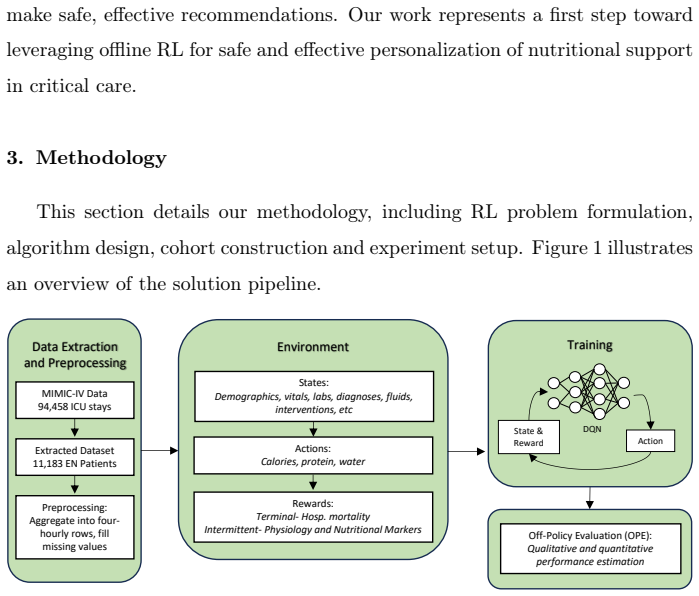
DeepEN's central claim is that a conservative offline reinforcement learning policy—specifically a dueling double deep Q-network with conservative Q-learning regularization—can learn safe, individualized enteral nutrition dosing from retrospective data. The policy selects 4-hourly combinations of weight-adjusted calories, protein, and water from a discretized space of 51 observed dose combinations, using a 102-variable state representation that includes demographics, diagnoses, vitals, labs, feeding history, and concurrent interventions like vasopressors and insulin. The paper reports the lowest calibrated mortality (18.8% ± 1.0%) among all tested policies—3.7 percentage points below the cli
What carries the argument
The argument is carried by a composite reward function paired with a conservative offline Q-learning update. The reward gives a terminal signal of +15 for survival and −15 for death, plus intermediate shaping rewards: a physiological term penalizing SOFA stagnation and worsening lactate, and a biomarker term rewarding maintenance of glucose within 140–180 mg/dL and phosphate within 2.5–4.5 mg/dL (with a bonus for improvement toward target). This reward is optimized by a dueling double DQN with conservative Q-learning regularization, which suppresses overestimation of rarely seen or unseen actions so the learned policy stays close to observed clinical practice. The evaluation then converts ex
Load-bearing premise
The headline mortality comparison assumes that the procedure translating a policy's expected score into a mortality rate produces a true counterfactual estimate, even though the score itself is built from the same survival/death signal the policy was trained on.
What would settle it
Compute the same score-to-mortality translation for a version of the policy trained without the terminal survival/death reward, keeping only the biomarker and physiology shaping rewards; if the estimated mortality advantage over clinicians disappears or shrinks significantly, the headline result would reflect the evaluation loop rather than the dosing decisions.
If this is right
- If DeepEN is right, ICU nutrition could move from fixed weight-based targets to dynamic, four-hourly recommendations conditioned on the patient's organ function, labs, and recent feeding response.
- Because the learned policy outperforms behavior cloning, the benefit does not come solely from imitating good clinician decisions; the reinforcement learning optimization itself adds value.
- The inclusion of biomarker stability in the reward means following the policy should also yield tighter glucose and phosphate control, not only a mortality difference.
- The U-shaped deviation curves imply that both underfeeding and overfeeding relative to the learned targets are harmful, supporting a middle-range rather than a maximal-or-minimal dosing philosophy for enteral nutrition.
- A reduction of roughly 37 deaths per 1,000 patients is comparable to or larger than the modest effect sizes seen in recent nutrition randomized trials, making personalization a potentially meaningful clinical lever if confirmed externally.
Where Pith is reading between the lines
- A natural next test, beyond the paper's internal evaluation, would be to run the same return-to-mortality mapping on a version of the policy trained without the terminal survival/death reward; that would reveal how much of the headline mortality advantage depends on the reward's own mortality signal.
- The paper's action space covers only periods where enteral nutrition is actively given, so the policy is conditional on a decision to feed; a fuller decision-support tool would also need to decide when to withhold or interrupt feeding, a direction the paper itself flags.
- The same reward-design logic—terminal survival balanced with biomarker shaping—could plausibly transfer to other slow-effect ICU interventions such as sedation titration or glycemic control, where immediate physiological targets and long-term outcomes both matter.
Editorial analysis
A structured set of objections, weighed in public.
Referee Report
Summary. DeepEN formulates enteral nutrition dosing in the ICU as an offline RL problem, using a D3QN with CQL on 11,378 MIMIC-IV patients. The state includes 102 variables, actions are four-level discretized calorie/protein/water targets, and the reward combines a terminal survival/death reward (R_term = +15/-15) with intermediate SOFA, lactate, glucose, and phosphate rewards. The paper reports that DeepEN achieves the lowest estimated mortality (18.8% vs. 22.5% for clinicians) and the highest CWPDIS return, and claims that deviations from the policy are independently associated with mortality and biomarker instability. The central evaluation, however, rests on a mortality estimator that is circular: it converts expected returns, which already include the terminal survival/death reward, into a mortality estimate via binning. This undermines the headline result.
Significance. If the central claim were valid, DeepEN would be a notable first application of offline RL to enteral nutrition, and the inclusion of a physiologically motivated reward and conservative Q-learning would be a useful contribution. The paper also makes code and data availability explicit, uses a substantial MIMIC-IV cohort, and compares against four baselines. However, the headline mortality reduction is not established: the estimated mortality in Table 2 is a model-derived calibration of the same return signal that the policy was trained to optimize, so the 18.8% vs. 22.5% result can be produced by construction even if the policy has no true mortality benefit. The 'independent association' claim in the abstract is also not supported by the unadjusted, binned analyses in Section 3.2.4. As presented, the paper is a proof-of-concept of an RL framework, but its main clinical performance claim requires a non-circular evaluation before it can be accepted.
major comments (3)
- [Sec. 3.2.4(3), Sec. 3.1.3, Table 2] The estimated-mortality procedure is circular. The terminal reward in Eq. (3.1.3) is +15 for ICU survival and -15 for death, so the expected return of a trajectory is a direct function of the outcome used to define mortality. Section 3.2.4(3) then bins expected returns and reads observed mortality in those bins to estimate a policy's mortality rate. A policy trained to maximize return will automatically be assigned a lower 'estimated mortality' even if it does not reduce mortality. Moreover, Table 2 compares the clinician policy's observed mortality (22.5%) with DeepEN's calibrated estimate (18.8%), which is an apples-to-oranges comparison. No validation of the bin-mapping is provided (for example, applying the same mapping to the clinician policy and checking that it reproduces 22.5%). Because this estimator is the sole basis for the headline 3.7 percentage-point reduction, the central
- [Sec. 3.2.4(4), Fig. 3, Abstract] The abstract states that deviation from the DeepEN policy was 'independently associated' with increased mortality and biomarker instability, but the main text presents only unadjusted, binned plots of dosage difference versus mortality (Figure 3) and versus biomarker deviation (Figure 4). There is no multivariable analysis, no adjustment for confounders such as severity of illness or concurrent treatments, and no formal statistical test for the U-shaped relationship. These plots can reflect confounding by indication (sicker patients receiving different dosages) rather than a causal effect of deviation. The word 'independently' is therefore unsupported by the evidence in the manuscript.
- [Table 2 and Sec. 3.2.4] The quantitative OPE results lack sufficient detail to be reproduced or interpreted. The definition of the expected-return bins is not given (e.g., number of bins, boundaries, whether bins are fit on the training or test set), and the reported confidence intervals (e.g., 3.7±0.17) do not state the resampling or uncertainty procedure. For CWPDIS, the behavior policy is a BC model fit to the same data, and policies like the expert-guidelines policy or random policy may fall outside the support of the behavior policy, making importance weights unstable. The absence of these details is particularly important because the entire performance comparison rests on these estimates.
minor comments (5)
- [Sec. 4.1, Table 2] There is a duplicated sentence: 'DeepEN also resulted the highest CWPDIS score among the policies, indicating superior expected returns under the learned value function (Table 2).' appears twice in the same paragraph.
- [Abstract vs. Sec. 4.1] The abstract reports a 4.0 percentage-point reduction (22.8% to 18.8%), while the main text and Table 2 report 22.5% and a 3.7-point reduction. Please harmonize these numbers.
- [Sec. 3.1.3, Eq. (1)] The intermediate reward notation is inconsistent: the definition of R_t writes R_im(t), but the text and equations use R_phys and R_bio without defining R_im. Please clarify the relationship between these terms.
- [Sec. 3.2.4(2), Fig. 2] The p-value for the return-mortality correlation is reported as p<0.001 without specifying the test or the correlation coefficient. Please provide the test name, the effect size, and the confidence interval.
- [Sec. 3.2.3, Sec. 5] The paper acknowledges the handcrafted nature of the reward and the single-center data. These limitations are appropriately stated, but they should be connected to the evaluation: a handcrafted reward that includes terminal survival/death makes the return-based mortality calibration particularly suspect, not merely a future direction.
Circularity Check
DeepEN's headline mortality reduction is an artifact of mapping returns—which already contain the terminal +15/−15 survival/death reward—back onto mortality.
specific steps
-
fitted input called prediction
[Section 3.1.3 (Rewards, Rterm(m)) and Section 3.2.4(3) (Estimated Mortality Rate); reported in Section 4.1 Table 2]
"Rterm(m)=+rT, if m=0; −rT, if m=1 ... we set rT=15. ... First, we categorized expected returns of patient trajectories into distinct bins and used mortality occurrences within each bin to calculate the average mortality rate. The resulting relationship between expected returns and mortality is then used to estimate mortality rates for all policies based on their expected returns. ... DeepEN achieved the lowest estimated mortality among all tested policies, with a 3.7±0.17 percent lower mortality rate compared to the clinician policy (18.8% vs. 22.5%)"
The quantity being binned (expected return) is defined using the terminal reward Rterm(m)=+15 for survival and −15 for death, so return already encodes the outcome that the procedure claims to estimate. Fitting observed mortality as a function of return and then reading off a policy's mortality from its return is a calibration of the training objective, not an independent counterfactual estimate. Any policy with higher expected return is mechanically assigned lower estimated mortality. The comparison is also asymmetric: 22.5% is the observed cohort mortality while 18.8% is a model-derived bin estimate, with no held-out validation of the bin mapping.
-
self definitional
[Section 4.2 (Return-Mortality Correlation, Figure 2)]
"Figure 2 displays a strong negative correlation between expected returns and mortality (p <0.001). This indicates that the policy learns to associate actions leading to lower returns with higher mortality and vice versa."
Because Rterm is +15 for survival and −15 for death, the negative return-mortality correlation is present by construction in the reward definition before any policy is learned. Presenting it as evidence that the policy 'learns' to associate low returns with mortality is a restatement of the reward function, not an independent finding about clinical alignment.
full rationale
The paper's headline claim—DeepEN reduces estimated mortality from 22.5% to 18.8%—is produced by a chain that is circular at its core. Section 3.1.3 defines the terminal reward as +15 for ICU survival and −15 for death; Section 3.2.4(3) bins expected returns and uses observed mortality within each bin to construct a return-to-mortality mapping; Section 4.1 then reads DeepEN's mortality off that mapping. Since the return used in the binning already contains the terminal survival/death reward, higher expected return and lower estimated mortality are linked by construction rather than by demonstrated counterfactual efficacy. The Figure 2 'return-mortality correlation' is similarly definitional. The comparison in Table 2 is also apples-to-oranges: the clinician baseline is the observed cohort mortality (22.5%) while DeepEN's 18.8% is a calibrated model output, and no validation of the calibration on held-out clinician trajectories is reported. Other evaluation components (biomarker target-range achievement, action distributions, CWPDIS ordering) retain some independent content, and the reward-design self-citation [12] is supportive rather than load-bearing, which is why the score is 8 rather than 10. But the central mortality-reduction claim is not established as an independent prediction.
Axiom & Free-Parameter Ledger
free parameters (5)
- Terminal reward magnitude rT =
15
- Physiological reward weights c0, c1, c2 =
0.025, 0.125, 2.0
- Biomarker weight lambda_g, lambda_p and bonus epsilon =
1, 1, 0.2
- CQL alpha and discount gamma =
alpha=0.5, gamma=0.99
- Action discretization thresholds (Table 5) =
Empirical quantiles (e.g., calories 0-1.91, 1.91-3.05, ... kcal/kg)
axioms (6)
- domain assumption MIMIC-IV accurately records enteral nutrition administration, intervened variables, and outcomes.
- domain assumption The MDP constructed from 4-hourly aggregated, linearly interpolated EHR data satisfies the Markov property.
- domain assumption The off-policy value estimator CWPDIS is unbiased under the trained behavior-cloning policy.
- ad hoc to paper The return-to-mortality binning curve is a valid counterfactual mortality estimator.
- ad hoc to paper The handcrafted reward function correctly encodes clinical priorities.
- domain assumption Excluding periods without EN and restricting to the first 10 ICU days does not bias policy evaluation.
Cite this review
Pith. "Pith review of DeepEN: A Deep Reinforcement Learning Framework for Personalized Enteral Nutrition in Critical Care." pith.science (2026). https://pith.science/paper/EWPVYKQQ
@misc{pith2026251008350,
  author       = {Pith},
  title        = {Pith review of: DeepEN: A Deep Reinforcement Learning Framework for Personalized Enteral Nutrition in Critical Care},
  year         = {2026},
  howpublished = {\url{https://pith.science/paper/EWPVYKQQ}},
  note         = {Machine review of arXiv:2510.08350}
}
abstract
Objective: Enteral nutrition (EN) delivery in the ICU remains suboptimal due to limited personalization and uncertainty regarding appropriate calorie, protein, and fluid targets under dynamic metabolic demands. We introduce DeepEN, a reinforcement learning (RL) framework for personalized EN optimization using electronic health record data. Methods: DeepEN was trained on over 11,000 ICU patients from MIMIC-IV to generate 4-hourly, patient-specific caloric, protein, and fluid targets. The state representation incorporated demographics, comorbidities, vital signs, laboratory values, and recent interventions. A physiologically aligned reward framework balanced biomarker stability with long-term survival. Policy learning employed a dueling double deep Q-network with Conservative Q-Learning regularization to enable safe offline training. Results: DeepEN achieved the highest estimated policy value ($V^\pi = 9.48$) and the lowest calibrated mortality (18.8 +/- 1.0%), representing a 4.0 percentage-point absolute reduction compared with clinician practice (22.8%). The policy also demonstrated superior metabolic stability, achieving the highest proportion of glucose, phosphate, and sodium values within target range. Furthermore, deviation from the DeepEN policy was independently associated with increased mortality and biomarker instability, whereas deviation from a random policy showed no such association. Interpretability analyses further indicated that recommendations were conditioned on physiologically relevant markers of organ function and metabolic status rather than static dosing heuristics. Conclusion: DeepEN demonstrates the feasibility of conservative offline RL for safe, individualized EN optimization, highlighting the potential of data-driven personalization to complement guideline-based approaches in critical care.
Figures


Reference graph
Works this paper leans on
-
[1]
Adeyinka, A
A. Adeyinka, A. S. Rouster, M. Valentine, Enteric feedings, Journal Name (2018)
2018
-
[2]
Preiser, Y
J.-C. Preiser, Y. M. Arabi, M. M. Berger, M. Casaer, S. McClave, J. C. Montejo-González, S. Peake, A. Reintam Blaser, G. Van den Berghe, A. van Zanten, et al., A guide to enteral nutrition in intensive care units: 10 expert tips for the daily practice, Critical Care 25 (1) (2021) 424
2021
-
[3]
Compher, A
C. Compher, A. L. Bingham, M. McCall, J. Patel, T. W. Rice, C. Braun- schweig, L. McKeever, Guidelines for the provision of nutrition support therapy in the adult critically ill patient: The american society for par- enteral and enteral nutrition, Journal of Parenteral and Enteral Nutrition 46 (1) (2022) 12–41. 22
2022
-
[4]
J. L. Bels, S. Thiessen, R. J. van Gassel, A. Beishuizen, A. D. B. Dekker, V. Fraipont, S. Lamote, D. Ledoux, C. Scheeren, E. De Waele, et al., Effect of high versus standard protein provision on functional recovery in peo- ple with critical illness (precise): an investigator-initiated, double-blinded, multicentre, parallel-group, randomised controlled tr...
2024
-
[5]
D. K. Heyland, J. Patel, C. Compher, T. W. Rice, D. E. Bear, Z.-Y. Lee, V. C. González, K. O’Reilly, R. Regala, C. Wedemire, et al., The effect of higher protein dosing in critically ill patients with high nutritional risk (effort protein): an international, multicentre, pragmatic, registry-based randomised trial, The Lancet 401 (10376) (2023) 568–576
2023
-
[6]
Mirhosiny, M
M. Mirhosiny, M. Arab, P. M. Shahrbabaki, How do physicians and nurses differintheirperceivedbarrierstoeffectiveenteralnutritionintheintensive care unit?, Acute and critical care 36 (4) (2021) 342–350
2021
-
[7]
Friesecke, A
S. Friesecke, A. Schwabe, S.-S. Stecher, P. Abel, Improvement of enteral nutrition in intensive care unit patients by a nurse-driven feeding protocol, Nursing in Critical Care 19 (4) (2014) 204–210
2014
-
[8]
R. J. Jarden, L. J. Sutton, A practice change initiative to improve the provision of enteral nutrition to intensive care patients, Nursing in critical care 20 (5) (2015) 242–255
2015
-
[9]
C. S. Ellis, Improving nutrition in mechanically ventilated patients, Journal of Neuroscience Nursing 47 (5) (2015) 263–270
2015
-
[10]
Ramaswamy, M
T. Ramaswamy, M. P. DeWane, H. S. Dashti, M. Lau, P. E. Wischmeyer, A. Nagrebetsky, J. Sparling, Nine myths about enteral feeding in critically ill adults: an expert perspective, Advances in Nutrition (2024) 100345
2024
-
[11]
A. Raghu, M. Komorowski, I. Ahmed, L. Celi, P. Szolovits, M. Ghas- semi, Deep reinforcement learning for sepsis treatment, arXiv preprint arXiv:1711.09602 (2017). 23
Pith/arXiv arXiv 2017
-
[12]
D. J. Tan, Q. Xu, K. C. See, D. Perera, M. Feng, Advancing multi-organ disease care: A hierarchical multi-agent reinforcement learning framework, arXiv preprint arXiv:2409.04224 (2024)
Pith/arXiv arXiv 2024
-
[13]
Peine, A
A. Peine, A. Hallawa, J. Bickenbach, G. Dartmann, L. B. Fazlic, A. Schmeink, G. Ascheid, C. Thiemermann, A. Schuppert, R. Kindle, et al., Development and validation of a reinforcement learning algorithm to dynamically optimize mechanical ventilation in critical care, NPJ digital medicine 4 (1) (2021) 32
2021
-
[14]
C. J. Watkins, P. Dayan, Q-learning, Machine learning 8 (1992) 279–292
1992
-
[15]
C. Yu, J. Liu, S. Nemati, G. Yin, Reinforcement learning in healthcare: A survey, ACM Computing Surveys (CSUR) 55 (1) (2021) 1–36
2021
-
[16]
V. Mnih, K. Kavukcuoglu, D. Silver, A. A. Rusu, J. Veness, M. G. Bellemare, A. Graves, M. Riedmiller, A. K. Fidjeland, G. Ostrovski, et al., Human-level control through deep reinforcement learning, nature 518 (7540) (2015) 529–533
2015
-
[17]
S. Levine, A. Kumar, G. Tucker, J. Fu, Offline reinforcement learn- ing: Tutorial, review, and perspectives on open problems, arXiv preprint arXiv:2005.01643 (2020)
Pith/arXiv arXiv 2005
-
[18]
Van Hasselt, A
H. Van Hasselt, A. Guez, D. Silver, Deep reinforcement learning with dou- ble q-learning, in: Proceedings of the AAAI conference on artificial intelli- gence, Vol. 30, 2016
2016
-
[19]
Z. Wang, T. Schaul, M. Hessel, H. Hasselt, M. Lanctot, N. Freitas, Dueling network architectures for deep reinforcement learning, in: International conference on machine learning, PMLR, 2016, pp. 1995–2003
2016
-
[20]
Hessel, J
M. Hessel, J. Modayil, H. Van Hasselt, T. Schaul, G. Ostrovski, W. Dabney, D.Horgan, B.Piot, M.Azar, D.Silver, Rainbow: Combiningimprovements in deep reinforcement learning, in: Proceedings of the AAAI conference on artificial intelligence, Vol. 32, 2018. 24
2018
-
[21]
Kumar, A
A. Kumar, A. Zhou, G. Tucker, S. Levine, Conservative q-learning for offline reinforcement learning, Advances in neural information processing systems 33 (2020) 1179–1191
2020
-
[22]
Besculides, M
M. Besculides, M. Mazumdar, S. Phlegar, R. Freeman, S. Wilson, H. Joshi, A. Kia, K. Gorbenko, et al., Implementing a machine learning screening tool for malnutrition: insights from qualitative research applicable to other machine learning–based clinical decision support systems, JMIR Formative Research 7 (1) (2023) e42262
2023
-
[23]
Raphaeli, L
O. Raphaeli, L. Statlender, C. Hajaj, I. Bendavid, A. Goldstein, E. Robin- son, P. Singer, Using machine-learning to assess the prognostic value of early enteral feeding intolerance in critically ill patients: a retrospective study, Nutrients 15 (12) (2023) 2705
2023
-
[24]
K. Hu, X. lei Deng, L. Han, S. Xiang, B. Xiong, L. Pinhu, et al., De- velopment and validation of a predictive model for feeding intolerance in intensive care unit patients with sepsis, Saudi Journal of Gastroenterology 28 (1) (2022) 32–38
2022
-
[25]
Q. Chen, Y. Chen, H. Wang, J. Huang, X. Ou, J. Hu, X. Yao, L. Guan, Development and validation of a predictive model for diarrhea in icu pa- tients with enteral nutrition, Journal of Parenteral and Enteral Nutrition 47 (4) (2023) 563–571
2023
-
[26]
A. R. Gosmanov, G. E. Umpierrez, Management of hyperglycemia during enteral and parenteral nutrition therapy, Current diabetes reports 13 (1) (2013) 155–162
2013
-
[27]
Uribarri, Phosphorus homeostasis in normal health and in chronic kidney disease patients with special emphasis on dietary phosphorus intake., in: Seminars in dialysis, Vol
J. Uribarri, Phosphorus homeostasis in normal health and in chronic kidney disease patients with special emphasis on dietary phosphorus intake., in: Seminars in dialysis, Vol. 20, 2007
2007
-
[28]
Kalantar-Zadeh, L
K. Kalantar-Zadeh, L. Gutekunst, R. Mehrotra, C. P. Kovesdy, R. Bross, C. S. Shinaberger, N. Noori, R. Hirschberg, D. Benner, A. R. Nissenson, 25 et al., Understanding sources of dietary phosphorus in the treatment of pa- tients with chronic kidney disease, Clinical Journal of the American Society of Nephrology 5 (3) (2010) 519–530
2010
-
[29]
T. A. Ikizler, N. J. Cano, H. Franch, D. Fouque, J. Himmelfarb, K. Kalantar-Zadeh, M. K. Kuhlmann, P. Stenvinkel, P. TerWee, D. Teta, et al., Prevention and treatment of protein energy wasting in chronic kidney disease patients: a consensus statement by the international society of renal nutrition and metabolism, Kidney international 84 (6) (2013) 1096–1107
2013
-
[30]
H. M. Mehanna, J. Moledina, J. Travis, Refeeding syndrome: what it is, and how to prevent and treat it, Bmj 336 (7659) (2008) 1495–1498
2008
-
[31]
Nguyen, K
N. Nguyen, K. Ching, R. Fraser, M. Chapman, R. Holloway, The rela- tionship between blood glucose control and intolerance to enteral feeding during critical illness, Intensive care medicine 33 (12) (2007) 2085–2092
2007
-
[32]
diabetes care in the hospital: standards of care in diabetes—2024, Di- abetes Care 47 (Supplement_1) (2024) S295–S306
16. diabetes care in the hospital: standards of care in diabetes—2024, Di- abetes Care 47 (Supplement_1) (2024) S295–S306
2024
-
[33]
D. A. Geerse, A. J. Bindels, M. A. Kuiper, A. N. Roos, P. E. Spronk, M. J. Schultz, Treatment of hypophosphatemia in the intensive care unit: a review, Critical Care 14 (4) (2010) R147
2010
-
[34]
A. E. Johnson, L. Bulgarelli, L. Shen, A. Gayles, A. Shammout, S. Horng, T. J. Pollard, S. Hao, B. Moody, B. Gow, et al., Mimic-iv, a freely accessible electronic health record dataset, Scientific data 10 (1) (2023) 1
2023
-
[35]
T. J. Iwashyna, C. L. Hodgson, D. Pilcher, N. Orford, J. D. Santamarial, M. Bailey, R. Bellomo, Towards defining persistent critical illness and other varieties of chronic critical illness, Critical Care and Resuscitation 17 (3) (2015) 215–218
2015
-
[36]
P. E. Wischmeyer, D. E. Bear, M. M. Berger, E. De Waele, J. Gunst, S. A. McClave, C. M. Prado, Z. Puthucheary, E. J. Ridley, G. Van den 26 Berghe, et al., Personalized nutrition therapy in critical care: 10 expert recommendations, Critical Care 27 (1) (2023) 261
2023
-
[37]
Stoian, A
M. Stoian, A. Andone, S. R. Bândilă, D. Onis,or, D.-F. Babă, R. Niculescu, A. Stoian, L. Azamfirei, Personalized nutrition strategies for patients in the intensive care unit: A narrative review on the future of critical care nutrition, Nutrients 17 (10) (2025) 1659
2025
-
[38]
Thomas, E
P. Thomas, E. Brunskill, Data-efficient off-policy policy evaluation for re- inforcement learning, in: International conference on machine learning, PMLR, 2016, pp. 2139–2148
2016
-
[39]
X. Wu, R. Li, Z. He, T. Yu, C. Cheng, A value-based deep reinforcement learning model with human expertise in optimal treatment of sepsis, NPJ Digital Medicine 6 (1) (2023) 15
2023
-
[40]
Komorowski, L
M. Komorowski, L. A. Celi, O. Badawi, A. C. Gordon, A. A. Faisal, The artificial intelligence clinician learns optimal treatment strategies for sepsis in intensive care, Nature medicine 24 (11) (2018) 1716–1720
2018
-
[41]
D. E. Bear, L. Wandrag, J. L. Merriweather, B. Connolly, N. Hart, M. P. Grocott, E.R.A.C.I.P.G.E.investigators, Theroleofnutritionalsupport in the physical and functional recovery of critically ill patients: a narrative review, Critical Care 21 (1) (2017) 226. 27 Appendix
2017
-
[42]
Cohort Information Table 3: Cohort details Cohort % Female Mean Age (years) Mean ICU Stay (hours) Total Population (n) Overall 41.63 64.92 241 11378Non-Survivors 43.19 68.76 258 2556Survivors 41.18 63.81 237 8822
-
[43]
Expert Guidelines Policy Definition These nutritional targets are based on the 2021 ASPEN requirements for enteral nutrition [3]. Original protein targets have been altered slightly with more recent evidence-based literature recommending a low-dosing period during the early-acute phase of critical illness [36, 37]. 3.1. Calories •For patients with BMI<30:...
2021
-
[44]
Comparison of Action Distributions Figure 5: Action Distributions of a) Calories, b) Protein, and c) Water for Clinician, EG, and DeepEN policies. 31
This paper was first reviewed by deepseek-v4-flash on August 4, 2026.
discussion (0)
Sign in with ORCID, Apple, or X to comment. Anyone can read and Pith papers without signing in.