REVIEW 3 major objections 5 minor 38 references
Eigenvalue spectra of attention and SSM dynamics show consistent signatures of memory retention and selective forgetting that align with task requirements.
Reviewed by Pith at T0; open to challenge. T0 means a machine referee read the full paper against a public rubric. the ladder, T0–T4 →
T0 review · deepseek-v4-flash
2026-08-04 10:26 UTC pith:D2NNJNUN
load-bearing objection Extensive empirical spectral atlas for sequence models, but the central eigenvalue-memory claim rests on an unproven LTI-to-LPV transfer. the 3 major comments →
Eigenvalues as a Metric for Memory Dynamics in Sequence Models
The pith
A machine-rendered reading of the paper's core claim, the machinery that carries it, and where it could break.
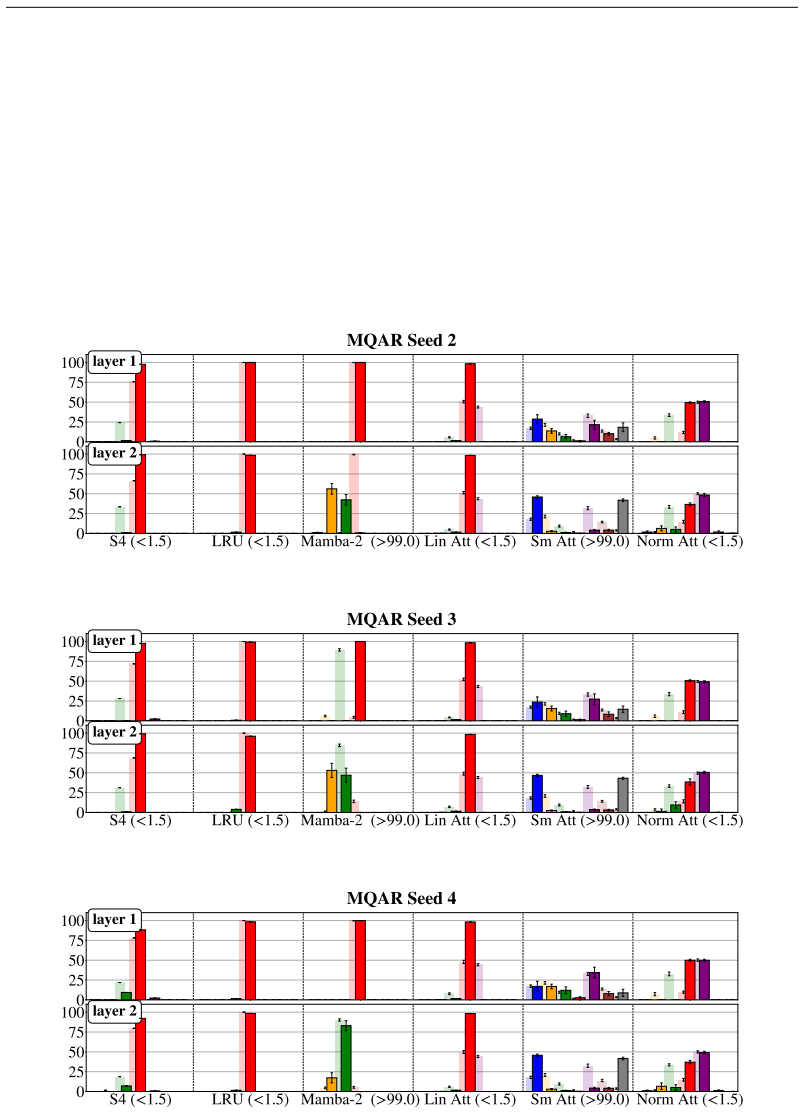
The central observation is that eigenvalues near 1 appear when a task requires long-term memory, and eigenvalues near 0 appear when a task requires selectively forgetting old information. For example, on Long ListOps, where every token matters, even attention models avoid near-zero eigenvalues; on MQAR, where only specific key-value pairs matter, softmax attention and Mamba-2 show strong peaks near 1 (retention) and near 0 (gating). They also modify architectures: adding gating shifts spectra away from zero, adding convolution shifts spectra toward zero, and changing normalization in norm attention changes the memory-selectivity trade-off.
The authors conclude that eigenvalue analysis could be a principled metric for interpreting and possibly improving sequence models. However, the interpretation leans heavily on linear time-invariant system intuition applied to time-varying systems, and the attention models are trained with less effort than the SSMs, so the performance gaps might not be purely about eigenvalues.
Core claim
In Section 4.2, the authors state: "Eigenvalues capture essential aspects of stability, memory, and long-range dependency modeling, not only for LTI SSMs, but also LPV models and attention mechanisms. In other words, downstream task requirements are reflected in spectral signatures of eigenvalues." This is the load-bearing assertion: specific eigenvalue distributions (near one for memory retention, near zero for selective forgetting) correspond to task demands and explain model performance differences.
Load-bearing premise
The paper assumes that the memory semantics of eigenvalues from linear time-invariant (LTI) systems—eigenvalues near 1 mean slow decay/long memory, near 0 mean fast forgetting—carry over to linear parameter-varying (LPV) systems with input-dependent transition matrices Λ_i. This is used throughout to interpret spectra of attention and Mamba-2. However, for time-varying systems, instantaneous eigenvalues do not generally determine stability or memory decay; Lyapunov exponents or joint spectral radius do. The paper does not justify this transfer, and its comment that eigenvalues >1 "could potentially be problematic" (Section 4.2) is not rigorous. If this assumption fails, the entire interpretation collapses.
Editorial analysis
A structured set of objections, weighed in public.
Referee Report
Summary. The paper proposes using eigenvalue spectra of state-transition matrices in a recently proposed dynamical-systems framework as a common metric for memory dynamics across SSMs and attention mechanisms. It recasts softmax, linear, and norm attention, as well as Mamba-2, as LPV systems (Eq. 1, Eq. 3), computes eigenvalues, and reports batch-averaged histograms on LRA, MQAR, and WikiText. The empirical study finds that tasks requiring long memory correlate with eigenvalue mass near one, tasks requiring selectivity correlate with mass near zero, and architectural modifications (gating, convolution, normalization changes, pseudo-LTI Mamba-2) shift spectra together with performance. The paper concludes that eigenvalues capture essential aspects of stability, memory, and long-range dependency modeling for both SSMs and attention, and that spectral signatures can guide architectural design.
Significance. If valid, the proposed spectral metric would provide a common quantitative language for comparing attention and SSM memory behavior, complementing memory-function analyses. The empirical corpus is extensive: six architectures, five tasks, multiple layers, heads, and seeds, with code released and standard benchmarks used. The paper also demonstrates a concrete use case by showing that architectural changes (gating, convolution, normalization, pseudo-LTI Mamba-2) produce interpretable spectral shifts. However, the central interpretive step—transferring LTI eigenvalue semantics to input-dependent LPV systems—is not established. The strength of the empirical observations therefore depends on an unvalidated assumption, and the paper's broad central claim in Section 4.2 is stronger than what the evidence currently supports.
major comments (3)
- [Section 3.2, Eq. (1), Eq. (3)] The memory interpretation 'eigenvalues near zero induce rapid forgetting, near one enable long-term memory' is stated for h_i = Λ_i h_{i-1} + B_i u_i, but Λ_i is input-dependent throughout (Eq. 1, Eq. 3). This statement is standard for LTI systems only; for LPV systems, the influence of input u_j on output y_i is governed by the ordered product C_i Λ_i ... Λ_{j+1} B_j, not by the instantaneous eigenvalues of Λ_i. Since all Λ_i considered here are scalar multiples of the identity, the relevant quantity is the cumulative product of the scalar eigenvalue sequence. A marginal, batch-averaged histogram of instantaneous eigenvalues discards the order in which eigenvalues occur, so systems with identical histograms can have very different memory behavior (e.g., alternating 0.1 and 10 yields a per-pair product near 1). The central claim in Section 4.2 and the gating/selectivity interpretations i
- [Section 4.2, eigenvalues > 1] The paper states that eigenvalues larger than one 'could potentially be problematic' because they cause unstable dynamics of LPV systems. For time-varying systems, this is not justified: a single instantaneous eigenvalue magnitude above one does not imply instability, and eigenvalues inside the unit circle do not guarantee bounded responses. The correct descriptors are Lyapunov exponents, joint spectral radius, or products of transition matrices. This issue affects the repeated interpretation of attention's high eigenvalues as 'unstable' or 'detrimental.' Please either provide a rigorous bound relating the histogram statistics to worst-case growth of the state, or explicitly downgrade such statements to heuristic observations.
- [Figure 1, Section 4.2] The empirical support for the central claim is correlational. The metric is a batch-averaged histogram of instantaneous eigenvalues, and the observed spectral differences between S4, Mamba-2, and attention models coincide with many other architectural differences (e.g., convolution, gating, parameterization). No experiment isolates the eigenvalue spectrum as the causal driver while holding other components fixed. A constructive remedy would be to include a controlled intervention—for example, spectral regularization on attention eigenvalues, or a direct comparison of the histogram-based predictions with actual convolution-kernel memory measures. Without such a test, the claim that 'downstream task requirements are reflected in spectral signatures' remains a post-hoc interpretation rather than a validated metric.
minor comments (5)
- [Section 4.2] The hedging in 'could potentially be problematic' and 'might further contribute' conflicts with the stronger claim made earlier in the same section. Please align the language with the level of support actually provided.
- [Figures 2 and 4] The labels 'with conv' and 'with gating' do not specify kernel sizes, gating projection dimensions, or insertion points in the main text; Appendix B provides some details but the main text should be self-contained enough to interpret the figures.
- [Figures 1 and 6] Notation is inconsistent: 'Sm Att' and 'SM Att' are both used for softmax attention. Please unify.
- [Section 5.5] The 'pseudo-LTI' Mamba-2 variant is described only in terms of changing the discretization sampling interval. Clarify exactly how the input-dependence is removed from Λ and how the input-dependent behavior is absorbed into B, since this is central to interpreting Figure 4.
- [Appendix C] The appendix is comprehensive but some panels are hard to read because six models share a single axis. Consider separating or enlarging the figures, or using facet labels instead of color alone.
Circularity Check
No significant circularity: the empirical eigenvalue–performance study is externally benchmarked, and the LTI-to-LPV interpretation is an unvalidated assumption rather than a circular reduction.
full rationale
The paper's central claim is an empirical correlation between eigenvalue distributions and task performance across several externally benchmarked tasks. The eigenvalue metric for attention is inherited from the authors' prior DSF work, but that prior work supplies a stated mathematical lemma with code, and the current paper performs controlled architectural experiments (gating, convolution, normalization, and a pseudo-LTI variant) whose performance is measured independently of the eigenvalue computation. No fitted parameter is later relabeled as a prediction, and no uniqueness theorem is invoked to force the choice of metric. Although for attention the DSF defines Λ_i through normalization ratios (Eq. 3/5a), the paper's conclusion is not equivalent to that definition: the computed spectra come from trained models, the normalization ratio alone does not determine the full attention memory kernel, and the task-alignment is an observed, falsifiable pattern rather than a tautology. The main weakness is the unproven transfer of instantaneous-eigenvalue memory semantics from LTI to LPV systems; that is a validity or correctness risk, not a circular derivation of the paper's results from its own inputs.
Axiom & Free-Parameter Ledger
free parameters (2)
- Eigenvalue bin edges =
0-0.1, 0.1-0.5, 0.5-0.9, 0.9-1, 1-10, 10-100, >100
- Sampling interval for Mamba-2 pseudo-LTI =
fixed (not input-dependent)
axioms (5)
- standard math Eigenvalues near 1 imply long memory, near 0 imply rapid forgetting (LTI eigenvalue-memory semantics).
- ad hoc to paper The same eigenvalue-memory semantics apply to LPV systems with time-varying transition matrices.
- domain assumption The DSF representation of masked attention is faithful, so eigenvalues of Λ_i in Eq. (3) are the correct spectral characterization.
- ad hoc to paper Batch-averaged eigenvalue distributions over test data adequately represent input-dependent dynamics.
- ad hoc to paper Eigenvalues with magnitude >1 indicate potential instability in LPV systems.
Cite this review
Pith. "Pith review of Eigenvalues as a Metric for Memory Dynamics in Sequence Models." pith.science (2026). https://pith.science/paper/D2NNJNUN
@misc{pith2026251009379,
  author       = {Pith},
  title        = {Pith review of: Eigenvalues as a Metric for Memory Dynamics in Sequence Models},
  year         = {2026},
  howpublished = {\url{https://pith.science/paper/D2NNJNUN}},
  note         = {Machine review of arXiv:2510.09379}
}
read the original abstract
While softmax attention drives state-of-the-art performance in sequence modeling, its quadratic complexity motivates linear alternatives such as state space models (SSMs). Structural differences between the two model classes, however, hinder direct comparisons of their memory dynamics, creating the need for a common metric to analyze, interpret, and improve their information processing capabilities. Inspired by recent advances in SSM performance driven by eigenvalue-guided insights, we leverage the dynamical systems framework to bring attention models into a unified analytical framework with SSMs. This allows us to perform a structured analysis, which investigates the applicability of an eigenvalue-spectrum memory dynamics metric to attention models. To this end, we first conduct an extensive empirical study across diverse attention-based models and SSMs on a range of benchmarks. We show that, for both model classes, eigenvalues influence key aspects of memory and long-range dependency modeling, revealing spectral signatures that align with task requirements. Building on these findings, we show how spectral signatures can motivate architectural modifications, how they can be guided through the training process, and how they can provide information about feature importance. The results thereby enable and emphasize the role of eigenvalue analysis as a principled metric for interpreting, explaining, and ultimately improving the capabilities of sequence models.
Figures




Reference graph
Works this paper leans on
-
[1]
write newline
" write newline "" before.all 'output.state := FUNCTION n.dashify 't := "" t empty not t #1 #1 substring "-" = t #1 #2 substring "--" = not "--" * t #2 global.max substring 't := t #1 #1 substring "-" = "-" * t #2 global.max substring 't := while if t #1 #1 substring * t #2 global.max substring 't := if while FUNCTION format.date year duplicate empty "emp...
-
[2]
Zoology: Measuring and Improving Recall in Efficient Language Models
Simran Arora, Sabri Eyuboglu, Aman Timalsina, Isys Johnson, Michael Poli, James Zou, Atri Rudra, and Christopher Ré. Zoology: Measuring and Improving Recall in Efficient Language Models . arXiv:2312.04927, 2023
Pith/arXiv arXiv 2023
-
[3]
Self-attention networks localize when qk-eigenspectrum concentrates
Han Bao, Ryuichiro Hataya, and Ryo Karakida. Self-attention networks localize when qk-eigenspectrum concentrates. In Proceedings of the 41st International Conference on Machine Learning, pp.\ 2903--2922, 2024
2024
-
[4]
xLSTM: Extended Long Short-Term Memory
Maximilian Beck, Korbinian Pöppel, Markus Spanring, Andreas Auer, Oleksandra Prudnikova, Michael Kopp, Günter Klambauer, Johannes Brandstetter, and Sepp Hochreiter. xLSTM: Extended Long Short-Term Memory . arXiv preprint arXiv:2405.04517, 2024
Pith/arXiv arXiv 2024
-
[5]
Eigen analysis of self-attention and its reconstruction from partial computation
Srinadh Bhojanapalli, Ayan Chakrabarti, Himanshu Jain, Sanjiv Kumar, Michal Lukasik, and Andreas Veit. Eigen analysis of self-attention and its reconstruction from partial computation. arXiv preprint arXiv:2106.08823, 2021
Pith/arXiv arXiv 2021
-
[6]
On the opportunities and risks of foundation models
Rishi Bommasani, Drew A Hudson, Ehsan Adeli, Russ Altman, Simran Arora, Sydney von Arx, Michael S Bernstein, Jeannette Bohg, Antoine Bosselut, Emma Brunskill, et al. On the opportunities and risks of foundation models. arXiv preprint arXiv:2108.07258, 2021
Pith/arXiv arXiv 2021
-
[7]
Language Models are Few-Shot Learners
Tom Brown, Benjamin Mann, Nick Ryder, Melanie Subbiah, Jared D Kaplan, Prafulla Dhariwal, Arvind Neelakantan, Pranav Shyam, Girish Sastry, Amanda Askell, Sandhini Agarwal, Ariel Herbert-Voss, Gretchen Krueger, Tom Henighan, Rewon Child, Aditya Ramesh, Daniel Ziegler, Jeffrey Wu, Clemens Winter, Chris Hesse, Mark Chen, Eric Sigler, Mateusz Litwin, Scott Gr...
1901
-
[8]
Transformers are SSMs: Generalized Models and Efficient Algorithms with Structured State Space Duality
Tri Dao and Albert Gu. Transformers are SSMs: Generalized Models and Efficient Algorithms with Structured State Space Duality . In ICML 2024 , 2024
2024
-
[9]
Daniel Y. Fu, Tri Dao, Khaled K. Saab, Armin W. Thomas, Atri Rudra, and Christopher Ré. Hungry Hungry Hippos: Towards Language Modeling with State Space Models , 2023. URL https://arxiv.org/abs/2212.14052
Pith/arXiv arXiv 2023
-
[10]
Riccardo Grazzi, Julien Siems, Arber Zela, Jörg K. H. Franke, Frank Hutter, and Massimiliano Pontil. Unlocking state-tracking in linear rnns through negative eigenvalues, 2025. URL https://arxiv.org/abs/2411.12537
Pith/arXiv arXiv 2025
-
[11]
HiPPO: Recurrent Memory with Optimal Polynomial Projections
Albert Gu, Tri Dao, Stefano Ermon, Atri Rudra, and Christopher R\' e . HiPPO: Recurrent Memory with Optimal Polynomial Projections . In Advances in Neural Information Processing Systems, volume 33, pp.\ 1474--1487. Curran Associates, Inc., 2020
2020
-
[12]
Efficiently modeling long sequences with structured state spaces
Albert Gu, Karan Goel, and Christopher R \'e . Efficiently modeling long sequences with structured state spaces. arXiv preprint arXiv:2111.00396, 2021
Pith/arXiv arXiv 2021
-
[13]
Efficiently Modeling Long Sequences with Structured State Spaces
Albert Gu, Karan Goel, and Christopher R\'e. Efficiently Modeling Long Sequences with Structured State Spaces . In The International Conference on Learning Representations ( ICLR ) , 2022
2022
-
[14]
Eigenvalue normalized recurrent neural networks for short term memory, 2019
Kyle Helfrich and Qiang Ye. Eigenvalue normalized recurrent neural networks for short term memory, 2019. URL https://arxiv.org/abs/1911.07964
Pith/arXiv arXiv 2019
-
[15]
Different eigenvalue distributions encode the same temporal tasks in recurrent neural networks
Cecilia Jarne. Different eigenvalue distributions encode the same temporal tasks in recurrent neural networks. Cognitive Neurodynamics, 17 0 (1): 0 257–275, April 2022. ISSN 1871-4099. doi:10.1007/s11571-022-09802-5. URL http://dx.doi.org/10.1007/s11571-022-09802-5
-
[16]
Linear systems, volume 156
Thomas Kailath. Linear systems, volume 156. Prentice-Hall Englewood Cliffs, NJ, 1980
1980
-
[17]
Transformers are RNN s: fast autoregressive transformers with linear attention
Angelos Katharopoulos, Apoorv Vyas, Nikolaos Pappas, and Fran c ois Fleuret. Transformers are RNN s: fast autoregressive transformers with linear attention. In Proceedings of the 37th International Conference on Machine Learning, ICML'20. JMLR.org, 2020
2020
-
[18]
Decoupled Weight Decay Regularization
Ilya Loshchilov and Frank Hutter. Decoupled Weight Decay Regularization . In International Conference on Learning Representations, 2019. URL https://openreview.net/forum?id=Bkg6RiCqY7
2019
-
[19]
Pointer sentinel mixture models, 2016
Stephen Merity, Caiming Xiong, James Bradbury, and Richard Socher. Pointer sentinel mixture models, 2016
2016
-
[20]
When recalling in-context, transformers are not ssms
Destiny Okpekpe and Antonio Orvieto. When recalling in-context, transformers are not ssms. arXiv preprint arXiv:2508.19029, 2025
arXiv 2025
-
[21]
Signals & systems
Alan V Oppenheim, Alan S Willsky, and Syed Hamid Nawab. Signals & systems. Pearson Educaci \'o n, 1997
1997
-
[22]
Resurrecting recurrent neural networks for long sequences
Antonio Orvieto, Samuel L Smith, Albert Gu, Anushan Fernando, Caglar Gulcehre, Razvan Pascanu, and Soham De. Resurrecting recurrent neural networks for long sequences. In International Conference on Machine Learning, pp.\ 26670--26698. PMLR, 2023 a
2023
-
[23]
Resurrecting Recurrent Neural Networks for Long Sequences
Antonio Orvieto, Samuel L Smith, Albert Gu, Anushan Fernando, Caglar Gulcehre, Razvan Pascanu, and Soham De. Resurrecting Recurrent Neural Networks for Long Sequences . In Proceedings of the 40th International Conference on Machine Learning, volume 202, pp.\ 26670--26698. PMLR, 23--29 Jul 2023 b
2023
-
[24]
Colin Raffel and Daniel P. W. Ellis. Feed-forward networks with attention can solve some long-term memory problems, 2016. URL https://arxiv.org/abs/1512.08756
Pith/arXiv arXiv 2016
-
[25]
One-layer transformers fail to solve the induction heads task
Clayton Sanford, Daniel Hsu, and Matus Telgarsky. One-layer transformers fail to solve the induction heads task. arXiv preprint arXiv:2408.14332, 2024
Pith/arXiv arXiv 2024
-
[26]
Linear transformers are secretly fast weight programmers
Imanol Schlag, Kazuki Irie, and J \"u rgen Schmidhuber. Linear transformers are secretly fast weight programmers. In International Conference on Machine Learning, pp.\ 9355--9366. PMLR, 2021
2021
-
[27]
Understanding the differences in foundation models: Attention, state space models, and recurrent neural networks
Jerome Sieber, Carmen Amo Alonso, Alexandre Didier, Melanie Zeilinger, and Antonio Orvieto. Understanding the differences in foundation models: Attention, state space models, and recurrent neural networks. In The Thirty-eighth Annual Conference on Neural Information Processing Systems, 2024. URL https://openreview.net/forum?id=iF7MnXnxRw
2024
-
[28]
Smith, Andrew Warrington, and Scott Linderman
Jimmy T.H. Smith, Andrew Warrington, and Scott Linderman. Simplified State Space Layers for Sequence Modeling . In The Eleventh International Conference on Learning Representations, 2023
2023
-
[29]
Yuanhang Su and C.-C. Jay Kuo. On extended long short-term memory and dependent bidirectional recurrent neural network. Neurocomputing, 356: 0 151–161, September 2019. ISSN 0925-2312. doi:10.1016/j.neucom.2019.04.044. URL http://dx.doi.org/10.1016/j.neucom.2019.04.044
-
[30]
Augmenting self-attention with persistent memory, 2019
Sainbayar Sukhbaatar, Edouard Grave, Guillaume Lample, Herve Jegou, and Armand Joulin. Augmenting self-attention with persistent memory, 2019. URL https://arxiv.org/abs/1907.01470
Pith/arXiv arXiv 2019
-
[31]
Long Range Arena : A Benchmark for Efficient Transformers
Yi Tay, Mostafa Dehghani, Samira Abnar, Yikang Shen, Dara Bahri, Philip Pham, Jinfeng Rao, Liu Yang, Sebastian Ruder, and Donald Metzler. Long Range Arena : A Benchmark for Efficient Transformers . In International Conference on Learning Representations ( ICLR ) , 2021
2021
-
[32]
Attention is All you Need
Ashish Vaswani, Noam Shazeer, Niki Parmar, Jakob Uszkoreit, Llion Jones, Aidan N Gomez, ukasz Kaiser, and Illia Polosukhin. Attention is All you Need . In Advances in Neural Information Processing Systems, volume 30. Curran Associates, Inc., 2017
2017
-
[33]
Shida Wang and Qianxiao Li. Stablessm: Alleviating the curse of memory in state-space models through stable reparameterization, 2024. URL https://arxiv.org/abs/2311.14495
Pith/arXiv arXiv 2024
-
[34]
State-space models with layer-wise nonlinearity are universal approximators with exponential decaying memory
Shida Wang and Beichen Xue. State-space models with layer-wise nonlinearity are universal approximators with exponential decaying memory. Advances in Neural Information Processing Systems, 36: 0 74021--74038, 2023
2023
-
[35]
Gated delta networks: Improving mamba2 with delta rule
Songlin Yang, Jan Kautz, and Ali Hatamizadeh. Gated delta networks: Improving mamba2 with delta rule. arXiv preprint arXiv:2412.06464, 2024
Pith/arXiv arXiv 2024
-
[36]
@esa (Ref
\@ifxundefined[1] #1\@undefined \@firstoftwo \@secondoftwo \@ifnum[1] #1 \@firstoftwo \@secondoftwo \@ifx[1] #1 \@firstoftwo \@secondoftwo [2] @ #1 \@temptokena #2 #1 @ \@temptokena \@ifclassloaded agu2001 natbib The agu2001 class already includes natbib coding, so you should not add it explicitly Type <Return> for now, but then later remove the command n...
-
[37]
\@lbibitem[] @bibitem@first@sw\@secondoftwo \@lbibitem[#1]#2 \@extra@b@citeb \@ifundefined br@#2\@extra@b@citeb \@namedef br@#2 \@nameuse br@#2\@extra@b@citeb \@ifundefined b@#2\@extra@b@citeb @num @parse #2 @tmp #1 NAT@b@open@#2 NAT@b@shut@#2 \@ifnum @merge>\@ne @bibitem@first@sw \@firstoftwo \@ifundefined NAT@b*@#2 \@firstoftwo @num @NAT@ctr \@secondoft...
-
[38]
@open @close @open @close and [1] URL: #1 \@ifundefined chapter * \@mkboth \@ifxundefined @sectionbib * \@mkboth * \@mkboth\@gobbletwo \@ifclassloaded amsart * \@ifclassloaded amsbook * \@ifxundefined @heading @heading NAT@ctr thebibliography [1] @ \@biblabel @NAT@ctr \@bibsetup #1 @NAT@ctr @ @openbib .11em \@plus.33em \@minus.07em 4000 4000 `\.\@m @bibit...
arXiv 2000
discussion (0)
Sign in with ORCID, Apple, or X to comment. Anyone can read and Pith papers without signing in.