REVIEW 3 major objections 3 minor 42 references
An imitation-learning policy autonomously steers a soft robotic guidewire to a target aneurysm in unseen vascular geometries with 83% success, matching expert clinicians.
Reviewed by Pith at T0; open to challenge. T0 means a machine referee read the full paper against a public rubric. the ladder, T0–T4 →
T0 review · deepseek-v4-flash
2026-08-04 10:26 UTC pith:R56VHZFO
load-bearing objection A credible step for imitation learning in soft endovascular navigation, but the 83% generalization claim is anchored to three hand-picked mazes and no code — worth a referee, not a clean pass. the 3 major comments →
Toward Autonomous Soft Robotic Endovascular Navigation via Imitation Learning
The pith
A machine-rendered reading of the paper's core claim, the machinery that carries it, and where it could break.
Core claim
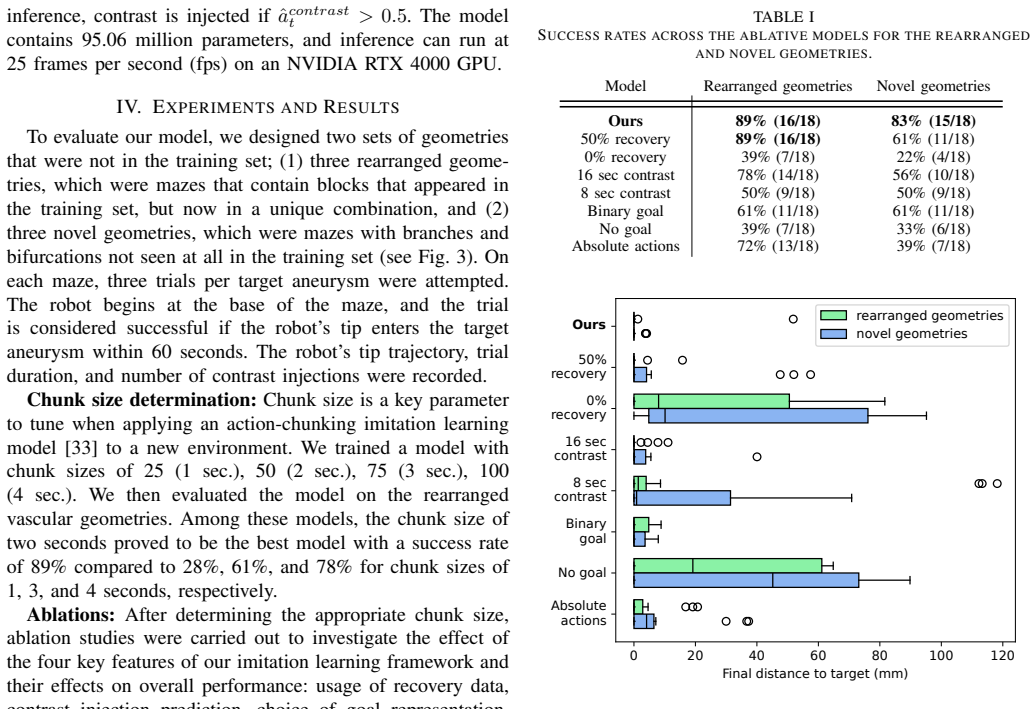
The central claim is that an end-to-end imitation learning policy, built on an action-chunking transformer with goal-conditioned distance feature maps, relative motor actions, and learned contrast injection, can generalize to entirely new vascular geometries. On three novel geometries not seen in training, the policy reached the aneurysm in 83% of trials (15/18), compared to 22% for a diffusion policy, 28% for an MLP, and 50% for a centerline-following controller. The same policy reached the target in a patient-derived geometry with 75% success. Ablations demonstrate that each component—recovery demonstrations, learned contrast, distance-based goal map, and relative actions—is necessary for
What carries the argument
The key machinery is a BERT-style transformer encoder–decoder that receives a live simulated fluoroscopy image and a goal-conditioned feature map encoding the x- and y-distance to the aneurysm at every vessel pixel. The policy outputs a chunk of relative motor-position commands (bend and translate) plus a binary contrast-injection flag. The relative action representation handles actuator hysteresis and slippage, while the learned contrast scheduling lets the policy decide when to reveal the otherwise invisible vessels.
Load-bearing premise
The load-bearing premise is that the large-scale 2D benchtop maze, with a 5 mm pneumatic actuator and a camera-based fluoroscopy simulation, preserves the core challenges of real endovascular navigation, so that a policy trained here will transfer to sub-millimeter clinical guidewires in 3D patient anatomy.
What would settle it
Run the trained policy on a small-scale (sub-millimeter) soft robotic guidewire in a 3D, patient-derived vascular phantom with pulsatile flow and deformable walls under real fluoroscopy. If the success rate drops from 83% to near the no-goal ablation level (around 33%), the claim that the benchtop setup preserves the core difficulties would be refuted.
If this is right
- If the 83% success generalizes beyond the benchtop, autonomous soft guidewire navigation could reduce the need for trial-and-error by clinicians and shorten procedures.
- The learned contrast-injection policy shows that an agent can manage its own intermittent visual feedback, a principle extendable to other procedures where continuous imaging is harmful or unavailable.
- The superior performance of dense goal-distance maps over binary goal images suggests that rich goal encoding is critical for generalization to new geometries.
- The DAgger-style recovery data collection proved essential for out-of-distribution performance, offering a practical recipe for imitation learning in surgical robotics.
Where Pith is reading between the lines
- The approach may transfer to other endovascular tasks (e.g., thrombectomy) by redefining the goal feature map for a target region or point, though the action space may need extension.
- The 2D single-bifurcation simplification likely understates the difficulty of 3D tortuous anatomy; a model trained on the benchtop maze may require substantial fine-tuning on 3D phantoms or clinical data.
- The relative action representation, by mitigating hysteresis, could be a broadly useful design choice for imitation learning on other soft-robot platforms with imprecise actuation.
- The learned contrast-sensing policy resembles an active-sensing strategy; a similar sensing-action coupling could be applied in other domains where sensors are expensive, toxic, or intermittent.
Editorial analysis
A structured set of objections, weighed in public.
Referee Report
Summary. This paper presents an imitation learning framework for autonomous navigation of a 5-mm-scale soft robotic guidewire in 2D-printed bifurcated vessel mazes under simulated fluoroscopy. The policy, a transformer-based action-chunking model with goal-conditioned feature maps, relative motor actions, and learned contrast-injection decisions, is trained on 647 demonstrations across 36 mazes and evaluated on three rearranged and three novel mazes. The authors report an 83% success rate (15/18) on novel geometries, outperforming diffusion, MLP, and centerline baselines and roughly matching two clinicians. Ablations examine recovery data, contrast prediction, goal representation, and relative actions. The paper also includes DAgger-style data collection and a failure-mode analysis.
Significance. If the results hold, this would be a useful step toward end-to-end learning for soft endovascular tools, demonstrating that imitation learning with action chunking can handle partial observability and underactuated dynamics on physical hardware. The inclusion of a physical bench-top platform, clinician comparison, ablations, and a DAgger procedure are strengths. However, the generality of the central claim is currently limited by evaluation protocol issues, so the significance is conditional on a revised analysis.
major comments (3)
- [III-B, IV (Tables I-II)] The three novel and three rearranged test mazes are 'chosen' but no selection rule (randomization, stratification, or difficulty criterion) is reported. With only 18 trials per condition, the 83% estimate has a wide binomial CI (~59–96% at 95%), and no significance tests are provided for the comparisons in Tables I and II (e.g., ours vs. centerline 50%, or vs. 50% recovery 61%). Because every ablation and baseline is measured on these same three mazes, all relative conclusions are conditional on this non-random sample. The authors should report the maze-selection protocol, per-maze results, and confidence intervals or significance tests, or otherwise justify representativeness.
- [IV, 'Chunk size determination'] The chunk size K=50 was selected by evaluating on the rearranged test geometries, and the same rearranged set is then used to report the 89% success rate and to compare ablations. This constitutes hyperparameter tuning on a test set, making the rearranged figures optimistic. The novel-geometry numbers are less affected but still use the selected K. Please either use a validation set (or nested procedure) or explicitly acknowledge that the rearranged performance is a selected maximum.
- [Abstract vs. Sections IV-V] The abstract claims 'we extend the policy to achieve 75% success on an unseen patient-derived geometry,' but no such experiment appears in the provided full text. This is a missing result that supports an advertised contribution; please add the experimental setup, results, or remove the claim.
minor comments (3)
- [III-C, Eq. (4)] The notation is unclear: if ĉ_s is a binary flag, the max is already binary and no sigmoid is needed; presumably ĉ_s is a logit. Please define the variable as the raw model output before thresholding.
- [Fig. 5 and 6 captions] The caption 'Each individual bar represents 18 trials' does not match the box/violin-style plots and should describe what the distributions show.
- [General] The project website is cited, but the manuscript does not state whether code, data, or trained model weights will be released; for reproducibility, please add an availability statement.
Circularity Check
Chunk-size selection on the rearranged test set makes that column partly selected; the headline novel-geometry claim is independent.
specific steps
-
fitted input called prediction
[Section IV (Experiments and Results), 'Chunk size determination'; Table I]
"We trained a model with chunk sizes of 25 (1 sec.), 50 (2 sec.), 75 (3 sec.), 100 (4 sec.). We then evaluated the model on the rearranged vascular geometries. Among these models, the chunk size of two seconds proved to be the best model with a success rate of 89% compared to 28%, 61%, and 78% for chunk sizes of 1, 3, and 4 seconds, respectively."
The 89% rearranged-geometry success rate is the criterion used to select the chunk size; the same three mazes then appear in Table I as the model's reported 'Rearranged geometries' result (89%, 16/18). Thus the rearranged column is not an independent hold-out prediction; it is the value that the hyperparameter choice was optimized against. This is a test-set selection artifact rather than a definitional equivalence, and it does not affect the separate 83% novel-geometry claim, because the novel mazes were held out from chunk-size selection. Still, presenting the selected model's rearranged performance as a result overstates the evidence for that specific comparison.
full rationale
This is an empirical imitation-learning systems paper without a formal derivation whose conclusion is equivalent to its assumptions. The headline 83% success is measured on three novel geometries that were excluded from both training and hyperparameter selection; the DAgger recovery data, while generated from the policy's own failures, is a standard training-data augmentation and does not make the test result circular. Goal conditioning, relative actions, and contrast-injection outputs are inputs or loss terms, not quantities defined by the success metric. Baseline and clinician comparisons are external. The only genuine selection-circularity is the chunk-size choice: it was selected by success on the rearranged set, and the same set is then reported as a result (89% in Table I). This affects only that secondary column; the novel-geometry generalization claim remains independent. Self-citations to prior actuator, teleoperation, and SRT work are descriptive and not load-bearing for the paper's main claim. The lack of a described random-selection rule for the three novel mazes is an internal-validity concern but not a circularity. Overall, the central claim does not reduce to a fit or to a self-citation chain, so the score is 2.
Axiom & Free-Parameter Ledger
free parameters (5)
- Chunk size K =
50 timesteps (2 sec)
- Contrast positive-class loss weight =
7
- Total loss weighting for BCE term =
0.5
- Goal feature normalizing constant c =
scales max possible distance to 1
- Trial success/timeout threshold =
60 seconds
axioms (4)
- domain assumption A single bifurcation projected to 2D is representative of real endovascular navigation.
- domain assumption Large-scale 3D-printed pneumatic robot dynamics are representative of future small-scale clinical guidewires.
- domain assumption Camera-based simulated fluoroscopy approximates real X-ray fluoroscopy with contrast dynamics.
- domain assumption Demonstrations from non-expert experimenters are sufficient to learn a clinically meaningful policy.
read the original abstract
In endovascular surgery, endovascular interventionists push a thin tube called a catheter, guided by a thin wire to a treatment site inside the patient's blood vessels to treat various conditions such as blood clots, aneurysms, and malformations. Robotic guidewires can enhance maneuverability but are difficult to model and control. Autonomous soft robotic guidewire navigation has the potential to overcome these challenges, increasing the precision and safety of endovascular navigation. As a first step, we establish a large-scale, 2D-projected environment for autonomous navigation. In other surgical domains, end-to-end imitation learning has shown promising results. Thus, we develop a transformer-based imitation learning framework with goal conditioning, relative action outputs, and automatic contrast dye injections to enable generalizable soft robot navigation in an aneurysm targeting task. We train the policy on 36 different modular bifurcated geometries, generating 647 total demonstrations under simulated fluoroscopy, and evaluate it on three previously unseen vascular geometries. The policy reaches the aneurysm with a success rate of 83% on the unseen geometries, outperforming several baselines. In addition, ablation and baseline studies evaluate the effectiveness of each design and data collection choice. Lastly, we extend the policy to achieve 75% success on an unseen patient-derived geometry. Project website: https://softrobotnavigation.github.io/
Figures




Reference graph
Works this paper leans on
-
[1]
Robotic endovascular surgery: current and future practice,
L. Cruddas, G. Martin, and C. Riga, “Robotic endovascular surgery: current and future practice,”Seminars in V ascular Surgery, vol. 34, no. 4, pp. 233–240, 2021. [Online]. Available: https: //www.sciencedirect.com/science/article/pii/S0895796721000594
2021
-
[2]
Au- tonomous navigation for robot-assisted intraluminal and endovascular procedures: A systematic review,
A. Pore, Z. Li, D. Dall’Alba, A. Hernansanz, E. De Momi, A. Menciassi, A. Casals Gelp ´ı, J. Dankelman, P. Fiorini, and E. V . Poorten, “Au- tonomous navigation for robot-assisted intraluminal and endovascular procedures: A systematic review,”IEEE Transactions on Robotics, vol. 39, no. 4, pp. 2529–2548, 2023
2023
-
[3]
Endovascular microrobotics for neurointervention,
D. R. Santiago-Dieppa and J. Friend, “Endovascular microrobotics for neurointervention,”Annual Review of Control, Robotics, and Au- tonomous Systems, vol. 7, 2024
2024
-
[4]
The critical tech- nologies of vascular interventional robotic catheterization: A review,
B. Ren, Y . Zhao, J. Zhang, H. Li, K. Li, and J. Zhang, “The critical tech- nologies of vascular interventional robotic catheterization: A review,” IEEE Sensors Journal, vol. 23, no. 24, pp. 30 051–30 069, 2023
2023
-
[5]
Soft robotic steerable microcatheter for the endovascular treatment of cerebral disorders,
T. Gopesh, J. H. Wen, D. Santiago-Dieppa, B. Yan, J. S. Pannell, A. Kha- lessi, A. Norbash, and J. Friend, “Soft robotic steerable microcatheter for the endovascular treatment of cerebral disorders,”Science Robotics, vol. 6, no. 57, p. eabf0601, 2021
2021
-
[6]
An approach for 3d mi- croprinting soft robotic surgical tools at 1.5 french length scales for endovascular interventions,
B. Felix, O. Young, J. Andreou, N. Portwood, K. Barvenik, N. Barnes, C. R. Weiss, C. Bailey, D. Gandhi, M. Janowski, J. D. Brown, E. Tubaldi, M. Fuge, A. Krieger, and R. D. Sochol, “An approach for 3d mi- croprinting soft robotic surgical tools at 1.5 french length scales for endovascular interventions,” inThe IEEE 7th International Conference on Soft Rob...
2024
-
[7]
Toxicity of mri and ct contrast agents,
K. M. Hasebroock and N. J. Serkova, “Toxicity of mri and ct contrast agents,”Expert opinion on drug metabolism & toxicology, vol. 5, no. 4, pp. 403–416, 2009
2009
-
[8]
Model-less feedback control of con- tinuum manipulators in constrained environments,
M. C. Yip and D. B. Camarillo, “Model-less feedback control of con- tinuum manipulators in constrained environments,”IEEE Transactions on Robotics, vol. 30, no. 4, pp. 880–889, 2014
2014
-
[9]
Cosserat rod-based dynamic modeling of a hybrid-actuated soft robot for robot-assisted cardiac ablation,
M. Roshanfar, J. Dargahi, and A. Hooshiar, “Cosserat rod-based dynamic modeling of a hybrid-actuated soft robot for robot-assisted cardiac ablation,”Actuators, vol. 13, no. 1, 2024
2024
-
[10]
Vision-based online learning kinematic control for soft robots using local gaussian process regression,
G. Fang, X. Wang, K. Wang, K.-H. Lee, J. D. L. Ho, H.-C. Fu, D. K. C. Fu, and K.-W. Kwok, “Vision-based online learning kinematic control for soft robots using local gaussian process regression,”IEEE Robotics and Automation Letters, vol. 4, no. 2, pp. 1194–1201, 2019
2019
-
[11]
Deep- learning-based compliant motion control of a pneumatically-driven robotic catheter,
D. Wu, X. T. Ha, Y . Zhang, M. Ourak, G. Borghesan, K. Niu, F. Trauzettel, J. Dankelman, A. Menciassi, and E. V . Poorten, “Deep- learning-based compliant motion control of a pneumatically-driven robotic catheter,”IEEE Robotics and Automation Letters, vol. 7, no. 4, pp. 8853–8860, 2022
2022
-
[12]
Data-driven methods applied to soft robot modeling and control: A review,
Z. Chen, F. Renda, A. L. Gall, L. Mocellin, M. Bernabei, T. Dangel, G. Ciuti, M. Cianchetti, and C. Stefanini, “Data-driven methods applied to soft robot modeling and control: A review,”IEEE Transactions on Automation Science and Engineering, pp. 1–16, 2024
2024
-
[13]
Automated motion control of the coast robotic guidewire under fluoroscopic guidance,
S. R. Ravigopal, T. A. Brumfiel, and J. P. Desai, “Automated motion control of the coast robotic guidewire under fluoroscopic guidance,” in 2021 International Symposium on Medical Robotics (ISMR), 2021, pp. 1–7
2021
-
[14]
Autonomous robotic intracardiac catheter navigation using haptic vision,
G. Fagogenis, M. Mencattelli, Z. Machaidze, B. Rosa, K. Price, F. Wu, V . Weixler, M. Saeed, J. E. Mayer, and P. E. Dupont, “Autonomous robotic intracardiac catheter navigation using haptic vision,”Science Robotics, vol. 4, no. 29, p. eaaw1977, 2019
2019
-
[15]
Vascular centerline- guided autonomous navigation methods for robot-lead endovascular interventions,
N. Li, Y . Wang, H. Cheng, H. Zhao, and H. Ding, “Vascular centerline- guided autonomous navigation methods for robot-lead endovascular interventions,” in2024 IEEE International Conference on Robotics and Automation (ICRA), 2024, pp. 11 578–11 584
2024
-
[16]
Benchmarking reinforcement learning algorithms for autonomous mechanical thrombectomy,
F. Moosa, H. Robertshaw, L. Karstensen, T. C. Booth, and A. Grana- dos, “Benchmarking reinforcement learning algorithms for autonomous mechanical thrombectomy,”International Journal of Computer Assisted Radiology and Surgery, pp. 1–8, 2025
2025
-
[17]
Recurrent neural networks for generalization towards the vessel geometry in autonomous endovascular guidewire navigation in the aortic arch,
L. Karstensen, J. Ritter, J. Hatzl, F. Ernst, J. Langej ¨urgen, C. Uhl, and F. Mathis-Ullrich, “Recurrent neural networks for generalization towards the vessel geometry in autonomous endovascular guidewire navigation in the aortic arch,”International Journal of Computer Assisted Radiology and Surgery, vol. 18, no. 9, pp. 1735–1744, 2023
2023
-
[18]
Autonomous guidewire navigation in dynamic environments,
V . Scarponi, F. Lecomte, M. Duprez, F. Nageotte, and S. Cotin, “Autonomous guidewire navigation in dynamic environments,” in2024 IEEE/RSJ International Conference on Intelligent Robots and Systems (IROS), 2024, pp. 6931–6938
2024
-
[19]
Learning-based autonomous navigation, benchmark environments and simulation framework for endovascular interventions,
L. Karstensen, H. Robertshaw, J. Hatzl, B. Jackson, J. Langej ¨urgen, K. Breininger, C. Uhl, S. M. H. Sadati, T. Booth, C. Bergeles, and F. Mathis-Ullrich, “Learning-based autonomous navigation, benchmark environments and simulation framework for endovascular interventions,”
-
[20]
Sim2real learning with domain randomization for autonomous guidewire navigation in robotic-assisted endovascular procedures,
T. Yao, H. Wang, B. Lu, J. Ge, Z. Pei, M. Kowarschik, L. Sun, L. Seneviratne, and P. Qi, “Sim2real learning with domain randomization for autonomous guidewire navigation in robotic-assisted endovascular procedures,”IEEE Transactions on Automation Science and Engineer- ing, vol. 22, pp. 13 842–13 854, 2025
2025
-
[21]
Collaborative robot-assisted endovascular catheterization with generative adversarial imitation learning,
W. Chi, G. Dagnino, T. M. Y . Kwok, A. Nguyen, D. Kundrat, M. E. M. K. Abdelaziz, C. Riga, C. Bicknell, and G.-Z. Yang, “Collaborative robot-assisted endovascular catheterization with generative adversarial imitation learning,” in2020 IEEE International Conference on Robotics and Automation (ICRA), 2020, pp. 2414–2420
2020
-
[22]
Surgical gan: Towards real-time path planning for passive flexible tools in endovascular surgeries,
Y . Zhao, Y . Wang, J. Zhang, X. Liu, Y . Li, S. Guo, X. Yang, and S. Hong, “Surgical gan: Towards real-time path planning for passive flexible tools in endovascular surgeries,”Neurocomputing, vol. 500, pp. 567–580, 2022
2022
-
[23]
Imitation learning for path planning in cardiac percutaneous interven- tions,
A. Peloso, R. Damiano, X. Zhang, A. Bicchi, E. V otta, and E. De Momi, “Imitation learning for path planning in cardiac percutaneous interven- tions,”IEEE Transactions on Biomedical Engineering, 2025
2025
-
[24]
Srt-h: A hierarchical framework for autonomous surgery via language- conditioned imitation learning,
J. W. B. Kim, J.-T. Chen, P. Hansen, L. X. Shi, A. Goldenberg, S. Schmidgall, P. M. Scheikl, A. Deguet, B. M. White, D. R. Tsai, R. J. Cha, J. Jopling, C. Finn, and A. Krieger, “Srt-h: A hierarchical framework for autonomous surgery via language- conditioned imitation learning,”Science Robotics, vol. 10, no. 104, p. eadt5254, 2025. [Online]. Available: ht...
-
[25]
Rt-sketch: Goal-conditioned imitation learning from hand-drawn sketches,
P. Sundaresan, Q. Vuong, J. Gu, P. Xu, T. Xiao, S. Kirmani, T. Yu, M. Stark, A. Jain, K. Hausman, D. Sadigh, J. Bohg, and S. Schaal, “Rt-sketch: Goal-conditioned imitation learning from hand-drawn sketches,” inProceedings of The 8th Conference on Robot Learning, ser. Proceedings of Machine Learning Research, P. Agrawal, O. Kroemer, and W. Burgard, Eds., v...
2025
-
[26]
D. Chen, B. Zhou, V . Koltun, and P. Kr ¨ahenb¨uhl, “Learning by cheating,” 2019. [Online]. Available: https://arxiv.org/abs/1912.12294
Pith/arXiv arXiv 2019
-
[27]
One-piece 3d-printed pneumatic catheter: Dual-segment design with integrated robotics control for endovascular interventions,
S. Jiang, L. Di, N. Barnes, H. Qu, O. Young, J. D. Brown, R. Sochol, and A. Krieger, “One-piece 3d-printed pneumatic catheter: Dual-segment design with integrated robotics control for endovascular interventions,” in2024 IEEE 7th International Conference on Soft Robotics (RoboSoft), 2024, pp. 832–838
2024
-
[28]
Bedside admittance control of a dual-segment soft robot for catheter-based interventions,
N. Barnes, S. Jiang, L. Di, H. Qu, M. Janowski, C. I. Berul, A. Colton, O. Young, R. D. Sochol, J. D. Brown, , and A. Krieger, “Bedside admittance control of a dual-segment soft robot for catheter-based interventions,” in2024 46th Annual International Conference of the IEEE Engineering in Medicine & Biology Society (EMBC), 2024, in pres
2024
-
[29]
U-net: Convolutional networks for biomedical image segmentation,
O. Ronneberger, P. Fischer, and T. Brox, “U-net: Convolutional networks for biomedical image segmentation,” 2015. [Online]. Available: https://arxiv.org/abs/1505.04597
Pith/arXiv arXiv 2015
-
[30]
Sam 2: Segment anything in images and videos,
N. Ravi, V . Gabeur, Y .-T. Hu, R. Hu, C. Ryali, T. Ma, H. Khedr, R. R ¨adle, C. Rolland, L. Gustafson, E. Mintun, J. Pan, K. V . Alwala, N. Carion, C.-Y . Wu, R. Girshick, P. Doll ´ar, and C. Feichtenhofer, “Sam 2: Segment anything in images and videos,”arXiv preprint arXiv:2408.00714, 2024. [Online]. Available: https://arxiv.org/abs/2408. 00714
Pith/arXiv arXiv 2024
-
[31]
A reduction of imitation learning and structured prediction to no-regret online learning,
S. Ross, G. J. Gordon, and J. A. Bagnell, “A reduction of imitation learning and structured prediction to no-regret online learning,” 2011. [Online]. Available: https://arxiv.org/abs/1011.0686
Pith/arXiv arXiv 2011
-
[32]
Surgical robot transformer (srt): Imitation learning for surgical tasks,
J. W. Kim, T. Z. Zhao, S. Schmidgall, A. Deguet, M. Kobilarov, C. Finn, and A. Krieger, “Surgical robot transformer (srt): Imitation learning for surgical tasks,” 2024. [Online]. Available: https://arxiv.org/ abs/2407.12998
Pith/arXiv arXiv 2024
-
[33]
Learning fine-grained bimanual manipulation with low-cost hardware,
T. Z. Zhao, V . Kumar, S. Levine, and C. Finn, “Learning fine-grained bimanual manipulation with low-cost hardware,” 2023. [Online]. Available: https://arxiv.org/abs/2304.13705
Pith/arXiv arXiv 2023
-
[34]
Bert: Pre-training of deep bidirectional transformers for language understanding,
J. Devlin, M.-W. Chang, K. Lee, and K. Toutanova, “Bert: Pre-training of deep bidirectional transformers for language understanding,” 2019. [Online]. Available: https://arxiv.org/abs/1810.04805
Pith/arXiv arXiv 2019
-
[35]
Deep residual learning for image recognition,
K. He, X. Zhang, S. Ren, and J. Sun, “Deep residual learning for image recognition,” 2015. [Online]. Available: https://arxiv.org/abs/1512.03385
Pith/arXiv arXiv 2015
-
[36]
Diffusion policy: Visuomotor policy learning via action diffusion,
C. Chi, S. Feng, Y . Du, Z. Xu, E. Cousineau, B. Burchfiel, and S. Song, “Diffusion policy: Visuomotor policy learning via action diffusion,” in Proceedings of Robotics: Science and Systems (RSS), 2023
2023
-
[37]
Towards autonomous eye surgery by combining deep imitation learning with optimal control,
J. W. Kim, P. Zhang, P. Gehlbach, I. Iordachita, and M. Kobilarov, “Towards autonomous eye surgery by combining deep imitation learning with optimal control,” inConference on Robot Learning. PMLR, 2021, pp. 2347–2358
2021
-
[38]
Movement primitive diffusion: Learning gentle robotic manipulation of deformable objects,
P. M. Scheikl, N. Schreiber, C. Haas, N. Freymuth, G. Neumann, R. Lioutikov, and F. Mathis-Ullrich, “Movement primitive diffusion: Learning gentle robotic manipulation of deformable objects,”IEEE Robotics and Automation Letters, vol. 9, no. 6, p. 5338–5345, June
-
[39]
What matters in learning from offline human demonstrations for robot manipulation,
A. Mandlekar, D. Xu, J. Wong, S. Nasiriany, C. Wang, R. Kulkarni, L. Fei-Fei, S. Savarese, Y . Zhu, and R. Mart ´ın-Mart´ın, “What matters in learning from offline human demonstrations for robot manipulation,”
-
[40]
Available: http://dx.doi.org/10.1109/LRA.2024.3382529
[Online]. Available: http://dx.doi.org/10.1109/LRA.2024.3382529
arXiv 2024
-
[2021]
Available: https://arxiv.org/abs/2108.03298
[Online]. Available: https://arxiv.org/abs/2108.03298
-
[2024]
Available: https://arxiv.org/abs/2410.01956
[Online]. Available: https://arxiv.org/abs/2410.01956
discussion (0)
Sign in with ORCID, Apple, or X to comment. Anyone can read and Pith papers without signing in.