Probing the Dependence of Partonic Energy Loss on the Initial Energy Density of the Quark Gluon Plasma
Pith reviewed 2026-05-18 08:07 UTC · model grok-4.3
The pith
High-momentum partons lose more average transverse momentum in quark-gluon plasmas that start at higher energy densities.
A machine-rendered reading of the paper's core claim, the machinery that carries it, and where it could break.
Core claim
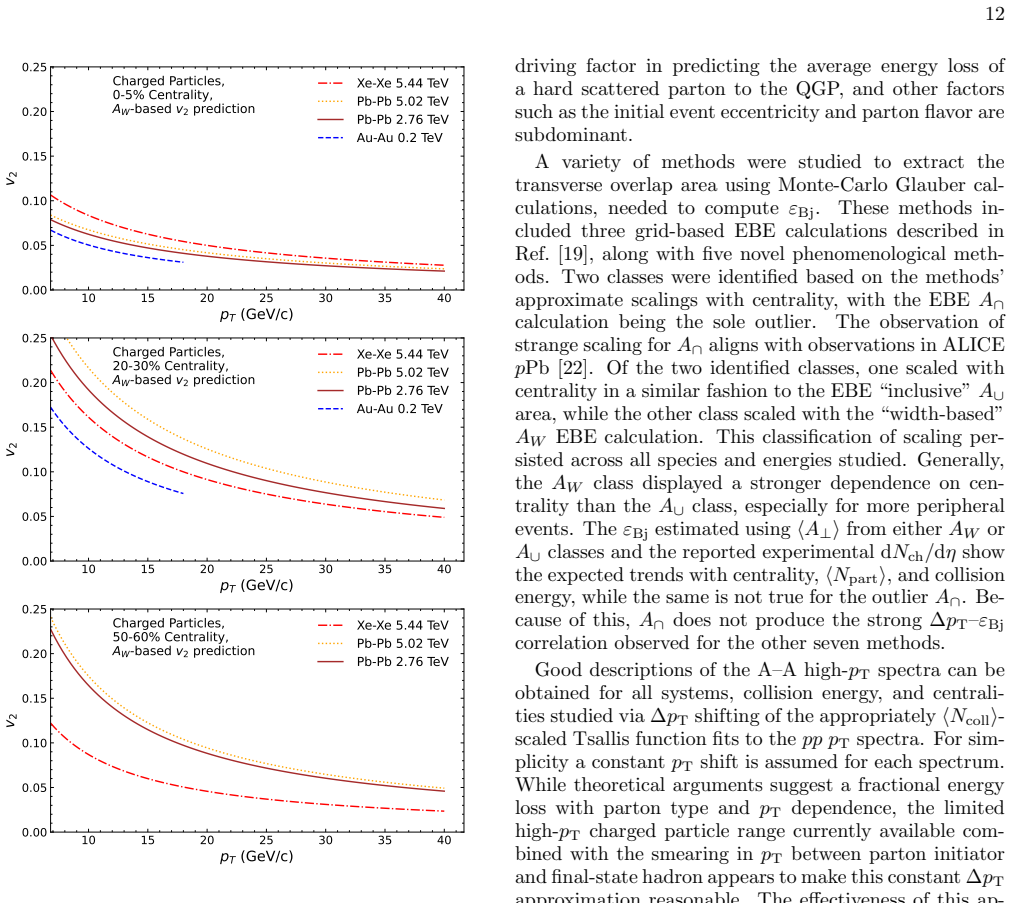
Using a phenomenologically motivated spectrum shift model to estimate the average transverse momentum loss Δp_T imparted on high p_T partons, the authors observe a striking correlation between Δp_T and Glauber-derived estimates of initial state energy density ε_Bj. This correlation remains consistent across two orders of magnitude in collision energy for a variety of nuclear species. Coupling the model to geometric event shape estimates from Glauber calculations produces predictions for high-p_T hadron elliptic flow v2 that agree reasonably with data.
What carries the argument
The phenomenologically motivated spectrum shift model that isolates the medium-induced average transverse momentum loss Δp_T from the kinematic effects of steeply falling pT spectra at different collision energies.
If this is right
- Partonic energy loss increases with the initial energy density of the quark-gluon plasma.
- The dependence holds uniformly across a wide range of collision energies and colliding nuclei.
- Geometric estimates of event shape allow extraction of path-length effects in energy loss.
- Predicted high-p_T elliptic flow v2 matches available experimental data.
Where Pith is reading between the lines
- Energy loss models may need to treat initial density as a primary variable rather than a secondary effect.
- The correlation could be tested directly with future data from lower or higher energy runs at existing facilities.
- Similar shifts could be applied to other observables such as jet fragmentation functions to probe the same density dependence.
Load-bearing premise
The spectrum shift model correctly isolates the medium-induced average transverse momentum loss from the kinematic effects of the steeply falling pT spectra at different collision energies.
What would settle it
New measurements of high-p_T hadron yields at an additional collision energy or with a different nuclear species that break the observed linear correlation between extracted Δp_T and Glauber ε_Bj would falsify the reported dependence.
Figures



read the original abstract
Considerable evidence now exists for partonic energy loss due to interaction with the hot, dense medium created in ultra-relativistic heavy-ion collisions. A primary signal of this energy loss is the suppression of high transverse momentum $p_{\mathrm{T}}$ hadron yields in A-A collisions relative to appropriately scaled $pp$ collisions at the same energy. Measuring the collision energy dependence of this energy loss is vital to understanding the medium, but it is difficult to disentangle the medium-driven energy loss from the natural kinematic variance of the steeply-falling $p_{\mathrm{T}}$ spectra across different $\sqrt{s_{\mathrm{NN}}}$. To decouple these effects, we utilize a phenomenologically motivated spectrum shift model to estimate the average transverse momentum loss $\Delta p_{\mathrm{T}}$ imparted on high $p_{\mathrm{T}}$ partons in A-A collisions, a proxy for the medium induced energy loss. We observe a striking correlation between $\Delta p_{\mathrm{T}}$ and Glauber-derived estimates of initial state energy density $\varepsilon_{\mathrm{Bj}}$, consistent across two orders of magnitude in collision energy for a variety of nuclear species. To access the path-length dependence of energy loss, we couple our model to geometric event shape estimates extracted from Glauber calculations to produce predictions for high-$p_{\mathrm{T}}$ hadron elliptic flow $v_2$ that agree reasonably with data.
Editorial analysis
A structured set of objections, weighed in public.
Referee Report
Summary. The manuscript introduces a phenomenologically motivated spectrum shift model to extract an average transverse momentum loss Δp_T as a proxy for partonic energy loss in heavy-ion collisions. It reports a correlation between this Δp_T and Glauber-derived initial energy density ε_Bj that holds across two orders of magnitude in √s_NN and multiple nuclear species. The model is further combined with geometric estimates to predict high-p_T v2, which is stated to agree reasonably with data.
Significance. If validated, the reported correlation would offer a direct probe of how partonic energy loss scales with initial energy density, providing a useful constraint on QGP transport properties. The consistency across energies and systems, together with the v2 comparison, would strengthen the case for medium-induced effects over purely kinematic explanations.
major comments (2)
- [Spectrum shift model and Δp_T extraction] The extraction of Δp_T via the spectrum shift model is load-bearing for the central correlation claim. The manuscript does not report a closure test in which the identical fitting procedure is applied to a Monte Carlo event generator embedding a known energy-loss model whose true Δp_T is known a priori. Without such a test, residual kinematic bias from the steeper pp spectra at lower √s_NN cannot be ruled out as a partial source of the observed Δp_T–ε_Bj correlation.
- [v2 predictions and data comparison] The abstract notes reasonable agreement between predicted and measured high-p_T v2, yet provides no quantitative details on error propagation, the precise p_T fitting range, or comparisons to alternative energy-loss implementations. This limits the strength of the supporting evidence for the path-length dependence extracted from Glauber geometry.
minor comments (2)
- Specify the exact functional form assumed for the spectrum shift (e.g., constant shift, p_T-dependent shift) and the p_T interval over which the fit is performed.
- Clarify the precise definition and numerical inputs used for the Bjorken energy density ε_Bj, including the assumed formation time τ_0 and any averaging procedure over the transverse plane.
Simulated Author's Rebuttal
We thank the referee for their constructive and detailed comments, which have helped us improve the clarity and robustness of our analysis. We provide point-by-point responses to the major comments below.
read point-by-point responses
-
Referee: The extraction of Δp_T via the spectrum shift model is load-bearing for the central correlation claim. The manuscript does not report a closure test in which the identical fitting procedure is applied to a Monte Carlo event generator embedding a known energy-loss model whose true Δp_T is known a priori. Without such a test, residual kinematic bias from the steeper pp spectra at lower √s_NN cannot be ruled out as a partial source of the observed Δp_T–ε_Bj correlation.
Authors: We agree that a full closure test with an embedded energy-loss model would provide valuable additional validation. However, performing such a test requires substantial new computational infrastructure to couple a specific jet-quenching implementation to our exact fitting procedure across multiple collision energies and systems. We have instead added a dedicated subsection on robustness checks, including variations of the p_T fitting window, alternative shift parametrizations, and explicit comparisons of the extracted Δp_T to results from independent jet-quenching calculations. These tests indicate that the Δp_T–ε_Bj correlation is stable and not driven by kinematic bias from the pp reference spectra, which are accounted for by construction in the model. We have expanded the discussion of possible systematic effects in the revised manuscript. revision: partial
-
Referee: The abstract notes reasonable agreement between predicted and measured high-p_T v2, yet provides no quantitative details on error propagation, the precise p_T fitting range, or comparisons to alternative energy-loss implementations. This limits the strength of the supporting evidence for the path-length dependence extracted from Glauber geometry.
Authors: We thank the referee for this observation. In the revised manuscript we now specify the p_T interval used for the v2 predictions (8 < p_T < 20 GeV/c), detail the propagation of uncertainties from both the extracted Δp_T values and the Glauber-derived geometric eccentricities, and include a short comparison to a simple path-length-dependent energy-loss parametrization. With these additions the agreement with measured high-p_T v2 remains reasonable within the quoted uncertainties, reinforcing the geometric path-length dependence. The abstract and relevant sections have been updated accordingly. revision: yes
Circularity Check
No significant circularity; extraction and correlation remain independent
full rationale
The paper applies a phenomenologically motivated spectrum shift model to measured AA/pp pT spectra to extract an average Δp_T, then directly correlates those extracted values against Glauber-computed ε_Bj. This step does not reduce to the correlation by construction because the shift parameters are chosen to match the shape of the suppression data at each energy, not tuned to enforce a specific dependence on initial energy density. The subsequent v2 predictions couple the same extracted Δp_T to geometric path-length estimates; this constitutes a consistency check on an independent observable rather than a tautological renaming of the input fit. No self-citation chains, uniqueness theorems, or ansatzes imported from prior author work are invoked to force the central result. The derivation therefore rests on external experimental spectra and standard Glauber modeling without the forbidden patterns of fitted inputs being relabeled as predictions or self-definitional loops.
Axiom & Free-Parameter Ledger
free parameters (1)
- spectrum shift parameters
axioms (1)
- domain assumption Glauber calculations provide accurate estimates of initial energy density ε_Bj
Lean theorems connected to this paper
-
IndisputableMonolith/Cost/FunctionalEquation.leanwashburn_uniqueness_aczel unclear?
unclearRelation between the paper passage and the cited Recognition theorem.
we utilize a phenomenologically motivated spectrum shift model to estimate the average transverse momentum loss Δp_T ... striking correlation between Δp_T and Glauber-derived estimates of initial state energy density ε_Bj
-
IndisputableMonolith/Foundation/RealityFromDistinction.leanreality_from_one_distinction unclear?
unclearRelation between the paper passage and the cited Recognition theorem.
assuming a linear path-length dependent energy loss
What do these tags mean?
- matches
- The paper's claim is directly supported by a theorem in the formal canon.
- supports
- The theorem supports part of the paper's argument, but the paper may add assumptions or extra steps.
- extends
- The paper goes beyond the formal theorem; the theorem is a base layer rather than the whole result.
- uses
- The paper appears to rely on the theorem as machinery.
- contradicts
- The paper's claim conflicts with a theorem or certificate in the canon.
- unclear
- Pith found a possible connection, but the passage is too broad, indirect, or ambiguous to say the theorem truly supports the claim.
Reference graph
Works this paper leans on
-
[1]
We use the standard 5 pion mass m = mπ in the kinetic energy ET for all particles
Reference pp spectra are first fit to a Tsallis distri- bution, given by 1 2π d2N dpTdη ∼ E d3N dp3 = C 1 + ET nT −n , (7) where ET = p m2 + p2 T − m is the transverse ki- netic energy, n is the high- pT power law scaling of the pT spectrum, T is a temperature-like parameter controlling the width of the collective region, and C is a normalization factor. ...
-
[2]
The resultant fit on the pp spectra is then scaled by a factor ⟨TAA⟩ obtained from MC Glauber esti- mates [2], as they would be for an RAA calculation
-
[3]
This optimal horizontal shift is ∆ pT
The A–A data are shifted horizontally rightward toward high- pT (or equivalently, the scaled pp fit can be translated horizontally leftward) until the shifted pp baseline spectrum and A–A data agree as well as possible, according to the same fit met- ric used for the pp spectrum fitting. This optimal horizontal shift is ∆ pT. This procedure is shown diagr...
-
[4]
Fourier decompose this function, and take the second harmonic coef- ficient c2
Consider a Glauber derived estimate of the path length of an event-averaged collision region as a function of azimuth R(∆ϕ), discussed above as phe- nomenological area estimates. Fourier decompose this function, and take the second harmonic coef- ficient c2. The ratio over the average radius c2/c0 is the path length fraction of the maximal/minimal path ag...
-
[5]
Take two copies of the ∆pT shifted pT spectrum fit. Shift one copy up toward higherpT according to the proportion δpT = ∆ pT · c2/c0, and another copy down by the same proportion. These spectra en- close the original shifted spectrum. The upshifted and downshifted spectra are labeled dN/d∆p+ T and dN/d∆p− T respectively
-
[6]
Our model estimate for the high- pT differential v2 is then the difference weighted to the original spec- trum: v2(pT) = dN d∆p+ T − dN d∆p− T 2 · dN d∆pT . (10) These steps are illustrated diagrammatically in Fig. 3. The v2 offers a new arena to compare the classes A∪ and AW observed in the transverse area. We will use the Full- Width-at-Half-Max contour...
work page 2018
-
[7]
J. W. Harris and B. M¨ uller, “QGP Signatures” revisited, Eur. Phys. J. C 84, 247 (2024)
work page 2024
-
[8]
Improved Monte Carlo Glauber predictions at present and future nuclear colliders
C. Loizides, J. Kamin, and D. d’Enterria, Improved Monte Carlo Glauber predictions at present and future nuclear colliders, Phys. Rev. C 97, 054910 (2018), [Erra- tum: Phys.Rev.C 99, 019901 (2019)], arXiv:1710.07098 [nucl-ex]
work page internal anchor Pith review Pith/arXiv arXiv 2018
- [9]
- [10]
-
[11]
K. Adcox et al. (PHENIX), Formation of dense partonic matter in relativistic nucleus-nucleus collisions at RHIC: Experimental evaluation by the PHENIX collaboration, Nucl. Phys. A 757, 184 (2005), arXiv:nucl-ex/0410003
work page internal anchor Pith review Pith/arXiv arXiv 2005
-
[12]
A. Adare et al. (PHENIX), Scaling properties of frac- tional momentum loss of high- pT hadrons in nucleus- nucleus collisions at √sNN from 62.4 GeV to 2.76 TeV, Phys. Rev. C 93, 024911 (2016), arXiv:1509.06735 [nucl- ex]
- [13]
- [14]
-
[15]
A. Adare et al. (PHENIX), Neutral pion production with respect to centrality and reaction plane in Au+Au col- lisions at √sNN = 200 GeV, Phys. Rev. C 87, 034911 (2013), arXiv:1208.2254 [nucl-ex]
work page internal anchor Pith review Pith/arXiv arXiv 2013
-
[16]
A. Adare et al. (PHENIX), Evolution of π0 suppression in Au+Au collisions from √sNN = 39 to 200 GeV, Phys. Rev. Lett. 109, 152301 (2012), [Erratum: Phys.Rev.Lett. 125, 049901 (2020)], arXiv:1204.1526 [nucl-ex]
-
[17]
S. S. Adler et al. (PHENIX), Detailed Study of High– pT Neutral Pion Suppression and Azimuthal Anisotropy in Au+Au Collisions at √sNN = 200 GeV, Phys. Rev. C 76, 034904 (2007), arXiv:nucl-ex/0611007
work page internal anchor Pith review Pith/arXiv arXiv 2007
-
[18]
S. Acharya et al. (ALICE), Transverse momentum spec- tra and nuclear modification factors of charged particles in Xe–Xe collisions at √sNN = 5.44 TeV, Phys. Lett. B 788, 166 (2019), arXiv:1805.04399 [nucl-ex]
work page internal anchor Pith review Pith/arXiv arXiv 2019
-
[19]
G. Aad et al. (ATLAS), Charged-hadron production in pp, p+Pb, Pb+Pb, and Xe+Xe collisions at √sNN = 5 TeV with the ATLAS detector at the LHC, JHEP 07, 074, arXiv:2211.15257 [hep-ex]
-
[20]
S. Acharya et al. (ALICE), Transverse momentum spec- tra and nuclear modification factors of charged particles in pp, p–Pb and Pb–Pb collisions at the LHC, JHEP 11, 013, arXiv:1802.09145 [nucl-ex]
work page internal anchor Pith review Pith/arXiv arXiv
-
[21]
J. Adams et al. (STAR), Transverse momentum and col- lision energy dependence of high pT hadron suppression in Au+Au collisions at ultrarelativistic energies, Phys. Rev. Lett. 91, 172302 (2003), arXiv:nucl-ex/0305015
work page internal anchor Pith review Pith/arXiv arXiv 2003
-
[22]
S. S. Adler et al. (PHENIX), High pT charged hadron suppression in Au+Au collisions at √sNN = 200 GeV, Phys. Rev. C 69, 034910 (2004), arXiv:nucl-ex/0308006
work page internal anchor Pith review Pith/arXiv arXiv 2004
-
[23]
B. I. Abelev et al. (STAR), Spectra of identified high–pT π± and p(¯p) in Cu+Cu collisions at √sNN = 200 GeV, Phys. Rev. C 81, 054907 (2010), arXiv:0911.3130 [nucl- ex]
work page internal anchor Pith review Pith/arXiv arXiv 2010
-
[24]
G. Agakishiev et al. (STAR), Identified hadron compo- sitions in p+p and Au+Au collisions at high transverse momenta at √sNN = 200 GeV, Phys. Rev. Lett. 108, 072302 (2012), arXiv:1110.0579 [nucl-ex]. 14
work page internal anchor Pith review Pith/arXiv arXiv 2012
-
[25]
Glauber modeling of high-energy nuclear collisions at sub-nucleon level
C. Loizides, Glauber modeling of high–energy nuclear collisions at the subnucleon level, Phys. Rev. C 94, 024914 (2016), arXiv:1603.07375 [nucl-ex]
work page internal anchor Pith review Pith/arXiv arXiv 2016
-
[26]
Fluctuating Glasma initial conditions and flow in heavy ion collisions
B. Schenke, P. Tribedy, and R. Venugopalan, Fluctuating Glasma initial conditions and flow in heavy ion collisions, Phys. Rev. Lett. 108, 252301 (2012), arXiv:1202.6646 [nucl-th]
work page internal anchor Pith review Pith/arXiv arXiv 2012
-
[27]
J. E. Bernhard, J. S. Moreland, and S. A. Bass, Bayesian estimation of the specific shear and bulk viscosity of quark–gluon plasma, Nature Phys. 15, 1113 (2019)
work page 2019
-
[28]
S. Acharya et al. (ALICE), System–size dependence of the charged-particle pseudorapidity density at √sNN = 5.02 TeV for pp, pPb, and Pb–Pb collisions, Phys. Lett. B 845, 137730 (2023), arXiv:2204.10210 [nucl-ex]
-
[29]
J. D. Bjorken, Highly Relativistic Nucleus-Nucleus Col- lisions: The Central Rapidity Region, Phys. Rev. D 27, 140 (1983)
work page 1983
-
[30]
A. Adare et al. (PHENIX), Transverse energy production and charged-particle multiplicity at midrapidity in vari- ous systems from √sNN = 7.7 to 200 GeV, Phys. Rev. C 93, 024901 (2016), arXiv:1509.06727 [nucl-ex]
work page internal anchor Pith review Pith/arXiv arXiv 2016
-
[31]
S. Chatrchyan et al. (CMS Collaboration), Measure- ment of the Pseudorapidity and Centrality Dependence of the Transverse Energy Density in Pb–Pb Collisions at√sNN = 2.76 TeV, Phys. Rev. Lett. 109, 152303 (2012)
work page 2012
-
[32]
K. Aamodt et al. (ALICE), Centrality dependence of the charged-particle multiplicity density at mid-rapidity in Pb–Pb collisions at √sNN = 2.76 TeV, Phys. Rev. Lett. 106, 032301 (2011), arXiv:1012.1657 [nucl-ex]
work page internal anchor Pith review Pith/arXiv arXiv 2011
-
[33]
C.-Y. Wong and G. Wilk, Tsallis Fits topT Spectra for pp Collisions at LHC, Acta Phys. Polon. B 43, 2047 (2012), arXiv:1210.3661 [hep-ph]
-
[34]
G. Wilk and Z. Wlodarczyk, On the interpretation of nonextensive parameter q in Tsallis statistics and Levy distributions, Phys. Rev. Lett. 84, 2770 (2000), arXiv:hep-ph/9908459
work page internal anchor Pith review Pith/arXiv arXiv 2000
-
[35]
Charged-particle multiplicities in pp interactions measured with the ATLAS detector at the LHC
G. Aad et al. (ATLAS), Charged-particle multiplicities in pp interactions measured with the ATLAS detector at the LHC, New J. Phys. 13, 053033 (2011), arXiv:1012.5104 [hep-ex]
work page internal anchor Pith review Pith/arXiv arXiv 2011
-
[36]
B. B. Abelev et al. (ALICE), Energy Dependence of the Transverse Momentum Distributions of Charged Parti- cles in pp Collisions Measured by ALICE, Eur. Phys. J. C 73, 2662 (2013), arXiv:1307.1093 [nucl-ex]
work page internal anchor Pith review Pith/arXiv arXiv 2013
-
[37]
B. I. Abelev et al. (STAR), Strange particle production in p+p collisions at √s = 200 GeV, Phys. Rev. C 75, 064901 (2007), arXiv:nucl-ex/0607033
work page internal anchor Pith review Pith/arXiv arXiv 2007
-
[38]
A. Adare et al. (PHENIX), Identified charged hadron production in pp collisions at √s = 200 and 62.4 GeV, Phys. Rev. C 83, 064903 (2011), arXiv:1102.0753 [nucl- ex]
-
[39]
G. Giacalone, A. Mazeliauskas, and S. Schlichting, Hy- drodynamic attractors, initial state energy and particle production in relativistic nuclear collisions, Phys. Rev. Lett. 123, 262301 (2019), arXiv:1908.02866 [hep-ph]
- [40]
-
[41]
S. Acharya et al. (ALICE), Energy dependence and fluctuations of anisotropic flow in Pb–Pb collisions at √sNN = 5 .02 and 2.76 TeV, JHEP 07, 103, arXiv:1804.02944 [nucl-ex]
work page internal anchor Pith review Pith/arXiv arXiv
-
[42]
Hydrodynamic predictions for 5.44 TeV Xe+Xe collisions
G. Giacalone, J. Noronha-Hostler, M. Luzum, and J.- Y. Ollitrault, Hydrodynamic predictions for 5.44 TeV Xe+Xe collisions, Phys. Rev. C 97, 034904 (2018), arXiv:1711.08499 [nucl-th]
work page internal anchor Pith review Pith/arXiv arXiv 2018
-
[43]
Anisotropic flow in Xe-Xe collisions at $\mathbf{\sqrt{s_{\rm{NN}}} = 5.44}$ TeV
S. Acharya et al. (ALICE), Anisotropic flow in Xe–Xe collisions at √sNN = 5 .44 TeV, Phys. Lett. B 784, 82 (2018), arXiv:1805.01832 [nucl-ex]
work page internal anchor Pith review Pith/arXiv arXiv 2018
- [44]
-
[45]
Nuclear ground-state masses and deformations: FRDM(2012)
P. M¨ oller, A. J. Sierk, T. Ichikawa, and H. Sagawa, Nuclear ground-state masses and deformations: FRDM(2012), Atom. Data Nucl. Data Tabl. 109- 110, 1 (2016), arXiv:1508.06294 [nucl-th]. 15 Appendix A: Additional Information Concerning Energy Density , ∆pT and Event Averaged Harmonic Calculations This appendix provides further details on the area calcula...
work page internal anchor Pith review Pith/arXiv arXiv 2012
discussion (0)
Sign in with ORCID, Apple, or X to comment. Anyone can read and Pith papers without signing in.