REVIEW 3 major objections 5 minor 1 cited by
People use fast and flat simulation to reason about new games
T0 review · 3 major / 5 minor · reviewed 2026-08-04 · deepseek-v4-flash
Pith's one-line read People can judge, play, and predict novel two-player games with zero experience, and this paper argues the underlying mechanism is fast, flat (one-step), goal-directed probabilistic simulation — implemented as the Intuitive Gamer model, whi
desk verdict A large, well-executed package that mostly earns its central claim about fast, flat mental simulation; the zero-shot evaluation results carry a scratchpad confound that needs a quantitative control. read the letter →
The pith
A machine-rendered reading of the paper's core claim, the machinery that carries it, and where it could break.
The reading
What carries the argument
The central object is the two-module Intuitive Gamer model. The player module scores every legal action by immediate goal progress (Uself), immediate blocking of the opponent's goal (Uopp), and a center-bias auxiliary term (Uaux), then samples an action via a Boltzmann softmax—making it 'flat' (single-step look-ahead), goal-directed, and probabilistic. The reasoning module nests this player in k self-play simulations (empirically k=6), aggregates the simulated outcomes to answer queries like payoff, funness (via balance, reward-for-thinking, and game-length features), or next-move distributions. The model's work is to show that a compute-limited, depth-limited sampler—not deep tree search an
What would settle it
Rerun the zero-shot payoff and funness experiments without any scratchpad and with a forced response delay that forbids board interaction. If human judgments then depart substantially from Intuitive Gamer predictions (R² falling well below the split-half noise ceiling), the thesis that people evaluate never-played games through internal fast-flat simulation fails. A cheaper check: pre-register that the flat model assigns higher per-move likelihood than the deep expert model to first-time moves on a new set of unseen games; a reversal would falsify the player module.
Extended reading notes
Core claim
The paper's central claim is that people reason about novel games—before playing, during first-time play, and when predicting other novices—through what the authors call the Intuitive Gamer: a model that samples a small number (about k=6) of self-play game trajectories, with each action chosen probabilistically from a softmax over a shallow, one-step look-ahead value function combining three general-purpose heuristics (advancing one's own goal, blocking the opponent's progress, and proximity to the board center). The same model accounts for judgments of objective payoff, subjective funness, actual first moves, distributions of likely moves, and even whether to accept a draw. It does so signi
Load-bearing premise
For the zero-shot 'just think' payoff and funness studies, the claim that people evaluate a game before playing it via internal mental simulation presupposes that the optional interactive scratchpad did not carry the reasoning; the paper's own supplemental analysis reports participants used it only 1.60±1.46 rollouts per game on average, but if the scratchpad supplied the simulations, the model fits partly an external aid, weakening the 'before they have played it even once'
Editorial extensions
If this is right
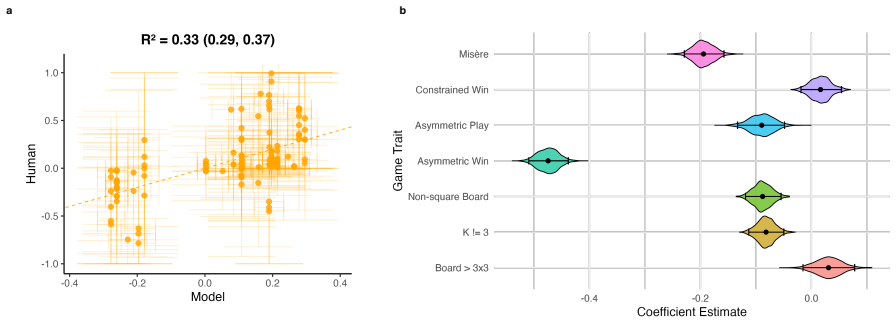
- Zero-shot evaluation: people can estimate a game's payoff and funness from a handful of imagined self-play traces, without ever having moved a piece; the model explains essentially all explainable variance in payoff judgments (R²=0.81 vs 0.82 split-half).
- First-time move selection follows the same flat policy: the Intuitive Gamer predicts the 9,892 moves made by novices better than a deep expert model or random play, with a per-move log-likelihood advantage of 0.51.
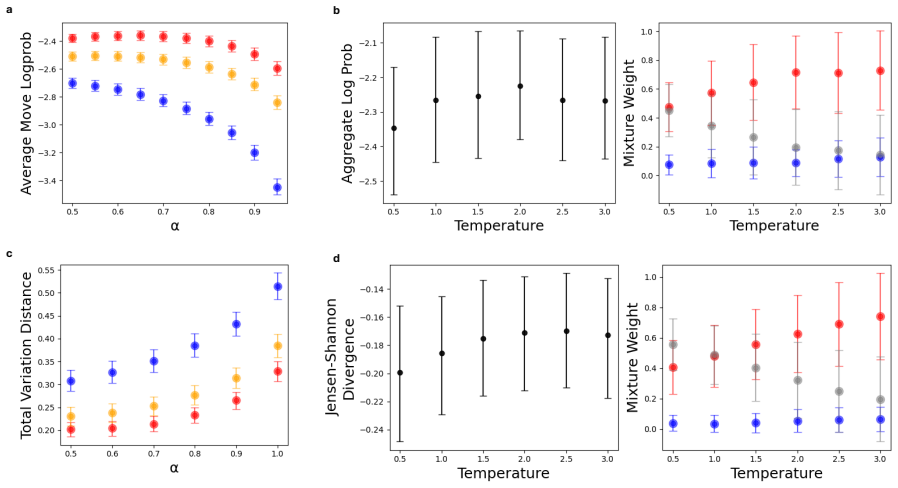
- The model also captures graded expectations: in watch-and-predict experiments, its move distributions approach the human split-half noise ceiling, whereas the deeper expert model tends to be overconfident or diffuse.
- The same model's self-play outcome distributions track actual novice match outcomes (R²=0.72), and draw accept/reject decisions are explained by expected value of continuing plus expected funness.
- Compute efficiency is a corollary: the flat model is roughly 700× faster than the deep expert model and about 40,000× faster than Monte Carlo Tree Search, yet provides better fits to human judgments.
Reading between the lines
- If this generalizes beyond games, fast few-sample depth-limited simulation could explain how people reason about novel economic mechanisms, interfaces, or social rule systems; the paper itself raises this agenda but leaves the test open.
- The result implies a benchmark shift for AI human-likeness: systems should be evaluated not only on expert play, but on zero-shot evaluation—'is this task worth solving?'—using the same flat simulation budget.
- Because k≈6 samples are apparently sufficient, individual judgment noise is intrinsic and predictable; time-pressure manipulations or think-aloud protocols could directly test whether people vary the number of simulations or their stopping rules.
- The endgame finding—where a depth-3 variant matches the flat model—suggests a testable extension: as the legal-move space shrinks, people may adaptively deepen search; manipulating board size and remaining moves should shift the optimal depth.
Editorial analysis
A structured set of objections, weighed in public.
Referee Report
Summary. The paper proposes the 'Intuitive Gamer' model, according to which people reason about novel two-player board games by running a small number of fast, flat, goal-directed probabilistic self-play simulations. The model has two components: a one-step-lookahead heuristic player with fixed hand-set weights and softmax temperature, and a reasoning module that aggregates k simulated games to answer queries such as expected payoff, funness, and move distributions. The authors test the model on more than 1,000 participants across 121 novel M-N-K-style games in four settings: zero-shot payoff and funness judgments, first-time human-human play, watching-and-predicting others' moves, and draw-accept/reject decisions. Headline results are a zero-shot payoff R² of 0.81 [0.77, 0.85] against a split-half noise ceiling of 0.82; a funness R² of 0.57 [0.51, 0.63] against 0.60 [0.51, 0.68]; a per-move log-likelihood advantage of 0.51 over the Expert Gamer in predicting 9,892 first-time moves; and watch-and-predict TVDs near the human split-half ceiling.
Significance. If the conclusions hold, this is a substantial contribution to the study of 'pre-expertise': it provides a rare computational account of how people form judgments and make decisions about entirely new rule systems without task-specific experience. The paper's strengths are considerable: a large and carefully constructed game stimulus set; a player model that is nearly parameter-free (fixed weights and temperature) and is tested on action-prediction data it was not tuned on; systematic comparison with random, deeper-search, MCTS, and language-model baselines; and unusually candid reporting of failure modes (misère games, over-sharp P(draw), late-game depth, post-watch noise). The action-selection and watch-and-predict results are largely independent of the scratchpad and provide strong convergent evidence for the player module. However, the headline zero-shot evaluation results are entangled with an interactive scratchpad that allows external self-play simulation, and the number of simulations k is selected from the same human payoff judgments used to report the payoff fit. These issues affect the strongest quantitative claims and require substantial revision.
major comments (3)
- [Methods, 'Zero-shot game outcome evaluation experiment'; SI §5.1] The zero-shot payoff and funness experiments provided an interactive scratchpad board that participants could use while 'just thinking.' SI §5.1 reports that participants used a mean of 1.60 ± 1.46 rollouts per game in the payoff task. The model's reasoning module itself works by running k self-play simulations and aggregating outcomes. The scratchpad is therefore not a neutral memory aid in this context: it is an external medium for exactly the kind of self-play simulation the model posits. If those external rollouts carried part of the simulation load, the model's R²=0.81 payoff fit and R²=0.57 funness fit partly reflect the structure of the task rather than purely internal mental simulation. The SI's statement that the authors 'do not draw a direct parallel between scratchpad rollouts and mental simulation' does not resolve this concern, because the threat is not that the count equals
- [Methods, 'Sensitivity analyses into the number of samples k'; Fig. 3c] The reasoning module's sample size is set to k=6 because 'a small number of simulations (k more than one, but less than 10) best captures the variance in human prediction' in the payoff experiment. The same human payoff judgments are then used to report the model's payoff R²=0.81. Thus k is not a fully a priori or held-out quantity for the zero-shot payoff evaluation; the 'fastness' component is in part identified from the very data used to validate the model. This does not invalidate the result, but it weakens the claim that the model is nearly parameter-free and that the fit is out-of-sample. Please report payoff R² as a function of k (beyond the variance-matching plots), or select k on a training subset of games/participants and test on the remainder, or otherwise show that the payoff R² is insensitive to the k-selection procedure.
- [SI §5.2, 'Decomposed game outcome prediction tasks'] The payoff composite R²=0.81 masks a systematic miss: the Intuitive Gamer's P(draw) predictions have R²=0.60 [0.56, 0.64] against a human split-half of R²=0.78 [0.72, 0.83], and the authors state that the model is 'substantially sharper in P(draw) predictions than people.' Because payoff is the difference P(P1 win) − P(P1 lose), a good payoff fit can be produced by compensating errors in the components. The paper should either report the decomposed fits prominently in the main text or temper the statement that the model 'matches the total explainable variance' from human payoff judgments. This is especially relevant given the scratchpad and k-selection issues above.
minor comments (5)
- [SI §5.1] Typo: 'we include the scratchpad was to the demands on spatial working memory' should read 'we included the scratchpad to reduce the demands on spatial working memory.'
- [Main text and SI figure captions] 'Total Variance Distance' should be 'Total Variation Distance' (e.g., Fig. 5c caption and SI Figures 47–48).
- [Methods, 'Game construction'] Typo: 'games wiht more atypical rules' should be 'games with more atypical rules.'
- [Main text, 'Is the game likely to be fair?'] 'k more than one, but less than 10' should be written as 1 < k < 10 for clarity and to avoid reading as an interval of integers.
- [SI §6.8.2] The post-watch funness split-half R² is 0.07 [0.0001, 0.27], which is effectively null. This is an important negative result and is only reported in the Supplementary Information. Please at least mention it in the main text's discussion of task differences or limitations.
Circularity Check
No significant circularity: the Intuitive Gamer's payoff, play, and prediction outputs are computed from game rules against fresh human data, with no reduction of predictions to fitted quantities.
full rationale
The central derivation chain is self-contained. Payoffs are ψ(G) computed from k self-play simulations of the player module; human payoff/funness judgments are fresh data. Player-module parameters are fixed (w=1, τ=1) with sensitivity analyses reported; the only tuned quantity, k, is selected by matching model payoff variance to human per-game variance in the same 121-game data. This is a mild model-calibration step, but k affects sampling noise of model payoff estimates rather than their expected values, and the main per-move play, watch-and-predict, and held-out funness comparisons do not depend on it; hence it does not make the payoff or fastness claims reduce by construction. The SI's scratchpad caveat (SI §5.1: 'Participants made on average 1.60±1.46 SD rollouts for the payoff task... We do not draw a direct parallel between scratchpad rollouts and mental simulation') is a real confound for the zero-shot evaluation pillar because participants could offload self-play to the external board, but the model is not fitted to scratchpad usage, and the play and watch-and-predict experiments involve no scratchpad and independently support the player module. There is no load-bearing self-citation: the Expert Gamer's search-iteration parameter comes from van Opheusden et al. (external), and other self-citations are not used to justify the model's core mechanism. No uniqueness theorem from the authors is invoked to rule out alternatives. Accordingly, no circular step meets the evidentiary bar; the paper should be assessed on empirical/correctness grounds rather than circularity.
Assumptions & free parameters
free parameters (6)
- k — number of mental game simulations =
6 (range 5–7)
- softmax temperature τ =
1
- heuristic weights wconnect, wblock, wcenter =
1, 1, 1
- exponentiation base for value features =
2
- funness regression coefficients (balance, reward-for-thinking, length, length²) =
8.7, 4.5, 9.9, −4.4 (SI Table 9)
- Expert Gamer exploration rate ϵ =
0.0001
assumptions (7)
- domain assumption Two-player zero-sum M-N-K grid games are the right stimulus class, and contiguous-connectivity progress is the natural goal metric
- domain assumption Action selection follows a Boltzmann/softmax rule with fixed temperature
- domain assumption People can weigh multiple goals (offense + defense) simultaneously
- domain assumption Mental simulations are independent and (in the primary model) run to termination
- domain assumption The ideal fun game is balanced, decisive, and rewards thinking
- ad hoc to paper The Expert Gamer with ~636 transferred search iterations and an inherited value function fairly represents deep search
- domain assumption Game-theoretic optimality for 78 of 121 games is estimable via Uiterwijk results plus MCTS convergence to {−1,0,1}
Cite this review
Pith. "Pith review of People use fast and flat simulation to reason about new games." pith.science (2026). https://pith.science/paper/YAJH2DKT
@misc{pith2026251011503,
  author       = {Pith},
  title        = {Pith review of: People use fast and flat simulation to reason about new games},
  year         = {2026},
  howpublished = {\url{https://pith.science/paper/YAJH2DKT}},
  note         = {Machine review of arXiv:2510.11503}
}
read the original abstract
Games have long been a microcosm for studying planning and reasoning in both natural and artificial intelligence (AI), often focusing on expert-level or even super-human play. But real life also pushes human intelligence along a different frontier, requiring people to flexibly navigate decision-making problems that they have never thought about before. Here, we use novice gameplay to study how people reason about new problem settings. Through a series of large-scale behavioral studies with over 1000 participants and 121 two-player strategic board games (almost all novel to our participants), we show that people are systematic and adaptively rational in how they play a game for the first time, or evaluate a game (e.g., how fair or how fun it is likely to be) before they have played it even once. We explain these capacities via a computational cognitive model that we call the 'Intuitive Gamer', a model based on mechanisms of fast and flat (depth-limited) goal-directed probabilistic simulation. Our work offers new insights into how people rapidly evaluate, act, and make suggestions when encountering novel problems, and could inform the design of more flexible and human-like AI systems that can determine not just how to solve new tasks, but whether a task is worth thinking about at all.
Figures


Figures from the paper (39 more)






Forward citations
Cited by 1 Pith paper
-
A Matter of Interest: Understanding Interestingness of Math Problems in Humans and Language Models
LLMs track average human interestingness ratings for contest math problems but mostly fail to reproduce the diversity of human ratings or the reasons behind them.
Reference graph
Works this paper leans on
-
[1]
Almaatouq, J
A. Almaatouq, J. Becker, J. P . Houghton, N. Paton, D. J. Watts, and M. E. Whiting. Empirica: a virtual lab for high-throughput macro-level experiments.Behavior Research Methods, 53 (5):2158–2171, 2021
2021
-
[2]
Althofer
I. Althofer. Computer-aided game inventing.Friedrich Schiller University, Jena, Germany, Tech. Rep, 2003
2003
-
[3]
O. Amir, L. Tyomkin, and Y. Hart. Adaptive search space pruning in complex strategic problems.PLoS Computational Biology, 18(8):e1010358, 2022. 15
2022
-
[4]
C. L. Baker, J. Jara-Ettinger, R. Saxe, and J. B. Tenenbaum. Rational quantitative attribution of beliefs, desires and percepts in human mentalizing.Nature Human Behaviour, 1(4):0064, 2017
2017
-
[5]
P . W. Battaglia, J. B. Hamrick, and J. B. Tenenbaum. Simulation as an engine of physical scene understanding.Proceedings of the National Academy of Sciences, 110(45):18327–18332, 2013
2013
-
[6]
C. B. Browne.Automatic generation and evaluation of recombination games. PhD thesis, Queensland University of Technology, 2008
2008
-
[7]
C. B. Browne, E. Powley, D. Whitehouse, S. M. Lucas, P . I. Cowling, P . Rohlfshagen, S. Tavener, D. Perez, S. Samothrakis, and S. Colton. A survey of monte carlo tree search methods.IEEE Transactions on Computational Intelligence and AI in Games, 4(1):1–43, 2012
2012
-
[8]
Campbell, A
M. Campbell, A. J. Hoane Jr, and F.-h. Hsu. Deep Blue.Artificial Intelligence, 134(1-2):57–83, 2002
2002
Show all 69 references
-
[9]
Cao and Y
X. Cao and Y. Lin. Uct-adp progressive bias algorithm for solving gomoku. In2019 IEEE Symposium Series on Computational Intelligence (SSCI), pages 50–56. IEEE, 2019
2019
-
[10]
Carroll, R
M. Carroll, R. Shah, M. K. Ho, T. Griffiths, S. Seshia, P . Abbeel, and A. Dragan. On the utility of learning about humans for human-AI coordination.Advances in neural information processing systems, 32, 2019
2019
-
[11]
Charness
N. Charness. Expertise in chess: The balance between knowledge and search. In K. A. Ericsson and J. Smith, editors,Toward a general theory of expertise: Prospects and limits, pages 39–63. Cambridge University Press, Cambridge, 1991
1991
-
[12]
W. G. Chase and H. A. Simon. The mind’s eye in chess. InVisual information processing, pages 215–281. Elsevier, 1973
1973
-
[13]
J. Chu, J. B. Tenenbaum, and L. E. Schulz. In praise of folly: flexible goals and human cognition.Trends in Cognitive Sciences, 2023
2023
-
[14]
A. A. Cleveland. The psychology of chess and of learning to play it.The American Journal of Psychology, 18(3):269–308, 1907
1907
-
[15]
K. M. Collins, I. Sucholutsky, U. Bhatt, K. Chandra, L. Wong, M. Lee, C. E. Zhang, T. Zhi- Xuan, M. Ho, V . Mansinghka, et al. Building machines that learn and think with people. Nature Human Behavior, 2024
2024
-
[16]
R. Coulom. Efficient selectivity and backup operators in monte-carlo tree search. In International conference on computers and games, pages 72–83. Springer, 2006
2006
-
[17]
Crowley and R
K. Crowley and R. S. Siegler. Flexible strategy use in young children’s tic-tac-toe.Cognitive Science, 17(4):531–561, 1993
1993
-
[18]
Bakhtin, N
FAIR, A. Bakhtin, N. Brown, E. Dinan, G. Farina, C. Flaherty, D. Fried, A. Goff, J. Gray, H. Hu, et al. Human-level play in the game of diplomacy by combining language models with strategic reasoning.Science, 378(6624):1067–1074, 2022
2022
-
[19]
Franke and J
M. Franke and J. Degen. The softmax function: Properties, motivation, and interpretation. OSF Preprints, 2023
2023
-
[20]
Genesereth and M
M. Genesereth and M. Thielscher.General Game Playing. Synthesis Lectures on Artificial Intelligence and Machine Learning. Morgan & Claypool Publishers, 2014. 16
2014
-
[21]
Gobet, J
F. Gobet, J. Retschitzki, and A. de Voogt.Moves in mind: The psychology of board games. Psychology Press, 2004
2004
-
[22]
T. L. Griffiths, A. N. Sanborn, K. R. Canini, and D. J. Navarro. Categorization as nonparametric Bayesian density estimation.The probabilistic mind: Prospects for Bayesian cognitive science, pages 303–328, 2008
2008
-
[23]
Hintikka
J. Hintikka. On the logic of an interrogative model of scientific inquiry.Synthese, pages 69–83, 1981
1981
-
[24]
M. K. Ho, D. Abel, C. G. Correa, M. L. Littman, J. D. Cohen, and T. L. Griffiths. People construct simplified mental representations to plan.Nature, 606(7912):129–136, 2022
2022
-
[25]
L. Hurwicz. The design of mechanisms for resource allocation.The American Economic Review, 63(2):1–30, 1973
1973
-
[26]
T. Icard. Subjective probability as sampling propensity.Review of Philosophy and Psychology, 7(4):863–903, 2016
2016
-
[27]
J. Kiefer. Sequential minimax search for a maximum.Proceedings of the American mathematical society, 4(3):502–506, 1953
1953
-
[28]
Kocsis and C
L. Kocsis and C. Szepesvari. Bandit based Monte-Carlo planning. InEuropean Conference on Machine Learning, pages 282–293. Springer, 2006
2006
-
[29]
Koster, J
R. Koster, J. Balaguer, A. Tacchetti, A. Weinstein, T. Zhu, O. Hauser, D. Williams, L. Campbell-Gillingham, P . Thacker, M. Botvinick, et al. Human-centred mechanism design with democratic ai.Nature Human Behaviour, 6(10):1398–1407, 2022
2022
-
[30]
Kuperwajs, M
I. Kuperwajs, M. K. Ho, and W. J. Ma. Heuristics for meta-planning from a normative model of information search.Planning, 1:a2, 2024
2024
-
[31]
Laudan.Progress and its problems: Towards a theory of scientific growth, volume 282
L. Laudan.Progress and its problems: Towards a theory of scientific growth, volume 282. Univ of California Press, 1978
1978
-
[32]
H. Li. gobang: JavaScript Gobang AI based on Alpha-Beta Pruning. https://github. com/lihongxun945/gobang, 2025
2025
-
[33]
R. D. Luce.Individual choice behavior, volume 4. Wiley New York, 1959
1959
-
[34]
E. S. Maskin. Mechanism design: How to implement social goals.American Economic Review, 98(3):567–576, 2008
2008
-
[35]
McFadden
D. McFadden. The human side of mechanism design: a tribute to Leo Hurwicz and Jean-Jacque Laffont.Review of Economic Design, 13(1):77–100, 2009
2009
-
[36]
M. L. Menéndez, J. A. Pardo, L. Pardo, and M. d. C. Pardo. The Jensen-Shannon divergence. Journal of the Franklin Institute, 334(2):307–318, 1997
1997
-
[37]
P . R. Milgrom.Putting auction theory to work. Cambridge University Press, 2004
2004
-
[38]
V . Mnih, K. Kavukcuoglu, D. Silver, A. A. Rusu, J. Veness, M. G. Bellemare, A. Graves, M. Riedmiller, A. K. Fidjeland, G. Ostrovski, et al. Human-level control through deep reinforcement learning.nature, 518(7540):529–533, 2015
2015
-
[39]
R. B. Myerson. Mechanism design by an informed principal.Econometrica: Journal of the Econometric Society, pages 1767–1797, 1983. 17
1983
-
[40]
M. R. Nassar and M. J. Frank. Taming the beast: extracting generalizable knowledge from computational models of cognition.Current opinion in behavioral sciences, 11:49–54, 2016
2016
-
[41]
Newell and H
A. Newell and H. A. Simon.Human problem solving. Prentice-Hall, Englewood Cliffs, NJ, 1972
1972
-
[42]
Newell, J
A. Newell, J. C. Shaw, and H. A. Simon. Chess-playing programs and the problem of complexity.IBM Journal of Research and Development, 2(4):320–335, 1958
1958
-
[43]
C. T. Nguyen. Games and the art of agency.Philosophical Review, 128(4):423–462, 2019
2019
-
[44]
Jaech, A
OpenAI Team, A. Jaech, A. Kalai, A. Lerer, A. Richardson, A. El-Kishky, A. Low, A. Helyar, A. Madry, A. Beutel, A. Carney, A. Iftimie, A. Karpenko, A. T. Passos, A. Neitz, A. Prokofiev, A. Wei, A. Tam, A. Bennett, A. Kumar, A. Saraiva, A. Vallone, A. Duberstein, A. Kondrich, A...
2024 arXiv
-
[45]
Palan and C
S. Palan and C. Schitter. Prolific.ac—A subject pool for online experiments.Journal of Behavioral and Experimental Finance, 17:22–27, 2018
2018
-
[46]
Piette, D
E. Piette, D. J. Soemers, M. Stephenson, C. F. Sironi, M. H. Winands, and C. Browne. Ludii–the ludemic general game system. InECAI 2020, pages 411–418. IOS Press, 2020
2020
-
[47]
Rubner, C
Y. Rubner, C. Tomasi, and L. J. Guibas. A metric for distributions with applications to image databases. InSixth international conference on computer vision (IEEE Cat. No. 98CH36271), pages 59–66. IEEE, 1998. 18
1998
-
[48]
R. B. Rutledge, N. Skandali, P . Dayan, and R. J. Dolan. A computational and neural model of momentary subjective well-being.Proceedings of the National Academy of Sciences, 111(33): 12252–12257, 2014
2014
-
[49]
A. N. Sanborn, T. L. Griffiths, and D. J. Navarro. Rational approximations to rational models: alternative algorithms for category learning.Psychological review, 117(4):1144, 2010
2010
-
[50]
C. E. Shannon. Xxii. programming a computer for playing chess.The London, Edinburgh, and Dublin Philosophical Magazine and Journal of Science, 41(314):256–275, 1950
1950
-
[51]
Sheoran, G
K. Sheoran, G. Dhand, M. Dabas, N. Dahiya, and P . Pushparaj. Solving connect 4 using optimized minimax and monte carlo tree search.Advances and Applications in Mathematical Sciences, 21(6):3303–3313, 2022
2022
-
[52]
Silver, A
D. Silver, A. Huang, C. J. Maddison, A. Guez, L. Sifre, G. van den Driessche, J. Schrittwieser, I. Antonoglou, V . Panneershelvam, M. Lanctot, S. Dieleman, D. Grewe, J. Nham, N. Kalchbrenner, I. Sutskever, T. Lillicrap, M. Leach, K. Kavukcuoglu, T. Graepel, and D. Hassabis. Ma...
2016
-
[53]
Silver, T
D. Silver, T. Hubert, J. Schrittwieser, I. Antonoglou, M. Lai, A. Guez, M. Lanctot, L. Sifre, D. Kumaran, T. Graepel, et al. Mastering chess and shogi by self-play with a general reinforcement learning algorithm.arXiv preprint arXiv:1712.01815, 2017
2017 arXiv
-
[54]
Silver, J
D. Silver, J. Schrittwieser, K. Simonyan, I. Antonoglou, A. Huang, A. Guez, T. Hubert, L. Baker, M. Lai, A. Bolton, Y. Chen, T. Lillicrap, F. Hui, L. Sifre, G. van den Driessche, T. Graepel, and D. Hassabis. Mastering the game of go without human knowledge.Nature, 550(7676):35...
2017
-
[55]
Simon and W
H. Simon and W. Chase. Skill in chess. InComputer chess compendium, pages 175–188. Springer, 1988
1988
-
[56]
Steyvers, H
M. Steyvers, H. Tejeda, G. Kerrigan, and P . Smyth. Bayesian modeling of human–ai complementarity.Proceedings of the National Academy of Sciences, 119(11):e2111547119, 2022
2022
-
[57]
T. Tao. There’s more to mathematics than rigour and proofs, 2007
2007
-
[58]
G. Todd, A. G. Padula, M. Stephenson, É. Piette, D. Soemers, and J. Togelius. Gavel: Generating games via evolution and language models.Advances in Neural Information Processing Systems, 37:110723–110745, 2024
2024
-
[59]
K. E. Train.Discrete choice methods with simulation. Cambridge University Press, 2009
2009
-
[60]
J. W. Uiterwijk. Solving strong and weak 4-in-a-row. In2019 IEEE conference on games (CIG), pages 1–8. IEEE, 2019
2019
-
[61]
T. D. Ullman, E. Spelke, P . Battaglia, and J. B. Tenenbaum. Mind games: Game engines as an architecture for intuitive physics.Trends in cognitive sciences, 21(9):649–665, 2017
2017
-
[62]
van Opheusden, I
B. van Opheusden, I. Kuperwajs, G. Galbiati, Z. Bnaya, Y. Li, and W. J. Ma. Expertise increases planning depth in human gameplay.Nature, pages 1–6, 2023
2023
-
[63]
Vinyals, I
O. Vinyals, I. Babuschkin, W. M. Czarnecki, M. Mathieu, A. Dudzik, J. Chung, D. H. Choi, R. Powell, T. Ewalds, P . Georgiev, et al. Grandmaster level in starcraft ii using multi-agent reinforcement learning.Nature, 575(7782):350–354, 2019
2019
-
[64]
E. Vul, N. Goodman, T. L. Griffiths, and J. B. Tenenbaum. One and done? Optimal decisions from very few samples.Cognitive science, 38(4):599–637, 2014. 19
2014
-
[65]
X. Wang, Z. Lu, and M. Yin. Will you accept the AI recommendation? predicting human behavior in ai-assisted decision making. InProceedings of the ACM Web Conference 2022, pages 1697–1708, 2022
2022
-
[66]
G. N. Yannakakis and J. Togelius.Artificial Intelligence and Games. Springer, 2018
2018
-
[67]
L. Ying, K. M. Collins, P . Sharma, C. Colas, K. I. Zhao, A. Weller, Z. Tavares, P . Isola, S. J. Gershman, J. D. Andreas, et al. Assessing adaptive world models in machines with novel games.arXiv preprint arXiv:2507.12821, 2025
2025 arXiv
-
[68]
Zhi-Xuan, J
T. Zhi-Xuan, J. Mann, T. Silver, J. Tenenbaum, and V . Mansinghka. Online Bayesian goal inference for boundedly rational planning agents.Advances in neural information processing systems, 33:19238–19250, 2020
2020
-
[69]
infinitely
J.-Q. Zhu, A. N. Sanborn, and N. Chater. The bayesian sampler: Generic bayesian inference causes incoherence in human probability judgments.Psychological review, 127(5):719, 2020. Methods Game construction We manually constructed the 121 two-player competitive strategy game va...
2020
Reviewed August 4, 2026 · model on record in the stance chip above.
Discussion (0). Sign in to comment.