REVIEW 4 major objections 5 minor 1 cited by
A fetal-ultrasound AI uses a disease-to-view knowledge graph to generate full multi-view reports and multi-label diagnoses, beating general-purpose and medical baselines.
Reviewed by Pith at T0; open to challenge. T0 means a machine referee read the full paper against a public rubric. the ladder, T0–T4 →
A multi-view vision-language model trained on 20,000 fetal ultrasound reports generates clinical text and diagnoses, reportedly outperforming general and medical baselines.
T0 review reviewed 2026-08-04 challenge →
load-bearing objection Useful system paper with a plausible method and a real gap, but the headline numbers are not yet trustworthy because the main comparison penalizes baselines with a GPT extraction step that is only controlled for FetalMind, not for GPT-5/Gemini. the 4 major comments →
Epistemic-aware Vision-Language Foundation Model for Fetal Ultrasound Interpretation
The pith
A machine-rendered reading of the paper's core claim, the machinery that carries it, and where it could break.
The reading
Core claim
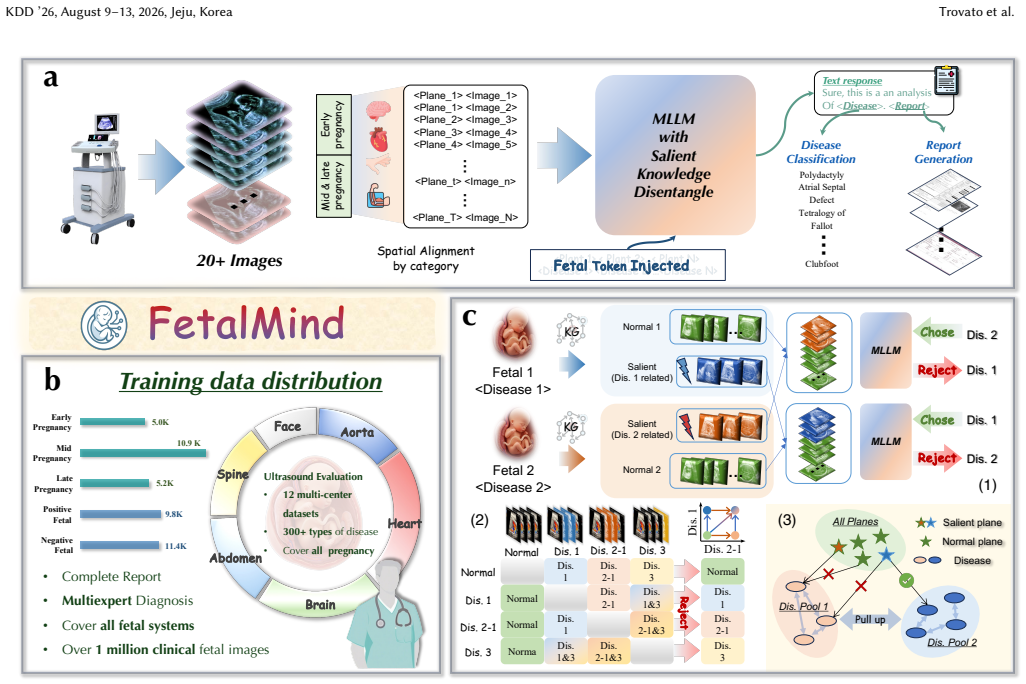
The paper's central claim is that the bottleneck in fetal ultrasound AI is not raw model capacity but the alignment of visual evidence with diagnostic knowledge. FetalMind introduces Salient Epistemic Disentanglement (SED): a bipartite graph maps each of 326 diseases to the 54 ultrasound views where its signs appear, and each case's images are split into salient and normal sets relative to a disease. Training builds synthetically swapped cases in which one fetus's disease-bearing views are grafted onto another fetus's normal views, and the model is optimized to prefer the donor's diagnosis and reject the receiver's original one. This forces diagnoses to be grounded in the planes that actuall
What carries the argument
The load-bearing mechanism is the disease-to-view bipartite knowledge graph G paired with Salient View Preference Optimization (SVPO). G encodes expert consensus on which of 54 ultrasound views are salient for each of 326 diseases. For a given disease d, a fetal case is split into salient images (views in G(d)) and non-salient images (the rest). SVPO constructs preference triplets by swapping the salient images between two fetuses with different diagnoses and training the model with a contrastive preference loss—plus a behavior-cloning regularizer that anchors outputs to expert-like reports—to choose the donor's diagnosis and reject the receiver's original one. A spatial-alignment module (a
Load-bearing premise
The expert-curated disease-to-view graph—saying exactly which ultrasound planes carry the evidence for each of 326 diseases—is correct and complete enough that swapping those views between fetuses creates trustworthy preference labels.
What would settle it
Take a set of confirmed cases and withhold every view that the graph labels salient for the true disease (or, conversely, show only views the graph labels normal). If FetalMind still diagnoses correctly, the graph is not doing the claimed work; if it fails, graph completeness is load-bearing. A complementary test: randomly corrupt the graph by deleting or adding edges, retrain, and measure the accuracy swing.
If this is right
- Fetal ultrasound can be treated as one joint task—multi-view report generation plus multi-label diagnosis—rather than a set of independent single-image subtasks, which matches how obstetricians actually work.
- Early-pregnancy screening may gain the most: the paper reports roughly 20-point Micro-D gains in the first trimester, precisely the stage where earlier anomaly detection gives the most time for clinical action.
- Structured clinical priors (a knowledge graph) can be injected into a multimodal language model through preference optimization, without changing the model architecture.
- A twelve-center corpus with over one million images and expert-verified diagnoses now exists for fetal ultrasound, enabling large-scale training and evaluation of future models in a field previously short on data.
Where Pith is reading between the lines
- The method's accuracy is only as good as the expert graph: if a disease's evidence also lives in views the graph calls 'normal,' the swapped preference labels are misleading, and reported gains may partly reflect the graph's own biases.
- The swap-and-reject recipe is transferable: any multi-view imaging domain with a known disease-to-region map (echocardiography, breast ultrasound, retinal imaging) could use the same SED+SVPO construction.
- A direct stress test would corrupt the graph—delete or add edges and retrain—to see how much of the gain is attributable to SED versus the backbone model; the paper does not report this sensitivity.
- Because swapped inputs are synthetic, the model may learn to spot 'splicing artifacts' rather than true cross-view evidence; the authors flag this risk in the limitations, and attention-based probes could reveal which signal is driving decisions.
Editorial analysis
A structured set of objections, weighed in public.
Referee Report
Summary. The paper proposes FetalMind, a vision–language model for fetal ultrasound that jointly performs multi-view report generation and multi-label diagnosis. The method has three components: class-wise spatial alignment that assigns each image to a standard anatomical view; fetal token injection that encodes domain terms as special tokens; and Salient Epistemic Disentanglement (SED) with Salient View Preference Optimization (SVPO), which uses an expert-curated disease→view bipartite graph to construct preference pairs by swapping salient views across fetuses. The authors also introduce FetalSigma-1M, a multi-center corpus of 20K reports and >1M images, and report experiments showing consistent gains over open- and closed-source baselines across trimesters, with a 98% accuracy on 153 major-malformation cases.
Significance. If the reported results are valid, FetalMind would be a substantive advance: it is the first system to jointly address whole-fetus multi-view ultrasound report generation and multi-label diagnosis, trained on a large multi-center corpus, and it demonstrates a concrete way to inject structured clinical knowledge (disease–view associations) into a multimodal LLM via preference optimization. The ablation structure gives credit to the proposed SED/SVPO components, and the attention analysis provides a complementary, non-metric check that the model preferentially attends to abnormal images. However, the paper currently ships no code or dataset, so reproducibility rests entirely on the text. The headline empirical claims are weakened by an asymmetric baseline-evaluation protocol and by an internal inconsistency in the reported preference-learning temperature; these issues need to be resolved before the central claims can be accepted.
major comments (4)
- [§3.3, Eq. (3); §4.1 Implementation Details] The implementation details state "the temperature parameter is fixed at β=0.0", but Eq. (3) requires β>0 and the derivative analysis in Eq. (4) is only meaningful for β>0. With β=0, Δ=0 for every pair, LSVPO is constant log(0.5), and SVPO cannot update the policy at all. This directly contradicts Table 3, where removing SED/SVPO causes a large degradation (F1 drops from 31.1 to 26.7). The authors must state the actual β used for training and, if β=0 is indeed what was run, explain how SVPO had any effect. The contradiction is load-bearing because the paper's central methodological contribution is the preference-optimization step.
- [§4.1; Table 1; Table 7] The main baseline comparison is not apples-to-apples. Gemini 2.5 Pro and GPT-5 are evaluated by asking GPT to extract diagnoses from their generated reports (Table 7: GPT Diagnosis ✓), while FetalMind is evaluated by direct diagnosis (GPT Diagnosis ✗). The control in Table 7 applies GPT extraction only to FetalMind reports, showing a ~0.4-point F1 drop; it does not quantify the extraction loss for Gemini or GPT-5. A baseline that states a correct diagnosis in non-canonical wording may be missed by the GPT extractor, artificially lowering its F1/ACC. The reported +14% average gains and +61.2% critical-condition advantage could therefore partly reflect the evaluation harness. The authors should either evaluate all models with the same protocol (direct diagnosis where supported, or GPT extraction for all) or report the extraction loss individually for every baseline.
- [§3.3; Table 1, Body F1-20 column] The Body F1-20 metric is derived from a disease-to-anatomy mapping that uses the same expert graph G (or a closely related construction) that defines the salient views for SED swaps. For FetalMind this metric measures consistency with the injected graph rather than independent visual localization, and comparing it against baselines that never saw G is not a fair test of anatomical grounding. The authors should clarify how the 20-category mapping was constructed and, ideally, evaluate localization fidelity with a clinician-annotated view/disease test set that is independent of the graph used during training.
- [§A.1; §4.1; §4.3] The dataset description states positive cases were deliberately enriched during curation (9.8K positive vs 11.4K negative). It is unclear whether the 7:1:2 test split preserves this enrichment or reflects the natural <1% base rate mentioned in the same paragraph. The reported ACC/F1 numbers, and especially the 98% accuracy on only 153 major-malformation cases, are difficult to interpret without this information and without confidence intervals. Please report the class distribution in the test set and provide CIs or uncertainty estimates for the headline diagnostic results.
minor comments (5)
- [Appendix F and G] The 'Use of Large Language Models' section appears twice verbatim (Appendix F and G). Remove one.
- [§B.1] Typo in the text: 'Feta l was trained' should be 'FetalMind was trained'.
- [Table 2] The table header is garbled and contains repeated/duplicated columns (e.g., 'Micro-D Macro-D' repeated in Early and Mid columns, and the Late column has an extra 'Micro-D'). The header should be normalized so each row has the same metric columns.
- [§4.5 / Figure 6] The parameter-sensitivity discussion says diagnostic performance is best at lower β while report generation peaks around β=0.1, but the implementation section fixes β=0.0. If the sensitivity analysis allowed β to vary, the training protocol used for the main results should be explicitly reconciled with this figure.
- [General] No code or dataset link is provided (the project page is referenced but not accessible in the reviewed text). For a dataset- and method-heavy paper, this limits reproducibility; a release plan should be stated.
Circularity Check
Main diagnostic comparison is independent; Body F1-20 is self-referential via the same expert disease–view graph used in SED training.
specific steps
-
self definitional
[Sec. 3.3 (Eqs. 1–3, view–disease swap / SVPO) and Sec. 4.2 / Table 1 (Body F1-20)]
"We construct an expert-curated disease→view bipartite knowledge graph G ... that maps each disease d to its salient views G(d)⊆P. ... We swap only the salient views ... The chosen labels come from the donor and reject labels come from the receiver's labels. ... To further assess localization fidelity from diseases to fetal anatomy, we construct a disease-view mapping spanning 20 anatomical categories (e.g., cardiac, cerebral). ... All nodes are determined based on textbooks, clinical guidelines, and expert consensus."
The same expert-curated disease–view graph G that defines which views are 'salient' and therefore controls the swap-derived SVPO preference pairs is also the source of the disease-to-anatomy mapping used to compute the Body F1-20 'localization fidelity' metric. Thus Body F1-20 does not measure grounding against an independent standard; it measures how well the model reproduces the very prior injected during SED training. The reported 23.8% Body F1-20 gain is therefore partly by construction, since FetalMind was explicitly trained on G-derived swaps while baselines were not given G. The primary diagnostic ACC/F1 and report-generation comparisons are evaluated against expert-verified labels independent of G, so the central headline claim is not circular, but this supporting grounding metric
full rationale
The central empirical claim—FetalMind outperforms baselines on multi-label diagnosis (F1/ACC) and report generation—is not circular: those labels come from multi-expert-verified clinical reports, not from the disease–view graph G, and the baseline comparisons use external checkpoints. The SED/SVPO objective (Eq. 3) is a standard offline preference loss; the paper transparently cites DPO/CPO and does not claim a new objective. No load-bearing self-citation chain is present: reference [8] is an irrelevant self-citation by a co-author but supports no derivation, and no uniqueness theorem or ansatz is imported from the authors' prior work. The one genuinely self-referential element is the Body F1-20 'localization fidelity' metric in Sec. 4.2/Table 1: the disease-to-anatomy mapping used to compute it is built from the same expert-curated disease–view knowledge graph that defines the salient views swapped to construct SVPO preference pairs (Sec. 3.3, Eqs. 1–3). That metric therefore measures adherence to the injected prior rather than independent grounding, making the grounding claim partially circular. The GPT-extraction asymmetry for closed baselines (Sec. 4.1, App. C.4) is a protocol-fairness risk rather than a circular derivation, so it does not raise the circularity score; similarly, the manuscript's own acknowledgment of possible 'splicing artifacts' is a stated validity limitation, not a circularity. Overall, the headline comparison is self-contained, and the circularity is confined to one supporting evaluation metric, giving a score of 3.
Axiom & Free-Parameter Ledger
free parameters (4)
- Temperature β (SVPO/CPO) =
stated 0.0 in §4.1; sensitivity peak for report generation ≈0.1 (§4.5)
- Disease–view bipartite graph edges (326 disease nodes, 54 view nodes, 879 edges) =
expert-curated, no uncertainty
- Image resolution 224×224 =
224
- Train/val/test split ratio and positive-case enrichment =
7:1:2; positive cases deliberately enriched
axioms (5)
- domain assumption The expert-curated disease→view graph G(d) correctly enumerates the salient views for each disease
- domain assumption A diagnosis can be made from a variable set of static 2D ultrasound images at 224×224 resolution with view annotations
- domain assumption Ground-truth diagnoses derived by DeepSeek-R1 extraction followed by multi-expert review are correct and complete
- standard math CPO with uniform reference and BC regularizer is a valid preference-optimization objective
- domain assumption Swapping images across fetuses within matched gestational stages yields anatomically plausible cases and valid chosen/rejected labels
Cite this review
Pith. "Pith review of Epistemic-aware Vision-Language Foundation Model for Fetal Ultrasound Interpretation." pith.science (2026). https://pith.science/paper/PWQ4C2VP
@misc{pith2026251012953,
  author       = {Pith},
  title        = {Pith review of: Epistemic-aware Vision-Language Foundation Model for Fetal Ultrasound Interpretation},
  year         = {2026},
  howpublished = {\url{https://pith.science/paper/PWQ4C2VP}},
  note         = {Machine review of arXiv:2510.12953}
}
read the original abstract
Recent medical vision-language models have shown promise on tasks such as VQA, report generation, and anomaly detection. However, most are adapted to structured adult imaging and underperform in fetal ultrasound, which poses challenges of multi-view image reasoning, numerous diseases, and image diversity. To bridge this gap, we introduce FetalMind, a medical AI system tailored to fetal ultrasound for both report generation and diagnosis. Guided by clinical workflow, we propose Salient Epistemic Disentanglement (SED), which injects an expert-curated bipartite graph into the model to decouple view-disease associations and to steer preference selection along clinically faithful steps via reinforcement learning. This design mitigates variability across diseases and heterogeneity across views, reducing learning bottlenecks while aligning the model's inference with obstetric practice. To train FetalMind at scale, we curate FetalSigma-1M dataset, the first large-scale fetal ultrasound report corpus, comprising 20K reports from twelve medical centers, addressing the scarcity of domain data. Extensive experiments show that FetalMind outperforms open- and closed-source baselines across all gestational stages, achieving +14% average gains and +61.2% higher accuracy on critical conditions while remaining efficient, stable, and scalable. Project Page: https://hexiao0275.github.io/FetalMind.
Figures




Forward citations
Cited by 1 Pith paper
-
FADA: Accessible fetal ultrasound interpretation and annotation with a selectively distilled unified vision-language model
FADA is a selectively distilled unified vision-language model for fetal ultrasound that performs interpretation, classification, detection, and segmentation in one pipeline, achieves strong metrics, and deploys offlin...
This paper was first reviewed by deepseek-v4-flash on August 4, 2026.
discussion (0)
Sign in with ORCID, Apple, or X to comment. Anyone can read and Pith papers without signing in.