On the Reasoning Abilities of Masked Diffusion Language Models
Pith reviewed 2026-05-18 06:51 UTC · model grok-4.3
The pith
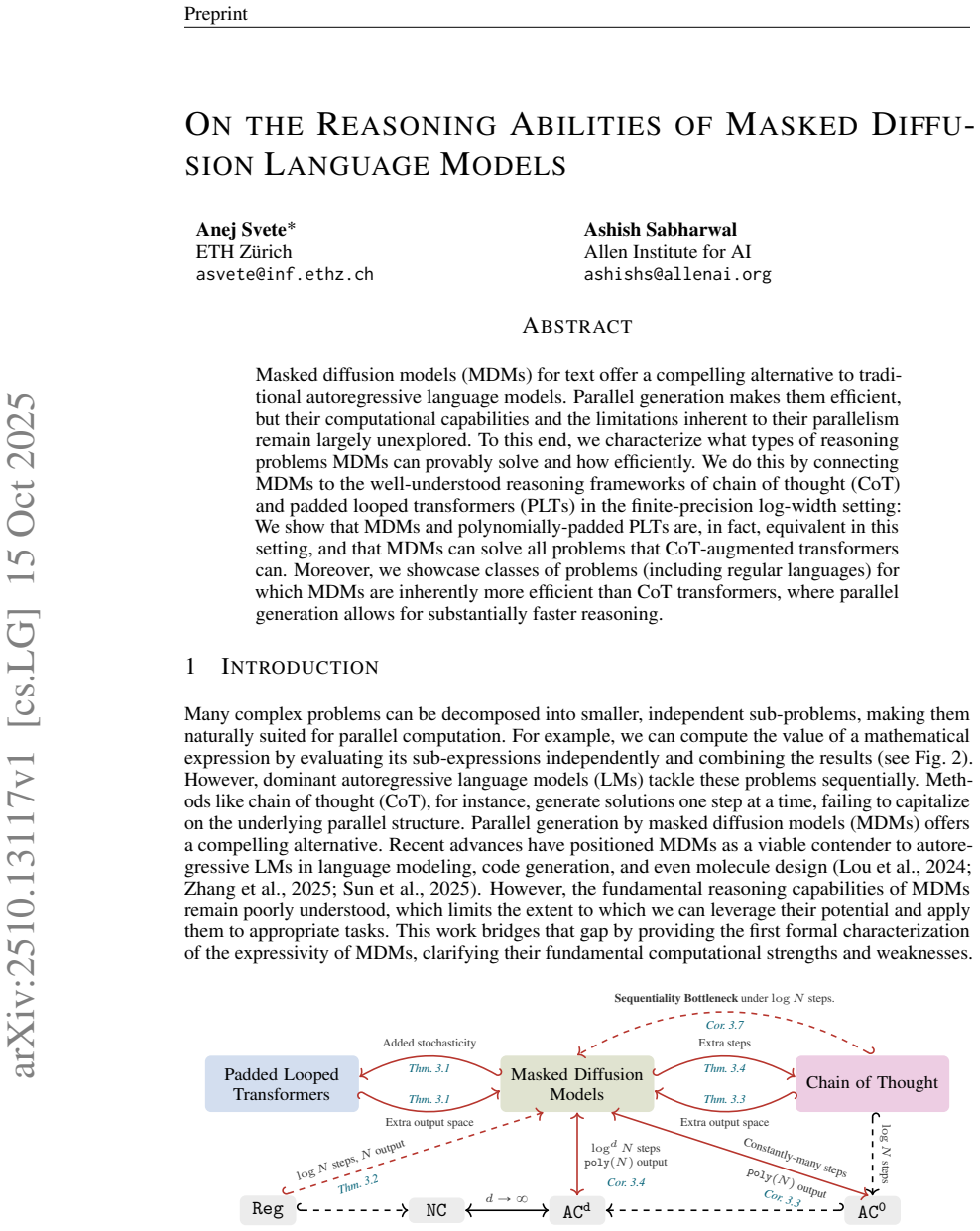
Masked diffusion models match the reasoning power of chain-of-thought transformers and outperform them in efficiency on regular languages through parallel generation.
A machine-rendered reading of the paper's core claim, the machinery that carries it, and where it could break.
Core claim
In the finite-precision log-width setting, masked diffusion models are equivalent to polynomially-padded padded looped transformers. As a direct consequence, MDMs can solve all problems solvable by CoT-augmented transformers. Moreover, MDMs are inherently more efficient than CoT transformers on classes of problems that include regular languages because parallel generation permits substantially faster reasoning.
What carries the argument
The equivalence between masked diffusion models and polynomially-padded looped transformers under finite-precision log-width constraints, which transfers both full reasoning power and efficiency properties from one model class to the other.
If this is right
- MDMs inherit the ability to solve any problem that CoT-augmented transformers can solve.
- MDMs achieve faster reasoning than sequential CoT models on regular languages and similar structured problems.
- Parallel generation in MDMs removes the need for explicit sequential CoT steps on tasks where parallelism suffices.
- The computational capabilities of MDMs are fully characterized by their relation to padded looped transformers.
Where Pith is reading between the lines
- If the finite-precision model is representative, then practical masked diffusion models may perform complex reasoning without requiring explicit chain-of-thought prompting.
- The efficiency results suggest exploring diffusion architectures optimized specifically for parallel reasoning rather than sequential generation.
- These equivalences could guide the design of hybrid models that combine diffusion parallelism with targeted sequential refinement for harder problems.
Load-bearing premise
The finite-precision log-width computational model accurately captures the relevant reasoning behavior of practical masked diffusion models.
What would settle it
A concrete demonstration that some regular language recognizable by a CoT-augmented transformer in polynomial steps cannot be recognized by any masked diffusion model in a comparable number of parallel steps under the same finite-precision log-width constraints.
Figures

read the original abstract
Masked diffusion models (MDMs) for text offer a compelling alternative to traditional autoregressive language models. Parallel generation makes them efficient, but their computational capabilities and the limitations inherent in their parallelism remain largely unexplored. To this end, we characterize what types of reasoning problems MDMs can provably solve and how efficiently. We do this by connecting MDMs to the well-understood reasoning frameworks of chain of thought (CoT) and padded looped transformers (PLTs) in the finite-precision log-width setting: We show that MDMs and polynomially-padded PLTs are, in fact, equivalent in this setting, and that MDMs can solve all problems that CoT-augmented transformers can. Moreover, we showcase classes of problems (including regular languages) for which MDMs are inherently more efficient than CoT transformers, where parallel generation allows for substantially faster reasoning.
Editorial analysis
A structured set of objections, weighed in public.
Referee Report
Summary. The paper claims that in the finite-precision log-width setting, masked diffusion models (MDMs) are equivalent to polynomially-padded padded looped transformers (PLTs), that MDMs can solve all problems solvable by chain-of-thought (CoT) augmented transformers, and that MDMs are inherently more efficient than CoT transformers on certain problem classes including regular languages because parallel generation allows simulating looped steps in fewer iterations.
Significance. If the equivalences and efficiency results hold under the stated model, the work supplies a useful theoretical bridge between diffusion-based generation and established reasoning frameworks, clarifying the computational power of MDMs and identifying concrete settings where their parallelism yields asymptotic advantages. The explicit connections to CoT and PLT strengthen the analysis and make the claims falsifiable within the chosen computational model.
major comments (1)
- Abstract and the main equivalence section: the central claims of equivalence to polynomially-padded PLTs and superior efficiency on regular languages are proved exclusively inside the finite-precision log-width regime. The manuscript supplies no argument that this restriction is without loss of generality; outside it, the masking schedule may fail to encode the required state transitions in a single parallel step, which directly undermines both the equivalence and the step-count advantage.
minor comments (1)
- Notation for the masking schedule and the precise definition of 'polynomially-padded' should be introduced earlier and used consistently across the equivalence proofs.
Simulated Author's Rebuttal
We thank the referee for their constructive feedback and for recognizing the significance of our work in establishing connections between masked diffusion models and established reasoning frameworks like CoT and PLTs. We address the major comment below.
read point-by-point responses
-
Referee: Abstract and the main equivalence section: the central claims of equivalence to polynomially-padded PLTs and superior efficiency on regular languages are proved exclusively inside the finite-precision log-width regime. The manuscript supplies no argument that this restriction is without loss of generality; outside it, the masking schedule may fail to encode the required state transitions in a single parallel step, which directly undermines both the equivalence and the step-count advantage.
Authors: We agree that our proofs and claims are presented within the finite-precision log-width setting, as explicitly noted in the abstract and the main sections of the manuscript. This setting is not claimed to be without loss of generality; instead, it is selected as it provides a realistic and standard model for analyzing the computational power of transformer-like architectures, where finite precision accounts for practical numerical representations and log-width reflects the typical relationship between model capacity and input length in complexity-theoretic analyses. In this regime, we demonstrate the equivalence to polynomially-padded PLTs and the efficiency advantages for problems like regular language recognition through parallel simulation of looped computations. To strengthen the manuscript, we will add a new paragraph in the introduction and a dedicated discussion section explaining the rationale for this modeling choice, its implications, and how the masking mechanism leverages the finite precision to enable single-step state transitions. This revision will make explicit that our results pertain to this important setting without overgeneralizing. revision: yes
Circularity Check
No significant circularity; equivalences derived via connections to established external CoT and PLT frameworks
full rationale
The paper derives its main results by explicitly connecting masked diffusion models to prior, well-understood reasoning frameworks of chain-of-thought and padded looped transformers inside a finite-precision log-width model. These equivalences and efficiency comparisons are presented as mappings to those external frameworks rather than as self-referential re-derivations, fitted parameters renamed as predictions, or load-bearing self-citations that close on themselves. No quoted step reduces an output quantity to an input by construction, and the central claims retain independent content from the cited prior models. This is the normal case of a self-contained derivation against external benchmarks.
Axiom & Free-Parameter Ledger
axioms (1)
- domain assumption Finite-precision log-width setting accurately represents relevant model behavior
Lean theorems connected to this paper
-
IndisputableMonolith/Cost/FunctionalEquation.leanwashburn_uniqueness_aczel unclear?
unclearRelation between the paper passage and the cited Recognition theorem.
We show that MDMs and polynomially-padded PLTs are, in fact, equivalent in this setting... MDMs with logN denoising steps can recognize regular languages.
-
IndisputableMonolith/Foundation/AlexanderDuality.leanalexander_duality_circle_linking unclear?
unclearRelation between the paper passage and the cited Recognition theorem.
MDMrlogN, Ns zCoTrlogNs, for example, contains all NC1-complete regular languages.
What do these tags mean?
- matches
- The paper's claim is directly supported by a theorem in the formal canon.
- supports
- The theorem supports part of the paper's argument, but the paper may add assumptions or extra steps.
- extends
- The paper goes beyond the formal theorem; the theorem is a base layer rather than the whole result.
- uses
- The paper appears to rely on the theorem as machinery.
- contradicts
- The paper's claim conflicts with a theorem or certificate in the canon.
- unclear
- Pith found a possible connection, but the passage is too broad, indirect, or ambiguous to say the theorem truly supports the claim.
Reference graph
Works this paper leans on
-
[1]
URLhttps://openreview.net/forum?id=FB8FMU99BC. Nadav Borenstein, Anej Svete, Robin Chan, Josef Valvoda, Franz Nowak, Isabelle Augenstein, Eleanor Chodroff, and Ryan Cotterell. What languages are easy to language-model? a perspective from learning probabilistic regular languages. InACL, 2024. URL https://aclanthology.org/ 2024.acl-long.807/. Alexandra Buto...
-
[2]
Selim Jerad, Anej Svete, Jiaoda Li, and Ryan Cotterell
URLhttps://aclanthology.org/2023.acl-long.248/. Selim Jerad, Anej Svete, Jiaoda Li, and Ryan Cotterell. Unique hard attention: A tale of two sides. arXiv, 2025. URLhttps://arxiv.org/abs/2503.14615. Jaeyeon Kim, Kulin Shah, Vasilis Kontonis, Sham Kakade, and Sitan Chen. Train for the worst, plan for the best: Understanding token ordering in masked diffusio...
-
[3]
Measuring Faithfulness in Chain-of-Thought Reasoning
URLhttps://arxiv.org/abs/2307.13702. Yaniv Leviathan, Matan Kalman, and Yossi Matias. Fast inference from transformers via speculative decoding. InICML, 2023. Gen Li and Changxiao Cai. A convergence theory for diffusion language models: An information- theoretic perspective.arXiv, 2025. URLhttps://arxiv.org/abs/2505.21400. Jiaoda Li and Ryan Cotterell. Ch...
work page internal anchor Pith review Pith/arXiv arXiv 2023
-
[4]
Zhiyuan Li, Hong Liu, Denny Zhou, and Tengyu Ma
URLhttps://arxiv.org/abs/2505.23623. Zhiyuan Li, Hong Liu, Denny Zhou, and Tengyu Ma. Chain of thought empowers transformers to solve inherently serial problems. InICLR, 2024. URL https://openreview.net/forum?id= 3EWTEy9MTM. 11 Preprint Bingbin Liu, Jordan T. Ash, Surbhi Goel, Akshay Krishnamurthy, and Cyril Zhang. Transform- ers learn shortcuts to automa...
-
[5]
URLhttps://arxiv.org/abs/2508.09834. Anej Svete and Ryan Cotterell. Transformers can represent n-gram language models. InNAACL,
-
[6]
Fast-dLLM: Training-free Acceleration of Diffusion LLM by Enabling KV Cache and Parallel Decoding
URLhttps://aclanthology.org/2024.naacl-long.381/. Anej Svete, Nadav Borenstein, Mike Zhou, Isabelle Augenstein, and Ryan Cotterell. Can transformers learn n-gram language models? InEMNLP, 2024. URL https://aclanthology.org/2024. emnlp-main.550/. Anej Svete, Will Merrill, and Ashish Sabharwal. The exact expressive power of fixed-precision looped padded tra...
work page internal anchor Pith review Pith/arXiv arXiv doi:10.1007/978-3-662-03927-4 2024
-
[7]
All intermediate computations in Eq
Sub-case 2a: qJ n kn1 ălog 2pp`1q . All intermediate computations in Eq. (44a) are bounded by log 2pp`1q ` BF{2 in absolute value, so they fall within the range of Fp. Moreover, addition of BF{2 can be exactly represented in Fp. This makes addition in Eq. (44a) associative and commutative. By Lem. D.3, the terms G in Eq. (44a) are 0, meaning that the fina...
-
[8]
In this case, the intermediate computations of Eq
Sub-case 2b: qJ n kn1 ělog 2pp`1q . In this case, the intermediate computations of Eq. (44a) are either exact or thresholded at BF. In both cases, the exponent of the resulting attention score isB F by Lem. D.1, preserving the attention score
-
[9]
In this case, all intermediate computations are representable in Fp analogously to the case 2a
Sub-case 2c: qJ n kn1 ďlog 2pp`1q . In this case, all intermediate computations are representable in Fp analogously to the case 2a. The attention score is therefore preserved. Taken together, this means that the attention scores between positions n and n1 of τ 1 are identical to those of τ on the positions in N , while the attention scores on the rest of ...
-
[10]
If it is, wn1 stores e1 and d1 def “w n1e1 in designated parts of its residual stream
In the first layer, each symbol wn1 P t0,1u checks if it is immediately preceded by the & symbol, which denotes the beginning of the pointer in the string. If it is, wn1 stores e1 and d1 def “w n1e1 in designated parts of its residual stream. Here, e1 is the first unit vector of RrlogNs
-
[11]
In the subsequent layers lP t2, . . . ,rlogNsu , each symbol wn1 checks if the entry el´1 has already been written to the designated space of the previous symbol’s residual stream. If it has, wn1 copies and shifts el´1 into el, and stores el and dl def “d l´1 `w n1el in designated parts of its residual stream. AfterrlogNslayers, the residual stream at pos...
work page 2025
-
[12]
We first note that the pCoT transformer predicts the next P 1 symbols at every timestep t based on the input string wďN`pt´1qP 1 ˝¨ ¨ ¨˝lo omo on pT´tqP 1 rather than wďN`pt´1qP 1. This is because, by Lem. D.6, the pCoT transformer can ignore all symbols containing the padding symbol and thus produce equivalent predictions at every step t. This will help ...
-
[13]
We assume that the final output of the MDM will be stored in the first P positions of the padding space. It will be filled in T generation steps, where at each step tP rTs , a new block of P 1 symbols will be predicted. In particular, by Lem. D.9, the planner can select the next P 1 positions to unmask at time t by including the values B˘prrn´N s`{P1sq an...
-
[14]
The predictor then uses an initial layer to copy the input string wďN`pt´1qP 1 ˝¨ ¨ ¨˝lo omo on pT´tqP 1 into the residual stream of the firstN`Ppositions of the padding space
-
[15]
The predictor then uses the pN`Pq 2 padding positions to predict the next P 1 symbols predicted by the pCoT transformer. These are written to the positions chosen to be unmasked by the planner. ■ Theorem 3.4(pCoT transformers can simulate MDMs). MDMrT, Ps ĎpCoTrT, LTpP`Nqs,(7) whereLis the number of layers in the transformer implementing the MDM. 34 Prepr...
discussion (0)
Sign in with ORCID, Apple, or X to comment. Anyone can read and Pith papers without signing in.