REVIEW 3 major objections 5 minor 2 cited by
The restricted quantum focusing conjecture, applied to null-deformed ball regions in d>2 CFTs, implies a bound on entropy derivatives stronger than the quantum null energy condition: the QNEC cannot saturate faster than the transverse area
Reviewed by Pith at T0; open to challenge. T0 means a machine referee read the full paper against a public rubric. the ladder, T0–T4 →
T0 review · deepseek-v4-flash
2026-08-04 09:39 UTC pith:HGO4YHTQ
load-bearing objection Solid 2D rQFC proof and explicit JT counterexamples; the new d>2 bound is conditional on an admitted Q-term assumption. the 3 major comments →
Tests of restricted Quantum Focusing and a new CFT bound
The pith
A machine-rendered reading of the paper's core claim, the machinery that carries it, and where it could break.
Core claim
The central claim is that rQFC — the rule that the quantum expansion Θ stops increasing whenever it crosses zero — is both valid and productive. In the d=2 toy model of JT gravity coupled to a large-c QFT, the paper shows Θ′ ≤ −θΘ follows from the QNEC, so Θ=0 implies Θ′≤0; the full QFC is shown to fail in regions where ℓ_S ≥ Φ, i.e., where matter quantum effects are comparable to the dilaton. For d>2, the paper derives Eq. (4.36): in a broad class of near-vacuum CFT states satisfying (1/√h)δS_ren/δV = O(ε/L^{d−1}), the rQFC forces (1/√h)∂_λ(δS_ren/δV) to approach zero no faster than O(Σ^{d−2}) as Σ→0, whenever the theory remains in the semiclassical regime Σ^{d−2} ≫ ℓ_S^{d−2}. This is stron
What carries the argument
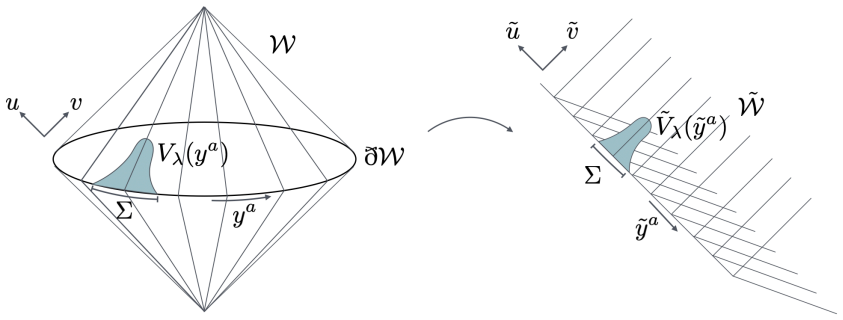
The central object is the restricted quantum focusing conjecture (rQFC): for a null-deformed family of wedges, whenever the quantum expansion Θ vanishes, its affine derivative must be non-positive. The paper combines rQFC with the semiclassical expansion of generalized entropy in the species scale ℓ_S = (cG)^{1/(d−2)}, a conformal map from ball-shaped regions to Rindler wedges, and a known relation between the second null variation of entanglement entropy and the coincident limit of two averaged null energy (E) operators. The E×E operator product expansion controls the Σ-scaling of the entropy derivative; the positive area-squared term competes with the negative entropy term, forcing the exp
Load-bearing premise
The d>2 derivation assumes that the unknown Q-terms in the generalized entropy contribute to ∂_λΘ only at order o(ℓ_S^{2(d−2)}), as stated in Eq. (4.13); this is supported by one worked example and a scaling sketch, not by a general proof, so if Q contributes at the same order the new CFT bound does not follow.
What would settle it
Compute the exponent δ in Eq. (4.31) for a specific near-vacuum CFT state of the form (4.4); if δ<0 while (1/√h)δS_ren/δV = O(ε/L^{d−1}), then Eq. (4.33) would be suppressed enough that the positive term in Eq. (4.25) wins, violating rQFC. Concretely, in a free scalar CFT one can calculate the E×E light-ray OPE and the second null entropy derivative for a Rindler wedge: if that derivative vanishes faster than Σ^{d−2} while the first derivative is nonzero, the paper's bound is false. A separate check is to compute the Q-term contribution in the belt braneworld model at higher orders in ℓ_S and
If this is right
- rQFC holds in JT gravity coupled to a QFT in the semiclassical regime, even while the full quantum focusing conjecture is violated in the same toy model.
- QFC violations in the d=2 model are confined to regions where the species scale is comparable to the dilaton; in the hierarchy ϕ0 ≫ ϕr ≫ ℓ_S, which admits a higher-dimensional interpretation, the QFC is safe.
- In d>2 near-vacuum CFT states, rQFC implies the new bound (4.36): the null second entropy derivative cannot vanish faster than Σ^{d−2} when the first derivative is O(ε/L^{d−1}).
- The bound is equivalent to δ≥0, a constraint on how singular the coincident limit of two averaged null energy operators can be in a CFT.
- The paper speculates that a universal strengthened QNEC of the form (4.37), with an explicit κΣ^{d−2} coefficient, holds for all QFT states and all Rindler-wedge null deformations.
Where Pith is reading between the lines
- If Eq. (4.36) survives direct computation, the light-ray OPE exponent δ becomes a new piece of CFT data constrained by quantum gravity; any CFT exhibiting δ<0 in a near-vacuum state would be incompatible with rQFC.
- The d=2 QFC counterexamples sit exactly in the regime where JT gravity has no higher-dimensional uplift; this suggests the full QFC may be a 2D artifact, while rQFC captures the transferable content.
- The assumption about Q-terms can be checked in the belt braneworld example by computing higher orders in ℓ_S; if Q contributes at order ℓ_S^{2(d−2)}, the new bound would acquire Q-dependent corrections.
- The speculative universal bound has the same shape as the known 2D strengthened QNEC, so proving it might be approached through modular Hamiltonian methods in general QFTs.
Editorial analysis
A structured set of objections, weighed in public.
Referee Report
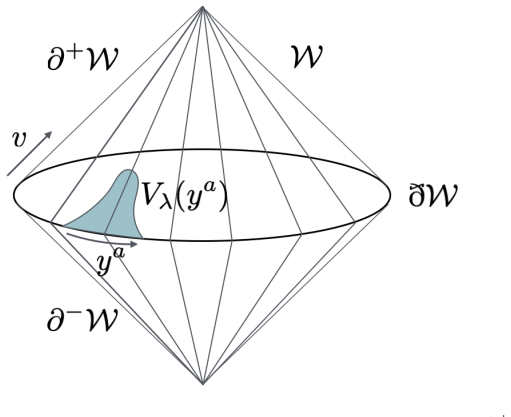
Summary. This paper tests the restricted quantum focusing conjecture (rQFC) in two independent settings. In §3, working in JT gravity coupled to a large-c QFT in the semiclassical limit, the authors prove rQFC by combining the 2D QNEC with the dilaton equation of motion: Eq. (3.15), Θ' ≤ −θΘ, immediately gives Θ=0 ⇒ Θ'≤0. They then construct explicit regions in AdS2 and dS2 toy models where the stronger QFC is violated, in the regime ℓ_S ≳ max(φ0, φr) where matter quantum effects compete with the dilaton. In §4, for d>2, the paper starts from rQFC for null-deformed ball regions, conformally maps to Rindler wedges, and uses the entropy-variation formula of [37] to derive a new CFT bound, Eq. (4.36): for near-vacuum states with (1/√h)δS̃_ren/δṼ = O(ϵ/L^{d−1}), the second null derivative of the renormalized entropy cannot vanish faster than O(Σ^{d−2}) as the transverse width Σ→0. This is stronger than the QNEC, which only requires non-positivity. The paper also speculates about a universal strengthened QNEC, Eq. (4.37).
Significance. If the d>2 bound is established, it is a genuinely new implication of rQFC and a sharper, falsifiable test than the QNEC alone. The 2D proof in §3 is clean and internally consistent, and the explicit QFC counterexamples are valuable even though the authors appropriately restrict them to a toy-model regime without a higher-dimensional uplift. A notable strength is the paper's transparency: the main assumption behind the d>2 result, Eq. (4.13), is explicitly labeled as an assumption, and the dimensional-analysis scaling (4.14) is flagged as an expectation. These admissions are helpful but they also mean the headline new bound is conditional. The 2D section is solid and could stand alone; the d>2 section would be a significant contribution if the Q-term suppression and the scaling (4.14) can be justified.
major comments (3)
- [§4, Eq. (4.13)] The central d>2 claim, Eq. (4.36), depends directly on Eq. (4.13), the assumption that ∂_λ(4ℓ_S^{d−2}/√h δQ/δV) = o(ℓ_S^{2(d−2)}). The text says 'which we assume from here on.' Appendix C gives a flat-belt braneworld example and a scaling sketch, but not a general proof. This is load-bearing: in the rQFC inequality (4.25), Q enters at the same place as the positive area-squared term, so a Q contribution of order ℓ_S^{2(d−2)} could cancel that positive term and remove the stated scaling of the entropy derivative. Without a controlled argument for (4.13), Eq. (4.36) is not established for the claimed class of CFT states.
- [§4, Eq. (4.14)] The scaling (1/√h)δS_ren/δV = O(ϵ/L^{d−1}) is justified by dimensional analysis, large-R/Rindler symmetry, and the statement 'we expect.' The R-independence is plausible, but the L-scaling is not derived. The state contains a smeared operator with its own scaling dimension, and dimensional analysis alone does not fix the power of L for arbitrary such operators. Since the positive term in Eq. (4.32) and the comparison leading to Eq. (4.36) use this scaling quantitatively, a different scaling would change the exponent in the bound. Please either prove (4.14) in a concrete class of examples, or state precisely the class of states in which it can be verified.
- [§4.27 and Appendix B] The explicit expression for ∂_λ(δS̃_ren/δṼ), Eq. (4.27), is the computational core of the new bound, but its derivation from [37] is only sketched in Appendix B. In particular, the passage from the relative entropy expansion (B.5)–(B.6) to the λ-derivative (B.9), and the modular Hamiltonian relation (B.8), are not shown. The sign and Σ-scaling of Eq. (4.30) are the entire content of the bound, so the paper should either reproduce enough of the derivation to display the stated hypotheses (convergence of the s-integral, absence of boundary terms in the shape derivative, validity of the O(ϵ³) truncation) or state the needed theorem from [37] in a self-contained way.
minor comments (5)
- [Abstract] The abstract says the bound forbids saturation faster than O(A), but the precise statement is O(Σ^{d−2}). Define A or Σ consistently.
- [§3] In the paragraph after Eq. (3.15), the text refers to 'violations of the QFC (Eq. (1.2))'; Eq. (1.2) defines Θ, while the QFC is Eq. (1.3).
- [§4, Eq. (4.33)] The sign '<0' is asserted from the QNEC. It would be clearer to display the explicit formula (4.27) and derive the sign, especially because Eq. (4.27) has a minus sign and involves an integral that must be positive.
- [§4, Eqs. (1.23), (4.36)] The notation '≥ O(ϵ²Σ^{d−2})' is nonstandard and could be misread. Define explicitly what 'cannot vanish faster than' means in terms of liminf/limsup.
- [Appendix C] The coefficient b_j in Eq. (C.17) is said to be d-dependent, but some of the b_j also depend on the shape/state; this is worth a brief clarification.
Circularity Check
No circularity: the d>2 bound is an explicit conditional consequence of rQFC; the unproved Q-term suppression is a fragility, not a self-referential fit.
full rationale
The d>2 derivation starts from the semiclassical generalized entropy expansion (Eq. 4.8) and the rQFC inequality (Eq. 4.25), obtained by direct differentiation of the quantum expansion. The new bound (4.36) follows by balancing the positive term (4.32) against the negative term (4.33), whose scaling comes from Eq. (4.27), cited from [37] and sketched in Appendix B. Nothing is fitted to the target quantity: the O(epsilon/L^{d-1}) scaling (4.14) is explicitly a dimensional-analysis input, and the Q-term suppression (4.13) is labeled as an assumption ('which we assume from here on'). Appendix C gives evidence but not a proof; if Q contributed at the same order, Eq. (4.36) would not follow. That is an unproved assumption/correctness gap, not circularity. In Sec. 3, the JT-gravity rQFC proof is explicitly acknowledged to be the AMM argument with the properly Phi-normalized quantum expansion; this is an attributed reinterpretation, not a concealed renaming. The self-citations ([23] for rQFC, [37] for entropy variations) are load-bearing premises, but [37] is an independent earlier calculation and the paper does not use its new bound to justify rQFC. The central output is a conditional, falsifiable implication of rQFC, so no step reduces by construction to its own input.
Axiom & Free-Parameter Ledger
free parameters (1)
- κ
axioms (7)
- domain assumption rQFC holds in d>2 semiclassical gravity
- ad hoc to paper Q-term suppression, Eq. (4.13)
- domain assumption 2D QNEC
- domain assumption Formula (4.27) from [37]
- domain assumption Scaling of entropy derivative, Eq. (4.14)
- standard math Conformal invariance of renormalized entropy, Eq. (4.20)
- domain assumption Semiclassical regime with classical background and species scale
Cite this review
Pith. "Pith review of Tests of restricted Quantum Focusing and a new CFT bound." pith.science (2026). https://pith.science/paper/HGO4YHTQ
@misc{pith2026251013961,
  author       = {Pith},
  title        = {Pith review of: Tests of restricted Quantum Focusing and a new CFT bound},
  year         = {2026},
  howpublished = {\url{https://pith.science/paper/HGO4YHTQ}},
  note         = {Machine review of arXiv:2510.13961}
}
read the original abstract
The restricted quantum focusing conjecture (rQFC) plays a central role in an axiomatic formulation of semiclassical gravity. Since much hinges on its validity, it is imperative to subject the rQFC to rigorous tests in novel settings. Here we do so in two independent directions. First, we prove rQFC in a class of spacetime dimension $d=2$ toy models, JT gravity coupled to a QFT. We also construct explicit counter-examples to the original and stronger Quantum Focusing Conjecture in a regime where matter quantum effects are comparable to the total dilaton value. Second, for $d>2$, we derive from the rQFC a constraint stronger than the Quantum Null Energy Condition (QNEC). In a broad class of states, this bound forbids the QNEC from saturating faster than $O(\mathcal{A})$ as the transverse area $\mathcal{A}$ of a certain null deformation shrinks to zero. We speculate about a universal strengthened QNEC holding across all QFT states.
Figures







Forward citations
Cited by 2 Pith papers
-
Entropy bound and the non-universality of entanglement islands
Universal compact entanglement islands are obstructed by an entropy bound violation, implying region-dependent interior reconstruction.
-
A Quantum Weak Cosmic Censorship and Its Proof
A quantum weak cosmic censorship principle is established, showing that singularities from hyperentropic regions must be hidden by generalized entropy to maintain thermodynamic consistency.
Reference graph
Works this paper leans on
-
[1]
R. Bousso, Z. Fisher, S. Leichenauer and A.C. Wall,Quantum focusing conjecture, Phys. Rev. D93(2016) 064044 [1506.02669]
Pith/arXiv arXiv 2016
-
[2]
C. Akers, J. Koeller, S. Leichenauer and A. Levine,Geometric Constraints from Subregion Duality Beyond the Classical Regime,1610.08968
-
[3]
C. Akers, V. Chandrasekaran, S. Leichenauer, A. Levine and A. Shahbazi Moghaddam,Quantum null energy condition, entanglement wedge nesting, and quantum focusing,Phys. Rev. D101(2020) 025011 [1706.04183]
Pith/arXiv arXiv 2020
-
[4]
A.R. Brown, H. Gharibyan, G. Penington and L. Susskind,The Python’s Lunch: geometric obstructions to decoding Hawking radiation,JHEP08(2020) 121 [1912.00228]
Pith/arXiv arXiv 2020
-
[5]
N. Engelhardt, G. Penington and A. Shahbazi-Moghaddam,Finding pythons in unexpected places,Class. Quant. Grav.39(2022) 094002 [2105.09316]
Pith/arXiv arXiv 2022
-
[6]
A. May, G. Penington and J. Sorce,Holographic scattering requires a connected entanglement wedge,JHEP08(2020) 132 [1912.05649]
Pith/arXiv arXiv 2020
-
[7]
N. Engelhardt, ˚A. Folkestad, A. Levine, E. Verheijden and L. Yang,Cryptographic Censorship,JHEP01(2025) 122 [2402.03425]
arXiv 2025
-
[8]
R. Bousso and E. Tabor,Discrete Max-Focusing,JHEP06(2025) 240 [2410.18192]
Pith/arXiv arXiv 2025
-
[9]
Bekenstein,Black holes and the second law,Lett
J.D. Bekenstein,Black holes and the second law,Lett. Nuovo Cim.4(1972) 737. 40For instance, one can consider the trajectory associated with the stress-tensor double-twist [T T]J , which at large spin have twist (i.e., scaling dimension minus spin)τ(J) = 2d+J−(J+ 4) = 2d−4. We then obtain ∆(J= 3) =τ(J= 3) + 3 = 2d−1. 51
1972
-
[10]
Wall,The Generalized Second Law implies a Quantum Singularity Theorem, Class
A.C. Wall,The Generalized Second Law implies a Quantum Singularity Theorem, Class. Quant. Grav.30(2013) 165003 [1010.5513]
Pith/arXiv arXiv 2013
-
[11]
R. Bousso and A. Shahbazi-Moghaddam,Quantum singularities,Phys. Rev. D107 (2023) 066002 [2206.07001]
Pith/arXiv arXiv 2023
-
[12]
Bousso,Robust Singularity Theorem,Phys
R. Bousso,Robust Singularity Theorem,Phys. Rev. Lett.135(2025) 011501 [2501.17910]
Pith/arXiv arXiv 2025
-
[13]
N. Engelhardt and A.C. Wall,Quantum Extremal Surfaces: Holographic Entanglement Entropy beyond the Classical Regime,JHEP01(2015) 073 [1408.3203]
Pith/arXiv arXiv 2015
-
[14]
C. Akers, N. Engelhardt, G. Penington and M. Usatyuk,Quantum Maximin Surfaces, JHEP08(2020) 140 [1912.02799]
Pith/arXiv arXiv 2020
-
[15]
G. Penington,Entanglement Wedge Reconstruction and the Information Paradox, JHEP09(2020) 002 [1905.08255]
Pith/arXiv arXiv 2020
-
[16]
A. Almheiri, N. Engelhardt, D. Marolf and H. Maxfield,The entropy of bulk quantum fields and the entanglement wedge of an evaporating black hole,JHEP12(2019) 063 [1905.08762]
Pith/arXiv arXiv 2019
-
[17]
R. Bousso, Z. Fisher, J. Koeller, S. Leichenauer and A.C. Wall,Proof of the Quantum Null Energy Condition,Phys. Rev. D93(2016) 024017 [1509.02542]
Pith/arXiv arXiv 2016
-
[18]
J. Koeller and S. Leichenauer,Holographic Proof of the Quantum Null Energy Condition,Phys. Rev. D94(2016) 024026 [1512.06109]
Pith/arXiv arXiv 2016
-
[19]
S. Balakrishnan, T. Faulkner, Z.U. Khandker and H. Wang,A General Proof of the Quantum Null Energy Condition,JHEP09(2019) 020 [1706.09432]
Pith/arXiv arXiv 2019
-
[20]
F. Ceyhan and T. Faulkner,Recovering the QNEC from the ANEC,Commun. Math. Phys.377(2020) 999 [1812.04683]
Pith/arXiv arXiv 2020
-
[21]
S. Hollands and R. Longo,A New Proof of the QNEC,Commun. Math. Phys.406 (2025) 269 [2503.04651]
arXiv 2025
-
[22]
Bekenstein,Black holes and entropy,Phys
J.D. Bekenstein,Black holes and entropy,Phys. Rev. D7(1973) 2333. 52
1973
-
[23]
Shahbazi-Moghaddam,Restricted quantum focusing,Phys
A. Shahbazi-Moghaddam,Restricted quantum focusing,Phys. Rev. D109(2024) 066023 [2212.03881]
Pith/arXiv arXiv 2024
-
[24]
C. Akers, A. Levine, G. Penington and E. Wildenhain,One-shot holography,SciPost Phys.16(2024) 144 [2307.13032]
Pith/arXiv arXiv 2024
-
[25]
L. Randall and R. Sundrum,A Large mass hierarchy from a small extra dimension, Phys. Rev. Lett.83(1999) 3370 [hep-ph/9905221]
Pith/arXiv arXiv 1999
-
[26]
L. Randall and R. Sundrum,An Alternative to compactification,Phys. Rev. Lett.83 (1999) 4690 [hep-th/9906064]
Pith/arXiv arXiv 1999
-
[27]
T. Shiromizu, K.-i. Maeda and M. Sasaki,The Einstein equation on the 3-brane world, Phys. Rev. D62(2000) 024012 [gr-qc/9910076]
Pith/arXiv arXiv 2000
-
[28]
Gubser,AdS/CFT and gravity,Phys
S.S. Gubser,AdS/CFT and gravity,Phys. Rev. D63(2001) 084017 [hep-th/9912001]
Pith/arXiv arXiv 2001
-
[29]
E.P. Verlinde and H.L. Verlinde,RG flow, gravity and the cosmological constant, JHEP05(2000) 034 [hep-th/9912018]
Pith/arXiv arXiv 2000
-
[30]
A. Karch and L. Randall,Locally localized gravity,JHEP05(2001) 008 [hep-th/0011156]
Pith/arXiv arXiv 2001
-
[31]
R. Emparan,Black hole entropy as entanglement entropy: A Holographic derivation, JHEP06(2006) 012 [hep-th/0603081]
Pith/arXiv arXiv 2006
-
[32]
R.C. Myers, R. Pourhasan and M. Smolkin,On Spacetime Entanglement,JHEP06 (2013) 013 [1304.2030]
Pith/arXiv arXiv 2013
-
[33]
H. Geng, A. Karch, C.F. Uhlemann, F. Usmani and X. Wang,Holographic BCFT with Dirichlet boundary condition,JHEP11(2020) 026 [2006.02438]
Pith/arXiv arXiv 2020
-
[34]
A. Almheiri, R. Mahajan and J. Maldacena,Islands outside the horizon,1910.11077
Pith/arXiv arXiv 1910
-
[35]
A.C. Wall,Testing the Generalized Second Law in 1+1 dimensional Conformal Vacua: An Argument for the Causal Horizon,Phys. Rev. D85(2012) 024015 [1105.3520]
Pith/arXiv arXiv 2012
-
[36]
I. Ben-Dayan,The quantum focusing conjecture and the improved energy condition, JHEP02(2024) 132 [2310.14396]. 53
Pith/arXiv arXiv 2024
-
[37]
S. Balakrishnan, V. Chandrasekaran, T. Faulkner, A. Levine and A. Shahbazi-Moghaddam,Entropy variations and light ray operators from replica defects,JHEP09(2022) 217 [1906.08274]
Pith/arXiv arXiv 2022
-
[38]
S. Leichenauer, A. Levine and A. Shahbazi-Moghaddam,Energy density from second shape variations of the von Neumann entropy,Phys. Rev. D98(2018) 086013 [1802.02584]
Pith/arXiv arXiv 2018
-
[39]
Flanagan and R.M
E.E. Flanagan and R.M. Wald,Does back reaction enforce the averaged null energy condition in semiclassical gravity?,Phys. Rev. D54(1996) 6233
1996
-
[40]
A.C. Wall,A proof of the generalized second law for rapidly changing fields and arbitrary horizon slices,Phys. Rev. D85(2012) 104049 [1105.3445]
Pith/arXiv arXiv 2012
-
[41]
X. Dong,Holographic Entanglement Entropy for General Higher Derivative Gravity, JHEP01(2014) 044 [1310.5713]
Pith/arXiv arXiv 2014
-
[42]
T.G. Mertens and G.J. Turiaci,Solvable models of quantum black holes: a review on Jackiw–Teitelboim gravity,Living Rev. Rel.26(2023) 4 [2210.10846]
Pith/arXiv arXiv 2023
-
[43]
A. Strominger and D.M. Thompson,A Quantum Bousso bound,Phys. Rev. D70 (2004) 044007 [hep-th/0303067]
Pith/arXiv arXiv 2004
-
[44]
V. Franken and F. Rondeau,On the quantum Bousso bound in JT gravity,JHEP03 (2024) 178 [2311.17152]
Pith/arXiv arXiv 2024
-
[45]
Jackiw,Lower Dimensional Gravity,Nucl
R. Jackiw,Lower Dimensional Gravity,Nucl. Phys. B252(1985) 343
1985
-
[46]
Teitelboim,Gravitation and Hamiltonian Structure in Two Space-Time Dimensions,Phys
C. Teitelboim,Gravitation and Hamiltonian Structure in Two Space-Time Dimensions,Phys. Lett. B126(1983) 41
1983
-
[47]
Henneaux,QUANTUM GRA VITY IN TWO-DIMENSIONS: EXACT SOLUTION OF THE JACKIW MODEL,Phys
M. Henneaux,QUANTUM GRA VITY IN TWO-DIMENSIONS: EXACT SOLUTION OF THE JACKIW MODEL,Phys. Rev. Lett.54(1985) 959
1985
-
[48]
P. Saad, S.H. Shenker and D. Stanford,JT gravity as a matrix integral,1903.11115
Pith/arXiv arXiv 1903
-
[49]
J. Cotler, K. Jensen and A. Maloney,Low-dimensional de Sitter quantum gravity, JHEP06(2020) 048 [1905.03780]. 54
Pith/arXiv arXiv 2020
-
[50]
York, Jr.,Role of conformal three geometry in the dynamics of gravitation,Phys
J.W. York, Jr.,Role of conformal three geometry in the dynamics of gravitation,Phys. Rev. Lett.28(1972) 1082
1972
-
[51]
Gibbons and S.W
G.W. Gibbons and S.W. Hawking,Action Integrals and Partition Functions in Quantum Gravity,Phys. Rev. D15(1977) 2752
1977
-
[52]
Witten,Gravity and the crossed product,JHEP10(2022) 008 [2112.12828]
E. Witten,Gravity and the crossed product,JHEP10(2022) 008 [2112.12828]
Pith/arXiv arXiv 2022
-
[53]
G. Penington and E. Witten,Algebras and States in JT Gravity,2301.07257
-
[54]
J.F. Pedraza, A. Svesko, W. Sybesma and M.R. Visser,Semi-classical thermodynamics of quantum extremal surfaces in Jackiw-Teitelboim gravity,JHEP12(2021) 134 [2107.10358]
Pith/arXiv arXiv 2021
-
[55]
M. Spradlin and A. Strominger,Vacuum states for AdS(2) black holes,JHEP11 (1999) 021 [hep-th/9904143]
Pith/arXiv arXiv 1999
-
[56]
J. Maldacena, G.J. Turiaci and Z. Yang,Two dimensional Nearly de Sitter gravity, JHEP01(2021) 139 [1904.01911]
Pith/arXiv arXiv 2021
-
[57]
Polyakov,Quantum Geometry of Bosonic Strings,Phys
A.M. Polyakov,Quantum Geometry of Bosonic Strings,Phys. Lett. B103(1981) 207
1981
-
[58]
A. Fabbri and J. Navarro-Salas,Modeling black hole evaporation, World Scientific, Singapore (2005), 10.1142/p378
doi:10.1142/p378 2005
-
[59]
A. Svesko, E. Verheijden, E.P. Verlinde and M.R. Visser,Quasi-local energy and microcanonical entropy in two-dimensional nearly de Sitter gravity,JHEP08(2022) 075 [2203.00700]
Pith/arXiv arXiv 2022
-
[60]
Bunch and P.C.W
T.S. Bunch and P.C.W. Davies,Quantum Field Theory in de Sitter Space: Renormalization by Point Splitting,Proc. Roy. Soc. Lond. A360(1978) 117
1978
-
[61]
Fulling,Nonuniqueness of canonical field quantization in riemannian space-time, Phys
S.A. Fulling,Nonuniqueness of canonical field quantization in riemannian space-time, Phys. Rev. D7(1973) 2850
1973
-
[62]
Davies,Scalar particle production in Schwarzschild and Rindler metrics,J
P.C.W. Davies,Scalar particle production in Schwarzschild and Rindler metrics,J. Phys. A8(1975) 609
1975
-
[63]
Unruh,Notes on black-hole evaporation,Phys
W.G. Unruh,Notes on black-hole evaporation,Phys. Rev. D14(1976) 870. 55
1976
-
[64]
Hartle and S.W
J.B. Hartle and S.W. Hawking,Path-integral derivation of black-hole radiance,Phys. Rev. D13(1976) 2188
1976
-
[65]
Boulware,Quantum field theory in schwarzschild and rindler spaces,Phys
D.G. Boulware,Quantum field theory in schwarzschild and rindler spaces,Phys. Rev. D11(1975) 1404
1975
-
[66]
L. Aalsma, M. Parikh and J.P. Van Der Schaar,Back(reaction) to the Future in the Unruh-de Sitter State,JHEP11(2019) 136 [1905.02714]
Pith/arXiv arXiv 2019
-
[67]
L. Aalsma and W. Sybesma,The Price of Curiosity: Information Recovery in de Sitter Space,JHEP05(2021) 291 [2104.00006]
Pith/arXiv arXiv 2021
-
[68]
C.R. Graham and E. Witten,Conformal anomaly of submanifold observables in AdS / CFT correspondence,Nucl. Phys. B546(1999) 52 [hep-th/9901021]
Pith/arXiv arXiv 1999
-
[69]
R. Haag,Local Quantum Physics, Theoretical and Mathematical Physics, Springer, Berlin (1996), 10.1007/978-3-642-61458-3
-
[70]
J. Koeller, S. Leichenauer, A. Levine and A. Shahbazi-Moghaddam,Local Modular Hamiltonians from the Quantum Null Energy Condition,Phys. Rev. D97(2018) 065011 [1702.00412]
Pith/arXiv arXiv 2018
-
[71]
H. Casini, E. Teste and G. Torroba,Modular Hamiltonians on the null plane and the Markov property of the vacuum state,J. Phys. A50(2017) 364001 [1703.10656]
Pith/arXiv arXiv 2017
-
[72]
T. Faulkner, F.M. Haehl, E. Hijano, O. Parrikar, C. Rabideau and M. Van Raamsdonk,Nonlinear Gravity from Entanglement in Conformal Field Theories,JHEP08(2017) 057 [1705.03026]
Pith/arXiv arXiv 2017
-
[73]
M. Kologlu, P. Kravchuk, D. Simmons-Duffin and A. Zhiboedov,The light-ray OPE and conformal colliders,JHEP01(2021) 128 [1905.01311]
Pith/arXiv arXiv 2021
-
[74]
C.-H. Chang, M. Kologlu, P. Kravchuk, D. Simmons-Duffin and A. Zhiboedov, Transverse spin in the light-ray OPE,JHEP05(2022) 059 [2010.04726]
Pith/arXiv arXiv 2022
-
[75]
P. Kravchuk and D. Simmons-Duffin,Light-ray operators in conformal field theory, JHEP11(2018) 102 [1805.00098]. 56
Pith/arXiv arXiv 2018
-
[76]
D.M. Hofman and J. Maldacena,Conformal collider physics: Energy and charge correlations,JHEP05(2008) 012 [0803.1467]. 57
Pith/arXiv arXiv 2008
discussion (0)
Sign in with ORCID, Apple, or X to comment. Anyone can read and Pith papers without signing in.