REVIEW 3 major objections 6 minor 97 references
Argon CEvNS detectors at stopped-pion sources could rival low-energy weak-mixing-angle measurements and improve neutrino magnetic-moment limits by an order of magnitude.
Reviewed by Pith at T0; open to challenge. T0 means a machine referee read the full paper against a public rubric. the ladder, T0–T4 →
T0 review · deepseek-v4-flash
2026-08-04 09:42 UTC pith:NKGOVVCX
load-bearing objection Useful four-experiment CEvNS projections, but the charge-radius table contradicts the paper's own chi-square, so the quoted sensitivities need a rerun with a stated statistical procedure. the 3 major comments →
Prospects for Exploring Non-Standard Neutrino Properties with Argon-Based CEvNS Experiments
The pith
A machine-rendered reading of the paper's core claim, the machinery that carries it, and where it could break.
Core claim
The paper argues that argon-based coherent elastic neutrino-nucleus scattering (CEvNS) detectors at stopped-pion sources can serve as precision electroweak instruments. Using simulated three-year exposures for existing and proposed argon detectors, it shows that a roughly 100-ton detector could determine the weak mixing angle at momentum transfers far below the electroweak scale with precision competitive with or better than current low-energy determinations, providing a clean test of the predicted running of the weak mixing angle. It further projects 90% confidence-level sensitivities to the neutrino magnetic moment around 10^-10 Bohr magnetons — improved by nearly an order of magnitude ove
What carries the argument
The central machinery is the CEvNS differential cross section, with its weak nuclear charge Q_W = (1−4 sin²θW)Z − N and a nuclear form factor, plus the incoherent electromagnetic correction that scales as 1/T and therefore dominates the lowest recoil-energy bins. The paper's chi-square analysis uses one global normalization pull to convert simulated event totals into projected intervals, and the recoil-energy shape — not just the total rate — is what separates magnetic-moment, charge-radius, and non-standard-interaction signals from the Standard Model.
Load-bearing premise
The projections rely on one global normalization pull (σ_η = 10%, or 5% with a proposed flux monitor) capturing all systematics, and on the background being zero (Eq. 7); if the true background floor or unmodeled systematics exceed that, the quoted limits shrink roughly proportionally.
What would settle it
Measure the low-recoil background of a ton-scale argon detector at a stopped-pion site: if the rate below about 5 keVee is not negligible compared to the Standard Model CEvNS rate, the projected order-of-magnitude magnetic-moment and NSI sensitivities, which live in those lowest bins, fail.
If this is right
- A roughly 100-ton argon detector at a stopped-pion source could determine sin²θW at low Q² with precision competitive with or better than today's low-energy measurements, testing the Standard Model's running of the weak mixing angle.
- Projected 90% confidence-level limits on the neutrino magnetic moment improve on current CEvNS bounds by nearly an order of magnitude, approaching constraints from neutrino-electron scattering.
- Projected charge-radius sensitivity reaches 10^-32 cm², comparable to or better than existing laboratory limits.
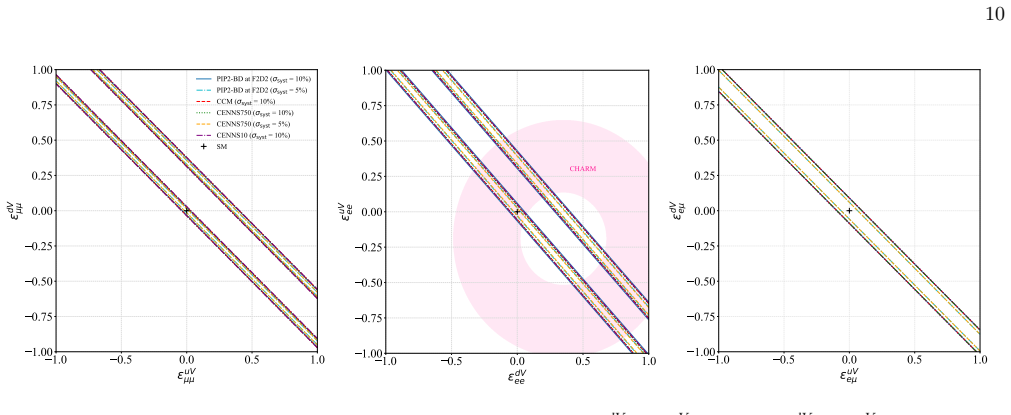
- Flavor-diagonal and flavor-changing non-standard neutrino interactions with up and down quarks are constrained to the few-percent level for large argon detectors, competitive with existing global limits.
- Because the same recoil spectrum carries all these signals, a single experiment could cross-check the weak mixing angle against electromagnetic and NSI interpretations of the same data.
Where Pith is reading between the lines
- If the proposed in-situ flux monitor is not built, the 5% systematic scenario should be read as an aspiration; the 10% numbers are the conservative projections.
- The magnetic-moment and NSI signals are concentrated in the lowest recoil bins, so the actual reach of any argon detector is set by its threshold and background rate, not its mass alone; a future detector could deliberately push sensitivity below roughly 5 keVee to exploit this.
- The assumed 'no background' simplification means the quoted intervals are upper bounds on precision; folding in a real background spectrum could degrade the limits by factors of order unity, though time-correlated analysis at pulsed stopped-pion sources may subtract much of it.
- A comparison of the same detector at two baselines could separate flux normalization from new-physics spectral distortions, offering an internal cross-check not discussed in the paper.
Editorial analysis
A structured set of objections, weighed in public.
Referee Report
Summary. The paper presents projected sensitivities for liquid-argon CEvNS detectors at stopped-pion sources — CENNS-10, CENNS-750 at ORNL, CCM at LANL, and the proposed PIP2-BD at F2D2 — to the weak mixing angle, neutrino magnetic moment and charge radius, and vector NSI parameters. The analysis uses the SM CEvNS cross section (Eq. 1), several nuclear form-factor models, detector parameters from Table II, and a total-count chi-square with a global normalization pull (Eq. 7), explicitly assuming no background. The central claims are that PIP2-BD with 5% systematics can determine sin^2 theta_W with precision competitive with current low-energy determinations, improve CEvNS magnetic-moment bounds by nearly an order of magnitude, reach O(10^-32) cm^2 charge-radius sensitivity, and constrain NSI parameters comparably to CHARM. The paper is a forward-projection study: no data are fitted, and all outputs are derived from SM predictions and assumed detector configurations.
Significance. If the numerical projections are correct, the paper would be a useful survey of the physics reach of argon-based CEvNS at current and proposed stopped-pion facilities, with a valuable comparison of nuclear form-factor uncertainties. The paper is clearly written, the detector parameters are realistic and referenced, and the form-factor sensitivity is quantified in Table I. However, the statistical framework as stated is not sufficient to reproduce the quoted tables, and the analysis does not exploit the spectral information that is emphasized in the physics motivation. The central quantitative claims therefore rest on an unstated or incorrect statistical procedure, which must be resolved before the projections can be used.
major comments (3)
- [Sec. IV, Eq. (7)] Eq. (7) is a rate-only chi-square: N_SM and N_Signal are total counts, not binned spectra. Because the normalization pull is separate and the first term is normalized by N_SM, for large N_SM the signal fraction is absorbed by the pull and Delta_chi^2 approaches delta^2/sigma_eta^2, independent of exposure. This explains why CENNS-10 (24 kg) and PIP2-BD (100 t) give nearly identical intervals in Tables III-VIII. Consequently, the claimed advantage of the larger detectors is not realized by the stated procedure, and the spectral distortions for magnetic moment, charge radius, and NSI — which the text emphasizes — are not used. The authors must either present a binned likelihood that uses the recoil spectra computed in Eqs. (5)-(6) or clearly state that all results are rate-only normalization-penalty projections.
- [Tables V-VII and Eq. (7)] The two disjoint 90% intervals in Tables V, VI, and VII are not reproducible from Eq. (7) with the SM as the Asimov data. For example, the universal charge-radius band <r^2> ~ -12.8e-32 cm^2 gives, via Eq. (12), sin^2 theta_W ~ 0.07 and Q_W ~ -9 for 40Ar, i.e., a total CEvNS rate of ~18% of the SM rate. Inserting this into Eq. (7) with sigma_eta = 10% gives Delta_chi^2 ~ 2e3, not 2.71, for every exposure considered. The second intervals in Tables V-VII therefore cannot follow from the stated statistical procedure. They appear to come from an unstated convention, possibly a shape-only or free-normalization likelihood. This affects not only the charge-radius table but also the sin^2 theta_W, magnetic-moment, and NSI projections, since all use the same framework. The true statistical procedure must be stated and the projections rerun.
- [Sec. IV, Eq. (7); Figs. 4-8] The analysis is explicitly background-free, but the new-physics signals to which the paper claims sensitivity — magnetic moment, charge radius, NSI — are concentrated in the lowest recoil bins (Fig. 4). At the shallow stopped-pion sites considered, beam-related neutrons and other backgrounds are not negligible, as evidenced by the COHERENT LAr measurement and CCM operations. Since Eq. (7) uses only total counts, the background-free assumption is especially optimistic: any low-recoil background floor directly degrades the limits roughly linearly. The authors should include a background model or a quantitative statement of the background floor required to achieve each projected limit, particularly for the 5% systematic scenarios.
minor comments (6)
- [Title/Abstract and Introduction] The facility name is inconsistent: the abstract and Sec. IV call it 'Facility for Dark Matter Discovery (F2D2)', while the Introduction says 'Facility for Dark Sector Discovery'. Please unify.
- [Eq. (14)] The quantities g_V^n and g_V^p are used but never defined. Define them in terms of sin^2 theta_W.
- [Tables V-VII] Caption wording 'Estimated two possible range' is grammatically awkward; should be 'two possible ranges' or 'estimated 90% intervals'.
- [Sec. IV.B.1, Fig. 5] The label 'µνe, µνµ' should be typeset as mu_{nu_e}, mu_{nu_mu}; also 'reaches improves' on page 9 is a typo.
- [Sec. IV.B.2, Eq. (12)] The unit analysis for <r^2> in Eq. (12) should be made explicit: the numerical coefficient depends on the conversion between cm^2 and GeV^-2. Adding this would help readers reproduce Table V.
- [Sec. III] Table II lists POT in s^-1, but Sec. IV.A states 'three years with each year accounting for approximately 5000 hours'. The exposure convention should be stated once and used consistently for all detectors.
Circularity Check
No circularity: all results are forward projections from the SM cross section, literature form factors, assumed systematics, and external benchmarks.
full rationale
The paper derives sensitivities by convolving the SM CEvNS cross section (Eq. 1) with stopped-pion fluxes and detector parameters, then evaluates a standard pull χ² (Eq. 7) under explicitly stated systematic assumptions. No observed data are used; the weak-mixing-angle, magnetic-moment, charge-radius, and NSI results are parameter forecasts, not fits, so they cannot be equivalent to their inputs by construction. The assumed ση = 10%/5% systematics and the 'no background' condition set the scale of the projected constraints, which is an input-sensitivity limitation rather than circularity. Self-citations by one of the authors (e.g., refs. [30,31]) only supply alternative form-factor models and review context; they are compared alongside external models and do not carry the central argument. The negative charge-radius bands in Table V appear inconsistent with the quoted χ² given the variance term N_SM in Eq. 7, but that is a potential numerical/statistical error, not a circular derivation of an output from an input. No step in the paper reduces a prediction to a fitted parameter or to a self-citation chain. Hence the circularity score is 0.
Axiom & Free-Parameter Ledger
free parameters (3)
- global normalization systematic σ_η =
10% baseline; 5% optimistic
- argon quenching factor coefficients =
Q_F = 0.246 + 0.00078 keV⁻¹·T
- detector energy resolution coefficient =
σ_I = 0.58 keV √(T_I/keV)
axioms (7)
- standard math SM CEvNS cross section, Eq. 1, with tree-level Q_W, Eq. 2
- domain assumption Helm form factor baseline, Eq. 3, with r0 = 0.52 fm, s = 0.9 fm
- domain assumption Stopped-pion (π-DAR) neutrino flux spectra
- ad hoc to paper No backgrounds in the statistical analysis
- domain assumption Neutrino magnetic moment cross section adds incoherently, Eq. 9, with F_ch = F_Weak
- domain assumption Charge radius enters solely as a shift of sin²θW, Eq. 12
- standard math NSI-modified weak charge, Eq. 14, vector NC only
read the original abstract
Coherent elastic neutrino-nucleus scattering (CEvNS) provides a powerful framework for testing the Standard Model (SM) and searching for new physics at low energies. In this work, we examine the prospects for argon-based CEvNS experiments at stopped-pion sources to perform precision measurements of weak interactions and probe non-standard neutrino properties. Our study focused on the CENNS-10 and CENNS-750 detectors at the Spallation Neutron Source at Oak Ridge National Laboratory, the Coherent Captain Mills (CCM) detector at Los Alamos National Laboratory, and the proposed PIP2-BD detector at Fermilabs Facility for Dark Matter Discovery (F2D2). Using realistic neutrino fluxes and detector configurations corresponding to these facilities, we evaluate event rates and sensitivities to a range of observables. Within the SM, argon-based CEvNS detectors enable precision tests of electroweak parameters, including the weak mixing angle, at momentum transfers well below the electroweak scale. We also investigate the sensitivity of these experiments to neutrino electromagnetic properties, such as the magnetic moment and effective charge radius, as well as to possible non-standard neutrino interactions with quarks. Together, these studies highlight the potential of argon-based CEvNS experiments as a clean and versatile platform for precision exploration of non-standard neutrino properties.
Figures




Reference graph
Works this paper leans on
-
[1]
8) have the same chiral structure
Neutrino Magnetic Moment For a Dirac neutrino, with the inclusion of a right- handed counterpart in the SM, the mass term and the magnetic moment operator (first term in Eq. 8) have the same chiral structure. This results in the magnetic moment being proportional to the Dirac mass term (m ν) with the value given in terms of Bohr Magneton (µ B) as [81], µν...
-
[2]
The effective charge radius modifies the neutral-current coupling of neutrinos to quarks and elec- trons and thus provides another sensitive probe of new physics
Neutrino Charge Radius In addition to the magnetic moment, massive neutri- nos may also possess an effective charge radius,⟨r 2⟩ν, which encapsulates loop-induced effects to the neutrino- photon vertex. The effective charge radius modifies the neutral-current coupling of neutrinos to quarks and elec- trons and thus provides another sensitive probe of new ...
-
[3]
J. A. Formaggio and G. P. Zeller, Rev. Mod. Phys.84, 1307 (2012), arXiv:1305.7513 [hep-ex]
Pith/arXiv arXiv 2012
-
[4]
K. G. Balasi, K. Langanke, and G. Mart ´ ınez-Pinedo, Prog. Part. Nucl. Phys.85, 33 (2015), arXiv:1503.08095 [nucl-th]
Pith/arXiv arXiv 2015
-
[5]
D. Z. Freedman, Phys. Rev. D9, 1389 (1974)
1974
-
[6]
Drukier and L
A. Drukier and L. Stodolsky, Phys. Rev. D30, 2295 (1984)
1984
- [7]
-
[8]
Akimovet al.(COHERENT), Science357, 1123 (2017), arXiv:1708.01294 [nucl-ex]
D. Akimovet al.(COHERENT), Science357, 1123 (2017), arXiv:1708.01294 [nucl-ex]
Pith/arXiv arXiv 2017
-
[9]
A. A. Aguilar-Arevaloet al.(CCM), Phys. Rev. D106, 012001 (2022), arXiv:2105.14020 [hep-ex]
Pith/arXiv arXiv 2022
-
[10]
J. Colaresi, J. I. Collar, T. W. Hossbach, A. R. L. Kavner, C. M. Lewis, A. E. Robinson, and K. M. Yocum, Phys. Rev. D104, 072003 (2021), arXiv:2108.02880 [hep-ex]
Pith/arXiv arXiv 2021
-
[11]
D. Akimovet al.(COHERENT), Phys. Rev. Lett.129, 081801 (2022), arXiv:2110.07730 [hep-ex]
Pith/arXiv arXiv 2022
-
[12]
Ackermannet al., Nature643, 1229 (2025), arXiv:2501.05206 [hep-ex]
N. Ackermannet al., Nature643, 1229 (2025), arXiv:2501.05206 [hep-ex]
Pith/arXiv arXiv 2025
-
[13]
Adamskiet al.(COHERENT), Phys
S. Adamskiet al.(COHERENT), Phys. Rev. Lett.134, 231801 (2025)
2025
-
[14]
D. Akimovet al.(COHERENT), Phys. Rev. Lett.126, 012002 (2021), arXiv:2003.10630 [nucl-ex]
Pith/arXiv arXiv 2021
-
[15]
D. K. Papoulias and T. S. Kosmas, Phys. Rev. D97, 033003 (2018), arXiv:1711.09773 [hep-ph]
Pith/arXiv arXiv 2018
-
[16]
B. C. Ca˜ nas, E. A. Garc´ es, O. G. Miranda, and A. Parada, Phys. Lett. B784, 159 (2018), arXiv:1806.01310 [hep-ph]
Pith/arXiv arXiv 2018
-
[17]
M. Cadeddu, F. Dordei, C. Giunti, Y. F. Li, and Y. Y. Zhang, Phys. Rev. D101, 033004 (2020), arXiv:1908.06045 [hep-ph]
Pith/arXiv arXiv 2020
-
[18]
O. G. Miranda, D. K. Papoulias, G. Sanchez Gar- cia, O. Sanders, M. T´ ortola, and J. W. F. Valle, JHEP05, 130 (2020), [Erratum: JHEP 01, 067 (2021)], arXiv:2003.12050 [hep-ph]
Pith/arXiv arXiv 2020
-
[19]
M. Cadeddu, F. Dordei, C. Giunti, Y. F. Li, E. Pic- ciau, and Y. Y. Zhang, Phys. Rev. D102, 015030 (2020), arXiv:2005.01645 [hep-ph]
Pith/arXiv arXiv 2020
-
[20]
M. Cadeddu, N. Cargioli, F. Dordei, C. Giunti, Y. F. Li, E. Picciau, C. A. Ternes, and Y. Y. Zhang, Phys. Rev. C104, 065502 (2021), arXiv:2102.06153 [hep-ph]
Pith/arXiv arXiv 2021
-
[21]
D. Aristizabal Sierra, V. De Romeri, and D. K. Papou- lias, JHEP09, 076 (2022), arXiv:2203.02414 [hep-ph]
Pith/arXiv arXiv 2022
-
[22]
M. Atzori Corona, M. Cadeddu, N. Cargioli, F. Dordei, C. Giunti, Y. F. Li, C. A. Ternes, and Y. Y. Zhang, JHEP09, 164 (2022), arXiv:2205.09484 [hep-ph]
Pith/arXiv arXiv 2022
-
[23]
M. Atzori Corona, M. Cadeddu, N. Cargioli, F. Dordei, C. Giunti, and G. Masia, Eur. Phys. J. C83, 683 (2023), arXiv:2303.09360 [nucl-ex]
Pith/arXiv arXiv 2023
-
[24]
M. Atzori Corona, M. Cadeddu, N. Cargioli, F. Dordei, and C. Giunti, Phys. Rev. D110, 033005 (2024), arXiv:2405.09416 [hep-ph]
Pith/arXiv arXiv 2024
-
[25]
M. Lindner, T. Rink, and M. Sen, JHEP08, 171 (2024), arXiv:2401.13025 [hep-ph]
Pith/arXiv arXiv 2024
-
[26]
M. Cadeddu, C. Giunti, Y. F. Li, and Y. Y. Zhang, Phys. Rev. Lett.120, 072501 (2018), arXiv:1710.02730 [hep-ph]
Pith/arXiv arXiv 2018
-
[27]
M. Cadeddu and F. Dordei, Phys. Rev. D99, 033010 (2019), arXiv:1808.10202 [hep-ph]
Pith/arXiv arXiv 2019
-
[28]
D. K. Papoulias, T. S. Kosmas, R. Sahu, V. K. B. Kota, and M. Hota, Phys. Lett. B800, 135133 (2020), arXiv:1903.03722 [hep-ph]. 14
Pith/arXiv arXiv 2020
-
[29]
D. Aristizabal Sierra, J. Liao, and D. Marfatia, JHEP 06, 141 (2019), arXiv:1902.07398 [hep-ph]
Pith/arXiv arXiv 2019
-
[30]
P. Coloma, I. Esteban, M. C. Gonzalez-Garcia, and J. Menendez, JHEP08, 030 (2020), arXiv:2006.08624 [hep-ph]
Pith/arXiv arXiv 2020
-
[31]
R. R. Rossi, G. Sanchez Garcia, and M. T´ ortola, Phys. Rev. D109, 095044 (2024), arXiv:2311.17168 [hep-ph]
Pith/arXiv arXiv 2024
-
[32]
N. Van Dessel, V. Pandey, H. Ray, and N. Jachowicz, Universe9, 207 (2023), arXiv:2007.03658 [nucl-th]
Pith/arXiv arXiv 2023
-
[33]
V. Pandey, Prog. Part. Nucl. Phys.134, 104078 (2024), arXiv:2309.07840 [hep-ph]
Pith/arXiv arXiv 2024
-
[34]
O. Tomalak, P. Machado, V. Pandey, and R. Plestid, JHEP02, 097 (2021), arXiv:2011.05960 [hep-ph]
Pith/arXiv arXiv 2021
-
[35]
J. Barranco, O. G. Miranda, and T. I. Rashba, JHEP 12, 021 (2005), arXiv:hep-ph/0508299
Pith/arXiv arXiv 2005
-
[36]
M. Lindner, W. Rodejohann, and X.-J. Xu, JHEP03, 097 (2017), arXiv:1612.04150 [hep-ph]
Pith/arXiv arXiv 2017
-
[37]
P. Coloma, M. C. Gonzalez-Garcia, M. Maltoni, and T. Schwetz, Phys. Rev. D96, 115007 (2017), arXiv:1708.02899 [hep-ph]
Pith/arXiv arXiv 2017
-
[38]
J. Liao and D. Marfatia, Phys. Lett. B775, 54 (2017), arXiv:1708.04255 [hep-ph]
Pith/arXiv arXiv 2017
-
[39]
D. Aristizabal Sierra, N. Rojas, and M. H. G. Tytgat, JHEP03, 197 (2018), arXiv:1712.09667 [hep-ph]
Pith/arXiv arXiv 2018
-
[40]
W. Altmannshofer, M. Tammaro, and J. Zupan, JHEP 09, 083 (2019), [Erratum: JHEP 11, 113 (2021)], arXiv:1812.02778 [hep-ph]
Pith/arXiv arXiv 2019
-
[41]
D. Aristizabal Sierra, V. De Romeri, and N. Rojas, Phys. Rev. D98, 075018 (2018), arXiv:1806.07424 [hep-ph]. [40]Neutrino Non-Standard Interactions: A Status Report, Vol. 2 (2019) arXiv:1907.00991 [hep-ph]
Pith/arXiv arXiv 2018
-
[42]
D. Aristizabal Sierra, N. Mishra, and L. Strigari, Phys. Rev. D111, 055007 (2025), arXiv:2409.02003 [hep-ph]
Pith/arXiv arXiv 2025
-
[43]
J. Billard, L. Strigari, and E. Figueroa-Feliciano, Phys. Rev. D89, 023524 (2014), arXiv:1307.5458 [hep-ph]
Pith/arXiv arXiv 2014
-
[44]
J. B. Dent, B. Dutta, S. Liao, J. L. Newstead, L. E. Strigari, and J. W. Walker, Phys. Rev. D96, 095007 (2017), arXiv:1612.06350 [hep-ph]
Pith/arXiv arXiv 2017
-
[45]
S.-F. Ge and I. M. Shoemaker, JHEP11, 066 (2018), arXiv:1710.10889 [hep-ph]
Pith/arXiv arXiv 2018
-
[46]
M. Bauer, P. Foldenauer, and J. Jaeckel, JHEP07, 094 (2018), arXiv:1803.05466 [hep-ph]
Pith/arXiv arXiv 2018
-
[47]
M. Abdullah, J. B. Dent, B. Dutta, G. L. Kane, S. Liao, and L. E. Strigari, Phys. Rev. D98, 015005 (2018), arXiv:1803.01224 [hep-ph]
Pith/arXiv arXiv 2018
-
[48]
J. Billard, J. Johnston, and B. J. Kavanagh, JCAP11, 016 (2018), arXiv:1805.01798 [hep-ph]
Pith/arXiv arXiv 2018
-
[49]
D. Aristizabal Sierra, B. Dutta, S. Liao, and L. E. Stri- gari, JHEP12, 124 (2019), arXiv:1910.12437 [hep-ph]
Pith/arXiv arXiv 2019
-
[50]
J. A. Formaggio, E. Figueroa-Feliciano, and A. J. An- derson, Phys. Rev. D85, 013009 (2012), arXiv:1107.3512 [hep-ph]
Pith/arXiv arXiv 2012
-
[51]
A. J. Anderson, J. M. Conrad, E. Figueroa-Feliciano, C. Ignarra, G. Karagiorgi, K. Scholberg, M. H. Shae- vitz, and J. Spitz, Phys. Rev. D86, 013004 (2012), arXiv:1201.3805 [hep-ph]
Pith/arXiv arXiv 2012
-
[52]
B. Dutta, Y. Gao, R. Mahapatra, N. Mirabolfathi, L. E. Strigari, and J. W. Walker, Phys. Rev. D94, 093002 (2016), arXiv:1511.02834 [hep-ph]
Pith/arXiv arXiv 2016
-
[53]
T. S. Kosmas, D. K. Papoulias, M. Tortola, and J. W. F. Valle, Phys. Rev. D96, 063013 (2017), arXiv:1703.00054 [hep-ph]
Pith/arXiv arXiv 2017
-
[54]
T. S. Kosmas, O. G. Miranda, D. K. Papoulias, M. Tor- tola, and J. W. F. Valle, Phys. Rev. D92, 013011 (2015), arXiv:1505.03202 [hep-ph]
Pith/arXiv arXiv 2015
-
[55]
T. S. Kosmas, O. G. Miranda, D. K. Papoulias, M. Tor- tola, and J. W. F. Valle, Phys. Lett. B750, 459 (2015), arXiv:1506.08377 [hep-ph]
Pith/arXiv arXiv 2015
-
[56]
M. Cadeddu, C. Giunti, K. A. Kouzakov, Y.-F. Li, Y.-Y. Zhang, and A. I. Studenikin, Phys. Rev. D 98, 113010 (2018), [Erratum: Phys.Rev.D 101, 059902 (2020)], arXiv:1810.05606 [hep-ph]
Pith/arXiv arXiv 2018
-
[57]
O. G. Miranda, D. K. Papoulias, M. T´ ortola, and J. W. F. Valle, JHEP07, 103 (2019), arXiv:1905.03750 [hep-ph]
Pith/arXiv arXiv 2019
-
[58]
Acciarriet al.(MicroBooNE, LAr1-ND, ICARUS- W A104), (2015), arXiv:1503.01520 [physics.ins-det]
R. Acciarriet al.(MicroBooNE, LAr1-ND, ICARUS- W A104), (2015), arXiv:1503.01520 [physics.ins-det]
arXiv 2015
-
[59]
Acciarriet al.(DUNE), (2015), arXiv:1512.06148 [physics.ins-det]
R. Acciarriet al.(DUNE), (2015), arXiv:1512.06148 [physics.ins-det]
arXiv 2015
-
[60]
A. A. Aguilar-Arevaloet al., (2023), arXiv:2311.09915 [hep-ex]
Pith/arXiv arXiv 2023
-
[61]
Navaset al.(Particle Data Group), Phys
S. Navaset al.(Particle Data Group), Phys. Rev. D110, 030001 (2024)
2024
-
[62]
R. H. Helm, Phys.Rev.104, 1466 (1956)
1956
-
[63]
S. R. Klein and J. Nystrand, Phys. Rev. C60, 014903 (1999), arXiv:hep-ph/9902259 [hep-ph]
Pith/arXiv arXiv 1999
-
[64]
J. Yang, J. A. Hernandez, and J. Piekarewicz, Phys. Rev. C100, 054301 (2019), arXiv:1908.10939 [nucl-th]
Pith/arXiv arXiv 2019
-
[65]
C. G. Payne, S. Bacca, G. Hagen, W. Jiang, and T. Papenbrock, Phys. Rev. C100, 061304 (2019), arXiv:1908.09739 [nucl-th]
Pith/arXiv arXiv 2019
-
[66]
M. Hoferichter, J. Men´ endez, and A. Schwenk, Phys. Rev. D102, 074018 (2020), arXiv:2007.08529 [hep-ph]
Pith/arXiv arXiv 2020
-
[67]
G. Duda, A. Kemper, and P. Gondolo, JCAP04, 012 (2007), arXiv:hep-ph/0608035
Pith/arXiv arXiv 2007
-
[68]
Akimovet al.(COHERENT), inSnowmass 2021 (2022) arXiv:2204.04575 [hep-ex]
D. Akimovet al.(COHERENT), inSnowmass 2021 (2022) arXiv:2204.04575 [hep-ex]
Pith/arXiv arXiv 2021
-
[69]
P. S. Barbeau, Y. Efremenko, and K. Scholberg, Ann. Rev. Nucl. Part. Sci.73, 41 (2023), arXiv:2111.07033 [hep-ex]
Pith/arXiv arXiv 2023
-
[70]
D. Akimovet al.(COHERENT), Phys. Rev. D106, 032003 (2022), arXiv:2109.11049 [hep-ex]
Pith/arXiv arXiv 2022
-
[71]
Asaadiet al., inSnowmass 2021(2022) arXiv:2209.02883 [hep-ex]
J. Asaadiet al., inSnowmass 2021(2022) arXiv:2209.02883 [hep-ex]
Pith/arXiv arXiv 2021
-
[72]
A. A. Aguilar-Arevaloet al.(CCM), Phys. Rev. Lett. 129, 021801 (2022), arXiv:2109.14146 [hep-ex]
Pith/arXiv arXiv 2022
-
[73]
A. A. Aguilar-Arevaloet al.(CCM), Phys. Rev. D107, 095036 (2023), arXiv:2112.09979 [hep-ph]
Pith/arXiv arXiv 2023
-
[74]
Toupset al., inSnowmass 2021(2022) arXiv:2203.08079 [hep-ex]
M. Toupset al., inSnowmass 2021(2022) arXiv:2203.08079 [hep-ex]
Pith/arXiv arXiv 2021
-
[75]
P. Coloma, I. Esteban, M. C. Gonzalez-Garcia, L. Lariz- goitia, F. Monrabal, and S. Palomares-Ruiz, JHEP05, 037 (2022), arXiv:2202.10829 [hep-ph]
Pith/arXiv arXiv 2022
-
[76]
Akimovet al.(COHERENT), JINST16, P08048 (2021), arXiv:2104.09605 [physics.ins-det]
D. Akimovet al.(COHERENT), JINST16, P08048 (2021), arXiv:2104.09605 [physics.ins-det]
Pith/arXiv arXiv 2021
-
[77]
V. De Romeri, O. G. Miranda, D. K. Papoulias, G. Sanchez Garcia, M. T´ ortola, and J. W. F. Valle, JHEP04, 035 (2023), arXiv:2211.11905 [hep-ph]
Pith/arXiv arXiv 2023
-
[78]
V. De Romeri, D. K. Papoulias, and C. A. Ternes, JCAP 05, 012 (2025), arXiv:2411.11749 [hep-ph]
Pith/arXiv arXiv 2025
-
[79]
C. Giunti and A. Studenikin, Rev. Mod. Phys.87, 531 (2015), arXiv:1403.6344 [hep-ph]
Pith/arXiv arXiv 2015
-
[80]
S. Bansal, G. Paz, A. Petrov, M. Tammaro, and J. Zu- pan, JHEP05, 142 (2023), arXiv:2210.05706 [hep-ph]
Pith/arXiv arXiv 2023
discussion (0)
Sign in with ORCID, Apple, or X to comment. Anyone can read and Pith papers without signing in.