Modeling nonlinear scales for dynamical dark energy cosmologies with COLA
Pith reviewed 2026-05-18 06:10 UTC · model grok-4.3
The pith
COLA simulations combined with a ΛCDM emulator predict nonlinear boosts for w0wa dark energy models to within 2 percent.
A machine-rendered reading of the paper's core claim, the machinery that carries it, and where it could break.
Core claim
We combine COLA simulations with an existing high-precision ΛCDM emulator to extend its predictions into new regions of parameter space for the w0wa dark energy model. Our emulator reproduces the nonlinear boosts from EuclidEmulator2 at less than 2% error. In an analysis of a simulated cosmic shear survey akin to LSST first year, it achieves less than 0.3σ shifts in cosmological parameters compared to the benchmark emulator, and yields significantly smaller Δχ² values, smaller parameter biases, and a higher figure of merit than the common practice of applying the ΛCDM boost without modification.
What carries the argument
The COLA (COmoving Lagrangian Acceleration) method for approximating nonlinear gravitational evolution at reduced computational cost, used to produce simulation suites in the w0wa model that are then combined with a high-precision ΛCDM emulator to supply the nonlinear correction factor.
If this is right
- The emulator reproduces nonlinear boosts from EuclidEmulator2 at less than 2% error.
- Parameter constraints from an LSST-like cosmic shear analysis differ by less than 0.3σ from those obtained with the benchmark emulator.
- The COLA-based emulator produces a significantly smaller Δχ² distribution and smaller parameter biases than reusing the unmodified ΛCDM boost.
- It delivers a higher figure of merit for cosmological constraints than the unmodified-boost approach.
- COLA emulators offer a computationally efficient alternative to full N-body simulation suites for exploring extended dark-energy models.
Where Pith is reading between the lines
- The same hybrid strategy could be applied to other dynamical dark-energy parametrizations or to certain modified-gravity models with comparable computational savings.
- Large future surveys could adopt COLA-emulator hybrids to scan wider parameter spaces without the need to generate new full N-body suites for every model variant.
- Targeted validation runs that compare the hybrid predictions against a handful of full N-body simulations at specific w0wa points would tighten the bound on any residual systematic error.
- The work illustrates how approximate simulation methods can bridge the gap between linear theory and full nonlinear modeling when survey data volumes grow faster than available computing resources.
Load-bearing premise
The nonlinear evolution differences introduced by the w0wa dark energy equation of state are small enough and sufficiently well captured by COLA that they can be grafted onto a ΛCDM emulator without creating significant systematic biases at the scales relevant for cosmic shear measurements.
What would settle it
A direct side-by-side comparison, at wavenumbers 0.1 to 10 h/Mpc, between the nonlinear power-spectrum boost produced by the COLA-emulator hybrid in a chosen w0wa cosmology and the boost measured in a full high-resolution N-body simulation of the same cosmology; a discrepancy larger than 2 percent would falsify the claimed accuracy.
Figures


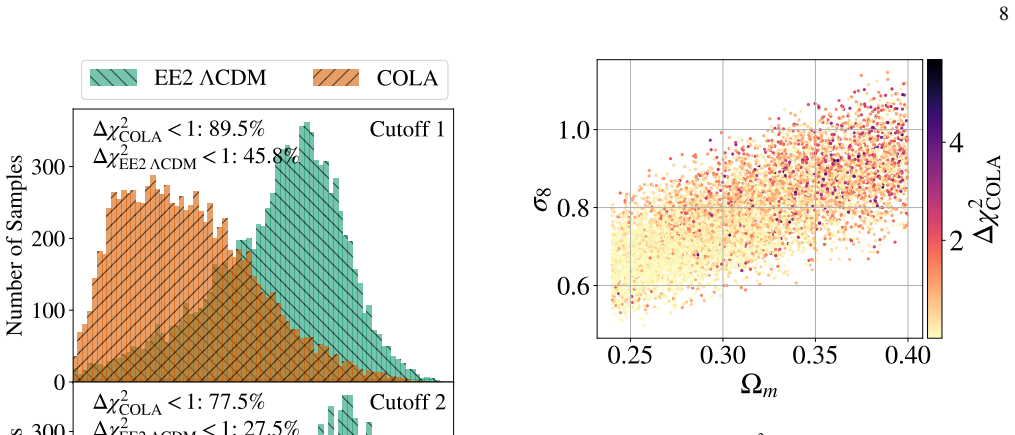


read the original abstract
Upcoming galaxy surveys will bring a wealth of information about the clustering of matter, but modeling small-scale structure beyond $\Lambda$CDM remains computationally challenging. While accurate N-body emulators exist to model the matter power spectrum for $\Lambda$CDM and some limited extensions, it's unfeasible to generate N-body simulation suites for all candidate models. Motivated by recent hints of an evolving dark energy equation of state, we assess the viability of employing the COmoving Lagrangian Acceleration (COLA) method to generate simulation suites assuming the $w_0w_a$ dark energy model. We combine COLA simulations with an existing high-precision $\Lambda$CDM emulator to extend its predictions into new regions of parameter space. We assess the precision of our emulator at the level of the matter power spectrum, finding that our emulator can reproduce the nonlinear boosts from EuclidEmulator2 at less than $2\%$ error. Moreover, we perform an analysis of a simulated cosmic shear survey akin to the Legacy Survey of Space and Time (LSST) first year of observations, assessing the differences in parameter constraints between our COLA-based emulator and the benchmark emulator. We find our emulator to be in excellent agreement with the benchmark, achieving less than $0.3\sigma$ shifts in cosmological parameters. We compare our emulator's performance to a commonly used approach: assuming the $\Lambda$CDM boost can be employed for extended parameter spaces without modification. We find that our emulator yields a significantly smaller $\Delta\chi^2$ distribution, parameter constraint biases, and a more accurate figure of merit compared to this second approach. Our results demonstrate that COLA emulators provide a computationally efficient path forward for modeling nonlinear structure in extended cosmologies, offering a practical alternative to full N-body suites.
Editorial analysis
A structured set of objections, weighed in public.
Referee Report
Summary. The manuscript proposes extending a high-precision ΛCDM matter power spectrum emulator to w0wa dark energy models by computing a multiplicative nonlinear boost factor from COLA simulations run in both cosmologies and applying the ratio to the ΛCDM emulator. Validation against EuclidEmulator2 shows the boosted emulator reproduces nonlinear power spectra to <2% accuracy; an end-to-end analysis of a simulated LSST Year-1 cosmic shear survey finds parameter constraints agree with the benchmark emulator to <0.3σ while outperforming the naive use of an unmodified ΛCDM boost in Δχ², bias, and figure of merit.
Significance. If the central accuracy claims hold, the work supplies a computationally inexpensive route to nonlinear modeling in dynamical dark energy cosmologies that avoids generating dedicated full N-body suites for every extended model. The explicit benchmark comparison to EuclidEmulator2 and the realistic survey forecast with quantitative parameter-shift metrics provide concrete, falsifiable support for the method's utility in analyses of upcoming Stage-IV data.
major comments (2)
- [§4] §4 (power-spectrum validation): the <2% agreement with EuclidEmulator2 is reported for the boost factor, but the construction multiplies a COLA-derived ratio onto a ΛCDM emulator; without separate quantification of absolute COLA residuals in the w0wa and ΛCDM runs (or resolution tests at k ≳ 1 h Mpc⁻¹), it remains unclear whether differential truncation errors cancel to the claimed precision at shear-relevant scales.
- [§5] §5 (cosmic-shear forecast): the <0.3σ parameter shifts and improved Δχ² relative to the naive ΛCDM-boost approach are central to the practical claim, yet the section does not report the k-range or scale cuts used in the likelihood nor the covariance matrix construction; these details are required to confirm that the reported agreement is not an artifact of the chosen analysis choices.
minor comments (3)
- [§3] The definition of the boost factor (ratio of COLA power spectra) should be written explicitly as an equation with the precise k and z ranges over which it is applied.
- [Figure 3] Figure captions for the power-spectrum ratio plots should state the number of COLA realizations, force resolution, and time-stepping parameters used.
- [§2] A short paragraph comparing the computational cost of the COLA suite versus a full N-body suite for the same w0wa grid would help readers assess the practical gain.
Simulated Author's Rebuttal
We thank the referee for their thoughtful and constructive comments on our manuscript. We have carefully considered each point and made revisions to the manuscript to address the concerns raised regarding the validation of the power spectrum and the details of the cosmic shear analysis. Our responses are provided below.
read point-by-point responses
-
Referee: [§4] §4 (power-spectrum validation): the <2% agreement with EuclidEmulator2 is reported for the boost factor, but the construction multiplies a COLA-derived ratio onto a ΛCDM emulator; without separate quantification of absolute COLA residuals in the w0wa and ΛCDM runs (or resolution tests at k ≳ 1 h Mpc⁻¹), it remains unclear whether differential truncation errors cancel to the claimed precision at shear-relevant scales.
Authors: We appreciate the referee pointing out the need for more detailed validation of the COLA residuals. Although the multiplicative boost approach is intended to mitigate common systematic errors in the COLA approximation by taking the ratio, we agree that explicit checks are valuable. In the revised manuscript, we have included additional analysis in §4 quantifying the absolute power spectrum errors from COLA in both the ΛCDM and w0wa cases against EuclidEmulator2. We have also added resolution convergence tests for k up to 2 h Mpc^{-1}, showing that the differential residuals are sub-percent at the relevant scales for weak lensing. This supports that the <2% accuracy is robust. revision: yes
-
Referee: [§5] §5 (cosmic-shear forecast): the <0.3σ parameter shifts and improved Δχ² relative to the naive ΛCDM-boost approach are central to the practical claim, yet the section does not report the k-range or scale cuts used in the likelihood nor the covariance matrix construction; these details are required to confirm that the reported agreement is not an artifact of the chosen analysis choices.
Authors: We agree that providing these specifics is necessary for full transparency and to allow readers to assess the analysis setup. We have revised §5 to include the k-range employed in the likelihood computation (specifically, scales up to k=1 h/Mpc), the scale cuts applied to the data vector to avoid baryonic effects and other systematics, and details on the covariance matrix, which was constructed using a combination of analytical terms for shape noise and sample variance based on the LSST Y1 survey parameters. These additions clarify that the reported parameter shifts are not sensitive to the particular choices made. revision: yes
Circularity Check
No significant circularity: results from new COLA runs and external benchmark comparisons
full rationale
The paper derives its emulator by running fresh COLA simulations in w0wa cosmologies, computing multiplicative boost factors relative to ΛCDM, and multiplying those boosts onto an independent high-precision ΛCDM emulator. Validation proceeds via direct numerical comparison to EuclidEmulator2 (reporting <2% error on nonlinear boosts) and via a separate simulated cosmic-shear likelihood analysis that measures parameter shifts (<0.3σ). None of these steps reduce by construction to fitted parameters, self-referential definitions, or load-bearing self-citations; the central claims rest on explicit simulation outputs and cross-checks against an external emulator, rendering the derivation self-contained.
Axiom & Free-Parameter Ledger
axioms (1)
- domain assumption COLA accurately captures the nonlinear boost differences induced by w0wa dark energy relative to ΛCDM
Lean theorems connected to this paper
-
IndisputableMonolith/Foundation/RealityFromDistinctionreality_from_one_distinction unclear?
unclearRelation between the paper passage and the cited Recognition theorem.
We combine COLA simulations with an existing high-precision ΛCDM emulator to extend its predictions... ˜B_COLA(k,z|θ) = B_N-body(k,z|θ_p) × B_COLA(k,z|θ)/B_COLA(k,z|θ_p)
What do these tags mean?
- matches
- The paper's claim is directly supported by a theorem in the formal canon.
- supports
- The theorem supports part of the paper's argument, but the paper may add assumptions or extra steps.
- extends
- The paper goes beyond the formal theorem; the theorem is a base layer rather than the whole result.
- uses
- The paper appears to rely on the theorem as machinery.
- contradicts
- The paper's claim conflicts with a theorem or certificate in the canon.
- unclear
- Pith found a possible connection, but the passage is too broad, indirect, or ambiguous to say the theorem truly supports the claim.
Reference graph
Works this paper leans on
-
[1]
Simulation Settings We use the COLA algorithm as implemented in the pub- licfml 1 code. Each simulation is performed in a box of size𝐿=1024ℎ −1Mpc, populated with𝑁part =1024 3 parti- cles, initialized at𝑧 ini =19, and evolved over 51 time steps chosen to maintain a uniform time resolution ofΔ𝑎≈0.02. The force grid uses𝑁 mesh =2048 3 cells, and the power s...
work page 2048
-
[2]
TheΛCDM model is recovered in the limit𝑤 0 =−1and𝑤 𝑎 =0
Definition of the Parameter Space Weconsiderthecosmological𝑤 0𝑤 𝑎CDMmodel,wherethe dark energy equation of state is parametrized as 𝑤(𝑎)=𝑤 0 +𝑤 𝑎 (1−𝑎),(2) with𝑎being the scale factor, and𝑤 0 and𝑤 𝑎 control the present-dayvalueandtimederivativeofthedarkenergyequa- tion of state, respectively. TheΛCDM model is recovered in the limit𝑤 0 =−1and𝑤 𝑎 =0. The fr...
-
[3]
Emulator Prototypes withhalofit Our goal is for the emulation error (i.e., the error in recov- ering COLA boosts from a predetermined test set excluded from training) to be significantly smaller than the intrinsic COLA approximation error relative to full𝑁-body simula- tions. Todetermineoptimalhyperparameters,suchastraining set size and emulator architect...
-
[4]
Post-processing the Simulation Boosts We define the nonlinear boost as 𝐵X (𝑘, 𝑧|θ) ≡ 𝑃X(𝑘, 𝑧|θ) 𝑃L (𝑘, 𝑧|θ) ,(3) whereθrefers to a point in the𝑤0𝑤 𝑎CDM parameter space, 𝑃𝑋 (𝑘, 𝑧|θ)is the matter power spectrum for cosmologyθ, either linear (denoted𝑃L), or calculated using COLA or an- otherN-body method (generically denoted𝑃 X). Prior to computing𝐵 COLA, we...
-
[5]
Neural Network Emulator After post-processing, we train our emulator with the nor- malized cosmological parameters as input features and the principal components as targets. We use a fully connected neural network with three hidden layers, each with 1024 neu- rons, with a mean squared error loss function, L= 𝑁train∑︁ 𝑖=1 𝑁PC∑︁ 𝑗=1 (𝛼𝑖,train 𝑗 −𝛼 𝑖,pred 𝑗 ...
-
[6]
Boost Errors Weperformaseriesofaccuracychecksontheemulatorout- puts. First, to assess the accuracy of our neural network, we compare the emulator’s predictions for test set cosmologies, unseen in the training procedure, against the actual COLA simulations. The relative errors are shown in the first panel of Figure 1. At𝑘=1ℎ/Mpc,90%of the test set cosmolo-...
-
[7]
M. A. Troxel, N. MacCrann, J. Zuntz, T. F. Eifler, E. Krause, et al., Dark Energy Survey Year 1 results: Cosmological con- straints from cosmic shear, Phys. Rev. D98, 043528 (2018), arXiv:1708.01538 [astro-ph.CO]
work page internal anchor Pith review Pith/arXiv arXiv 2018
-
[8]
T. M. C. Abbott, F. B. Abdalla, A. Alarcon, J. Aleksić, S. Al- lam,et al., Dark Energy Survey year 1 results: Cosmological constraintsfromgalaxyclusteringandweaklensing,Phys.Rev. D98, 043526 (2018), arXiv:1708.01530 [astro-ph.CO]
work page internal anchor Pith review Pith/arXiv arXiv 2018
- [9]
- [10]
- [11]
-
[12]
O. Friedrich, F. Andrade-Oliveira, H. Camacho, O. Alves, R. Rosenfeld,et al., Dark Energy Survey year 3 results: co- variancemodellinganditsimpactonparameterestimationand quality of fit, Mon. Not. of the Royal Astron. Soc.508, 3125 (2021), arXiv:2012.08568 [astro-ph.CO]
- [13]
-
[14]
S. Pandey, E.Krause, J.DeRose, N. MacCrann, B.Jain,etal., DarkEnergySurveyyear3results: Constraintsoncosmologi- cal parameters and galaxy-bias models from galaxy clustering and galaxy-galaxy lensing using the redMaGiC sample, Phys. Rev. D106, 043520 (2022), arXiv:2105.13545 [astro-ph.CO]
- [15]
- [16]
-
[17]
A. H. Wright, B. Stölzner, M. Asgari, M. Bilicki, B. Giblin, et al., KiDS-Legacy: Cosmological constraints from cosmic shear with the complete Kilo-Degree Survey, arXiv e-prints , 12 arXiv:2503.19441 (2025), arXiv:2503.19441 [astro-ph.CO]
work page internal anchor Pith review Pith/arXiv arXiv 2025
- [18]
-
[19]
M.Bilicki,A.Dvornik,H.Hoekstra,A.H.Wright,N.E.Chis- ari,et al., Bright galaxy sample in the Kilo-Degree Survey Data Release 4. Selection, photometric redshifts, and physi- cal properties, Astronomy & Astrophysics653, A82 (2021), arXiv:2101.06010 [astro-ph.GA]
-
[20]
A. Loureiro, L. Whittaker, A. Spurio Mancini, B. Joachimi, A.Cuceu,etal.,KiDSandEuclid: Cosmologicalimplications of a pseudo angular power spectrum analysis of KiDS-1000 cosmic shear tomography, Astronomy & Astrophysics665, A56 (2022), arXiv:2110.06947 [astro-ph.CO]
- [21]
- [22]
- [23]
- [24]
-
[25]
C. Heymans, T. Tröster, M. Asgari, C. Blake, H. Hilde- brandt,et al., KiDS-1000 Cosmology: Multi-probe weak gravitational lensing and spectroscopic galaxy clustering con- straints, Astronomy and Astrophysics646, A140 (2021), arXiv:2007.15632 [astro-ph.CO]
- [26]
-
[27]
H. Hildebrandt, J. L. van den Busch, A. H. Wright, C. Blake, B. Joachimi,et al., KiDS-1000 catalogue: Redshift distribu- tions and their calibration, Astronomy & Astrophysics647, A124 (2021), arXiv:2007.15635 [astro-ph.CO]
- [28]
- [29]
-
[30]
Cosmology from cosmic shear power spectra with Subaru Hyper Suprime-Cam first-year data
C. Hikage, M. Oguri, T. Hamana, S. More, R. Mandelbaum, et al., Cosmology from cosmic shear power spectra with Sub- aruHyperSuprime-Camfirst-yeardata,PublicationsoftheAs- tronomical Society of Japan71, 43 (2019), arXiv:1809.09148 [astro-ph.CO]
work page internal anchor Pith review Pith/arXiv arXiv 2019
-
[31]
T. Hamana, M. Shirasaki, S. Miyazaki, C. Hikage, M. Oguri, et al., Cosmological constraints from cosmic shear two-point correlation functions with HSC survey first-year data, Publi- cations of the Astronomical Society of Japan72, 16 (2020), arXiv:1906.06041 [astro-ph.CO]
-
[32]
The Hyper Suprime-Cam SSP Survey: Overview and Survey Design
H. Aihara, N. Arimoto, R. Armstrong, S. Arnouts, N. A. Bah- call,et al., The Hyper Suprime-Cam SSP Survey: Overview and survey design, Publications of the Astronomical Society of Japan70, S4 (2018), arXiv:1704.05858 [astro-ph.IM]
work page internal anchor Pith review Pith/arXiv arXiv 2018
-
[33]
M.Tanaka,J.Coupon,B.-C.Hsieh,S.Mineo,A.J.Nishizawa, et al., Photometric redshifts for Hyper Suprime-Cam Subaru Strategic Program Data Release 1, Publications of the Astro- nomical Society of Japan70, S9 (2018), arXiv:1704.05988 [astro-ph.GA]
work page internal anchor Pith review Pith/arXiv arXiv 2018
-
[34]
Weak lensing shear calibration with simulations of the HSC survey
R. Mandelbaum, F. Lanusse, A. Leauthaud, R. Armstrong, M. Simet,et al., Weak lensing shear calibration with simula- tions of the HSC survey, Monthly Notices of the Royal Astro- nomical Society481, 3170 (2018), arXiv:1710.00885 [astro- ph.CO]
work page internal anchor Pith review Pith/arXiv arXiv 2018
- [35]
-
[36]
Data Release 1 of the Dark Energy Spectroscopic Instrument
DESI Collaboration, M. Abdul-Karim, A. G. Adame, D.Aguado,J.Aguilar,etal.,DataRelease1oftheDarkEnergy Spectroscopic Instrument, arXiv e-prints , arXiv:2503.14745 (2025), arXiv:2503.14745 [astro-ph.CO]
work page internal anchor Pith review Pith/arXiv arXiv 2025
-
[37]
Andradeet al.(DESI) (2025), arXiv:2503.14742 [astro-ph.CO]
U. Andrade, E. Paillas, J. Mena-Fernandez, Q. Li, A. J. Ross, et al., Validation of the DESI DR2 Measurements of Baryon Acoustic Oscillations from Galaxies and Quasars, arXiv e- prints , arXiv:2503.14742 (2025), arXiv:2503.14742 [astro- ph.CO]
- [38]
-
[39]
DESI DR2 Results I: Baryon Acoustic Oscillations from the Lyman Alpha Forest
DESI Collaboration, M. Abdul-Karim, J. Aguilar, S. Ahlen, C.AllendePrieto,etal.,DESIDR2ResultsI:BaryonAcoustic Oscillations from the Lyman Alpha Forest, arXiv e-prints , arXiv:2503.14739 (2025), arXiv:2503.14739 [astro-ph.CO]
work page internal anchor Pith review Pith/arXiv arXiv 2025
-
[40]
DESI DR2 Results II: Measurements of Baryon Acoustic Oscillations and Cosmological Constraints
DESI Collaboration, M. Abdul-Karim, J. Aguilar, S. Ahlen, S.Alam,etal.,DESIDR2ResultsII:MeasurementsofBaryon Acoustic Oscillations and Cosmological Constraints, arXiv e- prints , arXiv:2503.14738 (2025), arXiv:2503.14738 [astro- ph.CO]
work page internal anchor Pith review Pith/arXiv arXiv 2025
-
[41]
Extended Dark Energy analysis using DESI DR2 BAO measurements
K. Lodha, R. Calderon, W. L. Matthewson, A. Shafieloo, M. Ishak,et al., Extended Dark Energy analysis using DESI DR2 BAO measurements, arXiv e-prints , arXiv:2503.14743 (2025), arXiv:2503.14743 [astro-ph.CO]
work page internal anchor Pith review Pith/arXiv arXiv 2025
-
[42]
Constraints on Neutrino Physics from DESI DR2 BAO and DR1 Full Shape
W. Elbers, A. Aviles, H. E. Noriega, D. Chebat, A. Menegas, et al., Constraints on Neutrino Physics from DESI DR2 BAO andDR1FullShape,arXive-prints,arXiv:2503.14744(2025), arXiv:2503.14744 [astro-ph.CO]
work page internal anchor Pith review Pith/arXiv arXiv 2025
-
[43]
A.J.Ross,F.Beutler,C.-H.Chuang,M.Pellejero-Ibanez,H.-J. Seo,et al., The clustering of galaxies in the completed SDSS- III Baryon Oscillation Spectroscopic Survey: observational systematics and baryon acoustic oscillations in the correlation function, Monthly Notices of the Royal Astronomical Society 464, 1168 (2017), arXiv:1607.03145 [astro-ph.CO]
work page internal anchor Pith review Pith/arXiv arXiv 2017
-
[44]
F. Beutler, H.-J. Seo, A. J. Ross, P. McDonald, S. Saito,et al., The clustering of galaxies in the completed SDSS-III Baryon OscillationSpectroscopicSurvey: baryonacousticoscillations in the Fourier space, Monthly Notices of the Royal Astro- nomical Society464, 3409 (2017), arXiv:1607.03149 [astro- ph.CO]
work page internal anchor Pith review Pith/arXiv arXiv 2017
-
[45]
S. Alam, M. Ata, S. Bailey, F. Beutler, D. Bizyaev,et al., The clustering of galaxies in the completed SDSS-III Baryon Os- cillation Spectroscopic Survey: cosmological analysis of the 13 DR12 galaxy sample, Monthly Notices of the Royal Astro- nomical Society470, 2617 (2017), arXiv:1607.03155 [astro- ph.CO]
work page internal anchor Pith review Pith/arXiv arXiv 2017
-
[46]
S. Satpathy, S. Alam, S. Ho, M. White, N. A. Bahcall,et al., The clustering of galaxies in the completed SDSS-III Baryon Oscillation Spectroscopic Survey: on the measurement of growth rate using galaxy correlation functions, Monthly No- tices of the Royal Astronomical Society469, 1369 (2017), arXiv:1607.03148 [astro-ph.CO]
work page internal anchor Pith review Pith/arXiv arXiv 2017
-
[47]
F. Beutler, H.-J. Seo, S. Saito, C.-H. Chuang, A. J. Cuesta, et al., The clustering of galaxies in the completed SDSS-III Baryon Oscillation Spectroscopic Survey: anisotropic galaxy clustering in Fourier space, Monthly Notices of the Royal Astronomical Society466, 2242 (2017), arXiv:1607.03150 [astro-ph.CO]
work page internal anchor Pith review Pith/arXiv arXiv 2017
-
[48]
K. S. Dawson, J.-P. Kneib, W. J. Percival, S. Alam, F. D. Al- bareti,etal.,TheSDSS-IVExtendedBaryonOscillationSpec- troscopicSurvey: OverviewandEarlyData,TheAstronomical Journal151, 44 (2016), arXiv:1508.04473 [astro-ph.CO]
work page internal anchor Pith review Pith/arXiv arXiv 2016
-
[49]
Z. Zhai, J. L. Tinker, C. Hahn, H.-J. Seo, M. R. Blanton, et al., The Clustering of Luminous Red Galaxies at z∼0.7 from EBOSS and BOSS Data, Astrophys. J.848, 76 (2017), arXiv:1607.05383 [astro-ph.CO]
work page internal anchor Pith review Pith/arXiv arXiv 2017
-
[50]
G.-B. Zhao, Y. Wang, A. J. Ross, S. Shandera, W. J. Percival, etal.,TheextendedBaryonOscillationSpectroscopicSurvey: a cosmological forecast, Monthly Notices of the Royal Astro- nomical Society457, 2377 (2016), arXiv:1510.08216 [astro- ph.CO]
work page internal anchor Pith review Pith/arXiv arXiv 2016
- [51]
-
[52]
M. Ata, F. Baumgarten, J. Bautista, F. Beutler, D. Bizyaev, et al., The clustering of the SDSS-IV extended Baryon Oscil- lation Spectroscopic Survey DR14 quasar sample: first mea- surement of baryon acoustic oscillations between redshift 0.8 and 2.2, Monthly Notices of the Royal Astronomical Society 473, 4773 (2018), arXiv:1705.06373 [astro-ph.CO]
work page internal anchor Pith review Pith/arXiv arXiv 2018
-
[53]
S. A. Rodríguez-Torres, J. Comparat, F. Prada, G. Yepes, E. Burtin,et al., Clustering of quasars in the first year of the SDSS-IV eBOSS survey: interpretation and halo occupa- tion distribution, Monthly Notices of the Royal Astronomical Society468, 728 (2017), arXiv:1612.06918 [astro-ph.CO]
work page internal anchor Pith review Pith/arXiv arXiv 2017
- [54]
-
[55]
H. Gil-Marín, J. Guy, P. Zarrouk, E. Burtin, C.-H. Chuang, et al., The clustering of the SDSS-IV extended Baryon Oscil- lation Spectroscopic Survey DR14 quasar sample: structure growth rate measurement from the anisotropic quasar power spectrum in the redshift range 0.8 < z < 2.2, Monthly No- tices of the Royal Astronomical Society477, 1604 (2018), arXiv:...
work page internal anchor Pith review Pith/arXiv arXiv 2018
-
[56]
R. Ruggeri, W. J. Percival, H. Gil-Marín, F. Beutler, E.- M. Mueller,et al., The clustering of the SDSS-IV extended Baryon Oscillation Spectroscopic Survey DR14 quasar sam- ple: measuringtheevolutionofthegrowthrateusingredshift- space distortions between redshift 0.8 and 2.2, Monthly No- tices of the Royal Astronomical Society483, 3878 (2019), arXiv:1801....
work page internal anchor Pith review Pith/arXiv arXiv 2019
-
[57]
C. Blake, E. A. Kazin, F. Beutler, T. M. Davis, D. Parkin- son,et al., The WiggleZ Dark Energy Survey: mapping the distance-redshift relation with baryon acoustic oscillations, MonthlyNoticesoftheRoyalAstronomicalSociety418,1707 (2011), arXiv:1108.2635 [astro-ph.CO]
work page internal anchor Pith review Pith/arXiv arXiv 2011
-
[58]
E. A. Kazin, J. Koda, C. Blake, N. Padmanabhan, S. Brough, et al., The WiggleZ Dark Energy Survey: improved distance measurements to z = 1 with reconstruction of the baryonic acoustic feature, Monthly Notices of the Royal Astronomical Society441, 3524 (2014), arXiv:1401.0358 [astro-ph.CO]
work page internal anchor Pith review Pith/arXiv arXiv 2014
-
[59]
S. Riemer-Sørensen, C. Blake, D. Parkinson, T. M. Davis, S. Brough,et al., WiggleZ Dark Energy Survey: Cosmolog- ical neutrino mass constraint from blue high-redshift galax- ies, Phys. Rev. D85, 081101 (2012), arXiv:1112.4940 [astro- ph.CO]
work page internal anchor Pith review Pith/arXiv arXiv 2012
-
[60]
The WiggleZ Dark Energy Survey: Final data release and cosmological results
D. Parkinson, S. Riemer-Sørensen, C. Blake, G. B. Poole, T. M. Davis,et al., The WiggleZ Dark Energy Survey: Final datareleaseandcosmologicalresults,Phys.Rev.D86,103518 (2012), arXiv:1210.2130 [astro-ph.CO]
work page internal anchor Pith review Pith/arXiv arXiv 2012
-
[61]
C.Blake,S.Brough,M.Colless,C.Contreras,W.Couch,etal., The WiggleZ Dark Energy Survey: the growth rate of cosmic structuresinceredshiftz=0.9,MonthlyNoticesoftheRoyalAs- tronomicalSociety415,2876(2011),arXiv:1104.2948[astro- ph.CO]
work page internal anchor Pith review Pith/arXiv arXiv 2011
-
[62]
E. Di Valentino, L. A. Anchordoqui, Ö. Akarsu, Y. Ali- Haimoud, L. Amendola,et al., Cosmology Intertwined III: f𝜎8 and S 8, Astroparticle Physics131, 102604 (2021), arXiv:2008.11285 [astro-ph.CO]
-
[63]
Union Through UNITY: Cosmology with 2,000 SNe Using a Unified Bayesian Framework
D. Rubin, G. Aldering, M. Betoule, A. Fruchter, X. Huang, et al., Union Through UNITY: Cosmology with 2,000 SNe Using a Unified Bayesian Framework, arXiv e-prints , arXiv:2311.12098 (2023), arXiv:2311.12098 [astro-ph.CO]
work page internal anchor Pith review Pith/arXiv arXiv 2023
-
[64]
DESCollaboration,T.M.C.Abbott,M.Acevedo,M.Aguena, A. Alarcon,et al., The Dark Energy Survey: Cosmology Re- sultswith∼1500NewHigh-redshiftTypeIaSupernovaeUsing the Full 5 yr Data Set, The Astrophysical Journal Letters973, L14 (2024), arXiv:2401.02929 [astro-ph.CO]
work page internal anchor Pith review Pith/arXiv arXiv 2024
-
[65]
J. Rebouças, D. H. F. de Souza, K. Zhong, V. Miranda, and R. Rosenfeld, Investigating late-time dark energy and massive neutrinos in light of DESI Y1 BAO, Journal of Cosmology andAstroparticlePhysics2025,024(2025),arXiv:2408.14628 [astro-ph.CO]
-
[66]
N. Roy, Dynamical dark energy in the light of desi 2024 data, Physics of the Dark Universe48, 101912 (2025)
work page 2024
-
[67]
Y. Carloni, O. Luongo, and M. Muccino, Does dark energy really revive using desi 2024 data?, Phys. Rev. D111, 023512 (2025)
work page 2024
-
[68]
A. Chakraborty, P. K. Chanda, S. Das, and K. Dutta, Desi results: Hint towards coupled dark matter and dark energy (2025), arXiv:2503.10806 [astro-ph.CO]
- [69]
-
[70]
H. Chaudhary, S. Capozziello, V. K. Sharma, and G. Mustafa, Does desi dr2 challenge𝜆cdm paradigm ? (2025), arXiv:2507.21607 [astro-ph.CO]
-
[71]
The LSST Dark Energy Science Collaboration, R. Mandel- baum, T. Eifler, R. Hložek, T. Collett,et al., The LSST Dark Energy Science Collaboration (DESC) Science Require- ments Document, arXiv e-prints , arXiv:1809.01669 (2018), arXiv:1809.01669 [astro-ph.CO]
- [72]
-
[73]
B. P. Crill, M. Werner, R. Akeson, M. Ashby, L. Bleem, et al., SPHEREx: NASA’s near-infrared spectrophotometric 14 all-skysurvey,inSpaceTelescopesandInstrumentation2020: Optical, Infrared, and Millimeter Wave, Society of Photo- Optical Instrumentation Engineers (SPIE) Conference Series, Vol. 11443, edited by M. Lystrup and M. D. Perrin (2020) p. 114430I, ...
- [74]
-
[75]
Lacasa,Fabien,Cosmologyinthenon-linearregime: thesmall scale miracle, A&A661, A70 (2022)
work page 2022
-
[77]
The Cosmic Linear Anisotropy Solving System (CLASS) I: Overview
J. Lesgourgues, The Cosmic Linear Anisotropy Solving Sys- tem (CLASS) I: Overview, arXiv e-prints , arXiv:1104.2932 (2011), arXiv:1104.2932 [astro-ph.IM]
work page internal anchor Pith review Pith/arXiv arXiv 2011
-
[78]
D. Blas, J. Lesgourgues, and T. Tram, The Cosmic Linear Anisotropy Solving System (CLASS). Part II: Approxima- tionschemes,JournalofCosmologyandAstroparticlePhysics 2011(7), 034, arXiv:1104.2933 [astro-ph.CO]
work page internal anchor Pith review Pith/arXiv arXiv 2011
-
[79]
A.Schneider,R.Teyssier,D.Potter,J.Stadel,J.Onions,etal., Matterpower spectrumand thechallenge ofpercent accuracy, JCAP04, 047, arXiv:1503.05920 [astro-ph.CO]
work page internal anchor Pith review Pith/arXiv arXiv
-
[80]
PKDGRAV3: Beyond Trillion Particle Cosmological Simulations for the Next Era of Galaxy Surveys
D. Potter, J. Stadel, and R. Teyssier, PKDGRAV3: beyond trillion particle cosmological simulations for the next era of galaxy surveys, Computational Astrophysics and Cosmology 4, 2 (2017), arXiv:1609.08621 [astro-ph.IM]
work page internal anchor Pith review Pith/arXiv arXiv 2017
-
[81]
V. Springel, R. Pakmor, O. Zier, and M. Reinecke, Simulating cosmicstructureformationwiththeGADGET-4code,Monthly Notices of the Royal Astronomical Society506, 2871 (2021), arXiv:2010.03567 [astro-ph.IM]
discussion (0)
Sign in with ORCID, Apple, or X to comment. Anyone can read and Pith papers without signing in.