REVIEW 3 major objections 5 minor 1 cited by
For a 1D incommensurate Schrödinger operator, the density of states matches a second-order semiclassical expansion at small mismatch, and residual oscillations are harmonic-oscillator levels at band critical points.
Reviewed by Pith at T0; open to challenge. T0 means a machine referee read the full paper against a public rubric. the ladder, T0–T4 →
T0 review · deepseek-v4-flash
2026-08-04 09:25 UTC pith:4WNFNB2F
load-bearing objection Solid, genuinely useful numerical study with a real but addressable caveat: the momentum-space reference looks under-converged exactly where the paper's main discrepancy story plays out. the 3 major comments →
Numerical computation of the density of states of aperiodic multiscale Schr\"odinger operators
The pith
A machine-rendered reading of the paper's core claim, the machinery that carries it, and where it could break.
Core claim
For Hε = −½Δ + V(x,(1+ε)x) with smooth, periodic V, Theorem 2.5 establishes that Tr[f(Hε)] = L0(f) + εL1(f) + ε²L2(f) + O(ε³), where each Lj is an explicit sum-over-states integral over the eigenvalues λn(k,X) of the operator-valued symbol h(k,X) = ½(−i∇+k)² + V(x,X) on the torus, together with its spectral matrix elements. The paper checks these coefficients by finite differences against the momentum-space method and finds full-DoS agreement for ε = 0.001. At ε = 0.01, the mismatch is localized near critical points (k0,X0) of the band functions, and the paper shows that near such a point the effective Hamiltonian is a quantum harmonic oscillator with eigenvalues E(p) + εωp(n+½). This harmon
What carries the argument
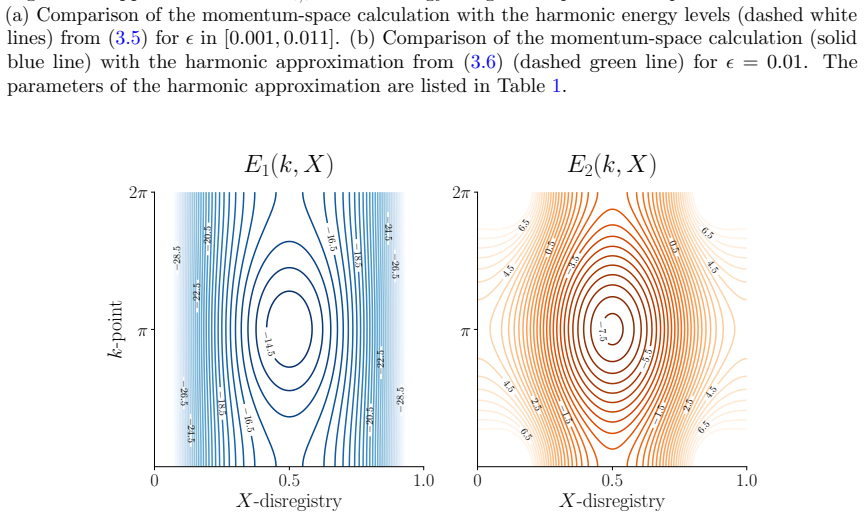
The central object is the operator-valued Weyl symbol h(k,X), the Bloch Hamiltonian of the commensurate approximation at local disregistry X. Its band structure (Ej(k,X)) and spectral matrix elements carry the argument: the semiclassical coefficients L0, L1, and L2 are integrals of divided differences of the test function over these bands, and the critical points of Ej drive an effective harmonic oscillator model Heff_p = E(p) − (Ap/2)d²/dx² + (ε²Cp/2)x². The Wigner transform of the oscillator eigenstates is used to diagnose whether the harmonic model is valid in a given region of phase space.
Load-bearing premise
The load-bearing premise is that the momentum-space reference calculation is converged wherever it is used as ground truth—especially in the ε = 0.01, σ = 0.08 case, where the plotted exact DoS dips below zero, which the true Gaussian-smeared density of states cannot.
What would settle it
Recompute the momentum-space/KPM approximation for ε = 0.01, σ = 0.08 with a systematically increased Chebyshev expansion order (reporting the order) until the DoS approximation is nonnegative everywhere to numerical precision. If the converged reference still disagrees with the second-order semiclassical curve in the energy range [9,18], the paper's attribution of the mismatch to missing higher-order semiclassical corrections is supported; if the reference shifts, the mismatch is partly a reference artifact.
If this is right
- For sufficiently small ε, the DoS of an incommensurate system can be computed from the band structure of a single commensurate symbol, avoiding direct simulation of the aperiodic system.
- The explicit formulas for L0, L1, and L2 make the semiclassical expansion directly usable once the spectral decomposition of h(k,X) is known.
- The harmonic-oscillator analysis predicts that sharp DoS oscillations appear at energies determined by band critical points and their second derivatives, explaining what would otherwise look like numerical artifacts.
- At less-small ε, missing higher-order semiclassical corrections are the reason the truncated expansion fails, pointing to where improved approximations are needed.
Where Pith is reading between the lines
- Editorial inference: In the ε = 0.01, σ = 0.08 comparison, the plotted momentum-space DoS dips below zero in the energy range [9,18], even though the exact Gaussian-smeared DoS must be nonnegative; this suggests the reference calculation is not fully converged there, so part of the reported mismatch may reflect reference error rather than missing semiclassical terms.
- Editorial inference: The harmonic-oscillator mechanism offers a practical diagnostic: from the second derivatives of any band critical point one can predict where sharp DoS peaks will appear in a moiré spectrum, without solving the full aperiodic problem.
- Editorial inference: In nearly degenerate band regions, such as the second/third band crossing near E ≈ 10 in this model, the single-band harmonic model breaks down even for small ε; a multi-band effective model would be a natural next test.
- Editorial inference: Because L0, L1, and L2 depend only on the potential and not on ε, they could be reused as inexpensive surrogates in parameter sweeps over twist angles or lattice mismatches.
Editorial analysis
A structured set of objections, weighed in public.
Referee Report
Summary. The paper compares two numerical approaches for the density of states of one-dimensional incommensurate Schrödinger operators of the form H_ε = -1/2 d²/dx² + V(x,(1+ε)x): a momentum-space method with KPM evaluation, and a semiclassical expansion in ε. The main theoretical output is Theorem 2.5, which gives explicit sum-over-states formulae (2.25)–(2.27) for the first three coefficients L0, L1, L2 of the expansion Tr[f(H_ε)] = L0 + εL1 + ε²L2 + ..., with a detailed derivation in Appendix A. Numerically, the authors compare L0, L1, L2 with finite differences of the momentum-space DoS, compare the full regularized DoS for ε=0.001 and ε=0.01, and attribute discrepancies at ε=0.01 to oscillations at Van Hove critical points captured by a harmonic-oscillator effective model (3.5)–(3.6).
Significance. If the numerical convergence questions are resolved, this is a valuable contribution. The paper provides a practical, parameter-free second-order semiclassical formula for the DoS of two-scale Schrödinger operators, with a self-contained algebraic derivation in Appendix A, and a predictive harmonic-oscillator description of DoS oscillations at band critical points. The comparisons at small ε (Figures 1–4) show impressive agreement, and the authors report their discretization parameters, which aids reproducibility. However, the momentum-space reference computation is not fully characterized in the very regime used to validate the failure analysis, and some quantitative claims lack supporting derivations.
major comments (3)
- [§3.2, Figure 5 (right)] For σ=0.08 and ε=0.01, the momentum-space approximation of ν_{ε,σ}(E) (solid blue) takes negative values in the energy range [9,18]. Since ν_{ε,σ} is the convolution of the positive DoS measure with a positive Gaussian, it must be nonnegative. A negative value is a rigorous indicator of numerical artifact, not a property of the true DoS. The manuscript does not discuss this, and the KPM/Chebyshev expansion order is not reported, so the reference accuracy is unquantified. This is exactly the regime in which the paper claims the second-order semiclassical method fails due to missing higher-order corrections; the reference must be demonstrated converged (e.g., by increasing Chebyshev order and showing stability) before that attribution is clean. The same issue affects the σ=0.04 results in §3.3, which use the momentum-space curves as ground truth.
- [§3.2, Figures 1–3] The momentum-space approximations of L1 and L2 are obtained by finite differences in ε, but the step size and stencil are not reported. The reported agreement (errors up to 10^-5 for L1 and 10^-3 for L2 at σ=0.08) could be limited by finite-difference truncation rather than by the methods themselves. Without the step size and a convergence check in the step, the consistency of the expansion coefficients is not fully established. Please provide this information.
- [§3.3, Eq. (3.6)] The harmonic approximation formula (3.6) is stated without derivation. In particular, the prefactor ε/|Ω| is not derived from the semiclassical quantization, and the calculation is restricted to a single band with Bp assumed zero. A derivation, or at least a precise statement of the approximations leading to (3.6), is necessary to assess the quantitative claims in Figures 7, 10, and 11. Currently the prefactor and the neglect of interband coupling are not justified, weakening the claim that the harmonic model is quantitative.
minor comments (5)
- [General] The abstract and body contain several typographical artifacts ('Schr¨odinger', 'DoS', etc.). Please proofread.
- [References] References [16] and [17] are identical; one should be removed or replaced.
- [§2.2.2 / §3.2] The theory is stated for irrational ε, but all numerical experiments use rational ε=0.001 and 0.01. Please explain whether the momentum-space formula (2.8) remains valid for rational ε, or why these rational approximations are representative of the incommensurate limit.
- [Theorem 2.5] The constant C_{d,m} in (2.28) is not stated to depend on V and f; clarify the dependence explicitly.
- [§3.3, Wigner transform] The Wigner transform formula introduces ℏ=1 without explaining the ε-scaling that is used in the subsequent localization argument; a short clarification would improve readability.
Circularity Check
No significant circularity: expansion terms and harmonic-level predictions are parameter-free and independently checked.
full rationale
The semiclassical coefficients L0,L1,L2 in (2.25)-(2.27) are derived in Appendix A by explicit Helffer-Sjostrand/resolvent calculus from the operator-valued symbol h(k,X); no parameter is fitted to the momentum-space DoS. The numerical comparison in Section 3.2 uses the momentum-space method (2.10), whose convergence is governed by Theorem 2.3, as an independent computation of Tr f(H_epsilon); the agreement at epsilon=0.001 is a genuine cross-check, and the epsilon=0.01 discrepancy is attributed to truncation of the semiclassical series rather than to any fitted input. The harmonic model in Section 3.3 obtains E(p), Ap, Bp, Cp, omega_p from the band structure of h(k,X) (Table 1), not from the oscillation positions; formula (3.5) then predicts level positions that are compared with the momentum-space calculation, so this is a genuine prediction rather than a fit renamed as a prediction. The paper does rely on prior work by overlapping authors for the existence of the expansion ([4]) and for the momentum-space approximation ([22]), but both are stated mathematical results with explicit assumptions and are not ad hoc constructions of the target numerical values; the load-bearing identity (2.29) is not equivalent to an input by construction. Any concern about convergence of the momentum-space reference (e.g., negative DoS values at sigma=0.08, epsilon=0.01) is a numerical-accuracy issue, not a circularity of the derivation.
Axiom & Free-Parameter Ledger
free parameters (3)
- V barrier amplitudes A1, A2 =
A1=7.0, A2=5.0
- Gaussian widths σ1, σ2 =
σ1=σ2=0.05
- test-function smearing σ =
0.4, 0.08, 0.04
axioms (6)
- standard math Ergodicity of the translation action yields a well-defined, ω-independent DoS for irrational ε
- domain assumption Theorem 2.2 momentum-space trace identity with exponential decay of Fourier modes of V
- standard math Semiclassical resolvent expansion (2.14) and functional calculus via Helffer–Sjöstrand
- domain assumption Theorem 2.5 error bound (2.28) with constant C_{d,m} independent of f
- domain assumption Gaussian test functions satisfy the growth condition (2.30)
- ad hoc to paper Cross-term Bp ≈ 0 at critical points; single-band harmonic model
Cite this review
Pith. "Pith review of Numerical computation of the density of states of aperiodic multiscale Schr\"odinger operators." pith.science (2026). https://pith.science/paper/4WNFNB2F
@misc{pith2026251015369,
  author       = {Pith},
  title        = {Pith review of: Numerical computation of the density of states of aperiodic multiscale Schr\"odinger operators},
  year         = {2026},
  howpublished = {\url{https://pith.science/paper/4WNFNB2F}},
  note         = {Machine review of arXiv:2510.15369}
}
read the original abstract
Computing the electronic structure of incommensurate materials is a central challenge in condensed matter physics, requiring efficient ways to approximate spectral quantities such as the density of states (DoS). In this paper, we numerically investigate two distinct approaches for approximating the DoS of incommensurate Hamiltonians for small values of the incommensurability parameters $\epsilon$ (e.g., small twist angle, or small lattice mismatch): the first employs a momentum-space decomposition, and the second exploits a semiclassical expansion with respect to $\epsilon$. In particular, we compare these two methods using a 1D toy model. We check their consistency by comparing the asymptotic expansion terms of the DoS, and it is shown that, for full DoS, the two methods exhibit good agreement in the small $\epsilon$ limit, while discrepancies arise for less small $\epsilon$, which indicates the importance of higher-order corrections in the semiclassical method for such regimes. We find these discrepancies to be caused by oscillations in the DoS at the semiclassical analogues of Van Hove singularities, which can be explained qualitatively, and quantitatively for $\epsilon$ small enough, by a semiclassical approach.
Figures




Forward citations
Cited by 1 Pith paper
-
Kohn-Sham models for encapsulated two-dimensional materials
Proves existence and well-posedness for Kohn-Sham DFT models of encapsulated 2D materials with Yukawa-screened interactions in periodic and quasi-periodic settings.
Reference graph
Works this paper leans on
-
[1]
M. Aizenman and S. Warzel.Random operators, volume 168 ofGraduate Studies in Mathematics. American Mathematical Society, Providence, RI, 2015. ISBN 978-1-4704-1913-4. doi: 10.1090/ gsm/168. URLhttps://doi.org/10.1090/gsm/168
-
[2]
Balezard-Konlein
A. Balezard-Konlein. Calcul fonctionnel pour les op´ erateursh-admissibles ` a symbole op´ erateur et applications. Th` ese de 3` eme cycle, Universit´ e de Nantes, 1985
1985
-
[3]
Bistritzer and A
R. Bistritzer and A. H. MacDonald. Moir´ e butterflies in twisted bilayer graphene.Phys. Rev. B, 84(3):035440, 2011. 25
2011
-
[4]
E. Canc` es and L. Meng. Semiclassical analysis of two-scale electronic hamiltonians for twisted bilayer graphene. arXiv:2311.14011
-
[5]
Y. Cao, V. Fatemi, S. Fang, K. Watanabe, T. Taniguchi, E. Kaxiras, and P. Jarillo-Herrero. Unconventional superconductivity in magic-angle graphene superlattices.Nature, 556(7699): 43–50, 2018. ISSN 1476-4687. doi: 10.1038/nature26160. URL https://doi.org/10.1038/ nature26160
-
[6]
S. Carr, D. Massatt, M. Luskin, and E. Kaxiras. Duality between atomic configurations and bloch states in twistronic materials.Phys. Rev. Res., 2:033162, July 2020. doi: 10.1103/ PhysRevResearch.2.033162. URL https://link.aps.org/doi/10.1103/PhysRevResearch. 2.033162
-
[7]
I. Catto, C. Le Bris, and P.-L. Lions. On the thermodynamic limit for Hartree-Fock type models.Ann. Inst. H. Poincar´ e C Anal. Non Lin´ eaire, 18(6):687–760, 2001. ISSN 0294- 1449,1873-1430. doi: 10.1016/S0294-1449(00)00059-7. URL https://doi.org/10.1016/ S0294-1449(00)00059-7
-
[8]
I. Catto, L. Meng, E. Paturel, and E. S´ er´ e. Existence of minimizers for the Dirac-Fock model of crystals.Arch. Ration. Mech. Anal., 248(4):Paper No. 63, 63, 2024. ISSN 0003-9527,1432-0673. doi: 10.1007/s00205-024-01988-8. URLhttps://doi.org/10.1007/s00205-024-01988-8
-
[9]
Colin de Verdi` ere
Y. Colin de Verdi` ere. Semiclassical trace formulas and heat expansions.Anal. PDE, 5:693–703, 2012
2012
-
[10]
M. Dimassi. D´ eveloppements asymptotiques des perturbations lentes de l’op´ erateur de schr¨ odinger p´ eriodique.Commun. Partial. Differ. Equ., 18(5-6):771–803, 1993
1993
-
[11]
Dimassi and J
M. Dimassi and J. Sj¨ ostrand.Spectral asymptotics in the semi-classical limit, volume 268 of London Mathematical Society Lecture Note Series. Cambridge University Press, Cambridge,
-
[12]
B. Helffer and D. Robert. Calcul fonctionnel par la transformation de Mellin et op´ erateurs admissibles.J. Funct. Anal., 53(3):246–268, 1983. ISSN 0022-1236. doi: 10.1016/0022-1236(83) 90034-4. URLhttps://doi.org/10.1016/0022-1236(83)90034-4
-
[13]
Helffer and J
B. Helffer and J. Sj¨ ostrand.´Equation de Schr¨ odinger avec champ magn´ etique et ´ equation de Harper, volume 345 ofLecture Notes in Phys.Springer, Berlin, 1989. ISBN 3-540-51783-9
1989
-
[14]
M. F. Herbst, A. Levitt, and E. Canc` es. DFTK: A Julian approach for simulating electrons in solids.Proc. JuliaCon Conf., 3:69, 2021. doi: 10.21105/jcon.00069
-
[15]
M. Koshino, P. Moon, and Y.-W. Son. Incommensurate double-walled carbon nanotubes as one-dimensional moir´ e crystals.Phys. Rev. B, 91:035405, Jan. 2015. doi: 10.1103/PhysRevB. 91.035405. URLhttps://link.aps.org/doi/10.1103/PhysRevB.91.035405
doi:10.1103/physrevb 2015
-
[17]
P. J. Ledwith, G. Tarnopolsky, E. Khalaf, and A. Vishwanath. Fractional chern insulator states in twisted bilayer graphene: An analytical approach.Phys. Rev. Res., 2:023237, May
-
[18]
K. e. a. Lejaeghere. Reproducibility in density functional theory calculations of solids.Science, 351:6280, 2016
2016
-
[19]
URL https://link.aps.org/doi/10.1103/ PhysRevResearch.2.023237
doi: 10.1103/PhysRevResearch.2.023237. URL https://link.aps.org/doi/10.1103/ PhysRevResearch.2.023237
-
[20]
Panati, H
G. Panati, H. Spohn, and S. Teufel. Effective dynamics for Bloch electrons: Peierls substitution and beyond.Comm. Math. Phys., 242(3):547–578, 2003. ISSN 0010-3616,1432-0916
2003
-
[21]
J. Mostowski and J. Pietraszewicz. Wigner function for harmonic oscillator and the classical limit, 2021. URLhttps://arxiv.org/abs/2104.06638. 26
Pith/arXiv arXiv 2021
-
[22]
T. Wang, H. Chen, A. Zhou, Y. Zhou, and D. Massatt. Convergence of the planewave approximations for quantum incommensurate systems.Multiscale Modeling & Simulation, 23 (1):545–576, 2025. doi: 10.1137/23M1553650. URLhttps://doi.org/10.1137/23M1553650
-
[23]
L. Van Hove. The occurrence of singularities in the elastic frequency distribution of a crystal.Phys. Rev., 89:1189–1193, Mar. 1953. doi: 10.1103/PhysRev.89.1189. URL https: //link.aps.org/doi/10.1103/PhysRev.89.1189
-
[24]
C. K. Zachos, D. B. Fairlie, and T. L. Curtright.Quantum Mechanics in Phase Space. WORLD SCIENTIFIC, 2005. doi: 10.1142/5287. URL https://www.worldscientific.com/doi/abs/ 10.1142/5287
doi:10.1142/5287 2005
-
[25]
Weiße, G
A. Weiße, G. Wellein, A. Alvermann, and H. Fehske. The kernel polynomial method.Rev. Mord. Phys., 78(1):275, 2006
2006
-
[27]
Zworski.Semiclassical analysis, volume 138 ofGraduate Studies in Mathematics
M. Zworski.Semiclassical analysis, volume 138 ofGraduate Studies in Mathematics. American Mathematical Society, Providence, RI, 2012. ISBN 978-0-8218-8320-4. 27
2012
discussion (0)
Sign in with ORCID, Apple, or X to comment. Anyone can read and Pith papers without signing in.