REVIEW 3 major objections 6 minor 69 references
Functional renormalization group for classical liquids without recourse to hard-core reference systems: A study of three-dimensional Lennard-Jones liquids
T0 review · 3 major / 6 minor · reviewed 2026-08-04 · deepseek-v4-flash
Pith's one-line read A functional renormalization group flow for classical liquids, truncated at pair level, preserves thermodynamic consistency far better than integral-equation closures and reproduces molecular dynamics results for the three-dimensional Lenna
desk verdict A credible 3D FRG method with good thermodynamic consistency in a narrow LJ window, but the abstract overstates against Rogers-Young and the flow-path dependence is untested. read the letter →
The pith
A machine-rendered reading of the paper's core claim, the machinery that carries it, and where it could break.
The reading
What carries the argument
The engine is the exact functional flow equation for the free energy density functional with respect to a parameter λ that switches on the pair interaction. Rewriting the derived hierarchy in terms of cavity distribution functions y^(n) removes the apparent divergences of hard-core interactions, so the flow can start from the ideal-gas reference and switch on the full Lennard-Jones potential. At second order the hierarchy is closed by the Kirkwood superposition approximation (KSA), which expresses y^(3) and y^(4) as products of y^(2)'s while preserving cluster decomposability. The spatial integrals are made tractable by a Legendre-polynomial expansion that turns three-dimensional double inte
What would settle it
At ρ* = 0.5, run the flow with a third-order truncation that solves for y^(3) from its own flow equation instead of imposing KSA on it; if the virial-route pressure shifts by more than the difference between FRG and MD, the KSA is the main source of error. Alternatively, compute the third virial coefficient from the flow's ρ→0 limit and compare with the exact virial coefficient for the Lennard-Jones potential.
Extended reading notes
Core claim
The central claim is that the functional renormalization group—implemented as a set of λ-flow equations for cavity distribution functions, truncated at two-body level with the Kirkwood superposition approximation and with the three-dimensional integrals handled by Legendre expansion—preserves thermodynamic consistency much more effectively than integral equation methods and tends to reproduce molecular dynamics results with higher accuracy for the three-dimensional Lennard-Jones liquid near its critical point. The paper demonstrates this at T* = 1.4 for densities up to ρ* ≈ 0.5, where the virial, compressibility, and direct-flow routes to pressure stay close to one another, while HNC, PY, an
Load-bearing premise
The load-bearing premise is that the Kirkwood superposition approximation at second order keeps the flow equations accurate over the density range studied; if higher-order correlations are actually significant there, the thermodynamic consistency the paper reports is a property of the truncation, not of the FRG framework.
Editorial extensions
If this is right
- If the claim holds, FRG gives a parameter-free liquid-state method whose thermodynamic consistency rivals or surpasses closures, without hard-sphere reference data.
- The method reproduces the critical-region pressure softening, so it can be used to locate critical and spinodal behavior without inputting coexistence data.
- At the studied state points, FRG's pair distribution function, particularly the first peak near r/σ = 1, is closer to molecular dynamics than HNC, PY, or KH.
- The present breakdown at ρ* > 0.5 is attributed to the interaction-range flow, so redesigning that flow (e.g., mixing in attraction during the repulsive stage) is expected to extend validity to higher densities and eventually to realistic solvents.
- Inclusion of higher-order distribution functions via the flow equations (beyond KSA) is a concrete, in-principle path to still better accuracy.
Reading between the lines
- The observed high-route consistency might be partly accidental: KSA bias could shift all routes in the same direction at these moderate densities. A decisive check would be to compute third or fourth virial coefficients with and without KSA and compare with low-density expansions.
- Since the λ-flow with a range cutoff is interpreted at early stages as a density evolution (packing fraction η = πρ(λ r_cut)^3/6), the method hints at a deeper mapping between 'switching on the interaction' and 'increasing density'—a link that could connect FRG liquid theory with density-functional formulations.
- If the flow is extended to higher densities without encountering hard-core divergences, FRG could replace the closure step in reference-interaction-site-model solvation treatments, offering a thermodynamically consistent route to solvent effects in electronic-structure calculations.
- The Legendre cutoff L_max = 10 and the numerical cost suggest the method is currently heavier than standard integral-equation solvers; a practical extension would need adaptive or accelerator schemes, but the convergence of the l-sum appears benign enough to warrant trying.
Editorial analysis
A structured set of objections, weighed in public.
Referee Report
Summary. This paper extends the authors' previous one-dimensional FRG scheme for classical liquids to three dimensions. Starting from an exact flow equation for the free-energy functional, the authors derive hierarchical flow equations for cavity distribution functions, truncate at second order using the Kirkwood superposition approximation, and reduce the relevant spatial integrals to a manageable form via Legendre expansion and a range-cutoff flow vλ(r)=v(r)θ(λr_cut−r). The method is applied to a Lennard-Jones fluid at T*=1.4 for ρ*≤0.5 and also near T*≈1.3. Pressure, excess free energy, excess chemical potential, and g(r) are compared with molecular dynamics and with HNC, PY, and KH integral-equation closures using virial and compressibility routes. The authors report that the FRG preserves thermodynamic consistency among flow, virial, and compressibility routes much better than the tested closures, reproduces MD results more closely, and captures pressure softening near the critical temperature. A numerical breakdown for ρ*>0.5 and in the spinodal region is also reported.
Significance. If the central consistency claim survives closer scrutiny, this would be a meaningful advance: a parameter-free, non-perturbative liquid-state method that avoids hard-core reference systems and competes with modern closures. The paper has clear strengths: no parameters are fitted to MD data; the comparison of flow, virial, and compressibility routes is a genuine internal consistency check; the Legendre-based reduction of the three-dimensional integrals is nontrivial and makes the calculation feasible; and the external benchmarks against MD are appropriate. The main caveats are the uncontrolled KSA truncation, the untested dependence of results on the chosen λ-flow, and the absence of the advertised Rogers-Young comparison. These caveats determine whether the observed consistency is a robust property of the FRG framework or a consequence of the specific numerical choices made here.
major comments (3)
- [Abstract; §III A; §IV] The abstract states that FRG can achieve accuracy comparable to the Rogers-Young closure, but no RY calculation appears anywhere in the manuscript. The benchmark set is limited to HNC, PY, and KH. This is a load-bearing comparative claim that is currently unsupported. Please either add RY results for the same state points and routes, or remove/qualify the claim.
- [§II B; §II C 2; Eqs. (14), (20)] Section II C explicitly acknowledges that with the KSA truncation the final results depend on the chosen λ-evolution of the interaction, yet all numerical results are obtained with the single range-cutoff flow (20). This is load-bearing: if another plausible flow (e.g., linear switching vλ=λv, or a flow that mixes in attraction during the early stage) yields materially different pressures or a larger spread among the three thermodynamic routes, then the observed thermodynamic consistency could be an accident of the chosen flow rather than a property of the FRG scheme. Please provide a flow-path dependence test at least at one state point, e.g., T*=1.4, ρ*=0.5, and ideally an estimate of the KSA error, e.g., by comparing with the Abe correction cited as Ref. [53] or by retaining third/fourth-order correlations.
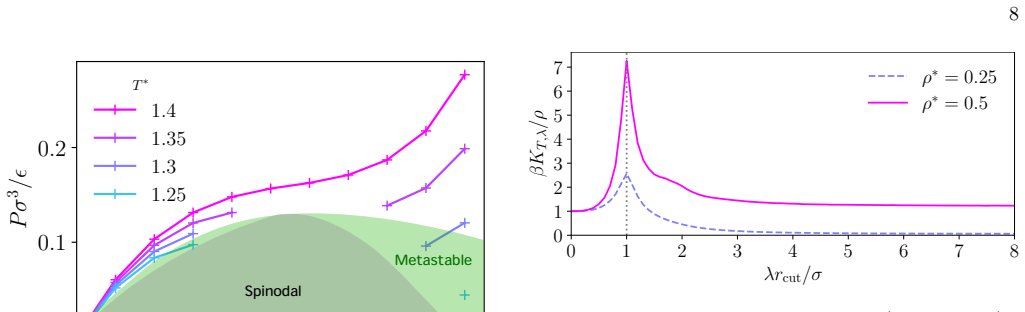
- [§III B; Fig. 4; §IV] The conclusion states that the method 'successfully captur[es] the presence of both the critical point and the first-order phase transition,' but the evidence in Fig. 4 is a pressure curve with a decreasing branch in a region labeled metastable. No Maxwell construction, no coexistence calculation, no quantitative spinodal criterion, and no MD benchmark near T_c is provided. The pressure softening is suggestive, but the conclusion overstates what can be inferred from the present data. Please either add a quantitative criterion for the spinodal/metastable boundaries and a comparison with known coexistence data, or soften the claim to 'the pressure develops an inflection/softening consistent with the presence of a critical point.'
minor comments (6)
- [Appendix A] The sentence 'With rcut = 8σ, these quantities are seen to converge at λ=1' is unclear: Fig. 7 appears to show results for rcut=5σ. Please clarify whether this is a convergence check with respect to rcut and show the corresponding curves if not already shown.
- [Fig. 4] The shaded regions labeled 'spinodal' and 'metastable' are described only as 'suggested by the results.' Please define the exact criterion used to assign these regions (e.g., where dP/dρ<0, or where the flow becomes numerically unstable).
- [Eq. (29) and surrounding text] The sentence explaining how F_ex/N and ψ_ex are obtained from the virial and compressibility routes is grammatically tangled ('are obtained from the resulting P using Eq. (29) and the relation Eq. (30)'). Please rewrite for clarity.
- [Appendix A] There is a typo: 'confirme the convergence' should be 'confirm the convergence.'
- [References] References [17] and [49] appear to have incomplete bibliographic information (missing journal volume/year or article number). Please complete them.
- [Appendix B 1] The MD simulation description does not mention tail corrections or equilibration time; adding this would help assess the numerical MD benchmark.
Circularity Check
No substantive circularity: the FRG derivation is self-contained and benchmarked against external MD and integral-equation results.
full rationale
The paper's derivation chain is not circular. The flow equations are inherited from the authors' previous paper [31], but that earlier work is an independent, published derivation, and the present paper restates the hierarchy (Eqs. (9)-(11)) rather than using it as a black-box conclusion. The genuinely new content here—the Legendre-expansion integration scheme and the range-cutoff flow v_lambda(r)=v(r)theta(lambda*r_cut-r)—is introduced in this paper, not merely cited. The central benchmarks (pressure, excess free energy, excess chemical potential, and g(r)) are computed with no parameters fitted to MD or to the integral-equation results; MD and HNC/PY/KH are external references. The three pressure routes are independent exact relations applied to the approximate KSA-truncated flow solution: the 'flow' route integrates the lambda-derivative equations, the virial route uses the pressure equation with g(r), and the compressibility route integrates the bulk modulus from g(r). Agreement among these routes is therefore a nontrivial numerical finding rather than a relation forced by definition. The paper itself flags the key limitations: KSA is guaranteed only at low density (Sec. II B), the truncation makes results depend on the chosen lambda-evolution (Sec. II C 2), and numerical breakdown occurs for rho*>0.5 and near the spinodal (Sec. III C). These are accuracy/robustness concerns, not circular reductions. The abstract's claim of accuracy comparable to the Rogers-Young closure is not supported by an actual RY calculation in the paper, but that is a missing benchmark, not a definitional equivalence. No fitted input is renamed as a prediction, and no self-citation is used to forbid alternative approaches.
Assumptions & free parameters
free parameters (2)
- r_cut =
5σ (also tested 8σ)
- Lmax =
10
assumptions (4)
- domain assumption Exact FRG flow equation for Fλ[ρ] (Eq. 4) and the resulting hierarchy (Eqs. 9-11) as derived in Ref [31].
- domain assumption Kirkwood superposition approximation (Eq. 14) closes the hierarchy at second order.
- ad hoc to paper The interaction-range flow vλ(r)=v(r)θ(λr_cut−r) (Eq. 20) does not materially change physical results under the KSA truncation.
- domain assumption The LJ interaction can be truncated at r_cut=5σ with negligible error.
Cite this review
Pith. "Pith review of Functional renormalization group for classical liquids without recourse to hard-core reference systems: A study of three-dimensional Lennard-Jones liquids." pith.science (2026). https://pith.science/paper/F5XDV4ZA
@misc{pith2026251016710,
  author       = {Pith},
  title        = {Pith review of: Functional renormalization group for classical liquids without recourse to hard-core reference systems: A study of three-dimensional Lennard-Jones liquids},
  year         = {2026},
  howpublished = {\url{https://pith.science/paper/F5XDV4ZA}},
  note         = {Machine review of arXiv:2510.16710}
}
read the original abstract
In our previous work [Phys. Rev. E 104, 014124 (2021)], we developed a method for analyzing classical liquids using the functional renormalization group (FRG) without relying on a hard-core reference system. In this paper, we extend this method to three-dimensional liquids. We describe an efficient approach for performing the spatial integrals that appear in the renormalization group equations, which is essential for realizing numerical calculations in three dimensions. As a demonstration, we present its application to the Lennard-Jones liquids. Through calculations of thermodynamic quantities, we find that FRG preserves thermodynamic consistency (TC) better than traditional integral-equation methods such as the hypernetted-chain, Percus-Yevick, and Kovalenko-Hirata closures. Taking the molecular dynamics results as a benchmark, we also show that FRG can achieve an accuracy comparable to that of integral-equation methods that incorporate TC, such as the Rogers-Young closure. We further assess the accuracy of the pair distribution function and examine whether our method remains applicable below the critical temperature. Our results demonstrate that FRG provides a new method for describing classical liquids with accuracy comparable to modern liquid theories.
Figures


Figures from the paper (1 more)

Reference graph
Works this paper leans on
-
[53]
J. F. Rentrop, S. G. Jakobs, and V. Meden, Two-particle irreducible functional renormalization group schemes—a comparative study,48, 145002 (2015)
2015
-
[1]
Here, a flow parameterλ∈[0,1]is introduced into the two-body interaction
Functional flow equation We consider a classical particle system interacting via a two-body potentialv λ(r−r ′), wherer−r ′ is the distance between two particles, under an external field U(r). Here, a flow parameterλ∈[0,1]is introduced into the two-body interaction. We study the evolution equa- tion with respect toλ, assuming thatv λ(r−r ′)interpo- lates ...
-
[2]
,rn)= ρ(n) λ (r1,
Hierarchical equations for cavity distribution functions To define the cavity distribution functions, we first in- troduce then-particle distribution function: g(n) λ (r1, . . . ,rn)= ρ(n) λ (r1, . . . ,rn) ρ(r1)⋯ρ(rn) ,(6) where then-particle densityρ (n) λ (r1, . . . ,rn)is given by the following functional derivative expression: ρ(n) λ (r1, . . . ,rn)=...
-
[3]
(15) and (16) contain double spatial integrals of the following form: I(r 1)= ∫ dr2 ∫ dr3F1(r1,r 2)F2(r2,r 3)F3(r3,r 1)
Legendre expansion Eqs. (15) and (16) contain double spatial integrals of the following form: I(r 1)= ∫ dr2 ∫ dr3F1(r1,r 2)F2(r2,r 3)F3(r3,r 1). (17) Here,F i(r,r′)(i=1,2,3) is assumed to depend only onr=∣r∣,r ′ =∣r ′∣, and cosθ= r⋅r ′ rr′ ; that is,F i(r,r′)= Fi(r, r′,cosθ). Reducing the computational cost of this integral is crucial for the feasibility ...
-
[4]
Choice of the evolution of interaction Depending on the choice ofvλ(r), the dimensionality of the integrals can be further reduced. Here, we consider a flow in terms of the interaction range, defined as follows: vλ(r)= v(r)θ(λr cut −r).(20) Here, we assume that the interaction is short-ranged, and that there exists a cutoffr cut beyond which the interac- ...
-
[5]
ForT ∗ >T ∗ c , where calculations can be stably per- formed over a wide range ofρ ∗, we compare our results with those of MD and the integral equation methods to assess the accuracy and the thermody- namic consistency of our approach
-
[6]
Details of the numerical setup for FRG are presented in Appendix A, while the MD and integral equation calcu- lations are described in Appendix B
NearT=T ∗ c , we examine whether our method is capable of capturing the phase transition. Details of the numerical setup for FRG are presented in Appendix A, while the MD and integral equation calcu- lations are described in Appendix B. A. Results forT ∗ >T ∗ c Here, we present the results for thermodynamic quan- tities and the pair distribution function ...
-
[7]
(22) and (23)
Calculation using Eqs. (22) and (23)
Show all 69 references
-
[8]
(Virial route) Calculation based on the pair distri- bution functiong (2)(r)=g (2) 1 (r)through the pres- sure equation βP=ρ− 2πρ2 3 ∫ ∞ 0 dr r3 dv(r) dr g(2)(r).(27)
-
[9]
(Compressibility route) Calculation based on g(2)(r)through the density integral of the bulk modulus (inverse compressibility), βP= ∫ ρ 0 dρ′ βKT,1∣ρ=ρ′ ρ′ ,(28) together with Eq. (12). In the first method,Pis determined from the obtained F ex /Nand ψ ex using βP=ρ(1+ ψex − F ...
-
[10]
We simulate 256 argon atoms in a cubic box with periodic boundary conditions, choosing the box length to reproduce the target density
Molecular dynamics For the MD simulations, we use the PIMD package [55]. We simulate 256 argon atoms in a cubic box with periodic boundary conditions, choosing the box length to reproduce the target density. The time evolution is carried out up to 0.25 ns with a time step of 0...
-
[11]
In the integral equation method, an approxi- mate relation, called a closure, is introduced to solve the Ornstein–Zernike equation
Integral equation method The integral equation method is based on the following Ornstein-Zernike equation [3]: ˜c(∣k∣)= ˜h(∣k∣) 1+ρ ˜h(∣k∣) ,(B1) where ˜c(∣k∣)and˜h(∣k∣)are the three-dimensional Fourier transforms of the direct correlation functionc(∣r∣)and the total correlati...
-
[12]
Hypernetted chain (HNC) [5, 6]: g(2)(r)≈e −v(r)+h(r)−c(r)
-
[13]
Percus-Yevick equation (PY) [4]: g(2)(r)≈e −v(r) (1+h(r)−c(r))
-
[14]
In the numerical calculations, we used a grid of 6851 points forrover the range 0≤r≤50σ
Kovalenko-Hirata closure (KH) [52]: g(2)(r)≈e d(r)θ(−d(r))+(1+d(r))θ(d(r)), withd(r)=− v(r)+h(r)−c(r). In the numerical calculations, we used a grid of 6851 points forrover the range 0≤r≤50σ. The solutions were obtained using an iterative method
-
[15]
Hansen and I
J. Hansen and I. McDonald,Theory of Simple Liquids: with Applications to Soft Matter(Elsevier Science, 2013)
2013
-
[16]
Nishihara and M
S. Nishihara and M. Otani, Hybrid solvation models for bulk, interface, and membrane: Reference interaction site methods coupled with density functional theory, Phys. Rev. B96, 115429 (2017)
2017
-
[17]
Ornstein and F
L. Ornstein and F. Zernike, Accidental deviations of den- sity and opalescence at the critical point of a single sub- stance, Koninklijke Nederlandse Akademie van Weten- schappen Proceedings Series B Physical Sciences17, 793 (1914)
1914
-
[18]
J. K. Percus and G. J. Yevick, Analysis of classical statis- tical mechanics by means of collective coordinates, Phys. Rev.110, 1 (1958)
1958
-
[19]
Morita and K
T. Morita and K. Hiroike, A new approach to the theory of classical fluids. I, Progress of Theoretical Physics23, 1003 (1960)
1960
-
[20]
R. J. Baxter, Ornstein-Zernike relation for a disordered fluid, Australian Journal of Physics21, 563 (1968)
1968
-
[21]
Rosenfeld and N
Y. Rosenfeld and N. W. Ashcroft, Theory of simple clas- sical fluids: Universality in the short-range structure, Phys. Rev. A20, 1208 (1979)
1979
-
[22]
F. J. Rogers and D. A. Young, New, thermodynamically consistent, integral equation for simple fluids, Phys. Rev. A30, 999 (1984)
1984
-
[23]
Ebner, W
C. Ebner, W. F. Saam, and D. Stroud, Density-functional theory of simple classical fluids. i. surfaces, Phys. Rev. A 14, 2264 (1976)
1976
-
[24]
A. J. M. Yang, P. D. Fleming, and J. H. Gibbs, Molecular theory of surface tension, J. Chem. Phys.64, 3732 (1976)
1976
-
[25]
W. F. Saam and C. Ebner, Density-functional theory of classical systems, Phys. Rev. A15, 2566 (1977)
1977
-
[26]
Evans, The nature of the liquid-vapour interface and other topics in the statistical mechanics of non-uniform, classical fluids, Advances in Physics28, 143 (1979)
R. Evans, The nature of the liquid-vapour interface and other topics in the statistical mechanics of non-uniform, classical fluids, Advances in Physics28, 143 (1979)
1979
-
[27]
Rosenfeld, Free-energy model for the inhomogeneous 11 hard-sphere fluid mixture and density-functional theory of freezing, Phys
Y. Rosenfeld, Free-energy model for the inhomogeneous 11 hard-sphere fluid mixture and density-functional theory of freezing, Phys. Rev. Lett.63, 980 (1989)
1989
-
[28]
Rosenfeld, D
Y. Rosenfeld, D. Levesque, and J. Weis, Free-energy model for the inhomogeneous hard-sphere fluid mixture: Triplet and higher-order direct correlation functions in dense fluids,92, 6818
-
[29]
closure” relation between generating functionals for “direct
Y. Rosenfeld, Free-energy model for the inhomogeneous hard-sphere fluid: “closure” relation between generating functionals for “direct” and “cavity” distribution func- tions,93, 4305
-
[30]
Rosenfeld, Free-energy model for the inhomogeneous hard-sphere fluid in d dimensions: Structure factors for the hard-disk (d=2) mixtures in simple explicit form, Phys
Y. Rosenfeld, Free-energy model for the inhomogeneous hard-sphere fluid in d dimensions: Structure factors for the hard-disk (d=2) mixtures in simple explicit form, Phys. Rev. A42, 5978 (1990)
1990
-
[31]
Tang and J
Y. Tang and J. Wu, A density-functional theory for bulk and inhomogeneous lennard-jones fluids from the energy route,119, 7388
-
[32]
Parola and L
A. Parola and L. Reatto, Hierarchical reference theory of fluids and the critical point, Phys. Rev. A31, 3309 (1985)
1985
-
[33]
L. W. Salvino and J. A. White, Calculation of density fluctuation contributions to thermodynamic properties of simple fluids, The Journal of Chemical Physics96, 4559 (1992)
1992
-
[34]
Parola, D
A. Parola, D. Pini, and L. Reatto, First-order phase tran- sitions, the maxwell construction, and the momentum- space renormalization group, Phys. Rev. E48, 3321 (1993)
1993
-
[35]
J. A. White and S. Zhang, Renormalization group the- ory for fluids, The Journal of Chemical Physics99, 2012 (1993)
2012
-
[36]
Parola and L
A. Parola and L. Reatto, Liquid state theories and critical phenomena, Advances in Physics44, 211 (1995)
1995
-
[37]
J. A. White and S. Zhang, Renormalization theory of nonuniversal thermal properties of fluids, The Journal of Chemical Physics103, 1922 (1995)
1922
-
[38]
Caillol, Non-perturbative renormalization group for simple fluids, Molecular Physics104, 1931 (2006)
J.-M. Caillol, Non-perturbative renormalization group for simple fluids, Molecular Physics104, 1931 (2006)
1931
-
[39]
Parola, D
A. Parola, D. Pini, and L. Reatto, Liquid-vapor tran- sition from a microscopic theory: Beyond the maxwell construction, Phys. Rev. Lett.100, 165704 (2008)
2008
-
[40]
Parola, D
A. Parola, D. Pini, and L. Reatto, The smooth cut-off hierarchical reference theory of fluids, Molecular Physics 107, 503 (2009)
2009
-
[41]
J.-M. Caillol, Link between the hierarchical reference the- ory of liquids and a new version of the non-perturbative renormalization group in statistical field theory, Molecu- lar Physics109, 2813 (2011)
2011
-
[42]
Parola and L
A. Parola and L. Reatto, Recent developments of the hierarchical reference theory of fluids and its relation to the renormalization group, Molecular Physics110, 2859 (2012)
2012
-
[43]
Lue, Application of the functional renormalization group method to classical free energy models, AIChE Journal61, 2985
L. Lue, Application of the functional renormalization group method to classical free energy models, AIChE Journal61, 2985
-
[44]
Iso and K
S. Iso and K. Kawana, Density Renormalization Group for Classical Liquids, Prog. Theor. Exp. Phys.2019, 013A01 (2019), arXiv:1808.08133 [cond-mat.stat-mech]
2019 arXiv
-
[45]
Yokota, J
T. Yokota, J. Haruyama, and O. Sugino, Functional- renormalization-group approach to classical liquids with short-range repulsion: A scheme without repulsive refer- ence system, Phys. Rev. E104, 014124 (2021)
2021
-
[46]
F. J. Wegner and A. Houghton, Renormalization Group Equation for Critical Phenomena, Phys. Rev. A8, 401 (1973)
1973
-
[47]
K. G. Wilson and J. Kogut, The renormalization group and theϵexpansion, Phys. Rep.12, 75 (1974)
1974
-
[48]
Polchinski, Renormalization and effective lagrangians, Nucl
J. Polchinski, Renormalization and effective lagrangians, Nucl. Phys. B231, 269 (1984)
1984
-
[49]
Wetterich, Exact evolution equation for the effective potential, Phys
C. Wetterich, Exact evolution equation for the effective potential, Phys. Lett. B301, 90 (1993)
1993
-
[50]
Polonyi and K
J. Polonyi and K. Sailer, Effective actions and the density functional theory, Phys. Rev. B66, 155113 (2002)
2002
-
[51]
Schwenk and J
A. Schwenk and J. Polonyi, Towards density functional calculations from nuclear forces, in32nd International Workshop on Gross Properties of Nuclei and Nuclear Ex- citation: Probing Nuclei and Nucleons with Electrons and Photons (Hirschegg 2004) Hirschegg, Austria, January 11-...
2004 arXiv
-
[52]
Kemler and J
S. Kemler and J. Braun, Towards a renormalization group approach to density functional theory–general for- malism and case studies, J. Phys. G40, 085105 (2013)
2013
-
[54]
Kemler, M
S. Kemler, M. Pospiech, and J. Braun, Formation of selfbound states in a one-dimensional nuclear model— a renormalization group based density functional study, J. Phys. G44, 015101 (2017)
2017
-
[55]
Liang, Y
H. Liang, Y. Niu, and T. Hatsuda, Functional renormal- ization group and Kohn-Sham scheme in density func- tional theory, Phys. Lett. B779, 436 (2018)
2018
-
[56]
Yokota, K
T. Yokota, K. Yoshida, and T. Kunihiro, Functional renormalization-group calculation of the equation of state of one-dimensional uniform matter inspired by the Hohenberg-Kohn theorem, Phys. Rev. C99, 024302 (2019)
2019
-
[57]
Yokota, K
T. Yokota, K. Yoshida, and T. Kunihiro,Ab initio description of excited states of 1D uniform matter with the Hohenberg–Kohn-theorem-inspired functional- renormalization-group method, Prog. Theor. Exp. Phys. 2019, 011D01 (2019)
2019
-
[58]
Yokota and T
T. Yokota and T. Naito, Functional-renormalization- group aided density functional analysis for the correlation energy of the two-dimensional homogeneous electron gas, Phys. Rev. B99, 115106 (2019)
2019
-
[59]
Yokota, H
T. Yokota, H. Kasuya, K. Yoshida, and T. Kunihiro, Microscopic derivation of density functional theory for superfluid systems based on effective action formalism, Prog. Theor. Exp. Phys.2021, 013A03 (2020)
2021
-
[60]
Yokota and T
T. Yokota and T. Naito, Ab initio construction of the energy density functional for electron systems with the functional-renormalization-group-aided density func- tional theory, Phys. Rev. Research3, L012015 (2021)
2021
-
[61]
Yokota and T
T. Yokota and T. Naito, Construction of energy density functional for arbitrary spin polarization using functional renormalization group, Phys. Rev. B105, 035105 (2022)
2022
-
[62]
J. G. Kirkwood, Statistical mechanics of fluid mixtures, The Journal of Chemical Physics3, 300 (1935)
1935
-
[63]
J. A. Barker and J. J. Monaghan, Fourth virial coeffi- cients for the 12–6 potential,36, 2564
-
[64]
Dupuis, L
N. Dupuis, L. Canet, A. Eichhorn, W. Metzner, J. Pawlowski, M. Tissier, and N. Wschebor, The nonper- turbative functional renormalization group and its appli- cations, Physics Reports910, 1 (2021)
2021
-
[65]
V. D. GROUBA, A. V. ZORIN, and L. A. SEV AS- TIANOV, The superposition approximation: A critical review, International Journal of Modern Physics B18, 1 12 (2004)
2004
-
[66]
Kovalenko and F
A. Kovalenko and F. Hirata, Self-consistent description of a metal–water interface by the kohn–sham density func- tional theory and t he three-dimensional reference inter- action site model, The Journal of Chemical Physics110, 10095 (1999)
1999
-
[67]
Abe, On the kirkwood superposition approximation, Progress of Theoretical Physics21, 421 (1959)
R. Abe, On the kirkwood superposition approximation, Progress of Theoretical Physics21, 421 (1959)
1959
-
[68]
Galassi, J
M. Galassi, J. Davies, J. Theiler, B. Gough, and G. Jung- man,GNU Scientific Library - Reference Manual, Third Edition, for GSL Version 1.12 (3. ed.).(2009)
2009
-
[69]
Shiga, PIMD version 2.7.0 (2025)
M. Shiga, PIMD version 2.7.0 (2025)
2025
Reviewed August 4, 2026 · model on record in the stance chip above.
Discussion (0). Continue with ORCID to comment.