REVIEW 3 major objections 4 minor 1 cited by
N\'eel-Vector-Orientation Induced Direction-Robust Spin Filtering in Two-Dimensional Altermagnets
T0 review · 3 major / 4 minor · reviewed 2026-08-04 · deepseek-v4-flash
Pith's one-line read The paper claims that reorienting the Néel vector in the compensated two-dimensional altermagnet Ta2TeSeO converts it into an intrinsic antiferromagnetic half-metal—one spin channel metallic, the other gapped—at zero net magnetization.
desk verdict A clear symmetry argument for a possible AFM half-metal, but the version mismatch and missing quantitative DFT results keep it from being checkable as submitted. read the letter →
The pith
A machine-rendered reading of the paper's core claim, the machinery that carries it, and where it could break.
The reading
What carries the argument
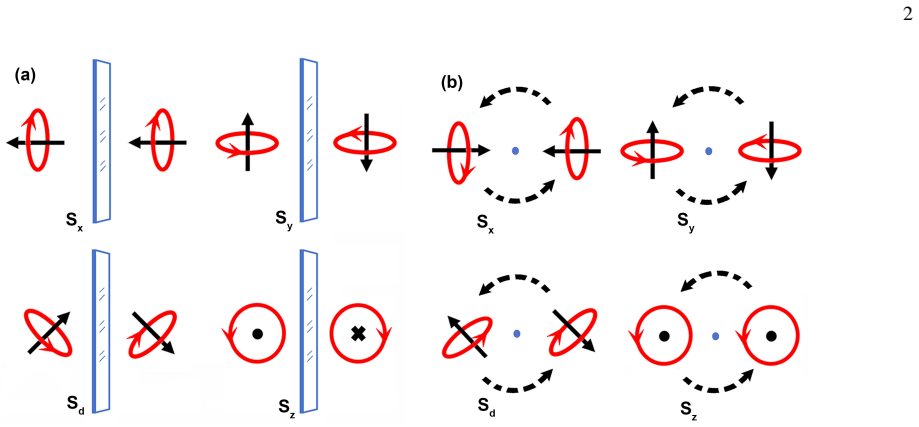
The central mechanism is Néel-vector-oriented magnetic space-group reduction. Because a magnetic moment is an axial vector, a mirror reflection Mx acts as (Sx, Sy, Sz) → (Sx, −Sy, −Sz): fixing the Néel vector along x preserves Mx as a unitary symmetry but makes My magnetic (MyT), and forces C2z to pair with time reversal, leaving only C2zT. This determines whether the k·p mass term m σy, odd under the surviving mirror, is symmetry-forbidden in one spin sector (keeping it gapless) or symmetry-allowed in the other (gapping it), while the loss of unitary C2z permits independent energy shifts δ1 and δ3 of the two remaining Weyl cones, driving the semimetal-to-half-metal transition.
What would settle it
A spin-resolved DFT band-structure calculation of Ta2TeSeO with the Néel vector along x that finds Fermi-level crossings in both spin channels, or finds both surviving Weyl cones on the same side of the Fermi level, would falsify the half-metallic claim; likewise, a computed in-plane easy-axis anisotropy large enough to prevent Néel reorientation below reasonable fields would remove the switching premise.
Extended reading notes
Core claim
Fixing the Néel vector along x (or y) converts Ta2TeSeO from a compensated altermagnetic Weyl semimetal into an intrinsic antiferromagnetic half-metal. The unitary mirror Mx survives and protects the Weyl crossings in one spin sector, while the orthogonal mirror becomes a magnetic mirror, allowing a spin-orbit-induced mass term to open a gap only in the opposite sector. Simultaneously, breaking the unitary C2z symmetry, leaving only the antiunitary C2zT, lifts the energy equivalence of the two surviving mirror-pinned Weyl cones, so one cone moves above the Fermi level and the other below it. The result is a single-spin Fermi surface at zero net magnetization, a state the paper calls an intri
Load-bearing premise
The whole result rests on the DFT prediction that Ta2TeSeO is a compensated altermagnet with spin-polarized Weyl cones sitting right at the Fermi level and almost equal in-plane easy axes; if the cones are not at the Fermi level, or the symmetry-lowering shifts do not push one cone above and one below it, the half-metal is not realized.
Editorial extensions
If this is right
- With the Néel vector along x, the spin-up channel is metallic and the spin-down channel is gapped; along y, the same half-metallic state appears with the spin polarization reversed.
- With the Néel vector along z, both spin sectors acquire equal gaps, giving a compensated insulating state; along the in-plane diagonal, both sectors host energy-inequivalent gapped cones.
- The longitudinal conductivity polarization remains positive for every in-plane current direction at charge neutrality and 20 K, ranging from 76.4% to 82.0%, demonstrating direction-robust spin filtering without a conventional spin-selective band gap.
- Because the in-plane magnetic anisotropy is nearly degenerate, minute strain, weak magnetic fields, or, the paper suggests, circularly polarized light can reversibly switch the conducting spin channel without generating a net moment.
- The mechanism yields concrete design criteria—mirror-protected altermagnetic Weyl cones near the Fermi energy, absence of horizontal mirror symmetry, and a Néel direction that lowers the magnetic space-group symmetry—and is predicted to extend to other two-dimensional decorated Lieb altermagnets such as V2SeSO and Nb2SeTeO.
Reading between the lines
- A testable extension: because the mechanism only requires a mirror-pinned spin-polarized Weyl pair near the Fermi level and no horizontal mirror, a high-throughput first-principles search over Janus-type Lieb-lattice altermagnets should find additional platforms beyond Ta2TeSeO.
- The half-metallic state here is gapless in the conducting channel, so spin-polarized scanning tunneling spectroscopy or angle-resolved photoemission would be a cleaner direct test of the single-spin Fermi surface than bulk conductivity, which sees the 76–82% polarization.
- The residual antiunitary C2zT symmetry protects the gaplessness of the conducting channel; perturbations that preserve it should leave the half-metallic state intact, while perturbations that break it would open a gap in the conducting sector, providing a robustness criterion for device design.
- The near-degeneracy of the in-plane easy axes suggests a two-state spin selector controlled by an order parameter with no stray field; engineering this degeneracy with strain could make the switching low-power and fast, relevant for antiferromagnetic spintronic memory concepts.
Editorial analysis
A structured set of objections, weighed in public.
Referee Report
Summary. This manuscript claims that monolayer Ta2TeSeO is a compensated altermagnetic Weyl semimetal whose magnetic space group can be reduced by rotating the Néel vector, converting it into an intrinsic AFM half-metal. The symmetry argument (Eqs. 1–4) is: for n∥x/y one unitary mirror survives, protecting single-spin Weyl cones; the orthogonal mirror becomes magnetic, permitting an SOC-induced mass term in the opposite spin sector; breaking unitary C2z (leaving only C2zT) allows the two surviving cones in the protected sector to shift relative in energy (Eq. 5, δ1≠δ3), giving one spin channel a Fermi surface. The abstract additionally reports 76.4–82.0% conductivity polarization at 20 K from semiclassical transport, while the full text presents the central result as an intrinsic AFM half-metal with a single-spin Fermi surface.
Significance. The symmetry mechanism is clean, parameter-free, and potentially general: it identifies a concrete set of design criteria (Weyl cones near EF, no horizontal mirror Mz, switchable in-plane Néel vector). If the quantitative half-metallic state is actually realized, this would be a notable conceptual advance in antiferromagnetic spintronics. The k·p treatment of the forbidden mσy mass under a unitary mirror is standard and internally coherent. The manuscript explicitly uses DFT for material parameters and provides no free parameters fitted to the target result; these are strengths. However, the decisive numerical support for the central half-metal claim is absent, so the significance is conditional on data the manuscript does not currently contain.
major comments (3)
- [Eq. (5), Fig. 3(b)] The central claim—half-metallicity for n∥x—rests on δ1≠δ3 straddling EF and on the opposite spin sector being fully gapped. The manuscript provides no SOC band-structure plot with an energy axis, no numerical values for δ1 and δ3, no gap magnitude for the gapped sector, and no spin-resolved Fermi surface or DOS. The phrase 'by small symmetry-compatible tuning (strain, gating)' indicates the effect may require additional tuning, but the nominal zero-strain state is not quantified. Without these numbers the half-metal claim cannot be checked from the manuscript as written.
- [Abstract vs full text] The abstract reports quantitative transport (76.4–82.0% at 20 K, full-Brillouin-zone Wannier interpolation, semiclassical transport) but the full text contains no transport calculation, no conductivity-polarization formula, and no current-direction analysis. The full text instead emphasizes an 'intrinsic AFM half-metal' with a 'single-spin Fermi surface,' whereas the abstract describes a 'gapless, direction-robust spin-filtering mechanism that requires neither a spin-selective band gap nor a large velocity contrast.' These are different central claims. The manuscript must be made internally consistent and must either present the transport calculation or remove/adjust the quantitative abstract claim.
- [Fermi-level position and Weyl-node energies] The mechanism requires symmetry-protected Weyl cones near EF in the SOC-free limit, and then a spin-selective gapping and energy shifting. The text states that theory predicts spin-polarized Weyl nodes pinned near the Fermi level and gives the Ta moment (~0.73 μB), but no SOC-free or SOC band-structure coordinates, node energies, or δ1, δ3 values are provided. If the nodes are not at EF, or if δ1 and δ3 do not straddle EF, the half-metallic state is not realized. Please provide the quantitative band structure and, ideally, the carrier density or DOS at EF for both spin channels.
minor comments (4)
- [Title] The title contains a typo: 'Néel-V ector' should be 'Néel-Vector'.
- [Fig. 3] Fig. 3 is captioned as spin-projected band structures for different Néel-vector orientations, but no energy axis, node energies, or gap sizes are given. Adding these would also address the major quantitative concerns.
- [Notation] The direction 'd≡(110)' should be written as [110] (or {110} when referring to a family). Also, the text alternates between 'C2z' and 'C2zT' without a compact magnetic-space-group notation; a table of the surviving symmetry generators for each n would improve clarity.
- [Eq. (4)] In Eq. (4), the proportionality m(n)∝λ|n⊥| is claimed but not derived in detail. A brief derivation or a sentence clarifying that n⊥ is the component of n perpendicular to the mirror plane would help the reader.
Circularity Check
No material circularity: the symmetry reduction is parameter-free and the half-metal conclusion is not forced by a fit; self-citations are background and not load-bearing.
full rationale
The paper's derivation chain is a symmetry analysis (Eqs. 1-5) applied to a DFT-derived altermagnetic Weyl semimetal. The mass amplitude m(n) ∝ λ|n⊥| and the scalar shifts δ1,δ3 are symmetry-allowed terms, not fitted to the target half-metallic state. Breaking unitary C2z permits δ1≠δ3 but does not, by itself, force one cone above and one below EF; the claimed half-metallicity therefore depends on unshown numerical DFT values (SOC band gap, δ1,δ3, Fermi-surface cross-section). That omission is an evidence gap, not a circular reduction. The manuscript also cites the authors' own prior works (refs. [16] and [19]), but only to contextualize spin-space-group symmetry and Lieb-lattice altermagnets; these citations do not carry the central half-metal argument. The abstract's 'gapless spin filtering' and the full text's 'half-metallicity' are mutually inconsistent characterizations, but inconsistency is not circularity. No self-definitional step, fitted-input-as-prediction, or uniqueness-imported-from-authors pattern is present.
Assumptions & free parameters
assumptions (4)
- standard math Axial-vector transformation rules for magnetic moments under mirror and rotation (Eq. 1, 2).
- domain assumption Ta2TeSeO is a compensated altermagnet with mirror-pinned Weyl cones near EF and with Mz absent.
- domain assumption Once a unitary mirror is lost, the SOC mass term mσy is symmetry-allowed; antiunitary mirrors do not protect crossings.
- domain assumption The in-plane magnetic anisotropy is nearly degenerate so the Néel vector can be reoriented with small fields or strain.
Cite this review
Pith. "Pith review of N\'eel-Vector-Orientation Induced Direction-Robust Spin Filtering in Two-Dimensional Altermagnets." pith.science (2026). https://pith.science/paper/WX7QUX72
@misc{pith2026251017522,
  author       = {Pith},
  title        = {Pith review of: N\'eel-Vector-Orientation Induced Direction-Robust Spin Filtering in Two-Dimensional Altermagnets},
  year         = {2026},
  howpublished = {\url{https://pith.science/paper/WX7QUX72}},
  note         = {Machine review of arXiv:2510.17522}
}
abstract
Whether an antiferromagnet can host direction-robust spin-polarized transport without a conventional spin-selective band gap remains a central challenge in antiferromagnetic spintronics. Here we establish a gapless, direction-robust spin-filtering mechanism in a compensated two-dimensional altermagnetic Weyl semimetal that requires neither a spin-selective band gap nor a large velocity contrast between spin projections. Using Janus monolayer Ta$_2$TeSeO as a realistic platform, we combine symmetry analysis with first-principles calculations, full-Brillouin-zone Wannier interpolation, and semiclassical transport. Rotating the N\'eel vector removes a unitary-mirror constraint and shifts one Weyl-cone pair away from its parent high-symmetry line. For an in-plane N\'eel vector, the residual $C_{2z}\mathcal T$ symmetry forbids the independent $\sigma_y$ mass that would open a local gap, allowing the reconstructed cones to shift in momentum while remaining gapless. Breaking unitary $C_{2z}$ simultaneously lifts the energy equivalence of the remaining mirror-pinned Weyl cones. The resulting coexistence of a metallic spin-projected manifold and a low-DOS Weyl-derived manifold produces a predominantly DOS-driven conductance imbalance. At charge neutrality and 20~K, the longitudinal conductivity polarization for $\mathbf n\parallel x$ remains positive for every in-plane current direction and ranges from $76.4\%$ to $82.0\%$. The degenerate in-plane magnetic anisotropy facilitates reversible switching between symmetry-related spin-filtering states using strain or weak anisotropic fields. This N\'eel-vector-driven symmetry mechanism provides a general route to direction-robust gapless spin filtering in compensated altermagnets.
Figures


Forward citations
Cited by 1 Pith paper
-
Spin-Locked Helical Currents and Charge-Neutral Spin-Channel Pumping in Altermagnetic Nanotubes
Altermagnetic nanotubes convert momentum-odd spin polarization into spin-locked helical currents and Faraday-pumped pure spin currents without spin-orbit coupling.
Reference graph
Works this paper leans on
-
[1]
Z. Xiao, J. Zhao, Y . Li, R. Shindou, and Z.-D. Song, Spin space groups: Full classification and applications, Phys. Rev. X14, 031037 (2024)
2024
- [2]
-
[3]
H.-J. Duan, M.-S. Fang, M.-X. Deng, and R. Wang, Néel vector and rashba soc effects on rkky interaction in 2dd-wave alter- magnets (2025), arXiv:2509.26285 [cond-mat.mes-hall]
arXiv 2025
-
[4]
L. Zhiheng, M. Dengpan, C. Jiangtao, X. Yan, and L. Zhifeng, Spin-axis dynamic locking (2025), arXiv:2509.18476 [cond- mat.other]
arXiv 2025
-
[5]
and Bourée, F., Symmetry and magnetic structures, EPJ Web of Conferences22, 00010 (2012)
Rodríguez-Carvajal, J. and Bourée, F., Symmetry and magnetic structures, EPJ Web of Conferences22, 00010 (2012)
2012
-
[6]
van Leuken and R
H. van Leuken and R. A. de Groot, Half-metallic antiferromag- nets, Phys. Rev. Lett.74, 1171 (1995)
1995
-
[7]
Šmejkal, J
L. Šmejkal, J. Sinova, and T. Jungwirth, Emerging research landscape of altermagnetism, Phys. Rev. X12, 040501 (2022)
2022
-
[8]
Šmejkal, J
L. Šmejkal, J. Sinova, and T. Jungwirth, Beyond conventional ferromagnetism and antiferromagnetism: A phase with nonrel- ativistic spin and crystal rotation symmetry, Phys. Rev. X12, 031042 (2022)
2022
Show all 40 references
-
[9]
L.-D. Yuan, Z. Wang, J.-W. Luo, E. I. Rashba, and A. Zunger, Giant momentum-dependent spin splitting in centrosymmetric low-zantiferromagnets, Phys. Rev. B102, 014422 (2020)
2020
-
[10]
Šmejkal, R
L. Šmejkal, R. González-Hernández, T. Jungwirth, and J. Sinova, Crystal time-reversal symmetry breaking and spon- taneous hall effect in collinear antiferromagnets, Sci. Adv.6, eaaz8809 (2020)
2020
-
[11]
V . Leeb, A. Mook, L. Šmejkal, and J. Knolle, Spontaneous formation of altermagnetism from orbital ordering, Phys. Rev. Lett.132, 236701 (2024)
2024
-
[12]
Šmejkal, A
L. Šmejkal, A. B. Hellenes, R. González-Hernández, J. Sinova, and T. Jungwirth, Giant and tunneling magnetoresistance in unconventional collinear antiferromagnets with nonrelativistic spin-momentum coupling, Phys. Rev. X12, 011028 (2022)
2022
-
[13]
H. Bai, L. Han, X. Y . Feng, Y . J. Zhou, R. X. Su, Q. Wang, L. Y . Liao, W. X. Zhu, X. Z. Chen, F. Pan, X. L. Fan, and C. Song, Observation of spin splitting torque in a collinear antiferromag- net ruo2, Phys. Rev. Lett.128, 197202 (2022)
2022
-
[14]
Jungwirth, R
T. Jungwirth, R. M. Fernandes, E. Fradkin, A. H. Mac- Donald, J. Sinova, and L. Šmejkal, Altermagnetism: An unconventional spin-ordered phase of matter, Newton1, 10.1016/j.newton.2025.100162 (2025), published: 2025-08-04, Accessed: 2025-10-07
2025
-
[15]
Y .-P. Zhu, X. Chen, X.-R. Liu, Y . Liu, P. Liu, H. Zha, G. Qu, C. Hong, J. Li, Z. Jiang, X.-M. Ma, Y .-J. Hao, M.-Y . Zhu, W. Liu, M. Zeng, S. Jayaram, M. Lenger, J. Ding, S. Mo, K. Tanaka, M. Arita, Z. Liu, M. Ye, D. Shen, J. Wrachtrup, Y . Huang, R.-H. He, S. Qiao, Q. Liu, ...
2024
-
[16]
X. Chen, Y . Liu, P. Liu, Y . Yu, J. Ren, J. Li, A. Zhang, and Q. Liu, Unconventional magnons in collinear magnets dictated by spin space groups, Nature640, 349 (2025)
2025
-
[17]
S.-J. Gong, C. Gong, Y .-Y . Sun, W.-Y . Tong, C.-G. Duan, J.-H. Chu, and X. Zhang, Electrically induced 2d half-metallic an- tiferromagnets and spin field effect transistors, Proceedings of the National Academy of Sciences115, 8511 (2018)
2018
-
[18]
Liu, S.-D
Y . Liu, S.-D. Guo, Y . Li, and C.-C. Liu, Two-dimensional fully compensated ferrimagnetism, Phys. Rev. Lett.134, 116703 (2025)
2025
-
[19]
X. Chen, D. Wang, L. Li, and B. Sanyal, Giant spin-splitting and tunable spin-momentum locked transport in room temper- ature collinear antiferromagnetic semimetallic CrO monolayer, Appl. Phys. Lett.123, 022402 (2023)
2023
-
[20]
L.-D. Yuan, A. B. Georgescu, and J. M. Rondinelli, Nonrela- tivistic spin splitting at the brillouin zone center in compensated magnets, Phys. Rev. Lett.133, 216701 (2024)
2024
-
[21]
Li and J
X. Li and J. Yang, First-principles design of spintronics materi- als, Natl. Sci. Rev.3, 365 (2016)
2016
-
[22]
Hu, Half-metallic antiferromagnet as a prospective material for spintronics, Adv
X. Hu, Half-metallic antiferromagnet as a prospective material for spintronics, Adv. Mater.24, 294 (2012)
2012
-
[23]
S.-D. Guo, Y . Liu, J. Yu, and C.-C. Liu, Valley polarization in twisted altermagnetism, Phys. Rev. B110, L220402 (2024)
2024
-
[24]
Guo, Valley polarization in two-dimensional zero-net- magnetization magnets, Applied Physics Letters126, 080502 (2025)
S.-D. Guo, Valley polarization in two-dimensional zero-net- magnetization magnets, Applied Physics Letters126, 080502 (2025)
2025
-
[25]
Wu, Y .-l
B. Wu, Y .-l. Song, W.-x. Ji, P.-j. Wang, S.-f. Zhang, and C.-w. Zhang, Quantum anomalous hall effect in an antiferromagnetic monolayer of moo, Phys. Rev. B107, 214419 (2023)
2023
-
[26]
Li, A.-D
J.-Y . Li, A.-D. Fan, Y .-K. Wang, Y . Zhang, and S. Li, Strain- induced valley polarization, topological states, and piezo- magnetism in two-dimensional altermagnetic v2te2o, v2steo, v2sseo, and v2s2o, Applied Physics Letters125, 222404 (2024)
2024
-
[27]
J. Tian, J. Li, H. Liu, Y . Li, Z. Liu, L. Li, J. Li, G. Liu, and J. Shi, Spin-layer coupling in an altermagnetic multilayer: A design 6 principle for spintronics, Phys. Rev. B111, 035437 (2025)
2025
-
[28]
H.-Y . Ma, M. Hu, N. Li, J. Liu, W. Yao, J.-F. Jia, and J. Liu, Multifunctional antiferromagnetic materials with giant piezo- magnetism and noncollinear spin current, Nature Communica- tions12, 2846 (2021)
2021
-
[29]
Xu and L
X. Xu and L. Yang, Alterpiezoresponse in two-dimensional lieb-lattice altermagnets, Nano Letters25, 11870 (2025)
2025
-
[30]
Y . Che, H. Lv, X. Wu, and J. Yang, Engineering altermagnetic states in two-dimensional square tessellations, Phys. Rev. Lett. 135, 036701 (2025)
2025
-
[31]
W. Xie, X. Xu, Y . Yue, H. Xia, and H. Wang, Piezovalley ef- fect and magnetovalley coupling in altermagnetic semiconduc- tors studied by first-principles calculations, Phys. Rev. B111, 134429 (2025)
2025
-
[32]
Jiang, X
Y . Jiang, X. Zhang, H. Bai, Y . Tian, B. Zhang, W.-J. Gong, and X. Kong, Strain-engineering spin-valley locking effect in altermagnetic monolayer with multipiezo properties, Applied Physics Letters126, 053102 (2025)
2025
-
[33]
I. Khan, D. Bezzerga, B. Marfoua, and J. Hong, Altermag- netism, piezovalley, and ferroelectricity in two-dimensional Cr2SeO altermagnet, npj 2D Materials and Applications9, 18 (2025)
2025
-
[34]
Sun, S.-C
X.-Q. Sun, S.-C. Zhang, and T. c. v. Bzdušek, Conversion rules for weyl points and nodal lines in topological media, Phys. Rev. Lett.121, 106402 (2018)
2018
-
[35]
A. A. Zyuzin, S. Wu, and A. A. Burkov, Weyl semimetal with broken time reversal and inversion symmetries, Phys. Rev. B 85, 165110 (2012)
2012
-
[36]
H. Ueda, M. García-Fernández, S. Agrestini, C. P. Romao, J. van den Brink, N. A. Spaldin, K.-J. Zhou, and U. Staub, Chi- ral phonons in quartz probed by x-rays, Nature618, 946 (2023)
2023
-
[37]
M. Che, J. Liang, Y . Cui, H. Li, B. Lu, W. Sang, X. Li, X. Dong, L. Zhao, S. Zhang, T. Sun, W. Jiang, E. Liu, F. Jin, T. Zhang, and L. Yang, Magnetic order induced chiral phonons in a ferro- magnetic weyl semimetal, Phys. Rev. Lett.134, 196906 (2025)
2025
-
[38]
Chaudhary, D
S. Chaudhary, D. M. Juraschek, M. Rodriguez-Vega, and G. A. Fiete, Giant effective magnetic moments of chiral phonons from orbit-lattice coupling, Phys. Rev. B110, 094401 (2024)
2024
-
[39]
T. H. Hsieh, H. Lin, J. Liu, W. Duan, A. Bansil, and L. Fu, Topological crystalline insulators in the snte material class, Na- ture Communications3, 982 (2012)
2012
-
[40]
J. Liu, W. Duan, and L. Fu, Two types of surface states in topo- logical crystalline insulators, Phys. Rev. B88, 241303 (2013)
2013
Reviewed August 4, 2026 · model on record in the stance chip above.
Discussion (0). Sign in to comment.