Graphical model for factorization and completion of relatively high rank tensors by sparse sampling
Pith reviewed 2026-05-18 06:42 UTC · model grok-4.3
The pith
Replica theory with cumulant expansion predicts performance of sparse tensor factorization in dense limits.
A machine-rendered reading of the paper's core claim, the machinery that carries it, and where it could break.
Core claim
The authors treat tensor factorization from sparse samples as inference on a random interaction graph. In the dense limit they construct message-passing algorithms and derive a replica-symmetric theory via cumulant expansion to compute the achievable performance in the Bayes-optimal setting, thereby sidestepping the Gaussian ansatz that fails for certain fully connected systems.
What carries the argument
Replica theory based on cumulant expansion that evaluates statistical inference performance for the dense limit of random graphs.
If this is right
- Message-passing algorithms recover the tensor factors from sparse measurements in tested Bayes-optimal cases.
- The replica theory supplies explicit performance predictions for the dense limit.
- The framework applies directly to matrix completion tasks with missing entries in recommendation systems.
Where Pith is reading between the lines
- The same cumulant-expansion approach could be adapted to other high-dimensional inference problems that involve structured but incomplete observations.
- Direct Monte-Carlo simulations on moderately sized random graphs would provide an independent check of the analytic predictions.
- Relaxing the random-graph assumption to include structured sampling patterns would test the robustness of the dense-limit results.
Load-bearing premise
The measurements are arranged so the interaction graph is random and the high-dimensional dense limit accurately represents the inference problem.
What would settle it
Numerical experiments that run the message-passing algorithm on large random graphs and compare recovered error rates against the analytic predictions of the cumulant-expansion replica theory; large systematic deviations would refute the central performance claims.
Figures




read the original abstract
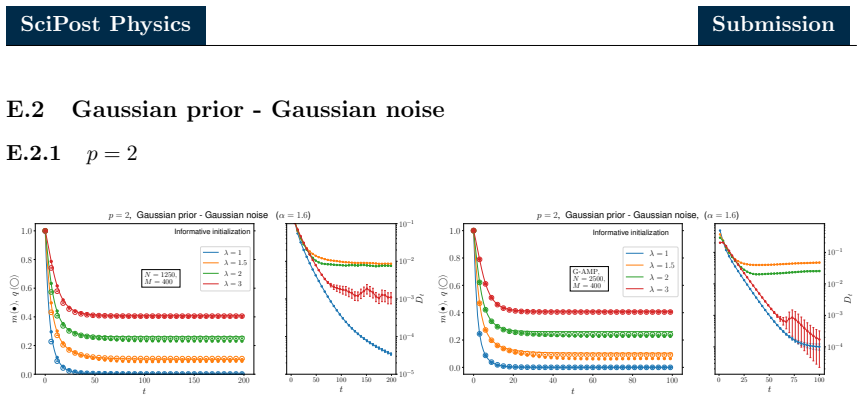
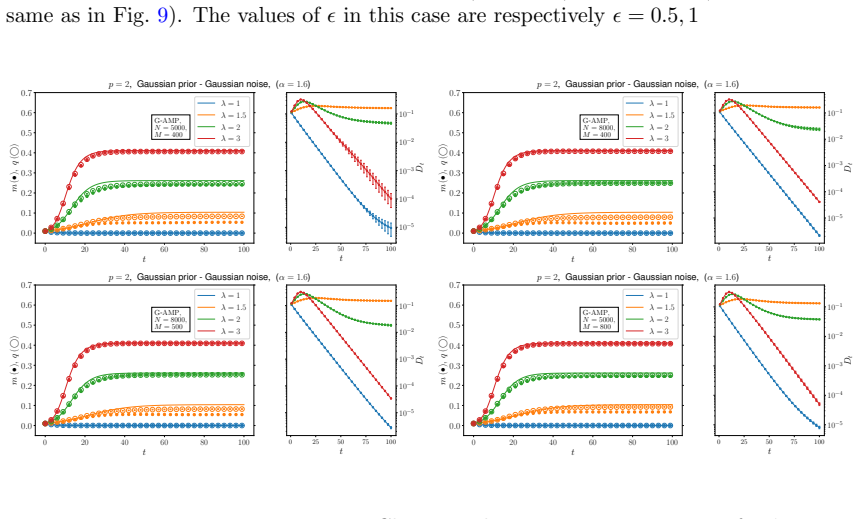
We consider tensor factorizations based on sparse measurements of the components of relatively high rank tensors. The measurements are designed in a way that the underlying graph of interactions is a random graph. The setup will be useful in cases where a substantial amount of data is missing, as in completion of relatively high rank matrices for recommendation systems heavily used in social network services. In order to obtain theoretical insights on the setup, we consider statistical inference of the tensor factorization in a high dimensional limit, which we call as dense limit, where the graphs are large and dense but not fully connected. We build message-passing algorithms and test them in a Bayes optimal teacher-student setting in some specific cases. We also develop a replica theory to examine the performance of statistical inference in the dense limit based on a cumulant expansion. The latter approach allows one to avoid blind usage of Gaussian ansatz which fails in some fully connected systems.
Editorial analysis
A structured set of objections, weighed in public.
Referee Report
Summary. The manuscript presents a graphical model for factorization and completion of relatively high-rank tensors from sparse measurements designed so that the underlying interaction graph is random. It constructs message-passing algorithms and tests them in a Bayes-optimal teacher-student setting for specific cases. It also develops a replica theory based on a cumulant expansion to analyze inference performance in the dense limit (large and dense but not fully connected graphs), with the expansion intended to capture non-Gaussian effects that a standard Gaussian ansatz fails to handle in some fully connected systems.
Significance. If the derivations and validations hold, the work would offer useful algorithmic tools and theoretical predictions for tensor completion with substantial missing data, relevant to recommendation systems. The methodological choice of cumulant expansion within replica analysis for dense random graphs is a potential strength, as it targets limitations of Gaussian approximations. The combination of practical algorithms and theoretical analysis is a positive feature.
major comments (1)
- The replica theory (described in the abstract) relies on a cumulant expansion to derive performance predictions that are asserted to succeed where a Gaussian ansatz fails. However, the manuscript provides no explicit truncation order, convergence controls, or demonstration that omitted higher-cumulant terms (which grow with tensor rank) vanish in the dense limit. This is load-bearing for the central theoretical claim and the benchmarking of the message-passing algorithms.
minor comments (2)
- The abstract states that algorithms are tested 'in some specific cases' but does not specify the tensor ranks, graph densities, or quantitative metrics (e.g., error bars or recovery thresholds) used in those tests.
- Notation for the dense limit and the random-graph construction could be clarified with a brief definition or reference to standard sparse-graph ensembles early in the manuscript.
Simulated Author's Rebuttal
We thank the referee for the careful review and for identifying a key point that requires clarification in our theoretical analysis. We address the major comment below and will revise the manuscript to incorporate the requested details.
read point-by-point responses
-
Referee: The replica theory (described in the abstract) relies on a cumulant expansion to derive performance predictions that are asserted to succeed where a Gaussian ansatz fails. However, the manuscript provides no explicit truncation order, convergence controls, or demonstration that omitted higher-cumulant terms (which grow with tensor rank) vanish in the dense limit. This is load-bearing for the central theoretical claim and the benchmarking of the message-passing algorithms.
Authors: We agree that the manuscript lacks an explicit statement of the truncation order and supporting scaling arguments. In the revised version we will add a dedicated paragraph in Section 4 (Replica analysis) that specifies the truncation: the expansion is carried to third order in the cumulants, with the fourth and higher orders shown to be O(1/√d) where d denotes the average degree in the dense random-graph ensemble. We will also include a short scaling analysis demonstrating that, although individual higher cumulants can increase with tensor rank r, their net contribution after averaging over the random graph vanishes as N→∞ at fixed d. These additions will be accompanied by a brief comparison of the truncated theory against direct simulations for r=3,5,7 to illustrate the practical error incurred by the truncation. The revised text will therefore provide the convergence control and rank dependence needed to support the benchmarking of the message-passing algorithms. revision: yes
Circularity Check
No circularity: replica-cumulant analysis presented as independent theoretical tool
full rationale
The manuscript develops message-passing algorithms and a replica-symmetric theory via cumulant expansion to analyze inference performance in the dense limit for high-rank tensor factorization on random graphs. The abstract and available description frame the cumulant expansion explicitly as a means to avoid the Gaussian ansatz that fails in fully connected cases, without any quoted equations showing that performance predictions are obtained by fitting parameters to the same data or by re-expressing the input measurements. No self-citations, uniqueness theorems, or ansatz smuggling are referenced in the provided text. The derivation therefore remains self-contained and does not reduce to its own inputs by construction.
Axiom & Free-Parameter Ledger
axioms (1)
- domain assumption The underlying graph of interactions formed by the sparse measurements is a random graph in the dense limit.
Reference graph
Works this paper leans on
-
[1]
S. Rangan and A. K. Fletcher, Iterative estimation of constrained rank-one matrices in noise, In 2012 IEEE International Symposium on Information Theory Proceedings, pp. 1246–1250. IEEE (2012)
work page 2012
-
[2]
R. Matsushita and T. Tanaka, Low-rank matrix reconstruction and clustering via approximate message passing, Advances in Neural Information Processing Systems 26(2013)
work page 2013
-
[3]
E. Richard and A. Montanari, A statistical model for tensor pca, Advances in neural information processing systems27(2014)
work page 2014
-
[4]
T. Lesieur, L. Miolane, M. Lelarge, F. Krzakala and L. Zdeborov´ a, Statistical and computational phase transitions in spiked tensor estimation, In 2017 IEEE International Symposium on Information Theory (ISIT), pp. 511–515. IEEE (2017)
work page 2017
-
[5]
A. Sakata and Y. Kabashima, Statistical mechanics of dictionary learning, Euro- physics Letters103(2), 28008 (2013)
work page 2013
-
[6]
A. Sakata and Y. Kabashima, Sample complexity of bayesian optimal dictionary learning, In 2013 IEEE International Symposium on Information Theory, pp. 669–
work page 2013
-
[7]
F. Krzakala, M. M´ ezard and L. Zdeborov´ a,Phase diagram and approximate message passing for blind calibration and dictionary learning, In 2013 IEEE International Symposium on Information Theory, pp. 659–663. IEEE (2013)
work page 2013
-
[8]
Y. Kabashima, F. Krzakala, M. M´ ezard, A. Sakata and L. Zdeborov´ a, Phase transitions and sample complexity in bayes-optimal matrix factorization, IEEE Trans- actions on information theory62(7), 4228 (2016)
work page 2016
-
[9]
D. L. Donoho, A. Maleki and A. Montanari, Message-passing algorithms for compressed sensing, Proceedings of the National Academy of Sciences106(45), 18914 (2009)
work page 2009
-
[10]
F. Pourkamali, J. Barbier and N. Macris, Matrix inference in growing rank regimes, IEEE Transactions on Information Theory (2024)
work page 2024
-
[11]
H. Yoshino, Disorder-free spin glass transitions and jamming in exactly solvable mean-field models, SciPost Phys.4, 40 (2018), doi:10.21468/SciPostPhys.4.6.040
-
[12]
H. Yoshino, Spatially heterogeneous learning by a deep student machine, Physical Review Research5(3), 033068 (2023)
work page 2023
-
[13]
S. Rangan, Generalized approximate message passing for estimation with random linear mixing, In 2011 IEEE International Symposium on Information Theory Proceedings, pp. 2168–2172. IEEE (2011)
work page 2011
-
[14]
L. Zdeborov´ a and F. Krzakala, Statistical physics of inference: Thresholds and algorithms, Advances in Physics65(5), 453 (2016)
work page 2016
-
[15]
S. F. Edwards and P. W. Anderson, Theory of spin glasses, Journal of Physics F: Metal Physics5(5), 965 (1975), doi:10.1088/0305-4608/5/5/017. 72 SciPost Physics Submission
-
[16]
Nishimori, Statistical physics of spin glasses and information processing: an introduction, 111
H. Nishimori, Statistical physics of spin glasses and information processing: an introduction, 111. Clarendon Press (2001)
work page 2001
-
[17]
Y. Iba, The nishimori line and bayesian statistics, Journal of Physics A: Mathematical and General32(21), 3875 (1999), doi:10.1088/0305-4470/32/21/302
-
[18]
J. Mairal, F. Bach, J. Ponce and G. Sapiro, Online dictionary learning for sparse coding, In Proceedings of the 26th Annual International Conference on Machine Learning, ICML ’09, p. 689–696. Association for Computing Machinery, New York, NY, USA, ISBN 9781605585161, doi:10.1145/1553374.1553463 (2009)
-
[19]
M. Elad and M. Aharon, Image denoising via sparse and redundant representations over learned dictionaries, IEEE Transactions on Image Processing15(12), 3736 (2006), doi:10.1109/TIP.2006.881969
-
[20]
E. Candes and B. Recht, Exact matrix completion via convex optimization, Com- munications of the ACM55(6), 111 (2012)
work page 2012
-
[21]
S. Ling and T. Strohmer, Blind deconvolution meets blind demixing: Algorithms and performance bounds, IEEE Transactions on Information Theory63(7), 4497 (2017), doi:10.1109/TIT.2017.2701342
-
[22]
E. J. Cand` es, X. Li, Y. Ma and J. Wright,Robust principal component analysis?, J. ACM58(3) (2011), doi:10.1145/1970392.1970395
-
[23]
A. Anandkumar, R. Ge, D. J. Hsu, S. M. Kakade, M. Telgarsky et al., Tensor decompositions for learning latent variable models., J. Mach. Learn. Res.15(1), 2773 (2014)
work page 2014
-
[24]
A. Cichocki, D. Mandic, L. De Lathauwer, G. Zhou, Q. Zhao, C. Caiafa and H. A. Phan, Tensor decompositions for signal processing applications: From two-way to multiway component analysis, IEEE signal processing magazine32(2), 145 (2015)
work page 2015
-
[25]
N. D. Sidiropoulos, L. De Lathauwer, X. Fu, K. Huang, E. E. Papalexakis and C. Faloutsos, Tensor decomposition for signal processing and machine learning, IEEE Transactions on signal processing65(13), 3551 (2017)
work page 2017
-
[26]
E. Acar, D. M. Dunlavy, T. G. Kolda and M. Mørup, Scalable tensor factorizations for incomplete data, Chemometrics and Intelligent Laboratory Systems106(1), 41 (2011)
work page 2011
-
[27]
Q. Zhao, L. Zhang and A. Cichocki, Bayesian cp factorization of incomplete tensors with automatic rank determination, IEEE transactions on pattern analysis and ma- chine intelligence37(9), 1751 (2015)
work page 2015
-
[28]
R. M. Bell, Y. Koren and C. Volinsky, The bellkor solution to the netflix prize, KorBell team’s report to Netflix2(2007)
work page 2007
- [29]
-
[30]
A. Maillard, F. Krzakala, M. M´ ezard and L. Zdeborov´ a, Perturbative construction of mean-field equations in extensive-rank matrix factorization and denoising, Journal of Statistical Mechanics: Theory and Experiment2022(8), 083301 (2022). 73 SciPost Physics Submission
work page 2022
-
[31]
G. Reeves, Information-theoretic limits for the matrix tensor product, IEEE Journal on Selected Areas in Information Theory1(3), 777 (2020)
work page 2020
-
[32]
J. Barbier, J. Ko and A. A. Rahman, A multiscale cavity method for sublinear-rank symmetric matrix factorization, arXiv preprint arXiv:2403.07189 (2024)
-
[33]
J. Barbier and N. Macris, Statistical limits of dictionary learning: random matrix theory and the spectral replica method, Physical Review E106(2), 024136 (2022)
work page 2022
-
[34]
J. Barbier, F. Camilli, J. Ko and K. Okajima, On the phase diagram of extensive-rank symmetric matrix denoising beyond rotational invariance, arXiv preprint arXiv:2411.01974 (2024)
-
[35]
A. G. Cavaliere, T. Lesieur and F. Ricci-Tersenghi, Optimization of the dynamic transition in the continuous coloring problem, Journal of Statistical Mechanics: The- ory and Experiment2021(11), 113302 (2021)
work page 2021
-
[36]
A. G. Cavaliere and F. Ricci-Tersenghi, Biased thermodynamics can explain the behaviour of smart optimization algorithms that work above the dynamical threshold, Journal of Statistical Mechanics: Theory and Experiment2025(5), 053405 (2025)
work page 2025
-
[37]
P. Charbonneau, J. Kurchan, G. Parisi, P. Urbani and F. Zamponi, Exact theory of dense amorphous hard spheres in high dimension. iii. the full replica symmetry breaking solution, Journal of Statistical Mechanics: Theory and Experiment 2014(10), P10009 (2014), doi:10.1088/1742-5468/2014/10/P10009
-
[38]
Classification of Electromagnetic and Gravitational Hopfions by Algebraic Type
S. Franz and G. Parisi, The simplest model of jamming, Journal of Physics A: Mathematical and Theoretical49(14), 145001 (2016), doi:10.1088/1751- 8113/49/14/145001
-
[39]
Sourlas, Spin-glass models as error-correcting codes, Nature339(6227), 693 (1989)
N. Sourlas, Spin-glass models as error-correcting codes, Nature339(6227), 693 (1989)
work page 1989
-
[40]
Y. Kabashima and D. Saad, Belief propagation vs. tap for decoding corrupted messages, EPL (Europhysics Letters)44(5), 668 (1998)
work page 1998
-
[41]
C. E. Shannon, A mathematical theory of communication, The Bell system technical journal27(3), 379 (1948)
work page 1948
-
[42]
T. Tanaka, A statistical-mechanics approach to large-system analysis of cdma multiuser detectors, IEEE Transactions on Information theory48(11), 2888 (2002)
work page 2002
-
[43]
Y. Kabashima, A cdma multiuser detection algorithm on the basis of belief propagation, Journal of Physics A: Mathematical and General36(43), 11111 (2003)
work page 2003
-
[44]
E. Gardner and B. Derrida, Three unfinished works on the optimal storage capacity of networks, Journal of Physics A: Mathematical and General22(12), 1983 (1989), doi:10.1088/0305-4470/22/12/004
-
[45]
G. Gy¨ orgyi, Inference of a rule by a neural network with thermal noise, Physical review letters64(24), 2957 (1990)
work page 1990
-
[46]
D. L. Donoho, Compressed sensing, IEEE Transactions on information theory52(4), 1289 (2006). 74 SciPost Physics Submission
work page 2006
-
[47]
Y. Kabashima, T. Wadayama and T. Tanaka, A typical reconstruction limit for compressed sensing based on lp-norm minimization, Journal of Statistical Mechanics: Theory and Experiment2009(09), L09003 (2009)
work page 2009
-
[48]
T. Plefka, Convergence condition of the tap equation for the infinite-ranged ising spin glass model, Journal of Physics A: Mathematical and general15(6), 1971 (1982), doi:10.1088/0305-4470/15/6/035
-
[49]
A. Georges and J. Yedidia, How to expand around mean-field theory using high-temperature expansions, Journal of Physics A: Mathematical and General24, 2173 (1991)
work page 1991
-
[50]
A. Georges, M. M´ ezard and J. S. Yedidia, Low-temperature phase of the ising spin glass on a hypercubic lattice, Physical review letters64(24), 2937 (1990)
work page 1990
-
[51]
J.-P. Hansen and I. R. McDonald, Theory of simple liquids, Elsevier (1990)
work page 1990
-
[52]
Zinn-Justin, Quantum field theory and critical phenomena, vol
J. Zinn-Justin, Quantum field theory and critical phenomena, vol. 171, Oxford university press (2021)
work page 2021
-
[53]
J. Kurchan, G. Parisi and F. Zamponi, Exact theory of dense amorphous hard spheres in high dimension i. the free energy, Journal of Statistical Mechanics: Theory and Experiment2012(10), P10012 (2012), doi:10.1088/1742-5468/2012/10/P10012
-
[54]
J. Kosterlitz, D. Thouless and R. C. Jones, Spherical model of a spin-glass, Physical Review Letters36(20), 1217 (1976), doi:10.1103/PhysRevLett.36.1217
-
[55]
B. Derrida, Random-energy model: Limit of a family of disordered models, Physical Review Letters45(2), 79 (1980), doi:10.1103/PhysRevLett.45.79
-
[56]
D. J. Gross and M. M´ ezard,The simplest spin glass, Nuclear Physics B240(4), 431 (1984), doi:10.1016/0550-3213(84)90237-2
-
[57]
H. Nishimori and K. M. Wong, Statistical mechanics of image restoration and error-correcting codes, Physical Review E60(1), 132 (1999)
work page 1999
-
[58]
S. Rangan, Estimation with random linear mixing, belief propagation and compressed sensing, In 2010 44th Annual Conference on Information Sciences and Systems (CISS), pp. 1–6. IEEE (2010)
work page 2010
-
[59]
S. Kirkpatrick and D. Sherrington, Infinite-ranged models of spin-glasses, Physical Review B17(11), 4384 (1978), doi:10.1103/PhysRevB.17.4384. 75
discussion (0)
Sign in with ORCID, Apple, or X to comment. Anyone can read and Pith papers without signing in.