Krylov Complexity Under Hamiltonian Deformations and Toda Flows
Pith reviewed 2026-05-18 05:17 UTC · model grok-4.3
The pith
Certain Hamiltonian deformations leave the Krylov subspace unchanged while reorganizing its basis via generalized Toda equations.
A machine-rendered reading of the paper's core claim, the machinery that carries it, and where it could break.
Core claim
For a certain class of deformations, the resulting Krylov subspace is unchanged, and we observe time evolutions with a reorganized basis. The tridiagonal form of the generator in the Krylov space is maintained, and we obtain generalized Toda equations as a function of the deformation parameters. The imaginary-time-like evolutions can be described by real-time unitary ones.
What carries the argument
The Krylov subspace method applied to Hamiltonian deformations, which preserves the subspace and produces generalized Toda equations for the basis coefficients.
Load-bearing premise
There exists a nontrivial class of Hamiltonian deformations that leave the Krylov subspace invariant while merely reorganizing its basis.
What would settle it
Take a concrete quadratic deformation of a known Hamiltonian such as the harmonic oscillator, compute the Lanczos coefficients before and after the deformation, and check whether the Krylov subspace is identical and the new coefficients satisfy the generalized Toda equations.
Figures


read the original abstract
The quantum dynamics of a complex system can be efficiently described in Krylov space, the minimal subspace in which the dynamics unfolds. We apply the Krylov subspace method for Hamiltonian deformations, which provides a systematic way of constructing solvable models from known instances. In doing so, we relate the evolution of deformed and undeformed theories and investigate their complexity. For a certain class of deformations, the resulting Krylov subspace is unchanged, and we observe time evolutions with a reorganized basis. The tridiagonal form of the generator in the Krylov space is maintained, and we obtain generalized Toda equations as a function of the deformation parameters. The imaginary-time-like evolutions can be described by real-time unitary ones. As possible applications, we discuss coherent Gibbs states for thermodynamic systems, for which we analyze the survival probability, spread complexity, Krylov entropy, and associated time-averaged quantities. We further discuss the statistical properties of random matrices and supersymmetric systems for quadratic deformations.
Editorial analysis
A structured set of objections, weighed in public.
Referee Report
Summary. The paper applies the Krylov subspace method to Hamiltonian deformations of quantum systems. For a certain class of deformations the Krylov subspace remains invariant while its basis is reorganized; the tridiagonal generator is preserved and generalized Toda equations are derived in terms of the deformation parameters. Imaginary-time-like evolution is shown to be equivalent to real-time unitary dynamics. Concrete applications are given to coherent Gibbs states (survival probability, spread complexity, Krylov entropy and their time averages) and to quadratic deformations in random-matrix and supersymmetric ensembles.
Significance. If the invariance and Toda-flow constructions hold, the work supplies a systematic route to solvable models whose Krylov complexity can be related directly to that of the undeformed theory. The real-time/unitary description of imaginary-time evolution and the explicit thermodynamic and random-matrix applications are concrete strengths that could be useful for both analytic and numerical studies of quantum dynamics.
minor comments (3)
- The precise definition of the class of deformations that leave the Krylov subspace invariant should be stated explicitly in the main text (rather than only in the abstract) so that readers can verify the scope of the Toda-flow construction.
- In the applications to Gibbs states, the time-averaged quantities are introduced without an explicit formula or reference to the averaging procedure; adding the relevant expression would improve reproducibility.
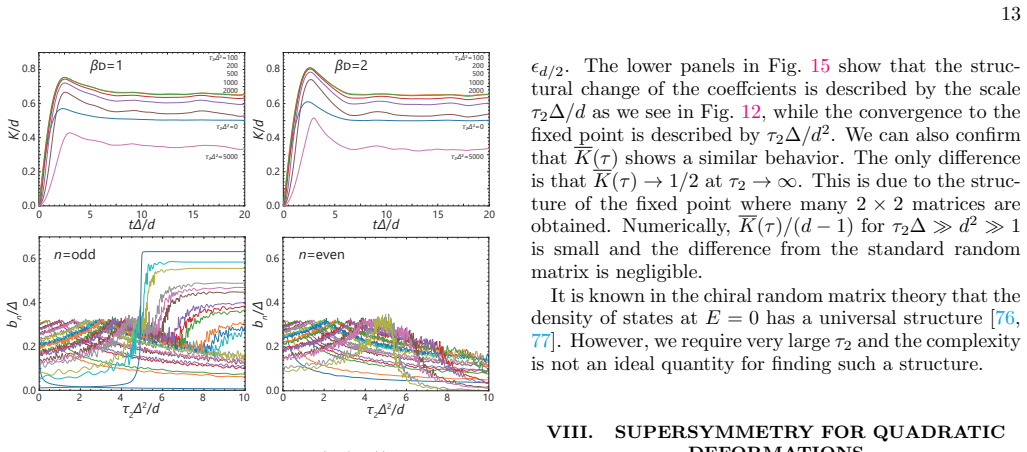
- Figure captions for the random-matrix and supersymmetric examples would benefit from a short statement of the ensemble parameters and the quadratic deformation used.
Simulated Author's Rebuttal
We thank the referee for their positive assessment of our manuscript and for recommending minor revision. The referee's summary correctly identifies the core results: the invariance of the Krylov subspace under a class of Hamiltonian deformations, the emergence of generalized Toda equations, the equivalence between imaginary-time-like and real-time unitary dynamics, and the concrete applications to coherent Gibbs states and quadratic deformations in random-matrix and supersymmetric ensembles. We are pleased that the potential utility for constructing solvable models and for both analytic and numerical studies is recognized.
Circularity Check
No significant circularity; derivation is self-contained
full rationale
The paper constructs Hamiltonian deformations that preserve the Krylov subspace and tridiagonal generator, then derives generalized Toda equations directly as functions of the deformation parameters. This is presented as an algebraic consequence of the invariance rather than a fit to complexity data. No self-definitional steps, fitted inputs renamed as predictions, or load-bearing self-citations appear in the abstract or described chain. Applications to Gibbs states and random-matrix statistics follow as direct implications of the same invariance. The derivation chain remains independent of the target observables.
Axiom & Free-Parameter Ledger
free parameters (1)
- deformation parameters
axioms (1)
- domain assumption The Krylov subspace method can be applied to Hamiltonian deformations while preserving the minimal subspace for a certain class of deformations.
Reference graph
Works this paper leans on
-
[1]
= 0.(A9) The first equation gives Eq. (25) and the second Eq. (27). Equations (A6) and (A7) also give ∂τ1 ˜Pn =b 2 n ˜Pn−1,(A10) ∂τ2 ˜Pn =b 2 n(an +a n−1) ˜Pn−1 +b 2 nb2 n−1 ˜Pn−2.(A11) In a similar way, Eqs. (24) and (26) can be derived from the derivative of the relation an(τ)h n(τ) = Z dx ρ(x, τ)x ˜P 2 n(x, τ).(A12) We can also find that theτ-evolution...
-
[2]
M. Mari˜ no,Instantons and Large N: An Introduction to Non-Perturbative Methods in Quantum Field Theory (Cambridge University Press, 2015)
work page 2015
-
[3]
A. B. Zamolodchikov, Expectation value of compos- ite fieldt ¯tin two-dimensional quantum field theory 10.48550/arXiv.hep-th/0401146 (2004)
work page internal anchor Pith review Pith/arXiv arXiv doi:10.48550/arxiv.hep-th/0401146 2004
-
[4]
A. Cavagli` a, S. Negro, I. M. Sz´ ecs´ enyi, and R. Tateo, T T-deformed 2D quantum field theories, Journal of High Energy Physics2016, 112 (2016)
work page 2016
-
[5]
F. Smirnov and A. Zamolodchikov, On space of inte- grable quantum field theories, Nuclear Physics B915, 363 (2017)
work page 2017
-
[6]
Y. Jiang, A pedagogical review on solvable irrelevant de- formations of 2d quantum field theory, Communications in Theoretical Physics73, 057201 (2021)
work page 2021
-
[7]
D. J. Gross, J. Kruthoff, A. Rolph, and E. Shaghoulian, T Tin AdS 2 and quantum mechanics, Phys. Rev. D101, 026011 (2020)
work page 2020
-
[8]
D. J. Gross, J. Kruthoff, A. Rolph, and E. Shaghoulian, Hamiltonian deformations in quantum mechanics,T T, and the SYK model, Phys. Rev. D102, 046019 (2020)
work page 2020
-
[9]
J. Kruthoff and O. Parrikar, On the flow of states under T T, SciPost Phys.9, 078 (2020)
work page 2020
-
[10]
Rosso,T Tdeformation of random matrices, Phys
F. Rosso,T Tdeformation of random matrices, Phys. Rev. D103, 126017 (2021)
work page 2021
-
[11]
Jiang,T T-deformed 1d Bose gas, SciPost Phys.12, 191 (2022)
Y. Jiang,T T-deformed 1d Bose gas, SciPost Phys.12, 191 (2022)
work page 2022
- [12]
-
[13]
A. Matsoukas-Roubeas, F. Roccati, J. Cornelius, Z. Xu, A. Chenu, and A. del Campo, Non-hermitian hamiltonian deformations in quantum mechanics, Journal of High En- ergy Physics2023, 60 (2023)
work page 2023
-
[14]
V. Viswanath and G. M¨ uller,The Recursion Method: Application to Many-Body Dynamics(Springer-Verlag, 1994)
work page 1994
-
[15]
D. E. Parker, X. Cao, A. Avdoshkin, T. Scaffidi, and E. Altman, A universal operator growth hypothesis, Phys. Rev. X9, 041017 (2019)
work page 2019
- [16]
-
[17]
S. Baiguera, V. Balasubramanian, P. Caputa, S. Chap- man, J. Haferkamp, M. P. Heller, and N. Y. Halpern, Quantum complexity in gravity, quantum field theory, and quantum information science (2025), arXiv:2503.10753 [hep-th]
-
[18]
E. Rabinovici, A. S´ anchez-Garrido, R. Shir, and J. Son- ner, Krylov complexity (2025), arXiv:2507.06286 [hep- th]
work page internal anchor Pith review Pith/arXiv arXiv 2025
-
[19]
K. Takahashi and A. del Campo, Shortcuts to adiabatic- ity in krylov space, Phys. Rev. X14, 011032 (2024)
work page 2024
-
[20]
K. Takahashi and A. del Campo, Krylov subspace meth- ods for quantum dynamics with time-dependent genera- tors, Phys. Rev. Lett.134, 030401 (2025)
work page 2025
-
[21]
A lanczos approach to the adiabatic gauge potential, 2023
B. Bhattacharjee, A lanczos approach to the adiabatic gauge potential (2023), arXiv:2302.07228 [quant-ph]
-
[22]
F. Balducci, A. Grabarits, and A. del Campo, Fight- ing exponentially small gaps by counterdiabatic driving (2024), arXiv:2410.02520 [quant-ph]. 18
- [23]
-
[24]
Universal defect statistics in counterdiabatic quantum critical dynamics, 2025
A. Grabarits and A. del Campo, Universal defect statis- tics in counterdiabatic quantum critical dynamics (2025), arXiv:2503.22212 [quant-ph]
-
[25]
Universal growth of krylov complexity across a quantum phase transition, 2025
A. Grabarits and A. del Campo, Universal growth of krylov complexity across a quantum phase transition (2025), arXiv:2510.13947 [quant-ph]
-
[26]
R. W. Brockett, Dynamical systems that sort lists, diago- nalize matrices, and solve linear programming problems, Linear Algebra and its Applications146, 79 (1991)
work page 1991
-
[27]
S. D. G lazek and K. G. Wilson, Renormalization of hamiltonians, Phys. Rev. D48, 5863 (1993)
work page 1993
-
[28]
S. D. Glazek and K. G. Wilson, Perturbative renormal- ization group for hamiltonians, Phys. Rev. D49, 4214 (1994)
work page 1994
-
[29]
Wegner, Flow-equations for hamiltonians, Annalen der Physik506, 77 (1994)
F. Wegner, Flow-equations for hamiltonians, Annalen der Physik506, 77 (1994)
work page 1994
-
[30]
S. Kehrein,The Flow Equation Approach to Many- Particle Systems, Springer Tracts in Modern Physics (Springer, 2006)
work page 2006
-
[31]
N. H¨ ornedal, N. Carabba, K. Takahashi, and A. del Campo, Geometric Operator Quantum Speed Limit, Wegner Hamiltonian Flow and Operator Growth, Quan- tum7, 1055 (2023)
work page 2023
-
[32]
M. Toda, Vibration of a chain with nonlinear interaction, Journal of the Physical Society of Japan22, 431 (1967)
work page 1967
-
[33]
M. Toda, Wave propagation in anharmonic lattices, Jour- nal of the Physical Society of Japan23, 501 (1967)
work page 1967
-
[34]
M. Okuyama and K. Takahashi, From classical nonlinear integrable systems to quantum shortcuts to adiabaticity, Phys. Rev. Lett.117, 070401 (2016)
work page 2016
-
[35]
M. E. H. Ismail,Classical and Quantum Orthogonal Poly- nomials in One Variable, Encyclopedia of Mathematics and its Applications (Cambridge University Press, 2005)
work page 2005
-
[36]
A. Dymarsky and A. Gorsky, Quantum chaos as delocal- ization in krylov space, Phys. Rev. B102, 085137 (2020)
work page 2020
- [37]
-
[38]
N. Angelinos, D. Chakraborty, and A. Dymarsky, Temperature dependence in krylov space (2025), arXiv:2508.19233 [hep-th]
-
[39]
A. del Campo, J. Molina-Vilaplana, and J. Sonner, Scrambling the spectral form factor: Unitarity con- straints and exact results, Phys. Rev. D95, 126008 (2017)
work page 2017
-
[40]
Z. Xu, A. Chenu, T. Prosen, and A. del Campo, Ther- mofield dynamics: Quantum chaos versus decoherence, Phys. Rev. B103, 064309 (2021)
work page 2021
-
[41]
V. Balasubramanian, P. Caputa, J. M. Magan, and Q. Wu, Quantum chaos and the complexity of spread of states, Phys. Rev. D106, 046007 (2022)
work page 2022
-
[42]
Maldacena, Eternal black holes in anti-de sitter, Jour- nal of High Energy Physics2003, 021 (2003)
J. Maldacena, Eternal black holes in anti-de sitter, Jour- nal of High Energy Physics2003, 021 (2003)
work page 2003
-
[43]
K. Papadodimas and S. Raju, Local operators in the eter- nal black hole, Phys. Rev. Lett.115, 211601 (2015)
work page 2015
-
[44]
S. Chapman, J. Eisert, L. Hackl, M. P. Heller, R. Jeffer- son, H. Marrochio, and R. C. Myers, Complexity and en- tanglement for thermofield double states, SciPost Phys. 6, 034 (2019)
work page 2019
-
[45]
A. S. Matsoukas-Roubeas, M. Beau, L. F. Santos, and A. del Campo, Unitarity breaking in self-averaging spec- tral form factors, Phys. Rev. A108, 062201 (2023)
work page 2023
-
[46]
Haake,Quantum Signatures of Chaos, Physics and astronomy online library (Springer, 2001)
F. Haake,Quantum Signatures of Chaos, Physics and astronomy online library (Springer, 2001)
work page 2001
-
[47]
J. S. Cotler, G. Gur-Ari, M. Hanada, J. Polchinski, P. Saad, S. H. Shenker, D. Stanford, A. Streicher, and M. Tezuka, Black holes and random matrices, J. High Energy Phys.2017(5), 118
work page 2017
-
[48]
J. Cornelius, Z. Xu, A. Saxena, A. Chenu, and A. del Campo, Spectral filtering induced by non-hermitian evo- lution with balanced gain and loss: Enhancing quantum chaos, Phys. Rev. Lett.128, 190402 (2022)
work page 2022
-
[49]
A. S. Matsoukas-Roubeas, T. Prosen, and A. d. Campo, Quantum Chaos and Coherence: Random Parametric Quantum Channels, Quantum8, 1446 (2024)
work page 2024
-
[50]
P. Martinez-Azcona, R. Shir, and A. Chenu, Decompos- ing the spectral form factor, Phys. Rev. B111, 165108 (2025)
work page 2025
-
[51]
W. M¨ uck and Y. Yang, Krylov complexity and orthogo- nal polynomials, Nuclear Physics B984, 115948 (2022)
work page 2022
-
[52]
J. Moser, Finitely many mass points on the line un- der the influence of an exponential potential – an in- tegrable system, inDynamical Systems, Theory and Ap- plications: Battelle Seattle 1974 Rencontres, edited by J. Moser (Springer Berlin Heidelberg, Berlin, Heidelberg,
work page 1974
-
[53]
P. D. Lax, Integrals of nonlinear equations of evolution and solitary waves, Communications on Pure and Ap- plied Mathematics21, 467 (1968)
work page 1968
-
[54]
L. D. Faddeev and L. A. Takhtajan,Hamiltonian Meth- ods in the Theory of Solitons, Classics in Mathematics (Springer, Berlin, Heidelberg, 2007)
work page 2007
- [55]
-
[56]
J. Moser, Three integrable hamiltonian systems con- nected with isospectral deformations, Advances in Math- ematics16, 197 (1975)
work page 1975
-
[57]
N. A. Sinitsyn, E. A. Yuzbashyan, V. Y. Chernyak, A. Patra, and C. Sun, Integrable time-dependent quan- tum hamiltonians, Phys. Rev. Lett.120, 190402 (2018)
work page 2018
- [58]
-
[59]
N. H¨ ornedal, N. Carabba, A. S. Matsoukas-Roubeas, and A. del Campo, Ultimate speed limits to the growth of operator complexity, Communications Physics5, 207 (2022)
work page 2022
-
[60]
C. Monthus, Flow towards diagonalization for many- body-localization models: adaptation of the toda matrix differential flow to random quantum spin chains, Journal of Physics A: Mathematical and Theoretical49, 305002 (2016)
work page 2016
-
[61]
H. Nishimori and G. Ortiz,Elements of Phase Transi- tions and Critical Phenomena, Oxford Graduate Texts, Vol. XIII (Oxford University Press, Oxford, 2011) p. 358
work page 2011
-
[62]
M. Heyl, A. Polkovnikov, and S. Kehrein, Dynamical quantum phase transitions in the transverse-field ising model, Phys. Rev. Lett.110, 135704 (2013)
work page 2013
-
[63]
M. Heyl, Dynamical quantum phase transitions: a re- view, Reports on Progress in Physics81, 054001 (2018)
work page 2018
-
[64]
A. del Campo, Exact quantum decay of an interacting 19 many-particle system: the Calogero–Sutherland model, New Journal of Physics18, 015014 (2016)
work page 2016
-
[65]
del Campo, Probing quantum speed limits with ultra- cold gases, Phys
A. del Campo, Probing quantum speed limits with ultra- cold gases, Phys. Rev. Lett.126, 180603 (2021)
work page 2021
-
[66]
C. N. Yang and T. D. Lee, Statistical theory of equations of state and phase transitions. i. theory of condensation, Phys. Rev.87, 404 (1952)
work page 1952
-
[67]
T. D. Lee and C. N. Yang, Statistical theory of equations of state and phase transitions. ii. lattice gas and ising model, Phys. Rev.87, 410 (1952)
work page 1952
-
[68]
C. Itzykson and J. Drouffe,Statistical Field Theory, Cambridge monographs on mathematical physics No. Bd. 1 (Cambridge University Press, 1991)
work page 1991
-
[69]
T. Obuchi and K. Takahashi, Dynamical singularities of glassy systems in a quantum quench, Phys. Rev. E86, 051125 (2012)
work page 2012
-
[70]
E. Rabinovici, A. S´ anchez-Garrido, R. Shir, and J. Son- ner, Operator complexity: a journey to the edge of Krylov space, Journal of High Energy Physics2021, 62 (2021)
work page 2021
-
[71]
P. H. S. Bento, A. del Campo, and L. C. C´ eleri, Krylov complexity and dynamical phase transition in the quenched Lipkin-Meshkov-Glick model, Phys. Rev. B109, 224304 (2024)
work page 2024
-
[72]
K. Takahashi, Dynamical quantum phase transition, metastable state, and dimensionality reduction: Krylov analysis of fully connected spin models, Phys. Rev. B 112, 054312 (2025)
work page 2025
-
[73]
P. Caputa, H.-S. Jeong, S. Liu, J. F. Pedraza, and L.- C. Qu, Krylov complexity of density matrix operators, JHEP05, 337, arXiv:2402.09522 [hep-th]
- [74]
-
[75]
Haake,Quantum signatures of chaos(Springer, 1991)
F. Haake,Quantum signatures of chaos(Springer, 1991)
work page 1991
-
[76]
B. Bhattacharjee and P. Nandy, Krylov fractality and complexity in generic random matrix ensembles, Phys. Rev. B111, L060202 (2025), arXiv:2407.07399 [quant- ph]
-
[77]
J. J. M. Verbaarschot and I. Zahed, Spectral density of the qcd dirac operator near zero virtuality, Phys. Rev. Lett.70, 3852 (1993)
work page 1993
-
[78]
Verbaarschot, Spectrum of the qcd dirac operator and chiral random matrix theory, Phys
J. Verbaarschot, Spectrum of the qcd dirac operator and chiral random matrix theory, Phys. Rev. Lett.72, 2531 (1994)
work page 1994
-
[79]
A. Altland and M. R. Zirnbauer, Nonstandard symme- try classes in mesoscopic normal-superconducting hybrid structures, Phys. Rev. B55, 1142 (1997)
work page 1997
-
[80]
Witten, Dynamical breaking of supersymmetry, Nu- clear Physics B188, 513 (1981)
E. Witten, Dynamical breaking of supersymmetry, Nu- clear Physics B188, 513 (1981)
work page 1981
discussion (0)
Sign in with ORCID, Apple, or X to comment. Anyone can read and Pith papers without signing in.