REVIEW 3 major objections 6 minor 1 cited by
Empathic Prompting claims that injecting real-time facial-expression descriptors into a prompt lets an unmodified LLM respond with emotionally attuned language at inference time.
Reviewed by Pith at T0; open to challenge. T0 means a machine referee read the full paper against a public rubric. the ladder, T0–T4 →
T0 review · deepseek-v4-flash
2026-08-04 08:22 UTC pith:CXKLZTFW
load-bearing objection A well-described prompt-injection prototype whose central effectiveness claim is not supported by the current evaluation; worth reviewing as a proof of concept, but needs a real baseline and human participants before claiming improvement. the 3 major comments →
Empathic Prompting: Non-Verbal Context Integration for Multimodal LLM Conversations
The pith
A machine-rendered reading of the paper's core claim, the machinery that carries it, and where it could break.
Core claim
On the paper's own terms, the discovery is that non-verbal affective context can be treated as first-class conversational context for LLMs: a structured emotional descriptor built from a majority vote over a three-second window of face readings is concatenated with the message history and an empathic system prompt, and the resulting query is passed to a locally hosted LLM whose parameters are never modified. The response generation then follows explicit rules — validate the text first, modulate tone by valence and arousal bands, gently name text-face incongruence, and invoke a safety script in crisis. The reported evaluation is preliminary, but the paper argues it is enough to establish that
What carries the argument
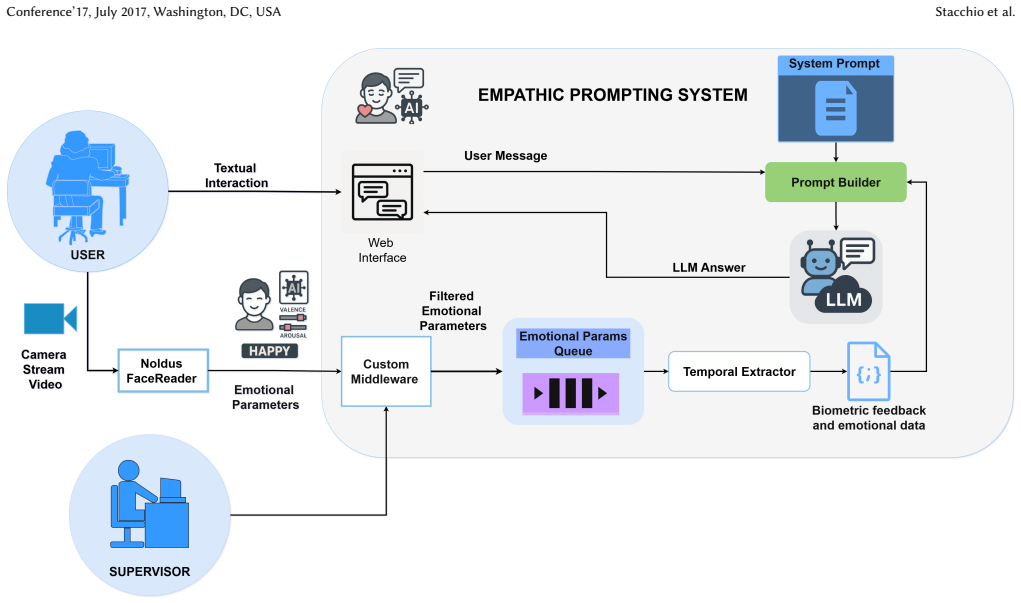
The load-bearing mechanism is the prompt-builder operation LLM_q = prompt_builder(F_e ⊕ M_h, S_p), where F_e is a compact emotional tuple — majority emotion, mean valence, mean arousal, timestamp — aggregated over a three-second window from a commercial facial-expression recognition service, M_h is the conversation history, and S_p is a hand-built empathic system prompt. The system prompt carries the behavioral rules: respond to the user's words first, modulate tone and pace according to valence and arousal bands, and handle mismatches between text and face by raising a gentle exploratory question rather than a correction. The tuple is made of semantic descriptors, so a human supervisor can
Load-bearing premise
Everything rests on the assumption that the commercial face recognizer's per-second emotion categories and valence and arousal values are a temporally accurate proxy for what the user is actually feeling; the paper reports no validation of those readings against user self-report, and its own small internal pilot and unstable safety-scale reliability leave that foundation untested.
What would settle it
A controlled experiment would settle it: with scripted emotional inductions, hold the user's text fixed and swap real face-derived descriptors for neutral or random ones; if blind raters cannot distinguish the resulting responses or empathy scores do not move with the descriptor, the claimed conditioning effect is not real. A second check is to correlate the face reader's valence and arousal with participants' self-reported emotion turn by turn — the central claim fails if the correlation is near zero.
If this is right
- If the central claim holds, conversational agents in healthcare, education, and mental-wellness contexts can adapt tone and pacing to a user's detected affect without any model fine-tuning.
- Because the affective context is expressed as transparent semantic descriptors, the conditioning is inspectable: a supervisor can see which emotion and valence values shaped a given response.
- Adding a new non-verbal modality, such as prosody or physiological signals, only requires a middleware that emits the same tuple format, leaving the prompting pipeline and model unchanged.
- The explicit incongruence protocol gives LLM chatbots a principled way to notice when words and facial expression disagree and to ask about that gap instead of ignoring it.
- Safety guardrails remain intact because conditioning happens only in the prompt and model parameters are untouched, making crisis-response behavior a matter of prompt adherence rather than learned policy.
- If the pilot's qualitative observation generalizes, users may experience such interactions as more fluid and emotionally aligned even when the detected emotion is not explicitly named in the reply.
Where Pith is reading between the lines
- An implication the paper leaves implicit is that the same conditioning can backfire when the face classifier is wrong — for example, under poor lighting, eyeglasses, cultural display rules, or when felt and displayed emotion diverge — and the LLM will then confidently condition on noise.
- The paper's modular tuple design suggests a testable extension beyond faces: prosodic or physiological signals could be encoded in the same semantic format and injected into prompts, but the privacy and interpretability trade-offs would need separate study.
- A direct editorial extension is that the incongruence-handling rule may be the most valuable part of the framework, more so than mirroring the detected emotion; this could be tested by comparing dialogue variants that name versus ignore mismatches.
- The local-deployment choice points toward a testable user-trust hypothesis: users may feel safer knowing biometric data stay on-device and only compact semantic descriptors are used, but the paper does not measure that trust directly.
Editorial analysis
A structured set of objections, weighed in public.
Referee Report
Summary. The paper proposes Empathic Prompting, a framework that injects real-time facial-expression-derived affective descriptors (emotion category, intensity, valence, arousal) into an LLM's prompt, so that non-verbal cues can condition language generation without model retraining. The implementation uses Noldus FaceReader, a middleware that filters and aggregates the biometric stream into a 3-second Emotional Params Queue, and a DeepSeek LLM backend. The evaluation is two-pronged: an LLM-as-a-judge model-selection study over a small synthetic multimodal dataset, and a five-participant internal usability study using PETS, SUS, and selected Godspeed subscales, complemented by a qualitative trace of one interaction. The paper reports positive usability and empathy ratings, and claims that non-verbal integration improves perceived empathy and conversational smoothness, while acknowledging the preliminary nature of the study.
Significance. If the causal claim is supported, the contribution is valuable: it offers a lightweight, prompt-only route to affectively responsive conversational agents, avoiding retraining and preserving modularity across sensing modalities. The architecture is transparent (semantic descriptors, auditable logs) and the paper makes appropriate use of validated psychometric instruments (PETS, SUS) in the usability portion. The qualitative trace (Figure 10) also demonstrates concrete integration of detected emotions into system behavior. However, because the central evaluative claim is not isolated from prompt-only effects, the current evidence is suggestive rather than conclusive. The paper is a reasonable proof-of-concept, but the stated RQ1 answer reaches beyond what the experimental design can support.
major comments (3)
- [§5.4 and §6 (RQ1)] The paper answers RQ1 affirmatively ('non-verbal integration improves the perception of empathy') without any text-only or emotion-absent baseline. All participants experienced the full system, whose system prompt (Figure 5) explicitly instructs empathic behavior, tone modulation, and congruence/incongruence handling. Absolute high ratings on PETS and other constructs cannot be attributed to the injected F_e; they could be driven entirely by S_p and M_h. A controlled comparison (e.g., same prompt with F_e omitted or scrambled) is required to support the causal claim. This is load-bearing for the first contribution.
- [§5.3 (LLM-as-a-Judge) and §3.3] The LLM-as-a-Judge evaluation is circular with respect to the central claim: the authors designed both the empathic system prompt and the judge rubric that rewards adherence to that prompt (e.g., 'modulates tone based on valence/arousal', 'comments on congruence/incongruence'). The judge model (gpt-oss-20b) is an LLM from a similar family, and the synthetic dataset uses hand-crafted biometric-like metadata rather than real FaceReader streams. No ablation with absent or scrambled emotion values is reported, so the selection among Table 1 models does not establish that the LLM actually uses F_e. At minimum, human-judge agreement or an independent outcome measure is needed to validate the rubric.
- [§3.2 and §3.3 (F_e validity)] Link (1) of the causal chain—that F_e validly represents the user's emotional state—is unexamined. FaceReader output is a proxy based on facial displays, which can be affected by lighting, glasses, cultural display rules, or the incongruence between felt and displayed emotion. The 3-second majority-vote/mean aggregation, the static averaging filter, and the discard of 'corrupted' or missing frames are free parameters with no sensitivity analysis. No comparison against self-reported emotion or an independent ground truth is provided. Without such validation, the prompt conditioning may be operating on noise, and the qualitative trace in Figure 10 is not sufficient to establish fidelity.
minor comments (6)
- [Figure 4 caption] The caption 'multimodal analysis of social media post outliers based on engagement' does not match the content, which shows emotion-conditioned user queries. Please correct.
- [§3.1, §3.2, §5.1] Typos and grammar issues: 'key-valye', 'condiiton', 'classc', 'the those are sent', and §3.2 has a duplicated sentence ('The middleware is implemented in Python 3.10. was implemented through...'). A copyedit pass is needed.
- [Table 3] The negative Cronbach's alpha for SUS_NEG (−0.288) is reported without discussion; negative internal-consistency estimates often indicate item-coding or scale-direction problems. Please interpret or explain.
- [§5.4.1] The participant gender description ('three identifying as category 1 and two as category 2') is opaque; use standard demographic labels.
- [§5.5] The qualitative analysis is based on 'one member of the team... aware of how the entire system works.' This reviewer is not convinced this is a 'never used/or implemented before' condition, and the relation between this trace and the five-participant usability study is unclear. Please clarify the sampling and independence of this analysis.
- [§5.2, citation [4]] The Circumplex Model of Affect is cited as reference [4] (Arjmand et al.), which is not the source of the Circumplex model (Russell's [42] is cited later in the paper). Please correct the citation.
Circularity Check
No significant circularity: the pipeline is a constructive system description and its evaluation, though limited, does not reduce to its inputs by construction.
full rationale
The claimed derivation chain is a system-construction claim: LLM_q = prompt_builder(F_e ⊕ M_h, S_p). F_e is produced by majority-vote/mean aggregation of FaceReader tuples; S_p is an authored prompt. Nothing in this chain is a fitted parameter renamed as a prediction, and no equation-level reduction is present. The LLM-as-judge rubrics overlap with the system prompt (e.g., 'modulates tone based on valence/arousal' is both a prompt instruction and an evaluation step), which creates a self-referential fidelity measure, but the paper uses it only for backbone selection, not as the sole evidence for the central empathic-prompting claim; the usability study uses independent validated scales (PETS, SUS, Godspeed). There are no load-bearing self-citations, no imported uniqueness theorems, and no ansatz smuggled in via citation. The main limitations—N=5 internal participants, synthetic biometric-like judge data, absence of a text-only ablation or baseline—are evidentiary/validity threats (the causal claim 'non-verbal integration improves perceived empathy' is under-supported), but they are not circularity: the reported outcomes are not equivalent to the inputs by construction.
Axiom & Free-Parameter Ledger
free parameters (5)
- EPQ temporal aggregation window =
3 s
- Valence/arousal modulation thresholds in system prompt =
valence +0.6/-0.6/-0.2; arousal >0.6/<0.3
- LLM-as-a-judge pass threshold =
0.8
- Five few-shot exemplars =
not disclosed
- Static averaging filter in middleware =
not specified
axioms (5)
- domain assumption Noldus FaceReader emotion/valence/arousal readings are a valid proxy for the user's momentary emotional state
- domain assumption LLM outputs can be modulated by adding affective descriptors to prompts
- domain assumption Valence-arousal circumplex adequately represents the affective states relevant to empathy
- domain assumption LLM-as-a-judge with author-written rubrics yields valid empathy/safety scores
- domain assumption Synthetic conversations validated by team psychologists approximate real multimodal interactions
read the original abstract
We present Empathic Prompting, a novel framework for multimodal human-AI interaction that enriches Large Language Model (LLM) conversations with implicit non-verbal context. The system integrates a commercial facial expression recognition service to capture users' emotional cues and embeds them as contextual signals during prompting. Unlike traditional multimodal interfaces, empathic prompting requires no explicit user control; instead, it unobtrusively augments textual input with affective information for conversational and smoothness alignment. The architecture is modular and scalable, allowing integration of additional non-verbal modules. We describe the system design, implemented through a locally deployed DeepSeek instance, and report a preliminary service and usability evaluation (N=5). Results show consistent integration of non-verbal input into coherent LLM outputs, with participants highlighting conversational fluidity. Beyond this proof of concept, empathic prompting points to applications in chatbot-mediated communication, particularly in domains like healthcare or education, where users' emotional signals are critical yet often opaque in verbal exchanges.
Figures


Forward citations
Cited by 1 Pith paper
-
Relational Intervention During Functional Collapse in Large Language Models: A Lexical-Statistical Ablation and a Structure x Register Factorial
A 2x2 factorial experiment on Qwen3.5-4B shows that relational structure and first-person register interact to drive behavioral persistence after functional collapse, while attention tracks lexical surprise and emotio...
Reference graph
Works this paper leans on
-
[1]
Abd-Alrazaq, Asma Rababeh, Mohannad Alajlani, Bridgette M
Alaa A. Abd-Alrazaq, Asma Rababeh, Mohannad Alajlani, Bridgette M. Bewick, and Mowafa Househ. 2020. Effectiveness and Safety of Using Chatbots to Improve Mental Health: Systematic Review and Meta-Analysis.Journal of Medical Internet Research22, 7 (2020), e16021. doi:10.2196/16021
doi:10.2196/16021 2020
-
[2]
Sandhini Agarwal, Lama Ahmad, Jason Ai, Sam Altman, Andy Applebaum, Edwin Arbus, Rahul K Arora, Yu Bai, Bowen Baker, Haiming Bao, et al. 2025. gpt-oss-120b & gpt-oss-20b Model Card.arXiv preprint arXiv:2508.10925(2025)
Pith/arXiv arXiv 2025
-
[3]
Imtiaz Ahmed, Sadman Islam, Partha Protim Datta, Imran Kabir, Naseef Ur Rah- man Chowdhury, and Ahshanul Haque. 2025. Qwen 2.5: A comprehensive review of the leading resource-efficient llm with potentioal to surpass all competitors. Authorea Preprints(2025)
2025
-
[4]
Mehdi Arjmand, Farnaz Nouraei, Ian Steenstra, and Timothy Bickmore. 2024. Empathic Grounding: Explorations using Multimodal Interaction and Large Lan- guage Models with Conversational Agents. InProceedings of the 24th ACM Inter- national Conference on Intelligent Virtual Agents. 1–10
2024
-
[5]
Ayers, Adam Poliak, Mark Dredze, Eric C
John W. Ayers, Adam Poliak, Mark Dredze, Eric C. Leas, Zechariah Zhu, Jes- sica B. Kelley, Dennis J. Faix, Aaron M. Goodman, Christopher A. Longhurst, Michael Hogarth, and Davey M. Smith. 2023. Comparing Physician and Ar- tificial Intelligence Chatbot Responses to Patient Questions Posted to a Pub- lic Social Media Forum.JAMA Internal Medicine183, 6 (2023...
arXiv 2023
-
[6]
Christoph Bartneck. 2023. Godspeed questionnaire series: Translations and usage. InInternational handbook of behavioral health assessment. Springer, 1–35
2023
-
[7]
Christoph Bartneck, Dana Kulić, Elizabeth Croft, and Susana Zoghbi. 2008. God- speed questionnaire series.International journal of social robotics(2008)
2008
-
[8]
Janet Beavin Bavelas, Linda Coates, and Trudy Johnson. 2000. Listeners as co- narrators.Journal of Personality and Social Psychology79, 6 (2000), 941–952. doi:10.1037/0022-3514.79.6.941
-
[9]
Xiao Bi, Deli Chen, Guanting Chen, Shanhuang Chen, Damai Dai, Chengqi Deng, Honghui Ding, Kai Dong, Qiushi Du, Zhe Fu, et al. 2024. Deepseek llm: Scaling open-source language models with longtermism.arXiv preprint arXiv:2401.02954 (2024)
Pith/arXiv arXiv 2024
-
[10]
John Brooke et al. 1996. SUS-A quick and dirty usability scale.Usability evaluation in industry189, 194 (1996), 4–7
1996
-
[11]
Tanya L. Chartrand and Jessica L. Lakin. 2013. The antecedents and consequences of human behavioral mimicry.Annual Review of Psychology64 (2013), 285–308. doi:10.1146/annurev-psych-113011-143754
-
[12]
Herbert H. Clark and Susan E. Brennan. 1991. Grounding in Communication. In Perspectives on Socially Shared Cognition, Lauren B. Resnick, John M. Levine, and Stephanie D. Teasley (Eds.). American Psychological Association, Washington, DC, 127–149. doi:10.1037/10096-006
-
[13]
Bridget Cooper. 2016. Empathy, emotion, technology, and learning. InEmotions, Technology, and Learning, Sharon Y. Tettegah and Michael P. McCreery (Eds.). Academic Press, 265–288. doi:10.1016/B978-0-12-800649-8.00011-0
-
[14]
Jean Decety and Jason M Cowell. 2014. The complex relation between morality and empathy.Trends in cognitive sciences18, 7 (2014), 337–339
2014
-
[15]
Jakob Håkansson Eklund and Martina Summer Meranius. 2021. Toward a con- sensus on the nature of empathy: A review of reviews.Patient Education and Counseling104, 2 (2021), 300–307
2021
-
[16]
Daniele Giunchi, Nels Numan, Elia Gatti, and Anthony Steed. 2024. Dreamcodevr: Towards democratizing behavior design in virtual reality with speech-driven programming. In2024 IEEE Conference Virtual Reality and 3D User Interfaces (VR). IEEE, 579–589
2024
-
[17]
Aaron Grattafiori, Abhimanyu Dubey, Abhinav Jauhri, Abhinav Pandey, Abhishek Kadian, Ahmad Al-Dahle, Aiesha Letman, Akhil Mathur, Alan Schelten, Alex Vaughan, et al. 2024. The llama 3 herd of models.arXiv preprint arXiv:2407.21783 (2024)
Pith/arXiv arXiv 2024
-
[18]
Jiawei Gu, Xuhui Jiang, Zhichao Shi, Hexiang Tan, Xuehao Zhai, Chengjin Xu, Wei Li, Yinghan Shen, Shengjie Ma, Honghao Liu, et al . 2024. A survey on llm-as-a-judge.arXiv preprint arXiv:2411.15594(2024)
Pith/arXiv arXiv 2024
-
[19]
Richard F Haase and Donald T Tepper. 1972. Nonverbal components of empathic communication.Journal of counseling psychology19, 5 (1972), 417
1972
-
[20]
Jakob Håkansson and Henry Montgomery. 2003. Empathy as an interpersonal phenomenon.Journal of Social and Personal Relationships20, 3 (2003), 267–284
2003
-
[21]
Judith A. Hall, Jinni A. Harrigan, and Robert Rosenthal. 1995. Nonverbal behavior in clinician-patient interaction.Applied and Preventive Psychology4, 1 (1995), 21–37. doi:10.1016/S0962-1849(05)80049-6
-
[22]
B. Han, C. Yau, S. Lei, and J. Gratch. 2024. Knowledge-based Emotion Recognition using Large Language Models. arXiv:2408.04123 [cs.CL]
Pith/arXiv arXiv 2024
-
[23]
Jen-tse Huang, Wenxuan Wang, Eric John Li, Man Ho Lam, Shujie Ren, Youliang Yuan, Wenxiang Jiao, Zhaopeng Tu, and Michael Lyu. 2023. On the humanity of conversational ai: Evaluating the psychological portrayal of llms. InThe Twelfth International Conference on Learning Representations
2023
-
[24]
Michael Inzlicht, C Daryl Cameron, Jason D’Cruz, and Paul Bloom. 2024. In praise of empathic AI.Trends in Cognitive Sciences28, 2 (2024), 89–91
2024
-
[25]
2025.deepeval
Jeffrey Ip and Kritin Vongthongsri. 2025.deepeval. https://github.com/confident- ai/deepeval
2025
-
[26]
Enkelejda Kasneci, Kathrin Sessler, Stefan Küchemann, Maria Bannert, Daryna Dementieva, Frank Fischer, Urs Gasser, Georg Groh, Stephan Günnemann, Eyke Hüllermeier, et al. 2023. ChatGPT for Good? On Opportunities and Challenges of Large Language Models for Education.Learning and Individual Differences103 (2023), 102274. doi:10.1016/j.lindif.2023.102274
arXiv 2023
-
[27]
Tushar Khot, Harsh Trivedi, Matthew Finlayson, Yao Fu, Kyle Richardson, Peter Clark, and Ashish Sabharwal. 2022. Decomposed prompting: A modular approach for solving complex tasks.arXiv preprint arXiv:2210.02406(2022)
Pith/arXiv arXiv 2022
-
[28]
Mohammad Amin Kuhail, Nazik Alturki, Salwa Alramlawi, and Kholood Alhejori
-
[29]
Peter Lewinski, Tim M Den Uyl, and Crystal Butler. 2014. Automated facial coding: validation of basic emotions and FACS AUs in FaceReader.Journal of neuroscience, psychology, and economics7, 4 (2014), 227
2014
-
[30]
A. Li, L. Xu, C. Ling, J. Zhang, and P. Wang. 2025. EmoVerse: Exploring Mul- timodal Large Language Models for Sentiment and Emotion Understanding. arXiv:2412.08049 [cs.CL]
Pith/arXiv arXiv 2025
-
[31]
Cheng Li, Jindong Wang, Yixuan Zhang, Kaijie Zhu, Wenxin Hou, Jianxun Lian, Fang Luo, Qiang Yang, and Xing Xie. 2023. Large language models understand and can be enhanced by emotional stimuli.arXiv preprint arXiv:2307.11760(2023)
Pith/arXiv arXiv 2023
-
[32]
Xingyu Bruce Liu, Shitao Fang, Weiyan Shi, Chien-Sheng Wu, Takeo Igarashi, and Xiang’Anthony’ Chen. 2025. Proactive conversational agents with inner thoughts. InProceedings of the 2025 CHI Conference on Human Factors in Computing Systems. 1–19
2025
-
[33]
Y. Liu, Y. Huang, S. Liu, Y. Zhan, Z. Chen, and Z. Chen. 2024. Open-Set Video-based Facial Expression Recognition with Human Expression-Sensitive Prompting. In Proceedings of ACM Multimedia ’24. ACM
2024
-
[34]
Yang Liu, Dan Iter, Yichong Xu, Shuohang Wang, Ruochen Xu, and Chenguang Zhu. 2023. G-eval: NLG evaluation using gpt-4 with better human alignment. arXiv preprint arXiv:2303.16634(2023)
Pith/arXiv arXiv 2023
-
[35]
Hui Ma, Bo Zhang, Jinpeng Hu, and Zenglin Shi. 2025. In-Context Examples Matter: Improving Emotion Recognition in Conversation with Instruction Tuning. arXiv preprint arXiv:2508.11889(2025)
Pith/arXiv arXiv 2025
-
[36]
Alexander Marquardt, David Golchinfar, and Daryoush Vaziri. 2025. RAGatar: Enhancing LLM-driven Avatars with RAG for Knowledge-Adaptive Conversa- tions in Virtual Reality. In2025 IEEE Conference on Virtual Reality and 3D User Interfaces Abstracts and Workshops (VRW). IEEE, 1604–1605
2025
-
[37]
Albert Mehrabian. 1967. Decoding of inconsistent communications.Journal of Personality and Social Psychology6, 1 (1967), 109–114. doi:10.1037/h0024532
-
[38]
Jakob Nielsen. 1995. Applying discount usability engineering.IEEE software12, 1 (1995), 98–100
1995
-
[39]
Dijana Plantak Vukovac, Ana Horvat, and Antonela Čižmešija. 2021. Usability and user experience of a chat application with integrated educational chatbot func- tionalities. InInternational Conference on Human-Computer Interaction. Springer, 216–229
2021
-
[40]
YHPP Priyadarshana, Ashala Senanayake, Zilu Liang, and Ian Piumarta. 2024. Prompt engineering for digital mental health: a short review.Frontiers in Digital Health6 (2024), 1410947
2024
-
[41]
Mirjana Prpa, Giovanni Troiano, Bingsheng Yao, Toby Jia-Jun Li, Dakuo Wang, and Hansu Gu. 2024. Challenges and opportunities of LLM-based synthetic personae and data in HCI. InCompanion Publication of the 2024 Conference on Computer-Supported Cooperative Work and Social Computing. 716–719
2024
-
[42]
James A Russell. 1980. A circumplex model of affect.Journal of personality and social psychology39, 6 (1980), 1161
1980
-
[43]
Pranab Sahoo, Ayush Kumar Singh, Sriparna Saha, Vinija Jain, Samrat Mondal, and Aman Chadha. 2024. A systematic survey of prompt engineering in large language models: Techniques and applications.arXiv preprint arXiv:2402.07927 (2024)
Pith/arXiv arXiv 2024
-
[44]
Matthias Schmidmaier, Jonathan Rupp, Darina Cvetanova, and Sven Mayer. 2024. Perceived Empathy of Technology Scale (PETS): measuring empathy of systems toward the user. InProceedings of the 2024 CHI Conference on Human Factors in Computing Systems. 1–18
2024
-
[45]
Sander Schulhoff, Michael Ilie, Nishant Balepur, Konstantine Kahadze, Amanda Liu, Chenglei Si, Yinheng Li, Aayush Gupta, HyoJung Han, Sevien Schulhoff, et al
-
[46]
Tanja Skiendziel, Andreas G Rösch, and Oliver C Schultheiss. 2019. Assessing the convergent validity between the automated emotion recognition software Noldus FaceReader 7 and Facial Action Coding System Scoring.PloS one14, 10 (2019), e0223905
2019
-
[47]
Osama Sohaib and Khalid Khan. 2010. Integrating usability engineering and agile software development: A literature review. In2010 international conference on Computer design and applications, Vol. 2. IEEE, V2–32
2010
-
[48]
Vera Sorin, Dana Brin, Yiftach Barash, Eli Konen, Alexander Charney, Girish Nadkarni, and Eyal Klang. 2024. Large language models and empathy: systematic Conference’17, July 2017, Washington, DC, USA Stacchio et al. review.Journal of medical Internet research26 (2024), e52597
2024
-
[49]
Gemma Team, Morgane Riviere, Shreya Pathak, Pier Giuseppe Sessa, Cassidy Hardin, Surya Bhupatiraju, Léonard Hussenot, Thomas Mesnard, Bobak Shahriari, Alexandre Ramé, et al. 2024. Gemma 2: Improving open language models at a practical size.arXiv preprint arXiv:2408.00118(2024)
Pith/arXiv arXiv 2024
-
[50]
Linda Tickle-Degnen and Robert Rosenthal. 1990. The nature of rapport and its nonverbal correlates.Psychological Inquiry1, 4 (1990), 285–293. doi:10.1207/ s15327965pli0104_1
1990
-
[51]
Jason Wei, Yi Tay, Rishi Bommasani, Colin Raffel, Barret Zoph, Sebastian Borgeaud, Dani Yogatama, Maarten Bosma, Denny Zhou, Donald Metzler, et al
-
[52]
Ziang Xiao, Michelle X Zhou, Wenxi Chen, Huahai Yang, and Changyan Chi
-
[53]
Martina S Zaharieva, Eliala A Salvadori, Daniel S Messinger, Ingmar Visser, and Cristina Colonnesi. 2024. Automated facial expression measurement in a longitudinal sample of 4-and 8-month-olds: Baby FaceReader 9 and manual coding of affective expressions.Behavior research methods56, 6 (2024), 5709–5731
2024
-
[54]
Lianmin Zheng, Wei-Lin Chiang, Ying Sheng, Siyuan Zhuang, Zhanghao Wu, Yonghao Zhuang, Zi Lin, Zhuohan Li, Dacheng Li, Eric Xing, et al. 2023. Judging llm-as-a-judge with mt-bench and chatbot arena.Advances in neural information processing systems36 (2023), 46595–46623. Received 10 September 2025
2023
-
[2020]
InProceedings of the 2020 CHI Conference on Human Factors in Computing Systems
If I hear you correctly: Building and evaluating interview chatbots with active listening skills. InProceedings of the 2020 CHI Conference on Human Factors in Computing Systems. 1–14
2020
-
[2022]
Emergent abilities of large language models.arXiv preprint arXiv:2206.07682 (2022)
Pith/arXiv arXiv 2022
-
[2023]
doi:10.1007/s10639-022-11177-3
Interacting with Educational Chatbots: A Systematic Review.Education and Information Technologies28, 1 (2023), 973–1018. doi:10.1007/s10639-022-11177-3
-
[2024]
arXiv preprint arXiv:2406.06608(2024)
The prompt report: a systematic survey of prompt engineering techniques. arXiv preprint arXiv:2406.06608(2024)
Pith/arXiv arXiv 2024
discussion (0)
Sign in with ORCID, Apple, or X to comment. Anyone can read and Pith papers without signing in.