A Deep Latent Factor Graph Clustering with Fairness-Utility Trade-off Perspective
Pith reviewed 2026-05-21 20:21 UTC · model grok-4.3
The pith
DFNMF uses deep nonnegative tri-factorization plus a soft parity regularizer to deliver higher group balance at comparable modularity in graph clustering.
A machine-rendered reading of the paper's core claim, the machinery that carries it, and where it could break.
Core claim
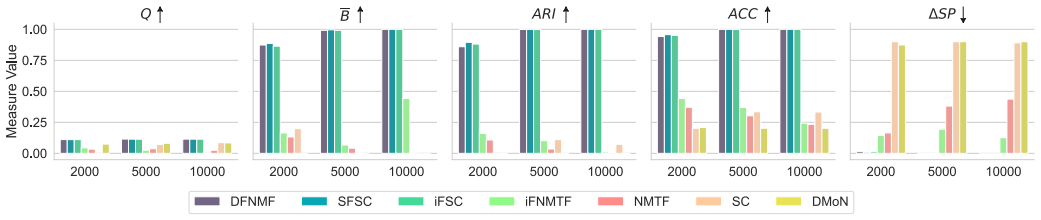
DFNMF is an end-to-end deep nonnegative tri-factorization tailored to graphs that directly optimizes cluster assignments with a soft statistical-parity regularizer. A single parameter tunes the fairness-utility balance, nonnegativity yields parts-based factors and transparent soft memberships, and across synthetic and real networks the approach achieves substantially higher group balance at comparable modularity, often dominating state-of-the-art baselines on the Pareto front.
What carries the argument
Nonnegative tri-factorization combined with a soft statistical-parity regularizer that enforces proportional group representation during modularity optimization through alternating updates.
Load-bearing premise
The combination of nonnegative tri-factorization and the soft statistical-parity regularizer produces a controllable and effective fairness-utility trade-off that generalizes beyond the tested networks without hidden biases from the alternating optimization.
What would settle it
A new network dataset in which increasing the fairness parameter lambda does not raise group balance while holding modularity steady, or in which DFNMF falls below existing baselines on the Pareto front.
Figures
read the original abstract
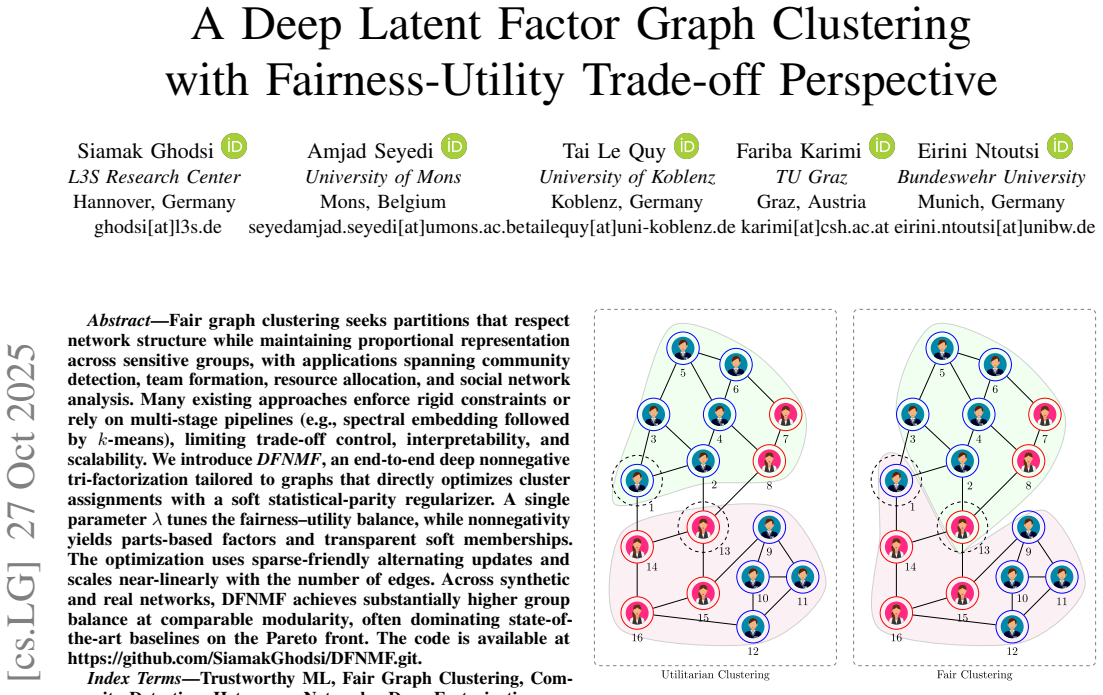
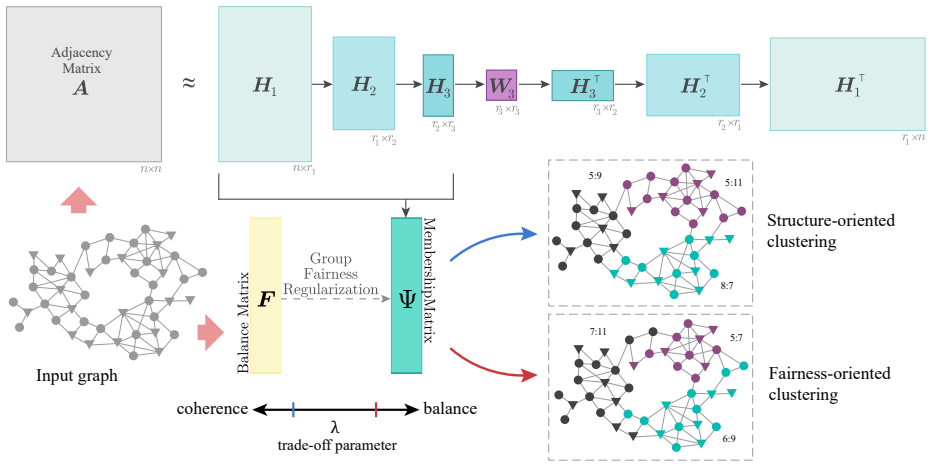
Fair graph clustering seeks partitions that respect network structure while maintaining proportional representation across sensitive groups, with applications spanning community detection, team formation, resource allocation, and social network analysis. Many existing approaches enforce rigid constraints or rely on multi-stage pipelines (e.g., spectral embedding followed by $k$-means), limiting trade-off control, interpretability, and scalability. We introduce \emph{DFNMF}, an end-to-end deep nonnegative tri-factorization tailored to graphs that directly optimizes cluster assignments with a soft statistical-parity regularizer. A single parameter $\lambda$ tunes the fairness--utility balance, while nonnegativity yields parts-based factors and transparent soft memberships. The optimization uses sparse-friendly alternating updates and scales near-linearly with the number of edges. Across synthetic and real networks, DFNMF achieves substantially higher group balance at comparable modularity, often dominating state-of-the-art baselines on the Pareto front. The code is available at https://github.com/SiamakGhodsi/DFNMF.git.
Editorial analysis
A structured set of objections, weighed in public.
Referee Report
Summary. The manuscript proposes DFNMF, an end-to-end deep nonnegative tri-factorization model for fair graph clustering. It augments standard NMF-style factorization with a soft statistical-parity regularizer whose strength is controlled by a single scalar λ, and optimizes the joint objective via sparse-friendly alternating updates. The central empirical claim is that DFNMF produces substantially higher group balance at comparable modularity than existing baselines and frequently dominates the Pareto front on both synthetic and real networks.
Significance. If the reported Pareto dominance is robust, the work would supply a scalable, parts-based, and single-parameter method for trading off community structure against demographic parity in graph clustering—an improvement over rigid-constraint or multi-stage pipelines. The public code release is a positive factor for verification.
major comments (3)
- [Abstract and Experiments] The abstract and experimental section report superior Pareto performance on synthetic and real networks, yet supply no quantitative details on the exact baselines, number of runs, error bars, statistical significance tests, or data-exclusion rules; without these the dominance claim cannot be evaluated.
- [Optimization and Experiments] The joint objective is non-convex; the manuscript does not report results across multiple random initializations or iteration-order permutations, leaving open the possibility that the observed fairness-utility trade-off is an artifact of favorable convergence rather than a stable property of the model class (see skeptic note on alternating optimization).
- [Method and Experiments] The claim that a single λ produces a controllable and generalizable trade-off rests on the assumption that the soft parity regularizer interacts cleanly with the tri-factorization; no ablation isolating the regularizer’s effect or testing sensitivity to initialization is provided.
minor comments (1)
- [Method] Notation for the tri-factorization matrices and the precise form of the statistical-parity term should be stated explicitly in the main text rather than deferred to the appendix.
Simulated Author's Rebuttal
We thank the referee for the thoughtful and constructive comments. These points help clarify the experimental rigor and robustness of our claims. We address each major comment below and commit to revisions that strengthen the manuscript without altering its core contributions.
read point-by-point responses
-
Referee: [Abstract and Experiments] The abstract and experimental section report superior Pareto performance on synthetic and real networks, yet supply no quantitative details on the exact baselines, number of runs, error bars, statistical significance tests, or data-exclusion rules; without these the dominance claim cannot be evaluated.
Authors: We agree that the current presentation lacks sufficient experimental detail to allow full evaluation of the Pareto-dominance claims. In the revised manuscript we will add: (i) an explicit table listing all baselines with citations, (ii) the precise number of independent runs (we will report results over 10 random seeds), (iii) error bars as mean ± one standard deviation, (iv) statistical significance results using paired Wilcoxon signed-rank tests against the strongest baseline, and (v) a clear description of data preprocessing and any exclusion criteria applied to the real-world networks. These additions will be placed in a dedicated “Experimental Setup” subsection. revision: yes
-
Referee: [Optimization and Experiments] The joint objective is non-convex; the manuscript does not report results across multiple random initializations or iteration-order permutations, leaving open the possibility that the observed fairness-utility trade-off is an artifact of favorable convergence rather than a stable property of the model class (see skeptic note on alternating optimization).
Authors: We acknowledge the non-convex nature of the joint objective and the potential sensitivity of alternating optimization to initialization and update ordering. Although our internal checks indicated stable convergence behavior, we did not systematically document this in the original submission. In the revision we will add a new subsection reporting performance across 10 distinct random initializations for both synthetic and real networks, together with a brief analysis of iteration-order sensitivity. We will also include a short discussion of why the observed trade-off appears robust under the chosen sparse-friendly alternating scheme. revision: yes
-
Referee: [Method and Experiments] The claim that a single λ produces a controllable and generalizable trade-off rests on the assumption that the soft parity regularizer interacts cleanly with the tri-factorization; no ablation isolating the regularizer’s effect or testing sensitivity to initialization is provided.
Authors: We appreciate this observation. To substantiate the controllability claim, the revised manuscript will contain an ablation study that directly compares DFNMF with the regularizer disabled (λ = 0) against the full model across a range of λ values. We will also report sensitivity of the fairness–utility frontier to different random initializations and provide a brief theoretical note on how the soft parity term interacts with the nonnegative tri-factorization constraints. These additions will be supported by additional figures and tables. revision: yes
Circularity Check
No significant circularity; method introduces independent regularizer and optimization
full rationale
The paper presents DFNMF as a new end-to-end deep nonnegative tri-factorization model that adds a soft statistical-parity regularizer (controlled by a single tunable lambda) to standard NMF-style factorization for graphs. The alternating sparse-friendly updates and Pareto-front claims are derived from this joint objective rather than reducing to any pre-fitted quantity, self-citation chain, or definitional equivalence within the paper's own equations. No load-bearing step quotes or relies on prior author work as an unverified uniqueness theorem or ansatz; results are framed as empirical outcomes on synthetic and real networks. The derivation remains self-contained against external NMF baselines plus the novel fairness term.
Axiom & Free-Parameter Ledger
free parameters (1)
- lambda
axioms (2)
- domain assumption Nonnegativity of the latent factors produces parts-based representations and transparent soft cluster memberships.
- domain assumption Alternating sparse-friendly updates converge to a useful solution for the joint clustering-plus-fairness objective on real graphs.
Lean theorems connected to this paper
-
IndisputableMonolith/Cost/FunctionalEquation.leanwashburn_uniqueness_aczel unclear?
unclearRelation between the paper passage and the cited Recognition theorem.
min_{H_i,W_p} ||A - Ψ W_p Ψ^T||_F^2 + λ ||F^T Ψ||_F^2 with alternating Lee-Seung-style updates (Eqs. 12-16)
-
IndisputableMonolith/Foundation/RealityFromDistinction.leanreality_from_one_distinction unclear?
unclearRelation between the paper passage and the cited Recognition theorem.
single parameter λ tunes fairness-utility trade-off; non-convex alternating optimization
What do these tags mean?
- matches
- The paper's claim is directly supported by a theorem in the formal canon.
- supports
- The theorem supports part of the paper's argument, but the paper may add assumptions or extra steps.
- extends
- The paper goes beyond the formal theorem; the theorem is a base layer rather than the whole result.
- uses
- The paper appears to rely on the theorem as machinery.
- contradicts
- The paper's claim conflicts with a theorem or certificate in the canon.
- unclear
- Pith found a possible connection, but the passage is too broad, indirect, or ambiguous to say the theorem truly supports the claim.
Reference graph
Works this paper leans on
-
[1]
Bias in data-driven artificial intelligence systems: An introductory survey,
E. Ntoutsi, P. Fafalios, U. Gadiraju, V . Iosifidis, W. Nejdl, M.-E. Vidal, S. Ruggieri, F. Turini, S. Papadopoulos, E. Krasanakiset al., “Bias in data-driven artificial intelligence systems: An introductory survey,” Wiley Interdisciplinary Reviews: Data Mining and Knowledge Discovery, vol. 10, no. 3, p. e1356, 2020
work page 2020
-
[2]
A survey on datasets for fairness-aware machine learning,
T. L. Quy, A. Roy, V . Iosifidis, W. Zhang, and E. Ntoutsi, “A survey on datasets for fairness-aware machine learning,”WIREs Data Mining Knowl. Discov., vol. 12, no. 3, 2022
work page 2022
-
[3]
Adversarial reweighting guided by wasserstein distance to achieve demographic parity,
X. Zhao, S. Fabbrizzi, P. R. Lobo, S. Ghodsi, K. Broelemann, S. Staab, and G. Kasneci, “Adversarial reweighting guided by wasserstein distance to achieve demographic parity,” inIEEE Big Data. IEEE, 2024, pp. 1605–1614
work page 2024
-
[4]
Verifying cross-modal entity consistency in news using vision-language models,
S. Tahmasebi, E. Müller-Budack, and R. Ewerth, “Verifying cross-modal entity consistency in news using vision-language models,” inECIR (4), ser. Lecture Notes in Computer Science, vol. 15575. Springer, 2025, pp. 339–354
work page 2025
-
[5]
Fairness in graph mining: A survey,
Y . Dong, J. Ma, S. Wang, C. Chen, and J. Li, “Fairness in graph mining: A survey,”IEEE Trans. Knowl. Data Eng., vol. 35, no. 10, pp. 10 583– 10 602, 2023
work page 2023
-
[6]
Policy advice and best practices on bias and fairness in AI,
J. M. Álvarez, A. B. Colmenarejo, A. Elobaid, S. Fabbrizzi, M. Fahimi, A. Ferrara, S. Ghodsi, C. Mougan, I. Papageorgiou, P. R. Lobo, M. Russo, K. M. Scott, L. State, X. Zhao, and S. Ruggieri, “Policy advice and best practices on bias and fairness in AI,”Ethics Inf. Technol., vol. 26, no. 2, p. 31, 2024
work page 2024
-
[7]
A survey of data-efficient graph learning,
W. Ju, S. Yi, Y . Wang, Q. Long, J. Luo, Z. Xiao, and M. Zhang, “A survey of data-efficient graph learning,” inIJCAI, 2024, pp. 8104–8113
work page 2024
-
[8]
Multi-fair capacitated students- topics grouping problem,
T. L. Quy, G. Friege, and E. Ntoutsi, “Multi-fair capacitated students- topics grouping problem,” inPAKDD (1), ser. LNCS, vol. 13935. Springer, 2023, pp. 507–519
work page 2023
-
[9]
Fair clustering through fairlets,
F. Chierichetti, R. Kumar, S. Lattanzi, and S. Vassilvitskii, “Fair clustering through fairlets,” inNeurIPS, 2017, pp. 5029–5037
work page 2017
-
[10]
A scalable algorithm for individually fair k-means clustering,
M. Bateni, V . Cohen-Addad, A. Epasto, and S. Lattanzi, “A scalable algorithm for individually fair k-means clustering,” inAISTATS, vol. 238. PMLR, 2024, pp. 3151–3159
work page 2024
-
[11]
Individual fairness for graph neural networks: A ranking based approach,
Y . Dong, J. Kang, H. Tong, and J. Li, “Individual fairness for graph neural networks: A ranking based approach,” inKDD. ACM, 2021, pp. 300–310
work page 2021
-
[12]
Fairness-aware graph neural networks: A survey,
A. Chen, R. A. Rossi, N. Park, P. Trivedi, Y . Wang, T. Yu, S. Kim, F. Dernoncourt, and N. K. Ahmed, “Fairness-aware graph neural networks: A survey,”ACM Trans. Knowl. Discov. Data, vol. 18, no. 6, pp. 138:1– 138:23, 2024
work page 2024
-
[13]
Fairsin: Achieving fairness in graph neural networks through sensitive information neutralization,
C. Yang, J. Liu, Y . Yan, and C. Shi, “Fairsin: Achieving fairness in graph neural networks through sensitive information neutralization,” inAAAI. AAAI Press, 2024, pp. 9241–9249
work page 2024
-
[14]
Guarantees for spectral clustering with fairness constraints,
M. Kleindessner, S. Samadi, P. Awasthi, and J. Morgenstern, “Guarantees for spectral clustering with fairness constraints,” inICML, vol. 97, 2019, pp. 3458–3467
work page 2019
-
[15]
Consistency of constrained spectral clustering under graph induced fair planted partitions,
S. Gupta and A. Dukkipati, “Consistency of constrained spectral clustering under graph induced fair planted partitions,” inNeurIPS, 2022, pp. 13 527–13 540
work page 2022
-
[16]
Scalable spectral clustering with group fairness constraints,
J. Wang, D. Lu, I. Davidson, and Z. Bai, “Scalable spectral clustering with group fairness constraints,” inAISTATS, 2023, pp. 6613–6629
work page 2023
-
[17]
Towards cohesion-fairness harmony: Contrastive regularization in individual fair graph clustering,
S. Ghodsi, S. A. Seyedi, and E. Ntoutsi, “Towards cohesion-fairness harmony: Contrastive regularization in individual fair graph clustering,” inPAKDD (1), vol. 14645, 2024, pp. 284–296
work page 2024
-
[18]
Graph learning based recommender systems: A review,
S. Wang, L. Hu, Y . Wang, X. He, Q. Z. Sheng, M. A. Orgun, L. Cao, F. Ricci, and P. S. Yu, “Graph learning based recommender systems: A review,” inProceedings of the 30th IJCAI, 2021, pp. 4644–4652
work page 2021
-
[19]
Affinity clustering framework for data debiasing using pairwise distribution discrepancy,
S. Ghodsi and E. Ntoutsi, “Affinity clustering framework for data debiasing using pairwise distribution discrepancy,” inEWAF, ser. CEUR Proceedings, vol. 3442, 2023
work page 2023
-
[20]
Context matters for fairness - a case study on the effect of spatial distribution shifts,
S. Ghodsi, H. Alani, and E. Ntoutsi, “Context matters for fairness - a case study on the effect of spatial distribution shifts,”CoRR, vol. abs/2206.11436, 2022
-
[21]
SoK: Fair Clustering: Critique, Caveats, and Future Directions,
J. Dickerson, S. A. Esmaeili, J. Morgenstern, and C. J. Zhang, “SoK: Fair Clustering: Critique, Caveats, and Future Directions,” inIEEE Conference on Secure and Trustworthy Machine Learning (SaTML). IEEE Computer Society, Apr. 2025, pp. 698–713
work page 2025
-
[22]
Spectral normalized-cut graph partitioning with fairness constraints,
J. Li, Y . Wang, and A. Merchant, “Spectral normalized-cut graph partitioning with fairness constraints,” inECAI, ser. Frontiers in Artificial Intelligence and Applications, vol. 372. IOS Press, 2023, pp. 1389–1397
work page 2023
-
[23]
Graph clustering with graph neural networks,
A. Tsitsulin, J. Palowitch, B. Perozzi, and E. Müller, “Graph clustering with graph neural networks,”J. Mach. Learn. Res., vol. 24, pp. 127:1– 127:21, 2023
work page 2023
-
[24]
Learning the parts of objects by non- negative matrix factorization,
D. D. Lee and H. S. Seung, “Learning the parts of objects by non- negative matrix factorization,”Nature, vol. 401, no. 6755, pp. 788–791, 1999
work page 1999
-
[25]
Gillis,Nonnegative matrix factorization
N. Gillis,Nonnegative matrix factorization. SIAM, 2020
work page 2020
-
[26]
Self- paced multi-label learning with diversity,
S. A. Seyedi, S. S. Ghodsi, F. A. Tab, M. Jalili, and P. Moradi, “Self- paced multi-label learning with diversity,” inACML, ser. Proceedings of Machine Learning Research, vol. 101. PMLR, 2019, pp. 790–805
work page 2019
-
[27]
Symmetric nonnegative matrix factorization for graph clustering,
D. Kuang, H. Park, and C. H. Q. Ding, “Symmetric nonnegative matrix factorization for graph clustering,” inSDM, 2012, pp. 106–117
work page 2012
-
[28]
Y . Pei, N. Chakraborty, and K. P. Sycara, “Nonnegative matrix tri- factorization with graph regularization for community detection in social networks,” inIJCAI. AAAI Press, 2015, pp. 2083–2089
work page 2015
-
[29]
Deep asymmetric nonnegative matrix factorization for graph clustering,
A. Hajiveiseh, S. A. Seyedi, and F. A. Tab, “Deep asymmetric nonnegative matrix factorization for graph clustering,”Pattern Recognit., vol. 148, p. 110179, 2024
work page 2024
-
[30]
A deep semi-nmf model for learning hidden representations,
G. Trigeorgis, K. Bousmalis, S. Zafeiriou, and B. W. Schuller, “A deep semi-nmf model for learning hidden representations,” inICML, vol. 32. JMLR.org, 2014, pp. 1692–1700
work page 2014
-
[31]
A survey on deep matrix factorizations,
P. D. Handschutter, N. Gillis, and X. Siebert, “A survey on deep matrix factorizations,”Comput. Sci. Rev., vol. 42, p. 100423, 2021
work page 2021
-
[32]
A tutorial on spectral clustering,
U. von Luxburg, “A tutorial on spectral clustering,”Statistics and Computing, vol. 17, no. 4, pp. 395–416, 2007
work page 2007
-
[33]
Metrics for community analysis: A survey,
T. Chakraborty, A. Dalmia, A. Mukherjee, and N. Ganguly, “Metrics for community analysis: A survey,”ACM Computing Surveys, vol. 50, no. 4, pp. 1–37, 2017
work page 2017
-
[34]
Fairness definitions explained,
S. Verma and J. Rubin, “Fairness definitions explained,” inFair- Ware@ICSE. ACM, 2018, pp. 1–7
work page 2018
-
[35]
E. Dai and S. Wang, “Say no to the discrimination: Learning fair graph neural networks with limited sensitive attribute information,” inWSDM, 2021, pp. 680–688
work page 2021
-
[36]
B. Rozemberczki and R. Sarkar, “Characteristic functions on graphs: Birds of a feather, from statistical descriptors to parametric models,” in CIKM, 2020, pp. 1325–1334
work page 2020
-
[37]
Social networks of drug users in high-risk sites: Finding the connections,
M. R. Weeks, S. Clair, S. P. Borgatti, K. Radda, and J. J. Schensul, “Social networks of drug users in high-risk sites: Finding the connections,”AIDS and Behavior, vol. 6, pp. 193–206, 2002
work page 2002
-
[38]
R. Mastrandrea, J. Fournet, and A. Barrat, “Contact patterns in a high school: a comparison between data collected using wearable sensors, contact diaries and friendship surveys,”PloS one, vol. 10, no. 9, p. e0136497, 2015
work page 2015
-
[39]
Community discovery using nonnegative matrix factorization,
F. Wang, T. Li, X. Wang, S. Zhu, and C. H. Q. Ding, “Community discovery using nonnegative matrix factorization,”Data Min. Knowl. Discov., vol. 22, no. 3, pp. 493–521, 2011
work page 2011
-
[40]
An ideal point based many-objective optimization for community detection of complex networks,
S. Tahmasebi, P. Moradi, S. Ghodsi, and A. Abdollahpouri, “An ideal point based many-objective optimization for community detection of complex networks,”Inf. Sci., vol. 502, pp. 125–145, 2019
work page 2019
-
[41]
Many-objective evolutionary optimization using density peaks scoring selection strategy,
S. Ghodsi, S. Tahmasebi, M. Jalili, and P. Moradi, “Many-objective evolutionary optimization using density peaks scoring selection strategy,” inGECCO Companion. ACM, 2024, pp. 331–334
work page 2024
-
[42]
On the convergence of multiplicative update algorithms for nonnegative matrix factorization,
C. Lin, “On the convergence of multiplicative update algorithms for nonnegative matrix factorization,”IEEE Trans. Neural Networks, vol. 18, no. 6, pp. 1589–1596, 2007
work page 2007
-
[43]
Rethinking neural vs. matrix-factorization collaborative filtering: the theoretical perspectives,
D. Xu, C. Ruan, E. Körpeoglu, S. Kumar, and K. Achan, “Rethinking neural vs. matrix-factorization collaborative filtering: the theoretical perspectives,” inICML, vol. 139, 2021, pp. 11 514–11 524
work page 2021
-
[44]
Neural collaborative filtering vs. matrix factorization revisited,
S. Rendle, W. Krichene, L. Zhang, and J. R. Anderson, “Neural collaborative filtering vs. matrix factorization revisited,” inRecSys. ACM, 2020, pp. 240–248
work page 2020
-
[45]
Fairbranch: Mitigating bias transfer in fair multi-task learning,
A. Roy, C. Koutlis, S. Papadopoulos, and E. Ntoutsi, “Fairbranch: Mitigating bias transfer in fair multi-task learning,” inIJCNN. IEEE, 2024, pp. 1–8
work page 2024
-
[46]
Multi-dimensional discrimination in law and machine learning - A comparative overview,
A. Roy, J. Horstmann, and E. Ntoutsi, “Multi-dimensional discrimination in law and machine learning - A comparative overview,” inFAccT. ACM, 2023, pp. 89–100
work page 2023
-
[47]
Mmm-fair: An interactive toolkit for exploring and operationalizing multi-fairness trade- offs,
S. Swati, A. Roy, E. Panagiotou, and E. Ntoutsi, “Mmm-fair: An interactive toolkit for exploring and operationalizing multi-fairness trade- offs,”CoRR, vol. abs/2509.08156, 2025. VIII. APPENDIX1: THEORETICS ANDDIFFERENTIAL CALCULUS A. Epistemic Comparison of NMF & DNN In this section, we discuss theoretical and epistemic differ- ences between NMF-based an...
discussion (0)
Sign in with ORCID, Apple, or X to comment. Anyone can read and Pith papers without signing in.