Study of Neutron Star Properties under the Two-Flavor Quark NJL Model
Pith reviewed 2026-05-18 03:10 UTC · model grok-4.3
The pith
Neutron star models require the hadron-quark crossover to begin near nuclear saturation density to match both high pulsar masses and compact radii.
A machine-rendered reading of the paper's core claim, the machinery that carries it, and where it could break.
Core claim
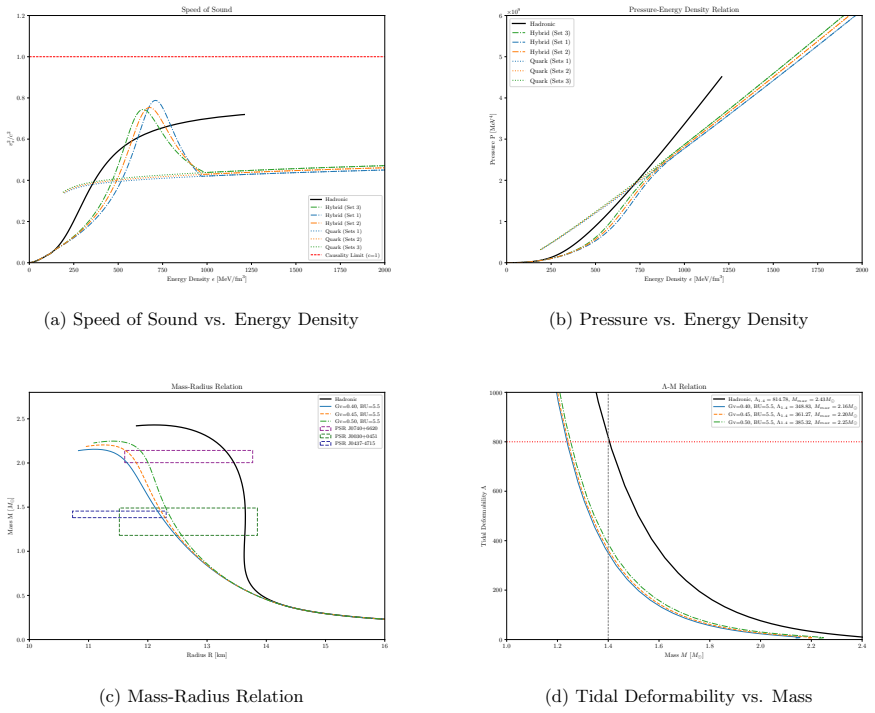
Integrating the DDME2 relativistic mean-field model for hadronic matter with the two-flavor Nambu-Jona-Lasinio model for quark matter, linked by a quintic polynomial that ensures C squared continuity and thermodynamic consistency, yields hybrid-star configurations that satisfy the 2.14 solar-mass measurement of PSR J0740+6620 together with NICER radius constraints only when the hadron-quark crossover begins near nuclear saturation density. This early onset of quark degrees of freedom is required to reconcile the high stiffness for large masses with the softness for small radii.
What carries the argument
The quintic polynomial interpolation that produces a thermodynamically consistent crossover between the DDME2 hadronic equation of state and the two-flavor NJL quark equation of state.
If this is right
- Hybrid stars with an early quark crossover can simultaneously reach masses above 2 solar masses and maintain compact radii.
- Quark degrees of freedom must appear at densities close to those found in atomic nuclei inside observed neutron stars.
- The parameter space of the two models is narrowed by the joint requirements of massive pulsars and NICER radius data.
- Smooth crossovers at low density become a necessary feature for any equation of state that fits current multi-messenger observations.
Where Pith is reading between the lines
- Most of the interior of a typical neutron star would then be in a mixed hadronic-quark state rather than pure hadronic matter.
- The same crossover construction could be tested against future gravitational-wave signals from neutron-star mergers.
- Extending the approach to three-flavor quark models might reveal whether strange quark matter alters the required onset density.
- The result tightens the link between laboratory nuclear physics and astrophysical observations of dense matter.
Load-bearing premise
The DDME2 hadronic model and the two-flavor NJL quark model remain accurate descriptions of matter up to and through the crossover region, and the interpolation introduces no thermodynamic inconsistencies that change the mass-radius curve.
What would settle it
A precise radius measurement for a neutron star near 2 solar masses that is substantially larger than the values produced by models with a crossover near saturation density, or a high-mass pulsar whose radius is incompatible with an early crossover.
Figures


read the original abstract
The Equation of State (EOS) of matter within neutron stars is a central topic in nuclear physics and astrophysics.This study investigates hadron-quark hybrid stars by integrating the density-dependent DDME2 relativistic mean-field model for hadronic matter with a two-flavor Nambu-Jona-Lasinio (NJL) model for quark matter.A quintic polynomial interpolation is employed to construct a smooth ($C^2$ continuity) and thermodynamically consistent crossover between the phases.We systematically explore the parameter space to reconcile the tension between the high stiffness required by massive pulsars and the softness demanded by tidal deformability and radius constraints.Our analysis demonstrates that to simultaneously satisfy the mass measurement of PSR J0740+6620 and the compact radius constraints from NICER (e.g., PSR J0437-4715), the hadron-quark crossover must initiate in the vicinity of nuclear saturation density.This result suggests that the early percolation of quark degrees of freedom is a necessary feature to accommodate current multi-messenger observations.
Editorial analysis
A structured set of objections, weighed in public.
Referee Report
Summary. The manuscript constructs a hybrid equation of state for neutron stars by matching the DDME2 relativistic mean-field model for hadronic matter to a two-flavor NJL model for quark matter via a quintic polynomial interpolation that enforces C^2 continuity and thermodynamic consistency. Systematic variation of NJL couplings, cutoff, and crossover onset density is used to generate mass-radius sequences, leading to the claim that only a hadron-quark crossover beginning near nuclear saturation density can simultaneously accommodate the 2.08 M_⊙ mass of PSR J0740+6620 and the compact radii inferred from NICER data on PSR J0437-4715.
Significance. If the interpolation is demonstrated to preserve causality and thermodynamic stability, the work supplies a concrete constraint on the density at which quark degrees of freedom must appear, helping to reconcile the stiffness required by massive pulsars with the softness implied by radius and tidal-deformability bounds. The explicit use of two established models plus a reproducible interpolation procedure is a methodological strength.
major comments (2)
- [§3.2] §3.2 (Hybrid EOS construction): the quintic polynomial is asserted to produce a thermodynamically consistent crossover, yet the manuscript provides neither tabulated coefficients nor explicit verification that c_s^2 = dP/dε remains ≤1 throughout the interpolated interval. Because the reported M-R curves that force the early-onset conclusion rest directly on this segment, the absence of these checks is load-bearing.
- [§4] §4 (Results and parameter scan): the necessity of crossover onset near n_sat is obtained by scanning NJL parameters and crossover density until the EOS reproduces the very mass and radius observations used as constraints. This procedure makes the central claim partly a fitted outcome rather than an independent prediction, weakening the assertion that early percolation is required by the data.
minor comments (2)
- [§2] Notation for the crossover onset density is introduced without a clear symbol definition in the text preceding Eq. (X).
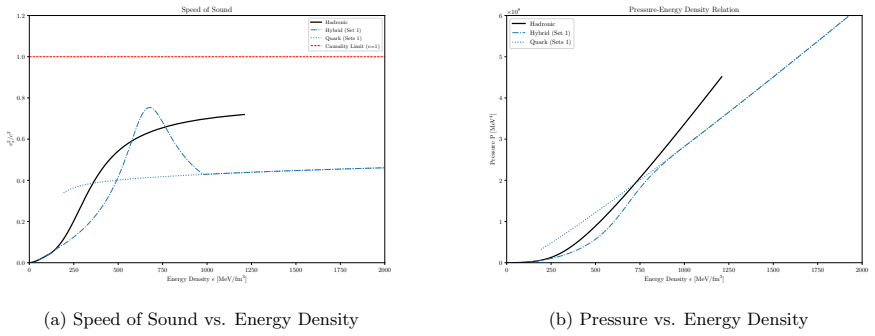
- [Fig. 5] Figure 5 (M-R curves) would benefit from an inset or separate panel showing c_s^2 versus density across the interpolated region.
Simulated Author's Rebuttal
We thank the referee for the detailed and constructive review. The comments have helped us identify areas where additional rigor and clarity are needed. We address each major comment below and indicate the revisions we will make.
read point-by-point responses
-
Referee: [§3.2] §3.2 (Hybrid EOS construction): the quintic polynomial is asserted to produce a thermodynamically consistent crossover, yet the manuscript provides neither tabulated coefficients nor explicit verification that c_s^2 = dP/dε remains ≤1 throughout the interpolated interval. Because the reported M-R curves that force the early-onset conclusion rest directly on this segment, the absence of these checks is load-bearing.
Authors: We agree that explicit verification of causality is necessary given the central role of the interpolated segment. In the revised version we have computed c_s² = dP/dε across the entire crossover interval for all parameter sets used in the mass-radius sequences and confirmed that it remains strictly below unity. We will add a new figure displaying c_s² versus baryon density in the interpolated region together with a brief discussion of the thermodynamic consistency checks. We will also tabulate the quintic coefficients for the representative models in a new appendix to ensure full reproducibility. revision: yes
-
Referee: [§4] §4 (Results and parameter scan): the necessity of crossover onset near n_sat is obtained by scanning NJL parameters and crossover density until the EOS reproduces the very mass and radius observations used as constraints. This procedure makes the central claim partly a fitted outcome rather than an independent prediction, weakening the assertion that early percolation is required by the data.
Authors: We acknowledge that our exploration of parameter space is used to locate viable models. Nevertheless, the central result is a constraint within the chosen framework: when the DDME2 hadronic EOS is matched to the two-flavor NJL quark EOS, only crossovers that begin near saturation density simultaneously satisfy both the 2.08 M_⊙ mass of PSR J0740+6620 and the compact radii reported by NICER. Later onset densities produce either an insufficient maximum mass or radii that are too large. We will revise the text in §4 to state this more precisely as a model-dependent requirement rather than an a priori prediction, thereby clarifying the scope of the conclusion. revision: partial
Circularity Check
No significant circularity; standard model-constrained EOS analysis
full rationale
The paper constructs a hybrid EOS by combining the standard DDME2 RMF hadronic model with a two-flavor NJL quark model, using quintic polynomial interpolation solely to enforce C^2 continuity and thermodynamic consistency at the crossover. Parameters (including crossover onset density) are then varied to match external observational benchmarks such as the PSR J0740+6620 mass and NICER radius constraints. The conclusion that crossover must begin near nuclear saturation density follows directly from identifying the parameter values that satisfy these independent data within the chosen models. No step reduces by construction to a self-definition, fitted input renamed as prediction, or self-citation chain; the models and interpolation are drawn from established literature without load-bearing reliance on the authors' prior work, and the observations serve as external falsifiers rather than tautological inputs. The derivation remains self-contained against these benchmarks.
Axiom & Free-Parameter Ledger
free parameters (2)
- NJL coupling constants and cutoff
- Crossover onset density and polynomial coefficients
axioms (2)
- domain assumption Beta equilibrium and charge neutrality hold throughout the star
- domain assumption DDME2 and two-flavor NJL remain applicable across the crossover region
Lean theorems connected to this paper
-
IndisputableMonolith/Foundation/AlexanderDuality.leanalexander_duality_circle_linking unclear?
unclearRelation between the paper passage and the cited Recognition theorem.
A quintic polynomial interpolation is employed to construct a smooth (C² continuity) and thermodynamically consistent crossover between the phases... P(μ_B) = Σ C_m μ_B^m with six boundary conditions matching P, ρ_B and χ_B at μ_BL and μ_BU.
-
IndisputableMonolith/Cost/FunctionalEquation.leanwashburn_uniqueness_aczel unclear?
unclearRelation between the paper passage and the cited Recognition theorem.
We systematically explore the parameter space to reconcile the tension between the high stiffness required by massive pulsars and the softness demanded by tidal deformability...
What do these tags mean?
- matches
- The paper's claim is directly supported by a theorem in the formal canon.
- supports
- The theorem supports part of the paper's argument, but the paper may add assumptions or extra steps.
- extends
- The paper goes beyond the formal theorem; the theorem is a base layer rather than the whole result.
- uses
- The paper appears to rely on the theorem as machinery.
- contradicts
- The paper's claim conflicts with a theorem or certificate in the canon.
- unclear
- Pith found a possible connection, but the passage is too broad, indirect, or ambiguous to say the theorem truly supports the claim.
Reference graph
Works this paper leans on
-
[1]
G Baym and C Pethick. “Neutron Stars”. In:Annual Review of Nuclear and Particle Science25.Volume 25, 1975 (1975), pp. 27–77.issn: 1545-4134.doi:https : / / doi . org / 10 . 1146 / annurev . ns . 25 . 120175.000331.url:https://www.annualreviews.org/content/journals/10.1146/annurev.ns. 25.120175.000331
-
[2]
Gordon Baym and Christopher Pethick. “Physics of Neutron Stars”. In:Annual Review of Astronomy and Astrophysics17.Volume 17, 1979 (1979), pp. 415–443.issn: 1545-4282.doi:https://doi.org/ 10 . 1146 / annurev . aa . 17 . 090179 . 002215.url:https : / / www . annualreviews . org / content / journals/10.1146/annurev.aa.17.090179.002215
-
[3]
From hadrons to quarks in neutron stars: a review
Gordon Baym et al. “From hadrons to quarks in neutron stars: a review”. In:Reports on Progress in Physics81.5 (Mar. 2018), p. 056902.issn: 1361-6633.doi:10 . 1088 / 1361 - 6633 / aaae14.url: http://dx.doi.org/10.1088/1361-6633/aaae14
-
[4]
Properties of hybrid stars with hadron–quark crossover
Bo-Lin Li et al. “Properties of hybrid stars with hadron–quark crossover”. In:Modern Physics Letters A37.12 (2022), p. 2250074.doi:10.1142/S0217732322500742. eprint:https://doi.org/10.1142/ S0217732322500742.url:https://doi.org/10.1142/S0217732322500742
-
[5]
Bo-Lin Li, Yan Yan, and Jia-Lun Ping. “Hadron–quark crossover and hybrid stars with quark core”. In:Journal of Physics G: Nuclear and Particle Physics49.4 (2022), p. 045201.doi:10.1088/1361- 6471/ac4ea1.url:https://dx.doi.org/10.1088/1361-6471/ac4ea1
-
[6]
Tuomo Salmi et al. “The Radius of the High-mass Pulsar PSR J0740+6620 with 3.6 yr of NICER Data”. In:The Astrophysical Journal974.2 (Oct. 2024), p. 294.issn: 1538-4357.doi:10.3847/1538- 4357/ad5f1f.url:http://dx.doi.org/10.3847/1538-4357/ad5f1f
-
[7]
Relativistic Shapiro delay measurements of an extremely massive millisecond pulsar
H. T. Cromartie et al. “Relativistic Shapiro delay measurements of an extremely massive millisecond pulsar”. In:Nature Astronomy4.1 (Sept. 2019), 72–76.issn: 2397-3366.doi:10.1038/s41550-019- 0880-2.url:http://dx.doi.org/10.1038/s41550-019-0880-2
-
[8]
A two-solar-mass neutron star measured using Shapiro delay
P. B. Demorest et al. “A two-solar-mass neutron star measured using Shapiro delay”. In:Nature 467.7319 (2010), 1081–1083.issn: 0028-0836.doi:10.1038/nature09466.url:https://dx.doi. org/10.1038/nature09466
-
[9]
THE NANOGRAV NINE-YEAR DATA SET: MASS AND GEOMETRIC MEASUREMENTS OF BINARY MILLISECOND PULSARS
Emmanuel Fonseca et al. “THE NANOGRAV NINE-YEAR DATA SET: MASS AND GEOMETRIC MEASUREMENTS OF BINARY MILLISECOND PULSARS”. In:The Astrophysical Journal832.2 (Nov. 2016), p. 167.issn: 1538-4357.doi:10.3847/0004- 637x/832/2/167.url:http://dx.doi. org/10.3847/0004-637X/832/2/167
-
[10]
Phenomenological QCD equation of state for massive neutron stars
Toru Kojo et al. “Phenomenological QCD equation of state for massive neutron stars”. In:Physical Review D91.4 (Feb. 2015).issn: 1550-2368.doi:10.1103/physrevd.91.045003.url:http://dx. doi.org/10.1103/PhysRevD.91.045003
-
[11]
B. P. Abbott et al. “GW170817: Observation of Gravitational Waves from a Binary Neutron Star Inspiral”. In:Physical Review Letters119.16 (Oct. 2017).issn: 1079-7114.doi:10.1103/physrevlett. 119.161101.url:http://dx.doi.org/10.1103/PhysRevLett.119.161101
-
[12]
ApJL , archivePrefix = "arXiv", eprint =
B. P. Abbott et al. “Multi-messenger Observations of a Binary Neutron Star Merger*”. In:The Astro- physical Journal Letters848.2 (Oct. 2017), p. L12.issn: 2041-8213.doi:10.3847/2041-8213/aa91c9. url:http://dx.doi.org/10.3847/2041-8213/aa91c9
-
[13]
GW170817: Measurements of Neutron Star Radii and Equation of State
B. P. Abbott et al. “GW170817: Measurements of Neutron Star Radii and Equation of State”. In: Phys. Rev. Lett.121 (16 2018), p. 161101.doi:10.1103/PhysRevLett.121.161101.url:https: //link.aps.org/doi/10.1103/PhysRevLett.121.161101
work page doi:10.1103/physrevlett.121.161101.url:https: 2018
-
[14]
Properties of the Binary Neutron Star Merger GW170817
B. P. Abbott et al. “Properties of the Binary Neutron Star Merger GW170817”. In:Phys. Rev. X9 (1 2019), p. 011001.doi:10.1103/PhysRevX.9.011001.url:https://link.aps.org/doi/10.1103/ PhysRevX.9.011001
work page doi:10.1103/physrevx.9.011001.url:https://link.aps.org/doi/10.1103/ 2019
-
[15]
NJL-model analysis of dense quark matter
M BUBALLA. “NJL-model analysis of dense quark matter”. In:Physics Reports407.4–6 (Feb. 2005), 205–376.issn: 0370-1573.doi:10.1016/j.physrep.2004.11.004.url:http://dx.doi.org/10. 1016/j.physrep.2004.11.004. 20
work page doi:10.1016/j.physrep.2004.11.004.url:http://dx.doi.org/10 2005
-
[16]
Dynamical Model of Elementary Particles Based on an Analogy with Superconductivity. I
Y. Nambu and G. Jona-Lasinio. “Dynamical Model of Elementary Particles Based on an Analogy with Superconductivity. I”. In:Phys. Rev.122 (1 1961), pp. 345–358.doi:10.1103/PhysRev.122.345. url:https://link.aps.org/doi/10.1103/PhysRev.122.345
-
[17]
Interacting ud and uds quark matter at finite densities and quark stars
Wen-Li Yuan et al. “Interacting ud and uds quark matter at finite densities and quark stars”. In: Physical Review D105.12 (June 2022).issn: 2470-0029.doi:10.1103/physrevd.105.123004.url: http://dx.doi.org/10.1103/PhysRevD.105.123004
-
[18]
QCD phenomenology based on a chiral effective Lagrangian
Tetsuo Hatsuda and Teiji Kunihiro. “QCD phenomenology based on a chiral effective Lagrangian”. In: Physics Reports247.5–6 (Oct. 1994), 221–367.issn: 0370-1573.doi:10.1016/0370-1573(94)90022-1. url:http://dx.doi.org/10.1016/0370-1573(94)90022-1
-
[19]
The Ground state of matter at high densities: Equation of state and stellar models
Gordon Baym, Christopher Pethick, and Peter Sutherland. “The Ground State of Matter at High Densities: Equation of State and Stellar Models”. In:Astrophys. J.170 (1971), pp. 299–317.doi: 10.1086/151216
-
[20]
Variational Monte Carlo calculations of n+H3 scattering
Shashi K. Dhiman, Raj Kumar, and B. K. Agrawal. “Nonrotating and rotating neutron stars in the extended field theoretical model”. In:Phys. Rev. C76 (4 2007), p. 045801.doi:10.1103/PhysRevC. 76.045801.url:https://link.aps.org/doi/10.1103/PhysRevC.76.045801
-
[21]
Neutron star radii and crusts: Uncertainties and unified equations of state
M. Fortin et al. “Neutron star radii and crusts: Uncertainties and unified equations of state”. In:Phys. Rev. C94 (3 2016), p. 035804.doi:10.1103/PhysRevC.94.035804.url:https://link.aps.org/ doi/10.1103/PhysRevC.94.035804
work page doi:10.1103/physrevc.94.035804.url:https://link.aps.org/ 2016
-
[22]
Asymmetric nuclear matter and neutron skin in an extended relativistic mean-field model
B. K. Agrawal. “Asymmetric nuclear matter and neutron skin in an extended relativistic mean-field model”. In:Phys. Rev. C81 (3 2010), p. 034323.doi:10.1103/PhysRevC.81.034323.url:https: //link.aps.org/doi/10.1103/PhysRevC.81.034323
-
[23]
The Relativistic Mean-Field Model of Nuclear Structure and Dynamics
P.-G. Reinhard et al. “The Relativistic Mean-Field Model of Nuclear Structure and Dynamics”. In: The Nuclear Equation of State: Part A: Discovery of Nuclear Shock Waves and the EOS. Ed. by Walter Greiner and Horst St¨ ocker. Boston, MA: Springer US, 1989, pp. 635–647.isbn: 978-1-4613-0583-5.doi: 10.1007/978-1-4613-0583-5_50.url:https://doi.org/10.1007/978...
work page doi:10.1007/978-1-4613-0583-5_50.url:https://doi.org/10.1007/978-1-4613-0583-5_50 1989
-
[24]
The equation of state of hot, dense matter and neutron stars
James M. Lattimer and Madappa Prakash. “The equation of state of hot, dense matter and neutron stars”. In:Physics Reports621 (Mar. 2016), 127–164.issn: 0370-1573.doi:10.1016/j.physrep. 2015.12.005.url:http://dx.doi.org/10.1016/j.physrep.2015.12.005
-
[25]
Neutron Stars 1: Equation of State and Structure
Pawe l Haensel, Alexander Y. Potekhin, and Dmitry G. Yakovlev. “Neutron Stars 1: Equation of State and Structure”. In:Astrophys. Space Sci. Libr.326 (2007).doi:10.1007/978-0-387-47301-4
-
[26]
Static Solutions of Einstein’s Field Equations for Spheres of Fluid
Richard C. Tolman. “Static Solutions of Einstein’s Field Equations for Spheres of Fluid”. In:Phys. Rev.55 (4 1939), pp. 364–373.doi:10.1103/PhysRev.55.364.url:https://link.aps.org/doi/ 10.1103/PhysRev.55.364
work page doi:10.1103/physrev.55.364.url:https://link.aps.org/doi/ 1939
-
[27]
J. R. Oppenheimer and G. M. Volkoff. “On Massive Neutron Cores”. In:Phys. Rev.55 (4 1939), pp. 374– 381.doi:10.1103/PhysRev.55.374.url:https://link.aps.org/doi/10.1103/PhysRev.55.374
work page doi:10.1103/physrev.55.374.url:https://link.aps.org/doi/10.1103/physrev.55.374 1939
-
[28]
G. Raaijmakers et al. “A Nicer View of PSR J0030+0451: Implications for the Dense Matter Equation of State”. In:Astrophysical Journal887.1, L22 (Dec. 2019), p. L22.doi:10.3847/2041-8213/ab451a. arXiv:1912.05703 [astro-ph.HE]
-
[29]
Slavko Bogdanov et al. “Constraining the Neutron Star Mass–Radius Relation and Dense Matter Equation of State with NICER. I. The Millisecond Pulsar X-Ray Data Set”. In:The Astrophysical Journal Letters887.1 (Dec. 2019), p. L25.issn: 2041-8213.doi:10.3847/2041-8213/ab53eb.url: http://dx.doi.org/10.3847/2041-8213/ab53eb
-
[30]
Tidal Love Numbers of Neutron Stars
Tanja Hinderer. “Tidal Love Numbers of Neutron Stars”. In:The Astrophysical Journal677.2 (Apr. 2008), 1216–1220.issn: 1538-4357.doi:10.1086/533487.url:http://dx.doi.org/10.1086/533487
work page doi:10.1086/533487.url:http://dx.doi.org/10.1086/533487 2008
-
[31]
Relativistic tidal properties of neutron stars
Thibault Damour and Alessandro Nagar. “Relativistic tidal properties of neutron stars”. In:Phys. Rev. D80 (8 2009), p. 084035.doi:10.1103/PhysRevD.80.084035.url:https://link.aps.org/ doi/10.1103/PhysRevD.80.084035
work page doi:10.1103/physrevd.80.084035.url:https://link.aps.org/ 2009
-
[32]
Constraints on a phenomenologically parametrized neutron-star equation of state
Jocelyn S. Read et al. “Constraints on a phenomenologically parametrized neutron-star equation of state”. In:Phys. Rev. D79 (12 2009), p. 124032.doi:10.1103/PhysRevD.79.124032.url:https: //link.aps.org/doi/10.1103/PhysRevD.79.124032. 21
-
[33]
Gravitational wave spectroscopy of binary neutron star merger remnants with mode stacking
Huan Yang et al. “Gravitational wave spectroscopy of binary neutron star merger remnants with mode stacking”. In:Physical Review D97.2 (Jan. 2018).issn: 2470-0029.doi:10 . 1103 / physrevd . 97 . 024049.url:http://dx.doi.org/10.1103/PhysRevD.97.024049
-
[34]
A. E. H. Love. “Some problems of geodynamics”. In:Nature89 (1912), 471–472.doi:10 . 1038 / 089471a0
work page 1912
-
[35]
Relativistic theory of tidal Love numbers
Taylor Binnington and Eric Poisson. “Relativistic theory of tidal Love numbers”. In:Phys. Rev. D80 (8 2009), p. 084018.doi:10.1103/PhysRevD.80.084018.url:https://link.aps.org/doi/10. 1103/PhysRevD.80.084018
work page doi:10.1103/physrevd.80.084018.url:https://link.aps.org/doi/10 2009
-
[36]
, year = 2008, month = jan, volume = 77, number = 2, eid =
´Eanna ´E. Flanagan and Tanja Hinderer. “Constraining neutron-star tidal Love numbers with gravitational-wave detectors”. In:Phys. Rev. D77 (2 2008), p. 021502.doi:10 . 1103 / PhysRevD . 77.021502.url:https://link.aps.org/doi/10.1103/PhysRevD.77.021502
-
[37]
Tanja Hinderer et al. “Tidal deformability of neutron stars with realistic equations of state and their gravitational wave signatures in binary inspiral”. In:Phys. Rev. D81 (12 2010), p. 123016.doi: 10.1103/PhysRevD.81.123016.url:https://link.aps.org/doi/10.1103/PhysRevD.81.123016
work page doi:10.1103/physrevd.81.123016.url:https://link.aps.org/doi/10.1103/physrevd.81.123016 2010
-
[38]
Non-radial pulsation of general relativistic stellar models. I. Analytical analysis for l¿=2
Kip S. Thorne and Alphonse Campolattaro. “Non-radial pulsation of general relativistic stellar models. I. Analytical analysis for l¿=2”. In:Astrophys. J.149 (Sept. 1967), p. 591.doi:10.1086/149251
-
[39]
Gravitational-Wave Constraints on the Neutron-Star-Matter Equation of State
Eemeli Annala et al. “Gravitational-Wave Constraints on the Neutron-Star-Matter Equation of State”. In:Phys. Rev. Lett.120 (17 2018), p. 172703.doi:10.1103/PhysRevLett.120.172703.url:https: //link.aps.org/doi/10.1103/PhysRevLett.120.172703. 22
work page doi:10.1103/physrevlett.120.172703.url:https: 2018
discussion (0)
Sign in with ORCID, Apple, or X to comment. Anyone can read and Pith papers without signing in.