REVIEW 3 major objections 6 minor 1 cited by
This paper shows that a many-body GW-BSE calculation reproduces the two lowest absorption peaks of 7-armchair nanographenes within 0.05 eV of experiment after a quadratic length extrapolation, and that the size of the lowest bright excitati
Reviewed by Pith at T0; open to challenge. T0 means a machine referee read the full paper against a public rubric. the ladder, T0–T4 →
2026-08-04 07:25 UTC pith:PHXUQY32
load-bearing objection A credible CP2K GW-BSE implementation backed by a strong cross-code benchmark; the sub-0.1 eV agreement with experiment is plausible but rests on a long extrapolation and should be read as suggestive, not definitive. the 3 major comments →
Optical excitations in nanographenes from the Bethe-Salpeter equation and time-dependent density functional theory: absorption spectra and spatial descriptors
The pith
A machine-rendered reading of the paper's core claim, the machinery that carries it, and where it could break.
Core claim
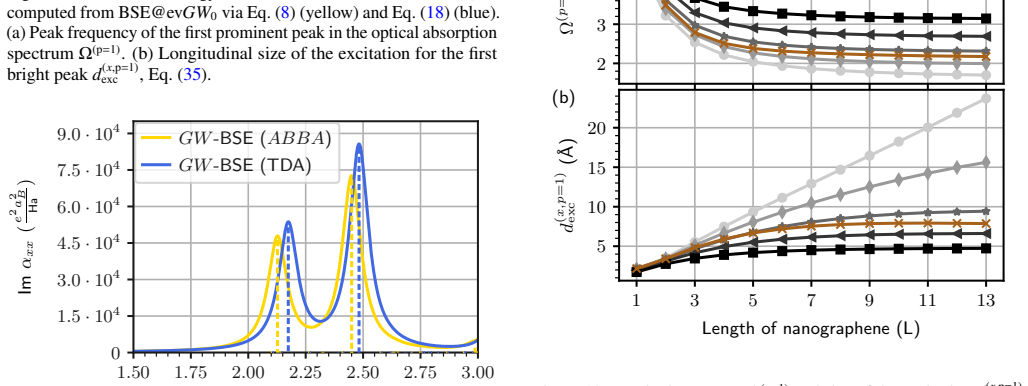
The central result is that the BSE@evGW0@PBE approach, implemented in the CP2K code, reproduces the two lowest longitudinal absorption peaks of 7-armchair nanographenes within 0.05 eV of experimental peak positions after a quadratic 1/L extrapolation to the experimental length, and that the spatial size of the lowest bright excitation converges to ~7.6 Å with increasing ribbon length. The paper further shows that TDDFT with any tested functional (PBE, BLYP, PBE0, B3LYP, HSE06, CAM-B3LYP, and PBEh with 0-100% exact exchange) fails to reproduce both the full spectral shape and the exciton size, highlighting the need for explicit electron-hole interaction and screening.
What carries the argument
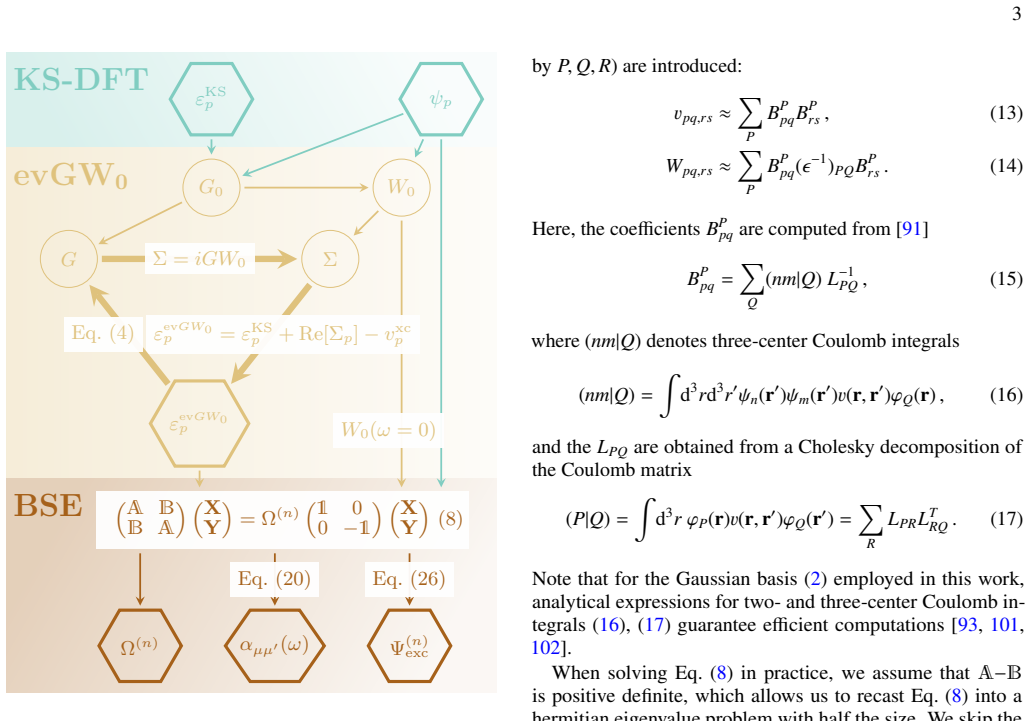
The central machinery is the Bethe-Salpeter equation built on eigenvalue-self-consistent GW quasiparticle energies (BSE@evGW0@PBE), which treats the electron-hole pair via the statically screened Coulomb interaction W0(ω=0). The spatial analysis uses the size of the excitation des = sqrt(⟨|r_e - r_h|²⟩), decomposed into electron-hole separation, electron and hole spreads, and a correlation coefficient. The finite-size analysis uses a quadratic fit Ω(p)(L)=a+b/L+c/L², motivated by a one-dimensional free-electron model, to extrapolate peak positions from L=4-13 to the experimental length L≈20 nm.
Load-bearing premise
The agreement with experiment rests on the quadratic 1/L extrapolation of the two peak positions from short ribbons (L=4-13) to the experimental length of about 20 nm; if the true length dependence deviates from this functional form at longer lengths, the claimed 0.05 eV agreement would not hold.
What would settle it
Compute BSE@evGW0@PBE absorption peaks for a nanographene with L=15 or L=20 (or use a more rigorous extrapolation with more data points) and check whether the peak positions follow the fitted quadratic curve; alternatively, measure the two experimental peak positions for ribbons of several well-characterized lengths to test the extrapolation.
If this is right
- The same GW-BSE workflow can now be applied to other finite nanostructures (nanoribbons, quantum dots, molecular aggregates) in CP2K, providing optical spectra and exciton sizes without empirical tuning.
- The saturation of the exciton size at ~7.6 Å in 7-armchair ribbons implies that optical properties of longer ribbons are governed by a local exciton with well-defined radius, not by ribbon length.
- TDDFT with standard hybrid functionals, even at 25-65% exact exchange, is insufficient for predicting both spectral shape and exciton spatial extent; quantitative exciton properties in nanographenes require many-body methods.
- The quadratic 1/L extrapolation connects computationally accessible finite flakes to experimentally synthesized ~20 nm ribbons, enabling quantitative comparison with experiment.
Where Pith is reading between the lines
- If the quadratic 1/L scaling holds beyond L=13, a direct BSE calculation at L=15 or L=20 should land on the fitted curve; a deviation would indicate the extrapolated agreement is fortuitous.
- The predicted exciton radius could be measured experimentally (e.g., via two-photon absorption or scanning tunneling spectroscopy), offering a direct test of the ~7.6 Å value.
- The descriptor framework introduced here (size of excitation, correlation coefficient) could serve as a quantitative benchmark for judging improved TDDFT kernels, such as range-separated hybrids with optimally tuned screening.
Editorial analysis
A structured set of objections, weighed in public.
Referee Report
Summary. The authors report an implementation of GW-BSE in the CP2K code and validate it against FHI-aims on Thiel's set of 28 organic molecules, obtaining a mean absolute error of 2.7 meV with different analytic-continuation settings (4.7 meV with matched settings). They then apply BSE@evGW0@PBE to finite 7-armchair nanographenes of increasing length (L=4–13), extract the two lowest longitudinal absorption peaks, and extrapolate quadratically in 1/L to the experimental length of about 20 nm. The extrapolated values (2.09 eV and 2.26 eV) agree with experiment (2.05 eV and 2.31 eV) to within 0.05 eV. The paper also computes spatial descriptors of the lowest bright excitation, finding that its longitudinal size converges to about 7.6 Å, and compares with TDDFT using several exchange–correlation functionals, concluding that none reproduce both the BSE size and the full spectral shape.
Significance. If the finite-size extrapolation is robust, the paper is a valuable contribution: it makes available an open-source GW-BSE implementation in a widely used code, backed by a strong cross-code validation (MAE < 5 meV) and reproducible data (GitHub/Zenodo). The 0.05 eV agreement with experiment would be an encouraging demonstration of BSE for finite nanostructures. The spatial-descriptor analysis provides a compact way to compare TDDFT and BSE excited-state character, and the finding that common hybrid functionals fail to simultaneously reproduce the size and spectral shape of the exciton is instructive. The claimed convergence of the exciton size to about 7.6 Å is an interesting falsifiable prediction. However, the central quantitative claim hinges on an extrapolation that is currently not sufficiently scrutinized, which tempers the significance until that point is addressed.
major comments (3)
- [Sec. III, Fig. 4 and Table I] The central claim of 0.05 eV agreement with experiment rests on the quadratic 1/L extrapolation of Ω^(p)(L) from L=4–13 to L≈46 (~20 nm). The extrapolation extends more than three times beyond the largest computed system, yet the paper provides no confidence intervals on a,b,c, no residual analysis, and no test of the assumed functional form. For p=2, b/L contributes 68 meV at L=46; a modest error in b would shift the extrapolated value by tens of meV. The BSE energy cutoff (E_empty=10 eV) already shifts peak positions by up to 45 meV at L=4 (Table II), an error comparable to the claimed agreement. Please report fit uncertainties, test sensitivity to excluding small-L points and to alternate 1/L forms, and preferably compute at least one longer system. If the extrapolated values shift by more than ~50 meV, the 'excellent agreement' wording should be softened.
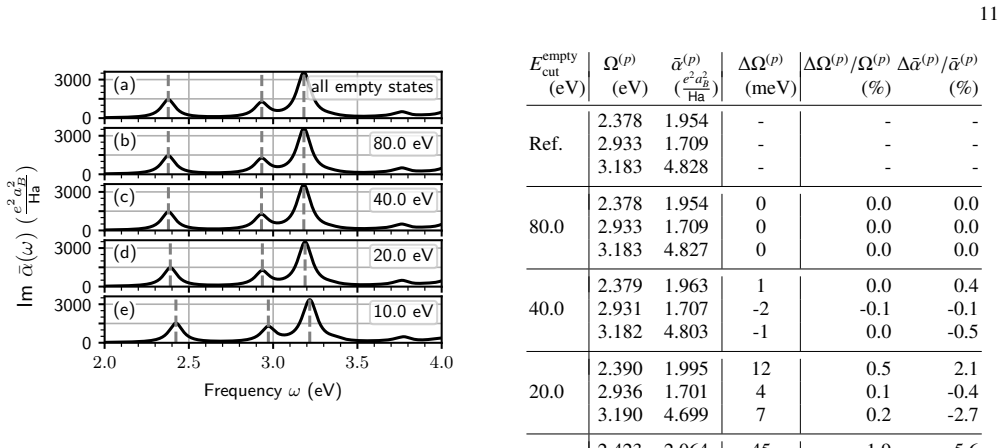
- [App. B, Table II] All production BSE calculations use E_empty^cut=10 eV (App. D). Table II shows that this cutoff shifts the first three peak positions by 35–45 meV for L=4 relative to the fully converged result, and Table III shows a 38 meV shift and 2.3% change in d_exc for the strongest excitation. This error is comparable to the claimed 0.05 eV agreement with experiment and is not included in the error budget of the extrapolated values. The authors should quantify the cutoff convergence at larger L (e.g., L=8,13) and report whether the extrapolated peak positions are stable with respect to cutoff corrections.
- [Sec. III, Fig. 5] The experimental spectra (Ref. 118) are measured for nanographenes on noble-metal surfaces, while the calculations treat free-standing molecules. Substrate screening and image-charge effects can shift excitation energies by tens of meV and are not discussed. Without an estimate of the substrate-induced shift, the agreement to 0.05 eV is not fully interpretable. Please discuss this effect and, if possible, provide a rough estimate (e.g., via a dielectric screening model or literature values for similar GNRs on metal surfaces).
minor comments (6)
- [Abstract / App. E] The abstract and Sec. II state a MAE 'below 3 meV', but this is for different analytic-continuation settings in CP2K (128 Padé, 500 grid) and FHI-aims (16 Padé, 100 grid). With matched settings the MAE is 4.7 meV (App. E, Fig. 10). Please report both values together to avoid overstatement.
- [Sec. III / Sec. VI] The direction nomenclature is inconsistent: Sec. III says 'seven carbon atoms in zigzag direction and ... L in armchair direction', while Sec. VI says the width is along the armchair direction and the length along the zigzag direction. The latter is the correct description of a 7-armchair nanographene; please fix the earlier sentence.
- [Fig. 4] The axis label '1/∞' is unconventional; consider labeling the limit as 0.
- [Eq. (24) / Fig. 5] The frequency-independent constant C in Eq. (24) is not determined, so the comparison of line shapes in Fig. 5 is qualitative. This should be stated explicitly.
- [App. G] The main text quotes a converged size of ~7.6 Å from TDA. App. G shows that solving the full BSE (ABBA) changes d_exc by up to 0.32 Å at large L; this uncertainty should be reflected in the quoted value.
- [Fig. 4 caption] Typo: 'We fit the the obtained peak frequencies' should read 'We fit the obtained peak frequencies'.
Circularity Check
No significant circularity: experimental agreement is a genuine extrapolation, implementation is benchmarked against an independent code, and self-citations are not load-bearing.
full rationale
The paper's central claims do not reduce to their own inputs. The CP2K GW-BSE implementation is validated against FHI-aims, an independent code, for Thiel's set (Sec. II, Fig. 2), giving an external benchmark rather than a self-referential check. The comparison with experiment is a genuine extrapolation: the peak positions Ω^(p)(L) are computed for L=4–13, fitted to Ω^(p)(L)=a^(p)+b^(p)/L+c^(p)/L², and only then evaluated at the experimental length L≈20 nm (Sec. III, Fig. 4, Table I). The fit parameters a,b,c are determined from the authors' own computed data, not from the experimental peak positions, so the agreement with Ω_exp=2.05 eV and 2.31 eV is not forced by construction. The use of this quadratic form is an extrapolation ansatz and is a robustness limitation, but it is not circularity. The spatial descriptors in Secs. IV–V are standard exciton-size definitions (Refs. 55,56,59) evaluated from BSE eigenvectors; the claimed ~7.6 Å saturation is a computed result, not an input. TDDFT comparisons likewise use independently defined functionals and spectra. Self-citations to the authors' prior GW methodology (Refs. 90,91,120) occur, but the methodological choices they support are benchmarked externally and are not used to forbid alternatives. No load-bearing derivation step is equivalent by construction to its input.
Axiom & Free-Parameter Ledger
free parameters (7)
- Fit coefficient a(p=1) for Ω(1)(L) =
2.08 eV
- Fit coefficient b(p=1) for Ω(1)(L) =
0.39 eV
- Fit coefficient c(p=1) for Ω(1)(L) =
3.96 eV
- Fit coefficient a(p=2) for Ω(2)(L) =
2.19 eV
- Fit coefficient b(p=2) for Ω(2)(L) =
3.13 eV
- Fit coefficient c(p=2) for Ω(2)(L) =
3.97 eV
- Broadening η =
0.05 eV (Figs. 3,9), 0.3 eV (Fig. 5)
axioms (4)
- domain assumption The GW approximation (Σ=iGW) and BSE with static screening provide a sufficiently accurate description of the optical excitations of these nanographenes.
- domain assumption The Tamm-Dancoff approximation (TDA) yields negligible deviations for the computed observables.
- ad hoc to paper The 1/L quadratic extrapolation model is valid over the range from L=4 to L→∞.
- domain assumption The isolated-molecule model is representative of the experimental nanographenes measured on a metal surface.
Cite this review
Pith. "Pith review of Optical excitations in nanographenes from the Bethe-Salpeter equation and time-dependent density functional theory: absorption spectra and spatial descriptors." pith.science (2026). https://pith.science/paper/PHXUQY32
@misc{pith2026251025658,
  author       = {Pith},
  title        = {Pith review of: Optical excitations in nanographenes from the Bethe-Salpeter equation and time-dependent density functional theory: absorption spectra and spatial descriptors},
  year         = {2026},
  howpublished = {\url{https://pith.science/paper/PHXUQY32}},
  note         = {Machine review of arXiv:2510.25658}
}
read the original abstract
The GW plus Bethe-Salpeter equation (GW-BSE) formalism is a well-established approach for calculating excitation energies and optical spectra of molecules, nanostructures, and crystalline materials. We implement GW-BSE in the CP2K code and validate the implementation for a standard organic molecular test set, obtaining excellent agreement with reference data, with a mean absolute error in excitation energies below 3 meV. We then study optical spectra of nanographenes of increasing length, showing excellent agreement with experiment. We further compute the size of the excitation of the lowest optically active excitation which converges to about 7.6 $\r{A}$ with increasing length. Comparison with time-dependent density functional theory using functionals of varying exact-exchange fraction shows that none reproduce both the size of the excitation and optical spectra of GW-BSE, underscoring the need for many-body methods for accurate description of electronic excitations in nanostructures.
Figures




Forward citations
Cited by 1 Pith paper
-
All-electron Dynamical Bethe-Salpeter Equation for Extended Systems with Atom-centered Orbital Basis Set
All-electron NAO implementation of dynamical BSE@G0W0 for extended systems, validated and demonstrated on naphthalene molecular crystal.
Reference graph
Works this paper leans on
-
[1]
C. A. Ullrich,Time-Dependent Density-Functional Theory: Concepts and Applications(Oxford University Press, Oxford, 2011)
2011
-
[2]
Onida, L
G. Onida, L. Reining, and A. Rubio, Electronic excitations: Density-functional versus many-body Green’s-function ap- proaches, Rev. Mod. Phys.74, 601 (2002)
2002
-
[3]
R. M. Martin, L. Reining, and D. Ceperley,Interacting Elec- trons: Theory and Computational Approaches(Cambridge University Press, New York, 2016)
2016
-
[4]
Kunstmann, F
J. Kunstmann, F. Mooshammer, P. Nagler, A. Chaves, F. Stein, N. Paradiso, G. Plechinger, C. Strunk, C. Sch¨uller, G. Seifert, D. R. Reichman, and T. Korn, Momentum-space indirect inter- layer excitons in transition-metal dichalcogenide van der Waals heterostructures, Nat. Phys.14, 801 (2018)
2018
-
[5]
Merkl, F
P. Merkl, F. Mooshammer, P. Steinleitner, A. Girnghuber, K.-Q. Lin, P. Nagler, J. Holler, C. Sch ¨uller, J. M. Lupton, T. Korn, S. Ovesen, S. Brem, E. Malic, and R. Huber, Ultrafast transition between exciton phases in van der Waals heterostructures, Nat. 15 Mater.18, 691 (2019)
2019
-
[6]
Siday, F
T. Siday, F. Sandner, S. Brem, M. Zizlsperger, R. Perea-Causin, F. Schiegl, S. Nerreter, M. Plankl, P. Merkl, F. Mooshammer, M. A. Huber, E. Malic, and R. Huber, Ultrafast Nanoscopy of High-Density Exciton Phases in WSe2, Nano Lett.22, 2561 (2022)
2022
-
[7]
M. H. Naik, E. C. Regan, Z. Zhang, Y .-H. Chan, Z. Li, D. Wang, Y . Yoon, C. S. Ong, W. Zhao, S. Zhao, M. I. B. Utama, B. Gao, X. Wei, M. Sayyad, K. Yumigeta, K. Watanabe, T. Taniguchi, S. Tongay, F. H. da Jornada, F. Wang, and S. G. Louie, In- tralayer charge-transfer moir´e excitons in van der Waals super- lattices, Nature609, 52 (2022)
2022
-
[8]
Schmitt, J
D. Schmitt, J. P. Bange, W. Bennecke, A. AlMutairi, G. Meneghini, K. Watanabe, T. Taniguchi, D. Steil, D. R. Luke, R. T. Weitz, S. Steil, G. S. M. Jansen, S. Brem, E. Malic, S. Hofmann, M. Reutzel, and S. Mathias, Formation of moir´e interlayer excitons in space and time, Nature608, 499 (2022)
2022
-
[9]
J. P. Bange, D. Schmitt, W. Bennecke, G. Meneghini, A. AlMu- tairi, K. Watanabe, T. Taniguchi, D. Steil, S. Steil, R. T. Weitz, G. S. M. Jansen, S. Hofmann, S. Brem, E. Malic, M. Reutzel, and S. Mathias, Probing electron-hole Coulomb correlations in the exciton landscape of a twisted semiconductor heterostruc- ture, Sci. Adv.10, eadi1323 (2024)
2024
-
[10]
Liebich, M
M. Liebich, M. Florian, N. Nilforoushan, F. Mooshammer, A. D. Koulouklidis, L. Wittmann, K. Mosina, Z. Sofer, F. Dirn- berger, M. Kira, and R. Huber, Controlling Coulomb correla- tions and fine structure of quasi-one-dimensional excitons by magnetic order, Nat. Mater.24, 384 (2025)
2025
-
[11]
Strinati, Application of the Green’s functions method to the study of the optical properties of semiconductors, Riv
G. Strinati, Application of the Green’s functions method to the study of the optical properties of semiconductors, Riv. Nuovo Cim.11, 1 (1988)
1988
-
[12]
Rohlfing and S
M. Rohlfing and S. G. Louie, Electron-hole excitations and optical spectra from first principles, Phys. Rev. B62, 4927 (2000)
2000
-
[13]
Bechstedt,Many-Body Approach to Electronic Excitations: Concepts and Applications, V ol
F. Bechstedt,Many-Body Approach to Electronic Excitations: Concepts and Applications, V ol. 181 (Springer, Berlin Heidel- berg, 2015)
2015
-
[14]
L. X. Benedict, E. L. Shirley, and R. B. Bohn, Optical Absorp- tion of Insulators and the Electron-Hole Interaction: An Ab Initio Calculation, Phys. Rev. Lett.80, 4514 (1998)
1998
-
[15]
Albrecht, L
S. Albrecht, L. Reining, R. Del Sole, and G. Onida, Ab Ini- tio Calculation of Excitonic Effects in the Optical Spectra of Semiconductors, Phys. Rev. Lett.80, 4510 (1998)
1998
-
[16]
Marini, C
A. Marini, C. Hogan, M. Gr ¨uning, and D. Varsano, Yambo: Anab initiotool for excited state calculations, Comput. Phys. Commun.180, 1392 (2009)
2009
-
[17]
Deslippe, G
J. Deslippe, G. Samsonidze, D. A. Strubbe, M. Jain, M. L. Cohen, and S. G. Louie, BerkeleyGW: A massively parallel computer package for the calculation of the quasiparticle and optical properties of materials and nanostructures, Comput. Phys. Commun.183, 1269 (2012)
2012
-
[18]
D. Y . Qiu, F. H. da Jornada, and S. G. Louie, Optical Spectrum of MoS2: Many-Body Effects and Diversity of Exciton States, Phys. Rev. Lett.111, 216805 (2013)
2013
-
[19]
A. J. Bradley, M. M. Ugeda, F. H. da Jornada, D. Y . Qiu, W. Ruan, Y . Zhang, S. Wickenburg, A. Riss, J. Lu, S.-K. Mo, Z. Hussain, Z.-X. Shen, S. G. Louie, and M. F. Crommie, Prob- ing the Role of Interlayer Coupling and Coulomb Interactions on Electronic Structure in Few-Layer MoSe2 Nanostructures, Nano Lett.15, 2594 (2015)
2015
-
[20]
Sander, E
T. Sander, E. Maggio, and G. Kresse, Beyond the Tamm- Dancoffapproximation for extended systems using exact diag- onalization, Phys. Rev. B92, 045209 (2015)
2015
-
[21]
V orwerk, B
C. V orwerk, B. Aurich, C. Cocchi, and C. Draxl, Bethe–Salpeter equation for absorption and scattering spec- troscopy: Implementation in the exciting code, Electron. Struct. 1, 037001 (2019)
2019
-
[22]
Sangalli, A
D. Sangalli, A. Ferretti, H. Miranda, C. Attaccalite, I. Marri, E. Cannuccia, P. Melo, M. Marsili, F. Paleari, A. Marrazzo, G. Prandini, P. Bonf`a, M. O. Atambo, F. Affinito, M. Palummo, A. Molina-S´anchez, C. Hogan, M. Gr¨uning, D. Varsano, and A. Marini, Many-body perturbation theory calculations using the yambo code, J. Phys.: Condens. Matter31, 325902 (2019)
2019
-
[23]
Merkel and F
K. Merkel and F. Ortmann, Linear scaling approach for optical excitations using maximally localized Wannier functions, J. Phys. Mater.7, 015001 (2023)
2023
-
[24]
Merkel, J
K. Merkel, J. Greiner, and F. Ortmann, Understanding the electronic pi-system of 2D covalent organic frameworks with Wannier functions, Sci Rep13, 1685 (2023)
2023
-
[25]
R. Zhou, Y . Yao, V . Blum, X. Ren, and Y . Kanai, All-Electron BSE@GW Method with Numeric Atom-Centered Orbitals for Extended Periodic Systems, J. Chem. Theory Comput.21, 291 (2025)
2025
-
[26]
Jacquemin, I
D. Jacquemin, I. Duchemin, and X. Blase, Benchmarking the Bethe–Salpeter Formalism on a Standard Organic Molecular Set, J. Chem. Theory Comput.11, 3290 (2015)
2015
-
[27]
Jacquemin, I
D. Jacquemin, I. Duchemin, and X. Blase, 0–0 Energies Using Hybrid Schemes: Benchmarks of TD-DFT, CIS(D), ADC(2), CC2, and BSE/GW formalisms for 80 Real-Life Compounds, J. Chem. Theory Comput.11, 5340 (2015)
2015
-
[28]
Bruneval, S
F. Bruneval, S. M. Hamed, and J. B. Neaton, A systematic benchmark of the ab initio Bethe-Salpeter equation approach for low-lying optical excitations of small organic molecules, J. Chem. Phys.142, 244101 (2015)
2015
-
[29]
Bruneval, T
F. Bruneval, T. Rangel, S. M. Hamed, M. Shao, C. Yang, and J. B. Neaton, Molgw 1: Many-body perturbation theory soft- ware for atoms, molecules, and clusters, Comput. Phys. Com- mun.208, 149 (2016)
2016
-
[30]
Blase, P
X. Blase, P. Boulanger, F. Bruneval, M. Fernandez-Serra, and I. Duchemin, GW and Bethe-Salpeter study of small water clusters, J. Chem. Phys.144, 034109 (2016)
2016
-
[31]
Jacquemin, I
D. Jacquemin, I. Duchemin, A. Blondel, and X. Blase, Assess- ment of the Accuracy of the Bethe–Salpeter (BSE/GW) Oscil- lator Strengths, J. Chem. Theory Comput.12, 3969 (2016)
2016
-
[32]
Rangel, S
T. Rangel, S. M. Hamed, F. Bruneval, and J. B. Neaton, An assessment of low-lying excitation energies and triplet insta- bilities of organic molecules with an ab initio Bethe-Salpeter equation approach and the Tamm-Dancoffapproximation, J. Chem. Phys.146, 194108 (2017)
2017
-
[33]
Jacquemin, I
D. Jacquemin, I. Duchemin, and X. Blase, Is the Bethe–Salpeter Formalism Accurate for Excitation Energies? Comparisons with TD-DFT, CASPT2, and EOM-CCSD, J. Phys. Chem. Lett. 8, 1524 (2017)
2017
-
[34]
Krause and W
K. Krause and W. Klopper, Implementation of the Bethe- Salpeter equation in the TURBOMOLE program, J. Comput. Chem.38, 383 (2017)
2017
-
[35]
X. Gui, C. Holzer, and W. Klopper, Accuracy Assessment of GW Starting Points for Calculating Molecular Excitation En- ergies Using the Bethe–Salpeter Formalism, J. Chem. Theory Comput.14, 2127 (2018)
2018
-
[36]
Blase, I
X. Blase, I. Duchemin, and D. Jacquemin, The Bethe–Salpeter equation in chemistry: Relations with TD-DFT, applications and challenges, Chem. Soc. Rev.47, 1022 (2018)
2018
-
[37]
Holzer, X
C. Holzer, X. Gui, M. E. Harding, G. Kresse, T. Helgaker, and W. Klopper, Bethe–Salpeter correlation energies of atoms and molecules, J. Chem. Phys.149, 144106 (2018). 16
2018
-
[38]
Blase, I
X. Blase, I. Duchemin, D. Jacquemin, and P.-F. Loos, The Bethe–Salpeter Equation Formalism: From Physics to Chem- istry, J. Phys. Chem. Lett.11, 7371 (2020)
2020
-
[39]
C. Liu, J. Kloppenburg, Y . Yao, X. Ren, H. Appel, Y . Kanai, and V . Blum, All-electron ab initio Bethe-Salpeter equation approach to neutral excitations in molecules with numeric atom- centered orbitals, J. Chem. Phys.152, 044105 (2020)
2020
-
[40]
F¨orster and L
A. F¨orster and L. Visscher, Quasiparticle Self-Consistent GW- Bethe–Salpeter Equation Calculations for Large Chromophoric Systems, J. Chem. Theory Comput.18, 6779 (2022)
2022
-
[41]
Rauwolf, W
N. Rauwolf, W. Klopper, and C. Holzer, Non-linear light–matter interactions from the Bethe–Salpeter equation, J. Chem. Phys.160, 061101 (2024)
2024
-
[42]
Knysh, F
I. Knysh, F. Lipparini, A. Blondel, I. Duchemin, X. Blase, P.-F. Loos, and D. Jacquemin, Reference CC3 Excitation En- ergies for Organic Chromophores: Benchmarking TD-DFT, BSE/GW, and Wave Function Methods, J. Chem. Theory Com- put.20, 8152 (2024)
2024
-
[43]
Holzer and Y
C. Holzer and Y . J. Franzke, A Guide to Molecular Properties from the Bethe–Salpeter Equation, J. Phys. Chem. Lett.16, 3980 (2025)
2025
-
[44]
G. E. Scuseria, T. M. Henderson, and D. C. Sorensen, The ground state correlation energy of the random phase approxi- mation from a ring coupled cluster doubles approach, J. Chem. Phys.129, 231101 (2008)
2008
-
[45]
T. C. Berkelbach, Communication: Random-phase approxima- tion excitation energies from approximate equation-of-motion coupled-cluster doubles, J. Chem. Phys.149, 041103 (2018)
2018
-
[46]
M. F. Lange and T. C. Berkelbach, On the Relation between Equation-of-Motion Coupled-Cluster Theory and the GW Ap- proximation, J. Chem. Theory Comput.14, 4224 (2018)
2018
-
[47]
Quintero-Monsebaiz, E
R. Quintero-Monsebaiz, E. Monino, A. Marie, and P.-F. Loos, Connections between many-body perturbation and coupled- cluster theories, J. Chem. Phys.157, 231102 (2022)
2022
-
[48]
T¨olle and G
J. T¨olle and G. Kin-Lic Chan, Exact relationships between the GW approximation and equation-of-motion coupled-cluster theories through the quasi-boson formalism, J. Chem. Phys. 158, 124123 (2023)
2023
-
[49]
Frenkel, On the Transformation of light into Heat in Solids
J. Frenkel, On the Transformation of light into Heat in Solids. I, Phys. Rev.37, 17 (1931)
1931
-
[50]
Frenkel, On the Transformation of Light into Heat in Solids
J. Frenkel, On the Transformation of Light into Heat in Solids. II, Phys. Rev.37, 1276 (1931)
1931
-
[51]
G. H. Wannier, The Structure of Electronic Excitation Levels in Insulating Crystals, Phys. Rev.52, 191 (1937)
1937
-
[52]
Plasser and H
F. Plasser and H. Lischka, Analysis of Excitonic and Charge Transfer Interactions from Quantum Chemical Calculations, J. Chem. Theory Comput.8, 2777 (2012)
2012
-
[53]
Plasser, M
F. Plasser, M. Wormit, and A. Dreuw, New tools for the sys- tematic analysis and visualization of electronic excitations. I. Formalism, J. Chem. Phys.141, 024106 (2014)
2014
-
[54]
Plasser, S
F. Plasser, S. A. B¨appler, M. Wormit, and A. Dreuw, New tools for the systematic analysis and visualization of electronic exci- tations. II. Applications, J. Chem. Phys.141, 024107 (2014)
2014
-
[55]
S. A. B¨appler, F. Plasser, M. Wormit, and A. Dreuw, Exciton analysis of many-body wave functions: Bridging the gap be- tween the quasiparticle and molecular orbital pictures, Phys. Rev. A90, 052521 (2014)
2014
-
[56]
S. A. Mewes, F. Plasser, and A. Dreuw, Communication: Exci- ton analysis in time-dependent density functional theory: How functionals shape excited-state characters, J. Chem. Phys.143, 171101 (2015)
2015
-
[57]
S. A. Mewes, J.-M. Mewes, A. Dreuw, and F. Plasser, Excitons in poly(para phenylene vinylene): A quantum-chemical per- spective based on high-level ab initio calculations, Phys. Chem. Chem. Phys.18, 2548 (2016)
2016
-
[58]
S. A. Mewes, F. Plasser, and A. Dreuw, Universal Exciton Size in Organic Polymers is Determined by Nonlocal Orbital Exchange in Time-Dependent Density Functional Theory, J. Phys. Chem. Lett.8, 1205 (2017)
2017
-
[59]
S. A. Mewes, F. Plasser, A. Krylov, and A. Dreuw, Bench- marking Excited-State Calculations Using Exciton Properties, J. Chem. Theory Comput.14, 710 (2018)
2018
-
[60]
S. A. Mewes and A. Dreuw, Density-based descriptors and ex- citon analyses for visualizing and understanding the electronic structure of excited states, Phys. Chem. Chem. Phys.21, 2843 (2019)
2019
-
[61]
Kimber and F
P. Kimber and F. Plasser, Toward an understanding of electronic excitation energies beyond the molecular orbital picture, Phys. Chem. Chem. Phys.22, 6058 (2020)
2020
-
[62]
Attaccalite, M
C. Attaccalite, M. Gr¨uning, and A. Marini, Real-time approach to the optical properties of solids and nanostructures: Time- dependent Bethe-Salpeter equation, Phys. Rev. B84, 245110 (2011)
2011
-
[63]
Jiang, Q
X. Jiang, Q. Zheng, Z. Lan, W. A. Saidi, X. Ren, and J. Zhao, Real-time GW-BSE investigations on spin-valley exciton dy- namics in monolayer transition metal dichalcogenide, Sci. Adv. 7, eabf3759 (2021)
2021
-
[64]
Sangalli, Excitons and carriers in transient absorption and time-resolved ARPES spectroscopy: An ab initio approach, Phys
D. Sangalli, Excitons and carriers in transient absorption and time-resolved ARPES spectroscopy: An ab initio approach, Phys. Rev. Mater.5, 083803 (2021)
2021
-
[65]
Y .-H. Chan, D. Y . Qiu, F. H. da Jornada, and S. G. Louie, Giant exciton-enhanced shift currents and direct current conduction with subbandgap photo excitations produced by many-electron interactions, Proc. Natl. Acad. Sci.118, e1906938118 (2021)
2021
-
[66]
Perfetto, Y
E. Perfetto, Y . Pavlyukh, and G. Stefanucci, Real-TimeGW: Toward an Ab Initio Description of the Ultrafast Carrier and Exciton Dynamics in Two-Dimensional Materials, Phys. Rev. Lett.128, 016801 (2022)
2022
-
[67]
Marek and J
ˇS. Marek and J. Wilhelm, Linear and Nonlinear Optical Prop- erties of Molecules from Real-Time Propagation Based on the Bethe–Salpeter Equation, J. Chem. Theory Comput.21, 9814 (2025)
2025
-
[68]
X. Li, N. Govind, C. Isborn, A. E. I. DePrince, and K. Lopata, Real-Time Time-Dependent Electronic Structure Theory, Chem. Rev.120, 9951 (2020)
2020
-
[69]
Mattiat and S
J. Mattiat and S. Luber, Comparison of Length, Velocity, and Symmetric Gauges for the Calculation of Absorption and Electric Circular Dichroism Spectra with Real-Time Time- Dependent Density Functional Theory, J. Chem. Theory Com- put.18, 5513 (2022)
2022
-
[70]
M. Kick, E. Alexander, A. Beiersdorfer, and T. Van V oorhis, Super-resolution techniques to simulate electronic spectra of large molecular systems, Nat. Commun.15, 1 (2024)
2024
-
[71]
Schreder and S
L. Schreder and S. Luber, Propagated (fragment) Pipek–Mezey Wannier functions in real-time time-dependent density func- tional theory, J. Chem. Phys.160, 214117 (2024)
2024
-
[72]
M. Choi, M. S. Okyay, A. P. Dieguez, M. D. Ben, K. Z. Ibrahim, and B. M. Wong, QRCODE: Massively parallelized real-time time-dependent density functional theory for periodic systems, Comput. Phys. Commun.305, 109349 (2024)
2024
-
[73]
Hanasaki and S
K. Hanasaki and S. Luber, Development of Real-Time TDDFT Program with k-Point Sampling and DFT+U in a Gaussian and Plane Waves Framework, J. Chem. Theory Comput.21, 1879 (2025)
2025
-
[74]
Villalobos-Castro, I
J. Villalobos-Castro, I. Knysh, D. Jacquemin, I. Duchemin, and X. Blase, Lagrangian Z-vector approach to Bethe–Salpeter analytic gradients: Assessing approximations, J. Chem. Phys. 159, 024116 (2023). 17
2023
-
[75]
T ¨olle, Fully Analytic G0W0 Nuclear Gradients, J
J. T ¨olle, Fully Analytic G0W0 Nuclear Gradients, J. Phys. Chem. Lett.16, 3672 (2025)
2025
-
[76]
T¨olle, M.-P
J. T¨olle, M.-P. Kitsaras, and P.-F. Loos, Fully Analytic Nuclear Gradients for the Bethe–Salpeter Equation, J. Phys. Chem. Lett. 16, 11134 (2025)
2025
-
[77]
M.-P. Kitsaras, J. T¨olle, and P.-F. Loos, AnalyticG0W0 Gradi- ents Based on a Double-Similarity Transformation Equation-of- Motion Coupled-Cluster Treatment (2025), arXiv:2510.23275
Pith/arXiv arXiv 2025
-
[78]
Roelcke, L
C. Roelcke, L. Z. Kastner, M. Graml, A. Biereder, J. Wilhelm, J. Repp, R. Huber, and Y . A. Gerasimenko, Ultrafast atomic- scale scanning tunnelling spectroscopy of a single vacancy in a monolayer crystal, Nat. Photon.18, 595 (2024)
2024
-
[79]
Siday, J
T. Siday, J. Hayes, F. Schiegl, F. Sandner, P. Menden, V . Berg- bauer, M. Zizlsperger, S. Nerreter, S. Lingl, J. Repp, J. Wilhelm, M. A. Huber, Y . A. Gerasimenko, and R. Huber, All-optical subcycle microscopy on atomic length scales, Nature629, 329 (2024)
2024
-
[80]
Zizlsperger, S
M. Zizlsperger, S. Nerreter, Q. Yuan, K. B. Lohmann, F. Sand- ner, F. Schiegl, C. Meineke, Y . A. Gerasimenko, L. M. Herz, T. Siday, M. A. Huber, M. B. Johnston, and R. Huber, In situ nanoscopy of single-grain nanomorphology and ultrafast car- rier dynamics in metal halide perovskites, Nat. Photon.18, 975 (2024)
2024
This paper was first reviewed by deepseek-v4-flash on August 4, 2026.
discussion (0)
Sign in with ORCID, Apple, or X to comment. Anyone can read and Pith papers without signing in.