REVIEW 4 major objections 5 minor 34 references
CorVS+ identifies warehouse workers by matching ceiling-camera trajectories to smartphone inertial data, reaching weighted participant F1 of 0.97.
Reviewed by Pith at T0; open to challenge. T0 means a machine referee read the full paper against a public rubric. the ladder, T0–T4 →
T0 review · deepseek-v4-flash
2026-08-04 07:09 UTC pith:4UMPJFDB
load-bearing objection Credible engineering contribution with a real dataset, but the evaluation likely leaks identity across train/test and rests on a single 10-minute window; the industrial-scale claim needs a cleaner split and a stronger baseline. the 4 major comments →
CorVS+: Correspondence-Driven Association of Video Trajectories and Sensors for Identity-Aware Person Localization in Warehouses
The pith
A machine-rendered reading of the paper's core claim, the machinery that carries it, and where it could break.
Core claim
The paper's central claim is that CorVS+ can identify sensor-wearing workers by associating each visual tracking trajectory with a smartphone's inertial measurements, using a deep model that predicts for every (trajectory, sensor) pair a correspondence probability and a separate activity-based reliability score. The reliability score, computed from the variance of movement speed and linear acceleration relative to their running averages, lets the matching algorithm postpone decisions when both signals are quiet or ambiguous, and the algorithm only confirms a match when exactly one sensor candidate exceeds the accept threshold among reliable time points. On a real warehouse dataset with 23 pa
What carries the argument
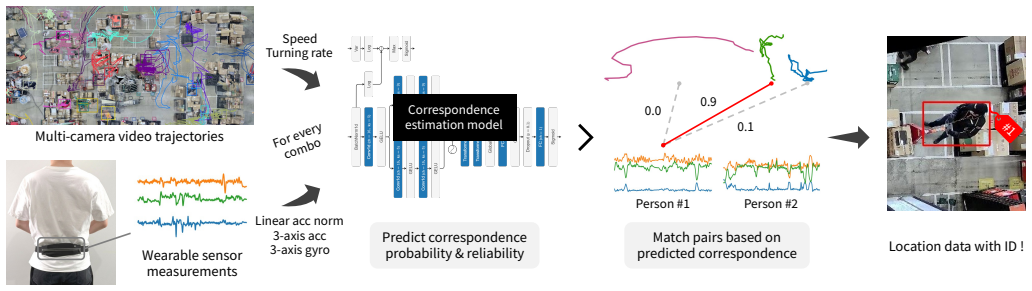
The key machinery is the two-stage design: (1) a DualCNN-Transformer correspondence model that ingests speed, turning rate, linear acceleration norm, 3-axis acceleration, and 3-axis angular velocity over a sliding window and outputs probability plus reliability, where reliability is r = sigmoid(max(log(var(x_spd)/σ̃²_spd), log(var(x_acc)/σ̃²_acc))); and (2) an incremental matching algorithm that gathers reliable time points above threshold R_csdr, averages their probabilities, and confirms a trajectory–sensor match only when the averaged probability uniquely exceeds P_acpt, otherwise deferring. This combination is what lets the method remain accurate when several workers are stationary and w
Load-bearing premise
The strongest numbers rest on the assumptions that the 10-minute test window with fixed, vest-color-labeled ground truth is representative of warehouse operations, and that trajectories shorter than the model window (or truncated at temporal boundaries) can be put aside as unscoreable rather than counted as errors.
What would settle it
Compute participant recall on a labeled test period much longer than 10 minutes (or restrict scoring to trajectories whose full duration exceeds the model window); if the W=600 recall deficit persists, the paper's explanation — boundary-truncated short trajectories — is wrong, and the method genuinely fails on brief or fragmented tracks.
If this is right
- If the claim holds, warehouses can deploy identity-aware localization by adding a low-cost phone sensor to each worker, without retrofitting uniform markers or face-readable viewpoints.
- The 'defer unreliable pairs' principle means accuracy improves with observation time, so longer operations should yield higher recall than the 10-minute test shows.
- Participant precision at W=600 reaching 1.0 suggests that uncertain, low-activity pairs are exactly the ones the method refuses to guess, which is what an operator would want.
- The new participant-oriented metrics (precision/recall/F1 restricted to sensor carriers) offer a template for evaluating identification under partial sensor coverage.
- The failure mode at large window sizes (recall drop from short/truncated trajectories) points to a concrete engineering target: variable-input-length models or online matching.
Where Pith is reading between the lines
- The reliability formula is a parameter-free, interpretable 'is anybody actually moving?' gate; the same log-variance-ratio trick could be reused in other sensor-fusion matching tasks where idle signals are confusable.
- The deferral strategy implies a scheduling interpretation: the system trades immediate answers for certainty, so a natural testable extension is to ask how long a deployment must run before every worker is confidently identified (e.g., time-to-identification distribution).
- Because the model is trained on random negative pairs, the method will inherit any failure mode where coordinated movement between two real workers resembles a positive pair; a stress test with deliberately synchronized walking pairs would reveal that boundary.
- The dataset's trajectory labels rely on vest color patterns; porting this to sites without such ground truth would require an automatic labeling step, which is an engineering prerequisite the paper leaves implicit.
Editorial analysis
A structured set of objections, weighed in public.
Referee Report
Summary. This paper presents CorVS, a method for associating visual tracking trajectories from ceiling cameras with smartphone inertial sensor measurements to identify warehouse workers without using appearance. The method first uses a DualCNN-Transformer model to predict, for each trajectory-sensor pair and time window, a correspondence probability and an activity-based reliability score; a matching algorithm then incrementally confirms or rejects pairs, deferring ambiguous or low-activity decisions. The authors introduce participant-specific precision/recall metrics and evaluate on a 40-minute annotated subset of a new warehouse dataset (27 h of sensor data, 38 km of trajectories), using 30 min for model/hyperparameter selection and 10 min for test. The reported weighted participant F1 reaches 0.97 at a 300-s window, versus 0.16 for a PDR-based baseline, with precision 1.0 at a 600-s window. The practical motivation and the proposed deferral mechanism are interesting, but the experimental validation has several load-bearing gaps.
Significance. The contribution is potentially significant for appearance-free person identification in industrial environments, where prior PDR-based methods are brittle. The activity-based reliability (Eq. 1) is a simple, non-parametric way to gate predictions, and the matching algorithm is designed for realistic scenarios with non-participants and stationary workers. The dataset release and the new evaluation metrics are useful to the community. However, the validity of the headline numbers depends on the unresolved train/test identity-overlap issue and the use of a single 10-minute test set; if these are addressed, the paper could be a solid contribution to indoor localization and human-in-the-loop logistics analytics.
major comments (4)
- [§V-A, Table II] The train/test split is not identity-disjoint. The text states that identity-exclusive assignment is applied only when splitting the 30-min tune data into training and validation subsets; it does not state that the 10-min test participants were excluded from the 30-min tune data. Since Table II lists 23 unique participants in the 10-min test and the labeled 40-min period is described as a peak period with the most workers (Sect. IV-C), it is likely that most test participants also appear in the tune data. The model can then memorize person-specific sensor/trajectory signatures, inflating the reported PF. An identity-disjoint split (or at least an overlap analysis) is essential to support the claimed superiority for new workers/roster changes.
- [§V-A, §V-E, Table III] The central result rests on a single 10-minute test segment, and the matching hyperparameters (R_csdr, P_acpt) are selected by grid search on a validation subset of the same 40-minute annotated period. With no repeated splits or confidence intervals, the reported PP/PR trade-off (e.g., PP=1.00/PR=0.66 at W=600) could shift substantially with a different test window. The 10-min test also truncates many trajectories (median duration 193 s, quarter < 63 s in Table II), which likely explains the PR drop; longer or multiple test periods are needed to separate algorithmic behavior from boundary effects.
- [§IV-C, §V-E] The evaluation uses trajectories for which tracking failures were manually fixed. This means the method's interaction with real tracking noise—an explicitly claimed challenge of real-world warehouse settings—is not measured. The paper acknowledges this, but the abstract's claim of 'industrial-scale settings' requires at least an ablation on uncorrected trajectories or a quantitative report of tracking error effects. Without this, the reported F1 pertains to an idealized trajectory input.
- [§III-C, §IV] The paper claims 'effectiveness of its unique designs' but provides no ablation of the reliability module or the deferral-based matching. Since the reliability is a non-parametric heuristic (Eq. 1), its contribution could be easily tested by removing it (e.g., matching on raw probability averages). Similarly, the negative-pair construction uses random couplings of different individuals/timestamps, which may not cover the coordinated-motion cases that the matching algorithm defers; the paper should evaluate on such cases or ablate the deferral rule.
minor comments (5)
- [Title] Title inconsistency: arXiv metadata uses 'CorVS+', while the paper body and abstract use 'CorVS'. Please harmonize.
- [§III-B1, §II-B] Typos: 'calculatd' should be 'calculated'; 'simplication' should be 'simplification'.
- [Eq. (1)] The notation for running variance σ̃² is not defined in the text; clarify that it is the batch-normalization running variance and that the max is taken over the two log ratios.
- [§IV-A] The dataset contains 27 hours of sensor measurements and 38 km of trajectories, but only 40 minutes are labeled and used. State whether the remaining data is used at all, and discuss the representativeness of the labeled subset.
- [Table III] Report weighted and unweighted metrics with confidence intervals or at least per-trajectory breakdowns; the current table gives only point estimates.
Circularity Check
Test identities are not disjoint from the 30-min tuning data, so the reported F1 partly re-identifies people whose sensor/trajectory signatures were fit during training.
specific steps
-
fitted input called prediction
[Section V-A (Model Training and Parameter Selection), Section V-E, Table III]
"With the labeled data in Sect. IV, we allocated 30 minutes for the model training and parameter selection (tune data) and the remaining 10 minutes for the test (test data). First, we randomly split the tune data into training and validation subsets with an approximate 8 : 2 ratio. Here, we assigned the individuals exclusively to either the subsets to prevent overfitting."
The only identity-disjoint split is between the training and validation subsets inside the 30-minute tune data. The 10-minute test is the remaining portion of the same 40-minute labeled peak period, and Table II reports 23 unique participants in that test. The paper never states that the test participants are excluded from the 30-minute tuning data. Therefore the correspondence model is fit on 30 minutes of the same individuals whose identities it later 'predicts' in the test. This allows the model to exploit person-specific sensor/gait signatures learned during training, so the reported participant F1 (0.97 at W=300) is partly a re-identification of seen individuals rather than a transferable prediction of trajectory-sensor correspondence. The claimed superiority over the PDR baseline is
full rationale
The core algorithmic derivation is not definitionally circular: the reliability r in Eq. (1) is a non-parametric function of input activity and running variances, is explicitly not trained ('The reliability estimation module is not involved in the training'), and the matching algorithm (Eqs. 2-6) operates on model outputs without being defined in terms of the target labels. The self-citations to the authors' prior DualCNN-Transformer [18] and dataset tools [31,32] are used as architecture/data-generation components, not as external proof of the central claim, so they are not load-bearing circularity. The main issue is the evaluation protocol: the 10-minute test is carved from the same 40-minute annotated peak period used to create the 30-minute tuning data, and identity-disjointness is only enforced within the tuning split, not between tuning and test. This means the empirical headline result is partly a test of recognizing already-seen individuals, which is a fitted-input-called-prediction concern for the industrial-scale generalization claim. Because the reliability module and matching logic still have independent content, the circularity is partial rather than total; score 4.
Axiom & Free-Parameter Ledger
free parameters (4)
- W (window length) =
300 (best PF1), 600 (best PP)
- rho_neg (negative sample ratio) =
256 for all W
- R_csdr (reliability threshold) =
0.3/0.1/0.1 for W=100/300/600
- P_acpt (probability acceptance threshold) =
0.7/0.7/0.9 for W=100/300/600
axioms (4)
- domain assumption The visual trajectories are accurate after manual fixing; evaluation is on corrected trajectories.
- domain assumption Smartphones are carried on the lower back in a fixed orientation and each sensor stream has a known identity entered by the worker.
- domain assumption A 10-minute test window is representative of the identification problem at industrial scale.
- domain assumption Random negative pairing during training approximates real confusable pairs.
Cite this review
Pith. "Pith review of CorVS+: Correspondence-Driven Association of Video Trajectories and Sensors for Identity-Aware Person Localization in Warehouses." pith.science (2026). https://pith.science/paper/4UMPJFDB
@misc{pith2026251026369,
  author       = {Pith},
  title        = {Pith review of: CorVS+: Correspondence-Driven Association of Video Trajectories and Sensors for Identity-Aware Person Localization in Warehouses},
  year         = {2026},
  howpublished = {\url{https://pith.science/paper/4UMPJFDB}},
  note         = {Machine review of arXiv:2510.26369}
}
read the original abstract
Logistics warehouses have struggled with labor shortages, but the inbound processes remain particularly human-powered. Worker location data is a key to higher productivity in such cases. Fixed cameras are a promising tool for localization, as they also offer valuable environmental information such as package status. However, identifying individuals from visual data alone is often impractical. To enable identity-aware localization, prior studies have attempted to identify people in videos by associating their trajectories with wearable sensor measurements. Although this appearance-independent approach has several advantages, existing methods may fail under real-world conditions. Therefore, we propose CorVS+, a novel data-driven person identification framework based on the correspondence between visual tracking trajectories and sensor measurements. Firstly, our deep learning model predicts the correspondence probabilities and reliabilities for every pair of a trajectory and sensor measurements. Secondly, our algorithm matches the pairs over time based on the model predictions. We developed a dataset comprising 27 hours of sensor measurements and 38 km of trajectories in a warehouse. This dataset covers actual activities and challenging situations, such as multiple stationary workers inspecting items. The evaluation indicated the superiority of CorVS+ over existing methods and the effectiveness of its unique designs for industrial-scale settings. The model and dataset will be available at https://doi.org/10.5281/zenodo.17745683.
Figures


Reference graph
Works this paper leans on
-
[1]
Digitization methods for a logistics warehouse towards digital twin-driven optimization,
N. Kawaguchi, Y . Asai, K. Kano, K. Takaki, Y . Mori, Y . Suzuki, K. Watanabe, Y . Gushi, S. Katayama, K. Urano, T. Yonezawa, and S. Hashiguchi, “Digitization methods for a logistics warehouse towards digital twin-driven optimization,” in2025 IEEE International Confer- ence on Smart Computing (SMARTCOMP), 2025, pp. 186–193
2025
-
[2]
M. Calzavara, M. Faccio, I. Granata, and A. Trevisani, “Achieving productivity and operator well-being: a dynamic task allocation strategy for collaborative assembly systems in industry 5.0,”The International Journal of Advanced Manufacturing Technology, vol. 134, no. 7, pp. 3201–3216, Oct 2024. [Online]. Available: https: //doi.org/10.1007/s00170-024-14302-3
-
[3]
A. Aslan, G. Vasantha, H. El-Raoui, J. Quigley, J. Hanson, J. Corney, and A. Sherlock, “Smarter facility layout design: leveraging worker localisation data to minimise travel time and alleviate congestion,”International Journal of Production Research, vol. 63, no. 4, pp. 1326–1353, 2025. [Online]. Available: https: //doi.org/10.1080/00207543.2024.2374847
arXiv 2025
-
[4]
Identifying people in camera networks using wearable accelerometers,
T. Teixeira, D. Jung, G. Dublon, and A. Savvides, “Identifying people in camera networks using wearable accelerometers,” inProceedings of the 2nd International Conference on PErvasive Technologies Related to Assistive Environments, ser. PETRA ’09, 2009. [Online]. Available: https://doi.org/10.1145/1579114.1579134
arXiv 2009
-
[5]
A. Akbari, P. Liu, B. J. Mortazavi, and R. Jafari, “Tagging wearable accelerometers in camera frames through information translation between vision sensors and accelerometers,” inProceedings of the 10th ACM/IEEE International Conference on Cyber-Physical Systems, ser. ICCPS ’19, 2019, pp. 174–184. [Online]. Available: https://doi.org/10.1145/3302509.3311057
arXiv 2019
-
[6]
H. Ishihara and S. Kumano, “Gravity-direction-aware joint inter- device matching and temporal alignment between camera and wearable sensors,” inCompanion Publication of the 2020 International Conference on Multimodal Interaction, ser. ICMI ’20 Companion, 2021, pp. 433–441. [Online]. Available: https://doi.org/10.1145/3395035. 3425968
-
[7]
3d person tracking in world coordinates and attribute estimation with pdr,
Y . Nagai, D. Kamisaka, N. Makibuchi, J. Xu, and S. Sakazawa, “3d person tracking in world coordinates and attribute estimation with pdr,” inProceedings of the 23rd ACM International Conference on Multimedia, ser. MM ’15, 2015, pp. 1139–1142. [Online]. Available: https://doi.org/10.1145/2733373.2806301
arXiv 2015
-
[8]
Combining passive visual cameras and active imu sensors to track cooperative people,
W. Jiang and Z. Yin, “Combining passive visual cameras and active imu sensors to track cooperative people,” in2015 18th International Conference on Information Fusion (Fusion), 2015, pp. 1338–1345
2015
-
[9]
Integrating low-resolution surveillance cam- era and smartphone inertial sensors for indoor positioning,
J. Zhang and P. Zhou, “Integrating low-resolution surveillance cam- era and smartphone inertial sensors for indoor positioning,” in2018 IEEE/ION Position, Location and Navigation Symposium (PLANS), 2018, pp. 410–416
2018
-
[10]
ipac: Integrate pedestrian dead reckoning and computer vision for indoor localization and tracking,
D. Li, Y . Lu, J. Xu, Q. Ma, and Z. Liu, “ipac: Integrate pedestrian dead reckoning and computer vision for indoor localization and tracking,” IEEE Access, vol. 7, pp. 183 514–183 523, 2019
2019
-
[11]
Identification of a person in a trajectory based on wearable sensor data analysis,
J. Yan, M. Toyoura, and X. Wu, “Identification of a person in a trajectory based on wearable sensor data analysis,”Sensors, vol. 24, no. 11, 2024. [Online]. Available: https://www.mdpi.com/1424-8220/24/11/3680
2024
-
[12]
Apriltag: A robust and flexible visual fiducial system,
E. Olson, “Apriltag: A robust and flexible visual fiducial system,” in2011 IEEE International Conference on Robotics and Automation, 2011, pp. 3400–3407
2011
-
[13]
Iot-enabled facial recognition for smart hospitality for contactless guest services and identity verification,
S. Srinivasan, R. Raja, C. Jehan, S. Murugan, C. Srinivasan, and M. Muthulekshmi, “Iot-enabled facial recognition for smart hospitality for contactless guest services and identity verification,” in2024 11th International Conference on Reliability, Infocom Technologies and Op- timization (Trends and Future Directions) (ICRITO), 2024, pp. 1–6
2024
-
[14]
Systematic review on profile-based criminal identification through partial face recognition and advanced technologies,
S. Weerarathne, D. Abeysinghe, and K. Abeywardhane, “Systematic review on profile-based criminal identification through partial face recognition and advanced technologies,” in2024 International Research Conference on Smart Computing and Systems Engineering (SCSE), vol. 7, 2024, pp. 1–5
2024
-
[15]
Long-range biometric identification in real world scenarios: A comprehensive evaluation framework based on missions,
D. Aykac, J. Brogan, N. Barber, R. Shivers, B. Zhang, D. Sacca, R. Tipton, G. Jager, A. Garret, M. Love, J. Goddard, D. Cornett, and D. S. Bolme, “Long-range biometric identification in real world scenarios: A comprehensive evaluation framework based on missions,” in2024 IEEE International Joint Conference on Biometrics (IJCB), 2024, pp. 1–9
2024
-
[16]
A comprehensive survey on deep gait recognition: Algorithms, datasets, and challenges,
C. Shen, S. Yu, J. Wang, G. Q. Huang, and L. Wang, “A comprehensive survey on deep gait recognition: Algorithms, datasets, and challenges,” IEEE Transactions on Biometrics, Behavior, and Identity Science, vol. 7, no. 2, pp. 270–292, 2025
2025
-
[17]
Ctin: Robust contextual transformer network for inertial navigation,
B. Rao, E. Kazemi, Y . Ding, D. M. Shila, F. M. Tucker, and L. Wang, “Ctin: Robust contextual transformer network for inertial navigation,” Proceedings of the AAAI Conference on Artificial Intelligence, vol. 36, no. 5, pp. 5413–5421, Jun. 2022. [Online]. Available: https://ojs.aaai.org/index.php/AAAI/article/view/20479
2022
-
[18]
Gait-robust heading estimation using horizontal accel- eration for smartphone-based pdr,
K. Kano, T. Yoshida, S. Katayama, K. Urano, T. Yonezawa, and N. Kawaguchi, “Gait-robust heading estimation using horizontal accel- eration for smartphone-based pdr,” inWiP Proceedings of the Thirteenth International Conference on Indoor Positioning and Indoor Navigation - Work-in-Progress Papers (IPIN-WiP 2023), vol. 3581, 12 2023
2023
-
[19]
imot: Inertial motion transformer for inertial navigation,
S. M. Nguyen, D. V . Le, and P. Havinga, “imot: Inertial motion transformer for inertial navigation,”Proceedings of the AAAI Conference on Artificial Intelligence, vol. 39, no. 6, pp. 6209–6217, Apr. 2025. [Online]. Available: https://ojs.aaai.org/index.php/AAAI/ article/view/32664
2025
-
[20]
Towards a real-time and energy- efficient edge ai camera architecture in mega warehouse environment,
Y . Asai, Y . Mori, K. Higashiura, K. Yokoyama, S. Katayama, K. Urano, T. Yonezawa, and N. Kawaguchi, “Towards a real-time and energy- efficient edge ai camera architecture in mega warehouse environment,” in2024 IEEE 3rd Real-Time and Intelligent Edge Computing Workshop (RAGE), 2024, pp. 1–6
2024
-
[21]
Efficient edge ai based annotation and detection framework for logistics warehouses,
Y . Mori, Y . Asai, K. Higashiura, S. Katayama, K. Urano, T. Yonezawa, and N. Kawaguchi, “Efficient edge ai based annotation and detection framework for logistics warehouses,” in2025 IEEE 22nd Consumer Communications & Networking Conference (CCNC), 2025, pp. 1–4
2025
-
[22]
Yolov10: Real-time end-to-end object detection,
A. Wang, H. Chen, L. Liu, K. Chen, Z. Lin, J. Han, and G. Ding, “Yolov10: Real-time end-to-end object detection,” inAdvances in Neural Information Processing Systems, vol. 37, 2024, pp. 107 984–108 011. [Online]. Available: https://proceedings.neurips.cc/paper files/paper/ 2024/file/c34ddd05eb089991f06f3c5dc36836e0-Paper-Conference.pdf
2024
-
[23]
Rt-detrv3: Real-time end-to- end object detection with hierarchical dense positive supervision,
S. Wang, C. Xia, F. Lv, and Y . Shi, “Rt-detrv3: Real-time end-to- end object detection with hierarchical dense positive supervision,” in 2025 IEEE/CVF Winter Conference on Applications of Computer Vision (WACV), 2025, pp. 1628–1636
2025
-
[24]
Smiletrack: similarity learning for occlusion-aware multiple object tracking,
Y .-H. Wang, J.-W. Hsieh, P.-Y . Chen, M.-C. Chang, H.-H. So, and X. Li, “Smiletrack: similarity learning for occlusion-aware multiple object tracking,” inProceedings of the Thirty-Eighth AAAI Conference on Artificial Intelligence and Thirty-Sixth Conference on Innovative Applications of Artificial Intelligence and Fourteenth Symposium on Educational Adva...
-
[25]
Focal loss for dense object detection,
T.-Y . Lin, P. Goyal, R. Girshick, K. He, and P. Doll ´ar, “Focal loss for dense object detection,”IEEE Transactions on Pattern Analysis and Machine Intelligence, vol. 42, no. 2, pp. 318–327, 2020
2020
-
[26]
Ubicomp/iswc 2015 pdr challenge corpus,
K. Kaji, M. Abe, W. Wang, K. Hiroi, and N. Kawaguchi, “Ubicomp/iswc 2015 pdr challenge corpus,” inProceedings of the 2016 ACM International Joint Conference on Pervasive and Ubiquitous Computing: Adjunct, ser. UbiComp ’16, 2016, pp. 696–704. [Online]. Available: https://doi.org/10.1145/2968219.2968276
arXiv 2015
-
[27]
Oxiod: The dataset for deep inertial odometry,
C. Chen, P. Zhao, C. X. Lu, W. Wang, A. Markham, and N. Trigoni, “Oxiod: The dataset for deep inertial odometry,” 2018. [Online]. Available: https://arxiv.org/abs/1809.07491
Pith/arXiv arXiv 2018
-
[28]
Rudacop: The dataset for smartphone-based intellectual pedestrian navigation,
A. Bayev, I. Chistyakov, A. Derevyankin, I. Gartseev, A. Nikulin, and M. Pikhletsky, “Rudacop: The dataset for smartphone-based intellectual pedestrian navigation,” in2019 International Conference on Indoor Positioning and Indoor Navigation (IPIN), 2019, pp. 1–8
2019
-
[29]
The double sphere camera model,
V . Usenko, N. Demmel, and D. Cremers, “The double sphere camera model,” in2018 International Conference on 3D Vision (3DV), 2018, pp. 552–560
2018
-
[30]
Ultralytics yolov8,
G. Jocher, A. Chaurasia, and J. Qiu, “Ultralytics yolov8,” 2023. [Online]. Available: https://github.com/ultralytics/ultralytics
2023
-
[31]
Semi- automated framework for digitalizing multi-product warehouses with large scale camera arrays,
K. Higashiura, K. Yokoyama, Y . Asai, H. Shimosato, K. Kano, S. Katayama, K. Urano, T. Yonezawa, and N. Kawaguchi, “Semi- automated framework for digitalizing multi-product warehouses with large scale camera arrays,” in2024 IEEE International Conference on Pervasive Computing and Communications (PerCom), 2024, pp. 98–105
2024
-
[32]
K. Kano, Y . Mori, K. Higashiura, T. Hossain, S. Katayama, K. Urano, T. Yonezawa, and N. Kawaguchi, “Composite image generation using labeled segments for pattern-rich dataset without unannotated target,” inCompanion of the 2024 on ACM International Joint Conference on Pervasive and Ubiquitous Computing, ser. UbiComp ’24, 2024, pp. 507–512. [Online]. Avai...
arXiv 2024
-
[33]
Bytetrack: Multi-object tracking by associating every detection box,
Y . Zhang, P. Sun, Y . Jiang, D. Yu, F. Weng, Z. Yuan, P. Luo, W. Liu, and X. Wang, “Bytetrack: Multi-object tracking by associating every detection box,” inComputer Vision - ECCV 2022: 17th European Conference, Tel Aviv, Israel, October 23-27, 2022, Proceedings, Part XXII, 2022, pp. 1–21. [Online]. Available: https://doi.org/10.1007/978-3-031-20047-2 1
-
[34]
Ronin: Robust neural inertial navigation in the wild: Benchmark, evaluations, & new methods,
S. Herath, H. Yan, and Y . Furukawa, “Ronin: Robust neural inertial navigation in the wild: Benchmark, evaluations, & new methods,” in2020 IEEE International Conference on Robotics and Automation (ICRA), 2020, pp. 3146–3152
2020
discussion (0)
Sign in with ORCID, Apple, or X to comment. Anyone can read and Pith papers without signing in.