REVIEW 4 major objections 5 minor 1 cited by
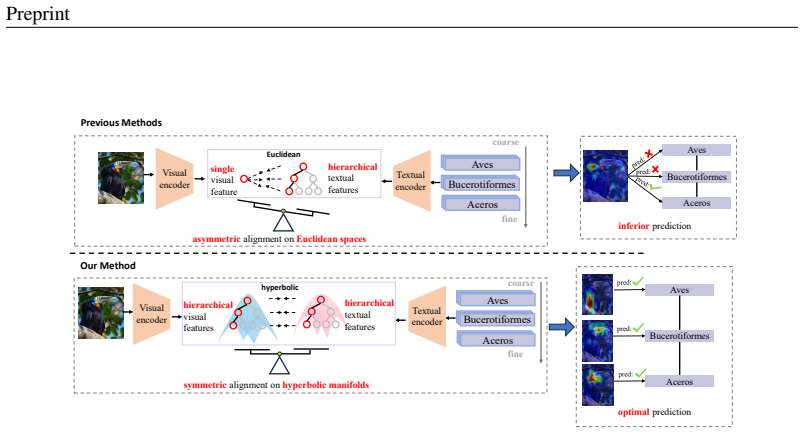
The paper claims that the vision-language modality gap is substantially an asymmetry between hierarchical text and flat image features, and that aligning tree-structured features for both modalities across separate hyperbolic manifolds—with
Reviewed by Pith at T0; open to challenge. T0 means a machine referee read the full paper against a public rubric. the ladder, T0–T4 →
T0 review · deepseek-v4-flash
2026-08-04 06:57 UTC pith:NHQFB4N2
load-bearing objection Interesting empirical idea, but the central theory collapses: the manifold distance diverges to -infinity, so the claimed unique intermediate manifold does not exist as stated. the 4 major comments →
Modality Alignment across Trees on Heterogeneous Hyperbolic Manifolds
The pith
A machine-rendered reading of the paper's core claim, the machinery that carries it, and where it could break.
Core claim
The central claim is that hierarchical text should be met with hierarchical vision. The method uses a text-guided cross-attention mechanism over class tokens from intermediate Transformer layers to produce visual features at every semantic level, matching the text hierarchy. The two feature trees are mapped to separate Lorentz hyperbolic manifolds with learnable curvatures, and the paper defines a manifold distance based on an approximate KL divergence between wrapped normal distributions on those manifolds. The optimal intermediate manifold is found by minimizing the sum of the two distances, and the paper proves this minimizer exists and is unique. On taxonomic open-set classification, the
What carries the argument
The load-bearing object is the manifold distance D_L(L^{c1}, L^{c3}) = (-sqrt(c1) + 2 sqrt(c3) cosh[(sqrt(c3) - sqrt(c1)) r]) / (2 sqrt(c1) sqrt(c3)), an affine transformation of an approximate KL divergence between wrapped normal distributions on two Lorentz hyperbolic manifolds. For a single pair of manifolds its unique minimum is at equal curvatures, and for the sum D_L(L^{c1}, L^{c3}) + D_L(L^{c2}, L^{c3}) the paper proves a unique minimizer c3* lies between the two given curvatures. Golden-section search locates c3*, the implicit function theorem supplies curvature gradients across the non-differentiable search, and hyperbolic entailment cones on the intermediate manifold enforce that e
Load-bearing premise
The whole construction rests on the distance formula treating text and image features as wrapped normal distributions with the same tangent-space radius r, held constant; if real features have different radii or r shifts with curvature, the distance stops measuring how far apart the two curved spaces are, and the uniqueness claim loses its footing.
What would settle it
Generate synthetic wrapped-normal samples on two Lorentz manifolds with different curvatures and different tangent-space radii r1 and r2, estimate the KL divergence by Monte Carlo, and compare it with Eq. (9); measurable divergence between the estimate and the formula as |r1 - r2| grows would show the uniqueness theorem optimizes a proxy rather than the claimed KL distance.
If this is right
- Taxonomic open-set classifiers can be built from a pretrained vision-language encoder plus hierarchy-shaped prompt tuning; no per-leaf retraining is needed to exceed single-feature baselines.
- Hierarchical Consistency Accuracy rises by 28.83% in the 16-shot setting and 7.72% in the 1-shot setting, indicating that much of the remaining modality gap is recoverable by symmetric tree alignment.
- Because the optimal intermediate manifold is unique, curvature selection is a well-posed one-dimensional optimization, not a search over local minima.
- The same framework transfers to novel classes: base-to-novel generalization improves, so the learned tree geometry is not merely memorizing training labels.
- Giving text and image different curvatures outperforms forcing them to share one curvature, so modality-specific geometry is a measurable part of the gain.
Where Pith is reading between the lines
- An assumption the paper leaves implicit is that the tangent-space radius r is shared and constant for both modalities; if text and image features differ enough in scale, a two-radii distance would be needed and the current gains might shrink in highly asymmetric regimes.
- The distance in Eq. (9) is only an approximation to the true KL divergence; stress-testing it on synthetic wrapped-normal samples across the curvature ranges used in training would show where the Taylor expansion breaks down.
- The intermediate-manifold idea extends naturally to more than two modalities or mixed-curvature product spaces, but the uniqueness proof is one-dimensional and would need re-derivation in those settings.
- The visual tree currently draws class tokens from fixed intermediate layers; making layer selection adaptive per image or per taxonomic level is a cheap testable extension that could sharpen both coarse and fine alignment.
Editorial analysis
A structured set of objections, weighed in public.
Referee Report
Summary. The paper proposes "Alignment across Trees," a vision-language method that builds hierarchical visual features from intermediate ViT class tokens via text-guided cross-attention, forms symmetric text/image feature trees, embeds them into Lorentz hyperbolic manifolds with separate learnable curvatures, and aligns the two manifolds through an intermediate manifold whose curvature c3 is obtained by minimizing a proposed manifold distance DL. The paper claims to prove existence and uniqueness of the optimal intermediate manifold, and reports consistent improvements over several baselines on taxonomic open-set classification across four datasets in few-shot and base-to-novel settings.
Significance. If the theoretical claims were sound, the paper would offer a principled treatment of heterogeneous hyperbolic manifolds for hierarchical multimodal alignment, together with a concrete visual feature hierarchy construction. The empirical evaluation is broad (four datasets, several prompt-learning backbones, multiple metrics), and the authors commit to releasing code, which are positive features. However, the central theoretical claim—existence and uniqueness of the minimizer of the manifold distance—is contradicted by the paper's own equations, and the distance derivation contains algebraic errors and unjustified assumptions. Since the theoretical result is advertised in the abstract and is the basis for the curvature optimization in Eq. (17), the manuscript does not currently support its central claim.
major comments (4)
- [§4.2.1, Eq. (9), Propositions 1–2] For fixed c1>0 and any finite r, the numerator in Eq. (9) tends to −√c1 while the denominator 2√c1√c3 tends to 0+ as c3→0+, so DL(Lc1,Lc3)→−∞. Hence Jc in Eq. (10) also tends to −∞, and no minimizer exists over c3>0. Proposition 1's asserted unique minimum at c3=c1 and Proposition 2's asserted unique minimizer in [min(c1,c2), max(c1,c2)] are therefore false as stated. Appendix A.2 repairs this by imposing c3≥c_min and r≥r_min, but those conditions are not part of the proposition statements and are data-dependent; the unconditional abstract claim 'we prove the existence and uniqueness' is unsupported.
- [Appendix A.1, Eq. (23)–(28)] The Taylor expansion in Eq. (23) contains a derivative error: d/dz arccosh²(z) = 2 arccosh(z)/√(z²−1), yet the displayed expression uses √(y²−1) in the numerator rather than the reciprocal. Consequently the constants A(y1) and B(y1) in Eq. (28), and hence the final formula Eq. (9), do not follow from the KL divergence expansion in Eq. (24). The derivation of Theorem 1 is therefore invalid independently of the shared-tangent-vector issue.
- [Appendix A.1, Eq. (26); Theorem 1] The simplification in Eq. (26) assumes that u1 and u3 are exponential maps of the same tangent vector v̄, so that both have the same norm r=||v̄||. The distributions in Eq. (8) are intended to represent text and image features, whose Fréchet means are generally different. Moreover r is not a constant of the problem: it is defined as the norm of the tangent-space midpoint, which depends on c1, c3 and on the learned features, while Theorem 1 and Propositions 1–2 treat r as fixed when optimizing c3. This is an internal inconsistency in the definition of the manifold distance.
- [Appendix A.2; Eq. (30)] The choice y1*≈3.016 is made precisely so that f′(c3;y1*,c1,r)=0 at c3=c1 (Eq. (30)). Proposition 1 then asserts that c3=c1 is the unique minimum. This is a constructional condition, not a property derived from the KL divergence between wrapped normals. The uniqueness argument further requires the unverified condition r≥r_min, which depends on c_min and the learned curvatures, and the proof of Proposition 2 similarly imposes r > max{3/√c2, 4/M} at the endpoints. None of these conditions is checked for the features used in the experiments, so the claimed existence-and-uniqueness result is not established.
minor comments (5)
- [§4.4, Eq. (18)] The curvature update for c2 is written as c2 ← c1 − η·dJ/dc1; the second term should be dJ/dc2, and the left side should be c2.
- [§3, Eq. (3) and Eq. (8)] Notation for the dispersion parameter is inconsistent: Eq. (3) uses σ while Eq. (8) uses δ; the normalization constant is written Z(σ) in one place and Z(δ) in another.
- [§3, Eq. (4)] The cone half-aperture formula is printed as sin^{-1}(2k√c||x_space||). This is dimensionally inconsistent; the standard hyperbolic entailment cone formula has 2k/(√c||x_space||) inside the arcsine. Please correct or clarify.
- [Throughout] Minor typos: 'REALTEDWORKS' in the section heading, 'villina' for 'vanilla' in Tables 1 and 3, and 'textitasizes' in Appendix C.3.
- [Appendix B.5, Algorithm 3] The algorithm body does not explicitly return the tree T after the loop; the 'return' line is missing, which is confusing for a pseudo-code description.
Circularity Check
The existence/uniqueness theorem is partly built into the distance construction; the empirical alignment results themselves are not circular.
specific steps
-
self definitional
[Section 4.2.1 Theorem 1/Proposition 1; Appendix A.1, Eqs. (27)-(31)]
"Next, we focus on selecting the Taylor expansion point y1. To ensure that dL(Lc1,Lc3;y1,c1,r) is a good approximation of the distance function, we need to find a y⋆1 that satisfies f′(c3;y⋆1,c1,r)=0 ... This equation has a numerical solution y⋆1≈3.016 ... Thus, we have dL(...)=B(y⋆1)[−√c1+2√c3cosh[(√c3−√c1)r]]/(2√c1√c3)."
The distance D_L is not derived independently and then checked. Its Taylor expansion point y1* is selected precisely so that f'(c3;...)|_{c3=c1}=0, i.e. so that c3=c1 is a critical point. Proposition 1 then asserts that the minimum is uniquely attained at c3=c1 and the text uses this to claim soundness of Theorem 1. The minimum is therefore a property baked into the definition of D_L by construction, not an emergent consequence of KL divergence between wrapped normal distributions.
-
other
[Appendix A.2-A.3; Proposition 2 statement in Section 4.2.1]
"we require N(c3)>0 for all c3 ≥ cmin >0 ... For r > rmin with rmin = max{1/√c1, 2/L, (1/L)ln(12√c1/(c_min^{3/2}L^2))}, we have N(c3)>0 ... Thus, Proposition 1 holds. ... For r≥max{r∗min, 4/M, 3/√c2}, ... This strict convexity guarantees a unique minimizer c∗3∈[c1,c2]. Thus proposition 2 holds for all cases."
The main text states Proposition 2 unconditionally, but the proof only works after adding data-dependent and arbitrary lower bounds c3≥cmin and r≥rmin, with thresholds chosen to force strict convexity. These assumptions are absent from the theorem statements and are introduced solely to make the desired uniqueness conclusion go through. Thus the claimed existence/uniqueness of the optimal intermediate manifold is forced by proof-specific conditions rather than derived from the original distance objective.
full rationale
The paper's empirical contribution is not circular: semantic-aware visual feature extraction, cross-attention, entailment losses, and the comparative evaluation against MaPLe, PromptSRC, ProTeCt, MERU, and HyCoCLIP are externally benchmarked and do not reduce to the fitted distance formula. The circularity is localized in the theoretical centerpiece. D_L in Eq. (9) is defined after choosing the Taylor point y1* so that f'(c3)|_{c3=c1}=0, so Proposition 1's 'minimum at c3=c1' is a restatement of the construction rather than an independent validation. Proposition 2's uniqueness is likewise obtained only by adding cmin and rmin thresholds that are not part of the stated theorem and are selected to make the second derivative positive. The separate mathematical issue that D_L→−∞ as c3→0+ makes the unconstrained objective ill-posed is a correctness risk rather than circularity, but it reinforces that the proof's imposed lower bound is doing the work. No load-bearing self-citation or imported uniqueness theorem was found.
Axiom & Free-Parameter Ledger
free parameters (5)
- Taylor expansion point y1* =
≈3.016
- Shared tangent vector norm r =
not fixed; data-dependent
- Cone aperture constant k =
0.1
- Entailment loss weight α =
0.5
- Initial curvatures c1, c2 =
chosen from {0.5, 0.25, 0.05, 0.025} depending on dataset
axioms (4)
- domain assumption Wrapped normal distributions on hyperbolic manifolds have a tractable normalization constant Z(σ) and the KL divergence between them is finite.
- ad hoc to paper The distance function d^2_c(x,u) can be accurately replaced by its first-order Taylor expansion around the point y1* ≈ 3.016 for all relevant x,u.
- ad hoc to paper The means u1, u3 of the two feature distributions are exponentials of the same tangent vector (same direction and norm r).
- ad hoc to paper For the learned values of c1, c2, the scalar r satisfies r ≥ r_min (the positivity condition in Appendix A.2).
invented entities (2)
-
Intermediate hyperbolic manifold L^{c3}
no independent evidence
-
Manifold distance D_L
no independent evidence
read the original abstract
Modality alignment is critical for vision-language models (VLMs) to effectively integrate information across modalities. However, existing methods extract hierarchical features from text while representing each image with a single feature, leading to asymmetric and suboptimal alignment. To address this, we propose Alignment across Trees, a method that constructs and aligns tree-like hierarchical features for both image and text modalities. Specifically, we introduce a semantic-aware visual feature extraction framework that applies a cross-attention mechanism to visual class tokens from intermediate Transformer layers, guided by textual cues to extract visual features with coarse-to-fine semantics. We then embed the feature trees of the two modalities into hyperbolic manifolds with distinct curvatures to effectively model their hierarchical structures. To align across the heterogeneous hyperbolic manifolds with different curvatures, we formulate a KL distance measure between distributions on heterogeneous manifolds, and learn an intermediate manifold for manifold alignment by minimizing the distance. We prove the existence and uniqueness of the optimal intermediate manifold. Experiments on taxonomic open-set classification tasks across multiple image datasets demonstrate that our method consistently outperforms strong baselines under few-shot and cross-domain settings.
Figures


Forward citations
Cited by 1 Pith paper
-
Learning Taxonomic Trees with Hierarchical Representation Regularization for Large Multimodal Models
HiR² extracts coarse-to-fine visual features from LMM layers and regularizes them with Lorentz entailment cones and unit-sphere dispersive loss, improving hierarchical consistency across models and fine-tuning methods.
Reference graph
Works this paper leans on
-
[1]
Hyperbolic geometry
James W Cannon, William J Floyd, Richard Kenyon, Walter R Parry, et al. Hyperbolic geometry. Flavors of geometry, 31 0 (59-115): 0 2, 1997
1997
-
[2]
Invite: Interpret and control vision-language models with text explanations
Haozhe Chen, Junfeng Yang, Carl Vondrick, and Chengzhi Mao. Invite: Interpret and control vision-language models with text explanations. In The Twelfth International Conference on Learning Representations, 2024
2024
-
[3]
Hyperbolic vae via latent gaussian distributions
Seunghyuk Cho, Juyong Lee, and Dongwoo Kim. Hyperbolic vae via latent gaussian distributions. Advances in Neural Information Processing Systems, 36, 2024
2024
-
[4]
Imagenet: A large-scale hierarchical image database
Jia Deng, Wei Dong, Richard Socher, Li-Jia Li, Kai Li, and Li Fei-Fei. Imagenet: A large-scale hierarchical image database. In Proceedings of the IEEE/CVF Conference on Computer Vision and Pattern Recognition, pp.\ 248--255. Ieee, 2009
2009
-
[5]
Hyperbolic image-text representations
Karan Desai, Maximilian Nickel, Tanmay Rajpurohit, Justin Johnson, and Shanmukha Ramakrishna Vedantam. Hyperbolic image-text representations. In International Conference on Machine Learning, pp.\ 7694--7731. PMLR, 2023
2023
-
[6]
Enhanced word clustering for hierarchical text classification
Inderjit S Dhillon, Subramanyam Mallela, and Rahul Kumar. Enhanced word clustering for hierarchical text classification. In Proceedings of the eighth ACM SIGKDD international conference on Knowledge discovery and data mining, pp.\ 191--200, 2002
2002
-
[7]
Beyond the seen: Bounded distribution estimation for open-vocabulary learning
Xiaomeng Fan, Yuchuan Mao, Zhi Gao, Yuwei Wu, Jin Chen, and Yunde Jia. Beyond the seen: Bounded distribution estimation for open-vocabulary learning. arXiv preprint arXiv:2510.04770, 2025 a
arXiv 2025
-
[8]
Curvature learning for generalization of hyperbolic neural networks: X
Xiaomeng Fan, Yuwei Wu, Zhi Gao, Mehrtash Harandi, and Yunde Jia. Curvature learning for generalization of hyperbolic neural networks: X. fan et al. International Journal of Computer Vision, pp.\ 1--37, 2025 b
2025
-
[9]
Christiane Fellbaum. Wordnet. WordNet An Electronic Lexical Database, pp.\ 69, 1998
1998
-
[10]
Hyperbolic active learning for semantic segmentation under domain shift
Luca Franco, Paolo Mandica, Konstantinos Kallidromitis, Devin Guillory, Yu-Teng Li, Trevor Darrell, and Fabio Galasso. Hyperbolic active learning for semantic segmentation under domain shift. In International Conference on Machine Learning. PMLR, 2024
2024
-
[11]
Hyperbolic geometric graph representation learning for hierarchy-imbalance node classification
Xingcheng Fu, Yuecen Wei, Qingyun Sun, Haonan Yuan, Jia Wu, Hao Peng, and Jianxin Li. Hyperbolic geometric graph representation learning for hierarchy-imbalance node classification. In Proceedings of the ACM Web Conference 2023, pp.\ 460--468, 2023
2023
-
[12]
Hyperbolic geometric latent diffusion model for graph generation
Xingcheng Fu, Yisen Gao, Yuecen Wei, Qingyun Sun, Hao Peng, Jianxin Li, and Xianxian Li. Hyperbolic geometric latent diffusion model for graph generation. In International Conference on Machine Learning (ICML), 2024
2024
-
[13]
Datacomp: In search of the next generation of multimodal datasets
Samir Yitzhak Gadre, Gabriel Ilharco, Alex Fang, Jonathan Hayase, Georgios Smyrnis, Thao Nguyen, Ryan Marten, Mitchell Wortsman, Dhruba Ghosh, Jieyu Zhang, et al. Datacomp: In search of the next generation of multimodal datasets. Advances in Neural Information Processing Systems, 36, 2024
2024
-
[14]
Curvature generation in curved spaces for few-shot learning
Zhi Gao, Yuwei Wu, Yunde Jia, and Mehrtash Harandi. Curvature generation in curved spaces for few-shot learning. In Proceedings of the IEEE/CVF International Conference on Computer Vision, pp.\ 8691--8700, 2021
2021
-
[15]
Curvature-adaptive meta-learning for fast adaptation to manifold data
Zhi Gao, Yuwei Wu, Mehrtash Harandi, and Yunde Jia. Curvature-adaptive meta-learning for fast adaptation to manifold data. IEEE Transactions on Pattern Analysis and Machine Intelligence, 45 0 (2): 0 1545--1562, 2022 a
2022
-
[16]
Hyperbolic feature augmentation via distribution estimation and infinite sampling on manifolds
Zhi Gao, Yuwei Wu, Yunde Jia, and Mehrtash Harandi. Hyperbolic feature augmentation via distribution estimation and infinite sampling on manifolds. Advances in neural information processing systems, 35: 0 34421--34435, 2022 b
2022
-
[17]
Exploring data geometry for continual learning
Zhi Gao, Chen Xu, Feng Li, Yunde Jia, Mehrtash Harandi, and Yuwei Wu. Exploring data geometry for continual learning. In Proceedings of the IEEE/CVF Conference on Computer Vision and Pattern Recognition, pp.\ 24325--24334, 2023
2023
-
[18]
A systematic survey of prompt engineering on vision-language foundation models
Jindong Gu, Zhen Han, Shuo Chen, Ahmad Beirami, Bailan He, Gengyuan Zhang, Ruotong Liao, Yao Qin, Volker Tresp, and Philip Torr. A systematic survey of prompt engineering on vision-language foundation models. arXiv preprint arXiv:2307.12980, 2023
Pith/arXiv arXiv 2023
-
[19]
Clipped hyperbolic classifiers are super-hyperbolic classifiers
Yunhui Guo, Xudong Wang, Yubei Chen, and Stella X Yu. Clipped hyperbolic classifiers are super-hyperbolic classifiers. In Proceedings of the IEEE/CVF Conference on Computer Vision and Pattern Recognition, pp.\ 11--20, 2022
2022
-
[20]
Helm: Hyperbolic large language models via mixture-of-curvature experts
Neil He, Rishabh Anand, Hiren Madhu, Ali Maatouk, Smita Krishnaswamy, Leandros Tassiulas, Menglin Yang, and Rex Ying. Helm: Hyperbolic large language models via mixture-of-curvature experts. arXiv preprint arXiv:2505.24722, 2025 a
arXiv 2025
-
[21]
Lorentzian residual neural networks
Neil He, Menglin Yang, and Rex Ying. Lorentzian residual neural networks. In Proceedings of the 31st ACM SIGKDD Conference on Knowledge Discovery and Data Mining V. 1, pp.\ 436--447, 2025 b
2025
-
[22]
Curved geometric networks for visual anomaly recognition
Jie Hong, Pengfei Fang, Weihao Li, Junlin Han, Lars Petersson, and Mehrtash Harandi. Curved geometric networks for visual anomaly recognition. IEEE Transactions on Neural Networks and Learning Systems, 2023 a
2023
-
[23]
Hyperbolic audio-visual zero-shot learning
Jie Hong, Zeeshan Hayder, Junlin Han, Pengfei Fang, Mehrtash Harandi, and Lars Petersson. Hyperbolic audio-visual zero-shot learning. In Proceedings of the IEEE/CVF International Conference on Computer Vision, pp.\ 7873--7883, 2023 b
2023
-
[24]
Scaling up visual and vision-language representation learning with noisy text supervision
Chao Jia, Yinfei Yang, Ye Xia, Yi-Ting Chen, Zarana Parekh, Hieu Pham, Quoc Le, Yun-Hsuan Sung, Zhen Li, and Tom Duerig. Scaling up visual and vision-language representation learning with noisy text supervision. In International conference on machine learning, pp.\ 4904--4916. PMLR, 2021
2021
-
[25]
Visual prompt tuning
Menglin Jia, Luming Tang, Bor-Chun Chen, Claire Cardie, Serge Belongie, Bharath Hariharan, and Ser-Nam Lim. Visual prompt tuning. In European Conference on Computer Vision, pp.\ 709--727. Springer, 2022
2022
-
[26]
Maple: Multi-modal prompt learning
Muhammad Uzair Khattak, Hanoona Rasheed, Muhammad Maaz, Salman Khan, and Fahad Shahbaz Khan. Maple: Multi-modal prompt learning. In Proceedings of the IEEE/CVF Conference on Computer Vision and Pattern Recognition, pp.\ 19113--19122, 2023 a
2023
-
[27]
Self-regulating prompts: Foundational model adaptation without forgetting
Muhammad Uzair Khattak, Syed Talal Wasim, Muzammal Naseer, Salman Khan, Ming-Hsuan Yang, and Fahad Shahbaz Khan. Self-regulating prompts: Foundational model adaptation without forgetting. In Proceedings of the IEEE/CVF International Conference on Computer Vision, pp.\ 15190--15200, 2023 b
2023
-
[28]
Sequential minimax search for a maximum
Jack Kiefer. Sequential minimax search for a maximum. Proceedings of the American mathematical society, 4 0 (3): 0 502--506, 1953
1953
-
[29]
Cifar-10 and cifar-100 datasets
Alex Krizhevsky, Vinod Nair, and Geoffrey Hinton. Cifar-10 and cifar-100 datasets. https://www.cs.toronto.edu/ kriz/cifar.html, 2009
2009
-
[30]
Riemannian manifolds: an introduction to curvature, volume 176
John M Lee. Riemannian manifolds: an introduction to curvature, volume 176. Springer Science & Business Media, 2006
2006
-
[31]
Geometry-aware distance measure for diverse hierarchical structures in hyperbolic spaces
Pengxiang Li, Yuwei Wu, Zhi Gao, Xiaomeng Fan, Wei Wu, Zhipeng Lu, Yunde Jia, and Mehrtash Harandi. Geometry-aware distance measure for diverse hierarchical structures in hyperbolic spaces. arXiv preprint arXiv:2506.18533, 2025 a
Pith/arXiv arXiv 2025
-
[32]
Hyperbolic-constraint point cloud reconstruction from single rgb-d images
Wenrui Li, Zhe Yang, Wei Han, Hengyu Man, Xingtao Wang, and Xiaopeng Fan. Hyperbolic-constraint point cloud reconstruction from single rgb-d images. In Proceedings of the AAAI Conference on Artificial Intelligence, volume 39, pp.\ 4959--4967, 2025 b
2025
-
[33]
Scaling language-image pre-training via masking
Yanghao Li, Haoqi Fan, Ronghang Hu, Christoph Feichtenhofer, and Kaiming He. Scaling language-image pre-training via masking. In Proceedings of the IEEE/CVF Conference on Computer Vision and Pattern Recognition, pp.\ 23390--23400, 2023
2023
-
[34]
Promptkd: Unsupervised prompt distillation for vision-language models
Zheng Li, Xiang Li, Xinyi Fu, Xin Zhang, Weiqiang Wang, Shuo Chen, and Jian Yang. Promptkd: Unsupervised prompt distillation for vision-language models. In Proceedings of the IEEE/CVF Conference on Computer Vision and Pattern Recognition, pp.\ 26617--26626, 2024
2024
-
[35]
Mind the gap: Understanding the modality gap in multi-modal contrastive representation learning
Victor Weixin Liang, Yuhui Zhang, Yongchan Kwon, Serena Yeung, and James Y Zou. Mind the gap: Understanding the modality gap in multi-modal contrastive representation learning. Advances in Neural Information Processing Systems, 35: 0 17612--17625, 2022
2022
-
[36]
Searching for actions on the hyperbole
Teng Long, Pascal Mettes, Heng Tao Shen, and Cees GM Snoek. Searching for actions on the hyperbole. In Proceedings of the IEEE/CVF Conference on Computer Vision and Pattern Recognition, pp.\ 1141--1150, 2020
2020
-
[37]
Optimizing millions of hyperparameters by implicit differentiation
Jonathan Lorraine, Paul Vicol, and David Duvenaud. Optimizing millions of hyperparameters by implicit differentiation. In International Conference on Artificial Intelligence and Statistics, pp.\ 1540--1552. PMLR, 2020
2020
-
[38]
Hyperdefender: A robust framework for hyperbolic gnns
Nikita Malik, Rahul Gupta, and Sandeep Kumar. Hyperdefender: A robust framework for hyperbolic gnns. In Proceedings of the AAAI Conference on Artificial Intelligence, volume 39, pp.\ 19396--19404, 2025
2025
-
[39]
Hyperbolic learning with multimodal large language models
Paolo Mandica, Luca Franco, Konstantinos Kallidromitis, Suzanne Petryk, and Fabio Galasso. Hyperbolic learning with multimodal large language models. In European Conference on Computer Vision, pp.\ 382--398. Springer, 2024
2024
-
[40]
A wrapped normal distribution on hyperbolic space for gradient-based learning
Yoshihiro Nagano, Shoichiro Yamaguchi, Yasuhiro Fujita, and Masanori Koyama. A wrapped normal distribution on hyperbolic space for gradient-based learning. In International conference on machine learning, pp.\ 4693--4702. PMLR, 2019
2019
-
[41]
Poincar\' e embeddings for learning hierarchical representations
Maximillian Nickel and Douwe Kiela. Poincar\' e embeddings for learning hierarchical representations. In I. Guyon, U. Von Luxburg, S. Bengio, H. Wallach, R. Fergus, S. Vishwanathan, and R. Garnett (eds.), Advances in Neural Information Processing Systems, volume 30. Curran Associates, Inc., 2017. URL https://proceedings.neurips.cc/paper_files/paper/2017/f...
2017
-
[42]
Compositional entailment learning for hyperbolic vision-language models
Avik Pal, Max van Spengler, Guido Maria D'Amely di Melendugno, Alessandro Flaborea, Fabio Galasso, and Pascal Mettes. Compositional entailment learning for hyperbolic vision-language models. In The Thirteenth International Conference on Learning Representations, 2025
2025
-
[43]
Prompt learning via meta-regularization
Jinyoung Park, Juyeon Ko, and Hyunwoo J Kim. Prompt learning via meta-regularization. In Proceedings of the IEEE/CVF Conference on Computer Vision and Pattern Recognition, pp.\ 26940--26950, 2024
2024
-
[44]
Learning transferable visual models from natural language supervision
Alec Radford, Jong Wook Kim, Chris Hallacy, Aditya Ramesh, Gabriel Goh, Sandhini Agarwal, Girish Sastry, Amanda Askell, Pamela Mishkin, Jack Clark, et al. Learning transferable visual models from natural language supervision. In International conference on machine learning, pp.\ 8748--8763. PMLR, 2021
2021
-
[45]
Accept the modality gap: An exploration in the hyperbolic space
Sameera Ramasinghe, Violetta Shevchenko, Gil Avraham, and Ajanthan Thalaiyasingam. Accept the modality gap: An exploration in the hyperbolic space. In Proceedings of the IEEE/CVF Conference on Computer Vision and Pattern Recognition, pp.\ 27263--27272, 2024
2024
-
[46]
Laion-5b: An open large-scale dataset for training next generation image-text models
Christoph Schuhmann, Romain Beaumont, Richard Vencu, Cade Gordon, Ross Wightman, Mehdi Cherti, Theo Coombes, Aarush Katta, Clayton Mullis, Mitchell Wortsman, et al. Laion-5b: An open large-scale dataset for training next generation image-text models. Advances in Neural Information Processing Systems, 35: 0 25278--25294, 2022
2022
-
[47]
Grad-cam: Visual explanations from deep networks via gradient-based localization
Ramprasaath R Selvaraju, Michael Cogswell, Abhishek Das, Ramakrishna Vedantam, Devi Parikh, and Dhruv Batra. Grad-cam: Visual explanations from deep networks via gradient-based localization. In Proceedings of the IEEE international conference on computer vision, pp.\ 618--626, 2017
2017
-
[48]
Hyperbolic neural networks++
Ryohei Shimizu, YUSUKE Mukuta, and Tatsuya Harada. Hyperbolic neural networks++. In International Conference on Learning Representations, 2021
2021
-
[49]
Mixed-curvature variational autoencoders
Ondrej Skopek, Octavian-Eugen Ganea, and Gary B \'e cigneul. Mixed-curvature variational autoencoders. In International Conference on Learning Representations, 2020
2020
-
[50]
Bioclip: A vision foundation model for the tree of life
Samuel Stevens, Jiaman Wu, Matthew J Thompson, Elizabeth G Campolongo, Chan Hee Song, David Edward Carlyn, Li Dong, Wasila M Dahdul, Charles Stewart, Tanya Berger-Wolf, et al. Bioclip: A vision foundation model for the tree of life. In Proceedings of the IEEE/CVF conference on computer vision and pattern recognition, pp.\ 19412--19424, 2024
2024
-
[51]
Eva-clip: Improved training techniques for clip at scale
Quan Sun, Yuxin Fang, Ledell Wu, Xinlong Wang, and Yue Cao. Eva-clip: Improved training techniques for clip at scale. arXiv preprint arXiv:2303.15389, 2023
Pith/arXiv arXiv 2023
-
[52]
Cliploss and norm-based data selection methods for multimodal contrastive learning
Yiping Wang, Yifang Chen, Wendan Yan, Alex Fang, Wenjing Zhou, Kevin Jamieson, and Simon S Du. Cliploss and norm-based data selection methods for multimodal contrastive learning. Advances in Neural Information Processing Systems, 37: 0 15028--15069, 2024 a
2024
-
[53]
G 3-lq: Marrying hyperbolic alignment with explicit semantic-geometric modeling for 3d visual grounding
Yuan Wang, Yali Li, and Shengjin Wang. G 3-lq: Marrying hyperbolic alignment with explicit semantic-geometric modeling for 3d visual grounding. In Proceedings of the IEEE/CVF Conference on Computer Vision and Pattern Recognition, pp.\ 13917--13926, June 2024 b
2024
-
[54]
Protect: Prompt tuning for taxonomic open set classification
Tz-Ying Wu, Chih-Hui Ho, and Nuno Vasconcelos. Protect: Prompt tuning for taxonomic open set classification. In Proceedings of the IEEE/CVF Conference on Computer Vision and Pattern Recognition, pp.\ 16531--16540, 2024
2024
-
[55]
Sun database: Large-scale scene recognition from abbey to zoo
Jianxiong Xiao, James Hays, Krista A Ehinger, Aude Oliva, and Antonio Torralba. Sun database: Large-scale scene recognition from abbey to zoo. In Proceedings of the IEEE/CVF Conference on Computer Vision and Pattern Recognition, pp.\ 3485--3492, 2010
2010
-
[56]
Hyperbolic dual feature augmentation for open-environment
Peilin Yu, Yuwei Wu, Zhi Gao, Xiaomeng Fan, Shuo Yang, and Yunde Jia. Hyperbolic dual feature augmentation for open-environment. arXiv preprint arXiv:2506.08906, 2025
Pith/arXiv arXiv 2025
-
[57]
Decouple before align: Visual disentanglement enhances prompt tuning
Fei Zhang, Tianfei Zhou, Jiangchao Yao, Ya Zhang, Ivor W Tsang, and Yanfeng Wang. Decouple before align: Visual disentanglement enhances prompt tuning. IEEE Transactions on Pattern Analysis and Machine Intelligence, 2025
2025
-
[58]
Conditional prompt learning for vision-language models
Kaiyang Zhou, Jingkang Yang, Chen Change Loy, and Ziwei Liu. Conditional prompt learning for vision-language models. In Proceedings of the IEEE/CVF conference on computer vision and pattern recognition, pp.\ 16816--16825, 2022 a
2022
-
[59]
Learning to prompt for vision-language models
Kaiyang Zhou, Jingkang Yang, Chen Change Loy, and Ziwei Liu. Learning to prompt for vision-language models. International Journal of Computer Vision, 130 0 (9): 0 2337--2348, 2022 b
2022
-
[60]
Prompt-aligned gradient for prompt tuning
Beier Zhu, Yulei Niu, Yucheng Han, Yue Wu, and Hanwang Zhang. Prompt-aligned gradient for prompt tuning. In Proceedings of the IEEE/CVF International Conference on Computer Vision, pp.\ 15659--15669, 2023
2023
-
[61]
write newline
" write newline "" before.all 'output.state := FUNCTION n.dashify 't := "" t empty not t #1 #1 substring "-" = t #1 #2 substring "--" = not "--" * t #2 global.max substring 't := t #1 #1 substring "-" = "-" * t #2 global.max substring 't := while if t #1 #1 substring * t #2 global.max substring 't := if while FUNCTION format.date year duplicate empty "emp...
-
[62]
@esa (Ref
\@ifxundefined[1] #1\@undefined \@firstoftwo \@secondoftwo \@ifnum[1] #1 \@firstoftwo \@secondoftwo \@ifx[1] #1 \@firstoftwo \@secondoftwo [2] @ #1 \@temptokena #2 #1 @ \@temptokena \@ifclassloaded agu2001 natbib The agu2001 class already includes natbib coding, so you should not add it explicitly Type <Return> for now, but then later remove the command n...
-
[63]
\@lbibitem[] @bibitem@first@sw\@secondoftwo \@lbibitem[#1]#2 \@extra@b@citeb \@ifundefined br@#2\@extra@b@citeb \@namedef br@#2 \@nameuse br@#2\@extra@b@citeb \@ifundefined b@#2\@extra@b@citeb @num @parse #2 @tmp #1 NAT@b@open@#2 NAT@b@shut@#2 \@ifnum @merge>\@ne @bibitem@first@sw \@firstoftwo \@ifundefined NAT@b*@#2 \@firstoftwo @num @NAT@ctr \@secondoft...
-
[64]
@open @close @open @close and [1] URL: #1 \@ifundefined chapter * \@mkboth \@ifxundefined @sectionbib * \@mkboth * \@mkboth\@gobbletwo \@ifclassloaded amsart * \@ifclassloaded amsbook * \@ifxundefined @heading @heading NAT@ctr thebibliography [1] @ \@biblabel @NAT@ctr \@bibsetup #1 @NAT@ctr @ @openbib .11em \@plus.33em \@minus.07em 4000 4000 `\.\@m @bibit...
discussion (0)
Sign in with ORCID, Apple, or X to comment. Anyone can read and Pith papers without signing in.