REVIEW 4 major objections 5 minor 49 references
NILC claims that New Intent Discovery improves when a large language model alternately refines cluster themes and rewrites ambiguous utterances inside an iterative clustering loop.
Reviewed by Pith at T0; open to challenge. T0 means a machine referee read the full paper against a public rubric. the ladder, T0–T4 →
NILC combines LLM-generated semantic centroids with hard-sample rewriting to improve new-intent clustering, but its 'consistent' superiority claim is contradicted on DBPedia.
T0 review reviewed 2026-08-03 challenge →
load-bearing objection A useful incremental LLM-assisted clustering framework whose headline superiority claim is contradicted by its own Table 3; worth peer review, but the claim needs to be fixed. the 4 major comments →
NILC: Discovering New Intents with LLM-assisted Clustering
The pith
A machine-rendered reading of the paper's core claim, the machinery that carries it, and where it could break.
The reading
Core claim
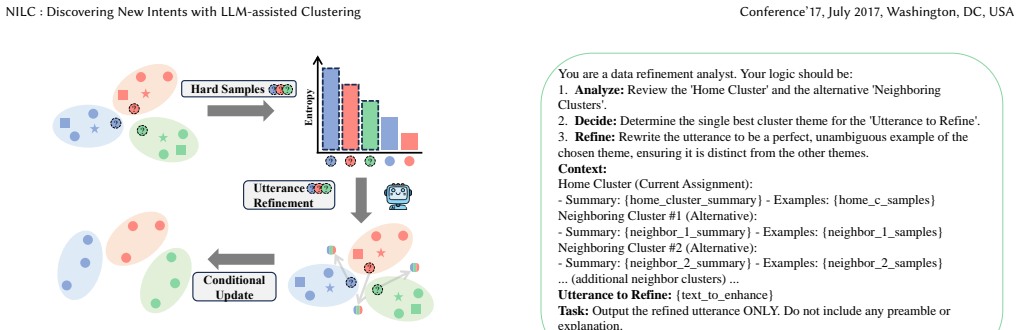
The paper's central claim is that the standard cascaded pipeline—embed first, cluster second—leaves a feedback gap that costs accuracy in new intent discovery. NILC closes this gap with an iterative workflow. In each pass, every cluster is represented twice: once by its Euclidean embedding centroid and once by a 'semantic centroid' that an LLM generates by summarizing the cluster's theme; utterance assignments are then updated against both. Next, the most uncertain utterances, identified by high assignment entropy, are rewritten by the LLM into clearer versions, and a rewrite is accepted only if it reduces the clustering cost. In the semi-supervised setting, labeled intents seed the initial
What carries the argument
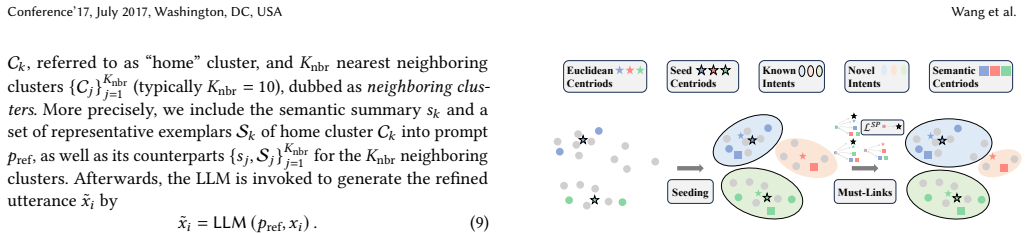
The framework's core is the Dual Centroid Scheme (DCS) plus Hard Sample Refinement (HSR). DCS supplements the standard Euclidean centroid of each cluster with an LLM-generated semantic centroid derived from representative exemplars; assignments are decided by a weighted cost that includes Euclidean distance, semantic similarity to the cluster's semantic centroid, and repulsion from the nearest competing semantic centroid. HSR selects high-entropy utterances, prompts the LLM to rewrite them with in-context information from the home and neighboring clusters, and conditionally updates the embedding only when the new embedding lowers the clustering cost. For semi-supervised settings, labeled dat
Load-bearing premise
The hard-sample refinement step assumes the LLM can infer the correct intent theme from the current cluster context and rewrite the utterance so its new embedding lands closer to the true cluster; if an early misassignment is reinforced, the rewrite could strengthen an already wrong cluster rather than fix it.
What would settle it
Construct a dataset whose hard samples are so terse that even a human cannot infer the intent without the true label—for instance, single-word slang with multiple unrelated meanings. Run NILC with and without hard sample refinement. If rewriting does not improve NMI, ARI, or ACC over the no-refinement variant, the assumption that LLM context can recover the correct theme from cluster context would be falsified.
If this is right
- NILC turns the clustering objective itself into the place where LLM knowledge enters, rather than only using embeddings or pair labels, so clustering can correct its own errors across iterations.
- The conditional update rule means LLM-generated rewrites are only trusted when they reduce the clustering objective, providing a built-in guard against noisy or off-topic generations.
- Ablation results show that removing either dual centroids or hard sample refinement degrades performance, indicating both components contribute to the reported gains.
- NILC improves across different text encoders and different LLMs in the reported experiments, suggesting the gains come from the iterative design rather than from one specific model.
Where Pith is reading between the lines
- If NILC is right, the main bottleneck in intent discovery may not be representation learning but assignment-time reasoning; future work could shift toward cluster-level semantic refinement rather than ever-better encoders.
- The conditional-update trick is a broadly transferable recipe: any LLM-assisted clustering pipeline in other domains—such as entity resolution or topic modeling—could adopt the rule of accepting generated text only when it lowers a well-defined clustering cost.
- The paper illustrates one failure case where cosine similarity between centroids maps 'Professional Athlete' to 'Artist' while the LLM mapping does not; a testable extension would be to measure how often similarity-based mappings fail on datasets with abstract or metaphorical label relationships, predicting where LLM-based mapping matters most.
Editorial analysis
A structured set of objections, weighed in public.
Referee Report
Summary. The paper proposes NILC, an iterative LLM-assisted clustering framework for new intent discovery (NID). In each iteration NILC (i) recomputes Euclidean centroids and additionally generates LLM-based "semantic centroids" from selected exemplars, then re-assigns utterances using a weighted combination of Euclidean distance, semantic cohesion, and semantic separation; (ii) identifies high-entropy "hard samples" and asks an LLM to rewrite them with cluster context, accepting the rewrite only when it lowers the clustering cost; and (iii) in the semi-supervised setting, injects labeled signals via seeded centroids and soft must-links. Experiments on six benchmarks compare NILC with embedding-based and LLM-based baselines under both settings, with ablations and sensitivity analyses. The abstract and Section 5.3 claim consistent and significant improvements over baselines on all datasets.
Significance. If the empirical claims held, the paper would make a solid contribution: it uses LLMs in a targeted, cost-aware way (only for cluster summaries and hard-sample rewriting), it is encoder-agnostic (Table 4), and the conditional update in Eq. (10) is a sensible safeguard against noisy LLM rewrites. The public code statement and the breadth of ablations are also strengths. However, the headline claim of consistent superiority is contradicted by the paper's own reported numbers, and no statistical significance evidence is provided. The core idea remains defensible and fixable, but the current wording overstates what the data show.
major comments (4)
- [§5.3 / Table 3] The central claim of consistency is falsified by the paper's own table. In the semi-supervised DBPedia column, NILC's NMI is 89.99 while LatentEM achieves 91.46, and the 'Improv.' row reports -1.47 for NMI. Yet Section 5.3 says NILC 'continues to establish its superiority' and the abstract claims 'significant performance improvements over six benchmark datasets ... consistently.' Even ignoring this specific contradiction, no error bars, multiple runs, or significance tests are reported anywhere, so 'significantly' is not established. Please either correct the claim, explain why NMI regresses on DBPedia while ARI/ACC improve, and add variance/significance reporting over multiple random initializations.
- [§5.5 / Appendix C / Tables 7, 11, 12] Hyperparameters are tuned per dataset: Table 7 lists different selection strategies, T, alpha, beta, gamma, and mapping strategy for every dataset, and Tables 11-12 compare those strategy choices on the same test datasets. Without a held-out validation protocol or a principled selection rule, the reported results may reflect per-dataset overfitting rather than a generally effective configuration. The paper should specify how these hyperparameters were chosen (e.g., validation split, pre-registered defaults) or show that the method is robust across a fixed, reasonable configuration.
- [§4.3 / Fig. 6 / Eq. (10)] The hard-sample refinement prompt gives the LLM the current 'home' cluster summary and examples along with neighboring clusters, and asks it to choose the best theme before rewriting. If the home cluster is already wrong, the LLM's rewrite can reinforce that error. The conditional update in Eq. (10) prevents an increase in the current clustering cost, but it cannot detect a wrong assignment when the cost function is itself built from the same flawed cluster context. Appendix F.2 provides a single successful case study but no failure analysis or quantitative error-propagation study. Please report, for hard samples, how often the LLM's chosen theme agrees with the true intent before and after refinement, and analyze cases where the refinement leaves the assignment unchanged or moves it further from the truth.
- [§5.3] Even in the unsupervised setting, several improvements over the strongest baseline are extremely small — e.g., CLINC NMI is +0.13 over USNID — so the phrase 'consistently and significantly outperforms all baselines across all datasets' is not supported by the point estimates alone. Please quantify uncertainty (e.g., multiple seeds, paired tests) or rephrase to describe the observed improvements as dataset-dependent.
minor comments (5)
- [Algorithm 1 / §4.1] The text refers to 'HRS' (Lines 3-13) while the acronym is HSR. Please standardize.
- [§5.3] The sentence 'injecting supervised signals through IS and ML' uses undefined abbreviations; should be 'seeding and soft must-links (SML)'.
- [Table 3] The LatentEM and NILC rows concatenate SNIPS and DBPedia values without visible column separation, making the table hard to parse. Please fix the LaTeX formatting.
- [Title page / references] The ACM template placeholders remain ('Conference’17', '©2018 ACM', references to 2018), which look like leftover template text rather than a final publication format.
- [Eq. (4)-(10)] The notation f(x_i) in Eq. (10) is used both as the assignment cost in Eq. (4) and, implicitly, after re-assignment; please clarify whether the comparison uses the same cluster assignments before and after the update.
Circularity Check
No load-bearing circularity; HSR is a heuristic risk and Table 3 contradicts the 'consistent' superiority claim, but no prediction reduces to its input by construction.
full rationale
The derivation chain is self-contained rather than circular. NILC initializes with K-Means++ on embeddings, then iterates between (i) DCS, which forms LLM-generated semantic centroids from each cluster's exemplars (Eqs. 1-3) and reassigns points by a cost over Euclidean and semantic centroids (Eq. 4), and (ii) HSR, which selects entropy-hard samples (Eq. 8), rewrites them under the current home/neighbor cluster context (Eq. 9), and only accepts the new embedding if the clustering cost strictly decreases (Eq. 10). In the semi-supervised setting, seeding and soft must-links (Eqs. 11-13) use the provided labeled training set. None of these steps predicts ground-truth intents from themselves: the LLM is not given intent labels in unsupervised runs, the optimized objective is the clustering cost, and NMI/ARI/ACC are measured against held-out labels. The HSR prompt's conditioning on the current cluster could bias rewrites toward the current assignment, but this is a heuristic risk, not a by-construction equivalence. The only author-overlap citation, [35], appears in a list of LLM-based methods and is not load-bearing. Separately, the claim of 'consistent' superiority is contradicted by the paper's own Table 3: on semi-supervised DBPedia, NILC NMI is 89.99 vs LatentEM 91.46, with the Improv. row reporting -1.47 for NMI; Table 7 also shows per-dataset hyperparameter tuning with no error bars. These are correctness/statistical concerns, not circularity.
Axiom & Free-Parameter Ledger
free parameters (6)
- alpha (semantic cohesion weight) =
Varies per dataset: 0.3–0.9 (Table 7)
- beta (semantic separation weight) =
Varies per dataset: 0.1–0.7 (Table 7)
- gamma (soft must-link weight) =
0.1–0.5 in semi-supervised settings (Table 7)
- T (iterations) =
2 or 3 per dataset (Table 7)
- Selection strategy for exemplars S_k =
MMR, NN, or MAD depending on dataset (Table 7)
- Mapping strategy for semi-supervised pi_t =
Similarity-based or LLM-based depending on dataset (Table 7)
axioms (3)
- domain assumption The total number of intents K is known a priori.
- domain assumption LLM-generated summaries accurately capture the theme of their cluster.
- domain assumption Pre-trained text encoder embeddings provide a meaningful Euclidean/cosine space for intent separation.
Cite this review
Pith. "Pith review of NILC: Discovering New Intents with LLM-assisted Clustering." pith.science (2026). https://pith.science/paper/652UREWW
@misc{pith2026251105913,
  author       = {Pith},
  title        = {Pith review of: NILC: Discovering New Intents with LLM-assisted Clustering},
  year         = {2026},
  howpublished = {\url{https://pith.science/paper/652UREWW}},
  note         = {Machine review of arXiv:2511.05913}
}
read the original abstract
New intent discovery (NID) seeks to recognize both new and known intents from unlabeled user utterances, which finds prevalent use in practical dialogue systems. Existing works towards NID mainly adopt a cascaded architecture, wherein the first stage focuses on encoding the utterances into informative text embeddings beforehand, while the latter is to group similar embeddings into clusters (i.e., intents), typically by K-Means. However, such a cascaded pipeline fails to leverage the feedback from both steps for mutual refinement, and, meanwhile, the embedding-only clustering overlooks nuanced textual semantics, leading to suboptimal performance. To bridge this gap, this paper proposes NILC, a novel clustering framework specially catered for effective NID. Particularly, NILC follows an iterative workflow, in which clustering assignments are judiciously updated by carefully refining cluster centroids and text embeddings of uncertain utterances with the aid of large language models (LLMs). Specifically, NILC first taps into LLMs to create additional semantic centroids for clusters, thereby enriching the contextual semantics of the Euclidean centroids of embeddings. Moreover, LLMs are then harnessed to augment hard samples (ambiguous or terse utterances) identified from clusters via rewriting for subsequent cluster correction. Further, we inject supervision signals through non-trivial techniques seeding and soft must links for more accurate NID in the semi-supervised setting. Extensive experiments comparing NILC against multiple recent baselines under both unsupervised and semi-supervised settings showcase that NILC can achieve significant performance improvements over six benchmark datasets of diverse domains consistently.
Figures




Reference graph
Works this paper leans on
-
[1]
Wenbin An, Haonan Lin, Jiahao Nie, Feng Tian, Wenkai Shi, Yaqiang Wu, Qiany- ing Wang, and Ping Chen. 2025. Unleashing the Potential of Model Bias for Generalized Category Discovery. InAAAI, Vol. 39. 15365–15373
2025
-
[2]
David Arthur and Sergei Vassilvitskii. 2007. k-means++ the advantages of careful seeding. InProceedings of the eighteenth annual ACM-SIAM symposium on Discrete algorithms. 1027–1035
2007
-
[3]
Sugato Basu, Arindam Banerjee, and Raymond J Mooney. 2002. Semi-supervised clustering by seeding. InProceedings of the nineteenth international conference on machine learning. 27–34
2002
-
[4]
Sugato Basu, Arindam Banerjee, and Raymond J Mooney. 2004. Active semi- supervision for pairwise constrained clustering. InProceedings of the 2004 SIAM international conference on data mining. SIAM, 333–344
2004
-
[5]
Mathilde Caron, Piotr Bojanowski, Armand Joulin, and Matthijs Douze. 2018. Deep clustering for unsupervised learning of visual features. InProceedings of the European conference on computer vision (ECCV). 132–149
2018
-
[6]
Maarten De Raedt, Fréderic Godin, Thomas Demeester, and Chris Develder
-
[7]
Liesbeth Degand and Philippe Muller. 2020. Introduction to the special issue on dialogue and dialogue systems.Traitement Automatique des Langues61, 3 (2020), 7–15
2020
-
[8]
Jairo Diaz-Rodriguez. 2025. k-LLMmeans: Summaries as Centroids for Inter- pretable and Scalable LLM-Based Text Clustering.arXiv e-prints(2025), arXiv– 2502
2025
-
[9]
Lu Fan, Jiashu Pu, Rongsheng Zhang, and Xiao-Ming Wu. 2025. Lanid: Llm- assisted new intent discovery.arXiv preprint arXiv:2503.23740(2025)
Pith/arXiv arXiv 2025
-
[10]
Xibin Gao, Radhika Arava, Qian Hu, Thahir Mohamed, Wei Xiao, Zheng Gao, and Mohammad AbdelHady. 2021. Graphire: Novel intent discovery with pretraining on prior knowledge using contrastive learning.Technical Report(2021)
2021
-
[11]
K Chidananda Gowda and GJPR Krishna. 1978. Agglomerative clustering using the concept of mutual nearest neighbourhood.Pattern recognition10, 2 (1978), 105–112
1978
-
[12]
Kai Han, Andrea Vedaldi, and Andrew Zisserman. 2019. Learning to discover novel visual categories via deep transfer clustering. InProceedings of the IEEE/CVF international conference on computer vision. 8401–8409
2019
-
[13]
Yen-Chang Hsu, Zhaoyang Lv, and Zsolt Kira. 2017. Learning to cluster in order to transfer across domains and tasks.arXiv preprint arXiv:1711.10125(2017)
Pith/arXiv arXiv 2017
-
[14]
Yen-Chang Hsu, Zhaoyang Lv, Joel Schlosser, Phillip Odom, and Zsolt Kira
-
[15]
Haoyang Li, Xin Wang, Ziwei Zhang, Jianxin Ma, Peng Cui, and Wenwu Zhu. 2021. Intention-aware sequential recommendation with structured intent transition. IEEE Transactions on Knowledge and Data Engineering34, 11 (2021), 5403–5414
2021
-
[16]
Yinfeng Li, Chen Gao, Xiaoyi Du, Huazhou Wei, Hengliang Luo, Depeng Jin, and Yong Li. 2022. Automatically discovering user consumption intents in meituan. InProceedings of the 28th ACM SIGKDD Conference on Knowledge Discovery and Data Mining. 3259–3269
2022
-
[17]
Yunfan Li, Peng Hu, Zitao Liu, Dezhong Peng, Joey Tianyi Zhou, and Xi Peng
-
[18]
Jinggui Liang, Lizi Liao, Hao Fei, and Jing Jiang. 2024. Synergizing large language models and pre-trained smaller models for conversational intent discovery. In Findings of the Association for Computational Linguistics ACL 2024. 14133–14147
2024
-
[19]
I-Fan Lin, Faegheh Hasibi, and Suzan Verberne. 2025. SPILL: Domain-Adaptive Intent Clustering based on Selection and Pooling with Large Language Models. arXiv preprint arXiv:2503.15351(2025)
Pith/arXiv arXiv 2025
-
[20]
Ting-En Lin, Hua Xu, and Hanlei Zhang. 2020. Discovering new intents via constrained deep adaptive clustering with cluster refinement. InProceedings of the AAAI Conference on Artificial Intelligence, Vol. 34. 8360–8367
2020
-
[21]
James B McQueen. 1967. Some methods of classification and analysis of multi- variate observations. InProc. of 5th Berkeley Symposium on Math. Stat. and Prob. 281–297
1967
-
[22]
G Ayorkor Mills-Tettey, Anthony Stentz, and M Bernardine Dias. 2007. The dynamic hungarian algorithm for the assignment problem with changing costs. Robotics Institute, Pittsburgh, PA, Tech. Rep. CMU-RI-TR-07-277 (2007)
2007
-
[23]
Yutao Mou, Keqing He, Yanan Wu, Pei Wang, Jingang Wang, Wei Wu, Yi Huang, Junlan Feng, and Weiran Xu. 2022. Generalized intent discovery: Learning from open world dialogue system.arXiv preprint arXiv:2209.06030(2022)
Pith/arXiv arXiv 2022
-
[24]
Jeffrey Pennington, Richard Socher, and Christopher D Manning. 2014. Glove: Global vectors for word representation. InProceedings of the 2014 conference on empirical methods in natural language processing (EMNLP). 1532–1543
2014
-
[25]
Nils Reimers and Iryna Gurevych. 2019. Sentence-bert: Sentence embeddings using siamese bert-networks.arXiv preprint arXiv:1908.10084(2019)
Pith/arXiv arXiv 2019
-
[26]
Stephen E Robertson and Steve Walker. 1994. Some simple effective approxi- mations to the 2-poisson model for probabilistic weighted retrieval. InSIGIR. Springer, 232–241
1994
-
[27]
Aaron Rodrigues, Mahmood Hegazy, and Azzam Naeem. 2025. From Intent Discovery to Recognition with Topic Modeling and Synthetic Data.arXiv preprint arXiv:2505.11176(2025)
Pith/arXiv arXiv 2025
-
[28]
Juan A Rodriguez, Nicholas Botzer, David Vazquez, Christopher Pal, Marco Pedersoli, and Issam Laradji. 2024. Intentgpt: Few-shot intent discovery with large language models.arXiv preprint arXiv:2411.10670(2024)
Pith/arXiv arXiv 2024
-
[29]
Claude E Shannon. 1948. A mathematical theory of communication.The Bell system technical journal27, 3 (1948), 379–423
1948
-
[30]
Xiang Shen, Yinge Sun, Yao Zhang, and Mani Najmabadi. 2021. Semi-supervised intent discovery with contrastive learning. InProceedings of the 3rd Workshop on Natural Language Processing for Conversational AI. 120–129
2021
-
[31]
Xiaoshuai Song, Keqing He, Pei Wang, Guanting Dong, Yutao Mou, Jingang Wang, Yunsen Xian, Xunliang Cai, and Weiran Xu. 2023. Large language models meet open-world intent discovery and recognition: An evaluation of chatgpt. arXiv preprint arXiv:2310.10176(2023)
Pith/arXiv arXiv 2023
-
[32]
Hongjin Su, Weijia Shi, Jungo Kasai, Yizhong Wang, Yushi Hu, Mari Ostendorf, Wen-tau Yih, Noah A Smith, Luke Zettlemoyer, and Tao Yu. 2022. One embedder, any task: Instruction-finetuned text embeddings.arXiv preprint arXiv:2212.09741 (2022)
Pith/arXiv arXiv 2022
-
[33]
Sagar Vaze, Kai Han, Andrea Vedaldi, and Andrew Zisserman. 2022. Generalized category discovery. InProceedings of the IEEE/CVF conference on computer vision and pattern recognition. 7492–7501
2022
-
[34]
Pascal Vincent, Hugo Larochelle, Isabelle Lajoie, Yoshua Bengio, Pierre-Antoine Manzagol, and Léon Bottou. 2010. Stacked denoising autoencoders: Learning useful representations in a deep network with a local denoising criterion.Journal of machine learning research11, 12 (2010)
2010
-
[35]
Hongtao Wang, Taiyan Zhang, Renchi Yang, and Jianliang Xu. 2025. Cequel: Cost-Effective Querying of Large Language Models for Text Clustering. InCIKM
2025
-
[36]
Xiang Wang, Buyue Qian, and Ian Davidson. 2014. On constrained spectral clustering and its applications.Data Mining and Knowledge Discovery28 (2014), 1–30
2014
-
[37]
Yu Wang, Zhengyang Wang, Hengrui Zhang, Qingyu Yin, Xianfeng Tang, Ying- han Wang, Danqing Zhang, Limeng Cui, Monica Cheng, Bing Yin, et al . 2023. Exploiting intent evolution in e-commercial query recommendation. InKDD. 5162–5173
2023
-
[38]
Junyuan Xie, Ross Girshick, and Ali Farhadi. 2016. Unsupervised deep embedding for clustering analysis. InInternational conference on machine learning. PMLR, 478–487
2016
-
[39]
Fanghua Ye, Meng Fang, Shenghui Li, and Emine Yilmaz. 2023. Enhancing conversational search: Large language model-aided informative query rewriting. arXiv preprint arXiv:2310.09716(2023)
Pith/arXiv arXiv 2023
-
[40]
Dejiao Zhang, Feng Nan, Xiaokai Wei, Shangwen Li, Henghui Zhu, Kathleen McKeown, Ramesh Nallapati, Andrew Arnold, and Bing Xiang. 2021. Supporting clustering with contrastive learning.arXiv preprint arXiv:2103.12953(2021)
Pith/arXiv arXiv 2021
-
[41]
Hanlei Zhang, Hua Xu, Ting-En Lin, and Rui Lyu. 2021. Discovering new intents with deep aligned clustering. InProceedings of the AAAI Conference on Artificial Intelligence, Vol. 35. 14365–14373. 10 NILC : Discovering New Intents with LLM-assisted Clustering Conference’17, July 2017, Washington, DC, USA
2021
-
[42]
Hanlei Zhang, Hua Xu, Xin Wang, Fei Long, and Kai Gao. 2023. A clustering framework for unsupervised and semi-supervised new intent discovery.IEEE Transactions on Knowledge and Data Engineering36, 11 (2023), 5468–5481
2023
-
[43]
Yuwei Zhang, Haode Zhang, Li-Ming Zhan, Xiao-Ming Wu, and Albert Lam
-
[44]
Yunhua Zhou, Guofeng Quan, and Xipeng Qiu. 2023. A probabilistic framework for discovering new intents. InProceedings of the 61st Annual Meeting of the Association for Computational Linguistics (Volume 1: Long Papers). 3771–3784
2023
-
[45]
best practices and precautions
Henry Peng Zou, Siffi Singh, Yi Nian, Jianfeng He, Jason Cai, Saab Mansour, and Hang Su. 2025. Glean: Generalized category discovery with diverse and quality-enhanced llm feedback.arXiv preprint arXiv:2502.18414(2025). A Notation Table 5 provides a summary of the key notations used throughout this paper. Table 5: Summary of notations. Symbol Description Y...
Pith/arXiv arXiv 2025
-
[2019]
Multi-class classification without multi-class labels.arXiv preprint arXiv:1901.00544(2019)
Pith/arXiv arXiv 1901
-
[2021]
InProceedings of the AAAI conference on artificial intelligence, Vol
Contrastive clustering. InProceedings of the AAAI conference on artificial intelligence, Vol. 35. 8547–8555
-
[2022]
New intent discovery with pre-training and contrastive learning.arXiv preprint arXiv:2205.12914(2022)
Pith/arXiv arXiv 2022
-
[2023]
IDAS: Intent discovery with abstractive summarization.arXiv preprint arXiv:2305.19783(2023)
Pith/arXiv arXiv 2023
This paper was first reviewed by deepseek-v4-flash on August 3, 2026.
discussion (0)
Sign in with ORCID, Apple, or X to comment. Anyone can read and Pith papers without signing in.