REVIEW 4 major objections 6 minor 64 references
H3Former claims that a dynamic weighted hypergraph grouping image tokens into semantic regions, supervised by a hierarchical contrastive loss in hyperbolic space, sets new highs on four fine-grained visual classification benchmarks.
Reviewed by Pith at T0; open to challenge. T0 means a machine referee read the full paper against a public rubric. the ladder, T0–T4 →
T0 review · deepseek-v4-flash
2026-08-03 22:26 UTC pith:XOCT376N
load-bearing objection The method is a plausible new combination, but the SOTA claim is undercut by protocol mismatch and an ablation loss defined only in the table, so it needs a major revision before the results can be taken at face value. the 4 major comments →
H3Former: Hypergraph-based Semantic-Aware Aggregation via Hyperbolic Hierarchical Contrastive Loss for Fine-Grained Visual Classification
The pith
A machine-rendered reading of the paper's core claim, the machinery that carries it, and where it could break.
Core claim
The paper's central claim is that fine-grained visual categories can be separated more cleanly when a model first groups image tokens into semantic regions and then organizes those regions into a hierarchy. The Semantic-Aware Aggregation Module (SAAM) does the grouping: multi-scale context is pooled into M learned prototype vectors, each prototype anchors one hyperedge of a weighted hypergraph, and every token joins every hyperedge with a soft participation weight computed by scaled dot-product similarity. Two rounds of hypergraph message passing—tokens to hyperedges, then hyperedges back to tokens—refine token features so that each token carries region-level context. The Hyperbolic Hierarch
What carries the argument
The load-bearing object is the dynamically constructed weighted hypergraph. Unlike a graph edge, which connects exactly two tokens, a hyperedge connects many tokens at once through a learned participation matrix, so one hyperedge can capture a whole semantic region such as a beak or wing. The hyperedge centroids are learnable prototypes seeded by multi-scale context vectors from the Context Generation Module, and the incidence weights are soft token-to-prototype similarities. Two hypergraph convolutions—node-to-hyperedge, then hyperedge-to-node—propagate region-level semantics back into token features. The second mechanism is the hierarchical contrastive loss: region features are merged by s
Load-bearing premise
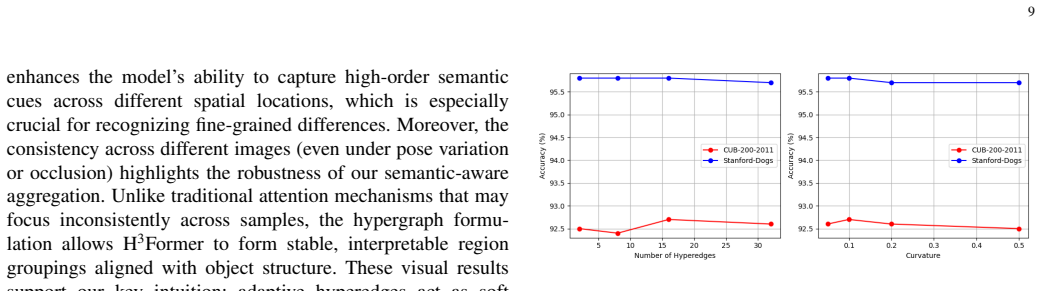
The reported gains assume that published numbers from other models are directly comparable despite different backbones, input sizes, and training recipes, and that hyperparameters M=16 and K=0.1, chosen from accuracy curves on the same test sets used for the final tables, do not inflate the results.
What would settle it
Re-run H3Former and the closest baselines under one shared protocol—same Swin-B backbone, 448x448 input, same pretraining and training schedule—and report the gap; or hold out a validation split for choosing M and K before touching the test sets. If the margin over matched baselines falls below a standard deviation of the runs, or if test-set-tuned hyperparameters do not reproduce on held-out data, the central state-of-the-art claim would not survive.
If this is right
- If H3Former's results hold, fine-grained classifiers can move from selecting individual informative tokens to aggregating them into coherent semantic regions, which should improve tolerance to pose variation and background clutter.
- The learned hyperedges act as soft part detectors: without part-level labels, each hyperedge aligns with a distinct object part, giving a path to interpretable region localization as a by-product of classification.
- The hierarchical contrastive loss implies that imposing tree-like semantic structure in a non-Euclidean embedding can tighten intra-class clusters and widen inter-class separation beyond what Euclidean contrastive learning achieves.
- Ablations showing that SAAM and HHCL each help, and that replacing them with pairwise GNNs or simpler hyperbolic losses hurts, support the claim that both high-order aggregation and hierarchy-aware supervision contribute to the reported accuracy.
- The framework is backbone-agnostic in principle, since SAAM operates on multi-stage transformer features; the same token-to-region aggregation could transfer to other fine-grained recognition settings.
Where Pith is reading between the lines
- The +4.7% gap on Stanford-Dogs is against ViT-B models, while H3Former uses Swin-B at 448x448; a matched-protocol rerun with identical pretraining, resolution, and training schedule could shrink the reported margins, so the architectural contribution may be smaller than the tables suggest.
- Because the paper selects M=16 and K=0.1 from accuracy curves on the same test sets used for the final numbers, a validation-based tuning study would separate the method's contribution from the tuning procedure.
- The dynamic hypergraph idea is not tied to classification: the same token-to-region aggregation with learned hyperedge prototypes could be applied to detection, segmentation, or retrieval, where high-order part relations are equally relevant. The paper does not test this.
- The visualizations imply a specific, testable property: if hyperedges encode class-discriminative parts, then ablating or occluding the tokens of one hyperedge should produce a targeted drop in classification confidence. The paper does not perform that lesion, but it could be done with the trained model.
Editorial analysis
A structured set of objections, weighed in public.
Referee Report
Summary. H3Former is a fine-grained visual classification (FGVC) framework built on a Swin-B transformer. It proposes two main components: (i) the Semantic-Aware Aggregation Module (SAAM), which uses multi-scale context to learn hyperedge prototypes and constructs a soft hypergraph over image tokens, then performs token-to-region message passing to form region-level representations; and (ii) the Hyperbolic Hierarchical Contrastive Loss (HHCL), which applies contrastive and hierarchy-preserving constraints in Euclidean and Lorentz hyperbolic spaces. The paper reports state-of-the-art results on CUB-200-2011 (92.7%), NA-Birds (91.6%), Stanford-Dogs (95.8%), and Oxford Flowers-101 (99.7%), with ablations, visualizations, and a computational cost table.
Significance. The conceptual contribution is appealing: hypergraph-based token aggregation is a natural way to obtain semantic regions without part annotations, and combining it with a hierarchical hyperbolic loss is a plausible and timely idea. If the empirical claims are correct, H3Former would be a strong new entry in FGVC. However, the current evidence is not yet convincing: the SOTA comparisons are mostly against models with different backbones, input resolutions, and training recipes, and the HHCL ablation is inconsistent with the method equations. The paper is significant as a proposal, but its central empirical claim needs to be either substantiated with controlled experiments or appropriately qualified.
major comments (4)
- [Sec. IV-C, Tables I-IV] The claim that H3Former 'consistently achieves the highest accuracy across all datasets' is not supported by controlled comparisons. The proposed method uses Swin-B at 448x448, pretrained on ImageNet-22K (or ImageNet-1K for Stanford-Dogs), while most baselines use ViT-B, Xception, DenseNet, or ResNet at lower resolutions with different recipes. The only same-backbone comparison is TransIFC+ on NA-Birds (+0.7%). The margins of +1.0% over IELT on CUB, +4.7% over FAL-ViT on Stanford-Dogs, and +0.7% over I2-HOFI on Flowers-101 could plausibly reflect the backbone/setup rather than the proposed modules. Please report re-runs of the strongest baselines under the same protocol, or at least compare against a Swin-B/448 trained with the same augmentations and pretraining, and temper the SOTA claim accordingly.
- [Sec. IV-E, Fig. 8] The hyperparameters M=16 and K=0.1 are selected from accuracy curves shown in Fig. 8. The text does not state whether these curves are on a held-out validation split or on the same test sets used for the final reported numbers. Since the main tables use these selected values, the headline results may be optimistic selections rather than independent evaluations. Please clarify the split used for tuning, and report means and standard deviations over multiple runs (or state the single-run variance) to support the reported margins.
- [Sec. III-C, Eq. (13)-(16) vs Sec. IV-E, Table VI] The loss definition is inconsistent. The method section defines a single supervised contrastive loss L_con (Eq. 14) that combines Euclidean and hyperbolic distances, plus L_hpop (Eq. 15), giving L_HHCL = L_con + β L_hpop (Eq. 16). Table VI, however, ablates three separate components: L_hcon, L_econ, and L_hpop. The losses L_hcon and L_econ are never defined in Sec. III-C, and the text in Sec. IV-E describes L_econ as an 'entropy minimization' regularizer in hyperbolic space, which is not present in the equations. This means the ablation that attributes the final gain to HHCL cannot be checked. Please either define L_hcon and L_econ explicitly in the method, or align Table VI with Eq. (16) by ablating L_con and L_hpop.
- [Sec. III-C, Eq. (15)] The Hypergraph Partial Order Preservation Loss is stated to enforce that higher-level features lie closer to their children, but Eq. (15) simply penalizes the hyperbolic distance d_L(H^{ℓ+1}, H^ℓ) with a ReLU, which is redundant because a distance is already non-negative. There is no margin or asymmetric constraint, and no explicit notion of an order such as an increasing norm or time coordinate. As written, this term could be trivially minimized by collapsing all levels to a single point, which would not preserve a hierarchy. A margin-based or norm-based ordering constraint would be needed to justify the claim that Eq. (15) preserves a partial order.
minor comments (6)
- [Sec. III-B] Typo: 'interpolateed' should be 'interpolated'.
- [Sec. IV-E, Table VI caption] The caption reads 'DIFFERENT RADIOS OF LOSSES'; 'radios' should be 'ratios'.
- [Fig. 8 caption] The caption reads 'he curvature K'; should be 'the curvature K'.
- [Table VIII] The caption states that 'All methods are evaluated under the same input resolution to ensure a fair comparison,' but the table lists input sizes 448 for ViT-based models, 384 for Swin-Base, and both 384 and 448 for Ours. Please clarify what 'same input resolution' means here.
- [Eq. (15)] The ReLU around a non-negative distance is unnecessary; if a margin is intended, it should be written explicitly.
- [Eq. (5)] The affinity computation uses a softmax without a temperature scale. Given the later choice of temperature τ=0.1 for the contrastive loss, the absence of a temperature in Eq. (5) may produce very peaked or flat assignments; please comment or add a temperature if needed.
Circularity Check
No circular derivation; score reflects a minor, non-load-bearing self-citation and protocol concerns, not a reduction of the central claim to its inputs.
full rationale
The paper's derivation chain is not circular. SAAM constructs a dynamic weighted hypergraph from token features and learnable prototypes (Eqs. 3-8) and HHCL adds a supervised contrastive regularizer with a parent-child consistency term (Eqs. 13-16); both are trained end-to-end with cross-entropy, which is standard supervised learning rather than a self-referential derivation. No fitted parameter is relabeled as a prediction: the reported accuracies are measured after training, not derived from the method's equations by construction. The only self-citation of note is SoftHGNN [63], used as an ablation baseline in Table VII; it shares co-authors with the present paper but is not load-bearing for the central SOTA claim, so it warrants only the rubric's minor-self-citation score. Two non-circular weaknesses should be flagged: (1) Fig. 8 selects hyperparameters M and K using accuracy on the same benchmark test sets later reported as final results, with no validation split described, so the reported margins may be optimistically biased; (2) Sec. IV-E and Table VI refer to separate losses L_hcon and L_econ, but Eqs. 13-16 define only a hybrid L_con and L_hpop, making the ablation attribution to HHCL components unverifiable. These are reproducibility and evaluation-protocol concerns, not circularity: the central architectural claim does not reduce to any equation's own input.
Axiom & Free-Parameter Ledger
free parameters (7)
- M (number of hyperedges) =
16
- K (Lorentz curvature) =
0.1
- τ (temperature) =
0.1
- λ (Euclidean/hyperbolic balance) =
1.0
- β (hierarchy preservation weight) =
0.1
- α (overall HHCL weight) =
not reported
- Hierarchy fusion ratios =
{16,8,4,1}
axioms (5)
- domain assumption Pretrained Swin Transformer features (ImageNet-22K/1K) transfer to fine-grained domains.
- domain assumption Published baseline accuracies are directly comparable despite different backbones, input sizes, and training recipes.
- ad hoc to paper Learnable prototype plus multi-scale context yields semantically coherent hyperedges that are discriminative for FGVC.
- ad hoc to paper Merging region features by similarity produces a valid category hierarchy for the partial-order loss.
- domain assumption The Lorentz model with fixed K=0.1 expresses fine-grained category hierarchy better than Euclidean geometry.
invented entities (1)
-
Semantic hyperedge prototypes P_m
no independent evidence
read the original abstract
Fine-Grained Visual Classification (FGVC) remains a challenging task due to subtle inter-class differences and large intra-class variations. Existing approaches typically rely on feature-selection mechanisms or region-proposal strategies to localize discriminative regions for semantic analysis. However, these methods often fail to capture discriminative cues comprehensively while introducing substantial category-agnostic redundancy. To address these limitations, we propose H3Former, a novel token-to-region framework that leverages high-order semantic relations to aggregate local fine-grained representations with structured region-level modeling. Specifically, we propose the Semantic-Aware Aggregation Module (SAAM), which exploits multi-scale contextual cues to dynamically construct a weighted hypergraph among tokens. By applying hypergraph convolution, SAAM captures high-order semantic dependencies and progressively aggregates token features into compact region-level representations. Furthermore, we introduce the Hyperbolic Hierarchical Contrastive Loss (HHCL), which enforces hierarchical semantic constraints in a non-Euclidean embedding space. The HHCL enhances inter-class separability and intra-class consistency while preserving the intrinsic hierarchical relationships among fine-grained categories. Comprehensive experiments conducted on four standard FGVC benchmarks validate the superiority of our H3Former framework.
Figures



Reference graph
Works this paper leans on
-
[1]
A Survey on Vision Transformer,
K. Han, Y . Wang, H. Chen, X. Chen, J. Guo, Z. Liu, Y . Tang, A. Xiao, C. Xu, Y . Xuet al., “A Survey on Vision Transformer,”IEEE Transactions on Pattern Analysis and Machine Intelligence, vol. 45, no. 1, pp. 87–110, 2022
2022
-
[2]
Fine-Grained Image Analysis with Deep Learning: A Survey,
X.-S. Wei, Y .-Z. Song, O. Mac Aodha, J. Wu, Y . Peng, J. Tang, J. Yang, and S. Belongie, “Fine-Grained Image Analysis with Deep Learning: A Survey,”IEEE Transactions on Pattern Analysis and Machine Intelli- gence, vol. 44, no. 12, pp. 8927–8948, 2021
2021
-
[3]
A Survey on Deep Learning- based Fine-Grained Object Classification and Semantic Segmentation,
B. Zhao, J. Feng, X. Wu, and S. Yan, “A Survey on Deep Learning- based Fine-Grained Object Classification and Semantic Segmentation,” International Journal of Automation and Computing, vol. 14, no. 2, pp. 119–135, 2017
2017
-
[4]
Transformers in Vision: A Survey,
S. Khan, M. Naseer, M. Hayat, S. W. Zamir, F. S. Khan, and M. Shah, “Transformers in Vision: A Survey,”ACM computing surveys (CSUR), vol. 54, no. 10s, pp. 1–41, 2022
2022
-
[5]
A Vision Transformer for Fine-Grained Classification by Reducing Noise and Enhancing Discriminative Information,
Z.-C. Zhang, Z.-D. Chen, Y . Wang, X. Luo, and X.-S. Xu, “A Vision Transformer for Fine-Grained Classification by Reducing Noise and Enhancing Discriminative Information,”Pattern Recognition, vol. 145, p. 109979, 2024
2024
-
[6]
Multi-Part Token Transformer with Dual Contrastive Learning for Fine-Grained Image Classification,
C. Wang, H. Fu, and H. Ma, “Multi-Part Token Transformer with Dual Contrastive Learning for Fine-Grained Image Classification,” in Proceedings of the 31st ACM International Conference on Multimedia, 2023, pp. 7648–7656
2023
-
[7]
Feature Fusion Vision Transformer for Fine-Grained Visual Categorization,
J. Wang, X. Yu, and Y . Gao, “Feature Fusion Vision Transformer for Fine-Grained Visual Categorization,”arXiv preprint arXiv:2107.02341, 2021
Pith/arXiv arXiv 2021
-
[8]
TransFG: A Transformer Architecture for Fine-Grained Recognition,
J. He, J.-N. Chen, S. Liu, A. Kortylewski, C. Yang, Y . Bai, and C. Wang, “TransFG: A Transformer Architecture for Fine-Grained Recognition,” inProceedings of the AAAI Conference on Artificial Intelligence, vol. 36, no. 1, 2022, pp. 852–860
2022
-
[9]
Fine-Grained Visual Classifica- tion via Internal Ensemble Learning Transformer,
Q. Xu, J. Wang, B. Jiang, and B. Luo, “Fine-Grained Visual Classifica- tion via Internal Ensemble Learning Transformer,”IEEE Transactions on Multimedia, 2023
2023
-
[10]
Local and Global Logit Adjustments for Long-Tailed Learning,
Y . Tao, J. Sun, H. Yang, L. Chen, X. Wang, W. Yang, D. Du, and M. Zheng, “Local and Global Logit Adjustments for Long-Tailed Learning,” inProceedings of the IEEE/CVF international conference on computer vision, 2023, pp. 11 783–11 792
2023
-
[11]
SR-GNN: Spatial Relation-Aware Graph Neural Network for Fine-Grained Image Categorization,
A. Bera, Z. Wharton, Y . Liu, N. Bessis, and A. Behera, “SR-GNN: Spatial Relation-Aware Graph Neural Network for Fine-Grained Image Categorization,”IEEE Transactions on Image Processing, vol. 31, pp. 6017–6031, 2022
2022
-
[12]
Interweaving Insights: High-Order Feature Interaction for Fine-Grained Visual Recognition,
A. Sikdar, Y . Liu, S. Kedarisetty, Y . Zhao, A. Ahmed, and A. Behera, “Interweaving Insights: High-Order Feature Interaction for Fine-Grained Visual Recognition,”International Journal of Computer Vision, vol. 133, no. 4, pp. 1755–1779, 2025
2025
-
[13]
Hypergraph-Induced Convolutional Networks for Visual Classifica- tion,
H. Shi, Y . Zhang, Z. Zhang, N. Ma, X. Zhao, Y . Gao, and J. Sun, “Hypergraph-Induced Convolutional Networks for Visual Classifica- tion,”IEEE transactions on neural networks and learning systems, vol. 30, no. 10, pp. 2963–2972, 2018
2018
-
[14]
Adaptive Neural Message Passing for Inductive Learning on Hypergraphs,
D. Arya, D. K. Gupta, S. Rudinac, and M. Worring, “Adaptive Neural Message Passing for Inductive Learning on Hypergraphs,”IEEE Trans- actions on Pattern Analysis and Machine Intelligence, 2024
2024
-
[15]
HGFormer: Topology-Aware Vision Transformer with Hypergraph Learning,
H. Wang, S. Zhang, and B. Leng, “HGFormer: Topology-Aware Vision Transformer with Hypergraph Learning,”IEEE Transactions on Multi- media, 2025
2025
-
[16]
The Caltech-Ucsd Birds-200-2011 Dataset,
C. Wah, S. Branson, P. Welinder, P. Perona, and S. Belongie, “The Caltech-Ucsd Birds-200-2011 Dataset,” 2011
2011
-
[17]
Novel Dataset for Fine-Grained Image Categorization: Stanford Dogs,
A. Khosla, N. Jayadevaprakash, B. Yao, and L. Fei-Fei, “Novel Dataset for Fine-Grained Image Categorization: Stanford Dogs,” inProceedings of the CVPR Workshop on Fine-Grained Visual Categorization (FGVC), vol. 2. Citeseer, 2011, pp. 1–2
2011
-
[18]
Attention is All You Need,
A. Vaswani, N. Shazeer, N. Parmar, J. Uszkoreit, L. Jones, A. N. Gomez, Ł. Kaiser, and I. Polosukhin, “Attention is All You Need,”Advances in Neural Information Processing Systems, vol. 30, 2017
2017
-
[19]
Rams- trans: Recurrent attention multi-scale transformer for fine-grained image recognition,
Y . Hu, X. Jin, Y . Zhang, H. Hong, J. Zhang, Y . He, and H. Xue, “Rams- trans: Recurrent attention multi-scale transformer for fine-grained image recognition,” inProceedings of the 29th ACM International Conference on Multimedia, 2021, pp. 4239–4248
2021
-
[20]
Delving into Multimodal Prompting for Fine-Grained Visual Classification,
X. Jiang, H. Tang, J. Gao, X. Du, S. He, and Z. Li, “Delving into Multimodal Prompting for Fine-Grained Visual Classification,” inPro- ceedings of the AAAI conference on artificial intelligence, vol. 38, no. 3, 2024, pp. 2570–2578
2024
-
[21]
Fine-Grained Recognition without Part Annotations,
J. Krause, H. Jin, J. Yang, and L. Fei-Fei, “Fine-Grained Recognition without Part Annotations,” inProceedings of the IEEE conference on computer vision and pattern recognition, 2015, pp. 5546–5555
2015
-
[22]
Bird Species Categorization using Pose Normalized Deep Convolutional Nets,
S. Branson, G. Van Horn, S. Belongie, and P. Perona, “Bird Species Categorization using Pose Normalized Deep Convolutional Nets,”arXiv preprint arXiv:1406.2952, 2014
Pith/arXiv arXiv 2014
-
[23]
Fully Convolutional Attention Networks for Fine-Grained Recognition,
X. Liu, T. Xia, J. Wang, Y . Yang, F. Zhou, and Y . Lin, “Fully Convolutional Attention Networks for Fine-Grained Recognition,”arXiv preprint arXiv:1603.06765, 2016
Pith/arXiv arXiv 2016
-
[24]
Bilinear CNN Models for Fine-Grained Visual Recognition,
T.-Y . Lin, A. RoyChowdhury, and S. Maji, “Bilinear CNN Models for Fine-Grained Visual Recognition,” inProceedings of the IEEE international conference on computer vision, 2015, pp. 1449–1457
2015
-
[25]
The Devil is in the Channels: Mutual-Channel Loss for Fine-Grained Image Classification,
D. Chang, Y . Ding, J. Xie, A. K. Bhunia, X. Li, Z. Ma, M. Wu, J. Guo, and Y .-Z. Song, “The Devil is in the Channels: Mutual-Channel Loss for Fine-Grained Image Classification,”IEEE Transactions on Image Processing, vol. 29, pp. 4683–4695, 2020
2020
-
[26]
Cross-Part Learning for Fine-Grained Image Classification,
M. Liu, C. Zhang, H. Bai, R. Zhang, and Y . Zhao, “Cross-Part Learning for Fine-Grained Image Classification,”IEEE Transactions on Image Processing, vol. 31, pp. 748–758, 2021
2021
-
[27]
Mask-CNN: Localizing Parts and Selecting Descriptors for Fine-Grained Bird Species Catego- rization,
X.-S. Wei, C.-W. Xie, J. Wu, and C. Shen, “Mask-CNN: Localizing Parts and Selecting Descriptors for Fine-Grained Bird Species Catego- rization,”Pattern Recognition, vol. 76, pp. 704–714, 2018
2018
-
[28]
Part-Guided Relational Trans- formers for Fine-Grained Visual Recognition,
Y . Zhao, J. Li, X. Chen, and Y . Tian, “Part-Guided Relational Trans- formers for Fine-Grained Visual Recognition,”IEEE Transactions on Image Processing, vol. 30, pp. 9470–9481, 2021
2021
-
[29]
Weakly Supervised Posture Min- ing for Fine-Grained Classification,
Z. Tang, H. Yang, and C. Y .-C. Chen, “Weakly Supervised Posture Min- ing for Fine-Grained Classification,” inProceedings of the IEEE/CVF conference on computer vision and pattern recognition, 2023, pp. 23 735–23 744
2023
-
[30]
Improving Visual Recognition with Hyperbolical Visual Hierarchy Mapping,
H. Kwon, J. Jang, J. Kim, K. Kim, and K. Sohn, “Improving Visual Recognition with Hyperbolical Visual Hierarchy Mapping,” inProceed- ings of the IEEE/CVF Conference on Computer Vision and Pattern Recognition, 2024, pp. 17 364–17 374
2024
-
[31]
Mode Hypergraph Neural Network,
S. Ji, Y . Feng, D. Di, S. Ying, and Y . Gao, “Mode Hypergraph Neural Network,”IEEE Transactions on Neural Networks and Learning Systems, 2025
2025
-
[32]
LightHGNN: Distilling Hyper- graph Neural Networks into MLPs for 100x Faster Inference,
Y . Feng, Y . Luo, S. Ying, and Y . Gao, “LightHGNN: Distilling Hyper- graph Neural Networks into MLPs for 100x Faster Inference,” inThe Twelfth International Conference on Learning Representations, 2024
2024
-
[33]
Hgnn+: General Hypergraph Neural Networks,
Y . Gao, Y . Feng, S. Ji, and R. Ji, “Hgnn+: General Hypergraph Neural Networks,”IEEE Transactions on Pattern Analysis and Machine Intelligence, vol. 45, no. 3, pp. 3181–3199, 2022
2022
-
[34]
Hyper-Yolo: When Visual Object Detection Meets Hypergraph Computation,
Y . Feng, J. Huang, S. Du, S. Ying, J.-H. Yong, Y . Li, G. Ding, R. Ji, and Y . Gao, “Hyper-Yolo: When Visual Object Detection Meets Hypergraph Computation,”IEEE Transactions on Pattern Analysis and Machine Intelligence, 2024
2024
-
[35]
Vision Hgnn: An Image Is More Than A Graph of Nodes,
Y . Han, P. Wang, S. Kundu, Y . Ding, and Z. Wang, “Vision Hgnn: An Image Is More Than A Graph of Nodes,” inProceedings of the IEEE/CVF International Conference on Computer Vision, 2023, pp. 19 878–19 888
2023
-
[36]
Hyperbolic Category Discovery,
Y . Liu, Z. He, and K. Han, “Hyperbolic Category Discovery,” inPro- ceedings of the Computer Vision and Pattern Recognition Conference, 2025, pp. 9891–9900
2025
-
[37]
HLFormer: Enhancing Partially Rel- evant Video Retrieval with Hyperbolic Learning,
L. Jun, W. Jinpeng, T. Chaolei, L. Niu, C. Long, Z. Min, W. Yaowei, X. Shu-Tao, and C. Bin, “HLFormer: Enhancing Partially Rel- evant Video Retrieval with Hyperbolic Learning,”arXiv preprint arXiv:2507.17402, 2025
Pith/arXiv arXiv 2025
-
[38]
Building A Bird Recognition APP and Large Scale Dataset with Citizen Scientists: The Fine Print in Fine- Grained Dataset Collection,
G. Van Horn, S. Branson, R. Farrell, S. Haber, J. Barry, P. Ipeirotis, P. Perona, and S. Belongie, “Building A Bird Recognition APP and Large Scale Dataset with Citizen Scientists: The Fine Print in Fine- Grained Dataset Collection,” inProceedings of the IEEE conference on computer vision and pattern recognition, 2015, pp. 595–604
2015
-
[39]
Automated Flower Classification Over A Large Number of Classes,
M.-E. Nilsback and A. Zisserman, “Automated Flower Classification Over A Large Number of Classes,” in2008 Sixth Indian conference on computer vision, graphics & image processing. IEEE, 2008, pp. 722–729
2008
-
[40]
Swin Transformer: Hierarchical Vision Transformer using Shifted Win- dows,
Z. Liu, Y . Lin, Y . Cao, H. Hu, Y . Wei, Z. Zhang, S. Lin, and B. Guo, “Swin Transformer: Hierarchical Vision Transformer using Shifted Win- dows,” inProceedings of the IEEE/CVF international conference on computer vision, 2021, pp. 10 012–10 022
2021
-
[41]
ImageNet-21k Pretraining for The Masses,
T. Ridnik, E. Ben-Baruch, A. Noy, and L. Zelnik-Manor, “ImageNet-21k Pretraining for The Masses,”arXiv preprint arXiv:2104.10972, 2021
Pith/arXiv arXiv 2021
-
[42]
ImageNet: A Large-Scale Hierarchical Image Database,
J. Deng, W. Dong, R. Socher, L.-J. Li, K. Li, and L. Fei-Fei, “ImageNet: A Large-Scale Hierarchical Image Database,” in2009 IEEE Conference on Computer Vision and Pattern Recognition, 2009, pp. 248–255
2009
-
[43]
An Attention- Locating Algorithm for Eliminating Background Effects in Fine-Grained Visual Classification,
Y . Huang, Z. Hechen, M. Zhou, Z. Li, and S. Kwong, “An Attention- Locating Algorithm for Eliminating Background Effects in Fine-Grained Visual Classification,”IEEE Transactions on Circuits and Systems for Video Technology, 2025. 12
2025
-
[44]
Filtration and Distillation: Enhancing Region Attention for Fine-Grained Visual Categorization,
C. Liu, H. Xie, Z.-J. Zha, L. Ma, L. Yu, and Y . Zhang, “Filtration and Distillation: Enhancing Region Attention for Fine-Grained Visual Categorization,” inProceedings of the AAAI Conference on Artificial Intelligence, vol. 34, no. 07, 2020, pp. 11 555–11 562
2020
-
[45]
Fine-Grained Visual Categorization by Localizing Object Parts with Single Image,
X. Zheng, L. Qi, Y . Ren, and X. Lu, “Fine-Grained Visual Categorization by Localizing Object Parts with Single Image,”IEEE Transactions on Multimedia, vol. 23, pp. 1187–1199, 2020
2020
-
[46]
AP-CNN: Weakly Supervised Attention Pyramid Convolutional Neural Network for Fine-Grained Visual Classification,
Y . Ding, Z. Ma, S. Wen, J. Xie, D. Chang, Z. Si, M. Wu, and H. Ling, “AP-CNN: Weakly Supervised Attention Pyramid Convolutional Neural Network for Fine-Grained Visual Classification,”IEEE Transactions on Image Processing, vol. 30, pp. 2826–2836, 2021
2021
-
[47]
Fine-Grained Object Classification via Self-Supervised Pose Alignment,
X. Yang, Y . Wang, K. Chen, Y . Xu, and Y . Tian, “Fine-Grained Object Classification via Self-Supervised Pose Alignment,” inProceedings of the IEEE/CVF Conference on Computer Vision and Pattern Recognition, 2022, pp. 7399–7408
2022
-
[48]
Granularity-Aware Distillation and Structure Modeling Region Proposal Network for Fine- Grained Image classification,
X. Ke, Y . Cai, B. Chen, H. Liu, and W. Guo, “Granularity-Aware Distillation and Structure Modeling Region Proposal Network for Fine- Grained Image classification,”Pattern Recognition, vol. 137, p. 109305, 2023
2023
-
[49]
Learning Mutually Exclusive Part Rep- resentations for Fine-Grained Image Classification,
C. Wang, H. Fu, and H. Ma, “Learning Mutually Exclusive Part Rep- resentations for Fine-Grained Image Classification,”IEEE Transactions on Multimedia, vol. 26, pp. 3113–3124, 2023
2023
-
[50]
Vit-Net: Interpretable Vision Transform- ers with Neural Tree Decoder,
S. Kim, J. Nam, and B. C. Ko, “Vit-Net: Interpretable Vision Transform- ers with Neural Tree Decoder,” inInternational conference on machine learning. PMLR, 2022, pp. 11 162–11 172
2022
-
[51]
TransIFC: Invariant Cues-Aware Feature Concentration Learning for Efficient Fine- Grained Bird Image Classification,
H. Liu, C. Zhang, Y . Deng, B. Xie, T. Liu, and Y .-F. Li, “TransIFC: Invariant Cues-Aware Feature Concentration Learning for Efficient Fine- Grained Bird Image Classification,”IEEE Transactions on Multimedia, vol. 27, pp. 1677–1690, 2023
2023
-
[52]
Learning Attentive Pairwise In- teraction for Fine-Grained Classification,
P. Zhuang, Y . Wang, and Y . Qiao, “Learning Attentive Pairwise In- teraction for Fine-Grained Classification,” inProceedings of the AAAI conference on artificial intelligence, vol. 34, no. 07, 2020, pp. 13 130– 13 137
2020
-
[53]
Context-Aware Attentional Pooling for Fine-Grained Visual Classification,
A. Behera, Z. Wharton, P. R. Hewage, and A. Bera, “Context-Aware Attentional Pooling for Fine-Grained Visual Classification,” inProceed- ings of the AAAI conference on artificial intelligence, vol. 35, no. 2, 2021, pp. 929–937
2021
-
[54]
Counterfactual Attention Learning for Fine-Grained Visual Categorization and Re-Identification,
Y . Rao, G. Chen, J. Lu, and J. Zhou, “Counterfactual Attention Learning for Fine-Grained Visual Categorization and Re-Identification,” inPro- ceedings of the IEEE/CVF international conference on computer vision, 2021, pp. 1025–1034
2021
-
[55]
PBC: Polygon- based Classifier for Fine-Grained Categorization,
C. Huang, H. Li, Y . Xie, Q. Wu, and B. Luo, “PBC: Polygon- based Classifier for Fine-Grained Categorization,”IEEE Transactions on Multimedia, vol. 19, no. 4, pp. 673–684, 2016
2016
-
[56]
Interactive: Inter- Layer Activeness Propagation,
L. Xie, L. Zheng, J. Wang, A. L. Yuille, and Q. Tian, “Interactive: Inter- Layer Activeness Propagation,” inProceedings of the IEEE conference on computer vision and pattern recognition, 2016, pp. 270–279
2016
-
[57]
Borrowing Treasures from The Wealthy: Deep Transfer Learning Through Selective Joint Fine-Tuning,
W. Ge and Y . Yu, “Borrowing Treasures from The Wealthy: Deep Transfer Learning Through Selective Joint Fine-Tuning,” inProceedings of the IEEE conference on computer vision and pattern recognition, 2017, pp. 1086–1095
2017
-
[58]
Object-Part Attention Model for Fine- Grained Image Classification,
Y . Peng, X. He, and J. Zhao, “Object-Part Attention Model for Fine- Grained Image Classification,”IEEE Transactions on Image Processing, vol. 27, no. 3, pp. 1487–1500, 2017
2017
-
[59]
Large scale Fine-Grained Categorization and Domain-Specific Transfer Learning,
Y . Cui, Y . Song, C. Sun, A. Howard, and S. Belongie, “Large scale Fine-Grained Categorization and Domain-Specific Transfer Learning,” inProceedings of the IEEE conference on computer vision and pattern recognition, 2018, pp. 4109–4118
2018
-
[60]
Learning A Mixture of Granularity-Specific Experts for Fine-Grained Categorization,
L. Zhang, S. Huang, W. Liu, and D. Tao, “Learning A Mixture of Granularity-Specific Experts for Fine-Grained Categorization,” in Proceedings of the IEEE/CVF international conference on computer vision, 2019, pp. 8331–8340
2019
-
[61]
Deep Learning on Small Datasets without Pre- training Using Cosine Loss,
B. Barz and J. Denzler, “Deep Learning on Small Datasets without Pre- training Using Cosine Loss,” inProceedings of the IEEE/CVF winter conference on applications of computer vision, 2020, pp. 1371–1380
2020
-
[62]
Bi-Modal Progres- sive Mask Attention for Fine-Grained Recognition,
K. Song, X.-S. Wei, X. Shu, R.-J. Song, and J. Lu, “Bi-Modal Progres- sive Mask Attention for Fine-Grained Recognition,”IEEE Transactions on Image Processing, vol. 29, pp. 7006–7018, 2020
2020
-
[63]
SoftHGNN: Soft Hypergraph Neural Networks for General Visual Recognition,
M. Lei, Y . Wu, S. Li, X. Zheng, J. Wang, Y . Gao, and S. Du, “SoftHGNN: Soft Hypergraph Neural Networks for General Visual Recognition,”arXiv preprint arXiv:2505.15325, 2025
Pith/arXiv arXiv 2025
-
[64]
Understanding Hyperbolic Metric Learning through Hard Negative Sampling,
Y . Yue, F. Lin, G. Mou, and Z. Zhang, “Understanding Hyperbolic Metric Learning through Hard Negative Sampling,” inProceedings of the IEEE/CVF Winter Conference on Applications of Computer Vision, 2024, pp. 1891–1903. Yongji Zhangis currently working toward the Ph.D. degree in the College of Computer Science and Technology, Jilin University, China. He re...
2024
discussion (0)
Sign in with ORCID, Apple, or X to comment. Anyone can read and Pith papers without signing in.