Scaling of free cumulants in closed system-bath setups
Pith reviewed 2026-05-17 22:20 UTC · model grok-4.3
The pith
Free cumulants of central-system observables scale universally with interaction strength in system-bath models.
A machine-rendered reading of the paper's core claim, the machinery that carries it, and where it could break.
Core claim
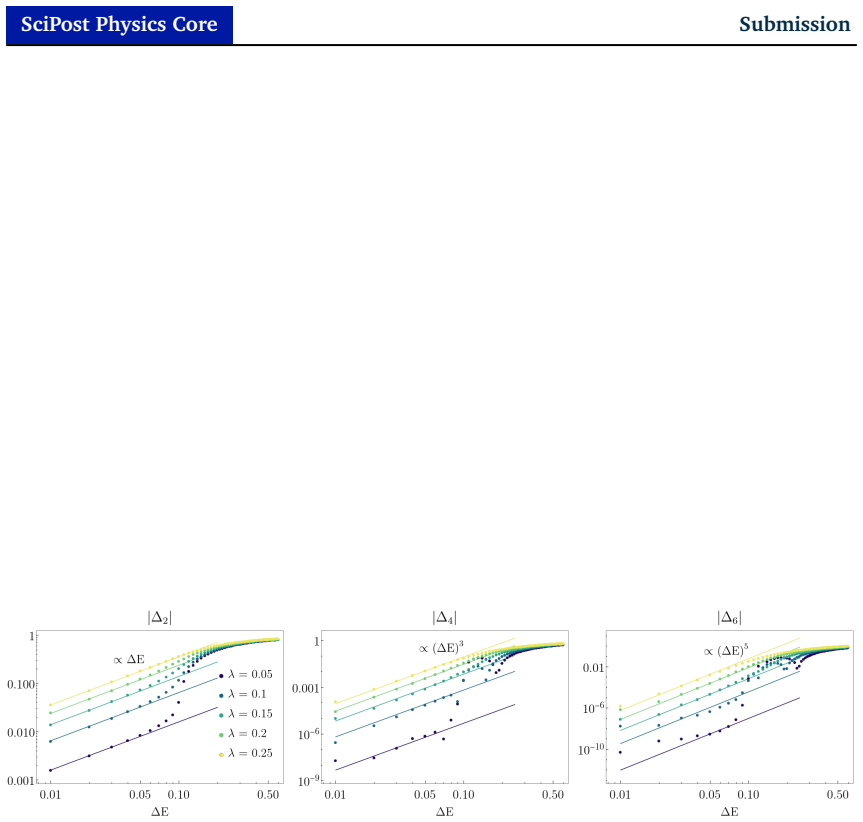
In closed system-bath setups the microcanonical free cumulants of observables associated with the central system Hamiltonian exhibit a universal scaling with respect to the interaction strength. The scaling is the same for an idealized random-matrix bath and for a defect Ising chain bath. The scaling behavior is further connected to the thermalization dynamics of the thermal free cumulants of the same observables.
What carries the argument
Full ETH framework with smooth multi-point correlation functions for matrix elements; it supplies the definition of free cumulants and permits their scaling analysis once a finite bath is coupled to the system.
If this is right
- The scaling supplies a compact characterization of thermalization that depends only on interaction strength rather than on the detailed spectrum of the combined system.
- The same scaling relation appears in both random-matrix and structured Ising baths, indicating model-independent behavior.
- Microcanonical free-cumulant scaling directly predicts the time scale on which thermal free cumulants relax to their equilibrium values.
Where Pith is reading between the lines
- If the scaling is confirmed in additional bath models it would suggest a general route to predicting thermalization rates from static correlation data alone.
- The observed connection between microcanonical and thermal cumulants might be tested in experiments on small quantum simulators coupled to engineered environments.
- The scaling law could be used to benchmark numerical methods that simulate open-system dynamics without requiring full diagonalization of the combined Hilbert space.
Load-bearing premise
The full ETH with smooth multi-point correlation functions remains valid when a finite bath is coupled to the system, and the two chosen bath models are representative of generic baths.
What would settle it
Compute the microcanonical free cumulants of a central-system observable at several values of the interaction strength in either bath model and test whether they collapse onto a single universal curve when plotted against the scaled interaction strength.
Figures


read the original abstract
The Eigenstate Thermalization Hypothesis (ETH) has been established as a cornerstone for understanding thermalization in quantum many-body systems. Recently, there has been growing interest in the full ETH, which extends the framework of the conventional ETH and postulates a smooth function to describe the multi-point correlations among matrix elements. Within this framework, free cumulants play a central role, and most previous studies have primarily focused on closed systems. In this paper, we extend the analysis to a system-bath setup, considering both an idealized case with a random-matrix bath and a more realistic scenario where the bath is modeled as a defect Ising chain. In both cases, we uncover a universal scaling of the microcanonical free cumulants of observables associated with the central system Hamiltonian with respect to the interaction strength. Furthermore we establish a connection between this scaling behavior and the thermalization dynamics of the thermal free cumulants of corresponding observables.
Editorial analysis
A structured set of objections, weighed in public.
Referee Report
Summary. The manuscript extends the full Eigenstate Thermalization Hypothesis (ETH) to closed system-bath setups. Using a central system coupled to either a random-matrix bath or a defect Ising chain, the authors extract microcanonical free cumulants of system observables and report a universal scaling with interaction strength λ. They further connect this scaling to the thermalization dynamics of the corresponding thermal free cumulants.
Significance. If the central scaling result holds, the work offers a concrete bridge between full ETH in closed systems and thermalization in finite system-bath models, with the use of two qualitatively different baths strengthening the universality claim. The explicit link between static cumulant scaling and dynamical thermalization is a positive feature that could be tested in future work.
major comments (2)
- [§3] §3 (ETH framework for system-bath): The derivation of the λ-scaling of microcanonical free cumulants rests on the assumption that the full ETH ansatz—smooth functions for all multi-point matrix-element correlations—remains valid for the total Hamiltonian of the finite system plus finite bath at all scanned λ. No explicit diagnostic (e.g., plots of higher-order correlation functions versus energy difference for several λ values) is provided to confirm that smoothness persists as λ increases and system-bath mixing strengthens. This assumption is load-bearing for the claimed universality.
- [§5] §5 (thermalization connection): The reported link between the microcanonical scaling and the dynamics of thermal free cumulants uses the same ETH smoothness functions to define both quantities. It is unclear whether the thermal cumulants are obtained from an independent long-time average or from the same microcanonical data set; any overlap would make the dynamical claim partially self-referential and weaken the evidence that the scaling governs thermalization.
minor comments (2)
- [Introduction] The notation for free cumulants of different orders is introduced without a compact summary table; adding one would improve readability when comparing scaling exponents across orders.
- [Figure 3] Figure captions for the scaling plots do not state the fitting range in λ or the number of disorder realizations; this information should be added for reproducibility.
Simulated Author's Rebuttal
We thank the referee for the careful reading of our manuscript and the positive assessment of its potential to bridge full ETH and thermalization in system-bath models. We address each major comment below with clarifications and revisions where appropriate.
read point-by-point responses
-
Referee: [§3] §3 (ETH framework for system-bath): The derivation of the λ-scaling of microcanonical free cumulants rests on the assumption that the full ETH ansatz—smooth functions for all multi-point matrix-element correlations—remains valid for the total Hamiltonian of the finite system plus finite bath at all scanned λ. No explicit diagnostic (e.g., plots of higher-order correlation functions versus energy difference for several λ values) is provided to confirm that smoothness persists as λ increases and system-bath mixing strengthens. This assumption is load-bearing for the claimed universality.
Authors: We agree that explicit verification of ETH smoothness across λ would strengthen the presentation. In the revised manuscript we add supplementary figures that plot the relevant higher-order matrix-element correlation functions versus energy difference for both bath models at several representative values of λ (including the largest λ scanned). These diagnostics confirm that the smoothness assumption continues to hold as system-bath mixing increases, thereby supporting the load-bearing step in the derivation. revision: yes
-
Referee: [§5] §5 (thermalization connection): The reported link between the microcanonical scaling and the dynamics of thermal free cumulants uses the same ETH smoothness functions to define both quantities. It is unclear whether the thermal cumulants are obtained from an independent long-time average or from the same microcanonical data set; any overlap would make the dynamical claim partially self-referential and weaken the evidence that the scaling governs thermalization.
Authors: The thermal free cumulants are computed from independent long-time dynamical evolution: we prepare microcanonical initial states, evolve them under the full system-bath Hamiltonian, and extract the cumulants from the long-time averages of the time-dependent observables. This procedure is separate from the static extraction of microcanonical cumulants via the ETH ansatz. We have revised the text in §5 to state this separation explicitly, including the precise time-averaging window and ensemble, so that the connection between scaling and thermalization dynamics is not self-referential. revision: yes
Circularity Check
No significant circularity; derivation applies external ETH framework to new setup
full rationale
The paper applies the full ETH (smooth multi-point matrix-element functions) as an input assumption to finite system-bath Hamiltonians, then reports an observed scaling of microcanonical free cumulants with coupling strength λ. This scaling is extracted from explicit numerical diagonalization on two concrete bath models rather than being imposed by definition or by fitting the same quantities that are later called predictions. The link to thermalization dynamics of thermal free cumulants is presented as a separate empirical observation, not as a self-referential redefinition. No load-bearing uniqueness theorem or ansatz is imported via self-citation; the central claim remains independent of the authors' prior work. The result is therefore self-contained against external benchmarks and receives the default non-circularity finding.
Axiom & Free-Parameter Ledger
axioms (1)
- domain assumption Eigenstate Thermalization Hypothesis holds with smooth multi-point correlation functions
Lean theorems connected to this paper
-
IndisputableMonolith/Cost/FunctionalEquation.leanwashburn_uniqueness_aczel unclear?
unclearRelation between the paper passage and the cited Recognition theorem.
we uncover a universal scaling of the microcanonical free cumulants of observables associated with the central system Hamiltonian with respect to the interaction strength
-
IndisputableMonolith/Foundation/DimensionForcing.leanalexander_duality_circle_linking unclear?
unclearRelation between the paper passage and the cited Recognition theorem.
ΔE_eq^{(n)} ∝ λ² … T_eq^{(n)} ∼ 2π / ΔE_eq^{(n)}
What do these tags mean?
- matches
- The paper's claim is directly supported by a theorem in the formal canon.
- supports
- The theorem supports part of the paper's argument, but the paper may add assumptions or extra steps.
- extends
- The paper goes beyond the formal theorem; the theorem is a base layer rather than the whole result.
- uses
- The paper appears to rely on the theorem as machinery.
- contradicts
- The paper's claim conflicts with a theorem or certificate in the canon.
- unclear
- Pith found a possible connection, but the passage is too broad, indirect, or ambiguous to say the theorem truly supports the claim.
Forward citations
Cited by 1 Pith paper
-
Timescales for Deep and Full Thermalization
In a chaotic quantum system, higher-order correlations reach thermal equilibrium faster than state design moments, both relaxing exponentially.
Reference graph
Works this paper leans on
-
[1]
J. M. Deutsch, Quantum statistical mechanics in a closed system, Phys. Rev. A 43, 2046 (1991), doi:10.1103/PhysRevA.43.2046
-
[2]
Chaos and quantum thermalization.Phys
M. Srednicki, Chaos and quantum thermalization, Phys. Rev. E 50, 888 (1994), doi:10.1103/PhysRevE.50.888
-
[3]
M. Srednicki, The approach to thermal equilibrium in quantized chaotic systems, Journal of Physics A: Mathematical and General 32(7), 1163 (1999), doi:10.1088/0305-4470/32/7/007
-
[4]
M. Srednicki, Thermal fluctuations in quantized chaotic systems, Journal of Physics A: Mathematical and General 29(4), L75 (1996), doi:10.1088/0305-4470/29/4/003
-
[5]
A. P. Luca D'Alessio, Yariv Kafri and M. Rigol, From quantum chaos and eigenstate thermalization to statistical mechanics and thermodynamics, Advances in Physics 65(3), 239 (2016), doi:10.1080/00018732.2016.1198134
-
[6]
M. Rigol, V. Dunjko and M. Olshanii, Thermalization and its mechanism for generic isolated quantum systems, Nature 452, 854 (2008), doi:10.1038/nature06838
-
[7]
D. Jansen, J. Stolpp, L. Vidmar and F. Heidrich-Meisner, Eigenstate thermalization and quantum chaos in the holstein polaron model, Phys. Rev. B 99, 155130 (2019), doi:10.1103/PhysRevB.99.155130
-
[8]
T. LeBlond, K. Mallayya, L. Vidmar and M. Rigol, Entanglement and matrix elements of observables in interacting integrable systems, Phys. Rev. E 100, 062134 (2019), doi:10.1103/PhysRevE.100.062134
-
[9]
L. F. Santos and M. Rigol, Localization and the effects of symmetries in the thermalization properties of one-dimensional quantum systems, Phys. Rev. E 82, 031130 (2010), doi:10.1103/PhysRevE.82.031130
-
[10]
R. Steinigeweg, J. Herbrych and P. Prelov s s ek, Eigenstate thermalization within isolated spin-chain systems, Phys. Rev. E 87, 012118 (2013), doi:10.1103/PhysRevE.87.012118
-
[11]
W. Beugeling, R. Moessner and M. Haque, Finite-size scaling of eigenstate thermalization, Phys. Rev. E 89, 042112 (2014), doi:10.1103/PhysRevE.89.042112
-
[12]
H. Kim, T. N. Ikeda and D. A. Huse, Testing whether all eigenstates obey the eigenstate thermalization hypothesis, Phys. Rev. E 90, 052105 (2014), doi:10.1103/PhysRevE.90.052105
-
[13]
W. Beugeling, R. Moessner and M. Haque, Off-diagonal matrix elements of local operators in many-body quantum systems, Phys. Rev. E 91, 012144 (2015), doi:10.1103/PhysRevE.91.012144
-
[14]
R. Mondaini, K. R. Fratus, M. Srednicki and M. Rigol, Eigenstate thermalization in the two-dimensional transverse field ising model, Phys. Rev. E 93, 032104 (2016), doi:10.1103/PhysRevE.93.032104
-
[15]
R. Mondaini and M. Rigol, Eigenstate thermalization in the two-dimensional transverse field ising model. ii. off-diagonal matrix elements of observables, Phys. Rev. E 96, 012157 (2017), doi:10.1103/PhysRevE.96.012157
-
[16]
L. V. Delacretaz, A. L. Fitzpatrick, E. Katz and M. T. Walters, Thermalization and chaos in a 1+1d QFT , JHEP 02, 045 (2023), doi:10.1007/JHEP02(2023)045, 2207.11261
-
[17]
C. Sch\"onle, D. Jansen, F. Heidrich-Meisner and L. Vidmar, Eigenstate thermalization hypothesis through the lens of autocorrelation functions, Phys. Rev. B 103, 235137 (2021), doi:10.1103/PhysRevB.103.235137
-
[18]
P. yd z \. z ba, R. S \' S wi e e tek, M. Mierzejewski, M. Rigol and L. Vidmar, Normal weak eigenstate thermalization, Phys. Rev. B 110, 104202 (2024), doi:10.1103/PhysRevB.110.104202
-
[19]
L. Foini and J. Kurchan, Eigenstate thermalization hypothesis and out of time order correlators, Phys. Rev. E 99, 042139 (2019), doi:10.1103/PhysRevE.99.042139
-
[20]
A. Chan, A. De Luca and J. T. Chalker, Eigenstate correlations, thermalization, and the butterfly effect, Phys. Rev. Lett. 122, 220601 (2019), doi:10.1103/PhysRevLett.122.220601
-
[21]
Bounds on chaos from the eigenstate ther- malization hypothesis
C. Murthy and M. Srednicki, Bounds on chaos from the eigenstate thermalization hypothesis, Physical Review Letters 123(23) (2019), doi:10.1103/physrevlett.123.230606
-
[22]
J. Richter, A. Dymarsky, R. Steinigeweg and J. Gemmer, Eigenstate thermalization hypothesis beyond standard indicators: Emergence of random-matrix behavior at small frequencies, Phys.\ Rev.\ E 102(4) (2020), doi:10.1103/PhysRevE.102.042127
-
[23]
M. Brenes, S. Pappalardi, M. T. Mitchison, J. Goold and A. Silva, Out-of-time-order correlations and the fine structure of eigenstate thermalization, Phys. Rev. E 104, 034120 (2021), doi:10.1103/PhysRevE.104.034120
-
[24]
J. Wang, M. H. Lamann, J. Richter, R. Steinigeweg, A. Dymarsky and J. Gemmer, Eigenstate thermalization hypothesis and its deviations from random-matrix theory beyond the thermalization time, Phys. Rev. Lett. 128, 180601 (2022), doi:10.1103/PhysRevLett.128.180601
-
[25]
Dymarsky, Bound on eigenstate thermalization from transport, Phys
A. Dymarsky, Bound on eigenstate thermalization from transport, Phys. Rev. Lett. 128, 190601 (2022), doi:10.1103/PhysRevLett.128.190601
-
[26]
D. Hahn, D. J. Luitz and J. T. Chalker, Eigenstate correlations, the eigenstate thermalization hypothesis, and quantum information dynamics in chaotic many-body quantum systems, Phys. Rev. X 14, 031029 (2024), doi:10.1103/PhysRevX.14.031029
-
[27]
S. Pappalardi, L. Foini and J. Kurchan, Eigenstate thermalization hypothesis and free probability, Phys. Rev. Lett. 129, 170603 (2022), doi:10.1103/PhysRevLett.129.170603
- [28]
-
[29]
S. Pappalardi, F. Fritzsch and T. Prosen, Full eigenstate thermalization via free cumulants in quantum lattice systems, Phys. Rev. Lett. 134, 140404 (2025), doi:10.1103/PhysRevLett.134.140404
-
[30]
L. Foini and J. Kurchan, Eigenstate thermalization and rotational invariance in ergodic quantum systems, Phys. Rev. Lett. 123, 260601 (2019), doi:10.1103/PhysRevLett.123.260601
-
[31]
M. Fava, J. Kurchan and S. Pappalardi, Designs via free probability, Physical Review X 15(1), 011031 (2025), doi:10.1103/PhysRevX.15.011031
-
[32]
F. Fritzsch, T. Prosen and S. Pappalardi, Microcanonical free cumulants in lattice systems, Phys. Rev. B 111, 054303 (2025), doi:10.1103/PhysRevB.111.054303
-
[33]
F. Fritzsch, G. O. Alves, M. A. Rampp and P. W. Claeys, Free cumulants and full eigenstate thermalization from boundary scrambling (2025), 2509.08060
- [34]
-
[35]
D. L. Jafferis, D. K. Kolchmeyer, B. Mukhametzhanov and J. Sonner, Matrix models for eigenstate thermalization, Phys. Rev. X 13, 031033 (2023), doi:10.1103/PhysRevX.13.031033
-
[36]
D. L. Jafferis, D. K. Kolchmeyer, B. Mukhametzhanov and J. Sonner, Jackiw-teitelboim gravity with matter, generalized eigenstate thermalization hypothesis, and random matrices, Phys. Rev. D 108, 066015 (2023), doi:10.1103/PhysRevD.108.066015
-
[37]
M. Serbyn, Z. Papi \'c and D. A. Abanin, Thouless energy and multifractality across the many-body localization transition, Phys. Rev. B 96, 104201 (2017), doi:10.1103/PhysRevB.96.104201
-
[38]
T. LeBlond and M. Rigol, Eigenstate thermalization for observables that break hamiltonian symmetries and its counterpart in interacting integrable systems, Phys. Rev. E 102, 062113 (2020), doi:10.1103/PhysRevE.102.062113
-
[39]
J. Wang, J. Richter, M. H. Lamann, R. Steinigeweg, J. Gemmer and A. Dymarsky, Emergence of unitary symmetry of microcanonically truncated operators in chaotic quantum systems, Phys. Rev. E 110, L032203 (2024), doi:10.1103/PhysRevE.110.L032203
-
[40]
H.-P. Breuer and F. Petruccione, The Theory of Open Quantum Systems, Oxford University Press (2007)
work page 2007
-
[41]
Weiss, Quantum dissipative systems, World Scientific (2012)
U. Weiss, Quantum dissipative systems, World Scientific (2012)
work page 2012
-
[42]
M. Esposito and P. Gaspard, Spin relaxation in a complex environment, Phys. Rev. E 68, 066113 (2003), doi:10.1103/PhysRevE.68.066113
-
[43]
W.-g. Wang, J. Gong, G. Casati and B. Li, Entanglement-induced decoherence and energy eigenstates, Phys. Rev. A 77, 012108 (2008), doi:10.1103/PhysRevA.77.012108
-
[44]
M. Carrera, T. Gorin and T. H. Seligman, Single-qubit decoherence under a separable coupling to a random matrix environment, Phys. Rev. A 90, 022107 (2014), doi:10.1103/PhysRevA.90.022107
-
[45]
S. Genway, A. F. Ho and D. K. K. Lee, Dynamics of thermalization and decoherence of a nanoscale system, Phys. Rev. Lett. 111, 130408 (2013), doi:10.1103/PhysRevLett.111.130408
-
[46]
E. Vallini and S. Pappalardi, Long-time freeness in the kicked top, arXiv preprint arXiv:2411.12050 (2024)
work page internal anchor Pith review arXiv 2024
-
[47]
H. A. Camargo, Y. Fu, V. Jahnke, K.-Y. Kim and K. Pal, Quantum signatures of chaos from free probability, Journal of High Energy Physics 2025(10), 1 (2025), doi:10.1007/JHEP10(2025)138
-
[48]
H. J. Chen and J. Kudler-Flam, Free independence and the noncrossing partition lattice in dual-unitary quantum circuits, Phys. Rev. B 111, 014311 (2025), doi:10.1103/PhysRevB.111.014311
-
[49]
, " * write output.state after.block =
ENTRY address archive author booktitle chapter doi edition editor eid eprint howpublished institution isbn journal key month note number organization pages publisher school series title type url volume year label INTEGERS output.state before.all mid.sentence after.sentence after.block FUNCTION init.state.consts #0 'before.all := #1 'mid.sentence := #2 'af...
-
[50]
" write newline "" before.all 'output.state := FUNCTION n.dashify 't := "" t empty not t #1 #1 substring "-" = t #1 #2 substring "--" = not "--" * t #2 global.max substring 't := t #1 #1 substring "-" = "-" * t #2 global.max substring 't := while if t #1 #1 substring * t #2 global.max substring 't := if while FUNCTION word.in bbl.in capitalize " " * FUNCT...
discussion (0)
Sign in with ORCID, Apple, or X to comment. Anyone can read and Pith papers without signing in.