REVIEW 3 major objections 5 minor 2 cited by
A gravity-aligned radar-leg-inertial pipeline gives legged robots sub-meter vertical odometry on stairs and slopes without LiDAR or cameras.
Reviewed by Pith at T0; open to challenge. T0 means a machine referee read the full paper against a public rubric. the ladder, T0–T4 →
T0 review · deepseek-v4-flash
2026-08-03 21:51 UTC pith:I4ZQ6NXP
load-bearing objection Solid, genuinely novel legged-odometry fusion with a useful open dataset, but the core gravity factor is currently unverifiable and the vertical SOTA claim only covers stationary-start runs. the 3 major comments →
GaRLILEO: Gravity-aligned Radar-Leg-Inertial Enhanced Odometry
The pith
A machine-rendered reading of the paper's core claim, the machinery that carries it, and where it could break.
Core claim
Vertical odometry drift in legged robots is mostly a roll-and-pitch observability problem, solvable without LiDAR or cameras by making gravity a continuous-time state. GaRLILEO decouples velocity from the IMU: a B-spline velocity spline is fit to radar Doppler and leg-kinematics velocities, so IMU acceleration observes gravity rather than being double-integrated. A second spline estimates local gravity, and a soft S² factor r_S2 = ḡ + [ω]×g drives its magnitude toward 9.81 m/s² while leaving direction free. With the global gravity reference fixed during stationary startup, the gravity vector gives continuous roll and pitch correction, and pose comes from dead-reckoning the velocity spline. T
What carries the argument
The load-bearing object is a set of three coupled third-order cumulative B-splines: orientation on SO(3), ego-velocity in R³, and local gravity. The named mechanism is the soft S²-constrained gravity factor r_S2 = ḡ + [ω]×g, a first-order derivative term that pulls the gravity spline toward magnitude 9.81 m/s² while letting direction optimize; the authors argue this avoids the brittleness of hard norm constraints in discrete formulations. Velocity is deliberately decoupled from the IMU—radar Doppler and leg kinematics build the velocity spline, so IMU acceleration is not double-integrated—which turns the IMU into a tilt sensor anchored by the radar-leg velocity.
Load-bearing premise
The method needs the robot to stand still at startup so the global gravity vector can be initialized; every evaluation sequence begins stationary, so the claimed sub-meter vertical accuracy has not been shown for a robot that starts walking immediately.
What would settle it
Take the same sensor suite and run GaRLILEO on a trajectory whose first seconds are non-stationary (e.g., the robot is carried or walks immediately after power-on), then compare vertical error to the stationary-initialized run; if vertical error jumps to the level of the no-gravity-factor ablation (several meters), the stationary initialization—not the gravity factor—is the load-bearing element.
If this is right
- Legged robots can maintain vertically accurate odometry on stairs, slopes, and slippery floors using only radar, joint encoders, contact sensors, and an IMU, eliminating the need for LiDAR or cameras in perception-degraded environments.
- The gravity factor alone drives the largest vertical improvements: removing it raises vertical error on the Quad sequence from about 2.1 m to about 6.9 m, showing that roll and pitch observability is the main lever.
- Radar and leg kinematics are complementary: in slippery or deformable-floor zones where leg kinematics fails, radar keeps the velocity spline stable, and the fused system outperforms either sensor alone.
- The continuous-time B-spline formulation allows asynchronous, preintegration-free fusion of 20 Hz radar, 100 Hz IMU, and 150 Hz leg data, mitigating odometry distortion from slips and impacts.
- Yaw remains weakly observable—horizontal drift still grows on long paths, as the authors acknowledge in the limitations—so the method is strongest for vertical pose, not full 6-DoF localization.
Where Pith is reading between the lines
- If the central claim holds, the radar may be replaceable: the soft S² gravity factor needs only a clean continuous velocity signal to anchor tilt, so a high-quality external velocity source (e.g., motion capture or wheel encoders on a different platform) could yield similar vertical gains—a testable experiment.
- The stationary-startup requirement suggests a natural stress test: running the robot from a moving start, or on a moving platform during initialization, should degrade the global gravity reference and break the sub-meter vertical claim; this boundary is not covered by the paper's evaluations.
- The same gravity-spline structure could combine with yaw-observing sensors (e.g., a second radar or a magnetometer) to attack the acknowledged horizontal drift, potentially yielding a full 6-DoF proprioceptive odometry that stays vertically and horizontally bounded over long missions.
- For the SLAM community, the implication is that vertical loop-closure constraints in legged systems may be unnecessary if gravity is estimated well; resources could shift to yaw and horizontal drift instead.
Editorial analysis
A structured set of objections, weighed in public.
Referee Report
Summary. The paper proposes GaRLILEO, a continuous-time radar-leg-inertial odometry framework for legged robots. Velocity is estimated from a B-spline built from SoC radar Doppler and leg kinematics, decoupled from IMU acceleration; a second B-spline models the local gravity vector, constrained by a soft S2-norm factor and a velocity-aware gravity residual. The global gravity reference is initialized during detected stationary periods and used to align the z-axis before incremental factor-graph optimization. Experiments on 12 self-collected indoor/outdoor sequences with TLS or MoCap ground truth report large reductions in vertical APE relative to several radar-inertial and leg-inertial baselines, with ablations for the gravity factors and the horizontal velocity-bias term. The dataset and code are promised open-source.
Significance. If the derivation is repaired, the reported vertical-accuracy gains are significant: sub-meter APE_z on most sequences, often 5–20× lower than the best baselines, without LiDAR or cameras. The decoupling of velocity from IMU acceleration is a credible mechanism for legged platforms, where contact impacts corrupt accelerometer data, and the soft S2 gravity factor addresses a real numerical brittleness in discrete gravity-magnitude constraints. The TLS/MoCap ground-truth dataset and intended code release would be valuable community assets. The central claim is currently not fully verifiable because the core gravity-factor equation is garbled and references an undeclared magnetometer, and the evaluation is restricted to stationary-start scenarios.
major comments (3)
- [§4.4, Eq. (19)] Equation (19), the central gravity factor r_G, is typeset as an unreadable string of glyphs and cannot be checked. The surrounding text references a magnetometer-derived rotation R̃_m and a term β_i^j, but no magnetometer appears in the sensor configuration (Table 1), the state definition (Eq. 10), or the factor graph (Figs. 4 and 6), and β_i^j is never defined. Since this factor is load-bearing for the claimed vertical-accuracy improvement, the paper must provide a clean equation, define every symbol, and either add the magnetometer to the system model or remove it from the formulation.
- [§5.1.2, Eqs. (23)–(24)] Global gravity is initialized only under stationary conditions, and the text explicitly states that every sequence in the dataset begins stationary. This means the claimed state-of-the-art vertical accuracy is demonstrated only for stationary startup. If the robot starts while moving, the accelerometer prior is contaminated by linear acceleration and the dynamic term (Eq. 22) is acknowledged to be inaccurate on legged robots; a biased g_G propagates to roll/pitch and vertical drift through Eqs. (33)–(34). This limitation is not listed in §8.1, which mentions only sparse-radar and yaw-drift issues. The claim should be scoped to stationary-start initialization, or experiments with non-stationary startup should be provided.
- [§7.5, Table 7] The velocity-bias ablation shows mixed results: on Downstair, Upstair, MoCap-E, and MoCap-H, removing the bias improves APE_xy (e.g., 3.926→3.752, 1.405→0.938, 0.846→0.794, 0.885→0.805), while on other sequences the bias helps. The conclusion is appropriately hedged, but the contributions section presents the velocity bias as a generally beneficial component. At minimum, this mixed evidence should be summarized in the contributions/abstract, and if the bias is intended as a contribution, its failure mode on abrupt slips should be analyzed beyond a qualitative remark.
minor comments (5)
- [§3.1, Eq. (1)] The radial-velocity equation is missing the vector dot product/transpose: it should read v_j = -(p_j/‖p_j‖)^T v, matching the later matrix forms in Eqs. (2)–(4).
- [Figure 1 caption] Typo: 'GaRLIELEO' should be 'GaRLILEO'.
- [Table 6] The ablated variant is labeled 'w/or S2'; this should be 'w/o S2' (without the S2 factor).
- [§4.4 and throughout] The notation 'S2' should be typeset as S² consistently, and the factor is described as 'soft S2-constrained' before its equation is introduced; a brief definition of 'soft' would help.
- [§5.1.2] The terms 'static initialization' and 'stationary initialization' are used interchangeably; please standardize the terminology.
Circularity Check
No significant circularity; vertical-accuracy claim rests on independent radar/leg velocity and IMU measurements, with a scoping limitation on stationary startup.
full rationale
GaRLILEO's derivation chain is not circular. The velocity state used for odometry is constructed from radar Doppler (Eq. 14) and leg forward-kinematics (Eqs. 15-18), and the incremental objective (Eq. 28) omits the accelerometer factor, so the velocity spline is not fit to the vertical pose it later predicts. The global gravity reference is a fixed physical constant (Eq. 10), obtained by a stationary accelerometer prior plus a dynamic term (Eq. 24), not tuned to APE_z. The soft S2 factor (Eq. 20) and post-optimization residual (Eq. 33) enforce consistency between the gravity spline and rotation, both of which are driven by independent IMU gyro/accel and radar/leg measurements. Evaluation uses independent TLS/MoCap ground truth (Sec. 6.4), and baselines are external. Self-citations to GaRLIO and Co-RaL are motivational and provide baselines only; there is no uniqueness theorem or ansatz whose only support is a same-author citation. The one noteworthy assumption - Section 5.1.2 admits 'every sequence included in the dataset of this paper begins stationary, thereby enabling the use of static initialization' - is a domain restriction on the claimed vertical SOTA, not a reduction of the output to an input; it should be weighed as a correctness/generalization limitation (and is omitted from Sec. 8.1), but it does not make the derivation circular.
Axiom & Free-Parameter Ledger
free parameters (3)
- factor graph weights and stationary thresholds
- velocity bias b_v =
time-varying 2D state, estimated online
- accelerometer bias b_a =
estimated online
axioms (4)
- domain assumption A stationary interval exists at startup for global gravity initialization (Eq. 23-24).
- domain assumption Leg contact frames remain static during contact, up to a horizontal slip compensated by b_v (Eq. 16-18).
- domain assumption Radar Doppler targets are predominantly static; outliers are handled by RANSAC/Cauchy loss.
- standard math B-spline theory as presented in Sommer et al. 2020; Schur complement marginalization (Sibley et al. 2010); standard least-squares and factor-graph optimization.
read the original abstract
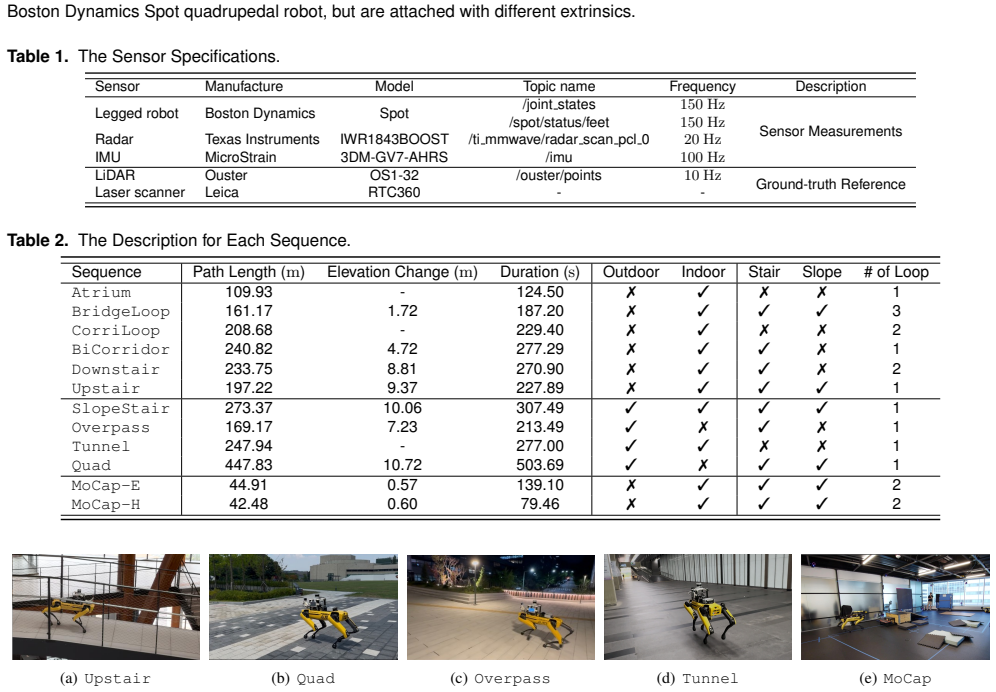
Deployment of legged robots for navigating challenging terrains (e.g., stairs, slopes, and unstructured environments) has gained increasing preference over wheel-based platforms. In such scenarios, accurate odometry estimation is a preliminary requirement for stable locomotion, localization, and mapping. Traditional proprioceptive approaches, which rely on leg kinematics sensor modalities and inertial sensing, suffer from irrepressible vertical drift caused by frequent contact impacts, foot slippage, and vibrations, particularly affected by inaccurate roll and pitch estimation. Existing methods incorporate exteroceptive sensors such as LiDAR or cameras. Further enhancement has been introduced by leveraging gravity vector estimation to add additional observations on roll and pitch, thereby increasing the accuracy of vertical pose estimation. However, these approaches tend to degrade in feature-sparse or repetitive scenes and are prone to errors from double-integrated IMU acceleration. To address these challenges, we propose GaRLILEO, a novel gravity-aligned continuous-time radar-leg-inertial odometry framework. GaRLILEO decouples velocity from the IMU by building a continuous-time ego-velocity spline from SoC radar Doppler and leg kinematics information, enabling seamless sensor fusion which mitigates odometry distortion. In addition, GaRLILEO can reliably capture accurate gravity vectors leveraging a novel soft S2-constrained gravity factor, improving vertical pose accuracy without relying on LiDAR or cameras. Evaluated on a self-collected real-world dataset with diverse indoor-outdoor trajectories, GaRLILEO demonstrates state-of-the-art accuracy, particularly in vertical odometry estimation on stairs and slopes. We open-source both our dataset and algorithm to foster further research in legged robot odometry and SLAM. https://garlileo.github.io/GaRLILEO
Figures




Forward citations
Cited by 2 Pith papers
-
Online Learning of Robust Legged Odometry with Minimal Exteroceptive Supervision
Develops an online-learned proprioceptive velocity model supervised by exteroceptive pipelines, fused via InEKF with IMU for resilient quadruped odometry that adapts without explicit calibration.
-
Four Simple Proprioceptive Estimators for Legged Robots
Presents four contact-aided floating-base state estimators for legged robots progressing from invariant EKF to factor-graph updates and fixed-lag smoothers, with open implementations.
Reference graph
Works this paper leans on
-
[1]
Agha A, Otsu K, Morrell B, Fan DD, Thakker R, Santamaria- Navarro A, Kim SK, Bouman A, Lei X, Edlund J et al. (2021) Nebula: Quest for robotic autonomy in challenging environments; team costar at the darpa subterranean challenge. arXiv preprint arXiv:2103.11470. Arndt C, Sabzevari R and Civera J (2023) Do planar constraints improve camera pose estimation ...
Pith/arXiv arXiv 2021
-
[6]
pp. 607–612. Prepared usingsagej.cls xxiv Journal Title XX(X) Seo DU, Lim H, Lee S and Myung H (2022) Pago-loam: Robust ground-optimized lidar odometry. In:Proceedings of the International Conference on Ubiquitous Robots. IEEE, pp. 1–
2022
-
[7]
In:Proceedings of the IEEE/RSJ International Conference on Intelligent Robots and Systems
Shan T and Englot B (2018) Lego-loam: Lightweight and ground- optimized lidar odometry and mapping on variable terrain. In:Proceedings of the IEEE/RSJ International Conference on Intelligent Robots and Systems. pp. 4758–4765. Shu F, Xie Y , Rambach J, Pagani A and Stricker D (2021) Visual slam with graph-cut optimized multi-plane reconstruction. In: Proce...
Pith/arXiv arXiv 2018
-
[15]
Springer. Qin T, Li P and Shen S (2018) Vins-mono: A robust and versatile monocular visual-inertial state estimator.IEEE Transactions on Robotics34(4): 1004–1020. Ramezani M, Khosoussi K, Catt G, Moghadam P, Williams J, Borges P, Pauling F and Kottege N (2022) Wildcat: Online continuous-time 3d lidar-inertial slam.arXiv preprint arXiv:2205.12595. Roston G...
Pith/arXiv arXiv 2018
-
[68]
Chen H, Liu Y and Cheng Y (2023) Drio: Robust radar-inertial odometry in dynamic environments.IEEE Robotics and Automation Letters8(9): 5918–5925. Chen S, Li X, Li S, Zhou Y and Wang S (2024) River: A tightly- coupled radar-inertial velocity estimator based on continuous- time optimization.IEEE Robotics and Automation Letters9(7): 6107–6114. Dh´edin V , L...
2023
-
[1710]
Geiger A, Lenz P, Stiller C and Urtasun R (2013) Vision meets robotics: The kitti dataset.International Journal of Robotics Research32(11): 1231–1237. Grupp M (2017) evo: Python package for the evaluation of odome- try and slam.https://github.com/MichaelGrupp/ evo. Harlow K, Jang H, Barfoot TD, Kim A and Heckman C (2024) A new wave in robotics: Survey on ...
arXiv 2013
-
[2270]
In:Proceedings of the IEEE/RSJ International Conference on Intelligent Robots and Systems
Michalczyk J, Jung R and Weiss S (2022) Tightly-coupled ekf- based radar-inertial odometry. In:Proceedings of the IEEE/RSJ International Conference on Intelligent Robots and Systems. pp. 12336–12343. Nemiroff R, Chen K and Lopez BT (2023) Joint on-manifold gravity and accelerometer intrinsics estimation for inertially aligned mapping. In:Proceedings of th...
Pith/arXiv arXiv 2022
discussion (0)
Sign in with ORCID, Apple, or X to comment. Anyone can read and Pith papers without signing in.