Systematic analysis of D_{(s)} meson semi-leptonic decays in the covariant light-front quark model
Pith reviewed 2026-05-17 21:04 UTC · model grok-4.3
The pith
The covariant light-front quark model reproduces D meson semi-leptonic decay rates for pseudoscalars and vectors but yields discrepant form factors for several scalar and axial-vector channels.
A machine-rendered reading of the paper's core claim, the machinery that carries it, and where it could break.
Core claim
Within the covariant light-front quark model the calculated form factors for D_{(s)} to P and V transitions agree with available data and other models in the majority of cases, while the same framework produces values for D to a0(980), a0(1450) and D_{(s)} to K_{1B} that differ markedly from alternative calculations; the predicted branching ratios for D to P and V semi-leptonic modes match experiment well, whereas some D to S and V modes show tension among theories.
What carries the argument
The covariant light-front quark model wave functions, which integrate the meson momentum distributions to obtain the transition form factors for weak decays.
If this is right
- Branching ratios for D to P and V semi-leptonic decays align with current data.
- Form-factor discrepancies appear specifically in D to a0(980), a0(1450) and D_s to K1B channels.
- The model supplies a reference set of numbers for future BESIII and Belle-II measurements.
- Further work on scalar and axial-vector internal structure is required to resolve the observed tensions.
Where Pith is reading between the lines
- Improved lattice determinations of the a0 and K1 mixing angles could be compared directly with the CLFQM wave-function choices.
- The same framework might be applied to B-meson decays to test whether the scalar discrepancies persist at higher mass scales.
- Tension among predictions for D to S modes suggests that experimental resolution of these channels would discriminate between quark-model assumptions.
Load-bearing premise
The chosen wave functions and input parameters for scalar and axial-vector mesons correctly encode their quark content and mixing angles.
What would settle it
A high-precision measurement of the branching fraction for D to a0(980) ell nu that lies outside the range predicted by the model would falsify the central claim.
Figures


read the original abstract
The weak decays of the $D_{(s)}$ meson provide a pivotal platform to advance our understanding of the Standard Model (SM) and to explore New Physics (NP). In recent years, experiments have collected a significant amount of data on the $D_{(s)}$ meson decays, particularly from BESIII, which provides substantial support for theoretical research. In this work, we systematically investigate the semi-leptonic decays of $D_{(s)}$ meson to pseudoscalar (P), scalar (S), vector (V), and axial-vector (A) mesons within the framework of the covariant light-front quark model (CLFQM). We calculate the form factors of the transitions $D_{(s)}\to P,S,V,A$ and the branching ratios of the corresponding semi-leptonic decays, then compare them with experimental data and results from other theoretical models. The form factor values of the transitions $D_{(s)}\to P, V$ obtained from the CLFQM are consistent with those of other theoretical models and available data in most cases. However, significant discrepancies are found in some specific $D_{(s)}\to S,A$ transitions, such as $D\to a_0(980), a_0(1450)$ and $D_{(s)} \to K_{1B}$, compared to other theoretical calculations. The predicted branching ratios for the semi-leptonic decays $D\to P(V)\ell\nu_\ell$ with $\ell=e,\mu$ agree well with experimental data and other theoretical results in most decay channels, validating the reliability of the model. However, for some $D\to S(V)\ell\nu_\ell$ decays, tension exists among different theoretical predictions and experimental results. Further clarification of such differences is necessary. Our study provides important insights into the internal structures for some scalar and axial-vector mesons and serves as a theoretical reference for future experiments.
Editorial analysis
A structured set of objections, weighed in public.
Referee Report
Summary. The manuscript applies the covariant light-front quark model (CLFQM) to compute transition form factors for D_{(s)} decays to pseudoscalar (P), scalar (S), vector (V), and axial-vector (A) mesons, then derives the corresponding semi-leptonic branching ratios. It reports consistency with data and other models for most P and V channels while highlighting significant discrepancies in selected S and A channels, notably D → a_0(980), a_0(1450) and D_{(s)} → K_{1B}.
Significance. If the reported discrepancies survive a controlled variation of the wave-function parameters, the calculation would supply useful phenomenological input on the quark content and mixing of scalar and axial-vector states that remain less constrained than P and V mesons. The validation on the better-constrained P and V sectors lends credibility to the overall CLFQM implementation.
major comments (2)
- Abstract and the section discussing scalar/axial-vector parameters: the claim that discrepancies in D → a_0(980), a_0(1450) and D_{(s)} → K_{1B} reflect internal meson structure assumes the Gaussian parameters β and mixing angles for these states are independently fixed. The text itself notes that quark content and mixing are less constrained than for P and V; without an explicit sensitivity scan or external lattice anchors for these β values, the form-factor differences can be reproduced by modest parameter shifts and therefore do not yet constitute a robust structural signal.
- Results section on branching ratios for S and A channels: the paper states tension exists among theoretical predictions and data, yet does not tabulate the individual form-factor values (e.g., f_+(0) or the full q^2 dependence) together with the precise β and mixing-angle choices used for each final state. This omission prevents readers from reproducing or diagnosing the source of the reported discrepancies.
minor comments (2)
- Notation for the two K_1 states (K_{1A} vs. K_{1B}) should be defined once at first appearance and used consistently in all tables and figures.
- A short paragraph summarizing the numerical values of all fitted quark masses and β parameters (with references to the original fits) would improve reproducibility.
Simulated Author's Rebuttal
We thank the referee for the careful reading of our manuscript and the constructive comments, which help improve the clarity and robustness of our analysis. We address each major comment below and have revised the manuscript accordingly to incorporate sensitivity studies and additional tabulated data for better reproducibility and transparency.
read point-by-point responses
-
Referee: Abstract and the section discussing scalar/axial-vector parameters: the claim that discrepancies in D → a_0(980), a_0(1450) and D_{(s)} → K_{1B} reflect internal meson structure assumes the Gaussian parameters β and mixing angles for these states are independently fixed. The text itself notes that quark content and mixing are less constrained than for P and V; without an explicit sensitivity scan or external lattice anchors for these β values, the form-factor differences can be reproduced by modest parameter shifts and therefore do not yet constitute a robust structural signal.
Authors: We agree that the parameters for scalar and axial-vector states are less constrained than for pseudoscalar and vector mesons, as already noted in the manuscript. To address this concern directly, we will add an explicit sensitivity analysis in the revised manuscript. Specifically, we will vary the Gaussian parameters β by ±10% around the central values adopted from the literature and recompute the relevant form factors and branching ratios for the channels D → a_0(980), a_0(1450) and D_{(s)} → K_{1B}. The results of this scan will be presented in a new table or figure, allowing us to assess whether the reported discrepancies persist under reasonable parameter variations. This addition will strengthen the interpretation regarding internal meson structure. revision: yes
-
Referee: Results section on branching ratios for S and A channels: the paper states tension exists among theoretical predictions and data, yet does not tabulate the individual form-factor values (e.g., f_+(0) or the full q^2 dependence) together with the precise β and mixing-angle choices used for each final state. This omission prevents readers from reproducing or diagnosing the source of the reported discrepancies.
Authors: We concur that providing the explicit numerical values of the form factors together with the precise model parameters would enhance reproducibility. In the revised manuscript, we will insert a new table in the results section that compiles, for each S and A channel, the form-factor values at q² = 0 (and selected additional q² points if space permits), the adopted β parameters, and the mixing angles. This table will be cross-referenced with the text discussing the discrepancies, enabling readers to directly verify and diagnose the sources of differences with other models or data. revision: yes
Circularity Check
CLFQM form-factor derivation is self-contained via overlap integrals with externally fixed parameters
full rationale
The paper computes transition form factors directly from the covariant light-front quark model wave-function overlaps for D(s) to P/S/V/A channels, then derives branching ratios from those form factors. Parameters (e.g., β values) are chosen to reproduce independent meson masses and decay constants, which are not the target semi-leptonic observables. Results for P and V channels are shown consistent with external data and other models; discrepancies for selected S and A channels are reported as model outputs rather than inputs. No equation reduces a claimed prediction to a fitted quantity by construction, and no load-bearing step relies on unverified self-citation chains. The derivation chain therefore remains independent of the specific branching-ratio comparisons presented.
Axiom & Free-Parameter Ledger
free parameters (1)
- quark masses and harmonic-oscillator parameters beta
axioms (1)
- domain assumption Covariant light-front dynamics and specific quark-antiquark wave-function ansatz
Lean theorems connected to this paper
-
IndisputableMonolith/Cost/FunctionalEquation.leanwashburn_uniqueness_aczel unclear?
unclearRelation between the paper passage and the cited Recognition theorem.
we use the phenomenological Gaussian-type wave function ϕ = 4(π/β²)^{3/4} √(dp_z/dx) exp(−(p_z² + p_⊥²)/2β²); β is a phenomenological parameter fixed by fitting the corresponding decay constant
-
IndisputableMonolith/Foundation/BranchSelection.leanbranch_selection unclear?
unclearRelation between the paper passage and the cited Recognition theorem.
significant discrepancies are found in some specific D(s)→S,A transitions... quark content and mixing are less constrained than for pseudoscalars and vectors
What do these tags mean?
- matches
- The paper's claim is directly supported by a theorem in the formal canon.
- supports
- The theorem supports part of the paper's argument, but the paper may add assumptions or extra steps.
- extends
- The paper goes beyond the formal theorem; the theorem is a base layer rather than the whole result.
- uses
- The paper appears to rely on the theorem as machinery.
- contradicts
- The paper's claim conflicts with a theorem or certificate in the canon.
- unclear
- Pith found a possible connection, but the passage is too broad, indirect, or ambiguous to say the theorem truly supports the claim.
Forward citations
Cited by 1 Pith paper
-
Review of experimental studies of charmed meson decays at BESIII
A review of BESIII charmed meson decay studies presents the most precise averages for |V_cs|, |V_cd|, D and D_s decay constants, and several hadronic form factors from combined experimental results.
Reference graph
Works this paper leans on
-
[1]
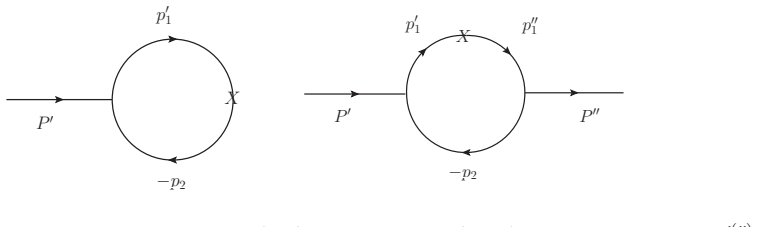
γ5 (− ̸ p2 + m2)] . (16) It is similar for the D(s) → S, V, A transition amplitudes, which are listed as following B D(s)S µ = − i3 Nc (2π)4 ∫ d4p′ 1 H ′ D(s)H ′′ S N ′ 1N ′′ 1 N2 S D(s)S µ , (17) where S D(s)S µ = Tr [( − i) (̸ p′′ 1 + m′′
-
[2]
γ5 (− ̸ p2 + m2)] = − iS D(s)P V µ (m′′ 1 → − m′′
-
[3]
(18) B D(s)V µ = − i3 Nc (2π)4 ∫ d4p′ 1 H ′ D(s) (iH ′′ V ) N ′ 1N ′′ 1 N2 S D(s)V µν ε′′∗ν, (19) where S D(s)V µν = ( S D(s)V V − S D(s)V A ) µν = Tr [( γν − 1 W ′′ V ( p′′ 1 − p2 ) ν ) ( ̸ p′′ 1 + m′′ 1 ) (γµ − γµ γ5) ( ̸ p′ 1 + m′ 1 ) γ5 (− ̸ p2 + m2) ] . (20) 5 There are two types axial-vector mesons with J P C = 1 ++ and 1 +− , respectively, which ar...
-
[4]
Other theoretical results and data are a lso listed for comparison
The D(s) → P transition form factors The D → P transtion form factors are calculated at maximum recoil ( q2 = 0), which are listed in Table II, where the uncertainties arise from the decay c onstants of the initial and final state mesons. Other theoretical results and data are a lso listed for comparison. Most our predictions agree with them within errors....
-
[5]
While the discrepancies for the A0(0) values between the CCQM and other approaches are significant
The D(s) → V transition form factors For most form factors of the transitions D(s) → V , the predictions among different theories are consistent with each other, which are listed in Tables III and IV. While the discrepancies for the A0(0) values between the CCQM and other approaches are significant . For instance, the A0(0) value of 2.08 for the D → K ∗ tra...
-
[6]
The D(s) → S transition form factors There are two typical schemes for the classification to the scalar m esons with masses near and below 1 . 5 GeV. The nonet mesons below 1 GeV, including f0(500), f 0(980), K ∗(800) and a0(980), are usually viewed as the lowest lying q ¯q states, while the nonet ones near 1.5 GeV, including f0(1370), f 0(1500)/f 0(1700),...
-
[7]
78 ± 0. 02 0 . 52 ± 0. 03 − 0. 36 ± 0. 01 − 0. 55 ± 0. 03 0 . 84 ± 0. 02 0 . 03 ± 0. 02
-
[8]
31 ± 0. 01 0 . 17 ± 0. 01 0 . 934 ± 0. 004 f0q f0s G , (45) where G denotes a glueball, f0q = ( u¯u + d ¯d)/ √ 2 and f0s = s¯s are pure flavor states. Certainly, some people with different viewpoint consider that f0(1500) is composed primarily of a glueball and f0(1710) is dominated by s¯s content [36]. Copmared with well established f0(15...
-
[9]
The D(s) → A transition form factors In the quark model, axial-vector mesons are considered as the orb itally excited q ¯q states, which are divided into two different types of nonnets 1 3P1 and 11P1 with J P C = 1 ++ and 1−− , respectively. The 1 ++ nonet is composed of a1(1260), f 1(1285), f 1(1420) and K1A, while the 1+− one contains b1(1235), h 1(1170)...
-
[10]
D(s) → P ℓνℓ decays TABLE IX: The branching ratios of the semi-leptonic decays D+ → η(′)ℓ+νℓ,D+ s → η(′)ℓ+νℓ, together with other results for comparison. 10− 3 × B r(D+ → ηe+νe) 10− 3 × B r(D+ → ηµ +νµ ) 10− 4 × B r(D+ → η′e+νe) 10− 4 × B r(D+ → η′µ +νµ ) This work 1. 06+0. 01+0. 00+0. 07 − 0. 01− 0. 00− 0. 09 0. 98+0. 00+0. 00+0. 07 − 0. 00− 0. 00− 0. 09...
-
[11]
D(s) → V ℓνℓ decays In Tables XI and XII, the branching ratios of the decays D(s) → V ℓνℓ are presented alongside other theoretical and experimental results for compar ison. Several comments should be addressed: 20 • The branching ratios of the decays Ds → K ∗ℓνℓ are consistent with most other the- oretical predictions and data. However, those of the deca...
-
[12]
For the decays D(s) → f0(980)ℓνℓ, f 0(500)ℓνℓ, their values correspond to the mixing angle θ = 34 ◦
D(s) → Sℓνℓ decays TABLE XIII: The branching ratios of the decays D(s) → a0(980)ℓνℓ, f 0(980)ℓνℓ, f 0(500)ℓνℓ, to- gether with other results for comparison. For the decays D(s) → f0(980)ℓνℓ, f 0(500)ℓνℓ, their values correspond to the mixing angle θ = 34 ◦. For simplicity, we replace a0(980), f 0(980) and f0(500) with a0, f 0 and σ , respectively, in this...
-
[13]
D(s) → Aℓνℓ decays For the semi-leptonic decays D(s) → Aℓνℓ, we employ the following notations for the final-state mesons: a1(1260) and b1(1235) are simplified as a1 and b1, the lighter mesons f1(1285), h 1(1170), K 1(1270) and the heavier mesons f1(1420), h 1(1380), K 1(1400) are de- noted as f1, h 1, K 1 and f ′ 1, h ′ 1, K ′ 1, respectivly. TABLE XV: The...
-
[14]
Additionally, the final- state phase space widens the gap between their branching ratios
03, so Br(D+ → h1ℓ+νℓ) is much larger than Br(D+ → h′ 1ℓ+νℓ). Additionally, the final- state phase space widens the gap between their branching ratios. While it is contrary for the decays D+ s → h(′) 1 ℓ+νℓ, that is Br(D+ s → h′ 1ℓ+νℓ) is much larger than Br(D+ s → h1ℓ+νℓ) since the decays D+ s → h′ 1ℓ+νℓ are connected with the large factor sin 2(86. 7◦), ...
-
[15]
γ5 (− ̸ p2 + m2) ] = − 2iǫµναβ { p′α 1 P β (m′′ 1 − m′
-
[16]
+ p′α 1 qβ (m′′ 1 + m′ 1 − 2m2) + qα P β m′ 1 } + 1 W ′′ V (4p′ 1ν − 3qν − Pν ) iǫµαβρ p′α 1 qβ P ρ +2gµν { m2 ( q2 − N ′ 1 − N ′′ 1 − m′2 1 − m′′2 1 ) − m′ 1 ( M ′′2 − N ′′ 1 − N2 − m′′2 1 − m2 2 ) − m′′ 1 ( M ′2 − N ′ 1 − N2 − m′2 1 − m2 2 ) − 2m′ 1m′′ 1 m2 } +8p′ 1µ p′ 1ν (m2 − m′
-
[17]
− 2 (Pµ qν + qµ Pν + 2qµ qν ) m′ 1 + 2p′ 1µ Pν (m′ 1 − m′′ 1 ) +2p′ 1µ qν (3m′ 1 − m′′ 1 − 2m2) + 2Pµ p′ 1ν (m′ 1 + m′′ 1 ) + 2qµ p′ 1ν (3m′ 1 + m′′ 1 − 2m2) + 1 2W ′′ V (4p′ 1ν − 3qν − Pν ) { 2p′ 1µ [ M ′2 + M ′′2 − q2 − 2N2 + 2 (m′ 1 − m2) (m′′ 1 + m2) ] +qµ [ q2 − 2M ′2 + N ′ 1 − N ′′ 1 + 2N2 − (m1 + m′′ 1 )2 + 2 (m′ 1 − m2)2] +Pµ [ q2 − N ′ 1 − N ′′ 1...
-
[18]
(x1m2 − x2m′′ 1 )] } . (B24) Similarly, the analytic expressions for the transition D(s) → A can be obtained from those of the transtion D(s) → V by the following replacements: S D(s)A V = iS D(s)V A , S D(s)A A = iS D(s)V V (m′′→ − m′′, W ′′ V → W ′′ A), (B25) AD(s)A(q2) = V D(s)V (q2), V D(s)A 0 (q2) = A D(s)V 0 (q2), V D(s)A 1 (q2) = A D(s)V 1 (q2), V ...
- [19]
- [20]
- [21]
- [22]
-
[23]
R. C. Verma, J. Phys. G: Nucl. Part. Phys 39, 025005 (2012)[arXiv:1103.2973 [hep-ph]]
work page internal anchor Pith review Pith/arXiv arXiv 2012
-
[24]
M. Ablikim et al. (BESIII Collaboration), Phys. Rev. D 111, L091501 (2025) [arXiv:2411.07730 [hep-ex]]
-
[25]
M. Ablikim et al. (BESIII Collaboration), Phys.Rev.Lett. 132, 14, 141901 (2024) [arXiv:2303.12927 [hep-ex]]
-
[26]
M. Ablikim et al. (BESIII Collaboration), Phys. Rev. Lett. 135, 091801 (2025) [arXiv:2503.02196 [hep-ex]]
work page internal anchor Pith review Pith/arXiv arXiv 2025
-
[27]
M. Ablikim et al. (BESIII Collaboration), Phys. Rev. D 111, L071101 (2025) [arXiv:2502.03828 [hep-ex]]
- [28]
- [29]
-
[30]
P. L. Chung, F. Coester, and W. N. Polyzou, Phys. Lett. B 2 05, 545 (1988). 39
work page 1988
- [31]
-
[32]
S. Momeni, Eur. Phys. J. C 80, 553 (2020) [arXiv:2004.02522 [hep-ph]]
-
[33]
M. Ablikim et al. (BESIII Collaboration), Phys. Rev. Lett. 127, 171801 (2021) [arXiv:2106.02218 [hep-ex]]
- [34]
-
[35]
Observation of $h_1(1380)$ in the $J/\psi \to \eta^{\prime} K\bar K \pi$ Decay
M. Ablikim et al. (BESIII Collaboration), Phys. Rev. D 98, 072005 (2018) [arXiv:1804.05536 [hep-ex]]
work page internal anchor Pith review Pith/arXiv arXiv 2018
- [36]
-
[37]
S. Momeni and R. Khosravi, J. Phys. G 46, 105006 (2019) [arXiv:1903.00860 [hep-ph]]
-
[38]
N. Offen, F. A. Porkert, and A. Schafer, Phys. Rev. D 88, 034023 (2013) [arXiv:1307.2797 [hep-ph]]
work page internal anchor Pith review Pith/arXiv arXiv 2013
-
[40]
M. A. Ivanov, J. G. Korner, J. N. Pandya, P. Santorelli, N . R. Soni and C. T. Tran, Frontiers of Phys 14, 64401 (2019)[arXiv:1904.07740 [hep-ph]]
work page internal anchor Pith review Pith/arXiv arXiv 2019
- [41]
-
[43]
G. S. Bali, S. Collins, S. D¡ §urr, and I. Kanamori, Phys. Rev. D 91, 014503 (2015) [arXiv:1406.5449 [hep-lat]]
work page internal anchor Pith review Pith/arXiv arXiv 2015
-
[44]
Study of Dynamics of $D^0 \to K^- e^+ \nu_{e}$ and $D^0\to\pi^- e^+ \nu_{e}$ Decays
M. Ablikim et al. (BESIII Collaboration), Phys. Rev. D 92, 072012 (2015) [arXiv:1508.07560[hep-ex]]
work page internal anchor Pith review Pith/arXiv arXiv 2015
-
[45]
Measurement of the Hadronic Form Factor in D0 --> K- e+ nue Decays
B. Aubert et al. (BABAR Collaboration), Phys. Rev. D 76, 052005 (2007) [arXiv:0704.0020[hep-ex]]
work page internal anchor Pith review Pith/arXiv arXiv 2007
-
[46]
Measurement of the Dynamics of the Decays ${ D_s^+ \rightarrow \eta^{(\prime)} e^{+} \nu_e}$
M. Ablikim et al. (BESIII Collaboration), Phys. Rev. Le tt. 122, 121801 (2019) 50 [arXiv:1901.02133]
work page internal anchor Pith review Pith/arXiv arXiv 2019
-
[47]
Weak form factors for heavy meson decays
D. Melikhov and B. Stech, Phys. Rev. D 62, 014006 (2000)[arXiv:hep-ph/0008261]
work page internal anchor Pith review Pith/arXiv arXiv 2000
-
[48]
The Semileptonic Decays $D\to \pi(\rho) e \nu$ and $B\to \pi (\rho) e \nu$ from QCD Sum Rules
P. Ball, Phys. Rev. D 48, 3190-3203 (1993)[arXiv:hep-ph/9305267]
work page internal anchor Pith review Pith/arXiv arXiv 1993
- [49]
-
[50]
Study of the decay $D^0\rightarrow \bar{K}^0\pi^-e^+\nu_e$
M. Ablikim et al. (BESIII Collaboration), Phys. Rev. D 99, 011103 (2019) [arXiv:1811.11349 [hep-ex]]
work page internal anchor Pith review Pith/arXiv arXiv 2019
-
[52]
M. Ablikim et al. (BESIII Collaboration), Phys. Rev. Lett. 122, 061801 (2019) [arXiv:1811.02911 [hep-ex]]
work page internal anchor Pith review Pith/arXiv arXiv 2019
-
[53]
H. Y. Cheng, C. K. Chua and K. F. Liu, Phys. Rev. D 92, no. 9, 094006 (2015)[arXiv:1503.06827 [hep-ph]]
work page internal anchor Pith review Pith/arXiv arXiv 2015
-
[54]
Scalar Quarkonium Masses and Mixing with the Lightest Scalar Glueball
W. Lee and D. Weingarten, Phys. Rev. D 61, 014015 (2000) [arXiv:hep-lat/9910008]
work page internal anchor Pith review Pith/arXiv arXiv 2000
- [55]
- [56]
- [57]
-
[58]
X. D. Cheng, H. B. Li, B. Wei, Y. G. Xu and M. Z. Yang, Phys. R ev. D 96, 033002 (2017), [arXiv:1706.01019 [hep-ph]]
work page internal anchor Pith review Pith/arXiv arXiv 2017
-
[59]
Y. J. Shi, W. Wang and S. Zhao, Eur. Phys. J. C 77, 452 (2017) [arXiv:1701.07571 [hep-ph]]
work page internal anchor Pith review Pith/arXiv arXiv 2017
-
[60]
$B_s\to f_0(980)$ form factors and $B_s$ decays into $f_0(980)$
P. Colangelo, F. D. Fazio and W. Wang, Phys. Rev. D 81, 074001 (2010) [arXiv:1002.2880 [hep-ph]]
work page internal anchor Pith review Pith/arXiv arXiv 2010
-
[61]
H. W. Ke, X. Q. Li and Z. T. Wei, Phys. Rev. D 80, 074030 (2009) [arXiv:0907.5465 [hep-ph]]
work page internal anchor Pith review Pith/arXiv arXiv 2009
-
[62]
The Scalar Meson f0(980) in Heavy-Meson Decays
B. El-Bennich, O. Leitner, J. P. Dedonder and B. Loiseau , Phys. Rev. D 79, 076004 (2009), [arXiv:0810.5771 [hep-ph]]
work page internal anchor Pith review Pith/arXiv arXiv 2009
- [63]
- [64]
-
[65]
M. Z. Yang, Phys.Rev.D 73, 034027 (2006) [arXiv:hep-ph/0509103]
work page internal anchor Pith review Pith/arXiv arXiv 2006
-
[66]
H. Y. Cheng and X. W. Kang, Eur. Phys. J. C 77, 587 (2017) [arXiv:1707.02851 [hep-ph]]
work page internal anchor Pith review Pith/arXiv arXiv 2017
-
[67]
H. Y. Cheng, Phys. Lett. B 707, 116-120 (2012) [arXiv:1110.2249 [hep-ph]]
work page internal anchor Pith review Pith/arXiv arXiv 2012
-
[68]
Y. B. Zuo et al. Int. J. Mod. Phys. A 31, (2016) [arXiv:1608.03651 [hep-ph]]
work page internal anchor Pith review Pith/arXiv arXiv 2016
- [69]
-
[70]
R. Khosravi, K. Azizi and N. Ghahramany, Phys. Rev. D 79, 036004 (2009)[arXiv:0812.1352 [hep-ph]]
work page internal anchor Pith review Pith/arXiv arXiv 2009
-
[71]
G. Duplancic and B. Melic, J. High Energy Phys. 11, (2015) 138 [arXiv:1508.05287[hep-ex]]
- [72]
-
[73]
M. Ablikim et al. (BESIII Collaboration), Phys. Rev. Lett. 134, 111801 (2025) [arXiv:2410.08603 [hep-ex]]. 41
-
[74]
Studies of D^+ -> {eta', eta, phi} e^+ nu_e
J. Yelton et al. (CLEO Collaboration), Phys. Rev. D 84, 032001 (2011) [arXiv:1011.1195[hep- ex]]
work page internal anchor Pith review Pith/arXiv arXiv 2011
-
[75]
M. Ablikim et al. (BESIII Collaboration), Physical Review D 108, 092003 (2023) [arXiv:2306.05194 [hep-ex]]
-
[76]
M. Ablikim et al. (BESIII Collaboration), Physical Review Letters 132, 091802 (2024) [arXiv:2307.12852 [hep-ex]]
-
[78]
Charm meson resonances in $D \to P \ell \nu$ decays
S. Fajfer and J. F. Kamenik, Phys. Rev. D 71, 014020 (2005) [arXiv:hep-ph/0412140]
work page internal anchor Pith review Pith/arXiv arXiv 2005
-
[79]
M. Ablikim et al. (BESIII Collaboration), Phys. Rev. Lett. 121, 171803 (2018) [arXiv:1802.05492[hep-ex]]
work page internal anchor Pith review Pith/arXiv arXiv 2018
- [80]
- [81]
-
[82]
Weak form factors for heavy meson decays: an update
D. Melikhov and B. Stech, Phys. Rev. D 62, 014006 (2000) [arXiv:hep-ph/0001113]
work page internal anchor Pith review Pith/arXiv arXiv 2000
-
[83]
Exclusive $D_s$ semileptonic branching fraction measurements
J. Hietala, D. Cronin-Hennessy, T. Pedlar, and I. Ships ey, Phys. Rev. D 92, 012009 (2015)[arXiv:1505.04205[hep-ex]]
work page internal anchor Pith review Pith/arXiv arXiv 2015
-
[84]
M. Ablikim et al. (BESIII Collaboration), Phys. Rev. D 2024 [arXiv:2406.191 90 [hep-ex]]
work page 2024
discussion (0)
Sign in with ORCID, Apple, or X to comment. Anyone can read and Pith papers without signing in.