REVIEW 5 major objections 5 minor 4 cited by
The paper claims that LiDAR scene flow models become sensor-agnostic when trained on a diverse mix of autonomous-driving datasets, improving accuracy on both known and unseen LiDAR sensors.
Reviewed by Pith at T0; open to challenge. T0 means a machine referee read the full paper against a public rubric. the ladder, T0–T4 →
Training existing LiDAR scene-flow models on a union of Argoverse 2, Waymo, and nuScenes improves in-domain accuracy and zero-shot accuracy on unseen trucking data.
T0 review reviewed 2026-08-03 challenge →
load-bearing objection UniFlow shows multi-dataset training helps LiDAR scene flow in-domain, but the zero-shot claim hinges on a metric choice and the abstract overreaches. the 5 major comments →
UniFlow: Zero-Shot LiDAR Scene Flow for Autonomous Vehicles
The pith
A machine-rendered reading of the paper's core claim, the machinery that carries it, and where it could break.
The reading
Core claim
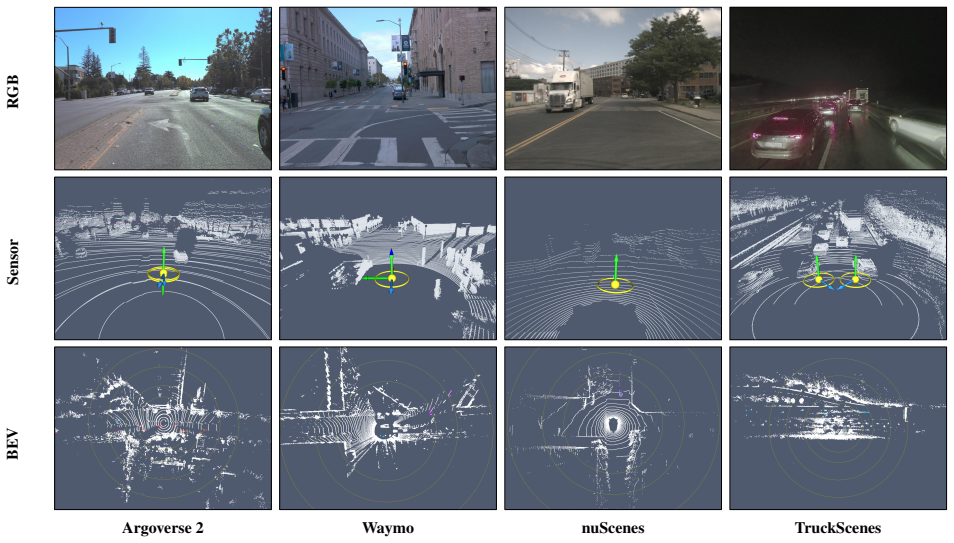
The central claim: conventional wisdom against multi-dataset LiDAR training does not hold for scene flow. Retraining off-the-shelf feedforward models on a unified 10 Hz mixture of Argoverse 2, Waymo, and nuScenes, with height jitter and LiDAR beam dropout, improves Dynamic Bucket-Normalized EPE on Waymo and nuScenes by 5.1% and 35.2% over single-dataset baselines, and beats models trained on TruckScenes by 30.1% despite never training on it. The reason offered: scene flow is a low-level, class-agnostic geometric task whose main domain gap is object velocity, not sensor placement or point density.
What carries the argument
The load-bearing mechanism is the training distribution, not a new architecture: a unified mixture of three heterogeneous LiDAR datasets with standardized frame rates, ground removal, and two dataset-agnostic augmentations—height randomization to simulate ego-vehicle height, and LiDAR beam dropout to match sparser sensors. The paper also uses velocity-bucket analysis—sorting error by object speed—to diagnose that cross-dataset transfer tracks the velocity distribution of training data; fast-moving training examples transfer to fast-moving objects across datasets. Dynamic Bucket-Normalized EPE, an error metric normalized by object speed, is the primary measure that exposes these gains.
Load-bearing premise
The result depends on Dynamic Bucket-Normalized EPE being the right primary measure and on standardized box-track labels being accurate enough across datasets; if unnormalized endpoint error or label noise is decisive, the zero-shot advantage can shrink or reverse.
What would settle it
On TruckScenes, the paper's own numbers show one architecture's zero-shot advantage reverses under Three-Way EPE (35.23 cm vs 6.20 cm for the single-dataset model), so a reader can already check the metric dependence. A cleaner test: train on the unified mixture and on a single dataset, evaluate on an unseen sensor with manually verified per-point flow labels, and report both metrics; if the unified model's Dynamic Bucket-Normalized EPE gain disappears under verified labels, the cross-domain claim is an artifact of label noise.
If this is right
- Existing scene flow architectures can adopt multi-dataset training without architectural changes; reported gains are model-agnostic across the three tested architectures.
- Adding highway or high-speed data to a training mix should improve flow on fast-moving objects in lower-speed urban datasets, since velocity distribution, not sensor similarity, drives transfer.
- Unified training transfers to longer sensor ranges: zero-shot error on TruckScenes beyond 50 m drops by roughly half relative to a single-dataset baseline.
- Unified models are more robust to sparsity: under synthetic beam dropout they degrade less than dataset-specific models on sparse LiDAR.
- Adding a semantic head does not hurt flow and slightly helps in-domain semantics, but zero-shot semantics worsen, reinforcing that the benefit is specific to low-level motion.
Where Pith is reading between the lines
- The velocity-transfer finding implies a practical data-selection rule the paper leaves implicit: to predict in a target operating domain, prioritize training data by velocity distribution rather than by sensor match; this could be tested by training UniFlow only on a velocity-balanced subset.
- Because the zero-shot ranking reverses under Three-Way EPE for one architecture, a deployment-centric re-evaluation with downstream costs—such as collision avoidance on fast vs slow objects—would clarify when normalized error improvements matter.
- The same class-agnostic argument suggests the recipe may transfer to other low-level point-cloud tasks such as tracking-by-detection-free correspondence, point-wise odometry, or dynamic occupancy prediction; the paper leaves this untested.
- A directly testable extension: train on synthetically sparsified and height-shifted copies of a single dataset rather than on three real datasets; if the gains persist, sensor diversity may be replaceable by augmentation alone.
Editorial analysis
A structured set of objections, weighed in public.
Referee Report
Summary. The paper proposes UniFlow, a training recipe that retrains existing feedforward LiDAR scene flow models (SSF, Flow4D, ΔFlow) on a unified mixture of Argoverse 2, Waymo, and nuScenes with two simple augmentations (height jitter and LiDAR beam dropout). It reports consistent in-domain improvements on Waymo and nuScenes, and claims zero-shot state-of-the-art accuracy on unseen TruckScenes and AEVAScenes. The paper identifies the velocity distribution as the main cross-domain axis and uses Dynamic Bucket-Normalized EPE as the primary metric, with Three-Way EPE reported as a secondary, allegedly biased, quantity.
Significance. If the in-domain results hold, the paper provides a valuable and surprisingly simple recipe: multi-dataset training improves supervised LiDAR scene flow across architectures and datasets without requiring architectural changes. The experimental scope is broad — three architectures, four datasets, ablations over augmentations, weighting, scaling, frame rates, long-range generalization, and synthetic sparsity. However, the headline zero-shot claim is currently metric-dependent, and one of the two unseen-dataset claims in the abstract (AEVAScenes) is not supported by any experiment in the text. These issues materially weaken the paper's central 'zero-shot SOTA' narrative, although they do not invalidate the in-domain contribution. The paper needs revision before these claims can be accepted.
major comments (5)
- [Abstract vs. full text] The abstract states that UniFlow achieves state-of-the-art accuracy on 'TruckScenes and AEVAScenes, outperforming prior dataset-specific models by 30.1% and 22.5% respectively.' The full text contains no AEVAScenes evaluation: no dataset description, no table, no baseline, and no result. Either add the complete AEVAScenes evaluation or remove the 22.5% claim and qualify the abstract accordingly.
- [Table 6 and Appendix D (Table 15)] The central zero-shot claim on TruckScenes is only true under Dynamic Bucket-Normalized EPE. Under Three-Way EPE, every UniFlow variant is worse than the corresponding TruckScenes-trained model: SSF 35.23 vs 6.20 cm, Flow4D 23.59 vs 16.14 cm, ΔFlow 15.76 vs 7.28 cm. The paper argues that Three-Way EPE is biased, but this is not only a metric artifact: Table 15 shows that in the >2.0 m/frame speed bucket, UniFlow models are substantially worse under the authors' own speed-bucket metric (Flow4D 0.389 vs 0.079, SSF 0.637 vs 0.086, ΔFlow 0.429 vs 0.102). Since TruckScenes is a highway dataset, the fast-moving regime is essential. The conclusion that UniFlow 'generalizes surprisingly well' to TruckScenes needs substantial qualification, and the high-speed failure should be discussed prominently in the main text, not only in Appendix D.
- [Appendix A; Table 9; Abstract] The paper claims to demonstrate that 'state-of-the-art scene flow methods greatly benefit from cross-dataset training without architectural modification.' However, Appendix A states that all Flow4D models trained on the unified dataset use Flow4D-XL, in which all channel widths of the 4D voxel network are multiplied by three. Table 9 separately attributes a gain to the XL backbone (Dynamic EPE 0.301 to 0.281 on TruckScenes). The Flow4D (UniFlow) results in Tables 3–6 are therefore not architecture-matched to the Flow4D baselines; part of the reported improvement is due to increased model capacity. Please report a non-XL Flow4D (UniFlow) baseline and correct the 'without architectural modification' wording.
- [Section 3 and Table 10; all experimental tables] No error bars or multiple seeds are reported anywhere. This is particularly important for the smaller in-domain deltas (e.g., ΔFlow on Waymo: 0.198 to 0.188, a 5.1% improvement; ΔFlow on Argoverse 2 actually degrades from 0.113 to 0.118) and for the choice of the 'Proportional' sampling recipe (60% Waymo, 25% AV2, 15% nuScenes). Please report mean ± std over at least three seeds, or otherwise justify that the central differences are not within run-to-run noise. In addition, §3 states 'we do not reweight dataset frequencies,' which is hard to reconcile with the 'Proportional 60/25/15' recipe in Table 10, since these weights do not equal the scene counts in Table 2 (798/700/700). The exact sampling distribution should be defined.
- [Section 3, Dataset Unification] The comparison across datasets assumes that standardized box-track annotations are accurate and comparable across Argoverse 2, Waymo, nuScenes, and TruckScenes. The paper carefully avoids interpolation noise by training on annotated frames, but it provides no measurement of label noise or annotation-consistency across datasets. Given that Table 8 demonstrates that semantic taxonomies are inconsistent, a label-noise analysis or sensitivity check would strengthen the claim that the observed gains are due to learned motion priors rather than differences in annotation quality.
minor comments (5)
- [Table 3 caption] The caption says Flow4D (UniFlow) outperforms Flow4D by 11.41% and SSF (UniFlow) outperforms SSF by 17.89%, but the text in §4 reports 8.97% and 13.81%, and the Dynamic Mean EPE values imply 8.97% and 13.81%. Please align the caption with the numbers.
- [Table 11, 20 Hz row] For ΔFlow (UniFlow) at 20 Hz, the Dynamic Mean EPE is reported as 0.010, while the category values (Car 0.153, Other 0.215, Pedestrian 0.277, VRU 0.138) imply a mean around 0.196–0.210. This appears to be a typo; please correct.
- [Figure 2 caption] The caption contains a typo: 'outpeforms' should be 'outperforms'.
- [Section 3, augmentation description] The augmentation hyperparameters (height jitter probability 0.8, offset [0.5, 2.0] m, beam dropout probability 0.35) are presented as fixed choices. Since the paper emphasizes a 'frustratingly simple' recipe, a brief sensitivity analysis for these two hyperparameters would help, even if only in the appendix.
- [Table 8] In the Unified TruckScenes row, '42.1s%' appears to be a typo for '42.1%'. Please check all percentages in the table.
Circularity Check
No construction-level circularity: training recipe neither fits nor is derived from target metrics. Mild self-reference: the zero-shot TruckScenes SOTA claim rests on the authors' own DyM-EPE metric [12] and reverses under Three-Way EPE (SSF 35.23 vs 6.20). Also flagged: unsupported AEVAScenes claim; disclosed high-speed-bucket failure.
full rationale
The paper's argument is empirical, not deductive: a velocity-gap analysis (Table 1, Fig. 2) motivates training SSF/Flow4D/DeltaFlow on the union of AV2, Waymo, and nuScenes, with results measured on held-out Waymo/nuScenes/AV2/TruckScenes. No parameter is fitted to TruckScenes, the evaluation metrics are not training losses, and the recipe does not reduce to the metrics; hence no step is equivalent to its inputs by construction (no fitted-input-called-prediction, no self-definitional identity, no ansatz smuggled by citation — the augmentations are ablated in Tables 7/9). In-domain gains hold under both Three-Way EPE and Dynamic Bucket-Normalized EPE (Tables 3–5). The zero-shot TruckScenes headline is, however, metric-contingent: it holds only under Dynamic Bucket-Normalized EPE, the protocol introduced by the authors' own prior work [12] (Khatri, Vedder, Peri, Ramanan — four of the seven UniFlow authors), which is invoked to disqualify the alternative ('We also report Three-Way EPE [4] for completeness, but note that it is a biased estimator of performance,' Sec. 4). Under Three-Way EPE, Table 6 reverses the comparison for SSF (35.23 vs 6.20 cm) and degrades Flow4D (23.59 vs 16.14) and DeltaFlow (15.76 vs 7.28); Appendix D (Table 15) confirms UniFlow is worse in the >2.0 m/frame bucket (Flow4D 0.389 vs 0.079; SSF 0.637 vs 0.086; DeltaFlow 0.429 vs 0.102) and states: 'We find that UniFlow models perform worse than in-domain models in the high-speed regime.' This disclosed limitation undercuts the velocity-domain-generalization narrative but is not circularity: the metric is prior-published, parameter-free, externally checkable, and reported alongside the alternative, so the self-citation is transparent, real evidence rather than an unverified load-bearing authority. Non-circularity flags per the reviewing rule: (a) the arXiv abstract claims 'state-of-the-art accuracy on unseen datasets like TruckScenes and AEVAScenes, outperforming prior dataset-specific models by 30.1% and 22.5% respectively,' yet no AEVAScenes result appears anywhere in the full text (missing support); (b) Appendix A states 'all Flow4D models trained on the unified dataset use Flow4D-XL' while dataset-specific Flow4D keeps the original backbone — a scale confound that Table 9 partially disentangles. These raise correctness/trust risk, not circularity. Verdict: score 2 — low self-referential evaluation bias, no circular derivation.
Axiom & Free-Parameter Ledger
free parameters (5)
- height jitter probability and range =
p=0.8, offset U[0.5, 2.0] m
- LiDAR beam dropout probability =
p=0.35 (every other beam on Waymo/AV2)
- Flow4D-XL channel width multiplier =
3
- dataset sampling weights =
proportional: 60% Waymo / 25% AV2 / 15% nuScenes
- frame-rate standardization =
10 Hz (nuScenes downsampled from 20 Hz)
axioms (4)
- domain assumption Ground-truth scene flow derived from 3D box/track annotations is accurate and consistent across datasets after frame-rate standardization.
- domain assumption Dynamic Bucket-Normalized EPE is the correct primary metric for cross-domain comparison.
- domain assumption Sparse near-range LiDAR points mimic dense far-range points, so near-range training transfers to long range.
- domain assumption Scene flow is class-agnostic and velocity distribution is the dominant domain shift axis.
Cite this review
Pith. "Pith review of UniFlow: Zero-Shot LiDAR Scene Flow for Autonomous Vehicles." pith.science (2026). https://pith.science/paper/AO45UUZG
@misc{pith2026251118254,
  author       = {Pith},
  title        = {Pith review of: UniFlow: Zero-Shot LiDAR Scene Flow for Autonomous Vehicles},
  year         = {2026},
  howpublished = {\url{https://pith.science/paper/AO45UUZG}},
  note         = {Machine review of arXiv:2511.18254}
}
read the original abstract
LiDAR scene flow is the task of estimating per-point 3D motion between consecutive point clouds. Recent methods achieve centimeter-level accuracy on popular autonomous vehicle (AV) datasets, but are typically only trained and evaluated on a single sensor. In this paper, we aim to learn general motion priors that transfer to diverse and unseen LiDAR sensors. However, prior work in LiDAR semantic segmentation and 3D object detection demonstrate that naively training on multiple datasets yields worse performance than single dataset models. Interestingly, we find that this conventional wisdom does not hold for motion estimation, and that state-of-the-art scene flow methods greatly benefit from cross-dataset training without architectural modification. We posit that low-level tasks such as motion estimation may be less sensitive to sensor configuration; indeed, our analysis shows that models trained on fast-moving objects (e.g., from highway datasets) perform well on fast-moving objects, even across different datasets. Informed by our analysis, we propose UniFlow, a feedforward model that unifies and trains on multiple large-scale LiDAR scene flow datasets with diverse sensor placements and point cloud densities. Our frustratingly simple solution establishes a new state-of-the-art on Waymo and nuScenes, improving over prior work by 5.1% and 35.2% respectively. Moreover, UniFlow achieves state-of-the-art accuracy on unseen datasets like TruckScenes and AEVAScenes, outperforming prior dataset-specific models by 30.1% and 22.5% respectively.
Figures


Forward citations
Cited by 4 Pith papers
-
SynFlow: Scaling Up LiDAR Scene Flow Estimation with Synthetic Data
Training scene flow networks on 940k synthetic CARLA LiDAR frames transfers zero-shot to real benchmarks and makes 5% real labels beat 20%.
-
CorrelationFlow: A Training-Free Geometric Approach for LiDAR Scene Flow Estimation
Grouping LiDAR points into bird's-eye blobs and recovering object motion from the best-overlap shift — with no training — ranks second among unsupervised methods on a five-dataset scene flow benchmark.
-
SynFlow: Scaling Up LiDAR Scene Flow Estimation with Synthetic Data
SynFlow creates a 34-times larger synthetic LiDAR scene flow dataset that lets models trained only on simulation match or beat supervised real-data baselines on multiple benchmarks.
-
Flux4D: Flow-based Unsupervised 4D Reconstruction
Flux4D reconstructs large-scale dynamic 4D scenes unsupervised by predicting moving 3D Gaussians from photometric losses and static regularization when trained across multiple scenes.
Reference graph
Works this paper leans on
-
[1]
Lang, Sourabh V ora, Venice Erin Liong, Qiang Xu, Anush Krishnan, Yu Pan, Gi- ancarlo Baldan, and Oscar Beijbom
Holger Caesar, Varun Bankiti, Alex H. Lang, Sourabh V ora, Venice Erin Liong, Qiang Xu, Anush Krishnan, Yu Pan, Gi- ancarlo Baldan, and Oscar Beijbom. nuscenes: A multi- modal dataset for autonomous driving. InCVPR, 2020. 1
2020
-
[2]
Andrew Caunes, Thierry Chateau, and Vincent Fremont. seg 3d by pc2d: Multi-view projection for domain general- ization and adaptation in 3d semantic segmentation.arXiv preprint arXiv:2505.15545, 2025. 3
arXiv 2025
-
[3]
Open- world semantic segmentation for lidar point clouds
Jun Cen, Peng Yun, Shiwei Zhang, Junhao Cai, Di Luan, Mingqian Tang, Ming Liu, and Michael Yu Wang. Open- world semantic segmentation for lidar point clouds. InEu- ropean Conference on Computer Vision, pages 318–334. Springer, 2022. 3
2022
-
[4]
Re- evaluating lidar scene flow
Nathaniel Chodosh, Deva Ramanan, and Simon Lucey. Re- evaluating lidar scene flow. InProceedings of the IEEE/CVF Winter Conference on Applications of Computer Vision (WACV), pages 6005–6015, 2024. 4
2024
-
[5]
Flownet: Learning optical flow with convolutional networks
Alexey Dosovitskiy, Philipp Fischer, Eddy Ilg, Philip Hausser, Caner Hazirbas, Vladimir Golkov, Patrick Van Der Smagt, Daniel Cremers, and Thomas Brox. Flownet: Learning optical flow with convolutional networks. InPro- ceedings of the IEEE international conference on computer vision, pages 2758–2766, 2015. 1
2015
-
[6]
Man truckscenes: A multimodal dataset for autonomous trucking in diverse con- ditions.Advances in Neural Information Processing Systems, 37:62062–62082, 2024
Felix Fent, Fabian Kuttenreich, Florian Ruch, Farija Rizwin, Stefan Juergens, Lorenz Lechermann, Christian Nissler, An- drea Perl, Ulrich V oll, Min Yan, et al. Man truckscenes: A multimodal dataset for autonomous trucking in diverse con- ditions.Advances in Neural Information Processing Systems, 37:62062–62082, 2024. 2, 4
2024
-
[7]
Multimodal 3d object detection on unseen domains
Deepti Hegde, Suhas Lohit, Kuan-Chuan Peng, Michael Jones, and Vishal Patel. Multimodal 3d object detection on unseen domains. InProceedings of the Computer Vision and Pattern Recognition Conference, pages 2499–2509, 2025. 3
2025
-
[8]
Fast segmentation of 3d point clouds for ground vehicles
Michael Himmelsbach, Felix V Hundelshausen, and H-J Wuensche. Fast segmentation of 3d point clouds for ground vehicles. InIntelligent Vehicles Symposium (IV), 2010 IEEE, pages 560–565. IEEE, 2010. 3
2010
-
[9]
Flox- els: Fast unsupervised voxel based scene flow estimation
David T Hoffmann, Syed Haseeb Raza, Hanqiu Jiang, Denis Tananaev, Steffen Klingenhoefer, and Martin Meinke. Flox- els: Fast unsupervised voxel based scene flow estimation. In Proceedings of the Computer Vision and Pattern Recognition Conference, pages 22328–22337, 2025. 3
2025
-
[10]
Flownet 2.0: Evolu- tion of optical flow estimation with deep networks
Eddy Ilg, Nikolaus Mayer, Tonmoy Saikia, Margret Keuper, Alexey Dosovitskiy, and Thomas Brox. Flownet 2.0: Evolu- tion of optical flow estimation with deep networks. InPro- ceedings of the IEEE conference on computer vision and pat- tern recognition, pages 2462–2470, 2017. 1
2017
-
[11]
Scalable scene flow from point clouds in the real world.IEEE Robotics and Automation Letters, 7 (2):1589–1596, 2021
Philipp Jund, Chris Sweeney, Nichola Abdo, Zhifeng Chen, and Jonathon Shlens. Scalable scene flow from point clouds in the real world.IEEE Robotics and Automation Letters, 7 (2):1589–1596, 2021. 3
2021
-
[12]
I cant believe its not scene flow! InEuropean Conference on Computer Vision, pages 242–257
Ishan Khatri, Kyle Vedder, Neehar Peri, Deva Ramanan, and James Hays. I cant believe its not scene flow! InEuropean Conference on Computer Vision, pages 242–257. Springer,
-
[13]
SSF: Sparse long-range scene flow for autonomous driving
Ajinkya Khoche, Qingwen Zhang, Laura Pereira Sanchez, Aron Asefaw, Sina Sharif Mansouri, and Patric Jensfelt. SSF: Sparse long-range scene flow for autonomous driving. In2025 IEEE International Conference on Robotics and Au- tomation (ICRA), pages 6394–6400, 2025. 3, 5
2025
-
[14]
Rethinking lidar domain generalization: Single source as multiple density domains
Jaeyeul Kim, Jungwan Woo, Jeonghoon Kim, and Sunghoon Im. Rethinking lidar domain generalization: Single source as multiple density domains. InEuropean Conference on Computer Vision, pages 310–327. Springer, 2024. 1, 3
2024
-
[15]
Flow4D: Leveraging 4d voxel network for lidar scene flow estimation.IEEE Robotics and Automation Letters, pages 1–8, 2025
Jaeyeul Kim, Jungwan Woo, Ukcheol Shin, Jean Oh, and Sunghoon Im. Flow4D: Leveraging 4d voxel network for lidar scene flow estimation.IEEE Robotics and Automation Letters, pages 1–8, 2025. 1, 2, 3, 5
2025
-
[16]
Mseg: A composite dataset for multi-domain semantic segmentation
John Lambert, Zhuang Liu, Ozan Sener, James Hays, and Vladlen Koltun. Mseg: A composite dataset for multi-domain semantic segmentation. InProceedings of the IEEE/CVF conference on computer vision and pattern recognition, pages 2879–2888, 2020. 1
2020
-
[17]
Scoop: Self-supervised correspon- dence and optimization-based scene flow
Itai Lang, Dror Aiger, Forrester Cole, Shai Avidan, and Michael Rubinstein. Scoop: Self-supervised correspon- dence and optimization-based scene flow. InProceedings of the IEEE/CVF Conference on Computer Vision and Pattern Recognition, pages 5281–5290, 2023. 3
2023
-
[18]
Neural scene flow prior.Advances in Neural Information Processing Systems, 34:7838–7851, 2021
Xueqian Li, Jhony Kaesemodel Pontes, and Simon Lucey. Neural scene flow prior.Advances in Neural Information Processing Systems, 34:7838–7851, 2021. 3, 5
2021
-
[19]
Fast neural scene flow
Xueqian Li, Jianqiao Zheng, Francesco Ferroni, Jhony Kae- semodel Pontes, and Simon Lucey. Fast neural scene flow. InProceedings of the IEEE/CVF International Conference on Computer Vision, pages 9878–9890, 2023. 3, 5
2023
-
[20]
Zero-shot monocular scene flow estima- tion in the wild
Yiqing Liang, Abhishek Badki, Hang Su, James Tompkin, and Orazio Gallo. Zero-shot monocular scene flow estima- tion in the wild. InProceedings of the Computer Vision and Pattern Recognition Conference, 2025. 1
2025
-
[21]
Icp-flow: Lidar scene flow estimation with icp
Yancong Lin and Holger Caesar. Icp-flow: Lidar scene flow estimation with icp. InCVPR, 2024. 5
2024
-
[22]
V oteflow: Enforcing local rigidity in self-supervised scene flow
Yancong Lin, Shiming Wang, Liangliang Nan, Julian Kooij, and Holger Caesar. V oteflow: Enforcing local rigidity in self-supervised scene flow. InProceedings of the Computer Vision and Pattern Recognition Conference, pages 17155– 17164, 2025. 5
2025
-
[23]
Multi-space alignments towards universal lidar segmentation
Youquan Liu, Lingdong Kong, Xiaoyang Wu, Runnan Chen, Xin Li, Liang Pan, Ziwei Liu, and Yuexin Ma. Multi-space alignments towards universal lidar segmentation. InPro- ceedings of the IEEE/CVF Conference on Computer Vision and Pattern Recognition (CVPR), pages 14648–14661, 2024. 3
2024
-
[24]
Jiehao Luo, Jintao Cheng, Xiaoyu Tang, Qingwen Zhang, Bohuan Xue, and Rui Fan. Mambaflow: A novel and flow- guided state space model for scene flow estimation.arXiv preprint arXiv:2502.16907, 2025. 3
Pith/arXiv arXiv 2025
-
[25]
Anish Madan, Neehar Peri, Shu Kong, and Deva Ramanan. Revisiting few-shot object detection with vision-language models.arXiv preprint arXiv:2312.14494, 2023. 3
Pith/arXiv arXiv 2023
-
[26]
Gblobs: Explicit local structure via gaussian blobs for improved cross-domain lidar-based 3d 9 object detection
Du ˇsan Mali´c, Christian Fruhwirth-Reisinger, Samuel Schul- ter, and Horst Possegger. Gblobs: Explicit local structure via gaussian blobs for improved cross-domain lidar-based 3d 9 object detection. InProceedings of the Computer Vision and Pattern Recognition Conference, pages 27357–27367, 2025. 3
2025
-
[27]
Saluda: Surface- based automotive lidar unsupervised domain adaptation
Bj ¨orn Michele, Alexandre Boulch, Gilles Puy, Tuan-Hung Vu, Renaud Marlet, and Nicolas Courty. Saluda: Surface- based automotive lidar unsupervised domain adaptation. In 2024 International Conference on 3D Vision (3DV), pages 421–431. IEEE, 2024. 3
2024
-
[28]
An empirical anal- ysis of range for 3d object detection
Neehar Peri, Mengtian Li, Benjamin Wilson, Yu-Xiong Wang, James Hays, and Deva Ramanan. An empirical anal- ysis of range for 3d object detection. InProceedings of the IEEE/CVF International Conference on Computer Vision, pages 4074–4083, 2023. 2
2023
-
[29]
Peter Robicheaux, Matvei Popov, Anish Madan, Isaac Robinson, Joseph Nelson, Deva Ramanan, and Neehar Peri. Roboflow100-vl: A multi-domain object detection benchmark for vision-language models.arXiv preprint arXiv:2505.20612, 2025. 3
arXiv 2025
-
[30]
Walking your lidog: A journey through multiple do- mains for lidar semantic segmentation
Cristiano Saltori, Aljosa Osep, Elisa Ricci, and Laura Leal- Taix´e. Walking your lidog: A journey through multiple do- mains for lidar semantic segmentation. InProceedings of the IEEE/CVF international conference on computer vision, pages 196–206, 2023. 1
2023
-
[31]
Mdt3d: Multi-dataset training for lidar 3d object detection generalization
Louis Soum-Fontez, Jean-Emmanuel Deschaud, and Franc ¸ois Goulette. Mdt3d: Multi-dataset training for lidar 3d object detection generalization. In2023 IEEE/RSJ International Conference on Intelligent Robots and Systems (IROS), pages 5765–5772. IEEE, 2023. 1
2023
-
[32]
Jiahao Sun, Chunmei Qing, Xiang Xu, Lingdong Kong, Youquan Liu, Li Li, Chenming Zhu, Jingwei Zhang, Zeqi Xiao, Runnan Chen, et al. An empirical study of training state-of-the-art lidar segmentation models.arXiv preprint arXiv:2405.14870, 2024. 3
Pith/arXiv arXiv 2024
-
[33]
Scalability in perception for autonomous driving: Waymo open dataset
Pei Sun, Henrik Kretzschmar, Xerxes Dotiwalla, Aurelien Chouard, Vijaysai Patnaik, Paul Tsui, James Guo, Yin Zhou, Yuning Chai, Benjamin Caine, et al. Scalability in perception for autonomous driving: Waymo open dataset. InProceed- ings of the IEEE/CVF conference on computer vision and pattern recognition, pages 2446–2454, 2020. 1
2020
-
[34]
Raft: Recurrent all-pairs field transforms for optical flow
Zachary Teed and Jia Deng. Raft: Recurrent all-pairs field transforms for optical flow. InEuropean conference on com- puter vision, pages 402–419. Springer, 2020. 1
2020
-
[35]
ZeroFlow: Fast Zero Label Scene Flow via Distillation.International Conference on Learning Repre- sentations (ICLR), 2024
Kyle Vedder, Neehar Peri, Nathaniel Chodosh, Ishan Kha- tri, Eric Eaton, Dinesh Jayaraman, Yang Liu Deva Ramanan, and James Hays. ZeroFlow: Fast Zero Label Scene Flow via Distillation.International Conference on Learning Repre- sentations (ICLR), 2024. 1, 3
2024
-
[36]
Neural eulerian scene flow fields
Kyle Vedder, Neehar Peri, Ishan Khatri, Siyi Li, Eric Eaton, Mehmet Kemal Kocamaz, Yue Wang, Zhiding Yu, Deva Ra- manan, and Joachim Pehserl. Neural eulerian scene flow fields. InThe Thirteenth International Conference on Learn- ing Representations, 2025. 1, 3, 5
2025
-
[37]
Three-dimensional scene flow.IEEE transactions on pattern analysis and machine intelligence, 27(3):475– 480, 2005
Sundar Vedula, Peter Rander, Robert Collins, and Takeo Kanade. Three-dimensional scene flow.IEEE transactions on pattern analysis and machine intelligence, 27(3):475– 480, 2005. 3
2005
-
[38]
Pointaugmenting: Cross-modal augmentation for 3d object detection
Chunwei Wang, Chao Ma, Ming Zhu, and Xiaokang Yang. Pointaugmenting: Cross-modal augmentation for 3d object detection. InProceedings of the IEEE/CVF conference on computer vision and pattern recognition, pages 11794– 11803, 2021. 3
2021
-
[39]
Flux4d: Flow-based unsupervised 4d reconstruction
Jingkang Wang, Henry Che, Yun Chen, Ze Yang, Lily Goli, Sivabalan Manivasagam, and Raquel Urtasun. Flux4d: Flow-based unsupervised 4d reconstruction. InThe Thirty- ninth Annual Conference on Neural Information Processing Systems, 2025. 3
2025
-
[40]
Ruicheng Wang, Sicheng Xu, Yue Dong, Yu Deng, Jianfeng Xiang, Zelong Lv, Guangzhong Sun, Xin Tong, and Jiaolong Yang. Moge-2: Accurate monocular geometry with metric scale and sharp details.arXiv preprint arXiv:2507.02546,
-
[41]
Train in germany, test in the usa: Making 3d ob- ject detectors generalize
Yan Wang, Xiangyu Chen, Yurong You, Li Erran Li, Bharath Hariharan, Mark Campbell, Kilian Q Weinberger, and Wei- Lun Chao. Train in germany, test in the usa: Making 3d ob- ject detectors generalize. InProceedings of the IEEE/CVF conference on computer vision and pattern recognition, pages 11713–11723, 2020. 1
2020
-
[42]
3d point-voxel correlation fields for scene flow estimation
Ziyi Wang, Yi Wei, Yongming Rao, Jie Zhou, and Jiwen Lu. 3d point-voxel correlation fields for scene flow estimation. IEEE Transactions on Pattern Analysis and Machine Intelli- gence, 2023. 3
2023
-
[43]
PV-RAFT: Point-V oxel Correlation Fields for Scene Flow Estimation of Point Clouds
Yi Wei, Ziyi Wang, Yongming Rao, Jiwen Lu, and Jie Zhou. PV-RAFT: Point-V oxel Correlation Fields for Scene Flow Estimation of Point Clouds. InCVPR, 2021. 3
2021
-
[44]
Argoverse 2: Next genera- tion datasets for self-driving perception and forecasting
Benjamin Wilson, William Qi, Tanmay Agarwal, John Lam- bert, Jagjeet Singh, and et al. Argoverse 2: Next genera- tion datasets for self-driving perception and forecasting. In Proceedings of the Neural Information Processing Systems Track on Datasets and Benchmarks (NeurIPS Datasets and Benchmarks 2021), 2021. 1
2021
-
[45]
Xiang Xu, Lingdong Kong, Hui Shuai, Wenwei Zhang, Liang Pan, Kai Chen, Ziwei Liu, and Qingshan Liu. Su- perflow++: Enhanced spatiotemporal consistency for cross- modal data pretraining.arXiv preprint arXiv:2503.19912,
-
[46]
DeFlow: Decoder of scene flow network in autonomous driving
Qingwen Zhang, Yi Yang, Heng Fang, Ruoyu Geng, and Patric Jensfelt. DeFlow: Decoder of scene flow network in autonomous driving. In2024 IEEE International Confer- ence on Robotics and Automation (ICRA), pages 2105–2111,
-
[47]
SeFlow: A self-supervised scene flow method in autonomous driving
Qingwen Zhang, Yi Yang, Peizheng Li, Olov Andersson, and Patric Jensfelt. SeFlow: A self-supervised scene flow method in autonomous driving. InEuropean Conference on Computer Vision (ECCV), page 353369. Springer, 2024. 5
2024
-
[48]
HiMo: High-speed objects motion compensation in point cloud.arXiv preprint arXiv:2503.00803, 2025
Qingwen Zhang, Ajinkya Khoche, Yi Yang, Li Ling, Sharif Mansouri Sina, Olov Andersson, and Patric Jensfelt. HiMo: High-speed objects motion compensation in point cloud.arXiv preprint arXiv:2503.00803, 2025. 5
arXiv 2025
-
[49]
Qingwen Zhang, Xiaomeng Zhu, Yushan Zhang, Yixi Cai, Olov Andersson, and Patric Jensfelt. DeltaFlow: An efficient multi-frame scene flow estimation method.arXiv preprint arXiv:2508.17054, 2025. 1, 3, 5
arXiv 2025
-
[50]
Gmsf: Global matching scene flow.Advances in Neural Informa- tion Processing Systems, 36, 2024
Yushan Zhang, Johan Edstedt, Bastian Wandt, Per-Erik Forss´en, Maria Magnusson, and Michael Felsberg. Gmsf: Global matching scene flow.Advances in Neural Informa- tion Processing Systems, 36, 2024. 3 10 A. Implementation Details Models.We train and evaluate SSF and∆Flow using their official implementations without modification. As shown in Table 9, Flow4D...
arXiv 2024
This paper was first reviewed by deepseek-v4-flash on August 3, 2026.
discussion (0)
Sign in with ORCID, Apple, or X to comment. Anyone can read and Pith papers without signing in.