Systems and Control · arXiv:2511.18267 v3 · submitted 23 Nov 2025 · 40 references
Laboratory and field testing of a residential heat pump retrofit for a DC solar nanogrid
The paper says
“Residential buildings are increasingly integrating large devices that run natively on direct current (DC), such as solar photovoltaics, electric vehicles, stationary batteries, and DC motors that drive heat pumps and other major appliances.”
more of the abstract
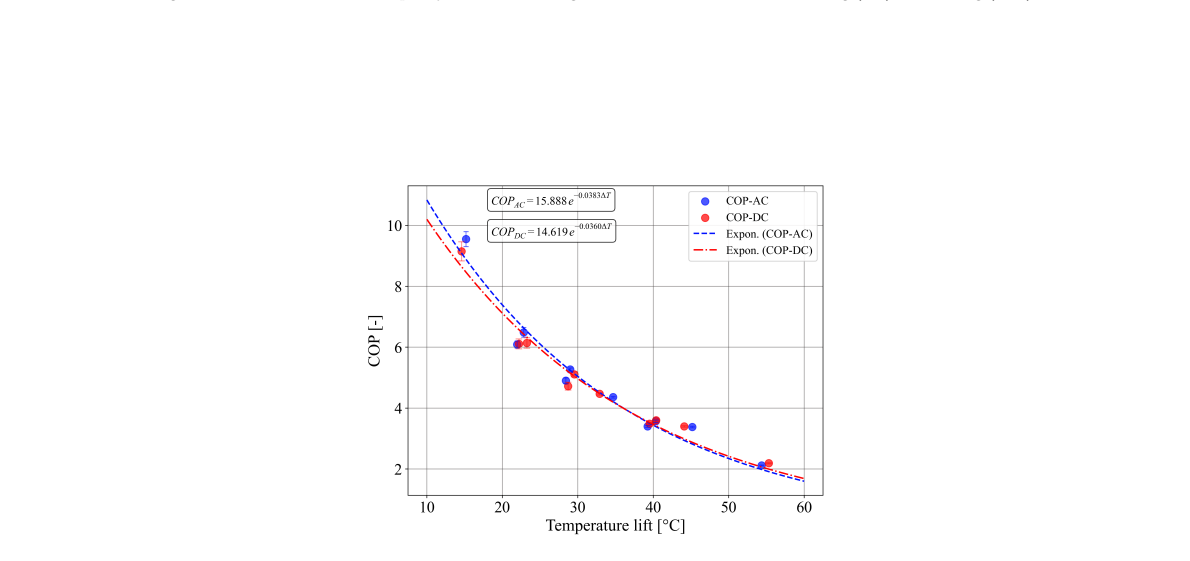
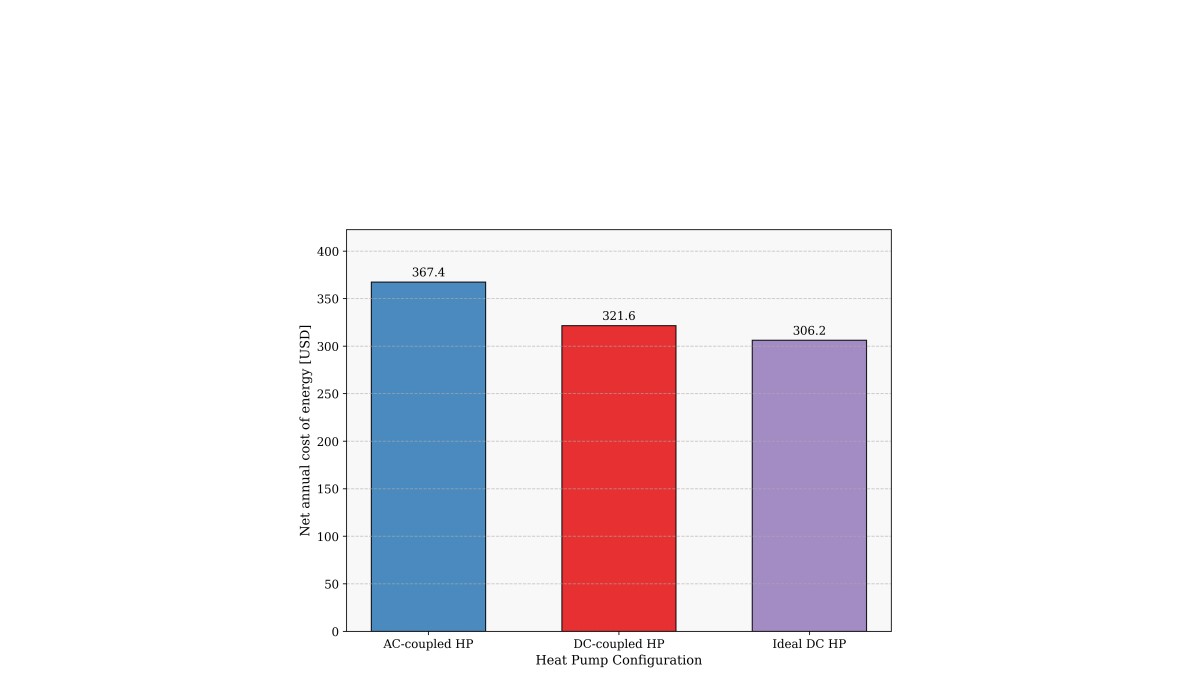
Today, these natively-DC devices typically connect within buildings through alternating current (AC) distribution systems, entailing significant energy losses due to conversions between AC and DC. This paper investigates the alternative of connecting DC devices through DC distribution. Specifically, this paper shows through laboratory and field experiments that an off-the-shelf residential heat pump designed for conventional AC systems can be powered directly on DC with few hardware modifications and little change in performance. Supporting simulations of a DC nanogrid including historical heat pump and rest-of-house load measurements, a solar photovoltaic array, and a stationary battery suggest that connecting these devices through DC distribution could decrease annual electricity bills by 12.5% with an after-market AC-to-DC heat pump retrofit and by 16.7% with a heat pump designed to run on DC. The associated savings in gross nanogrid energy are 8% and 9.2%, respectively.
from the abstract
Pith says
Machine review · deepseek-v4-flash · 3 Aug 2026 · what was read was not recorded · not checked by a person
It can be wrong. Challenge this review or reply to it.
Holds up, with conditions. First hardware evidence that a residential heat pump can run on a 350 V DC bus without measurable performance loss, though the 12.5–16.7% bill-savings number is a model output resting on stylized converter part-load curves. This line is wrong
3 major objections · 4 minor
How often objections from reviews like this one are right: not yet measured
Not checked: figures, code, what the 40 references say.
The paper says, at §5.2, Fig. 13, §6.2
The review did not quote this passage.
Pith says: Objection 1 of 3 · major
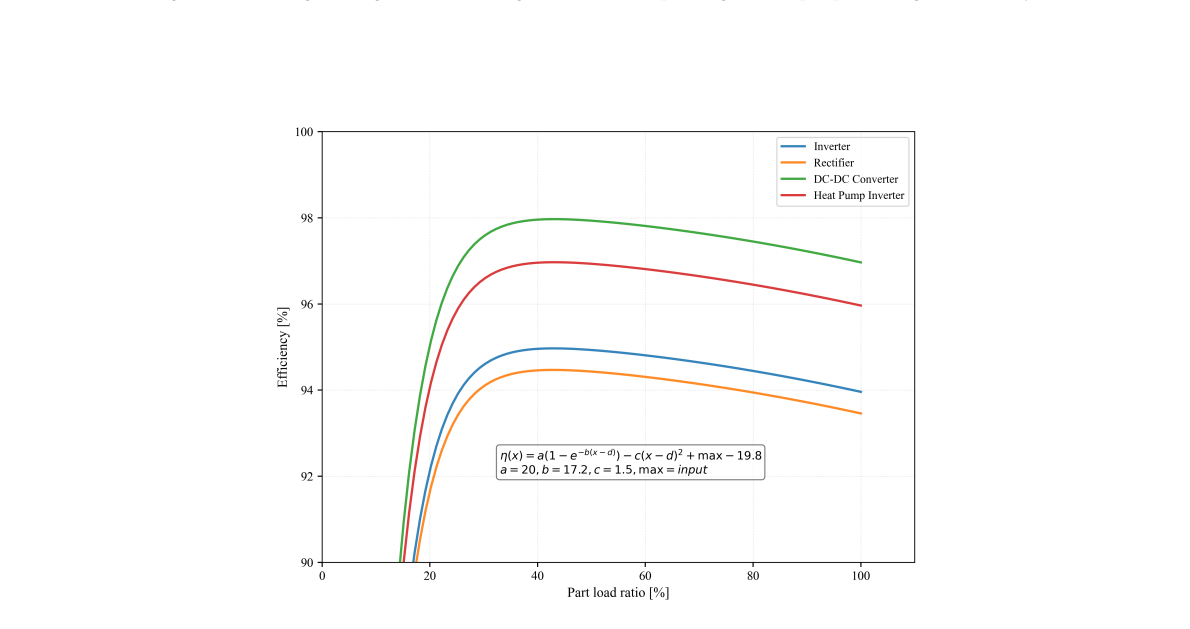
The annual savings estimates (12.5% and 16.7%) are outputs of the converter part-load model, since the same historical heat-pump demand is used for AC and DC in the simulation (§5.1). The text states that only the peak of each converter's part-load curve was tuned to manufacturer data and that Fig. 13 uses a single stylized curve shape for all converters; §6.2 explicitly concedes that tailored full part-load curves are needed.
more of objection 1
Real converters often lose efficiency disproportionately at the low loads that dominate residential operation. No sensitivity analysis is provided. If actual part-load efficiencies are even a few points below the modeled curves in the low-load region, the conversion-loss savings shrink and the 612 USD ten-year-payback ceiling used in §6.1 may no longer be met. Please replace the stylized curves with measured or manufacturer-specific curves, or add a conservative se
The paper says, at §4.2, Eq. (3)-(5)
The review did not quote this passage.
Pith says: Objection 2 of 3 · major
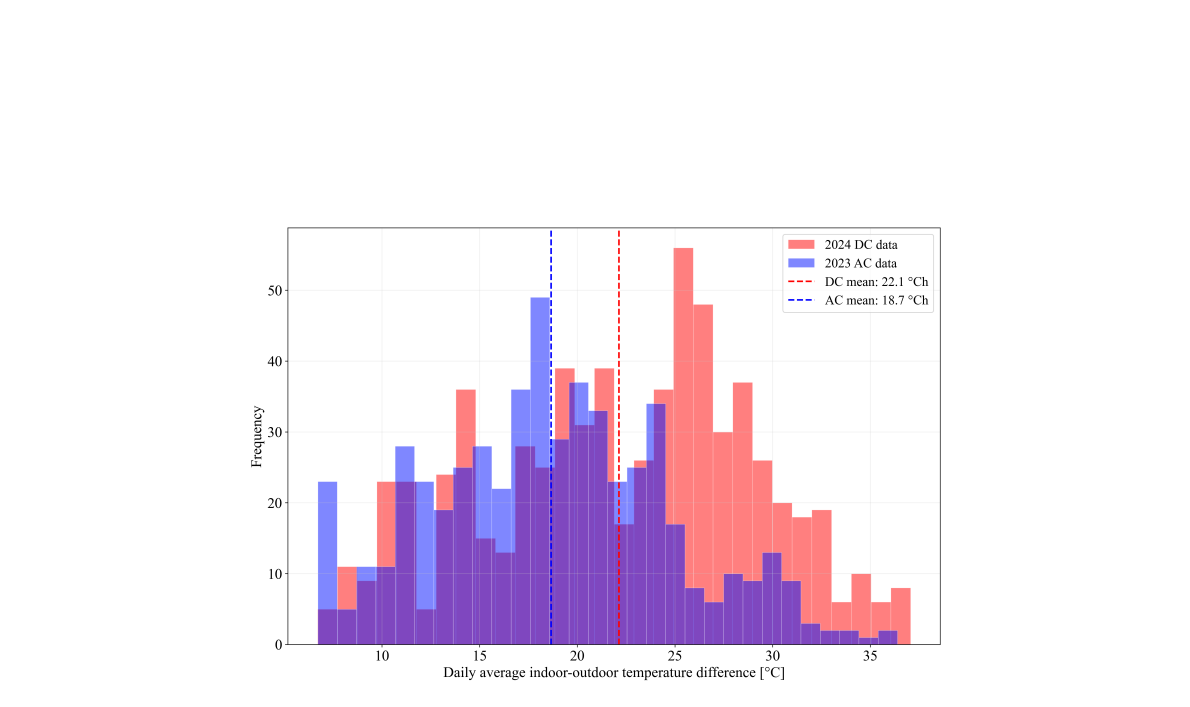
The field-equivalence result is load-bearing for the claim that the nanogrid savings stem from conversion-loss reductions rather than from heat-pump performance differences. The AC reference data were collected one year earlier in warmer weather (mean ΔT 18.7 vs 21.1 °C), and the paper itself notes possible performance degradation under DC operation.
more of objection 2
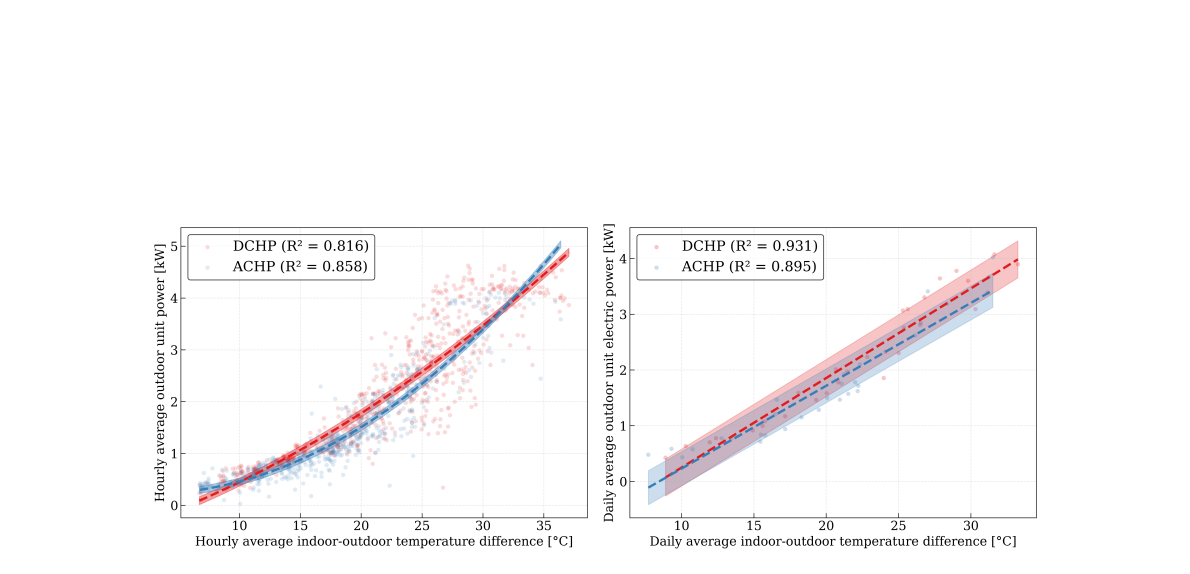
The t-test normalizes by Eq. (3) with c = 8 °C fixed, but no sensitivity to c is reported. The results paragraph also contains an internal inconsistency: p = 0.18 is reported, followed by “Because 0.23 > 0.05”. Please correct the typo and strengthen the analysis with a sensitivity study over c and/or an equivalence/non-inferiority test; otherwise the conclusion of “no statistically significant difference” may overstate the evidence for parity.
The paper says, at §5.1, Fig. 14
The review did not quote this passage.
Pith says: Objection 3 of 3 · major
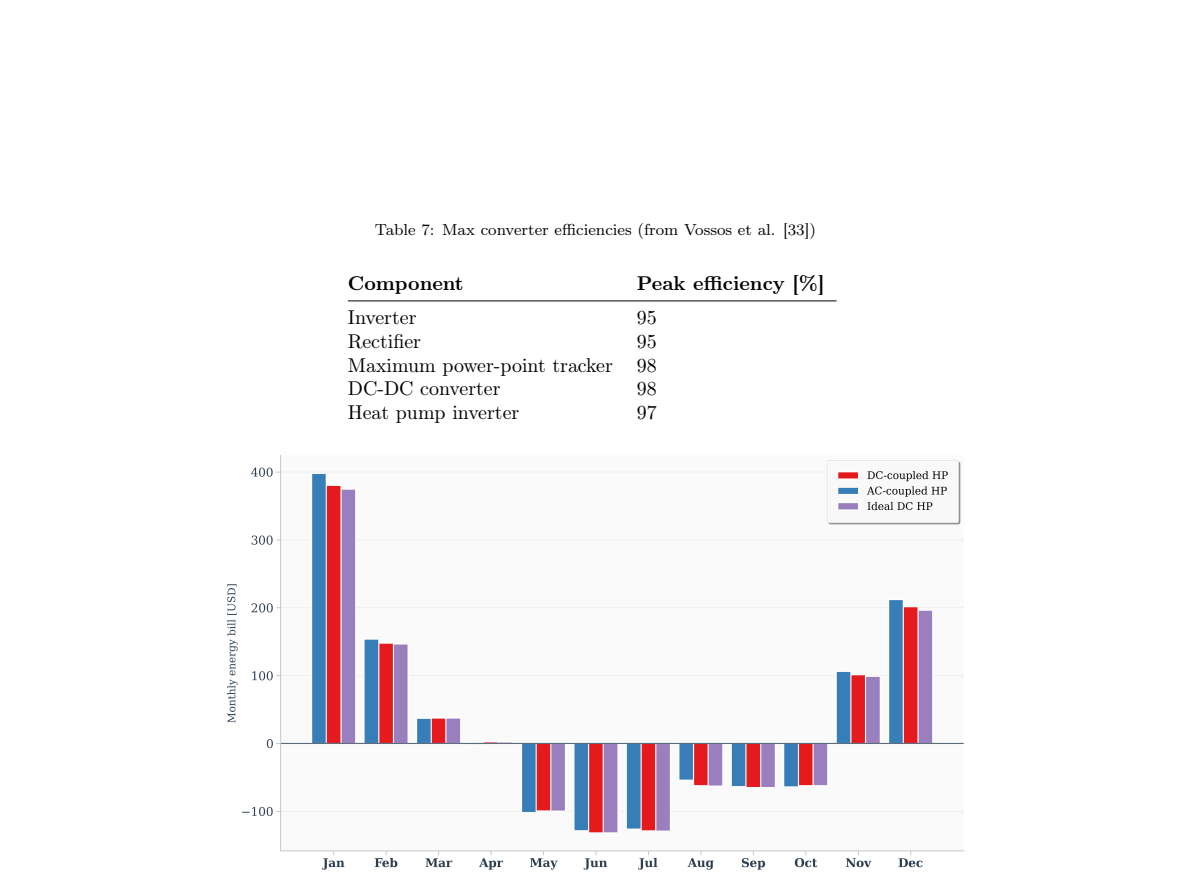
The bill savings include credits for exporting surplus solar at the full retail rate of 0.14 USD/kWh. Under net-metering policies that compensate exports at avoided cost or wholesale rates, the summer negative bills in Fig. 14 would shrink, and so would the annual savings.
more of objection 3
Since this assumption, together with the converter part-load curves, drives the headline savings, it should be reported as a conditional assumption and tested with a sensitivity case, e.g., export price = 0 or a typical export tariff.
4 minor objections
The paper says, at §4.2, near Fig. 10
Pith says: minor objection 1 of 4
The text reports R² values of 0.895 for AC and 0.931 for DC, then says “The AC fit likely has a higher R² value”; this is contradicted by the reported numbers and the following reasoning should be revised.
The paper says, at §4.2, paragraph after Fig. 10
Pith says: minor objection 2 of 4
The sentence “For intermediate temperature differences, the heat pump appears to draw slightly more power on AC than on DC” appears to be a typo for “more power on DC than on AC”, since the preceding sentence already states that DC draws less power at low and high temperature differences.
show 2 more
The paper says, at §5.1, Eq. (8)-(9)
Pith says: minor objection 3 of 4
The symbol b is used both as a scalar battery power capacity (b = 12.5 kW) and as a time-varying battery power b(k) in Eq. (8) and Eq. (9). Please use distinct symbols to avoid ambiguity.
The paper says, at §2.4 and §7
Pith says: minor objection 4 of 4
The claim of “the first modeling results informed by real-world data from an occupied test house” is strong; earlier work by Vossos et al. and others also used measured load data. Consider softening or documenting the exact basis for the claim.
What would settle it
Using the public GitHub repository (github.com/AaronFarha/dchp), replace Fig. 13's single stylized part-load curve with manufacturer-specific efficiency-vs-load data for each converter—or, at minimum, with a conservative curve that is 5 points lower below 30% load—and re-run the annual bill comparison. Report the resulting AC vs DC bills for the after-market and ideal-DC configurations. If the 12.5%/16.7% savings fall below roughly 5%, or if the ordering between configurations changes, the system-level claim is not supported by the current evidence.
from the skeptic's reading
How the review went
4 readings by deepseek-v4-flash · 3 Aug 2026
- Reader holds up, with conditions
- Skeptic agrees
- Editor wrote the verdict above
- Referee major revision: 3 major objections, 4 minor
Not run on this paper: the simulated authors' defence.
Pith did not check this review's objections against the paper.
The review in full
The review in brief, machine-written
Here’s my read on arXiv:2511.18267. The device-level claim is solid: an off-the-shelf variable-speed heat pump, fed 350 V DC instead of 230 V AC after a modest outdoor-unit retrofit, delivers equivalent capacity and COP in AHRI-standard chamber tests (heating and cooling), and the field comparison in an occupied house shows no statistically significant difference (p=0.18). That is genuinely new — prior work on this same pump covered only steady cooling at full speed — and the authors have done the experiments carefully: energy balances within 6%, documented sensor uncertainties, and a weather-normalized Welch t-test. They also ship data and code. Credit where due.
The soft spot is not the heat pump; it’s the system-level savings estimate. The 12.5–16.7% annual bill reduction in the DC nanogrid is a model output in which the heat pump’s electricity demand is identical on AC and DC, so all savings come from the modeled converter efficiencies. Section 5.2 says only the peak of each converter’s part-load curve was tuned to a manufacturer spec sheet, and Fig. 13 uses a single stylized curve shape for every converter. Section 6.2 concedes a more tailored approach is needed. Real converters often sag more at 10–30% load, and that is where a house lives most of the year. No sensitivity analysis is reported. The full-retail buy-back at 0.14 USD/kWh also sweetens summer exports. The authors flag these limitations, and the paper is honest about them, but they are not quantified, so the annual savings number should be treated as an upper-end estimate, not a robust prediction. The paper’s own simple payback ceiling of 612 USD makes clear how much rests on that number.
One minor typo: the text says “Because 0.23>0.05” right after reporting p=0.18. Not a substantive problem.
Overall: this is a serious paper. The experimental contribution will be the reference point for DC heat-pump retrofits for a while. The modeling section needs revision — real part-load curves and a sensitivity analysis — before the savings claim should be taken at face value. But the device-level finding is the main event and it holds up.
For you: worth reading if you care about DC distribution or heat pump integration. I’d cite it. And yes, if this came to my desk, I’d send it to peer review — the experiments deserve referee time; the model may get revised but that’s what review is for.
The strongest objection
The central system-level claim is that measured device-level parity plus modeled conversion-loss reductions yield 12.5–16.7% annual bill savings. In the simulation, the heat pump's electricity demand is identical under AC and DC, so all savings come from the converter efficiency model. Section 5.2 states that only the peak of each converter's part-load curve was tuned to a manufacturer specification sheet, and Fig. 13 uses a single stylized curve shape for every converter. Section 6.2 explicitly concedes that a more sophisticated approach would tailor each converter's full part-load efficiency curve. This matters because real converters, especially DC-DC stages and inverters, often have substantially lower efficiency at 10–30% load, and a house operates in that low-load region for most of the year. The paper reports no sensitivity analysis for these curves. If actual part-load efficiencies are even 5–10 points lower in the low-load region, the modeled conversion-loss savings shrink directly and could fall below the 10-year simple-payback threshold (612 USD capital cost ceiling) that the authors themselves use. The full-retail net-metering assumption (0.14 USD/kWh) similarly inflates the summer export credits shown in Fig. 14, but the part-load curves are the more load-bearing unsupported input because they are the sole source of the savings in the model.
The reader's weakest assumption identifies the same load-bearing concern I find: the system-level savings are produced by stylized converter part-load curves whose shape is not measured and whose sensitivity is unreported. This is not a manufactured objection—the paper's own Section 6.2 limitation states that a single stylized curve was used for all converters and that tailoring full curves would be more sophisticated. Because the model holds heat pump demand identical between AC and DC, every dollar of the 12.5–16.7% savings is attributable to modeled conversion losses, making the converter curves the sole mechanism for the headline result. The proposed test is cheap and decisive: re-run the published code with realistic per-converter part-load data. The device-level claim, by contrast, is reasonably supported: AHRI laboratory tests show capacity and COP within measurement uncertainty, the field t-test (p=0.18) does not reject equality, and the authors disclose the main confounds (one-year-apart AC data, warmer AC weather, possible degradation). Those limitations weaken but do not overturn the experimental contribution. The verdict should remain CONDITIONAL: the hardware demonstration is credible, but the annual bill savings should be treated as conditional on the converter part-load model being representative. I agree with the reader rather than escalating to REJECT because there is no internal inconsistency in the experiments and the modeling limitation is explicitly acknowledged; it is an addressable condition, not a fatal flaw.
The referee's report
The experimental contribution is genuinely valuable: it provides the first laboratory heating-mode results and the first field results for a retrofit DC heat pump, with careful attention to AHRI test conditions, energy-balance closure to within 6%, documented sensor uncertainties, and a formal hypothesis test. The public availability of data and code is a further strength. The device-level parity claim is plausible and well supported. However, the headline system-level savings are not yet robust: the simulation's savings come entirely from a stylized converter part-load model whose curve shapes are not empirically supported, and the field parity evidence is weakened by non-concurrent AC data and a stated risk of DC-induced degradation. If the modeling uncertainties are addressed, the paper would be a strong experimental and modeling contribution to the DC-nanogrid literature.
Pith's reading of the paper (a machine's summary, not the authors')
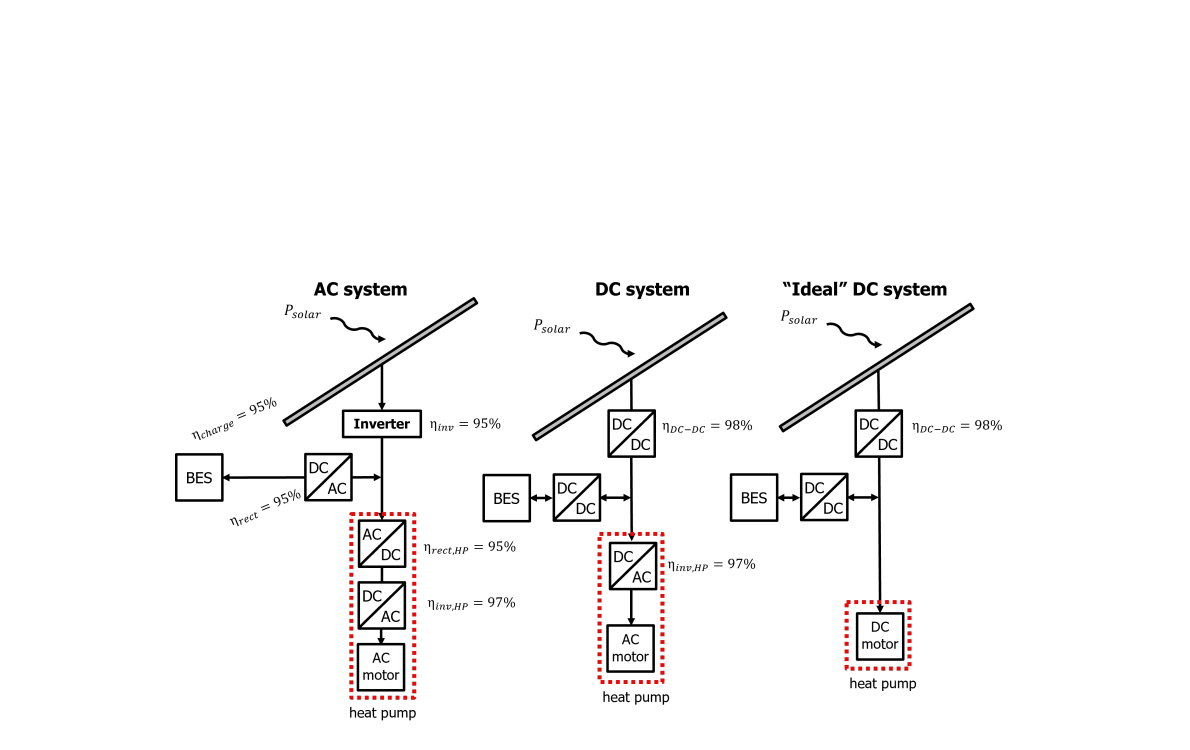
The paper tries to establish that a normal variable-speed residential heat pump, designed for 230 V AC, can be powered directly from a 350 V DC bus after a small retrofit, with no meaningful loss in heating or cooling performance. Laboratory tests across standard rating conditions found AC and DC thermal capacity agreed within about 6%, and COP differences were within measurement uncertainty. A one-month winter field test in an occupied house confirmed the device-level parity: weather-normalized input power was statistically indistinguishable between AC and DC. The authors then use the measured heat-pump load in a year-long model of a solar-plus-battery nanogrid, showing that DC distribution lowers the test house's annual electric bill by 12.5% with the retrofit and 16.7% with a heat pump designed for DC. The savings come from removing AC/DC conversions in the rest of the nanogrid, not from the heat pump itself, and the paper gives an experimental anchor to the idea that DC distribution can reduce residential electricity costs.
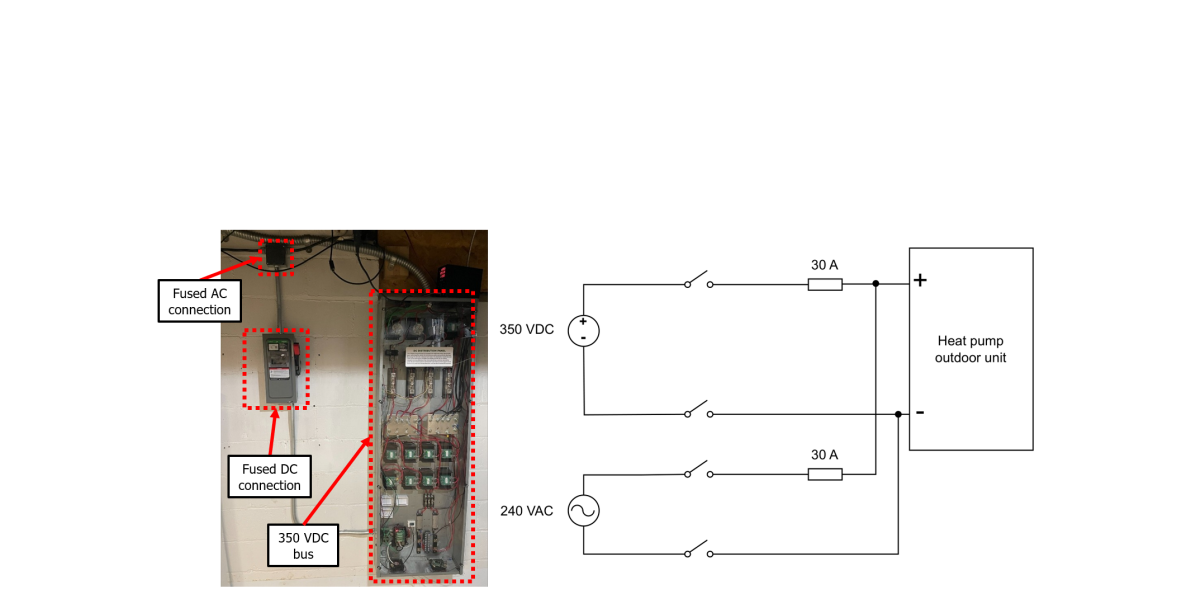
What carries the argument. The carrying object is the DC nanogrid bus and the converter chain around it. In the AC configuration, solar and battery each require inverters, and the heat pump internally rectifies AC back to DC before its own inverter drives the compressor. The retrofit feeds 350 V DC directly into the heat pump's variable-speed drive, bypassing the onboard rectifier. The quantitative engine is a set of converter part-load efficiency curves—one stylized curve shape, tuned at its peak to manufacturer spec-sheet values for each converter type—combined with a battery control logic that prioritizes solar for the heat pump first, then battery charging, and a full year of measured heat-pump and rest-of-house l
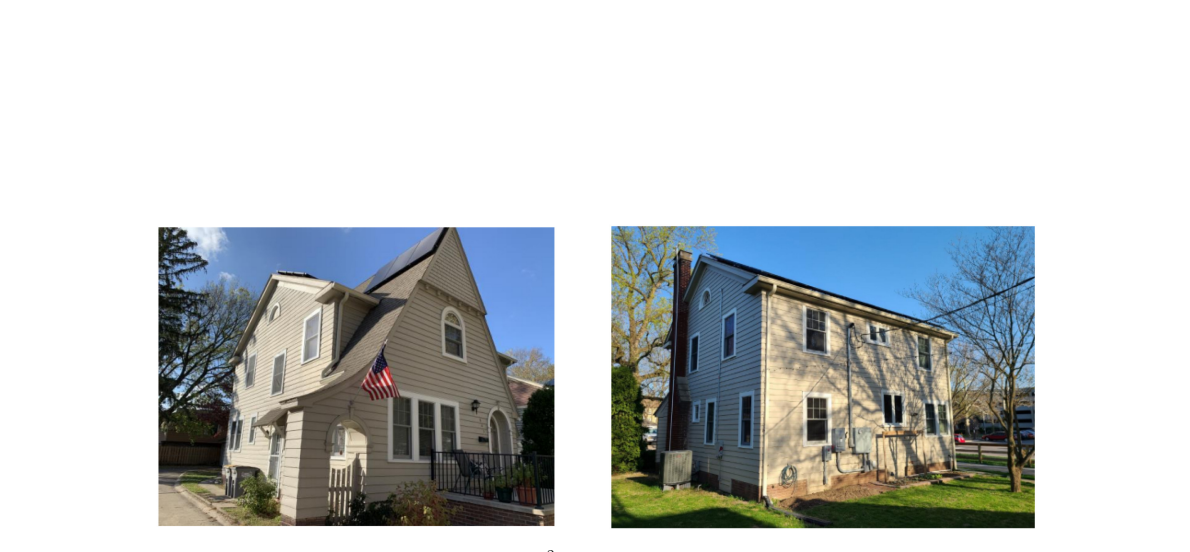
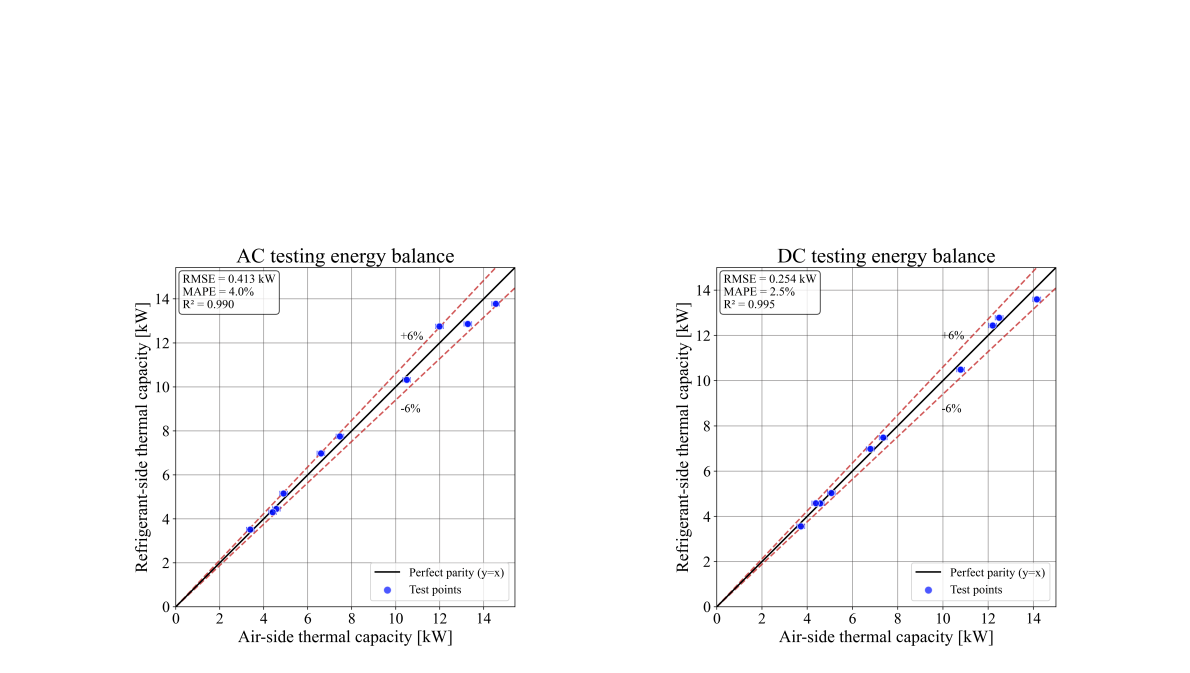
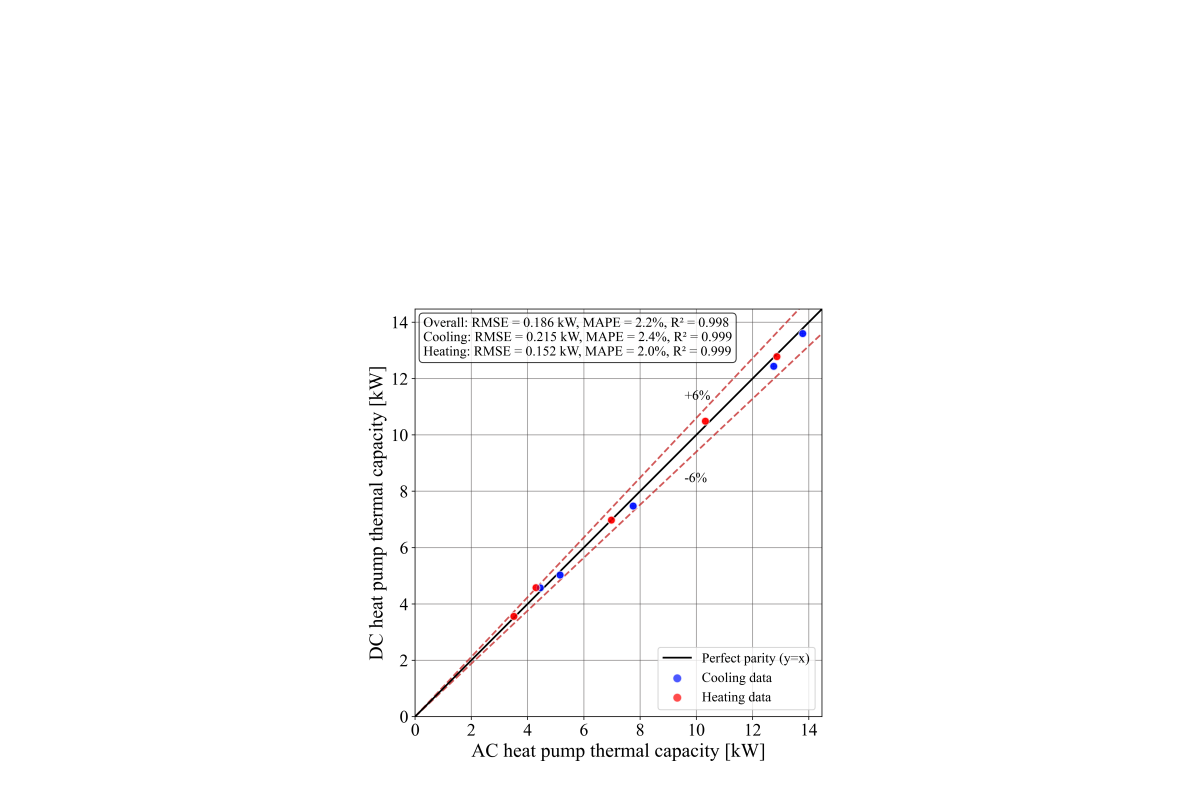
Core claim. The paper's central claim is that a residential variable-speed heat pump sold for conventional AC service can be retrofitted to run on a 350 V DC bus with minimal hardware changes and with no statistically significant change in capacity or coefficient of performance. In steady-state laboratory tests spanning cooling and heating conditions, the heat pump delivered essentially the same thermal capacity on DC as on AC, with COP differences within the measurement uncertainty (about 6%). A winter field test in an occupied 208 m² house, comparing weather-normalized input power on AC versus DC, found the difference statistically insignificant at p = 0.18. The paper then argues that the real benefit
The premise it rests on. The bill savings rest on modeled part-load efficiency curves for the converters, whose peak values come from specification sheets and whose shape is the same stylized curve for every converter; if real converters are less efficient at the partial loads where the house actually operates, the 12.5–16.7% savings shrink.
If the paper is right (Pith's inferences, not the authors')
Existing AC heat pumps can be retrofitted to run on DC without sacrificing capacity or efficiency, so a DC distribution upgrade does not require replacing the largest residential load.
The 12.5% and 16.7% annual bill savings in the modeled house come from eliminating inverter/rectifier losses and improving battery round-trip efficiency, not from the heat pump operating better on DC.
Given a ten-year simple payback ceiling, the highest justifiable retrofit cost for this house is about $612, meaning DC retrofits are not economically attractive today for single-family homes on energy savings alone.
The device-level parity shown in the lab and field justifies moving to full system-level field trials of DC nanogrids with heat pumps, batteries, and solar arrays.
A heat pump designed natively for DC, without the internal rectifier and inverter stages, offers a larger modeled saving (16.7% vs. 12.5%) than the after-market retrofit.
The 12.5–16.7% savings are sensitive to the assumed converter part-load curves and to the assumption that surplus solar is sold at full retail price; under real-world export tariffs or less efficient partial-load converters, the savings would be smaller.
The paper's equivalence result applies to a heat pump whose compressor still uses an internal inverter; a heat pump with a true DC-driven compressor might show additional gains or different reliability characteristics that the current retrofit cannot reveal.
The same retrofit logic extends naturally to other natively-DC residential loads, such as EV chargers and LED lighting, so the system-level savings likely grow as more loads are added to the DC bus.
A more decisive field test would switch the same heat pump between AC and DC within the same season, avoiding the year-apart weather and equipment-aging confound that the current field comparison carries.
Check this review
Pith stored no record of this review's passes and took no fingerprint of it. Reviews made by code from 13 Nov 2026 on carry both.
How often reviews like this one are right
Reviews like this one: written by deepseek-v4-flash, where what was read was not recorded.
How often objections from reviews like this one are right: not yet measured
Reviews by people
This review was written by a machine. No person has reviewed this paper on Pith yet. A scientist listed on Pith can review it for a fee, and their review is published here whatever it concludes.
The paper
Abstract
Residential buildings are increasingly integrating large devices that run natively on direct current (DC), such as solar photovoltaics, electric vehicles, stationary batteries, and DC motors that drive heat pumps and other major appliances. Today, these natively-DC devices typically connect within buildings through alternating current (AC) distribution systems, entailing significant energy losses due to conversions between AC and DC. This paper investigates the alternative of connecting DC devices through DC distribution. Specifically, this paper shows through laboratory and field experiments that an off-the-shelf residential heat pump designed for conventional AC systems can be powered directly on DC with few hardware modifications and little change in performance. Supporting simulations of a DC nanogrid including historical heat pump and rest-of-house load measurements, a solar photovoltaic array, and a stationary battery suggest that connecting these devices through DC distribution could decrease annual electricity bills by 12.5% with an after-market AC-to-DC heat pump retrofit and by 16.7% with a heat pump designed to run on DC. The associated savings in gross nanogrid energy are 8% and 9.2%, respectively.
The paper's own sentences, arranged, kept beside the review and separate from it. Each label is drawn from a closed vocabulary; the number beside it is the probability the classifier gave that label. No sentence in this record was written by a model.
abstract compiled · 2026-09-23
The authors' main claim, as the classifier picked it out 0.54
“Specifically, this paper shows through laboratory and field experiments that an off-the-shelf residential heat pump designed for conventional AC systems can be powered directly on DC with few hardware modifications and little change in performance.”
How the main claim is stated: asserted 1.00
What the abstract itself states, as probabilities: claims first 0.04 · states limitation 0.19 · human participants 0.08 · controlled comparison 0.60 · randomized assignment 0.01 · states quantitative result 0.99 · compares with prior results 0.77 · mentions code or data availability 0.03
The abstract, sentence by sentence
This table labels the abstract only (arXiv listing abstract v3). The number is the probability the classifier gave the label.
| Sentence | Role | The authors' own work | States the main conclusion | Strength |
|---|---|---|---|---|
| Residential buildings are increasingly integrating large devices that run natively on direct current (DC), such as solar photovoltaics, electric vehicles, stationary batteries, and DC motors that drive heat pumps and other major appliances. | background 1.00 | 0.06 | 0.02 | asserted 0.98 |
| Today, these natively-DC devices typically connect within buildings through alternating current (AC) distribution systems, entailing significant energy losses due to conversions between AC and DC. | background 0.99 | 0.07 | 0.02 | asserted 1.00 |
| This paper investigates the alternative of connecting DC devices through DC distribution. | contribution 0.92 | 0.35 | 0.07 | asserted 0.69 |
| Specifically, this paper shows through laboratory and field experiments that an off-the-shelf residential heat pump designed for conventional AC systems can be powered directly on DC with few hardware modifications and little change in performance. | result 0.66 | 0.96 | 0.76 | asserted 1.00 |
| Supporting simulations of a DC nanogrid including {historical heat pump and rest-of-house load measurements,} a solar photovoltaic array, and a stationary battery suggest that connecting these devices through DC distribution could decrease annual electricity bills by 12.5% with an after-market AC-to-DC heat pump retrofit and by 16.7% with a heat pump designed to run on DC. | result 1.00 | 0.87 | 0.41 | hedged possibility 0.96 |
| The associated savings in gross nanogrid energy are 8% and 9.2%, respectively. | result 1.00 | 0.86 | 0.12 | asserted 0.99 |
What kind of paper the classifier reports this is: empirical study 1.00 · evidence from observation or experiment 1.00
What was examined, and what was not
Sources read
- arXiv listing abstract v3
Not examined
- full text
- figures and tables
- references and citing sentences
- relations to other papers
Levels run
- P abstract
Not run
- S sections
- T body sentences
- C citations
- R cross-paper relations
How the labels were made
Compiled by classifier-1.13.0 via TypeSafe API, question bank abstract-p1-20260923, 2026-09-23: 1 request, 5,076 input tokens.
Every quoted sentence on this record is the authors'. Every label is from Pith's closed vocabulary, with the probability shown beside it. This record as JSON
Figures (15)

Figures are the authors', reproduced from the paper.
References (40)
- [1] U.S. Energy Information Administration.Energy Consumption by Sector. 2025.url:http://www. eia.gov/totalenergy/data/monthly/%5C#consumption on Pith
- [2] J. Assaf, J. S. Menye, M. B. Camara, D. Guilbert, and B. Dakyo. “Power Converter Topologies for Heat Pumps Powered by Renewable Energy Sources: A Literature Review”. In:Electronics13.19 (Oct. 9, 2024). Publisher: MDPI AG, p. 3965.issn: 2079-9292.doi:10.3390/electronics13193965... on Pithdoi:10.3390/electronics13193965.url:
- [3] K. Garbesi, V. Vossos, and H. Shen.Catalog of DC Appliances and Power Systems. Berkeley, CA (United States): Lawrence Berkeley National Laboratory (LBNL), Oct. 13, 2010.doi:10 . 2172 / 1076790.url:https://www.osti.gov/servlets/purl/1076790/(visited on 07/16/2025) on PitharXiv
- [4] A. Stippich, A. Sewergin, G. Engelmann, J. Gottschlich, and M. Neubert. “From AC to DC: Demon- stration of Benefits in Household Appliances”. In: (2017) on Pith
- [5] V. Vossos, K. Garbesi, and H. Shen. “Energy savings from direct-DC in U.S. residential buildings”. In:Energy and Buildings68 (Jan. 2014). Publisher: Elsevier BV, pp. 223–231.issn: 0378-7788.doi: 10.1016/j.enbuild.2013.09.009.url:https://linkinghub.elsevier.com/retrieve/pii/ S0... on Pithdoi:10.1016/j.enbuild.2013.09.009.url:https://linkinghub.elsevier.com/retrieve/pii/
- [6] M. Fotopoulou, D. Rakopoulos, D. Trigkas, F. Stergiopoulos, O. Blanas, and S. Voutetakis. “State of the art of low and medium voltage direct current (DC) microgrids”. In:Energies14.18 (2021), p. 5595. 20 on Pith
- [7] E. Rodriguez-Diaz, M. Savaghebi, J. C. Vasquez, and J. M. Guerrero. “An overview of low voltage DC distribution systems for residential applications”. In:2015 IEEE 5th International Conference on Consumer Electronics-Berlin (ICCE-Berlin). IEEE. 2015, pp. 318–322 on Pith
- [8] B. Chen, J. Wang, X. Gu, C. Chen, and S. Zhao. “Networked Microgrids for Grid Resilience, Ro- bustness, and Efficiency: A Review”. In:IEEE Trans. Smart Grid12.1 (Jan. 2021). Publisher: In- stitute of Electrical and Electronics Engineers (IEEE), pp. 18–32.issn: 1949-3053, 1949-... on PitharXiv
- [9] C. Charalambous, C. Heracleous, A. Michael, and V. Efthymiou. “Hybrid AC-DC distribution system for building integrated photovoltaics and energy storage solutions for heating-cooling purposes. A case study of a historic building in Cyprus”. In:Renewable Energy216 (2023), p. 11... on PitharXiv
- [10] J. Ore, F. Meral, O. Obst, O. Kurtulus, and E. A. Groll. “Evaluation of a Hybrid AC/DC Powered Residential Split- System Heat Pump Performance using a DC Nanogrid”. In:International Energy Agency(2020) on Pith
- [11] L. Sriram, A. Farha, A. Hoess, D. Ziviani, E. Groll, E. Pergantis, and K. Kircher. “Development and Comparative Analysis of a Power-over-Ethernet (PoE) DC Lighting System for Residential Buildings”. In: (2024) on Pith
- [12] R. Chacko, A. Thevarkunnel, Z. Lakaparampil, and J. Thomas. “DC nanogrid for Buildings: Study based on experimental investigation of load performance and Annual energy consumption”. In:Ma- terials Today: Proceedings58 (2022). Publisher: Elsevier BV, pp. 352–358.issn: 2214-7853... on Pith
- [13] N. R. Watson and J. D. Watson. “An overview of HVDC technology”. In:Energies13.17 (2020), p. 4342 on Pith
- [14] W. Wang, G. Li, and J. Guo. “Large-scale renewable energy transmission by HVDC: Challenges and proposals”. In:Engineering19 (2022), pp. 252–267 on Pith
- [15] M. Shahidehpour, X. Liu, Z. Li, and Y. Cao. “Microgrids for Enhancing the Power Grid Resilience in Extreme Conditions”. In:IEEE Trans. Smart Grid(2016). Publisher: Institute of Electrical and Electronics Engineers (IEEE), pp. 1–1.issn: 1949-3053, 1949-3061.doi:10.1109/tsg.2016... on PitharXiv
- [16] F. Dastgeer, H. E. Gelani, H. M. Anees, Z. J. Paracha, and A. Kalam. “Analyses of efficiency/energy- savings of DC power distribution systems/microgrids: Past, present and future”. In:International journaltitle of Electrical Power & Energy Systems104 (Jan. 2019). Publisher: El... on Pithdoi:10.1016/j.ijepes.2018.06.057.url:https://linkinghub.elsevier
- [17] F. Dastgeer and H. E. Gelani. “A Comparative analysis of system efficiency for AC and DC residential power distribution paradigms”. In:Energy and Buildings138 (Mar. 2017). Publisher: Elsevier BV, pp. 648–654.issn: 0378-7788.doi:10.1016/j.enbuild.2016.12.077.url:https://linking... on Pithdoi:10.1016/j.enbuild.2016.12.077.url:https://linkinghub
- [18] T. Dragicevic, X. Gu, J. C. Vasquez, and J. M. Guerrero. “DC Microgrids—Part II: A Review of Power Architectures, Applications, and Standardization Issues”. In:IEEE Trans. Power Electron.31.5 (May 2016). Publisher: Institute of Electrical and Electronics Engineers (IEEE), pp. ... on PitharXiv
- [19] R. K. Chauhan, F. Gonzalez-Gongatt, B. S. Rajpurohit, and S. N. Singh. “DC microgrid in residential buildings”. In:DC Distribution Systems and Microgrids. Institution of Engineering and Technology, Oct. 5, 2018, pp. 367–388.doi:10.1049/pbpo115e\_ch15.url:https://digital-librar... on Pithdoi:10.1049/pbpo115e
- [20] A. T. Elsayed, A. A. Mohamed, and O. A. Mohammed. “DC microgrids and distribution systems: An overview”. In:Electric Power Systems Research119 (Feb. 2015). Publisher: Elsevier BV, pp. 407–417. issn: 0378-7796.doi:10.1016/j.epsr.2014.10.017.url:https://linkinghub.elsevier.com/ ... on Pithdoi:10.1016/j.epsr.2014.10.017.url:https://linkinghub.elsevier.com/
show 20 more
- [21] D. Lorusso, S. Mlyniec, and J. Casey. “Introduction to Fault-Managed Power”. In:2025 IEEE Inter- national Symposium on Product Compliance Engineering (ISPCE). IEEE. 2025, pp. 1–6 on Pith
- [22] J. P. Ore and E. A. Groll. “Analysis of a Residential House for the Design and Implementation of a DC Nanogrid”. In:2020 IEEE PES Innovative Smart Grid Technologies Europe (ISGT-Europe). The Hague, Netherlands: IEEE, Oct. 26, 2020, pp. 749–753.doi:10 . 1109 / isgt - europe4729... on PitharXiv
- [23] J. Ore, F. Meral, D. Ziviani, and E. Groll. “The Case for DC: Motivation of Modern Topologies, DC-Powered Solutions, and Applications within Residential Environments”. In: (2021) on Pith
- [24] J. P. Ore. “The DC Nanogrid House: Converting a Residential Building from AC to DC Power to Improve Energy Efficiency”. PhD thesis. Purdue University, 2021 on Pith
- [25] E. N. Pergantis, N. Al Theeb, P. Dhillon, J. P. Ore, D. Ziviani, E. A. Groll, K. J. Kircher, et al. “Field demonstration of predictive heating control for an all-electric house in a cold climate”. In:Applied Energy360 (2024), p. 122820 on Pith
- [26] E. N. Pergantis, P. Dhillon, L. D. R. Premer, A. H. Lee, D. Ziviani, and K. J. Kircher. “Humidity-aware model predictive control for residential air conditioning: A field study”. In:Building and Environment 266 (2024), p. 112093 on Pith
- [27] E. N. Pergantis, L. D. R. Premer, A. H. Lee, H. Liu, E. A. Groll, D. Ziviani, K. J. Kircher, et al. “Protecting residential electrical panels and service through model predictive control: A field study”. In:Applied Energy386 (2025), p. 125528 on Pith
- [28] V. Vossos, D. L. Gerber, M. Gaillet-Tournier, B. Nordman, R. Brown, W. Bernal Heredia, O. Ghat- pande, A. Saha, G. Arnold, and S. M. Frank. “Adoption Pathways for DC Power Distribution in Buildings”. In:Energies15.3 (Jan. 21, 2022). Publisher: MDPI AG, p. 786.issn: 1996-1073.d... on Pithdoi:10.3390/en15030786.url:https://www.mdpi.com/1996-1073/15/3/786(visited
- [29] D. Fregosi, S. Ravula, D. Brhlik, J. Saussele, S. Frank, E. Bonnema, J. Scheib, and E. Wilson. “A comparative study of DC and AC microgrids in commercial buildings across different climates and operating profiles”. In:2015 IEEE First International Conference on DC Microgrids (... on PitharXiv
- [30] H. Kakigano, M. Nomura, and T. Ise. “Loss evaluation of DC distribution for residential houses com- pared with AC system”. In:The 2010 International Power Electronics Conference - ECCE ASIA -. 2010 International Power Electronics Conference (IPEC - Sapporo). Sapporo, Japan: IE... on PitharXiv
- [31] B. Muruganantham, R. Gnanadass, and N. Padhy. “Challenges with renewable energy sources and storage in practical distribution systems”. In:Renewable and Sustainable Energy Reviews73 (June 2017).Publisher:ElsevierBV,pp.125–134.issn:1364-0321.doi:10.1016/j.rser.2017.01.089.url: ... on Pithdoi:10.1016/j.rser.2017.01.089.url:
- [32] A. Frances, R. Asensi, O. Garcia, R. Prieto, and J. Uceda. “Modeling Electronic Power Converters in Smart DC Microgrids—An Overview”. In:IEEE Trans. Smart Grid9.6 (Nov. 2018). Publisher: Institute of Electrical and Electronics Engineers (IEEE), pp. 6274–6287.issn: 1949-3053, 1... on Pith
- [33] V. Vossos, S. Pantano, R. Heard, and R. Brown. “DC Appliances and DC Power Distribution: A Bridge to the Future Net Zero Energy Homes”. In:9th International Conference on Energy Efficiency in Do- mestic Appliances and Lighting(2017).url:https://publications.europa.eu/en/public... on Pith
- [34] K. Garbesi, V. Vossos, A. Sanstad, and G. Burch.Optimizing Energy Savings from Direct-DC in U.S. Residential Buildings. Lawrence Berkeley National Laboratory (LBNL), July 16, 2012 on Pith
- [35] C. B. Nzoundja Fapi, M. L. Touré, M.-B. Camara, and B. Dakyo. “Control Strategy for DC Micro- Grids in Heat Pump Applications with Renewable Integration”. In:Electronics14.1 (Jan. 2, 2025). Publisher: MDPI AG, p. 150.issn: 2079-9292.doi:10.3390/electronics14010150.url:https: /... on Pithdoi:10.3390/electronics14010150.url:https:
- [36] American Heating, Air-Conditioning and Refrigeration Institute.Performance Rating of Unitary Air- conditioning & Air-source Heat Pump Equipment. AHRI Standard 210/240. American Heating, Air- Conditioning and Refrigeration Institute, 2023 on Pith
- [37] E. N. Pergantis, A. S. Sangamnerkar, O. J. Priyadarshan, P. Dhillon, D. Ziviani, E. A. Groll, and K. J. Kircher. “Sensors, storage, and algorithms for practical optimal controls in residential buildings”. In:ASHRAE Trans129 (2023), pp. 437–444 on Pith
- [38] American Society of Heating, Refrigeration, and Air-Conditioning Engineers. “Climatic Data for Build- ing Design Standards”. In:ASHRAE Standing Project Committee 169(2020) on Pith
- [39] K. S. Anderson, C. W. Hansen, W. F. Holmgren, A. R. Jensen, M. A. Mikofski, and A. Driesse. “PVlib python: 2023 project update”. In:JOSS8.92 (Dec. 22, 2023). Publisher: The Open journaltitle, p. 5994. issn: 2475-9066.doi:10.21105/joss.05994.url:https://joss.theoj.org/papers/10... on Pithdoi:10.21105/joss.05994.url:https://joss.theoj.org/papers/10.21105/
- [40] Duke Energy Indiana.Residential rates. 2025.url:https://www.duke-energy.com/. 23 on Pith
Challenges and discussion
Disagree with the review, or know something it missed? Leave a comment, or challenge this review formally: a challenge becomes a permanent entry in this paper's record, and its decision is published here.
Come back by email
A short list of the week's newly reviewed papers. Nothing is sent until you confirm from your inbox, and every email has a link that stops it. No account.
No comments yet.
Sign in to comment