REVIEW 4 major objections 4 minor 2 cited by
A hyperparameter-free alignment rule sets the likelihood step in diffusion posterior sampling, claiming better perceptual quality with little or no distortion loss, across inverse problems.
Reviewed by Pith at T0; open to challenge. T0 means a machine referee read the full paper against a public rubric. the ladder, T0–T4 →
AdaPS adaptively scales likelihood guidance in DDIM posterior sampling via agreement between two surrogates, improving LPIPS/PSNR trade-offs on image restoration tasks without task-specific tuning.
T0 review reviewed 2026-08-03 challenge →
load-bearing objection Empirically promising adaptive guidance sampler, but Eq. 24 has a time-dependent factor error that undercuts the 'derived' step size; send to review with expectation of major revision. the 4 major comments →
Jacobian-Aware Posterior Sampling for Inverse Problems
The pith
A machine-rendered reading of the paper's core claim, the machinery that carries it, and where it could break.
The reading
Core claim
Under the linear-Gaussian measurement model and a Gaussian approximation of the intermediate clean-signal posterior, the paper derives a closed-form MAP residual in noise space that approximates the difference between the optimal posterior noise and the unconditional denoiser's noise prediction, without backpropagating through the denoiser. The final update is x_{t-1} = DDIM(x_t) - 2γ_t (⟨d_t, g_t⟩/||g_t||²) g_t, where g_t is any likelihood-direction surrogate, d_t is the Jacobian-free MAP residual, γ_t is the DDIM coefficient, and the factor 2 compensates for the empirically observed ~0.5 cosine alignment between the two surrogates. The paper argues this yields a principled, hyperparameter-
What carries the argument
The load-bearing object is the projection coefficient ⟨d_t, g_t⟩/||g_t||² between two approximations of the intractable likelihood score. d_t is a MAP-based residual computed in the denoised-image space without the denoiser Jacobian, while g_t is a likelihood direction that may include the Jacobian. The DDIM coefficient γ_t multiplies the whole correction, and the factor 2 is a data-agnostic bias correction for the systematic shrinkage caused by imperfect alignment. Splitting magnitude (Jacobian-free) from direction (potentially Jacobian-aware) is what lets the method avoid ill-conditioned step sizes while preserving useful Jacobian information.
Load-bearing premise
The fixed factor-of-two bias correction assumes that throughout the trajectory the expected cosine similarity between the two likelihood surrogates is close to 0.5 in every task, dataset, and noise level; if the true mean alignment differs, the guidance magnitude is systematically wrong.
What would settle it
Measure the per-timestep average of the cosine similarity between the two likelihood surrogates on a task the paper does not test, such as inpainting or phase retrieval at 256px; if it departs from 0.5 by more than roughly 0.1 over the mid-trajectory, the factor-2 rule is miscalibrated. Directly comparing AdaPS with a fixed factor 2 against a version using a per-task fitted factor would settle whether the universal constant is correct.
If this is right
- Posterior samplers built on unconditional diffusion priors no longer need per-task step-size tuning; the alignment rule sets the scale automatically.
- The missing scaling factor means earlier likelihood insertions were miscalibrated; including it makes guidance scale with step count and stochasticity, so more diffusion steps continue to improve perceptual quality.
- Splitting magnitude from direction gives a stable compromise that avoids overweighting ill-conditioned directions while keeping the benefit of Jacobian information, without extra computational cost.
- The same construction extends to nonlinear measurement operators through a scalar Gauss-Newton MAP refinement with fixed hyperparameters.
- Because the method is hyperparameter-free, it transfers across tasks and noise levels without re-fitting, which prior approaches generally require.
Where Pith is reading between the lines
- The alignment statistic could be monitored online during sampling; replacing the fixed factor 2 with a moving average of the cosine similarity would make the method adaptive to tasks where the 0.5 assumption fails.
- The agreement heuristic doubles as a confidence diagnostic: when the two likelihood surrogates strongly disagree, the update is automatically attenuated, which may explain the method's robustness to high measurement noise.
- If a latent-diffusion version could define both surrogates in latent space, the schedule-robustness demonstrated here would plausibly carry over, provided the alignment statistic remains informative in that space.
Editorial analysis
A structured set of objections, weighed in public.
Referee Report
Summary. The submission is internally inconsistent: the title and abstract describe a "Jacobian-Aware Posterior Sampling (JAPS)" method, while the full text presents "Adaptive Posterior diffusion Sampling (AdaPS)". Taking the full text as the actual contribution, the paper proposes AdaPS, which incorporates a likelihood-score surrogate g_t into the DDIM update (Eq. 15) and selects the guidance coefficient ξ_t by least-squares projection of a posterior-noise residual d_t onto g_t (Eq. 16). d_t is approximated via a MAP estimate of x_0 given (x_t, y) under a Gaussian approximation (Eqs. 23–24), and the update includes an empirical factor-of-two bias correction (Eq. 19). The method is evaluated on super-resolution, Gaussian deblurring, and motion deblurring on CelebA-HQ and ImageNet-256, plus a nonlinear deblurring extension. The experimental sections are extensive, but the derivation contains a concrete algebraic error and an empirically fitted constant that undermine the theoretical claims.
Significance. If the derivation were sound, the contribution would be significant: an adaptive, multi-task guidance scaling that preserves DDIM scheduling, avoids Jacobian computation in the magnitude, and attains a favorable perception–distortion trade-off. The experimental breadth is a strength: two datasets, three tasks, noisy/noiseless settings, ablations over step count, noise, stochasticity, and surrogate pairings, and a cross-validated ΠGDM reimplementation. The reported LPIPS gains (e.g., Table 1, ImageNet motion deblurring: 0.147 for AdaPS-ΠGDM vs 0.205 for DDPG) are meaningful. However, Eq. (24) is algebraically wrong and the factor-of-two correction is an empirical fit; as written, the central claim of a "principled, hyperparameter-free" sampler is not established. The significance is therefore conditional on fixing the derivation and validating the fitted constant.
major comments (4)
- [Abstract / Title; §1–§3] The manuscript's title and abstract describe 'Jacobian-Aware Posterior Sampling (JAPS)' with a 'corrected conditional factor', but the body introduces 'Adaptive Posterior diffusion Sampling (AdaPS)' and never defines JAPS. For example, the abstract claims the method 'bridges direct and proximal approaches' and 'leverages the Jacobian's prior knowledge', while §3's derivation uses d_t from an \hat{x}_0-space MAP residual and g_t chosen as DPS or ΠGDM. This is not cosmetic: the reader cannot verify which method is being presented. Harmonize the title, abstract, and body before review can be completed.
- [§3.2.2, Eq. (24); also Eq. (34)] Combining Eq. (7), Eq. (9), and Eq. (23) gives ε*_t − ε_θ,t = [(x_t − √ᾱ_t x*_0) − (x_t − √ᾱ_t \hat{x}_0)]/√(1−ᾱ_t) = (√ᾱ_t/√(1−ᾱ_t))(\hat{x}_0 − x*_0). Substituting Eq. (23) yields d_t = (√ᾱ_t/√(1−ᾱ_t)) A^T(AA^T + σ_y²/r_t² I)^{-1}(A\hat{x}_0−y), not the √ᾱ_t√(1−ᾱ_t) in Eq. (24). The error is by a factor 1/(1−ᾱ_t), which diverges as t→0. Because d_t enters ξ*_t, ⟨d_t,g_t⟩, and the update Eq. (19), the implemented update is not the derived one; the missing factor cannot be absorbed into the fixed factor 2. This is a load-bearing inconsistency. The same expression appears in Eq. (34). Please correct the derivation and state whether the implementation uses the corrected factor or the printed one.
- [§3.2.1, Eq. (19)] The 'simple, data-agnostic bias correction, scaling by 2≈1/E[⟨d̂_t, ĝ_t⟩] (empirically≈0.5 at mid-trajectory)' is an empirical fit, not a derived constant. No supporting measurement of the alignment statistic is shown, and it may vary with task, noise level, step count, and diffusion time. This contradicts the 'hyperparameter-free' claim and makes the update magnitude partly heuristic. Furthermore, correcting Eq. (24) will change d_t and hence the statistic, so the factor 2 may no longer be valid. Provide evidence of its stability or revise the claims.
- [B.1, Eqs. (30)–(33)] The nonlinear extension replaces J(x_0)^T J(x_0) with λ(x_0) I_n (Eq. 30) and fixes λ_damp>0 and K=5 (after Eq. 33). Fixed constants are still hyperparameters; fixing them across tasks does not make the method 'essentially hyperparameter-free.' Since only one nonlinear task (Table 3) is shown, the robustness of these constants is not established. This is secondary, but should be addressed if the nonlinear claim is retained.
minor comments (4)
- [§3.2.1 / Supplement C] In §3.2.1, g_t is used in Eq. (16) without the normalization mentioned in Supplement C ('when using any likelihood surrogate for g_t, it is normalized'). Define g_t consistently in the main text.
- [Table 1, caption] The caption says 'Values in gray are excluded because they were obtained with a larger number of sampling steps,' but no gray values are distinguishable in the rendered text. Mark excluded entries explicitly.
- [Eq. (24) / Eq. (34)] The equivalence between Eq. (24)'s d_t and \tilde{ε}^{MAP}_θ in Eq. (34) is not stated. Align the notation so the surrogate definitions are easy to compare.
- [§5, Limitations] The Limitations say the derivation 'leverages the linear–Gaussian setting for clarity and efficiency,' but Eq. (23) depends on the linear-Gaussian form. The statement that extension to nonlinear/non-Gaussian models is possible 'in principle' should be qualified by the approximate nature and the extra constants introduced in B.1.
Circularity Check
No significant circularity: the adaptive step is a projection-based combination of two stated surrogates, and the main claims are supported by external comparisons.
full rationale
I walked the derivation chain from Eq. 14 through Eq. 24 and the experimental tables. The least-squares choice xi*_t = <d_t,g_t>/||g_t||^2 in Eq. 16 is literally the projection of the residual d_t onto the direction g_t, so it is not circular: d_t is a MAP residual computed in x0-space (Eq. 23) and g_t is a separate likelihood-score surrogate (DPS/PGDM); the update then moves along g_t with that projected magnitude. The Gaussian approximation p(x0|xt) ~ N(xhat0, r_t^2 I) is explicitly adopted from prior work [4,28], i.e. an imported assumption rather than a derived result, and is not used to prove the experimental outcomes. The fixed factor 2 in Eq. 19 is an empirical calibration ('empirically about 0.5 at mid-trajectory'), which weakens the literal claim of being fully hyperparameter-free but is not a hidden fit to the reported metrics and does not make the prediction follow from the input by construction. Self-citations ([1,11,14,33,34]) are background and baselines, not load-bearing; no uniqueness theorem is imported. I also note an algebraic inconsistency: combining Eqs. 7 and 23 gives d_t = [sqrt(alpha_bar_t)/sqrt(1-alpha_bar_t)] A^T(...)(A xhat0 - y), whereas Eq. 24 has sqrt(alpha_bar_t)*sqrt(1-alpha_bar_t), i.e. a missing 1/(1-alpha_bar_t) factor. This is a correctness/reproducibility concern in the derivation, not a circularity, so it does not change the circularity score. The central empirical claims are evaluated against external baselines and are self-contained.
Axiom & Free-Parameter Ledger
free parameters (3)
- bias correction factor =
2
- λ_damp =
not reported
- K =
5
axioms (5)
- standard math The score approximation ∇_xt log p_t(x_t) ≈ −ϵ_θ(x_t,t)/√(1−ᾱ_t) (Tweedie) is valid.
- domain assumption p(x0|xt) ≈ N(x̂0, r_t² I) with r_t² = 1−ᾱ_t
- domain assumption Linear–Gaussian measurement model y = Ax + ε with known σ_y
- ad hoc to paper E[⟨d̂_t, ĝ_t⟩] ≈ 0.5 at mid-trajectory and is constant across tasks, times, datasets, noise levels
- ad hoc to paper J^T J ≈ λ(x0) I_n (isotropic curvature) in the nonlinear extension
Cite this review
Pith. "Pith review of Jacobian-Aware Posterior Sampling for Inverse Problems." pith.science (2026). https://pith.science/paper/TJIOWTUP
@misc{pith2026251118471,
  author       = {Pith},
  title        = {Pith review of: Jacobian-Aware Posterior Sampling for Inverse Problems},
  year         = {2026},
  howpublished = {\url{https://pith.science/paper/TJIOWTUP}},
  note         = {Machine review of arXiv:2511.18471}
}
read the original abstract
Diffusion models provide powerful generative priors for solving inverse problems by sampling from a posterior distribution conditioned on corrupted measurements. Existing methods primarily follow two paradigms: direct methods, which approximate the likelihood term, and proximal methods, which incorporate intermediate solutions satisfying measurement constraints into the sampling process. Under standard Gaussian approximations and locally-linear measurements, we demonstrate that these approaches differ fundamentally in their treatment of the diffusion denoiser's Jacobian within the likelihood term. While this Jacobian encodes critical prior knowledge of the data distribution, training-induced non-idealities can degrade performance in zero-shot settings. In this work, we bridge direct and proximal approaches by proposing a principled Jacobian-Aware Posterior Sampler (JAPS). JAPS leverages the Jacobian's prior knowledge while mitigating its detrimental effects through a corresponding proximal solution, requiring no additional computational cost. Additionally, we integrate our guidance into DDIM sampling, with a corrected conditional factor that has been missing in previous works. Our method enhances reconstruction quality across diverse linear and nonlinear noisy imaging tasks, outperforming existing diffusion-based baselines in perceptual quality while maintaining or improving distortion metrics.
Figures




Forward citations
Cited by 2 Pith papers
-
Image Restoration via Diffusion Models with Dynamic Resolution
Dynamic resolution priors enable faster diffusion-based image restoration by operating in lower-dimensional subspaces, with adapted methods outperforming prior DM approaches on most tasks.
-
Latent Diffusion Posterior Sampling with Surrogate Likelihood Guidance for PDE Inverse Problems
L-DPS performs approximate Bayesian inference for PDE inverse problems by combining latent diffusion priors with surrogate-guided likelihood in a lower-dimensional space, demonstrated on Darcy flow permeability inversion.
Reference graph
Works this paper leans on
-
[1]
Adir: Adaptive diffusion for image reconstruction
Shady Abu-Hussein, Tom Tirer, and Raja Giryes. Adir: Adaptive diffusion for image reconstruction. arXiv preprint arXiv:2212.03221, 2022. 2
Pith/arXiv arXiv 2022
-
[2]
Reverse-time diffusion equation models.Stochastic Processes and their Applications, 12(3):313–326, 1982
Brian DO Anderson. Reverse-time diffusion equation models.Stochastic Processes and their Applications, 12(3):313–326, 1982. 3
1982
-
[3]
The perception- distortion tradeoff
Yochai Blau and Tomer Michaeli. The perception- distortion tradeoff. In2018 IEEE/CVF Conference on Computer Vision and Pattern Recognition, page 6228–6237. IEEE, 2018. 6
2018
-
[4]
Tweedie moment projected diffusions for inverse problems.arXiv preprint arXiv:2310.06721, 2023
Benjamin Boys, Mark Girolami, Jakiw Pidstrigach, Sebastian Reich, Alan Mosca, and O Deniz Aky- ildiz. Tweedie moment projected diffusions for inverse problems.arXiv preprint arXiv:2310.06721, 2023. 5
Pith/arXiv arXiv 2023
-
[5]
Improving diffusion models for in- verse problems using manifold constraints.Advances in Neural Information Processing Systems, 35:25683– 25696, 2022
Hyungjin Chung, Byeongsu Sim, Dohoon Ryu, and Jong Chul Ye. Improving diffusion models for in- verse problems using manifold constraints.Advances in Neural Information Processing Systems, 35:25683– 25696, 2022. 2, 4
2022
-
[6]
Diffusion posterior sampling for general noisy inverse problems
Hyungjin Chung, Jeongsol Kim, Michael T Mccann, Marc L Klasky, and Jong Chul Ye. Diffusion posterior sampling for general noisy inverse problems. InIn- ternational Conference on Learning Representations,
-
[7]
Decomposed diffusion sampler for accelerating large- scale inverse problems, 2024
Hyungjin Chung, Suhyeon Lee, and Jong Chul Ye. Decomposed diffusion sampler for accelerating large- scale inverse problems, 2024. 11, 12
2024
-
[8]
Diffusion models beat gans on image synthesis.Advances in neural information processing systems, 34:8780– 8794, 2021
Prafulla Dhariwal and Alexander Nichol. Diffusion models beat gans on image synthesis.Advances in neural information processing systems, 34:8780– 8794, 2021. 6
2021
-
[9]
Image super-resolution using deep convo- lutional networks.IEEE transactions on pattern anal- ysis and machine intelligence, 38(2):295–307, 2015
Chao Dong, Chen Change Loy, Kaiming He, and Xi- aoou Tang. Image super-resolution using deep convo- lutional networks.IEEE transactions on pattern anal- ysis and machine intelligence, 38(2):295–307, 2015. 2
2015
-
[10]
Tweedie’s formula and selection bias
Bradley Efron. Tweedie’s formula and selection bias. Journal of the American Statistical Association, 106 (496):1602–1614, 2011. 3
2011
-
[11]
Image restoration by denoising diffusion models with iteratively precondi- tioned guidance
Tomer Garber and Tom Tirer. Image restoration by denoising diffusion models with iteratively precondi- tioned guidance. InProceedings of the IEEE/CVF conference on computer vision and pattern recogni- tion, pages 25245–25254, 2024. 2, 4, 6, 13
2024
-
[12]
Zero-shot image restora- tion using few-step guidance of consistency models (and beyond)
Tomer Garber and Tom Tirer. Zero-shot image restora- tion using few-step guidance of consistency models (and beyond). InProceedings of the Computer Vision and Pattern Recognition Conference, pages 2398– 2407, 2025. 2
2025
-
[13]
Denois- ing diffusion probabilistic models.Advances in neural information processing systems, 33:6840–6851, 2020
Jonathan Ho, Ajay Jain, and Pieter Abbeel. Denois- ing diffusion probabilistic models.Advances in neural information processing systems, 33:6840–6851, 2020. 2, 3
2020
-
[14]
Cor- rection filter for single image super-resolution: Robus- tifying off-the-shelf deep super-resolvers
Shady Abu Hussein, Tom Tirer, and Raja Giryes. Cor- rection filter for single image super-resolution: Robus- tifying off-the-shelf deep super-resolvers. InProceed- ings of the IEEE/CVF conference on computer vision and pattern recognition, pages 1428–1437, 2020. 2
2020
-
[15]
Estimation of non-normalized statistical models by score matching
Aapo Hyv ¨arinen and Peter Dayan. Estimation of non-normalized statistical models by score matching. Journal of Machine Learning Research, 6(4), 2005. 3
2005
-
[16]
Denoising diffusion restoration models
Bahjat Kawar, Michael Elad, Stefano Ermon, and Ji- aming Song. Denoising diffusion restoration models. Advances in neural information processing systems, 35:23593–23606, 2022. 2, 6
2022
-
[17]
Efficient diffusion posterior sampling for noisy inverse problems.SIAM Journal on Imaging Sciences, 18(2):1468–1492, 2025
Ji Li and Chao Wang. Efficient diffusion posterior sampling for noisy inverse problems.SIAM Journal on Imaging Sciences, 18(2):1468–1492, 2025. 5
2025
-
[18]
Enhanced deep residual networks for single image super-resolution
Bee Lim, Sanghyun Son, Heewon Kim, Seungjun Nah, and Kyoung Mu Lee. Enhanced deep residual networks for single image super-resolution. InPro- ceedings of the IEEE conference on computer vision and pattern recognition workshops, pages 136–144,
-
[19]
Re- paint: Inpainting using denoising diffusion probabilis- tic models
Andreas Lugmayr, Martin Danelljan, Andres Romero, Fisher Yu, Radu Timofte, and Luc Van Gool. Re- paint: Inpainting using denoising diffusion probabilis- tic models. InProceedings of the IEEE/CVF con- ference on computer vision and pattern recognition, pages 11461–11471, 2022. 6
2022
-
[20]
Morteza Mardani, Jiaming Song, Jan Kautz, and Arash Vahdat. A variational perspective on solving in- verse problems with diffusion models.arXiv preprint arXiv:2305.04391, 2023. 2, 7, 15
Pith/arXiv arXiv 2023
-
[21]
Improving diffusion models for inverse problems us- ing optimal posterior covariance
Xinyu Peng, Ziyang Zheng, Wenrui Dai, Nuoqian Xiao, Chenglin Li, Junni Zou, and Hongkai Xiong. Improving diffusion models for inverse problems us- ing optimal posterior covariance. InInternational Conference on Machine Learning, pages 40347– 40370. PMLR, 2024. 4
2024
-
[22]
Dreamfusion: Text-to-3d using 2d dif- fusion.arXiv preprint arXiv:2209.14988, 2022
Ben Poole, Ajay Jain, Jonathan T Barron, and Ben Mildenhall. Dreamfusion: Text-to-3d using 2d dif- fusion.arXiv preprint arXiv:2209.14988, 2022. 11, 12
Pith/arXiv arXiv 2022
-
[23]
The little engine that could: Regularization by denois- ing (red).SIAM journal on imaging sciences, 10(4): 1804–1844, 2017
Yaniv Romano, Michael Elad, and Peyman Milanfar. The little engine that could: Regularization by denois- ing (red).SIAM journal on imaging sciences, 10(4): 1804–1844, 2017. 2
2017
-
[24]
Dimakis, and Sanjay Shakkottai
Litu Rout, Negin Raoof, Giannis Daras, Constan- tine Caramanis, Alexandros G. Dimakis, and Sanjay Shakkottai. Solving linear inverse problems provably via posterior sampling with latent diffusion models,
-
[25]
zero- shot
Assaf Shocher, Nadav Cohen, and Michal Irani. “zero- shot” super-resolution using deep internal learning. In Proceedings of the IEEE conference on computer vi- sion and pattern recognition, pages 3118–3126, 2018. 2
2018
-
[26]
Solving inverse prob- lems with latent diffusion models via hard data con- sistency, 2024
Bowen Song, Soo Min Kwon, Zecheng Zhang, Xinyu Hu, Qing Qu, and Liyue Shen. Solving inverse prob- lems with latent diffusion models via hard data con- sistency, 2024. 8
2024
-
[27]
Denoising diffusion implicit models
Jiaming Song, Chenlin Meng, and Stefano Er- mon. Denoising diffusion implicit models. arXiv:2010.02502, 2020. 3
Pith/arXiv arXiv 2010
-
[28]
Pseudoinverse-guided diffusion models for inverse problems
Jiaming Song, Arash Vahdat, Morteza Mardani, and Jan Kautz. Pseudoinverse-guided diffusion models for inverse problems. InInternational Conference on Learning Representations, 2023. 2, 4, 5, 6, 7, 15
2023
-
[29]
Generative modeling by estimating gradients of the data distribution.Ad- vances in neural information processing systems, 32,
Yang Song and Stefano Ermon. Generative modeling by estimating gradients of the data distribution.Ad- vances in neural information processing systems, 32,
-
[30]
Yang Song, Jascha Sohl-Dickstein, Diederik P Kingma, Abhishek Kumar, Stefano Ermon, and Ben Poole. Score-based generative modeling through stochastic differential equations.arXiv preprint arXiv:2011.13456, 2020. 2, 3
Pith/arXiv arXiv 2011
-
[31]
Yang Song, Liyue Shen, Lei Xing, and Stefano Er- mon. Solving inverse problems in medical imaging with score-based generative models.arXiv preprint arXiv:2111.08005, 2021. 2
Pith/arXiv arXiv 2021
-
[32]
Learning a convolutional neural network for non- uniform motion blur removal
Jian Sun, Wenfei Cao, Zongben Xu, and Jean Ponce. Learning a convolutional neural network for non- uniform motion blur removal. InProceedings of the IEEE conference on computer vision and pattern recognition, pages 769–777, 2015. 2
2015
-
[33]
Image restoration by itera- tive denoising and backward projections.IEEE Trans- actions on Image Processing, 28(3):1220–1234, 2018
Tom Tirer and Raja Giryes. Image restoration by itera- tive denoising and backward projections.IEEE Trans- actions on Image Processing, 28(3):1220–1234, 2018. 2
2018
-
[34]
Super-resolution via image-adapted denoising cnns: Incorporating external and internal learning.IEEE Signal Processing Letters, 26(7):1080–1084, 2019
Tom Tirer and Raja Giryes. Super-resolution via image-adapted denoising cnns: Incorporating external and internal learning.IEEE Signal Processing Letters, 26(7):1080–1084, 2019. 2
2019
-
[35]
Explore image deblurring via blur kernel space.arXiv preprint arXiv:2104.00317, 2021
Phong Tran, Anh Tran, Quynh Phung, and Minh Hoai. Explore image deblurring via blur kernel space.arXiv preprint arXiv:2104.00317, 2021. 13
Pith/arXiv arXiv 2021
-
[36]
Plug-and-play priors for model based reconstruction
Singanallur V Venkatakrishnan, Charles A Bouman, and Brendt Wohlberg. Plug-and-play priors for model based reconstruction. In2013 IEEE global conference on signal and information processing, pages 945–948. IEEE, 2013. 2
2013
-
[37]
A connection between score matching and denoising autoencoders.Neural computation, 23 (7):1661–1674, 2011
Pascal Vincent. A connection between score matching and denoising autoencoders.Neural computation, 23 (7):1661–1674, 2011. 3
2011
-
[38]
Zero-shot image restoration using denoising diffusion null-space model
Yinhuai Wang, Jiwen Yu, and Jian Zhang. Zero-shot image restoration using denoising diffusion null-space model. InInternational Conference on Learning Rep- resentations, 2023. 2, 6
2023
-
[39]
Guidance with spherical gaussian constraint for conditional diffusion
Lingxiao Yang, Shutong Ding, Yifan Cai, Jingyi Yu, Jingya Wang, and Ye Shi. Guidance with spherical gaussian constraint for conditional diffusion. InIn- ternational Conference on Machine Learning, pages 56071–56095. PMLR, 2024. 2, 6
2024
-
[40]
Im- proving diffusion inverse problem solving with decou- pled noise annealing
Bingliang Zhang, Wenda Chu, Julius Berner, Chen- lin Meng, Anima Anandkumar, and Yang Song. Im- proving diffusion inverse problem solving with decou- pled noise annealing. InProceedings of the Computer Vision and Pattern Recognition Conference, pages 20895–20905, 2025. 11
2025
-
[41]
Beyond a gaussian denoiser: Residual learning of deep cnn for image denoising
Kai Zhang, Wangmeng Zuo, Yunjin Chen, Deyu Meng, and Lei Zhang. Beyond a gaussian denoiser: Residual learning of deep cnn for image denoising. IEEE transactions on image processing, 26(7):3142– 3155, 2017. 2
2017
-
[42]
Learning deep cnn denoiser prior for image restoration
Kai Zhang, Wangmeng Zuo, Shuhang Gu, and Lei Zhang. Learning deep cnn denoiser prior for image restoration. InProceedings of the IEEE conference on computer vision and pattern recognition, pages 3929– 3938, 2017. 2
2017
-
[43]
Denoising diffusion models for plug-and-play image restoration
Yuanzhi Zhu, Kai Zhang, Jingyun Liang, Jiezhang Cao, Bihan Wen, Radu Timofte, and Luc Van Gool. Denoising diffusion models for plug-and-play image restoration. InProceedings of the IEEE/CVF con- ference on computer vision and pattern recognition, pages 1219–1229, 2023. 2, 4, 6 A. Additional Method Details A.1. Proof of Eq. 23 LetΦ(x 0)be as in Eq. 20. Sin...
2023
-
[44]
push-through
= 0⇐ ⇒σ −2 y A⊤(Ax∗ 0 −y) +r −2 t (x∗ 0 −ˆx0) = 0. Proceeding step by step, σ−2 y A⊤(Ax∗ 0 −y) +r −2 t (x∗ 0 −ˆx0) = 0 ⇐ ⇒x∗ 0 −ˆx0 = r2 t σ2y A⊤ y−Ax ∗ 0 ⇐ ⇒ r2 t σ2y A⊤A+I n x∗ 0 = ˆx0 + r2 t σ2y A⊤y ⇐ ⇒ A⊤A+ σ2 y r2 t In x∗ 0 = σ2 y r2 t ˆx0 +A ⊤y ⇐ ⇒ A⊤A+ σ2 y r2 t In x∗ 0 =A ⊤Aˆx0 + σ2 y r2 t ˆx0 +A ⊤y−A ⊤Aˆx0 ⇐ ⇒ A⊤A+ σ2 y r2 t In x∗ 0 = A⊤A+ σ2 y r...
-
[45]
Its gradient and Gauss–Newton Hessian approximation are gd(x0) :=∇ x0 ϕd(x0) = 1 σ2y J(x 0)⊤r(x0), Hd(x0)≈ 1 σ2y J(x 0)⊤J(x 0), (29) whereJ(x 0) :=∂A(x 0)/∂x0 is the Jacobian ofA. To avoid formingJ ⊤J, we approximate it by an isotropic curvature model J(x 0)⊤J(x 0)≈λ(x 0)I n,(30) a standard assumption in scalar Gauss–Newton methods, so thatHd(x0)≈λ(x 0)In...
-
[46]
We test on 100 CelebA-HQ images and compare our AdaPS-based sampler (AdaPS-DPS) to DPS
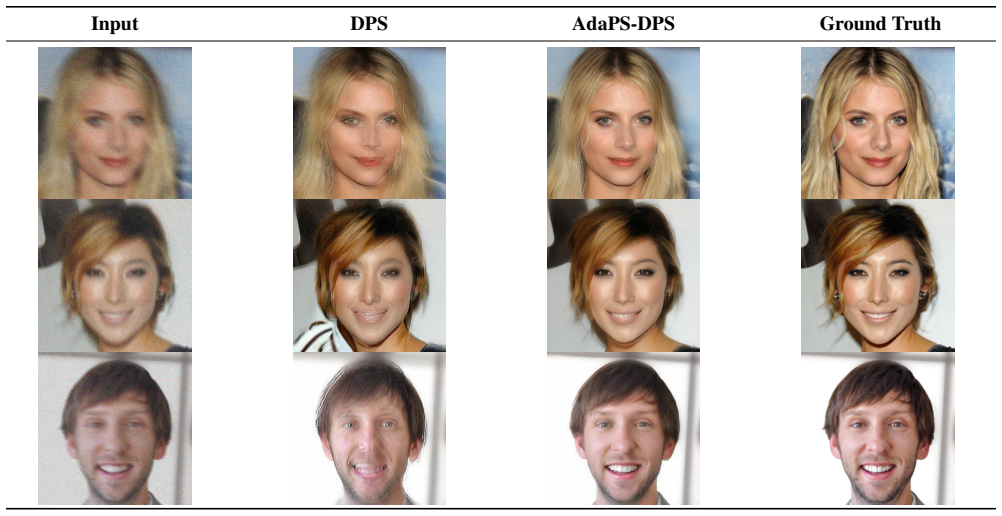
with measurement noiseσ y = 0.05. We test on 100 CelebA-HQ images and compare our AdaPS-based sampler (AdaPS-DPS) to DPS. Results are reported in Fig. 6 and Table 3. Despite using only 100 sampling steps (vs. 1000 for DPS), AdaPS-DPS significantly improves both PSNR and LPIPS. In this experiment, we excludeΠGDM, as its non-linear extension is non-trivial ...
-
[47]
To verify correctness, we cross-validated our reimplementation against results reported in [28] on overlapping setups
use a Variance–Exploding (VE) formulation. To verify correctness, we cross-validated our reimplementation against results reported in [28] on overlapping setups. In particular, both implementations yield an LPIPS of0.122on clean bicubic SR×4, confirming consistency. Notice that when using any likelihood surrogate forg t, it is normalized, removing any tim...
This paper was first reviewed by deepseek-v4-flash on August 3, 2026.
discussion (0)
Sign in with ORCID, Apple, or X to comment. Anyone can read and Pith papers without signing in.