REVIEW 4 major objections 5 minor 27 references
A feedforward dual-branch generator, trained on cross-pose garment videos and topology-edited images, transfers textures across non-isometric image–mesh pairs and bakes them into production-ready PBR maps, reporting the best KID and FID amo
Reviewed by Pith at T0; open to challenge. T0 means a machine referee read the full paper against a public rubric. the ladder, T0–T4 →
2026-08-03 20:39 UTC pith:5LLHIN64
load-bearing objection A genuinely new data recipe for garment texture transfer across pose/topology mismatch; the central claim mostly holds up, but the cross-topology mechanism leans on an unvalidated black-box editor and the quantitative case is thin. the 4 major comments →
NI-Tex: Non-isometric Image-based Garment Texture Generation
The pith
A machine-rendered reading of the paper's core claim, the machinery that carries it, and where it could break.
Core claim
The central claim is that non-isometric image-based garment texture generation can be solved by constructing the right training data rather than by aligning geometry. NI-Tex learns invariance from two sources: pairs of frames of the same garment under different human poses, drawn from physically simulated 3D Garment Videos built on BEDLAM, and images whose garment topology has been synthetically altered by an editing model while the texture identity is kept. The trained dual-branch U-Net takes the input image as a guidance branch and multi-view normal and position maps as geometric conditions, outputting albedo, roughness, and metallic maps. A separate uncertainty-quantification network, tra
What carries the argument
The load-bearing mechanism is the training-pair construction: cross-frame sampling from physically simulated garment videos supplies pose and deformation invariance with consistent albedo ground truth, while cross-topology augmentation via image editing supplies topology invariance. The network is a dual-branch U-Net with Multi-Channel Aligned Attention (MCAA), an attention module that injects reference texture features into the albedo channel and lets the metallic-roughness channel share the same alignment. A switchable MR channel lets the model train on albedo alone when edited images have inconsistent reflections. The iterative baking loop uses a per-pixel uncertainty predictor—trained by
Load-bearing premise
The whole non-isometric capability rests on the assumption that the commercial image editor used for augmentation can change a garment's shape while faithfully preserving its texture identity—and the paper's own editing principles concede that the editor sometimes produces texture swaps, layering confusion, or extraneous body parts.
What would settle it
Collect a test set where the image prompt and target mesh share no topology and the texture is a precisely repeated logo, run NI-Tex, and inspect whether the logo bends, duplicates, or drifts at seams; if the model consistently redraws the logo instead of transferring it, the cross-topology gain would disappear in an ablation that removes the edited training images.
If this is right
- Industrial garment meshes with limited texture variety can be re-textured from arbitrary input photos without mesh deformation or topology matching.
- Cross-pose texture consistency is learnable from simulated garment video sequences even when roughness and metallic values are assigned as globally uniform random values.
- Uncertainty-guided iterative baking produces more complete texture maps than coverage-based view selection, reducing holes and blurriness from multi-view fusion.
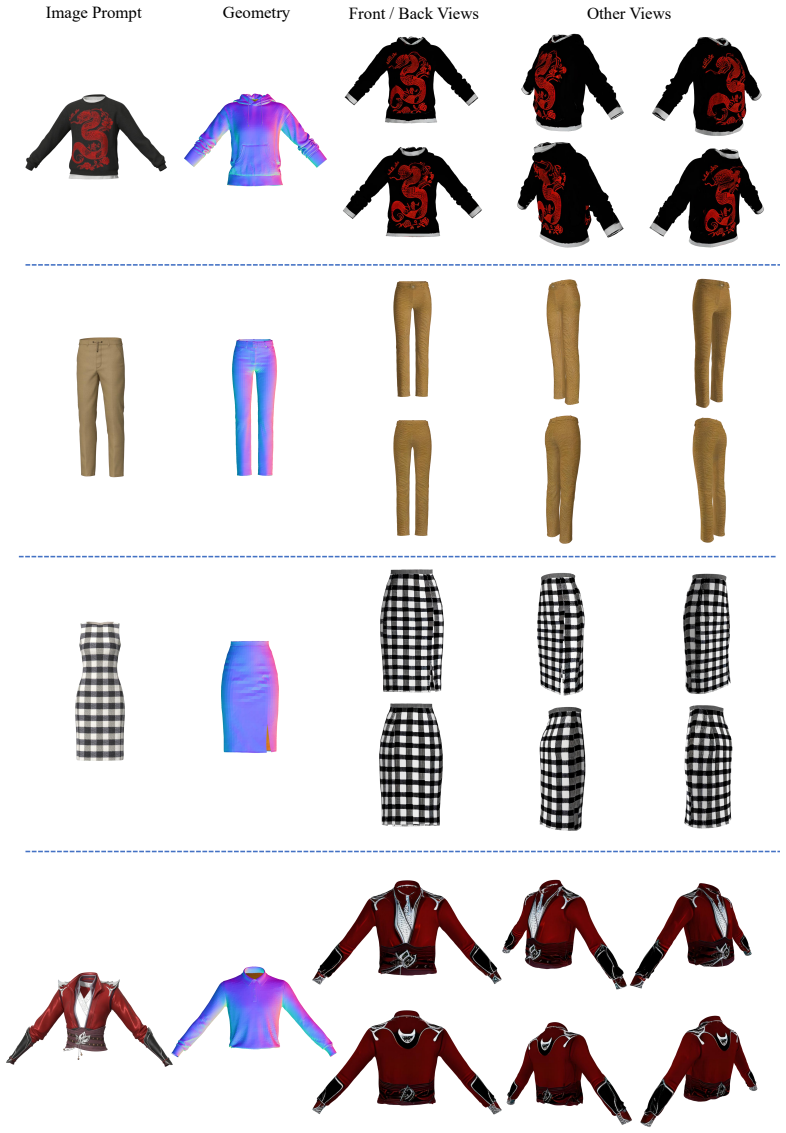
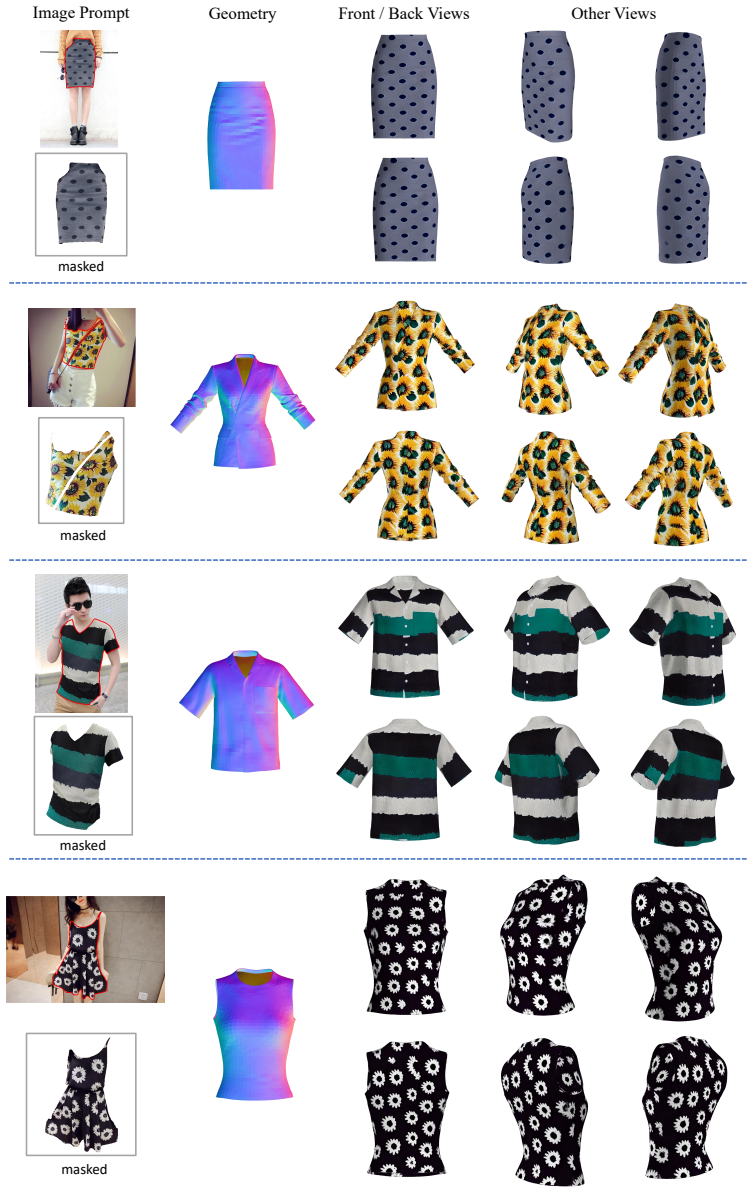
- The approach works on wild images, such as masked DeepFashion2 photos, and on meshes generated by text-to-3D models, not only on clean rendered views.
- The switchable albedo-only training mode avoids distilling unreliable metallic and roughness attributes from edited images that lack consistent surface reflections.
Where Pith is reading between the lines
- The reliance on a commercial image editor means the cross-topology capability is bounded by that editor's texture-preservation quality; outside the curated examples, the model may learn to redraw textures rather than transfer them.
- The same recipe—paired frames plus shape-preserving image edits—could be transferred to other object categories, such as shoes or bags, where small topology changes matter and paired video data or simulation is available.
- Because roughness and metallic values in the garment videos are globally uniform and randomly assigned, the model's MR generalization is likely weaker than its albedo generalization; the cross-mixing with Objaverse and TexVerse data is only a partial remedy.
- The contribution of each pipeline stage could be isolated by ablating cross-pose video pairs and cross-topology edits separately, quantifying how much of the KID/FID gain comes from each.
Editorial analysis
A structured set of objections, weighed in public.
Referee Report
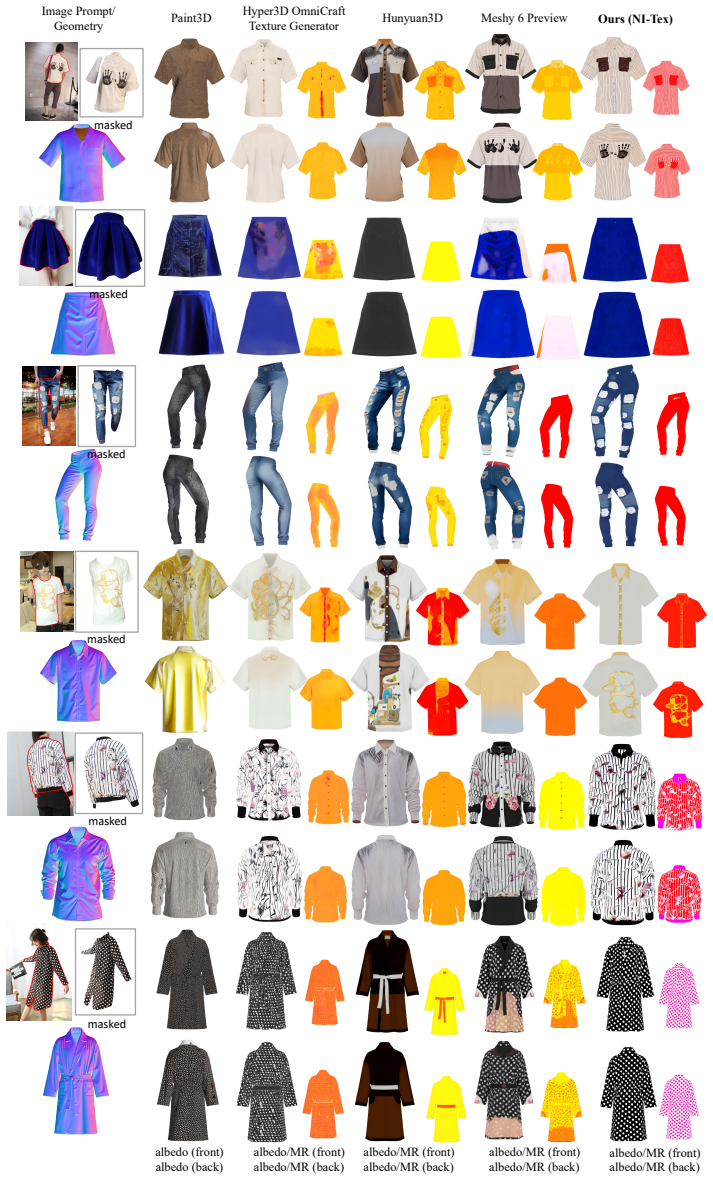
Summary. The paper proposes NI-Tex, a feedforward dual-branch method for image-conditioned PBR texture generation on garment meshes under non-isometric image–mesh pairs. It builds a physically simulated '3D Garment Videos' dataset from BEDLAM for cross-pose supervision, uses Nano Banana-edited images for cross-topology augmentation, and introduces an uncertainty-aware iterative baking procedure with view selection and reweighting. Experiments compare against Paint3D, Hyper3D, Hunyuan3D, and Meshy, reporting the best KID and FID in Table 1 and showing qualitative improvements on industrial and generated meshes.
Significance. If the claims hold, the paper addresses a real gap: existing image-to-texture pipelines degrade under pose or topology mismatch, and NI-Tex is a plausible feedforward solution. The physically simulated garment-video data with consistent albedo across frames is a reasonable external grounding for cross-pose learning, and the uncertainty-guided iterative baking is an interesting contribution that goes beyond simple coverage-based view selection. The paper is reproducible-sounding in architecture and data, and the authors state code and dataset release plans. However, the central non-isometric claim currently rests on a black-box image editor with no quantitative validation, and the headline quantitative evidence is a small-scale table without error bars.
major comments (4)
- [Section 4.1 (Cross-topology Augmentation)] The entire cross-topology capability is built on the assumption that Nano Banana can change garment topology while preserving texture identity. This is load-bearing: no other component in the pipeline addresses topology mismatch, and the paper provides no citation, no validation, no failure-rate statistics, and no filtering criterion for the 50K edited images. The paper's own design principles admit that the editor can cause texture swaps, inner/outer confusion, and extraneous body parts. If the editor's texture preservation is inconsistent outside curated examples, the training signal becomes 'redraw the texture from a corrupted image' rather than 'transfer the texture,' and the claimed non-isometric robustness is editor-dependent. I ask for a quantitative evaluation of editor fidelity (e.g., LPIPS/CLIP similarity between input and edited garment regions on a held-out set), a failure-ra
- [Section 5.3, Table 1] The quantitative claim 'significantly outperforms existing baselines' is not supported by Table 1 as reported. Only 10 image prompts/objects are used, with no standard deviations, confidence intervals, or significance tests. The KID margin over Meshy is 0.0364 vs 0.0383, which is small relative to typical KID variability. Moreover, it is unclear whether the 10 test cases specifically isolate non-isometric image–mesh pairs; a mixed set of 10 objects does not enable a claim about cross-topology robustness. I ask for error bars across multiple evaluation runs, a breakdown by topology-mismatch severity, and a larger test set (or a user study) to substantiate the central claim.
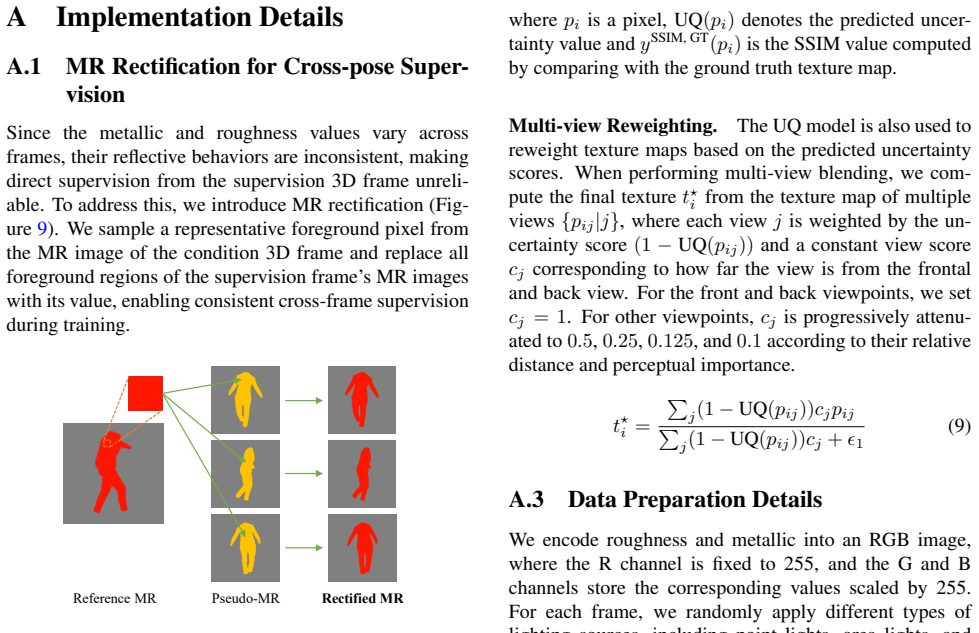
- [Section 4.1, Eq. (3), Appendix A.1 (MR Rectification)] The MR supervision is assigned as random per-frame uniform roughness with metallic=0, and then rectified by sampling a single foreground pixel from the condition frame. This is not ground-truth material information; it is an ad hoc proxy. The paper itself notes that the model tends to overfit these constant MR values and must be supplemented with Objaverse/TexVerse data. Given the paper's claim of generating production-ready PBR materials, the roughness/metallic quality needs evidence beyond qualitative images. Please provide an ablation or quantitative analysis showing that the learned MR maps are not simply predicting the uniform prior or a constant value.
- [Section 5.2, Figure 10 / Appendix B.4] The baking-strategy evaluation is limited. The quantitative comparison reports PSNR on a single 'worst viewpoint' per example, and the greedy metrics i_UQ and i_cvg in Eq. (7) score candidate views, not the final baked texture. There is no sensitivity analysis for c_j in Eq. (9), and the stopping thresholds epsilon and N_view are deferred to an appendix that is not provided in the main text. Since the iterative baking is one of the three main contributions, its benefit should be evaluated on the whole mesh, not only on one selected test view, and with multiple seeds to account for greedy selection randomness.
minor comments (5)
- [General] Nano Banana is used throughout as a black-box external tool but is never cited or described technically. At minimum, a reference or version/API identifier is needed for reproducibility.
- [Section 4.2] The sentence 'we train an Uncertainty Quantification (UQ) model' and the surrounding text contain typographical and grammatical issues (e.g., 'our train an'), which should be corrected. The description of the latent-code optimization in Eq. (4) also lacks details on initialization, optimizer, and stopping criterion.
- [Section 5.1] The training setup is described as 8 H200 GPUs for 10 days with batch size 2, but no learning rate, noise schedule, or fine-tuning details are given. These details are needed for reproducibility beyond a high-level description.
- [Section 4.1] The claim that cross-frame pairs expand to 'tens of billions of training samples' is combinatorial and not tied to the actual training budget. Please clarify how these pairs are sampled or whether this is simply an upper bound.
- [Section 5.3] The description 'using a fixed set of 42 random seeds' is ambiguous. It is not clear whether the 42 seeds are used for inference, for KID estimation, or for bootstrapping confidence intervals. Please clarify.
Circularity Check
No significant circularity: the training signals and evaluations are externally grounded.
full rationale
The paper's derivation chain is not circular. (1) Cross-pose training samples condition and supervision frames from BEDLAM sequences with a shared albedo texture and external PBR supervision; no predicted quantity is reinserted as its own training target. (2) Cross-topology augmentation uses Nano Banana to edit condition images while supervision remains the original PBR maps — an external (though uncited and unvalidated) source of topology variation; the trained model is later evaluated on independent DeepFashion2 prompts and industrial/Hunyuan meshes, so the claimed robustness does not reduce to the augmentation itself. (3) The UQ model is the closest self-referential component: its training errors are simulated with the same texture generator it later reweights. But the supervision for UQ is per-pixel SSIM against ground-truth maps, an external target, and the baking comparison is evaluated with PSNR on selected test views, not with UQ's own outputs. Thus this is self-training/calibration, not a definitional or fitted-input circle. (4) The cited references are external (BEDLAM, Objaverse, TexVerse, Hunyuan3D, MaterialMVP, etc.); no load-bearing result is justified only by a self-citation. The unvalidated Nano Banana fidelity assumption is a robustness/validity risk, not circularity.
Axiom & Free-Parameter Ledger
free parameters (6)
- per-frame roughness value =
U(0,1) random draw per frame (Eq. 3)
- metallic value =
0 for all garments (Eq. 3)
- MR rectification reference value =
single foreground pixel sampled from condition frame MR (App. A.1)
- loss balancing factor alpha =
2 (Eq. 6)
- view weighting scores c_j =
1, 0.5, 0.25, 0.125, 0.1 (Eq. 9)
- iterative baking stop threshold epsilon and max views N_view =
not specified
axioms (5)
- domain assumption BEDLAM's physically simulated garment deformations cover the pose/geometry distribution needed for garment texture transfer.
- domain assumption Nano Banana edits preserve texture identity while altering garment topology.
- ad hoc to paper A uniform scalar per garment is an adequate roughness/metallic supervision signal.
- domain assumption Per-pixel SSIM between generated and ground-truth texture maps is a valid per-pixel uncertainty label.
- standard math Stable Diffusion 2.1 denoising objective and Hunyuan3D/MaterialMVP MCAA cross-attention architecture transfer to the garment texture domain.
Cite this review
Pith. "Pith review of NI-Tex: Non-isometric Image-based Garment Texture Generation." pith.science (2026). https://pith.science/paper/5LLHIN64
@misc{pith2026251118765,
  author       = {Pith},
  title        = {Pith review of: NI-Tex: Non-isometric Image-based Garment Texture Generation},
  year         = {2026},
  howpublished = {\url{https://pith.science/paper/5LLHIN64}},
  note         = {Machine review of arXiv:2511.18765}
}
read the original abstract
Existing industrial 3D garment meshes already cover most real-world clothing geometries, yet their texture diversity remains limited. To acquire more realistic textures, generative methods are often used to extract Physically-based Rendering (PBR) textures and materials from large collections of wild images and project them back onto garment meshes. However, most image-conditioned texture generation approaches require strict topological consistency between the input image and the input 3D mesh, or rely on accurate mesh deformation to match to the image poses, which significantly constrains the texture generation quality and flexibility. To address the challenging problem of non-isometric image-based garment texture generation, we construct 3D Garment Videos, a physically simulated, garment-centric dataset that provides consistent geometry and material supervision across diverse deformations, enabling robust cross-pose texture learning. We further employ Nano Banana for high-quality non-isometric image editing, achieving reliable cross-topology texture generation between non-isometric image-geometry pairs. Finally, we propose an iterative baking method via uncertainty-guided view selection and reweighting that fuses multi-view predictions into seamless, production-ready PBR textures. Through extensive experiments, we demonstrate that our feedforward dual-branch architecture generates versatile and spatially aligned PBR materials suitable for industry-level 3D garment design.
Figures





Reference graph
Works this paper leans on
-
[1]
Objaverse: A universe of annotated 3d objects
Matt Deitke, Dustin Schwenk, Jordi Salvador, Luca Weihs, Oscar Michel, Eli VanderBilt, Ludwig Schmidt, Kiana Ehsani, Aniruddha Kembhavi, and Ali Farhadi. Objaverse: A universe of annotated 3d objects. InProceedings of the IEEE/CVF conference on computer vision and pattern recognition, pages 13142–13153, 2023
2023
-
[2]
Yibo Zhang, Li Zhang, Rui Ma, and Nan Cao. Texverse: A universe of 3d objects with high-resolution textures.arXiv preprint arXiv:2508.10868, 2025
Pith/arXiv arXiv 2025
-
[3]
Hunyuan3d 2.1: From images to high-fidelity 3d assets with production-ready pbr material
Team Hunyuan3D, Shuhui Yang, Mingxin Yang, Yifei Feng, Xin Huang, Sheng Zhang, Zebin He, Di Luo, Haolin Liu, Yunfei Zhao, et al. Hunyuan3d 2.1: From images to high-fidelity 3d assets with production-ready pbr material. arXiv preprint arXiv:2506.15442, 2025
Pith/arXiv arXiv 2025
-
[4]
Bedlam: A synthetic dataset of bodies exhibit- ing detailed lifelike animated motion
Michael J Black, Priyanka Patel, Joachim Tesch, and Jin- long Yang. Bedlam: A synthetic dataset of bodies exhibit- ing detailed lifelike animated motion. InProceedings of the IEEE/CVF Conference on Computer Vision and Pattern Recognition, pages 8726–8737, 2023
2023
-
[5]
Texture: Text-guided texturing of 3d shapes
Elad Richardson, Gal Metzer, Yuval Alaluf, Raja Giryes, and Daniel Cohen-Or. Texture: Text-guided texturing of 3d shapes. InACM SIGGRAPH 2023 conference proceedings, pages 1–11, 2023
2023
-
[6]
Text2tex: Text- driven texture synthesis via diffusion models
Dave Zhenyu Chen, Yawar Siddiqui, Hsin-Ying Lee, Sergey Tulyakov, and Matthias Nießner. Text2tex: Text- driven texture synthesis via diffusion models. InProceed- ings of the IEEE/CVF international conference on com- puter vision, pages 18558–18568, 2023
2023
-
[7]
Easi-tex: edge-aware mesh texturing from single-image
Sai Raj Kishore Perla. Easi-tex: edge-aware mesh texturing from single-image. 2024
2024
-
[8]
Paint3d: Paint anything 3d with lighting-less texture diffu- sion models
Xianfang Zeng, Xin Chen, Zhongqi Qi, Wen Liu, Zibo Zhao, Zhibin Wang, Bin Fu, Yong Liu, and Gang Yu. Paint3d: Paint anything 3d with lighting-less texture diffu- sion models. InProceedings of the IEEE/CVF conference on computer vision and pattern recognition, pages 4252– 4262, 2024
2024
-
[9]
Fan- tasia3d: Disentangling geometry and appearance for high- quality text-to-3d content creation
Rui Chen, Yongwei Chen, Ningxin Jiao, and Kui Jia. Fan- tasia3d: Disentangling geometry and appearance for high- quality text-to-3d content creation. InProceedings of the IEEE/CVF international conference on computer vision, pages 22246–22256, 2023
2023
-
[10]
Xudong Xu, Zhaoyang Lyu, Xingang Pan, and Bo Dai. Matlaber: Material-aware text-to-3d via latent brdf auto- encoder.arXiv preprint arXiv:2308.09278, 2023
Pith/arXiv arXiv 2023
-
[11]
Paint-it: Text-to-texture synthesis via deep convolutional texture map optimization and physically-based rendering
Kim Youwang, Tae-Hyun Oh, and Gerard Pons-Moll. Paint-it: Text-to-texture synthesis via deep convolutional texture map optimization and physically-based rendering. InProceedings of the ieee/cvf conference on computer vi- sion and pattern recognition, pages 4347–4356, 2024
2024
-
[12]
Flashtex: Fast relightable mesh texturing with lightcontrolnet
Kangle Deng, Timothy Omernick, Alexander Weiss, Deva Ramanan, Jun-Yan Zhu, Tinghui Zhou, and Maneesh Agrawala. Flashtex: Fast relightable mesh texturing with lightcontrolnet. InEuropean conference on computer vi- sion, pages 90–107. Springer, 2024
2024
-
[13]
Dreammat: High-quality pbr material generation with geometry-and light-aware diffu- sion models.ACM Transactions on Graphics (TOG), 43(4):1–18, 2024
Yuqing Zhang, Yuan Liu, Zhiyu Xie, Lei Yang, Zhongyuan Liu, Mengzhou Yang, Runze Zhang, Qilong Kou, Cheng Lin, Wenping Wang, et al. Dreammat: High-quality pbr material generation with geometry-and light-aware diffu- sion models.ACM Transactions on Graphics (TOG), 43(4):1–18, 2024
2024
-
[14]
Objaverse-xl: A universe of 10m+ 3d objects.Advances in Neural Information Processing Systems, 36:35799–35813, 2023
Matt Deitke, Ruoshi Liu, Matthew Wallingford, Huong Ngo, Oscar Michel, Aditya Kusupati, Alan Fan, Chris- tian Laforte, Vikram V oleti, Samir Yitzhak Gadre, et al. Objaverse-xl: A universe of 10m+ 3d objects.Advances in Neural Information Processing Systems, 36:35799–35813, 2023
2023
-
[15]
Ma- terial anything: Generating materials for any 3d object via diffusion
Xin Huang, Tengfei Wang, Ziwei Liu, and Qing Wang. Ma- terial anything: Generating materials for any 3d object via diffusion. InProceedings of the Computer Vision and Pat- tern Recognition Conference, pages 26556–26565, 2025
2025
-
[16]
Riza Velioglu, Petra Bevandic, Robin Chan, and Barbara Hammer. Tryoffdiff: Virtual-try-off via high-fidelity gar- ment reconstruction using diffusion models.arXiv preprint arXiv:2411.18350, 2024
Pith/arXiv arXiv 2024
-
[17]
Jinxi Liu, Zijian He, Guangrun Wang, Guanbin Li, and Liang Lin. One model for all: Partial diffusion for unified try-on and try-off in any pose.arXiv preprint arXiv:2508.04559, 2025
Pith/arXiv arXiv 2025
-
[18]
Seungyong Lee and Jeong-gi Kwak. V oost: A unified and scalable diffusion transformer for bidirectional virtual try- on and try-off.arXiv preprint arXiv:2508.04825, 2025
arXiv 2025
-
[19]
Learning to transfer texture from clothing images to 3d humans
Aymen Mir, Thiemo Alldieck, and Gerard Pons-Moll. Learning to transfer texture from clothing images to 3d humans. InProceedings of the IEEE/CVF conference on computer vision and pattern recognition, pages 7023–7034, 2020
2020
-
[20]
Cloth2tex: A customized cloth texture generation pipeline for 3d vir- tual try-on
Daiheng Gao, Xu Chen, Xindi Zhang, Qi Wang, Ke Sun, Bang Zhang, Liefeng Bo, and Qixing Huang. Cloth2tex: A customized cloth texture generation pipeline for 3d vir- tual try-on. In2024 international conference on 3D vision (3DV), pages 602–611. IEEE, 2024
2024
-
[21]
Garment3dgen: 3d gar- ment stylization and texture generation
Nikolaos Sarafianos, Tuur Stuyck, Xiaoyu Xiang, Yilei Li, Jovan Popovic, and Rakesh Ranjan. Garment3dgen: 3d gar- ment stylization and texture generation. In2025 Interna- tional Conference on 3D Vision (3DV), pages 1382–1393. IEEE, 2025
2025
-
[22]
Materialmvp: Illumination- invariant material generation via multi-view pbr diffusion
Zebin He, Mingxin Yang, Shuhui Yang, Yixuan Tang, Tao Wang, Kaihao Zhang, Guanying Chen, Yuhong Liu, Jie Jiang, Chunchao Guo, et al. Materialmvp: Illumination- invariant material generation via multi-view pbr diffusion. arXiv preprint arXiv:2503.10289, 2025
Pith/arXiv arXiv 2025
-
[23]
Zirui Wang, Yash Bhalgat, Ruining Li, and Victor Adrian Prisacariu. Active view selector: Fast and accurate active view selection with cross reference image quality assess- ment.arXiv preprint arXiv:2506.19844, 2025
Pith/arXiv arXiv 2025
-
[24]
Deep residual learning for image recognition
Kaiming He, Xiangyu Zhang, Shaoqing Ren, and Jian Sun. Deep residual learning for image recognition. InProceed- ings of the IEEE conference on computer vision and pattern recognition, pages 770–778, 2016
2016
-
[25]
Deepfashion2: A versatile bench- mark for detection, pose estimation, segmentation and re-identification of clothing images
Yuying Ge, Ruimao Zhang, Xiaogang Wang, Xiaoou Tang, and Ping Luo. Deepfashion2: A versatile bench- mark for detection, pose estimation, segmentation and re-identification of clothing images. InProceedings of the IEEE/CVF conference on computer vision and pattern recognition, pages 5337–5345, 2019. 9
2019
-
[26]
Sam 2: Segment anything in images and videos.arXiv preprint arXiv:2408.00714, 2024
Nikhila Ravi, Valentin Gabeur, Yuan-Ting Hu, Ronghang Hu, Chaitanya Ryali, Tengyu Ma, Haitham Khedr, Roman R¨adle, Chloe Rolland, Laura Gustafson, et al. Sam 2: Segment anything in images and videos.arXiv preprint arXiv:2408.00714, 2024
Pith/arXiv arXiv 2024
-
[27]
4d-dress: A 4d dataset of real-world human clothing with semantic annotations
Wenbo Wang, Hsuan-I Ho, Chen Guo, Boxiang Rong, Artur Grigorev, Jie Song, Juan Jose Zarate, and Otmar Hilliges. 4d-dress: A 4d dataset of real-world human clothing with semantic annotations. InProceedings of the IEEE/CVF Conference on Computer Vision and Pattern Recognition, pages 550–560, 2024. 10 A Implementation Details A.1 MR Rectification for Cross-p...
2024
This paper was first reviewed by deepseek-v4-flash on August 3, 2026.
discussion (0)
Sign in with ORCID, Apple, or X to comment. Anyone can read and Pith papers without signing in.