REVIEW 2 major objections 6 minor 58 references
This paper claims that the overlapping Schwarz alternating method can couple subdomain-local data-driven reduced-order models, built by operator inference, with each other and with full-order finite element models, achieving accurate soluti
Reviewed by Pith at T0; open to challenge. T0 means a machine referee read the full paper against a public rubric. the ladder, T0–T4 →
T0 review · deepseek-v4-flash
2026-08-03 21:03 UTC pith:RMKRNUVE
load-bearing objection Solid, honest engineering demonstration of Schwarz-coupled OpInf ROMs in 3D solid dynamics, but the headline accuracy and speedup claims rest on a non-converged FOM-FOM reference. the 2 major comments →
Hybrid coupling with operator inference and the overlapping Schwarz alternating method
The pith
A machine-rendered reading of the paper's core claim, the machinery that carries it, and where it could break.
Core claim
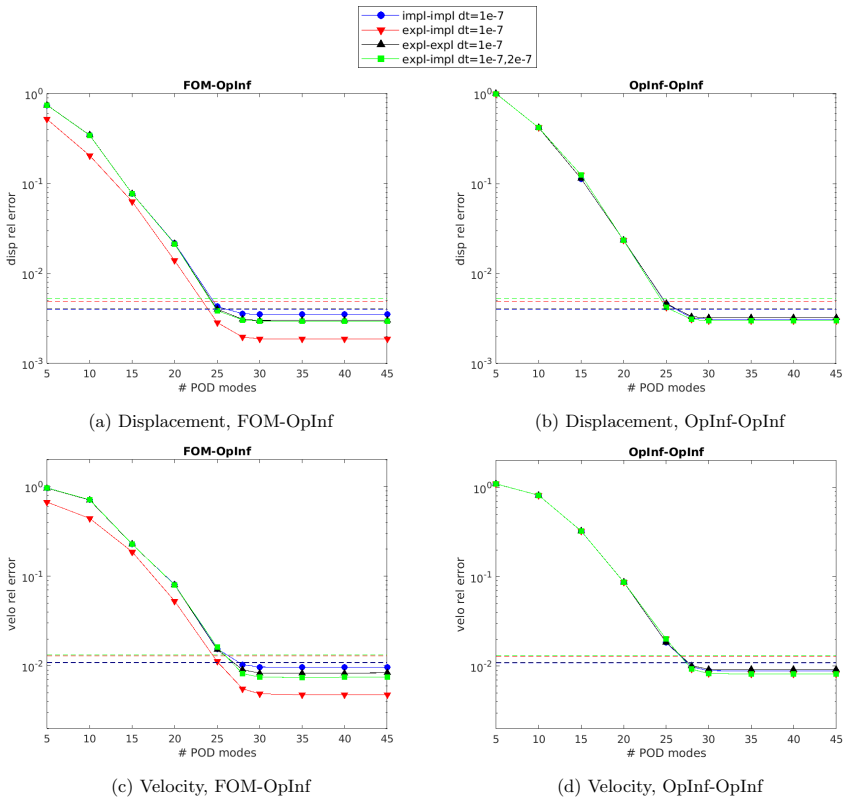
The paper's central claim is that converged O-SAM iterations with subdomain-local OpInf ROMs — linear, quadratic, or cubic — reproduce the accuracy of FOM-FOM Schwarz solutions while costing far less online CPU time. The claim is supported by four test problems: a 1D elastic wave with mixed time integrators, a 3D bolted joint with cubic Saint Venant–Kirchhoff nonlinearities, a 3D torsion bar with generic hyperelastic nonlinearities modeled by quadratic OpInf, and a 3D tension specimen where quadratic OpInf models coupled to each other are reported to match the FOM-FOM reference to roughly 0.01–5% error while running up to about 106× faster. A key reported observation is that the hybrid coupl
What carries the argument
The central mechanism is the overlapping Schwarz alternating method (O-SAM) itself, which exchanges Dirichlet boundary data between subdomain solves and iterates until displacement/velocity convergence; the paper's novel twist is to let some (or all) subdomain solvers be OpInf ROMs. OpInf (operator inference) learns reduced linear/quadratic/cubic operators from snapshots of a FOM-FOM Schwarz simulation, using a least-squares fit with regularization. Two enabling components are introduced: boundary POD bases (Φ∂S, Φ∂φ) that compress the boundary forcing term so the learned boundary operator does not scale with interface DoF count, and a subdomain-local regularization sweep that chooses λ by a
Load-bearing premise
The accuracy and speedup numbers rest on treating the FOM-FOM Schwarz solution as the ground truth, but in the headline tension-specimen case that reference never reached the Schwarz convergence tolerances within the 32-iteration cap, so reported errors are relative to an unconverged baseline.
What would settle it
Re-run the tension-specimen case allowing the FOM-FOM O-SAM to iterate until the stated tolerances are met (or obtain a monolithic reference with a compatible mesh) and count the offline training cost; if the converged reference differs from the 32-iteration reference by more than the claimed hybrid-model errors, or if the end-to-end time including training exceeds the FOM-FOM time for a single query, the reported accuracy and 106× speedup are not validated.
If this is right
- Multi-query analyses (design, uncertainty quantification) on complex geometries can replace one subdomain's high-fidelity solver with a learned surrogate, cutting online solve time while preserving Schwarz-level accuracy.
- Different meshes, element types, and time integrators within one simulation become routine: ROM subdomains can use implicit time stepping with coarse meshes while FOM subdomains run explicit, as demonstrated in the torsion and wave cases.
- Because hybrid couplings converge in fewer Schwarz iterations than FOM-FOM, the speedup is not solely from reduced DoFs but also from faster coupling convergence, making ROM placement in 'simpler' subdomains an attractive accuracy-preserving acceleration strategy.
- Higher-order polynomial OpInf (quadratic and cubic) is sufficient to reproduce the global response of fully non-polynomial hyperelastic models once localized via Schwarz, suggesting the polynomial structural assumption is not an obstacle in the tested regime.
- A single Schwarz iteration per time step (an additive-Schwarz-like shortcut) can converge to the wrong solution in nonlinear problems; iterating to the tolerance is necessary — a direct caution for cheaper Schwarz variants.
Where Pith is reading between the lines
- The 106× speedup is an online-only figure; it excludes the offline FOM-FOM training runs and OpInf operator learning. In a one-off analysis the method would be slower end-to-end, so the practical benefit is in multi-query settings where training costs amortize.
- In the tension-specimen benchmark the FOM-FOM reference run consumed all 32 allowed Schwarz iterations without meeting the tolerance (mean/max 32.0/32), so the reported errors and speedup are measured against a reference that may not be fully converged; an independently converged reference could change those numbers.
- The observation that ROM-involved couplings converge in fewer Schwarz iterations suggests a testable extension: using an intentionally coarsened or smoothed model in selected subdomains may accelerate Schwarz convergence even without formal ROM accuracy, as long as the final iterate is checked against tolerances.
- Because the coupling is formulated at the algebraic level and the paper frames O-SAM as PDE-agnostic, the same recipe should transfer to other nonlinear PDEs (e.g., thermo-mechanics or plasticity) provided the polynomial OpInf form is replaced or augmented appropriately.
Editorial analysis
A structured set of objections, weighed in public.
Referee Report
Summary. The paper proposes a hybrid coupling method for subdomain-local non-intrusive Operator Inference (OpInf) reduced order models (ROMs) and full order models (FOMs) using the overlapping Schwarz alternating method (O-SAM). The offline stage builds subdomain-local POD bases and infers cubic (or lower-order) polynomial ROM operators, including a new boundary-POD compression and a regularization-parameter selection procedure. The online stage couples these ROMs with each other or with FOMs using O-SAM, allowing disparate meshes, element types, and time integrators. Numerical experiments on 1D wave propagation, a 3D bolted joint, a 3D torsion specimen, and a 3D tension specimen demonstrate, in most cases, good accuracy relative to FOM-FOM O-SAM references and substantial online speedups, with the largest reported speedup being 106x in the tension specimen. The paper emphasizes a 'top-down' training strategy and evaluates both reproductive and predictive scenarios.
Significance. If the central claims hold, the paper provides a practical, plug-and-play framework for coupling non-intrusive ROMs with FOMs in nonlinear solid dynamics, addressing a long-standing barrier in multiscale simulation. The methodology is well-motivated and the exposition is generally clear. Notable strengths include: (i) a reproducible implementation with commit-hashed code and input decks; (ii) predictive test cases that use parameter/initial-condition combinations not in the training set; (iii) a demonstration that quadratic/cubic polynomial ROMs can serve as local surrogates even for non-polynomial hyperelastic models; and (iv) a thorough comparison with related work. The main caveat is that the flagship tension-specimen accuracy and speedup claims rest on a FOM-FOM reference that did not meet the stated Schwarz convergence tolerances, which undermines the headline numbers.
major comments (2)
- [Section 5.4, Tables 7-8] The FOM-FOM reference run in the tension specimen hits the 32-iteration cap with mean/max Schwarz iterations of 32.0/32, i.e., it does not satisfy the stated tolerances (δrel=1e-8, δabs=1e-6). Since the reported hybrid errors are computed via Eq. (28) relative to this FOM-FOM solution, the O(1e-4)-O(1e-3) errors and the 106x speedup are not validated against a converged coupled solution. Please either provide a converged FOM-FOM reference (or a monolithic reference), or explicitly characterize the errors as being relative to an unconverged iterate and perform a sensitivity study with respect to the Schwarz iteration cap.
- [Section 5 (above §5.1) and §5.4, Tables 7-8] The reported speedups are online-only. The 106x figure compares online CPU times (4m 42.1s vs. 8h 19m 29.5s) and excludes the offline FOM-FOM runs required for 'top-down' training as well as the OpInf operator-inference time. For a single query, the end-to-end speedup is therefore not established. Please state this limitation explicitly and, if appropriate, provide an amortized cost analysis for multi-query scenarios.
minor comments (6)
- [Section 2 (text near Eq. (8))] Typo: 'denots' should be 'denotes'.
- [Eq. (22)] The notation for the convergence check is hard to parse; consider simplifying the subscript/superscript structure or adding a short explanation after the equation.
- [Table 7, QOpInf-QOpInf 1-iter row] CPU time is listed as '1m 43.5' without a unit; add 's' for consistency.
- [§5.3-5.4] It would help the reader if the text explicitly states that QOpInf is chosen as a quadratic surrogate for the non-polynomial Neohookean model, rather than leaving the reader to infer this from the model assignment.
- [§5.1.3] Scenario 3 is predictive in initial condition but not in material parameters; the distinction between state-predictive and parameter-predictive should be stated more clearly to avoid overstating the predictive scope.
- [§1.2] The claim of being 'first' to apply SAM-based OpInf coupling to realistic 3D nonlinear solid dynamics could be softened given the closely related works [16] and [19]; consider phrasing as 'among the first'.
Circularity Check
No significant circularity: the headline predictive evaluations use out-of-sample parameters/initial conditions, and the reference solutions are independent FOM-FOM O-SAM runs (plus an exact solution in 1D).
full rationale
The paper's derivation chain is not circular. OpInf operators are learned by solving the regularized least-squares problem (25) from FOM-FOM O-SAM training snapshots, and the online O-SAM couplings (Section 4.2.2 and 4.2.3) then integrate these learned operators with Schwarz boundary transfer. The key predictive claims use parameter/initial-condition combinations that are not present in the training set: Scenario 3 in Section 5.1 trains on the Rounded Square initial condition and predicts the Symmetric Gaussian; the bolted joint predictive case trains on (a1,a2,a3) = (2,0,0), (0,0,2), (2,2,0) and predicts (2,0,2); the torsion predictive case trains on b1,b2 in {500,1000,5000,8000} and predicts 5500; and the tension predictive case trains on alpha in {0.003,0.006} and predicts alpha = 0.005. Thus the reported predictive errors are not restatements of the training data. The self-citations to [36,37,47,35,34] are background/prior-work support for FOM-FOM O-SAM convergence and earlier coupling frameworks; they are not load-bearing for the new hybrid method's accuracy, which is assessed against FOM-FOM O-SAM references and, in the 1D case, against the exact analytical solution (31). The paper does have validation limitations - the FOM-FOM tension-specimen reference hits the 32-iteration cap (Tables 7-8) and no monolithic reference is computed - but these are ground-truth/correctness concerns, not circularity. No step in the derivation reduces by construction to its own inputs.
Axiom & Free-Parameter Ledger
free parameters (3)
- Subdomain-local OpInf regularization parameters lambda_i =
10^-11 to 10^-4 depending on test/subdomain (Tables 3-8)
- POD basis dimensions (interior and boundary) =
e.g., r=2-56; boundary bases 1-24
- Schwarz tolerances and controller time-step =
delta_abs=1e-8..1e-4, delta_rel=1e-12..1e-6; controller step per problem (e.g., 1e-7 s in 1D, 2e-6 s in torsion)
axioms (6)
- domain assumption O-SAM converges for nonlinear FOM-FOM solid-dynamics problems (cited [36,37]); the same convergence behavior is assumed to transfer to FOM-OpInf and OpInf-OpInf couplings.
- ad hoc to paper A polynomial (cubic) ROM structure (11)/(17) adequately represents the dynamics even when the underlying material is non-polynomial (Neohookean, Sections 5.3-5.4).
- ad hoc to paper The terms h(H,C,chi_h) and M_uc chi_doubledot_h can be neglected in going from (10) to (11).
- domain assumption Top-down training is possible: a FOM-FOM O-SAM solution for the full physical domain can be obtained and its snapshots are adequate for subdomain ROM training.
- ad hoc to paper FOM-FOM O-SAM can serve as a reference solution even when it fails to meet the Schwarz tolerance within the allowed iterations (tension specimen).
- standard math OpInf least-squares recovers the projected operators in the limit of sufficient data (Eq. 19, cited from [44]).
read the original abstract
This paper presents a novel hybrid approach for coupling subdomain-local non-intrusive Operator Inference (OpInf) reduced order models (ROMs) with each other and with subdomain-local high-fidelity full order models (FOMs) with using the overlapping Schwarz alternating method (O-SAM). The proposed methodology addresses significant challenges in multiscale modeling and simulation, particularly the long runtime and complex mesh generation requirements associated with traditional high-fidelity simulations. By leveraging the flexibility of O-SAM, we enable the seamless integration of disparate models, meshes, and time integration schemes, enhancing computational efficiency while maintaining high accuracy. Our approach is demonstrated through a series of numerical experiments on complex three-dimensional (3D) solid dynamics problems, showcasing speedups of up to 106x compared to conventional FOM-FOM couplings. This work paves the way for more efficient simulation workflows in engineering applications, with potential extensions to a wide range of partial differential equations.
Figures




Reference graph
Works this paper leans on
-
[1]
Joshua Barnett and Charbel Farhat. “Quadratic approximation manifold for mitigating the Kol- mogorov barrier in nonlinear projection-based model order reduction”. In:Journal of Computational Physics464 (2022), p. 111348.doi:10.1016/j.jcp.2022.111348
arXiv 2022
-
[2]
Joshua Barnett, Charbel Farhat, and Yvon Maday. “Neural-network-augmented projection-based model order reduction for mitigating the Kolmogorov barrier to reducibility”. In:Journal of Computational Physics492 (2023), p. 112420.doi:10.1016/j.jcp.2023.112420. 41
arXiv 2023
-
[3]
Joshua Barnett, Irina Tezaur, and Alejandro Mota.The Schwarz alternating method for the seamless coupling of nonlinear reduced order models and full order models. ArXiv pre-print. 2022.url: https://arxiv.org/abs/2210.12551
Pith/arXiv arXiv 2022
-
[4]
A zonal Galerkin-free POD model for incompressible flows
Michel Bergmann et al. “A zonal Galerkin-free POD model for incompressible flows”. In:Journal of Computational Physics352 (2018), pp. 301–325.doi:10.1016/j.jcp.2017.10.001
-
[5]
Boresi and Richard J
Arthur P. Boresi and Richard J. Schmidt.Advanced Mechanics of Materials. John Wiley & Sons, 2013
2013
-
[6]
Iterative methods for model reduction by domain decomposition
Marcelo Buffoni, Haysam Telib, and Angelo Iollo. “Iterative methods for model reduction by domain decomposition”. In:Computers & Fluids38.6 (2009), pp. 1160–1167.doi: 10.1016/j.compfluid. 2008.11.008
-
[7]
Youngsoo Choi et al.Defining Foundation Models for Computational Science: A Call for Clarity and Rigor. 2025. arXiv:2505.22904 [cs.LG].url:https://arxiv.org/abs/2505.22904
Pith/arXiv arXiv 2025
-
[8]
Seung Whan Chung et al. “Train small, model big: Scalable physics simulators via reduced order modeling and domain decomposition”. In:Computer Methods in Applied Mechanics and Engineering 427 (2024), p. 117041.doi:10.1016/j.cma.2024.117041
arXiv 2024
-
[9]
A hybrid method based on POD and domain decomposition to compute the 2-D aerodynamic flow field - incompressible validation
Davide Cinquegrana, Raffaele Donelli, and Antonio Viviani. “A hybrid method based on POD and domain decomposition to compute the 2-D aerodynamic flow field - incompressible validation”. In: XX Congresso dell’Associazione Italiana di Meccanica Teorica e Applicata, Bologna, ITA. 2011, pp. 1–10
2011
-
[10]
A domain decomposition framework for fluid-structure interaction problems
Simone Deparis, Marco Discacciati, and Alfio Quarteroni. “A domain decomposition framework for fluid-structure interaction problems”. In:Computational Fluid Dynamics 2004: Proceedings of the Third International Conference on Computational Fluid Dynamics, ICCFD3, Toronto, 12–16 July
2004
-
[11]
Alejandro N Diaz et al.Interpretable and flexible non-intrusive reduced-order models using repro- ducing kernel Hilbert spaces. 2025. arXiv: 2506.10224 [cs.CE].url: https://arxiv.org/abs/ 2506.10224
arXiv 2025
-
[12]
Alejandro N. Diaz et al.Kernel manifolds: nonlinear-augmentation dimensionality reduction using reproducing kernel Hilbert spaces. 2025. arXiv: 2509.00224 [cs.CE].url: https://arxiv.org/ abs/2509.00224
Pith/arXiv arXiv 2025
-
[13]
Marco Discacciati, Ben J. Evans, and Matteo Giacomini. “An overlapping domain decomposition method for the solution of parametric elliptic problems via proper generalized decomposition”. In: Computer Methods in Applied Mechanics and Engineering418 (2024), p. 116484.doi: 10.1016/j. cma.2023.116484
arXiv 2024
-
[14]
Marco Discacciati, Ben J. Evans, and Matteo Giacomini.PGD-based local surrogate models via over- lapping domain decomposition: a computational comparison. 2025. arXiv: 2508.01313 [math.NA]. url:https://arxiv.org/abs/2508.01313
arXiv 2025
-
[15]
Niccol` o Discacciati and Jan S. Hesthaven. “Model reduction of coupled systems based on non- intrusive approximations of the boundary response maps”. In:Computer Methods in Applied Mechanics and Engineering420 (2024), p. 116770.doi:10.1016/j.cma.2024.116770
arXiv 2024
-
[16]
Domain Decomposition for Data-Driven Reduced Modeling of Large- Scale Systems
Ionut-Gabriel Farcas et al. “Domain Decomposition for Data-Driven Reduced Modeling of Large- Scale Systems”. In:AIAA Journal62.11 (2024), pp. 1–16.doi:10.2514/1.J063715
-
[17]
Schwarz methods over the course of time
Martin J. Gander. “Schwarz methods over the course of time”. In:Electronic Transactions on Numerical Analysis31 (2008), pp. 228–255
2008
-
[18]
Operator inference for non-intrusive model reduction with quadratic manifolds
Rudy Geelen, Stephen Wright, and Karen Willcox. “Operator inference for non-intrusive model reduction with quadratic manifolds”. In:Computer Methods in Applied Mechanics and Engineering 403 (2023), p. 115717.doi:10.1016/j.cma.2022.115717
arXiv 2023
-
[19]
Non-intrusive reduced-order modeling for dynamical systems with spatially localized features
Leonidas Gkimisis et al. “Non-intrusive reduced-order modeling for dynamical systems with spatially localized features”. In:Computer Methods in Applied Mechanics and Engineering444 (2025), p. 118115.doi:10.1016/j.cma.2025.118115
arXiv 2025
-
[20]
Variationally Consistent Hamiltonian Model Reduction
Anthony Gruber and Irina Tezaur. “Variationally Consistent Hamiltonian Model Reduction”. In: SIAM Journal on Applied Dynamical Systems24.1 (2025), pp. 376–414.doi: 10.1137/24M1652490
-
[21]
Lumley, and Gahl Berkooz.Turbulence, Coherent Structures, Dynamical Systems and Symmetry
Philip Holmes, John L. Lumley, and Gahl Berkooz.Turbulence, Coherent Structures, Dynamical Systems and Symmetry. Cambridge University Press, 1996. 42
1996
-
[22]
Holzapfel.Nonlinear Solid Mechanics: A Continuum Approach for Engineering
Gerhard A. Holzapfel.Nonlinear Solid Mechanics: A Continuum Approach for Engineering. English. Wiley, 2000, p. 455.isbn: 9780471823049
2000
-
[23]
Galerkin proper orthogonal decomposition methods for parabolic problems
K. Kunisch and S. Volkwein. “Galerkin proper orthogonal decomposition methods for parabolic problems”. In:Numerische Mathematik90.1 (2001), pp. 117–148.doi:10.1007/s002110100282
-
[24]
Accessed: 2025-10-31
Sandia National Laboratories.Automating complex 3D modeling. Accessed: 2025-10-31. 2020.url: https://www.sandia.gov/labnews/2020/04/23/vorocrust/
2025
-
[25]
Accessed: 2025-10-23
Sandia National Laboratories.CUBIT Mesher. Accessed: 2025-10-23. 2023.url: https://cubit. sandia.gov/
2025
-
[26]
Accessed: 2025-10-23
Sandia National Laboratories.norma-opinf. Accessed: 2025-10-23. 2023.url: https://github. com/sandialabs/norma-opinf
2025
-
[27]
https: //github.com/sandialabs/Norma.jl
Sandia National Laboratories.Norma.jl: A Julia testbed for coupling and multiphysics. https: //github.com/sandialabs/Norma.jl. Commit on GitHub: accessed on September 2, 2025. 2025
2025
-
[28]
Accessed: 2025-11-07
Sandia National Laboratories.SIERRA/SM: A Multi-Physics Simulation Framework. Accessed: 2025-11-07. 2023.url:https://www.sandia.gov/sierra/
2025
-
[29]
Model reduction of dynamical systems on nonlinear manifolds using deep convolutional autoencoders
Kookjin Lee and Kevin T. Carlberg. “Model reduction of dynamical systems on nonlinear manifolds using deep convolutional autoencoders”. In:Journal of Computational Physics404 (2020), p. 108973. doi:10.1016/j.jcp.2019.108973
arXiv 2020
-
[30]
D3M: A Deep Domain Decomposition Method for Partial Differential Equations
Ke Li et al. “D3M: A Deep Domain Decomposition Method for Partial Differential Equations”. In: IEEE Access8 (2020), pp. 5283–5294.doi:10.1109/ACCESS.2019.2957200
arXiv 2020
-
[31]
Deep Domain Decomposition Method: Elliptic Problems
Wuyang Li, Xueshuang Xiang, and Yingxiang Xu. “Deep Domain Decomposition Method: Elliptic Problems”. In:Proceedings of Machine Learning Research107 (2020), pp. 269–286
2020
-
[32]
Luis Mandl et al. “Separable physics-informed DeepONet: Breaking the curse of dimensionality in physics-informed machine learning”. In:Computer Methods in Applied Mechanics and Engineering 434 (2025), p. 117586.doi:10.1016/j.cma.2024.117586
arXiv 2025
-
[33]
Shane A. McQuarrie, Cheng Huang, and Karen E. Willcox. “Data-driven reduced-order models via regularised Operator Inference for a single-injector combustion process”. In:Journal of the Royal Society of New Zealand51.2 (2021), pp. 194–211.doi:10.1080/03036758.2020.1863237
arXiv 2021
-
[34]
Ian Moore et al.Domain Decomposition-Based Coupling of High-Fidelity Finite Element and Reduced Order Operator Inference Models Using the Schwarz Alternating Method. 2025. arXiv: 2510.05350 [math.NA].url:https://arxiv.org/abs/2510.05350
arXiv 2025
-
[35]
Ian Moore et al.Domain Decomposition-based coupling of Operator Inference reduced order models via the Schwarz alternating method. 2024. arXiv:2409.01433
Pith/arXiv arXiv 2024
-
[36]
The Schwarz alternating method in solid mechanics
Alejandro Mota, Irina Tezaur, and Coleman Alleman. “The Schwarz alternating method in solid mechanics”. In:Computer Methods in Applied Mechanics and Engineering319 (2017), pp. 19–51. doi:10.1016/j.cma.2017.02.006
-
[37]
The Schwarz alternating method for dynamic solid mechanics
Alejandro Mota, Irina Tezaur, and Gregory Phlipot. “The Schwarz alternating method for dynamic solid mechanics”. In:International Journal for Numerical Methods in Engineering(2022), pp. 1–36. doi:10.1002/nme.6982
-
[38]
A variational, finite-deformation constitutive model for piezoelectric materials
Alejandro Mota and Jonathan A. Zimmerman. “A variational, finite-deformation constitutive model for piezoelectric materials”. In:International Journal for Numerical Methods in Engineering85.6 (2011), pp. 752–767.doi:10.1002/nme.2993
-
[39]
Alejandro Mota et al. “A Fundamentally New Coupled Approach to Contact Mechanics via the Dirichlet-Neumann Schwarz Alternating Method”. In:International Journal for Numerical Methods in Engineering126.9 (2025), e70039.doi:10.1002/nme.70039
-
[40]
Finite-element simulation of firearm injury to the human cranium
Alejandro Mota et al. “Finite-element simulation of firearm injury to the human cranium”. In: Computational Mechanics31 (2003), pp. 115–121.doi:10.1007/s00466-002-0398-8
-
[41]
Parish, A
E. Parish, A. Gruber, and I. Tezaur.Non-intrusive reduced-order modeling of dynamical systems using structure-preserving composable neural networks. in preparation. 2025
2025
-
[42]
Eric Parish et al. “Embedded symmetric positive semi-definite machine-learned elements for reduced-order modeling in finite-element simulations with application to threaded fasteners”. In: Computational Mechanics74 (2024), pp. 1357–1381.doi:10.1007/s00466-024-02481-5. 43
-
[43]
Model Reduction for Transport-Dominated Problems via Online Adaptive Bases and Adaptive Sampling
Benjamin Peherstorfer. “Model Reduction for Transport-Dominated Problems via Online Adaptive Bases and Adaptive Sampling”. In:SIAM Journal on Scientific Computing42.5 (2020), A2803– A2836.doi:10.1137/19M1257275
-
[44]
Data-driven operator inference for nonintrusive projection-based model reduction
Benjamin Peherstorfer and Karen Willcox. “Data-driven operator inference for nonintrusive projection-based model reduction”. In:Computer Methods in Applied Mechanics and Engineering 306 (2016), pp. 196–215
2016
-
[45]
Reduced Operator Inference for Nonlinear Partial Differential Equations
Elizabeth Qian, Ionut ¸-Gabriel Farca¸ s, and Karen Willcox. “Reduced Operator Inference for Nonlinear Partial Differential Equations”. In:SIAM Journal on Scientific Computing44.4 (2022), A1934– A1959.doi:10.1137/21M1393972
-
[46]
Physics-informed neural networks: A deep learning framework for solving forward and inverse problems involving nonlinear partial differential equations
Maziar Raissi, Paris Perdikaris, and George E. Karniadakis. “Physics-informed neural networks: A deep learning framework for solving forward and inverse problems involving nonlinear partial differential equations”. In:Journal of Computational Physics378 (2019), pp. 686–707.doi: 10. 1016/j.jcp.2018.10.045
2019
-
[47]
Cameron Rodriguez et al.Transmission Conditions for the Non-Overlapping Schwarz Coupling of Full Order and Operator Inference Models. 2025. arXiv: 2509.12228 [math.NA].url: https: //arxiv.org/abs/2509.12228
arXiv 2025
-
[48]
Henrik Rosenberger, Benjamin Sanderse, and Giovanni Stabile.Exact operator inference with minimal data. 2025. arXiv:2506.01244 [math.NA].url:https://arxiv.org/abs/2506.01244
arXiv 2025
-
[49]
Z¨ urcher u
Hermann Amandus Schwarz.Ueber einen Grenz¨ ubergang durch alternirendes Verfahren. Z¨ urcher u. Furrer, 1870
-
[50]
Turbulence and the dynamics of coherent structures, part III: dynamics and scaling
Lawrence Sirovich. “Turbulence and the dynamics of coherent structures, part III: dynamics and scaling”. In:Quarterly of Applied Mathematics45.3 (1987), pp. 583–590
1987
-
[51]
Will Snyder, Irina Tezaur, and Christopher Wentland.Domain decomposition-based coupling of physics-informed neural networks via the Schwarz alternating method. 2023. arXiv: 2311.00224 [math.NA]
Pith/arXiv arXiv 2023
-
[52]
Anderson Acceleration for Fixed-Point Iterations
Homer F. Walker and Peng Ni. “Anderson Acceleration for Fixed-Point Iterations”. In:SIAM Journal on Numerical Analysis49.4 (2011), pp. 1715–1735.doi:10.1137/10078356X
-
[53]
Mosaic flows: A transferable deep learning framework for solving PDEs on unseen domains
Hengjie Wang et al. “Mosaic flows: A transferable deep learning framework for solving PDEs on unseen domains”. In:Computer Methods in Applied Mechanics and Engineering389 (2022), p. 114424.doi:10.1016/j.cma.2021.114424
arXiv 2022
-
[54]
Wei Wang et al.Time Marching Neural Operator FE Coupling: AI Accelerated Physics Modeling
-
[55]
Christopher R. Wentland et al.The role of interface boundary conditions and sampling strategies for Schwarz-based coupling of projection-based reduced order models. ArXiv pre-print. 2024.url: https://arxiv.org/abs/2410.04668
Pith/arXiv arXiv 2024
-
[56]
GPTune: A Framework for Automated Hyperparameter Tuning of Machine Learning Models
Zhiqiang Yuan et al. “GPTune: A Framework for Automated Hyperparameter Tuning of Machine Learning Models”. In:Proceedings of the 2021 IEEE International Conference on Big Data (Big Data). IEEE, 2021, pp. 1234–1242.doi:10.1109/BigData52589.2021.9671740. 44
arXiv 2021
-
[2004]
2006, pp
Springer. 2006, pp. 41–58
2006
-
[2025]
arXiv:2504.11383 [cs.LG].url:https://arxiv.org/abs/2504.11383
discussion (0)
Sign in with ORCID, Apple, or X to comment. Anyone can read and Pith papers without signing in.