Recognition: 2 theorem links
· Lean TheoremCosmological Probes of Lepton Parity Freeze-in Dark Matter: Delta N_{rm eff} & Gravitational Waves
Pith reviewed 2026-05-17 04:42 UTC · model grok-4.3
The pith
Lepton parity stabilizes a Majorana fermion as freeze-in dark matter that can source gravitational waves or extra relativistic degrees of freedom.
A machine-rendered reading of the paper's core claim, the machinery that carries it, and where it could break.
Core claim
Introducing a Majorana fermion S with even lepton parity keeps it stable as dark matter. The odd scalar σ couples to the right-handed neutrino N and to S, allowing two freeze-in channels: N decays to S and σ when the reheating temperature lies above the N mass, or Higgs decays to two S particles at one loop when the reheating temperature sits below the N mass but above the electroweak scale. Large σ-Higgs quartic coupling produces a strong first-order electroweak phase transition whose gravitational-wave spectrum is potentially detectable, whereas small coupling permits σ to freeze out and later decay into S and neutrinos, yielding a measurable shift in ΔN_eff.
What carries the argument
The lepton parity symmetry (-1)^L that stabilizes the even-parity Majorana fermion S while the odd scalar σ mediates either a strong first-order electroweak phase transition or late decays contributing to ΔN_eff.
If this is right
- Dark matter masses span the MeV to TeV interval while satisfying the observed relic density through the two distinct freeze-in channels.
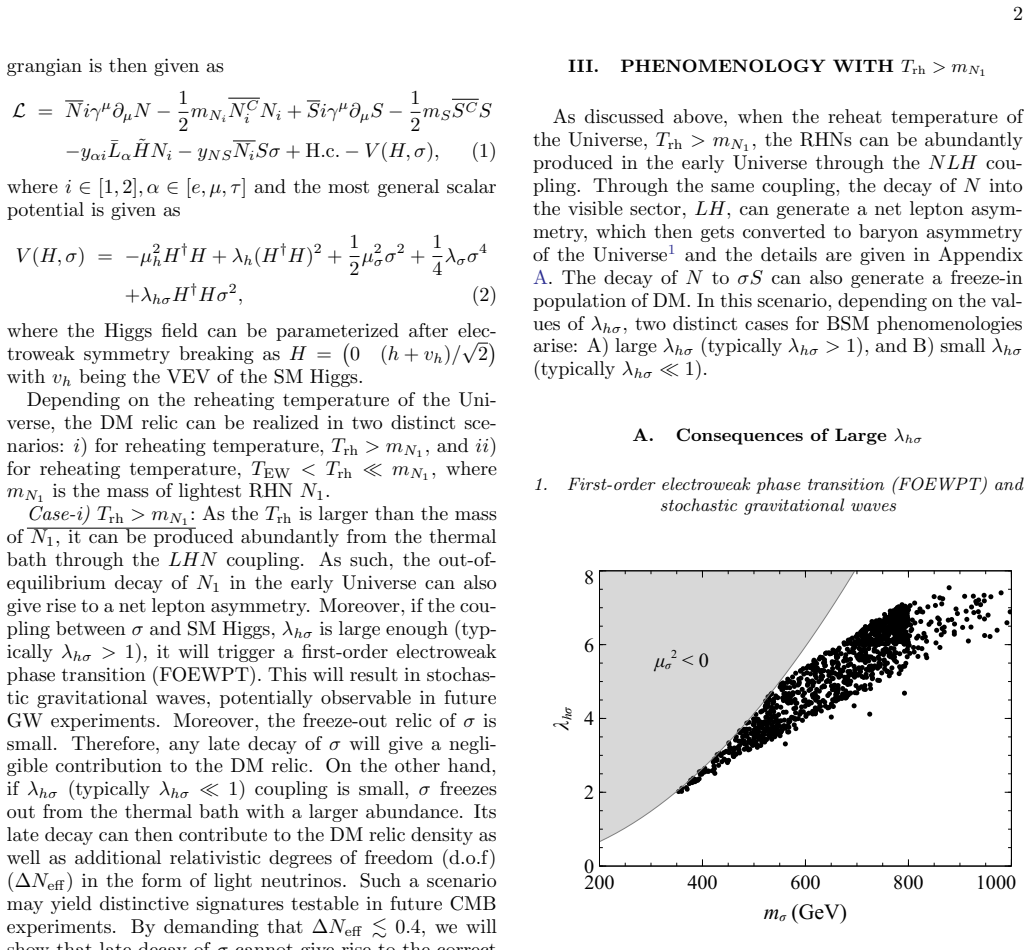
- A sufficiently strong σ-Higgs quartic coupling generates a gravitational-wave background from the first-order electroweak phase transition.
- A weak σ-Higgs coupling instead allows late σ decays that produce a detectable excess in the effective number of relativistic degrees of freedom.
- The two regimes are separated by the relative size of the reheating temperature compared with the right-handed neutrino mass.
- Future gravitational-wave observatories and cosmic microwave background experiments can jointly constrain or discover the model parameters.
Where Pith is reading between the lines
- The same scalar that controls the phase transition or late decays could also influence the neutrino mass matrix through higher-order effects without spoiling the parity protection.
- Non-detection of both signals would force the model into a narrow window of very small couplings, potentially testable by direct dark matter searches at low masses.
- The framework naturally accommodates variations in the right-handed neutrino spectrum while preserving the parity-based stability of S.
Load-bearing premise
The Majorana fermion S stays non-thermalized during its entire production epoch and lepton parity remains exactly unbroken by any additional effects.
What would settle it
A null result for gravitational waves at the frequencies expected from an electroweak-scale first-order transition combined with a ΔN_eff measurement consistent with zero would rule out the two production regimes for the stated range of σ-Higgs couplings.
Figures


read the original abstract
In the canonical type-I seesaw mechanism for neutrino masses, a residual symmetry known as lepton parity: $(-1)^L$, remains preserved. Introducing a Majorana fermion $S$ with even lepton parity renders it naturally stable, making it a viable dark matter (DM) candidate. The addition of a lepton parity odd singlet scalar $\sigma$ allows for the coupling $N S \sigma$, where $N$ is the right-handed neutrino. If $S$ is not thermalized, then DM relic can be produced in two distinct ways: (i) for reheating temperature, $T_{\rm rh}>m_{N}$, dominantly through the decay of $N$ ($N\rightarrow S\sigma$), and (ii) for $T_{\rm EW}<T_{\rm rh}\ll m_{N}$, via standard model Higgs ($h$) decay ($h\rightarrow SS$ at one loop). If the $\sigma-h$ quartic coupling is large, then it can lead to a strong first-order electroweak phase transition even if $\langle\sigma\rangle=0$. Alternatively, if $\sigma-h$ coupling is small, then $\sigma$ can freeze out with a larger abundance, and hence its decay ($\sigma\rightarrow S\nu$) at late epochs can give rise to additional relativistic degrees of freedom ($\Delta{N}_{\rm eff}$). Thus, the framework gives a viable DM with mass range varying from MeV to TeV and leaves observable imprints, via gravitational waves and $\Delta{N}_{\rm eff}$, which offer complementary probes, potentially detectable in future gravitational wave and CMB experiments.
Editorial analysis
A structured set of objections, weighed in public.
Referee Report
Summary. The manuscript extends the type-I seesaw with a Majorana fermion S (even lepton parity) as a stable DM candidate and an odd singlet scalar σ. It considers two freeze-in production channels for S (N→Sσ decay when T_rh > m_N; loop-induced h→SS when T_EW < T_rh ≪ m_N) under the assumption that S remains non-thermalized. Depending on the size of the σ-h quartic, the model either realizes a strong first-order electroweak phase transition (yielding GWs) with ⟨σ⟩=0 or allows late σ→Sν decays that contribute to ΔN_eff. The framework is claimed to accommodate DM masses from MeV to TeV with observable cosmological signatures detectable by future GW and CMB experiments.
Significance. If the non-thermal production calculations and phase-transition dynamics are shown to be consistent, the work supplies a concrete link between neutrino-mass generation, freeze-in DM, and two independent cosmological observables (GWs and ΔN_eff), providing falsifiable predictions that complement direct-detection searches.
major comments (2)
- [Abstract / production mechanisms] Abstract and model section: the non-thermal freeze-in assumption for S is load-bearing for both production regimes, yet the abstract states that a sizable σ-h quartic is needed for a strong FOPT even with ⟨σ⟩=0. This quartic induces tree-level σ-h mixing, which generates effective S-SM couplings via the NSσ vertex; the resulting interaction rate must be shown to remain Γ < H throughout the relevant epoch, or the relic-density calculation is invalidated.
- [Electroweak phase transition] Phase-transition discussion: the parameter choice that realizes a strong FOPT (large σ-h quartic) is parametrically linked to the mixing that can thermalize S. The manuscript must demonstrate, via explicit rate calculation or scan, a non-empty region of parameter space (m_S, m_N, λ_σh, T_rh) where both the strong FOPT and the non-thermal condition hold simultaneously; otherwise the two regimes cannot be treated as independent.
minor comments (2)
- [Abstract] Clarify whether the quoted MeV–TeV mass range refers exclusively to m_S or also encompasses m_N and m_σ; provide benchmark points with explicit relic-density values.
- [Notation] Define all temperature scales (T_rh, T_EW, T_dec) at first appearance and ensure consistent notation between text and any figures or equations.
Simulated Author's Rebuttal
We thank the referee for their thorough review and valuable comments on our manuscript. We address the major concerns point by point below, providing clarifications and indicating revisions where necessary to strengthen the consistency of our analysis.
read point-by-point responses
-
Referee: [Abstract / production mechanisms] Abstract and model section: the non-thermal freeze-in assumption for S is load-bearing for both production regimes, yet the abstract states that a sizable σ-h quartic is needed for a strong FOPT even with ⟨σ⟩=0. This quartic induces tree-level σ-h mixing, which generates effective S-SM couplings via the NSσ vertex; the resulting interaction rate must be shown to remain Γ < H throughout the relevant epoch, or the relic-density calculation is invalidated.
Authors: We agree that the σ-h quartic coupling λ_σh induces mixing between the singlet scalar σ and the Higgs boson after electroweak symmetry breaking. This mixing can in principle lead to effective interactions between S and the SM sector through the NSσ vertex. However, the mixing angle is proportional to λ_σh v / (m_σ² - m_h²), and for sufficiently heavy σ or appropriate parameter choices, it remains small. We have added an explicit calculation of the interaction rate Γ for S in the revised manuscript (new subsection in Section 3), demonstrating that there exist regions where Γ < H holds even for the values of λ_σh required for a strong FOPT. The relic density calculation remains valid in these regions. revision: yes
-
Referee: [Electroweak phase transition] Phase-transition discussion: the parameter choice that realizes a strong FOPT (large σ-h quartic) is parametrically linked to the mixing that can thermalize S. The manuscript must demonstrate, via explicit rate calculation or scan, a non-empty region of parameter space (m_S, m_N, λ_σh, T_rh) where both the strong FOPT and the non-thermal condition hold simultaneously; otherwise the two regimes cannot be treated as independent.
Authors: We appreciate this point and have performed a parameter scan to identify viable regions. In the revised version, we include a figure and discussion showing a non-empty parameter space where the strong first-order phase transition occurs (with the required λ_σh) while maintaining the non-thermal condition for S (Γ < H). This is achieved by choosing m_σ in the range 100-500 GeV and appropriate T_rh, ensuring the mixing-induced rates are suppressed. Thus, the two regimes remain independent in distinct but overlapping parameter spaces. revision: yes
Circularity Check
No significant circularity; derivation remains self-contained
full rationale
The paper sets up a lepton-parity model with stable Majorana fermion S as freeze-in DM, produced either via N decay (high T_rh) or loop-induced h→SS (low T_rh), under the explicit assumption that S remains non-thermalized. It then presents two alternative regimes for the σ-h quartic: large values yielding strong FOPT (and GW signals) with ⟨σ⟩=0, or small values allowing late σ decay and ΔN_eff. These are framed as distinct phenomenological branches rather than a single fitted prediction renamed as output. No equations reduce a claimed result to an input parameter by construction, no self-citation supplies a uniqueness theorem that forbids alternatives, and no ansatz is smuggled via prior work. The mass range MeV–TeV and complementary probes follow directly from the stated production channels and coupling choices without circular reduction. The framework is therefore self-contained against external benchmarks.
Axiom & Free-Parameter Ledger
free parameters (2)
- σ-h quartic coupling
- m_S, m_N, m_σ
axioms (2)
- domain assumption Lepton parity (-1)^L remains exactly preserved as a residual symmetry of the type-I seesaw
- ad hoc to paper S is not thermalized
invented entities (2)
-
Majorana fermion S
no independent evidence
-
Singlet scalar σ
no independent evidence
Lean theorems connected to this paper
-
IndisputableMonolith/Cost/FunctionalEquation.leanwashburn_uniqueness_aczel unclear?
unclearRelation between the paper passage and the cited Recognition theorem.
If S is not thermalized, then DM relic can be produced in two distinct ways: (i) for reheating temperature, T_rh > m_N, dominantly through the decay of N (N→Sσ), and (ii) for T_EW < T_rh ≪ m_N, via standard model Higgs (h) decay (h→SS at one loop).
-
IndisputableMonolith/Foundation/DimensionForcing.leanalexander_duality_circle_linking unclear?
unclearRelation between the paper passage and the cited Recognition theorem.
If the σ−h quartic coupling is large, then it can lead to a strong first-order electroweak phase transition even if ⟨σ⟩=0.
What do these tags mean?
- matches
- The paper's claim is directly supported by a theorem in the formal canon.
- supports
- The theorem supports part of the paper's argument, but the paper may add assumptions or extra steps.
- extends
- The paper goes beyond the formal theorem; the theorem is a base layer rather than the whole result.
- uses
- The paper appears to rely on the theorem as machinery.
- contradicts
- The paper's claim conflicts with a theorem or certificate in the canon.
- unclear
- Pith found a possible connection, but the passage is too broad, indirect, or ambiguous to say the theorem truly supports the claim.
Reference graph
Works this paper leans on
-
[1]
First-order electroweak phase transition (FOEWPT) and stochastic gravitational waves μ σ 2 < 0 λ h σ 0 2 4 6 8 m σ (GeV) 200 400 600 800 1000 FIG. 1. Parameter space (shown by black dotted points) of first-order EWPT in the plane ofλ hσ vsm σ. In Eq. 2, we chooseµ 2 σ >0 such thatσdoes not ob- tain any VEV and only SM Higgs obtains a VEV:v h. Theσmass get...
-
[2]
Freeze-in production of dark matter fromN 1 decay The singlet fermionS, which is even under the lep- ton parity, acts as a natural candidate for DM in our scenario. It is known that if a singlet fermion is ther- malized, then its freeze-out relic remains overabundant in most of the parameter space. Here, we assume thatS never thermalizes and its relic is ...
-
[3]
Freeze-in and SuperWIMP production of DM σ S N ν FIG. 6. Feynman diagram ofσdecay toSandν. Ifλ hσ coupling is small compared to the previous case, σfreezes out with a relatively larger abundance. In this case, the late decay ofσ→Sν, as shown in Fig. 6, can also produce some amount of DM, which is known as the SuperWIMP contribution, Ω SuperWIMPh2. The com...
work page 2024
-
[4]
In this parameter space, the contribution of the SuperWIMP component to the DM relic remains≲1%
Here, the Planck data excludeλ hσ ≲0.055 (0.26) for 100 GeV (1000 GeV)σmass. In this parameter space, the contribution of the SuperWIMP component to the DM relic remains≲1%. The future CMB-HD experi- ment will be able to excludeλ hσ ≲0.19 (0.95) for 100 GeV (1000 GeV)σmass. Based on the above discussion, we conclude that the current constraints on ∆N eff ...
work page 2024
-
[5]
Minkowski,µ→eγat a Rate of One Out of 10 9 Muon Decays?, Phys
P. Minkowski,µ→eγat a Rate of One Out of 10 9 Muon Decays?, Phys. Lett. B67, 421 (1977)
work page 1977
-
[6]
Complex Spinors and Unified Theories
M. Gell-Mann, P. Ramond, and R. Slansky, Complex Spinors and Unified Theories, Conf. Proc. C790927, 315 (1979), arXiv:1306.4669 [hep-th]
work page internal anchor Pith review Pith/arXiv arXiv 1979
-
[7]
R. N. Mohapatra and G. Senjanovic, Neutrino Mass and Spontaneous Parity Nonconservation, Phys. Rev. Lett. 44, 912 (1980)
work page 1980
-
[8]
J. Schechter and J. W. F. Valle, Neutrino Masses in SU(2) x U(1) Theories, Phys. Rev. D22, 2227 (1980)
work page 1980
-
[9]
Derivation of Dark Matter Parity from Lepton Parity
E. Ma, Derivation of Dark Matter Parity from Lep- ton Parity, Phys. Rev. Lett.115, 011801 (2015), arXiv:1502.02200 [hep-ph]
work page internal anchor Pith review Pith/arXiv arXiv 2015
-
[10]
Ma, Light dark fermion in two natural scenarios, Nucl
E. Ma, Light dark fermion in two natural scenarios, Nucl. Phys. B1010, 116761 (2025), arXiv:2409.16246 [hep-ph]
-
[11]
E. Ma, P. K. Paul, and N. Sahu, Lepton parity dark matter and naturally unstable domain walls, Phys. Rev. D112, 095020 (2025), arXiv:2508.02642 [hep-ph]
work page internal anchor Pith review Pith/arXiv arXiv 2025
-
[12]
Testing Electroweak Baryogenesis with Future Colliders
D. Curtin, P. Meade, and C.-T. Yu, Testing Elec- troweak Baryogenesis with Future Colliders, JHEP11, 127, arXiv:1409.0005 [hep-ph]
work page internal anchor Pith review Pith/arXiv arXiv
- [13]
-
[14]
A. G. Adameet al.(DESI), DESI 2024 VI: cosmologi- cal constraints from the measurements of baryon acous- tic oscillations, JCAP02, 021, arXiv:2404.03002 [astro- ph.CO]
work page internal anchor Pith review Pith/arXiv arXiv 2024
-
[15]
Planck 2018 results. VI. Cosmological parameters
N. Aghanimet al.(Planck), Planck 2018 results. VI. Cosmological parameters, Astron. Astrophys.641, A6 (2020), [Erratum: Astron.Astrophys. 652, C4 (2021)], arXiv:1807.06209 [astro-ph.CO]
work page internal anchor Pith review Pith/arXiv arXiv 2018
-
[16]
The Atacama Cosmology Telescope: DR6 Constraints on Extended Cosmological Models
E. Calabreseet al.(ACT), The Atacama Cosmology Tele- scope: DR6 Constraints on Extended Cosmological Mod- els, (2025), arXiv:2503.14454 [astro-ph.CO]
work page internal anchor Pith review Pith/arXiv arXiv 2025
- [17]
-
[18]
CMB-S4 Science Case, Reference Design, and Project Plan
K. Abazajianet al., CMB-S4 Science Case, Reference De- sign, and Project Plan, (2019), arXiv:1907.04473 [astro- ph.IM]
work page internal anchor Pith review Pith/arXiv arXiv 2019
-
[19]
Aiolaet al.(CMB-HD), Snowmass2021 CMB-HD White Paper, (2022), arXiv:2203.05728 [astro-ph.CO]
S. Aiolaet al.(CMB-HD), Snowmass2021 CMB-HD White Paper, (2022), arXiv:2203.05728 [astro-ph.CO]
-
[20]
Asymmetric Dark Matter from Leptogenesis
A. Falkowski, J. T. Ruderman, and T. Volansky, Asym- metric Dark Matter from Leptogenesis, JHEP05, 106, arXiv:1101.4936 [hep-ph]
work page internal anchor Pith review Pith/arXiv arXiv
- [21]
-
[22]
S. Mahapatra, P. K. Paul, N. Sahu, and P. Shukla, Asym- metric long-lived dark matter and leptogenesis from the type-III seesaw framework, Phys. Rev. D111, 015043 (2025), arXiv:2305.11138 [hep-ph]
-
[23]
C. L. Wainwright, CosmoTransitions: Computing Cos- mological Phase Transition Temperatures and Bubble Profiles with Multiple Fields, Comput. Phys. Commun. 183, 2006 (2012), arXiv:1109.4189 [hep-ph]
work page internal anchor Pith review Pith/arXiv arXiv 2006
-
[24]
E. G. Adelberger, N. A. Collins, and C. D. Hoyle, An- alytic expressions for gravitational inner multipole mo- 13 ments of elementary solids and for the force between two rectangular solids, Class. Quant. Grav.23, 125 (2006), [Erratum: Class.Quant.Grav. 23, 5463 (2006), Erra- tum: Class.Quant.Grav. 38, 059501 (2021)], arXiv:gr- qc/0512055
-
[25]
N. Yunes and E. Berti, Accuracy of the post-Newtonian approximation: Optimal asymptotic expansion for qua- sicircular, extreme-mass ratio inspirals, Phys. Rev. D 77, 124006 (2008), [Erratum: Phys.Rev.D 83, 109901 (2011)], arXiv:0803.1853 [gr-qc]
work page internal anchor Pith review Pith/arXiv arXiv 2008
-
[26]
Current status of space gravitational wave antenna DECIGO and B-DECIGO
S. Kawamuraet al., Current status of space gravitational wave antenna DECIGO and B-DECIGO, PTEP2021, 05A105 (2021), arXiv:2006.13545 [gr-qc]
work page internal anchor Pith review arXiv 2021
-
[27]
Detector configuration of DECIGO/BBO and identification of cosmological neutron-star binaries
K. Yagi and N. Seto, Detector configuration of DE- CIGO/BBO and identification of cosmological neutron- star binaries, Phys. Rev. D83, 044011 (2011), [Erratum: Phys.Rev.D 95, 109901 (2017)], arXiv:1101.3940 [astro- ph.CO]
work page internal anchor Pith review Pith/arXiv arXiv 2011
-
[28]
Laser Interferometer Space Antenna
P. Amaro-Seoaneet al.(LISA), Laser Interferometer Space Antenna, (2017), arXiv:1702.00786 [astro-ph.IM]
work page internal anchor Pith review Pith/arXiv arXiv 2017
-
[29]
Sesanaet al., Unveiling the gravitational universe atµ-Hz frequencies, Exper
A. Sesanaet al., Unveiling the gravitational universe atµ-Hz frequencies, Exper. Astron.51, 1333 (2021), arXiv:1908.11391 [astro-ph.IM]
-
[30]
Thermally Generated Gauge Singlet Scalars as Self-Interacting Dark Matter
J. McDonald, Thermally generated gauge singlet scalars as selfinteracting dark matter, Phys. Rev. Lett.88, 091304 (2002), arXiv:hep-ph/0106249
work page internal anchor Pith review Pith/arXiv arXiv 2002
-
[31]
keV Warm Dark Matter via the Supersymmetric Higgs Portal
J. McDonald and N. Sahu, keV Warm Dark Matter via the Supersymmetric Higgs Portal, Phys. Rev. D79, 103523 (2009), arXiv:0809.0247 [hep-ph]
work page internal anchor Pith review Pith/arXiv arXiv 2009
-
[32]
L. J. Hall, K. Jedamzik, J. March-Russell, and S. M. West, Freeze-In Production of FIMP Dark Matter, JHEP 03, 080, arXiv:0911.1120 [hep-ph]
work page internal anchor Pith review Pith/arXiv arXiv
-
[33]
Relic neutrino decoupling including flavour oscillations
G. Mangano, G. Miele, S. Pastor, T. Pinto, O. Pisanti, and P. D. Serpico, Relic neutrino decoupling includ- ing flavor oscillations, Nucl. Phys. B729, 221 (2005), arXiv:hep-ph/0506164
work page internal anchor Pith review Pith/arXiv arXiv 2005
-
[34]
Neutrino energy transport in weak decoupling and big bang nucleosynthesis
E. Grohs, G. M. Fuller, C. T. Kishimoto, M. W. Paris, and A. Vlasenko, Neutrino energy transport in weak de- coupling and big bang nucleosynthesis, Phys. Rev. D93, 083522 (2016), arXiv:1512.02205 [astro-ph.CO]
work page internal anchor Pith review Pith/arXiv arXiv 2016
-
[35]
P. F. de Salas and S. Pastor, Relic neutrino decou- pling with flavour oscillations revisited, JCAP07, 051, arXiv:1606.06986 [hep-ph]
work page internal anchor Pith review Pith/arXiv arXiv
- [36]
- [37]
-
[38]
A. Pilaftsis and T. E. J. Underwood, Resonant lep- togenesis, Nucl. Phys. B692, 303 (2004), arXiv:hep- ph/0309342
-
[39]
On Higgs and sphaleron effects during the leptogenesis era
E. Nardi, Y. Nir, J. Racker, and E. Roulet, On Higgs and sphaleron effects during the leptogenesis era, JHEP01, 068, arXiv:hep-ph/0512052
work page internal anchor Pith review Pith/arXiv arXiv
-
[40]
Leptogenesis with heavy neutrino flavours: from density matrix to Boltzmann equations
S. Blanchet, P. Di Bari, D. A. Jones, and L. Marzola, Leptogenesis with heavy neutrino flavours: from den- sity matrix to Boltzmann equations, JCAP01, 041, arXiv:1112.4528 [hep-ph]
work page internal anchor Pith review Pith/arXiv arXiv
-
[41]
Three-Flavoured Non-Resonant Leptogenesis at Intermediate Scales
K. Moffat, S. Pascoli, S. T. Petcov, H. Schulz, and J. Turner, Three-flavored nonresonant leptogenesis at intermediate scales, Phys. Rev. D98, 015036 (2018), arXiv:1804.05066 [hep-ph]
work page internal anchor Pith review Pith/arXiv arXiv 2018
-
[42]
The Sphaleron Rate in the Minimal Standard Model
M. D’Onofrio, K. Rummukainen, and A. Tranberg, Sphaleron Rate in the Minimal Standard Model, Phys. Rev. Lett.113, 141602 (2014), arXiv:1404.3565 [hep-ph]
work page internal anchor Pith review Pith/arXiv arXiv 2014
-
[43]
A. De Simone and A. Riotto, On Resonant Leptogenesis, JCAP08, 013, arXiv:0705.2183 [hep-ph]
work page internal anchor Pith review Pith/arXiv arXiv
-
[44]
P. Huang and K. Zhang, Testable flavored TeV-scale res- onant leptogenesis with MeV-GeV dark matter in a neu- trinophilic two-Higgs-doublet model, Phys. Rev. D111, 115011 (2025), arXiv:2411.18973 [hep-ph]
-
[45]
W. Buchmuller, P. Di Bari, and M. Plumacher, Lepto- genesis for pedestrians, Annals Phys.315, 305 (2005), arXiv:hep-ph/0401240
work page internal anchor Pith review Pith/arXiv arXiv 2005
-
[46]
CalcHEP 3.4 for collider physics within and beyond the Standard Model
A. Belyaev, N. D. Christensen, and A. Pukhov, CalcHEP 3.4 for collider physics within and beyond the Stan- dard Model, Comput. Phys. Commun.184, 1729 (2013), arXiv:1207.6082 [hep-ph]
work page internal anchor Pith review Pith/arXiv arXiv 2013
-
[47]
J. Aalberset al.(LZ), Dark Matter Search Results from 4.2 Tonne-Years of Exposure of the LUX-ZEPLIN (LZ) Experiment, Phys. Rev. Lett.135, 011802 (2025), arXiv:2410.17036 [hep-ex]
-
[48]
DARWIN: towards the ultimate dark matter detector
J. Aalberset al.(DARWIN), DARWIN: towards the ultimate dark matter detector, JCAP11, 017, arXiv:1606.07001 [astro-ph.IM]
work page internal anchor Pith review Pith/arXiv arXiv
discussion (0)
Sign in with ORCID, Apple, or X to comment. Anyone can read and Pith papers without signing in.