REVIEW 4 major objections 6 minor 4 cited by
This paper argues that turbulent heating alone cannot balance radiative cooling in cool-core clusters, even when pre-existing turbulence is included at observed levels, and that the XRISM central velocity rise is transient bulk motion.
Reviewed by Pith at T0; open to challenge. T0 means a machine referee read the full paper against a public rubric. the ladder, T0–T4 →
T0 review · deepseek-v4-flash
2026-08-03 19:32 UTC pith:SM6MZZVM
load-bearing objection A solid controlled simulation study that makes a real addition to the turbulent-heating debate, but the central Q_turb < Q_cool comparison is missing its baseline because Q_cool is never defined. the 4 major comments →
Simulating AGN feedback in galaxy clusters with pre-existing turbulence
The pith
A machine-rendered reading of the paper's core claim, the machinery that carries it, and where it could break.
Core claim
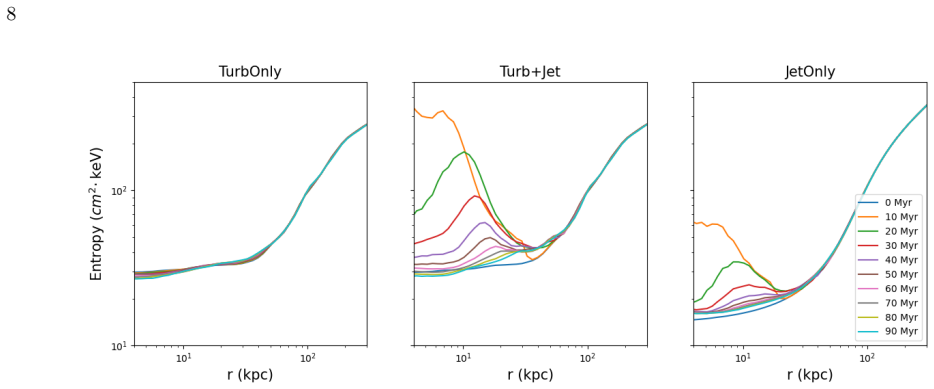
Central discovery: in a Perseus-like cool-core cluster with pre-existing turbulence stirred to the observed σ_LOS ≈ 185 km/s, two independent Kolmogorov estimators—the longitudinal velocity structure function (ℓ_VSF ≈ 53.1 kpc) and the energy power spectrum (ℓ_Ek ≈ 52.6 kpc)—give turbulent heating rates below the radiative cooling rate in the core (r < 50 kpc), and the rates are treated as upper limits. Early-time energy spectra show the AGN jet's injected energy decays within ~20–30 Myr without cascading, so the jet drives transient coherent bulk flows, not sustained turbulence; the authors argue the XRISM central σ_LOS enhancement in Perseus is this bulk motion, not AGN-powered turbulence.
What carries the argument
The key machinery is the Kolmogorov-cascade estimator of turbulent dissipation. The velocity structure function D_LL(ℓ) gives the variance of longitudinal velocity differences and is fitted to C_2 ε^{2/3} ℓ^{2/3} in the inertial range; the energy power spectrum E(k) is fitted to C_K ε^{2/3} k^{-5/3}. The inertial range is identified at 20–100 kpc, ε is read off at the tangent points (ℓ_VSF ≈ 53.1 kpc, ℓ_Ek ≈ 52.6 kpc), and the volumetric heating rate Q_turb = ρ ε is compared with cooling in radial shells. A second element is the time-resolved E(k) comparison between the run with and without the jet, which separates a self-sustaining cascade from transient coherent large-scale motions.
Load-bearing premise
The load-bearing premise is that the 20–100 kpc velocity fluctuations in the cluster core obey a classical incompressible Kolmogorov cascade, so that the dissipation rate can be read off from the structure function and power spectrum with standard constants; if compressibility, stratification, or numerical viscosity distort the inertial-range scaling, the inferred turbulent heating rate could be off by a factor and the central shortfall might shrink or grow.
What would settle it
Measure the two-point velocity statistics in the Perseus core over scales 20–100 kpc with a future X-ray spectrometer that has both high spectral resolution and sufficient spatial resolution (or use a large sample of emission-line velocity maps) and check whether D_LL(ℓ) follows ℓ^{2/3} with the assumed constant; if the measured dissipation rate, integrated over the core, equals or exceeds the radiative cooling rate, the paper's central claim fails. A complementary check: if the central σ_LOS enhancement observed by XRISM is resolved spatially and shows a Kolmogorov power spectrum extending to
If this is right
- Turbulent heating is not the primary mechanism solving the cooling-flow problem in cool-core clusters; other AGN channels (bubble mixing, weak shocks, sound waves, cosmic-ray heating) must supply the missing heat.
- Even when pre-existing turbulence is driven to the maximum level consistent with Hitomi/XRISM velocity measurements, the core heating rate remains below the cooling rate, so boosting turbulence alone will not close the energy budget.
- The central σ_LOS enhancement observed by XRISM in Perseus should not be interpreted as direct evidence of AGN-powered turbulence; if the simulated picture is right, it is a transient coherent flow, and turbulent heating estimates based on that line broadening would be overestimates.
- Both VSF and E(k) methods give the same radial trend (heating shortfall in the core, comparability at large radii), with the E(k) estimate systematically higher, bracketing the systematic uncertainty in the upper limit.
- The jet's contribution to the global velocity statistics is minor, yet it still heats the ICM through pressure work, so AGN feedback remains effective even when the velocity field is turbulence-dominated.
Where Pith is reading between the lines
- If the central velocity enhancement in Perseus is indeed a transient bulk flow, then X-ray line measurements with spatial resolution sufficient to resolve 20–100 kpc scales might see a coherent shearing or dipole pattern in the velocity centroid map rather than random small-scale eddies; this is a testable distinction from sustained turbulence.
- The simulation's conclusion depends on the assumption that numerical dissipation on the grid mimics the physical dissipation at the true ICM Reynolds number; if the real ICM has a much longer inertial range or the cascade is modified by magnetic fields, the inferred Q_turb could shift—an extension the authors note but do not quantify.
- Because the simulation excludes radiative cooling, magnetic fields, thermal conduction, and cosmic rays, a natural next step is to repeat the comparison in self-regulated feedback runs with cooling; if cooling changes the density and stratification, the inertial-range scalings and the inferred heating rates may change, potentially moving the conclusion in either direction.
- The paper's reinterpretation of XRISM data suggests a caution for the broader practice of inferring turbulent velocities from unresolved line broadening or surface brightness fluctuations: attributing all velocity variance to a turbulent cascade may systematically overestimate the dissipation available to heat the gas.
Editorial analysis
A structured set of objections, weighed in public.
Referee Report
Summary. The authors present 3D hydrodynamic simulations of a Perseus-like galaxy cluster using the FLASH code, comparing three controlled runs: pre-existing turbulence only, AGN jet only, and both. The turbulence is stirred by spectral Ornstein–Uhlenbeck forcing calibrated to the Hitomi line-of-sight velocity dispersion, and the AGN is a single 10 Myr kinetic bipolar jet. The central claim is that when the simulated velocity field is analyzed with the second-order velocity structure function and the kinetic-energy power spectrum under Kolmogorov scalings, the inferred turbulent heating rate Q_turb is smaller than the radiative cooling rate Q_cool in the cluster core, so turbulent heating alone cannot offset radiative cooling in cool-core clusters. A secondary claim is that the central σ_LOS enhancement recently reported by XRISM is reproduced by the combined run but is better interpreted as transient, coherent bulk motion than as sustained turbulence.
Significance. If the central comparison is made reproducible, the paper would strengthen the simulation-based case that turbulent heating is subdominant in cool-core cluster cores, while explicitly including pre-existing turbulence stirred to the observationally constrained Perseus level. Strengths of the paper are the controlled run design, the use of two independent estimators of the dissipation rate, the explicit interpretation of the estimates as upper limits, the convergence check, and the direct engagement with the new XRISM velocity-dispersion measurement. The main quantitative result, however, currently rests on an undefined and unreferenced radiative-cooling baseline, and the Kolmogorov-based estimates would benefit from a quantitative justification of the underlying assumptions. These issues are local and fixable; they do not by themselves invalidate the qualitative conclusion, but they block verification as written.
major comments (4)
- [§3.5 / Fig. 10] The central inequality Q_turb < Q_cool is not testable as written because Q_cool is never defined. Radiative cooling is excluded from the simulations (Eqs. 1–3), so Q_cool must be an external input, but the manuscript supplies no cooling function, metallicity, redshift, density/temperature profile, radial shell edges, or reference. Figure 10 also lacks explicit axis labels and units. Please specify how Q_cool was computed or from which observational estimate it was taken, and give the numerical values in the five radial shells. Without this, the abstract's claim cannot be verified or reproduced.
- [§2.4, §3.5] The dissipation-rate estimates assume Kolmogorov incompressible turbulence with fixed constants (C2 ≈ 2.0, CK ≈ 1.65) applied over a 20–100 kpc inertial range. The justification that this is appropriate—solenoidal dominance and Fr > 0.1—is qualitative. Because the absolute magnitude of ε carries the whole argument, please quantify: (i) the compressive kinetic-energy fraction in the inertial range; (ii) the sensitivity of ε to the chosen fitting interval and to constants within published ranges; (iii) the variation of D_LL/E(k) across radial shells if shell-resolved estimates are used. This matters most in the outer bins, where Q_turb and Q_cool become comparable and a factor-of-order-unity error could alter the conclusion.
- [§3.5 / Fig. 10] The method used to assign Q_turb to the five clustercentric shells is underspecified. The text says Q_turb = ρε with ρ averaged within each shell, but does not state whether ε is evaluated separately per shell or taken from a global VSF/E(k), nor the shell boundaries or weighting (emissivity, volume). The claim that the two methods bracket the true heating rate also requires that the same radial binning and fitting procedure be applied to both. Please specify the radial bins and the shell-wise computation, and give the resulting ε values (or Q_turb values) in a table so the comparison can be reproduced.
- [§4.2 / Fig. 11] The secondary conclusion that the central σ_LOS enhancement is "not turbulence" is based on the visual similarity of E(k) at t = 30 Myr and the short-lived bump in the combined run. This is not quantitative enough to support the strong wording. Please provide a quantitative measure: the fraction of injected jet energy that appears as solenoidal vs irrotational power on scales below the driving range, the decay time of excess large-scale power relative to the local eddy turnover time, or a comparison of the shell-resolved VSF slopes in the core with and without the jet. As written, the statement that XRISM's central enhancement is primarily coherent bulk motion is suggestive but not established.
minor comments (6)
- [Abstract / §5] The abstract and conclusions should soften "CC clusters" to "the Perseus-like cluster modeled here"; the simulations contain one cluster model with a single episodic jet and no radiative cooling.
- [Fig. 10 / §3.5] Please state the units of Q_turb and Q_cool and explicitly define the radial bins. The text refers to "radiative cooling rates" but does not say whether these are per unit volume, per unit mass, or integrated luminosities in shells.
- [§2.2] The σ_LOS calibration is described as domain-averaged, while Hitomi/XRISM measure inner-core values. Clarify the region used for matching and verify that the simulated central σ_LOS profile is consistent with the observational aperture.
- [§4.1] The Froude number is quoted as Fr > 0.1 but never defined. Give the formula and the calculated value (with the integral-scale quantities used) so the stratification argument can be checked.
- [General / Data availability] The data availability statement says data will be shared upon reasonable request. Consider depositing analysis scripts and derived profiles in a permanent repository with a DOI; this would make the central figures auditable.
- [General] Typographical and formatting issues: the Table 1 header appears as "T able 1"; "velocity disperson" in §4.1; a repeated sentence after Fig. 11; inconsistent use of spaces in "T urb+Jet" in captions and text.
Circularity Check
No significant circularity: the central Q_turb < Q_cool comparison is not fit to or derived from the cooling rate; the paper's self-citations are corroborating prior context rather than load-bearing.
full rationale
The derivation chain in Sections 2.4 and 3.5 is not circular. The pre-existing turbulence amplitude is calibrated to the observed Hitomi σ_LOS (Section 2.2, Table 1), and the jet power is an externally referenced input (Section 2.3), but neither is fit to the radiative cooling rate. The turbulent dissipation rate ε is estimated from the simulated velocity field by fitting D_LL and E(k) to Kolmogorov scalings with standard constants (Eqs. 9 and 10; C2≈2.0, CK≈1.65), and Q_turb = ρε is only then compared with cooling in Fig. 10. The cooling rate plotted is never defined in the manuscript, and radiative cooling is excluded from Eqs. (1)–(3); this is a reproducibility/verification gap rather than a circularity, because the manuscript does not construct Q_cool from Q_turb or from any fitted parameter. The self-citations (e.g., Yang & Reynolds 2016a for the cluster setup, 2016b for jet power and prior conclusions) are corroborating context rather than the load-bearing derivation; the paper's new E(k) analysis and the Turb+Jet versus TurbOnly comparison provide independent content. The XRISM comparison is also not forced: the σ_LOS calibration sets only the global amplitude, while the central enhancement appears specifically in Turb+Jet, so it is a nontrivial simulation output. No predictive step reduces by construction to its input.
Axiom & Free-Parameter Ledger
free parameters (5)
- Turbulence injection rate ε_inj =
4×10^-5 cm^2 s^-3
- Characteristic VSF scale ℓ_VSF =
53.1 kpc
- Characteristic spectrum scale ℓ_Ek =
52.6 kpc
- OU forcing autocorrelation time τ_d =
8.5×10^15 s (~270 Myr)
- AGN jet power and duration =
5×10^45 erg/s, 10 Myr
axioms (5)
- domain assumption Kolmogorov incompressible turbulence scaling (Eqs. 9-10) with C2=2.0 and CK=1.65 describes the simulated ICM velocity field in the inertial range.
- domain assumption Statistical isotropy of the turbulent flow, so that the longitudinal structure function carries the full energy content and the Kolmogorov constant C2 applies.
- domain assumption Numerical dissipation at the grid scale approximates physical dissipation in a high-Reynolds-number ICM.
- domain assumption Radiative cooling can be omitted when measuring turbulent heating, and the cooling rate used for comparison is an external input.
- domain assumption The initial conditions (Eqs. 4-5) and jet parameters represent a Perseus-like cool-core cluster.
read the original abstract
Feedback from active galactic nuclei (AGN) is believed to play a significant role in suppressing cooling flows in cool-core (CC) clusters. Turbulence in the intracluster medium (ICM), which may be induced by AGN activity or pre-existing motions, has been proposed as a potential heating mechanism based on analysis of Chandra X-ray surface brightness fluctuations. However, subsequent simulation results have found the subdominant role of turbulence in heating the ICM. To investigate this discrepancy, we perform three-dimensional hydrodynamic simulations of a Perseus-like cluster including both AGN feedback and pre-existing turbulence, which is stirred to the observationally constrained level in the Perseus cluster. Our results indicate that, although the velocity field is dominated by the pre-existing turbulence, AGN heating through bubbles and shocks remains significant. More importantly, analysis of the velocity structure function and the energy power spectrum shows that the turbulent heating rate is smaller than the radiative cooling rate, especially in the cluster core. Our results offer insights relevant for recent XRISM observations and indicate that turbulent heating alone cannot offset radiative cooling in CC clusters.
Figures




Forward citations
Cited by 4 Pith papers
-
Gas Motions in Hydra-A: XRISM Constraints on ICM Kinematics Across Jet-Inflated Cavities
In Hydra-A, XRISM sub-array spectra show a 260 km/s velocity dispersion in the northeast quarter near uplifted metal-rich gas, while dispersions of 80-140 km/s elsewhere imply the jet stirs gas efficiently at small sc...
-
Bulk vs. turbulent motions at the centres of galaxy clusters: AGN-driven turbulence according to TNG-Cluster
TNG-Cluster simulations find that in galaxy cluster centers turbulence accounts for under half the total velocity dispersion (typically 50-75 km/s), is mostly subsonic, provides sub-percent pressure support, and is pr...
-
Are X-ray Atmospheres Heated by Turbulent Dissipation? XRISM Constraints
XRISM measurements indicate turbulent dissipation from jets struggles to balance cooling in cluster atmospheres except possibly in limited inner regions of systems like Hydra A.
-
Active galactic nucleus driven jet feedback in cosmologically forming cool-core galaxy clusters I: The effect of hierarchical assembly on intra-cluster medium properties
Cosmological simulations with AGN jet feedback reproduce observed cool-core cluster ICM properties more accurately than isolated simulations or IllustrisTNG due to merger-driven effects on gas velocity and warm gas abundance.
Reference graph
Works this paper leans on
-
[1]
Berlok, T., Quataert, E., Pessah, M. E., & Pfrommer, C. 2021, MNRAS, 504, 3435, doi: 10.1093/mnras/stab832
-
[2]
N., von der Linden, A., Kauffmann, G., Heckman, T
Best, P. N., von der Linden, A., Kauffmann, G., Heckman, T. M., & Kaiser, C. R. 2007, MNRAS, 379, 894, doi: 10.1111/j.1365-2966.2007.11937.x B ˆ ırzan, L., Rafferty, D. A., Nulsen, P. E. J., et al. 2012, MNRAS, 427, 3468, doi: 10.1111/j.1365-2966.2012.22083.x
arXiv 2007
-
[3]
Bourne, M. A., & Yang, H.-Y. K. 2023, Galaxies, 11, 73, doi: 10.3390/galaxies11030073 Di Gennaro, G., van Weeren, R. J., Brunetti, G., et al. 2021, Nature Astronomy, 5, 268, doi: 10.1038/s41550-020-01244-5
-
[4]
Drury, L. O. 1983, Reports on Progress in Physics, 46, 973, doi: 10.1088/0034-4885/46/8/002
-
[5]
Dubey, A., Reid, L. B., & Fisher, R. 2008, Phys. Scr., 2008, 014046, doi: 10.1088/0031-8949/2008/T132/014046
-
[6]
Dunn, R. J. H., & Fabian, A. C. 2004, MNRAS, 355, 862, doi: 10.1111/j.1365-2966.2004.08365.x
arXiv 2004
-
[7]
Eswaran, V., & Pope, S. 1988, Compu. Fluids, 16, 257, doi: https://doi.org/10.1016/0045-7930(88)90013-8
-
[8]
Fabian, A. C. 1994, ARA&A, 32, 277, doi: 10.1146/annurev.aa.32.090194.001425
arXiv 1994
-
[9]
Fabian, A. C., Walker, S. A., Russell, H. R., et al. 2017, MNRAS, 464, L1, doi: 10.1093/mnrasl/slw170
-
[10]
2013, MNRAS, 436, 1245, doi: 10.1093/mnras/stt1644
Federrath, C. 2013, MNRAS, 436, 1245, doi: 10.1093/mnras/stt1644
-
[11]
2016, Journal of Plasma Physics, 82, 535820601, doi: 10.1017/S0022377816001069
Federrath, C. 2016, Journal of Plasma Physics, 82, 535820601, doi: 10.1017/S0022377816001069
-
[13]
Federrath, C., Roman-Duval, J., Klessen, R. S., et al. 2010, A&A, 512, A81, doi: 10.1051/0004-6361/200912437
-
[14]
2000, ApJS, 131, 273, doi: 10.1086/317361
Fryxell, B., Olson, K., Ricker, P., et al. 2000, ApJS, 131, 273, doi: 10.1086/317361
doi:10.1086/317361 2000
-
[15]
Gaspari, M., Ruszkowski, M., & Oh, S. P. 2013, MNRAS, 432, 3401, doi: 10.1093/mnras/stt692
-
[16]
Gaspari, M., McDonald, M., Hamer, S. L., et al. 2018, ApJ, 854, 167, doi: 10.3847/1538-4357/aaaa1b Hitomi Collaboration. 2016, Nature, 535, 117, doi: 10.1038/nature18627
-
[17]
S., Donahue, M., Hicks, A., & Barthelemy, R
Hoffer, A. S., Donahue, M., Hicks, A., & Barthelemy, R. S. 2012, ApJS, 199, 23, doi: 10.1088/0067-0049/199/1/23
-
[18]
2003, Physics of Fluids, 15, L21, doi: 10.1063/1.1539855
Uno, A. 2003, Physics of Fluids, 15, L21, doi: 10.1063/1.1539855
-
[19]
Kingsland, M., Yang, H.-Y. K., Reynolds, C. S., & Zuhone, J. A. 2019, ApJL, 883, L23, doi: 10.3847/2041-8213/ab40be
-
[20]
Kolmogorov, A. N. 1941, Akademiia Nauk SSSR Doklady, 32, 16
1941
-
[21]
Kritsuk, A. G., Norman, M. L., Padoan, P., & Wagner, R. 2007, ApJ, 665, 416, doi: 10.1086/519443
doi:10.1086/519443 2007
-
[22]
Kunz, M. W., Schekochihin, A. A., & Stone, J. M. 2014, Physical Review Letters, 112, 205003, doi: 10.1103/PhysRevLett.112.205003
-
[23]
Li, Y., & Bryan, G. L. 2014, ApJ, 789, 153, doi: 10.1088/0004-637X/789/2/153 15
-
[24]
Li, Y., Ruszkowski, M., & Bryan, G. L. 2017, ApJ, 847, 106, doi: 10.3847/1538-4357/aa88c1
-
[25]
Lin, Y.-H., Yang, H.-Y. K., & Owen, E. R. 2023, MNRAS, 520, 963, doi: 10.1093/mnras/stad185
-
[28]
McDonald, M., Veilleux, S., Rupke, D. S. N., Mushotzky, R., & Reynolds, C. 2011, ApJ, 734, 95, doi: 10.1088/0004-637X/734/2/95
-
[29]
McNamara, B. R., & O’Connell, R. W. 1989, AJ, 98, 2018, doi: 10.1086/115275
doi:10.1086/115275 1989
-
[30]
Mittal, R., Hudson, D. S., Reiprich, T. H., & Clarke, T. 2009, A&A, 501, 835, doi: 10.1051/0004-6361/200810836
-
[31]
2020, MNRAS, 493, 5838, doi: 10.1093/mnras/staa711
Mohapatra, R., Federrath, C., & Sharma, P. 2020, MNRAS, 493, 5838, doi: 10.1093/mnras/staa711
-
[32]
2021, Monthly Notices of the Royal Astronomical Society, 510, 2327, doi: 10.1093/mnras/stab3429
Mohapatra, R., Jetti, M., Sharma, P., & Federrath, C. 2021, Monthly Notices of the Royal Astronomical Society, 510, 2327, doi: 10.1093/mnras/stab3429
-
[33]
2019, MNRAS, 484, 4881, doi: 10.1093/mnras/stz328
Mohapatra, R., & Sharma, P. 2019, MNRAS, 484, 4881, doi: 10.1093/mnras/stz328
-
[34]
Narayan, R., & Medvedev, M. V. 2001, ApJL, 562, L129, doi: 10.1086/338325
doi:10.1086/338325 2001
-
[35]
Navarro, J. F., Frenk, C. S., & White, S. D. M. 1996, ApJ, 462, 563, doi: 10.1086/177173 O’Dea, C. P., Baum, S. A., Privon, G., et al. 2008, ApJ, 681, 1035, doi: 10.1086/588212
doi:10.1086/177173 1996
-
[36]
Parrish, I. J., & Quataert, E. 2008, ApJL, 677, L9, doi: 10.1086/587937
doi:10.1086/587937 2008
-
[37]
Pope, S. B. 2000, Turbulent Flows (Cambridge University Press)
2000
-
[38]
Porter, D. H., Jones, T. W., & Ryu, D. 2015, ApJ, 810, 93, doi: 10.1088/0004-637X/810/2/93
-
[39]
Reynolds, C. S., Balbus, S. A., & Schekochihin, A. A. 2015, ApJ, 815, 41, doi: 10.1088/0004-637X/815/1/41
-
[40]
Ricker, P. M., & Sarazin, C. L. 2001, ApJ, 561, 621, doi: 10.1086/323365
doi:10.1086/323365 2001
-
[41]
Ruszkowski, M., & Oh, S. P. 2010, ApJ, 713, 1332, doi: 10.1088/0004-637X/713/2/1332
-
[43]
Ruszkowski, M., Yang, H.-Y. K., & Reynolds, C. S. 2017, ApJ, 844, 13, doi: 10.3847/1538-4357/aa79f8
-
[44]
Saddoughi, S. G., & Veeravalli, S. V. 1994, Journal of Fluid Mechanics, 268, 333–372, doi: 10.1017/S0022112094001370
-
[45]
Santos-Lima, R., de Gouveia Dal Pino, E. M., Kowal, G., et al. 2014, ApJ, 781, 84, doi: 10.1088/0004-637X/781/2/84
-
[46]
Niemeyer, J. C. 2009, A&A, 494, 127, doi: 10.1051/0004-6361:200809967
-
[47]
Sharma, P., McCourt, M., Quataert, E., & Parrish, I. J. 2012, MNRAS, 420, 3174, doi: 10.1111/j.1365-2966.2011.20246.x
arXiv 2012
-
[48]
2022, A&A, 658, A149, doi: 10.1051/0004-6361/202141703
Simonte, M., Vazza, F., Brighenti, F., et al. 2022, A&A, 658, A149, doi: 10.1051/0004-6361/202141703
-
[49]
Sreenivasan, K. R. 1995, Physics of Fluids, 7, 2778, doi: 10.1063/1.868656
-
[50]
Walker, S. A., Sanders, J. S., & Fabian, A. C. 2018, MNRAS, 481, 1718, doi: 10.1093/mnras/sty2390
-
[51]
Wang, C., Oh, S. P., & Ruszkowski, M. 2023, MNRAS, 519, 4408, doi: 10.1093/mnras/stad003
-
[52]
Yang, H.-Y. K. 2021, MNRAS, 504, 898, doi: 10.1093/mnras/stab966
-
[53]
Wang, S.-C., & Yang, H.-Y. K. 2022, MNRAS, 512, 5100, doi: 10.1093/mnras/stac788
-
[54]
Wiener, J., Oh, S. P., & Guo, F. 2013, MNRAS, 434, 2209, doi: 10.1093/mnras/stt1163 XRISM Collaboration, Audard, M., Awaki, H., et al. 2025a, arXiv e-prints, arXiv:2509.04421, doi: 10.48550/arXiv.2509.04421 XRISM Collaboration, Audard, M., Awaki, H., et al. 2025b, PASJ, 77, S242, doi: 10.1093/pasj/psaf055 XRISM Collaboration, Audard, M., Awaki, H., et al....
-
[55]
Yang, H. Y. K., Gaspari, M., & Marlow, C. 2019, ApJ, 871, 6, doi: 10.3847/1538-4357/aaf4bd
-
[56]
Yang, H.-Y. K., & Reynolds, C. S. 2016a, ApJ, 818, 181, doi: 10.3847/0004-637X/818/2/181
-
[57]
Yang, H.-Y. K., & Reynolds, C. S. 2016b, ApJ, 829, 90, doi: 10.3847/0004-637X/829/2/90
-
[58]
Zakamska, N. L., & Narayan, R. 2003, ApJ, 582, 162, doi: 10.1086/344641
doi:10.1086/344641 2003
-
[59]
2022, MNRAS, 517, 616, doi: 10.1093/mnras/stac2282
Zhang, C., Zhuravleva, I., Gendron-Marsolais, M.-L., et al. 2022, MNRAS, 517, 616, doi: 10.1093/mnras/stac2282
-
[60]
Zhuravleva, I., Allen, S. W., Mantz, A., & Werner, N. 2018, ApJ, 865, 53, doi: 10.3847/1538-4357/aadae3
-
[61]
Zhuravleva, I., Churazov, E., Schekochihin, A. A., et al. 2019, Nature Astronomy, 3, 832, doi: 10.1038/s41550-019-0794-z
-
[62]
Zhuravleva, I., Churazov, E., Schekochihin, A. A., et al. 2014, Nature, 515, 85, doi: 10.1038/nature13830
-
[63]
2016, MNRAS, 458, 2902, doi: 10.1093/mnras/stw520 16
Zhuravleva, I., Churazov, E., Ar´ evalo, P., et al. 2016, MNRAS, 458, 2902, doi: 10.1093/mnras/stw520 16
-
[64]
A., Markevitch, M., & Johnson, R
ZuHone, J. A., Markevitch, M., & Johnson, R. E. 2010, ApJ, 717, 908, doi: 10.1088/0004-637X/717/2/908
discussion (0)
Sign in with ORCID, Apple, or X to comment. Anyone can read and Pith papers without signing in.