REVIEW 3 major objections 7 minor 37 references
Medical phrase grounding should return a set of zero, one, or multiple scored image regions per sentence, and the new MedGrounder model shows this is achievable with far fewer human box annotations than end-to-end grounded report generators
Reviewed by Pith at T0; open to challenge. T0 means a machine referee read the full paper against a public rubric. the ladder, T0–T4 →
T0 review · deepseek-v4-flash
2026-08-03 19:17 UTC pith:2WTW4VSA
load-bearing objection GMPG is a real step forward, but the abstract overstates the non-groundable advantage; MAIRA-2 GR is at parity on N-Acc. the 3 major comments →
Generalised Medical Phrase Grounding
The pith
A machine-rendered reading of the paper's core claim, the machinery that carries it, and where it could break.
Core claim
On PadChest-GR and MS-CXR, the pretrained-only MedGrounder outperforms all baselines in zero-shot transfer, and after fine-tuning it sets the best results on multi-box phrases—for example 28.6% P@F1=1 on PadChest-GR multi-box cases, nearly double the strongest competitor MAIRA-2, while abstaining correctly on non-groundable sentences. When composed with two different report generators (MAIRA-2 in finding-generation mode and CXRMate-RRG24), MedGrounder produces grounded reports whose RadFact spatial F1 is on par with or better than the end-to-end MAIRA-2 GR, despite being trained on one tenth of the human annotations. The authors attribute the transfer to the anatomical inductive bias learned
What carries the argument
The load-bearing object is the GMPG task definition itself: a variable-size set of scored boxes, including the empty set, replaces the fixed single-box regression of REC. MedGrounder realises it with a DETR-style architecture—ResNet-101 and BioClinical ModernBERT encoders, a cross-modal transformer encoder-decoder, bipartite matching between predictions and ground-truth sets, and a confidence head whose threshold permits abstention. The two-stage training regime is the other piece of machinery: an LLM-filtered version of Chest ImaGenome supplies 426,749 weak sentence–box pairs that teach the model which anatomical regions a sentence is about, and a short fine-tuning stage on human boxes refi
Load-bearing premise
The whole pretraining benefit rests on the assumption that the LLM-cleaned Chest ImaGenome annotations are a faithful 'most specific regions' decomposition of each sentence; the paper reports no manual audit or agreement study of this cleaned data, and if the cleanup removes legitimate regions or keeps hallucinated ones, the model's inductive bias—and the zero-shot and fine-tuning gains built on it—are unvalidated.
What would settle it
A human audit of a random sample of GMPG-ImaGenome would settle it: if annotators often find that the retained region is not entailed by the sentence, or that a sensible region was discarded, the pretraining signal is biased. A cheaper quantitative check is an ablation training MedGrounder identically on raw Chest ImaGenome versus the cleaned version; if raw-pretrained performance matches or beats the cleaned version on multi-box and diffuse findings, the LLM filter is not the source of the reported gains.
If this is right
- GMPG becomes the natural evaluation setting for medical phrase grounding; future datasets and models should report metrics that separate non-groundable, single-box, and multi-box cases, not only mIoU.
- Weakly supervised pretraining on sentence–anatomy alignments can substitute for a large fraction of human box annotation, lowering the annotation cost of building grounding systems.
- Grounded report generation becomes modular: any existing report generator can be upgraded to a grounded generator by appending MedGrounder, avoiding expensive image–report–box training triplets.
- Confidence scores and explicit abstention make AI-generated reports more checkable by radiologists, since every grounded sentence carries spatial evidence.
- The released GMPG-ImaGenome cleanup provides a reusable weak-supervision resource for pretraining future grounding models.
Where Pith is reading between the lines
- If the weak-label assumption holds, the same LLM-filtering recipe could be ported to other weakly aligned medical corpora (CT, MRI, pathology) to create pretraining data for grounding in those modalities.
- The performance gap between anatomically fixed findings (cardiomegaly) and diffuse or spatially variable ones (lung opacity, rib fractures) suggests an intrinsic ceiling to what fixed anatomical-region priors can teach; further gains will require finer supervision such as segmentation masks or disease-specific box sets.
- The modular generation-plus-grounding result implies that progress in text-only report generation can be directly converted into progress in verifiable grounded reporting, decoupling the two improvement curves.
- A concrete test of the cleaning pipeline's value would be to compare MedGrounder pretrained on the raw versus the LLM-cleaned Chest ImaGenome; if raw pretraining matches or beats it on diffuse findings, the 89.6% discard is removing signal, not just noise.
Editorial analysis
A structured set of objections, weighed in public.
Referee Report
Summary. The paper reformulates medical phrase grounding as generalised medical phrase grounding (GMPG), in which a phrase is mapped to zero, one, or multiple scored bounding boxes. To solve GMPG the authors propose MedGrounder, an MDETR-style detector pretrained on an LLM-cleaned version of Chest ImaGenome and fine-tuned on MS-CXR and PadChest-GR. They report strong zero-shot transfer, gains over REC-style and GRG baselines on multi-box and non-groundable phrases, and a modular pipeline in which MedGrounder grounds the output of existing report generators. Ablations indicate pretraining is essential, WBF post-processing helps, and a clinical language encoder improves results.
Significance. If the claims hold, GMPG is a well-motivated task reformulation and MedGrounder demonstrates a data-efficient route to multi-box grounding and negative suppression. The paper's strengths are its explicit zero/one/multi formulation, the weak-to-expert training recipe, the inclusion of non-grounding examples, and the planned release of code and data. The ablations are informative: from-scratch training collapses, and WBF and BioClinical ModernBERT give consistent gains. However, the headline non-groundable claim is not supported by the fine-tuned comparison in Table III, and the pretraining signal from the 89.6% filtered weak labels lacks validation. These issues are fixable but require additional experiments or a softened claim.
major comments (3)
- [Abstract; Table III] The abstract states that MedGrounder 'outperforms ... non-groundable phrases', but in the fine-tuned comparison on PadChest-GR, MAIRA-2 GR has N-Acc 91.0 while MedGrounder (M,P) has 90.1. Since N-Acc is the only non-groundable metric, the claimed advantage over GRG baselines on this requirement is unsupported. The 0.9-point gap is reported without confidence intervals or significance tests. N-Acc is also gameable: Table VII shows from-scratch models reach 99.8-99.9 N-Acc with P@F1 near zero. Please add interval estimates or significance tests, report N-Acc together with P@F1, and adjust the abstract to 'comparable' unless superiority is statistically supported.
- [§III-D.1; Fig. 3] The central pretraining step is built on LLaMA-3-70B filtering that discards 89.6% of Chest ImaGenome sentence-box pairs, yet there is no manual audit, agreement study, or comparison against pretraining on the unfiltered dataset. Since Table VII establishes that pretraining is essential, a biased filter could be the source of the zero-shot and fine-tuning gains. I request a sample audit and a raw-vs-cleaned pretraining ablation, or at minimum a per-region error analysis showing the retained labels are not systematically wrong.
- [Table VI; §V-B] The modular-GRG conclusion rests heavily on a 38-case non-overlapping subset. The reported differences (e.g., Spatial F1 53.52 vs 52.03) are within plausible noise for n=38. Please provide confidence intervals or a larger non-overlapping evaluation set before claiming the pipeline matches or exceeds MAIRA-2 GR.
minor comments (7)
- [Fig. 2] Caption typo: 'MobernBERT' should be 'ModernBERT'.
- [Eq. (3)] The notation 'αtj =0 = 0.1' is confusing; use α_{t_j=0}.
- [Table VII] The PadChest-GR from-scratch row shows P@F1=41.3 with CH-F1=1.5; please verify the column alignment.
- [Tables III/IV] Several numbers are merged in the text (e.g., '60.775.1', '086.5'); fix the spacing.
- [§III-E] CH-F1 and Mask IoU accuracy are described only informally; provide formal definitions or equations.
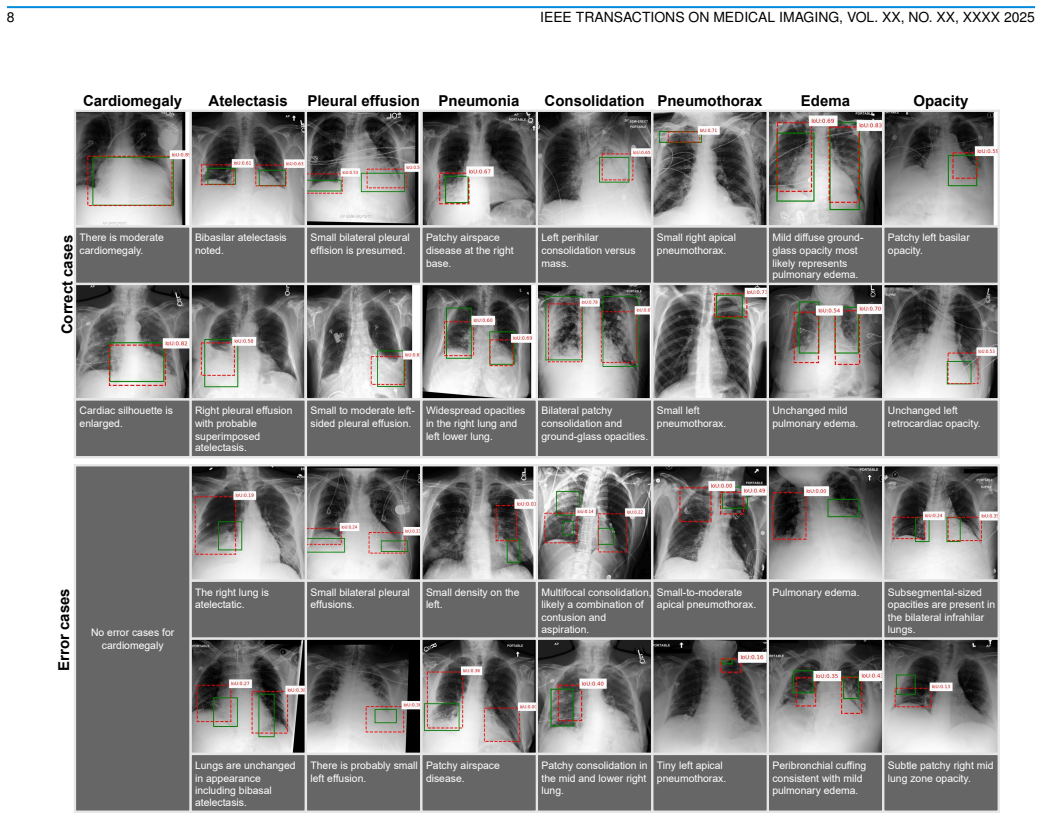
- [Fig. 7] Figure contains typos: 'sihouette', 'Enlongated', 'efusion'.
- [§V-B] The 38-case subset is not described; report how it was selected and its disease distribution. Also 'subest' is a typo.
Circularity Check
No significant circularity: MedGrounder's results are empirical comparisons on independent human-annotated benchmarks; no reported metric reduces to a fitted parameter, a self-citation chain, or a by-construction definition.
full rationale
MedGrounder's derivation chain is empirical and externally benchmarked. The GMPG objective (Eqs. 2–4) is the standard MDETR set-prediction loss; no reported number (P@F1=1, CH-F1, N-Acc, Mask IoU, RadFact) is defined in terms of a fitted parameter of the same experiment. Pretraining on LLM-cleaned Chest ImaGenome is a label-generation step: LLaMA-3-70B filters candidate regions and negative sentences before training, and the fine-tuning/evaluation sets (MS-CXR, PadChest-GR) are independent expert annotations. Thus the model's ability to suppress non-groundable phrases or emit multiple boxes is learned from weak labels but tested against human labels; it is not forced by construction. Self-citations [1], [24], [25], [29], [37] are either baselines (AGPT) or unrelated report-generation references; none supplies an unverified premise required for the central claim. The closest issue is not circularity: the abstract says MedGrounder 'outperforms ... baselines on ... non-groundable phrases', while Table III shows MAIRA-2 GR N-Acc 91.0 vs MedGrounder (M,P) 90.1 on PadChest-GR. That is a factual/statistical overclaim (no error bars), not an equation reducing the prediction to its input. The LLM cleanup's 89.6% reduction without a manual audit is a data-quality limitation, not a circular step.
Axiom & Free-Parameter Ledger
free parameters (3)
- confidence_threshold =
0.8
- wbf_iou_threshold =
0.1
- loss_weights =
α_tj=0=0.1, λ_L1=5, λ_giou=2
axioms (4)
- domain assumption Chest ImaGenome anatomical boxes, after LLM filtering, are valid spatial supervision for radiology sentences
- domain assumption LLaMA-3-70B region filtering is accurate and unbiased
- domain assumption MS-CXR and PadChest-GR human boxes are trustworthy ground truth
- domain assumption RadFact LLM evaluation measures clinical and spatial entailment faithfully
read the original abstract
Medical phrase grounding (MPG) maps textual descriptions of radiological findings to corresponding image regions. These grounded reports are easier to interpret, especially for non-experts. Existing MPG systems mostly follow the referring expression comprehension (REC) paradigm and return exactly one bounding box per phrase. Real reports often violate this assumption. They contain multi-region findings, non-diagnostic text, and non-groundable phrases, such as negations or descriptions of normal anatomy. Motivated by this, we reformulate the task as generalised medical phrase grounding (GMPG), where each sentence is mapped to zero, one, or multiple scored regions. To realise this formulation, we introduce the first GMPG model: MedGrounder. We adopted a two-stage training regime: pre-training on report sentence--anatomy box alignment datasets and fine-tuning on report sentence--human annotated box datasets. Experiments on PadChest-GR and MS-CXR show that MedGrounder achieves strong zero-shot transfer and outperforms REC-style and grounded report generation baselines on multi-region and non-groundable phrases, while using far fewer human box annotations. Finally, we show that MedGrounder can be composed with existing report generators to produce grounded reports without retraining the generator.
Figures



Reference graph
Works this paper leans on
-
[1]
Anatomical grounding pre- training for medical phrase grounding,
W. Zhang, S. S. Chandra, and A. Nicolson, “Anatomical grounding pre- training for medical phrase grounding,” inISBI, 2025, pp. 1–5
2025
-
[2]
Medical phrase grounding with region-phrase context contrastive alignment,
Z. Chen, Y . Zhou, A. Tran, J. Zhao, L. Wan, G. S. K. Ooi, L. T.-E. Cheng, C. H. Thng, X. Xu, Y . Liu, and H. Fu, “Medical phrase grounding with region-phrase context contrastive alignment,” inMICCAI, 2023, pp. 371–381
2023
-
[3]
Interactive and explainable region-guided radiology report generation,
T. Tanida, P. M ¨uller, G. Kaissis, and D. Rueckert, “Interactive and explainable region-guided radiology report generation,” inCVPR, 2023, pp. 7433–7442
2023
-
[4]
GREC: Generalized referring expression comprehension,
S. He, H. Ding, C. Liu, and X. Jiang, “GREC: Generalized referring expression comprehension,”arXiv:2308.16182 [cs.LG], 2023
Pith/arXiv arXiv 2023
-
[5]
Towards visual grounding: A survey,
L. Xiao, X. Yang, X. Lan, Y . Wang, and C. Xu, “Towards visual grounding: A survey,”IEEE Transactions on Pattern Analysis and Machine Intelligence, pp. 1–20, 2025
2025
-
[6]
MDETR – modulated detection for end-to-end multi-modal understand- ing,
A. Kamath, M. Singh, Y . LeCun, G. Synnaeve, I. Misra, and N. Carion, “MDETR – modulated detection for end-to-end multi-modal understand- ing,” inICCV, 2021, pp. 1760–1770
2021
-
[7]
Chest ImaGenome dataset for clinical reasoning,
J. T. Wu, N. N. Agu, I. Lourentzou, A. Sharma, J. A. Paguio, J. S. Yao, E. C. Dee, W. Mitchell, S. Kashyap, A. Giovannini, L. A. Celi, and M. Moradi, “Chest ImaGenome dataset for clinical reasoning,” in NeurIPS, 2021, pp. 1–14
2021
-
[8]
Making the most of text semantics to improve biomedical vision–language processing,
B. Boecking, N. Usuyama, S. Bannur, D. C. Castro, A. Schwaighofer, S. Hyland, M. Wetscherek, T. Naumann, A. Nori, J. Alvarez-Valle, H. Poon, and O. Oktay, “Making the most of text semantics to improve biomedical vision–language processing,” inECCV, 2022, pp. 1–21
2022
-
[9]
PadChest-GR: A bilingual chest X-ray dataset for grounded radiology report generation,
D. C. de Castro, A. Bustos, S. Bannur, S. L. Hyland, K. Bouzid, M. T. Wetscherek, M. D. S ´anchez-Valverde, L. Jaques-P´erez, L. P ´erez- Rodr´ıguez, K. Takeda, J. M. Salinas-Serrano, J. Alvarez-Valle, J. Galant- Herrero, and A. Pertusa, “PadChest-GR: A bilingual chest X-ray dataset for grounded radiology report generation,”NEJM AI, vol. 2, no. 7, 6 2025
2025
-
[10]
Multimodal health- care AI: Identifying and designing clinically relevant vision-language applications for radiology,
N. Yildirim, H. Richardson, and e. a. Wetscherek, “Multimodal health- care AI: Identifying and designing clinically relevant vision-language applications for radiology,”Conference on Human Factors in Computing Systems - Proceedings, vol. 22, 2 2024
2024
-
[11]
MAIRA- 2: Grounded radiology report generation,
S. Bannur, K. Bouzid, D. Coelho de Castro, A. Schwaighofer, S. Bond- Taylor, M. Ilse, F. P ´erez-Garc´ıa, V . Salvatelli, H. Sharma, F. Meissen, M. Ranjit, S. Srivastav, J. Gong, F. Falck, O. Oktay, A. Thieme, M. P. Lungren, M. T. Wetscherek, J. Alvarez-Valle, and S. Hyland, “MAIRA- 2: Grounded radiology report generation,” Microsoft, Tech. Rep., 2024
2024
-
[12]
GLoRIA: A multimodal global-local representation learning framework for label- efficient medical image recognition,
S.-C. Huang, L. Shen, M. P. Lungren, and S. Yeung, “GLoRIA: A multimodal global-local representation learning framework for label- efficient medical image recognition,” inICCV, 2021, pp. 3942–3951
2021
-
[13]
Learning to exploit temporal structure for biomedical vision-language processing,
S. Bannur, S. Hyland, Q. Liu, F. Perez-Garcia, M. Ilse, D. C. Castro, B. Boecking, H. Sharma, K. Bouzid, A. Thieme, A. Schwaighofer, M. Wetscherek, M. P. Lungren, A. Nori, J. Alvarez-Valle, and O. Oktay, “Learning to exploit temporal structure for biomedical vision-language processing,” inCVPR, 2023, pp. 15 016–15 027
2023
-
[14]
Zero-shot medical phrase grounding with off-the-shelf diffusion models,
K. Vilouras, P. Sanchez, A. Q. O’neil, and S. A. Tsaftaris, “Zero-shot medical phrase grounding with off-the-shelf diffusion models,”IEEE Journal of Biomedical and Health Informatics, 2024
2024
-
[15]
Generate to ground: Mul- timodal text conditioning boosts phrase grounding in medical vision- language models,
F. N ¨utzel, M. Dombrowski, and B. Kainz, “Generate to ground: Mul- timodal text conditioning boosts phrase grounding in medical vision- language models,” inMedical Imaging with Deep Learning, 2025
2025
-
[16]
MedRG: Medical report grounding with multi- modal large language model,
K. Zou, Y . Bai, Z. Chen, Y . Zhou, Y . Chen, K. Ren, M. Wang, X. Yuan, X. Shen, and H. Fu, “MedRG: Medical report grounding with multi- modal large language model,”arXiv:2404.06798 [cs.CV], 2024
Pith/arXiv arXiv 2024
-
[17]
ChEX: Interactive localization and region description in chest X-rays,
P. M ¨uller, G. Kaissis, and D. Rueckert, “ChEX: Interactive localization and region description in chest X-rays,” inECCV, 2024, pp. 92–111
2024
-
[18]
End-to-end object detection with transformers,
N. Carion, F. Massa, G. Synnaeve, N. Usunier, A. Kirillov, and S. Zagoruyko, “End-to-end object detection with transformers,” in ECCV, 2020, pp. 213–229
2020
-
[19]
Visual grounding of whole radiology reports for 3D CT images,
A. Ichinose, T. Hatsutani, K. Nakamura, Y . Kitamura, S. Iizuka, E. Simo- Serra, S. Kido, and N. Tomiyama, “Visual grounding of whole radiology reports for 3D CT images,” inMICCAI, 2023, pp. 611–621
2023
-
[20]
ReferItGame: Referring to objects in photographs of natural scenes,
S. Kazemzadeh, V . Ordonez, M. Matten, and T. Berg, “ReferItGame: Referring to objects in photographs of natural scenes,” inEMNLP, 2014, pp. 787–798
2014
-
[21]
Visual Genome: Connecting language and vision using crowdsourced dense image annotations,
R. Krishna, Y . Zhu, O. Groth, J. Johnson, K. Hata, J. Kravitz, S. Chen, Y . Kalantidis, L.-J. Li, D. A. Shamma, M. S. Bernstein, and L. Fei-Fei, “Visual Genome: Connecting language and vision using crowdsourced dense image annotations,”International Journal of Computer Vision, vol. 123, no. 1, pp. 32–73, 2017
2017
-
[22]
Modeling context in referring expressions,
L. Yu, P. Poirson, S. Yang, A. C. Berg, and T. L. Berg, “Modeling context in referring expressions,” inECCV, 2016, pp. 69–85
2016
-
[23]
RECANTFormer: Referring expression comprehension with varying numbers of targets,
B. Hemanthage, H. Bilen, P. Bartie, C. Dondrup, and O. Lemon, “RECANTFormer: Referring expression comprehension with varying numbers of targets,” inEMNLP, 2024, pp. 21 784–21 798
2024
-
[24]
Improving chest X-ray report generation by leveraging warm starting,
A. Nicolson, J. Dowling, and B. Koopman, “Improving chest X-ray report generation by leveraging warm starting,”Artificial Intelligence in Medicine, vol. 144, p. 102633, 2023
2023
-
[25]
The impact of auxiliary patient data on automated chest X-ray report generation and how to incorporate it,
A. Nicolson, S. Zhuang, J. Dowling, and B. Koopman, “The impact of auxiliary patient data on automated chest X-ray report generation and how to incorporate it,” inACL, 2025, pp. 177–203
2025
-
[26]
Exploring and distilling posterior and prior knowledge for radiology report generation,
F. Liu, X. Wu, S. Ge, W. Fan, and Y . Zou, “Exploring and distilling posterior and prior knowledge for radiology report generation,” inCVPR, 2021, pp. 13 753–13 762
2021
-
[27]
Towards gener- alist foundation model for radiology by leveraging web-scale 2D&3D medical data,
C. Wu, X. Zhang, Y . Zhang, W. Xie, and Y . Wang, “Towards gener- alist foundation model for radiology by leveraging web-scale 2D&3D medical data,”Nature Communications, vol. 16, no. 1, p. 7866, 2025
2025
-
[28]
MedVersa: A generalist foundation model for medical image interpretation,
H.-Y . Zhou, J. N. Acosta, S. Adithan, S. Datta, E. J. Topol, and P. Rajpurkar, “MedVersa: A generalist foundation model for medical image interpretation,”arXiv:2405.07988 [cs.CV], 2024
Pith/arXiv arXiv 2024
-
[29]
Longitudinal data and a semantic similarity reward for chest X-ray report generation,
A. Nicolson, J. Dowling, D. Anderson, and B. Koopman, “Longitudinal data and a semantic similarity reward for chest X-ray report generation,” Informatics in Medicine Unlocked, vol. 50, p. 101585, 2024
2024
-
[30]
Development of a large-scale grounded vision language dataset for chest CT analysis,
X. Zhang, C. Wu, Z. Zhao, J. Lei, W. Tian, Y . Zhang, W. Xie, and Y . Wang, “Development of a large-scale grounded vision language dataset for chest CT analysis,”Scientific Data, vol. 12, no. 1, p. 1636, 2025
2025
-
[31]
VividMed: Vision lan- guage model with versatile visual grounding for medicine,
L. Luo, B. Tang, X. Chen, R. Han, and T. Chen, “VividMed: Vision lan- guage model with versatile visual grounding for medicine,” inNAACL, 2025, pp. 1800–1821
2025
-
[32]
Deep residual learning for image recognition,
K. He, X. Zhang, S. Ren, and J. Sun, “Deep residual learning for image recognition,” inCVPR, 2016, pp. 770–778
2016
-
[33]
BioClinical ModernBERT: A state-of-the-art long-context encoder for biomedical and clinical NLP,
T. Sounack, J. Davis, B. Durieux, A. Chaffin, T. J. Pollard, E. Lehman, A. E. W. Johnson, M. McDermott, T. Naumann, and C. Lindvall, “BioClinical ModernBERT: A state-of-the-art long-context encoder for biomedical and clinical NLP,”arXiv:2506.10896 [cs.CL], 2025
Pith/arXiv arXiv 2025
-
[34]
MIMIC-CXR, a de- identified publicly available database of chest radiographs with free-text reports,
A. E. Johnson, T. J. Pollard, S. J. Berkowitz, N. R. Greenbaum, M. P. Lungren, C.-y. Deng, R. G. Mark, and S. Horng, “MIMIC-CXR, a de- identified publicly available database of chest radiographs with free-text reports,”Scientific Data, vol. 6, no. 1, p. 317, 2019
2019
-
[35]
Introducing Meta Llama 3,
Meta AI, “Introducing Meta Llama 3,” https://ai.meta.com/blog/ meta-llama-3/, 2024
2024
-
[36]
Decoupled weight decay regularization,
I. Loshchilov and F. Hutter, “Decoupled weight decay regularization,” inICLR, 2017
2017
-
[37]
e-Health CSIRO at RRG24: Entropy-augmented self-critical sequence training for radiology report generation,
A. Nicolson, J. Liu, J. Dowling, A. Nguyen, and B. Koopman, “e-Health CSIRO at RRG24: Entropy-augmented self-critical sequence training for radiology report generation,” inProceedings of the 23rd Workshop on Biomedical Natural Language Processing, 2024, pp. 99–104
2024
discussion (0)
Sign in with ORCID, Apple, or X to comment. Anyone can read and Pith papers without signing in.