On-the-Fly Cavity-Molecular Dynamics of Vibrational Polaritons
Pith reviewed 2026-05-17 01:48 UTC · model grok-4.3
The pith
Mulliken charges can stand in for Born charges to compute qualitatively accurate linear spectra of vibrational polaritons when molecular nonlinearity stays low.
A machine-rendered reading of the paper's core claim, the machinery that carries it, and where it could break.
Core claim
Combining DFTB with a real-space light-matter Hamiltonian allows propagation of vibrational polariton dynamics, and Mulliken charges can replace Born charges to obtain qualitatively accurate linear spectra when the nonlinearity arising from molecular vibrations remains limited; the same replacement produces spurious heating that disqualifies it for studies of energy transport or chemical dynamics.
What carries the argument
The sparse real-space representation of light-matter interactions that supports a parallelized propagation scheme with lightweight inter-CPU communication.
If this is right
- Angle-resolved polaritonic spectra become computable for molecules such as water at modest cost.
- The method enables routine exploration of cavity effects on vibrational spectra without full Born-charge overhead.
- The approximation remains unsuitable for following energy transport or reaction dynamics because it introduces artificial heating.
- Open-source code allows direct testing on other molecular systems coupled to confined radiation.
Where Pith is reading between the lines
- The charge replacement may extend naturally to other semi-empirical electronic-structure methods used in polariton simulations.
- Adding explicit higher-order terms to the interaction could remove the heating artifact and broaden applicability to reactive processes.
Load-bearing premise
Nonlinearity in the light-matter interaction term stays small enough that Mulliken charges still capture the essential coupling physics.
What would settle it
A side-by-side calculation of linear spectra for a molecule with strong vibrational nonlinearity, showing clear mismatches in peak positions or intensities between Born-charge and Mulliken-charge versions.
Figures


read the original abstract
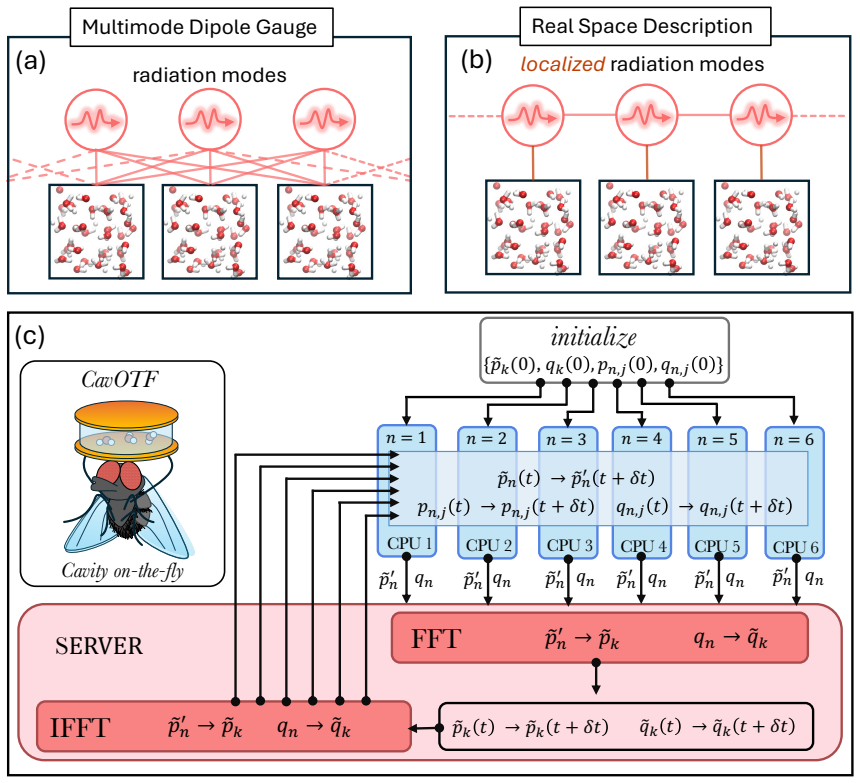
In this work, we combine the density functional tight-binding (DFTB) approach with a light-matter Hamiltonian beyond the long-wavelength approximation to propagate the dynamics of vibrational polaritons formed by coupling molecular vibrations to confined radiation inside a Fabry-P\'{e}rot optical cavity. Here, we develop a parallelized propagation scheme with lightweight inter-CPU communication by exploiting the sparse nature of the light-matter interactions in the real space representation. We find that the computationally expensive Born charges required for our propagation can be replaced with the computationally inexpensive Mulliken charges to obtain qualitatively accurate linear spectra especially when the nonlinearity (arising from molecular vibrations) of the light-matter interaction term is not substantial. However, the same approach may not be suitable to be used for studying cavity modification of energy transport or chemical dynamics as this approximation leads to spurious heating of the light-matter hybrid system. We demonstrate the utility of this on-the-fly approach to compute angle resolved polaritonic spectra of water. We implement our approach as an open-source computational package, CavOTF, which is available on GitHub.
Editorial analysis
A structured set of objections, weighed in public.
Referee Report
Summary. The manuscript develops an on-the-fly cavity-molecular dynamics scheme that couples density-functional tight-binding (DFTB) to a light-matter Hamiltonian beyond the long-wavelength approximation. It exploits sparsity for a parallelized propagation algorithm and reports that computationally cheap Mulliken charges can replace expensive Born charges to produce qualitatively accurate linear polariton spectra provided the vibrational nonlinearity in the light-matter interaction remains limited; the same replacement produces spurious heating that precludes reliable transport or reactive dynamics. The approach is demonstrated on angle-resolved spectra of water and released as the open-source CavOTF package.
Significance. If the central approximation holds under a clearly delineated regime, the method supplies an efficient route to cavity-modified vibrational spectra for systems too large for ab initio treatments, with the open-source implementation and parallelization constituting concrete strengths. The reported distinction between linear-response accuracy and heating artifacts in non-equilibrium observables is potentially useful for the polaritonics community.
major comments (2)
- Abstract and §3 (charge-approximation discussion): the central claim that Mulliken charges suffice for qualitatively accurate linear spectra 'especially when the nonlinearity ... is not substantial' is load-bearing yet lacks any quantitative metric, threshold, or deviation measure (e.g., integrated spectral difference or bound on quadratic interaction terms) that would delineate the validity regime; without such a criterion the statement remains difficult to falsify or apply.
- §4 (heating and transport results): the observation of spurious heating under the Mulliken approximation is presented as disqualifying for energy-transport or chemical-dynamics studies, but no explicit energy-conservation diagnostic, drift rate, or comparison of conserved quantities versus Born-charge reference trajectories is supplied, leaving open whether the artifact is systematic or controllable.
minor comments (2)
- The parallelization scheme and sparsity exploitation are described at a high level; a short pseudocode or timing table would clarify the claimed lightweight inter-CPU communication.
- Notation for the light-matter interaction term (real-space representation) should be cross-referenced to the specific equation defining the dipole or charge operator to avoid ambiguity for readers implementing the method.
Simulated Author's Rebuttal
We thank the referee for their careful reading of the manuscript and for the constructive comments. We address each major comment below and propose revisions to strengthen the presentation of our results.
read point-by-point responses
-
Referee: Abstract and §3 (charge-approximation discussion): the central claim that Mulliken charges suffice for qualitatively accurate linear spectra 'especially when the nonlinearity ... is not substantial' is load-bearing yet lacks any quantitative metric, threshold, or deviation measure (e.g., integrated spectral difference or bound on quadratic interaction terms) that would delineate the validity regime; without such a criterion the statement remains difficult to falsify or apply.
Authors: We agree that the validity regime would be better delineated with a quantitative metric. In the revised manuscript we will add a quantitative comparison, specifically the integrated absolute difference between the linear spectra obtained with Mulliken and Born charges across the systems studied. We will also report the relative magnitude of the quadratic terms in the light-matter interaction for the cases examined, thereby providing an operational threshold for when the nonlinearity remains limited. revision: yes
-
Referee: §4 (heating and transport results): the observation of spurious heating under the Mulliken approximation is presented as disqualifying for energy-transport or chemical-dynamics studies, but no explicit energy-conservation diagnostic, drift rate, or comparison of conserved quantities versus Born-charge reference trajectories is supplied, leaving open whether the artifact is systematic or controllable.
Authors: We acknowledge that explicit diagnostics would make the heating artifact more transparent. In the revision we will include time traces of the total energy for representative trajectories using both Mulliken and Born charges, together with the observed energy drift rates. We will also compare additional conserved quantities (such as the cavity-field energy) between the two approximations to illustrate the systematic character of the spurious heating. revision: yes
Circularity Check
No significant circularity; derivation rests on explicit propagation and spectral comparisons
full rationale
The paper develops a new parallelized on-the-fly propagation scheme that couples DFTB to a light-matter Hamiltonian beyond the long-wavelength limit, exploiting sparsity for inter-CPU communication. The central finding—that Mulliken charges can substitute for Born charges to yield qualitatively accurate linear spectra when vibrational nonlinearity in the interaction term remains limited—is presented as an empirical outcome of their simulations on water, not as a definitional equivalence, a fitted parameter renamed as a prediction, or a result forced by self-citation. No load-bearing uniqueness theorems, ansatzes smuggled via prior work, or renamings of known patterns appear in the derivation chain; the results are benchmarked against computed angle-resolved polaritonic spectra and are therefore self-contained against external computational checks.
Axiom & Free-Parameter Ledger
axioms (2)
- domain assumption DFTB provides a sufficiently accurate description of molecular vibrations and charges for the systems studied
- domain assumption The light-matter Hamiltonian beyond the long-wavelength approximation accurately captures cavity confinement effects
Lean theorems connected to this paper
-
IndisputableMonolith/Cost/FunctionalEquation.leanwashburn_uniqueness_aczel unclear?
unclearRelation between the paper passage and the cited Recognition theorem.
We find that the computationally expensive Born charges required for our propagation can be replaced with the computationally inexpensive Mulliken charges to obtain qualitatively accurate linear spectra especially when the nonlinearity (arising from molecular vibrations) of the light-matter interaction term is not substantial.
-
IndisputableMonolith/Foundation/BlackBodyRadiationDeep.leanoff_match_positive unclear?
unclearRelation between the paper passage and the cited Recognition theorem.
However, the same approach may not be suitable to be used for studying cavity modification of energy transport or chemical dynamics as this approximation leads to spurious heating of the light-matter hybrid system.
What do these tags mean?
- matches
- The paper's claim is directly supported by a theorem in the formal canon.
- supports
- The theorem supports part of the paper's argument, but the paper may add assumptions or extra steps.
- extends
- The paper goes beyond the formal theorem; the theorem is a base layer rather than the whole result.
- uses
- The paper appears to rely on the theorem as machinery.
- contradicts
- The paper's claim conflicts with a theorem or certificate in the canon.
- unclear
- Pith found a possible connection, but the passage is too broad, indirect, or ambiguous to say the theorem truly supports the claim.
Reference graph
Works this paper leans on
-
[1]
F.; Recabal, F.; Herrera, F.; Simpkins, B
(2) Ahn, W.; Triana, J. F.; Recabal, F.; Herrera, F.; Simpkins, B. S. Modification of ground-state chemical reactivity via light–matter coherence in infrared cavities.Science2023,380, 1165–1168. (3) Nagarajan, K.; Thomas, A.; Ebbesen, T. W. Chemistry under vibrational strong coupling. Journal of the American Chemical Society2021, 143, 16877–16889. (4) Yin...
work page 2023
-
[2]
(28) Sun, J.; Vendrell, O. Modification of thermal chemical rates in a cavity via resonant effects in the collective regime.The Journal of Physical Chemistry Letters2023,14, 8397–8404. (29) Li, T. E.; Nitzan, A.; Subotnik, J. E. Collective vi- brational strong coupling effects on molecular vi- brational relaxation and energy transfer: Numer- ical insights...
work page 2021
-
[3]
(36) Mondal, S.; Wang, D. S.; Keshavamurthy, S. Dis- sociation dynamics of a diatomic molecule in an optical cavity.The Journal of Chemical Physics 2022,157. (37) Liu, W.; Chen, J.; Dou, W. Polaritons under ex- tensive disordered gas-phase molecular rotations in a Fabry–P´ erot cavity.The Journal of Physical Chemistry C2024,128, 12544–12550. (38) Li, X.; ...
work page 2022
-
[4]
(39) Mandal, A.; Li, X.; Huo, P. Theory of vibra- tional polariton chemistry in the collective cou- pling regime.The Journal of Chemical Physics 2022,156. (40) Campos-Gonzalez-Angulo, J. A.; Ribeiro, R. F.; Yuen-Zhou, J. Resonant catalysis of thermally ac- tivated chemical reactions with vibrational polari- tons.Nature communications2019,10,
work page 2022
-
[5]
F.; Du, M.; Chen, L.; Yang, Z.; Wang, J.; Yuen-Zhou, J.; Xiong, W
10 (41) Xiang, B.; Ribeiro, R. F.; Du, M.; Chen, L.; Yang, Z.; Wang, J.; Yuen-Zhou, J.; Xiong, W. In- termolecular vibrational energy transfer enabled by microcavity strong light–matter coupling.Sci- ence2020,368, 665–667. (42) Brawley, Z. T.; Pannir-Sivajothi, S.; Yim, J. E.; Poh, Y. R.; Yuen-Zhou, J.; Sheldon, M. Vibra- tional weak and strong coupling m...
work page 2021
-
[6]
(55) Zheng, G.; Lundberg, M.; Jakowski, J.; Vreven, T.; Frisch, M. J.; Morokuma, K. Implementation and benchmark tests of the DFTB method and its application in the ONIOM method.International Journal of Quantum Chemistry2009,109, 1841–1854. (56) Wickramasinghe, S.; Hoehn, A.; Wetthas- inghe, S. T.; Lin, H.; Wang, Q.; Jakowski, J.; Rassolov, V.; Tang, C.; ...
work page 2012
-
[7]
(62) Carpenter, W. B.; Fournier, J. A.; Biswas, R.; Voth, G. A.; Tokmakoff, A. Delocalization and stretch-bend mixing of the HOH bend in liquid wa- ter.The Journal of Chemical Physics2017,147. (63) Vinaykin, M.; Benderskii, A. V. Vibrational sum-frequency spectrum of the water bend at the air/water interface.The Journal of Physical Chemistry Letters2012,3...
work page 2023
discussion (0)
Sign in with ORCID, Apple, or X to comment. Anyone can read and Pith papers without signing in.