REVIEW 3 major objections 5 minor 1 cited by
A cross-modal flow matching framework infers complete MIMO channel state information in real time from camera, LiDAR, and GPS sensing, with no pilot signals required.
Reviewed by Pith at T0; open to challenge. T0 means a machine referee read the full paper against a public rubric. the ladder, T0–T4 →
T0 review · deepseek-v4-flash
2026-08-03 18:28 UTC pith:DUIGESUR
load-bearing objection Solid simulation study with a genuinely new combination (flow matching + multimodal sensing for pilot-free CSI), but the central real-world claim is not yet earned by the evidence. the 3 major comments →
Environment-Aware Channel Inference via Cross-Modal Flow: From Multimodal Sensing to Wireless Channels
The pith
A machine-rendered reading of the paper's core claim, the machinery that carries it, and where it could break.
Core claim
The central claim is that sensing-to-channel inference can be cast as a cross-modal flow matching problem: a stochastic encoder fuses camera, LiDAR, and GPS into a latent distribution in channel space, and a neural velocity field transports that distribution to the real angular-domain channel distribution via an ordinary differential equation. The learning is made tractable by reformulating the flow matching objective as a conditional flow matching loss with paired sensing-channel samples, plus a modality alignment loss that maximizes mutual information between the latent and channel representations. In the paper's own terms, this is 'the first environment-aware technique capable of achievin
What carries the argument
The key mechanism is the cross-modal flow matching framework. It defines a probability path interpolating between a latent distribution (produced by a multimodal stochastic encoder that maps image, point cloud, and coordinate into a channel-shaped Gaussian) and the target angular-domain channel distribution. The velocity field of this path is learned by a time-conditioned U-Net trained with an equivalent conditional flow matching objective—since the true velocity is intractable—and a contrastive modality alignment loss that shortens the transport path. During inference, the ODE is integrated with a second-order Adams-Bashforth scheme to produce the estimated channel at low latency.
Load-bearing premise
The paired sensing-channel dataset from the procedural simulator is a faithful proxy for real-world conditions in which the same observed camera, LiDAR, and GPS data are jointly sufficient to determine the wireless channel; if real sensors are not a sufficient statistic, the learned flow may fail outside the simulator.
What would settle it
Record real-world camera, LiDAR, and GPS data alongside channel-sounder ground-truth MIMO measurements at a busy intersection, and feed the real observations into the pretrained network. If the NMSE of the estimated channel matrix is much worse than the reported -10 dB or fails to beat a simple pilot-based estimator, then the assumption that sensing data fully determines the channel is violated.
If this is right
- Eliminates pilot overhead entirely: the CSI acquisition period no longer needs pilot transmission, freeing spectrum for data.
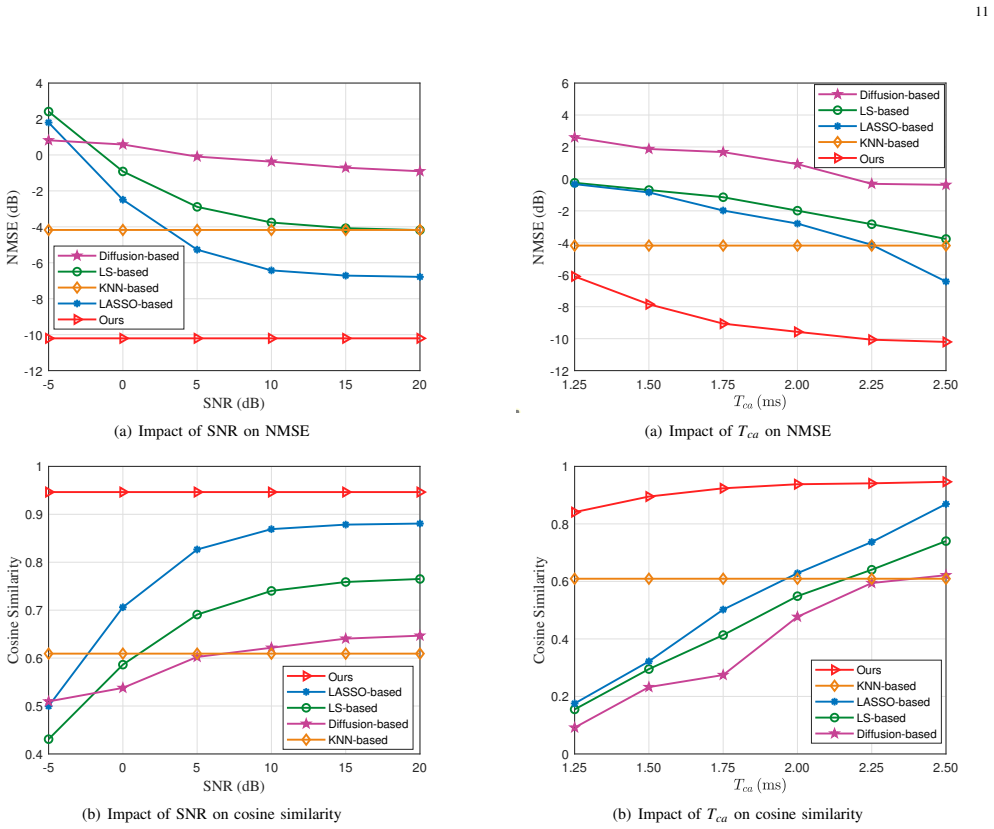
- Estimation quality is nearly invariant to SNR, because inference relies on sensing rather than noisy pilots.
- Full-CSI recovery supports generic downstream physical-layer tasks such as hybrid beamforming, not just task-specific beam selection.
- Inference latency (under 2.5 ms at 7 integration steps) fits within 5G frame constraints, enabling real-time use.
- The framework generalizes beyond a single task; the authors note easy extension to multi-user MIMO via orthogonal resource allocation.
Where Pith is reading between the lines
- If the sensor data is a sufficient statistic for the propagation environment, the same flow-matching pipeline could be recycled for other radio-sensing tasks such as localization, blockage prediction, or digital-twin channel replay; the paper only demonstrates beamforming.
- The paper's own conclusion concedes that real-world sensors provide partial observations with occlusions and calibration errors; a natural extension is to exploit the probabilistic encoder to output a distribution of plausible channels, enabling uncertainty-aware beamforming, which the paper leaves for future work.
- Because the model is trained on a procedural simulator, a strong testable extension is domain adaptation: use a small amount of real-world matched sensing-channel data to fine-tune the final integration steps, which could preserve performance where the simulator is imperfect.
- The framework's reliance on full CSI reconstruction suggests it could serve as a data-augmentation engine for pilot-based estimators, generating synthetic channel samples matched to observed environments without additional pilot transmissions.
Editorial analysis
A structured set of objections, weighed in public.
Referee Report
Summary. The paper proposes a pilot-free, environment-aware CSI acquisition framework for massive MIMO. A stochastic encoder maps camera images, LiDAR point clouds, and GPS coordinates into a latent distribution in the angular-domain channel space, and a U-Net velocity field transports this latent to the channel distribution via an ODE. Training uses a conditional flow matching loss augmented by a contrastive/KL alignment loss; inference uses second-order Adams-Bashforth integration. The method is evaluated on a self-generated Sionna/Blender urban intersection with 30,000 synchronized samples, against LS, LASSO, diffusion, KNN, and sensing-based beam-selection baselines. The reported results include NMSE around -10 dB, cosine similarity about 0.95, inference latency about 2.5 ms, and spectral-efficiency gains of up to about 25% for a downstream beamforming task. The source code is available on GitHub.
Significance. If the concerns below are addressed, this is a useful contribution. The formulation of sensing-to-channel inference as conditional flow matching is clean, the architecture is modular, and the authors provide code and a procedural multimodal channel benchmark. The ablation study supports the value of the alignment loss, and the comparisons to pilot-based and sensing-based baselines are broadly well specified. However, the advertised central claim — 'first environment-aware technique capable of achieving real-time full CSI recovery' — is supported only in a closed simulated world. The paper itself concedes in Sec. VI that real-world sensing is partial and that the same observed modalities can correspond to multiple propagation conditions, yet no experiment exercises that failure mode. In addition, the theoretical justification for the training objective overstates an existing gradient-equivalence result. These are correctable, so the work is promising but not yet conclusive.
major comments (3)
- [Sec. VI (also Intro and Sec. V)] The central claim that the method is 'capable of achieving real-time full CSI recovery' from multimodal sensing is not supported by the evidence. All experiments use a single procedural Sionna/Blender scene in which the camera, LiDAR, and GPS inputs and the wireless channel are generated from the same underlying 3D model. This closed-world design does not exercise the partial-observation failure mode that the manuscript explicitly acknowledges in Sec. VI: real sensors have limited resolution, occlusions, and calibration errors, so the same observed modalities may correspond to multiple plausible channels. No sensor-noise, occlusion, calibration-error, or out-of-distribution experiment is reported, and no analysis quantifies how much channel-relevant information the simulated sensors actually capture. The sub-10 dB NMSE and up-to-25% SE claims in Sec. V are therefore closed-world demonstr
- [Sec. IV-A, Eq. (14)] The statement that the conditional formulation achieves the same gradient dynamics as the original flow matching objective, ∇J_FM = ∇J_CFM, is imported from [19,20], where the source distribution is fixed and the gradient is taken with respect to the velocity-field parameters θ only. In this paper the source distribution q_ψ(x0|M,C,p) is itself trained through ψ, so the marginal path p_t depends on ψ. The gradient of J_FM with respect to ψ therefore includes additional terms through p_t that are not present in the CFM objective of Eq. (16). Hence Eq. (14) does not justify joint optimization of ψ and θ via L_CFM. The paper should either prove an analogous identity for ψ, or describe L_CFM as a surrogate objective and discuss the consequences for the learned encoder.
- [Sec. V, Tables II and Figs. 7-13] Every quantitative conclusion is a single-seed point estimate from one scene of 30,000 samples. There are no error bars, no multiple seeds, and no scene variation. The choice of K=7 in Fig. 7, the NMSE values in Table II, and the spectral-efficiency comparisons in Figs. 12-13 are therefore not shown to be statistically stable. Since comparisons to baselines are a major part of the contribution, at least three seeds and preferably a second scene configuration should be reported. Without this, the numerical claims are not robust.
minor comments (5)
- [Eq. (18)] The KL-divergence term appears to be missing the conventional factor 1/2; with λ=1e-4 this is numerically negligible, but the formula should be corrected.
- [Eq. (24)] The 'cosine similarity' is defined as ||H^H Ĥ||_F / (||H||_F ||Ĥ||_F), which is not the standard Frobenius cosine of the vectorized matrices. This is better described as a subspace-alignment measure; the naming and the text describing the metric should be reconciled.
- [Sec. V-A] The text says the improvement from -4.86 dB to -10.21 dB NMSE is 'approximately factor 10'; this is incorrect. The 5.35 dB difference corresponds to a factor of about 3.4.
- [Sec. IV-A.2] Minimizing the contrastive loss is described as 'equivalent' to maximizing mutual information. The InfoNCE-style loss is a lower bound on mutual information, not an exact equivalent; please state this more carefully.
- [Sec. V] Important data-generator parameters are missing: image resolution, LiDAR point count U, camera field of view, vehicle trajectories, and how the train/test split is performed at user-location level. Since the procedural dataset is a contribution, these details should be included for reproducibility.
Circularity Check
No circularity found: the cross-modal flow is trained with supervised paired data and evaluated on a held-out split; no fitted parameter or self-cited theorem is relabeled as a prediction.
full rationale
The paper's derivation chain is self-contained and not circular. The central objective (19) combines L_CFM (Eq. 16), which regresses v_theta(x_t,t) against the ground-truth residual H'_ad - x0 on paired multimodal-channel samples, with L_MA (Eqs. 17-18), a supervised contrastive and KL regularizer. The target H'_ad is ground-truth channel supervision, not a fitted constant later reported as a prediction. The dataset is split 9:1 into training and testing, and no parameter is fit to test frames. The 'first technique' claim is a literature-comparison claim, not derived from a self-citation. The two self-citations are not load-bearing: [22] is a contextual GAN citation in related work and [40] is only used for the two-stage hybrid beamforming search when computing SE. No uniqueness theorem or ansatz is imported from the authors' prior work. Two caveats should be noted, both as correctness/external-validity risks rather than circularity: (i) Sec. VI concedes that in real-world scenarios sensing modalities provide 'only a partial environmental observation due to limited sensor resolution, occlusions and calibration errors,' so 'the same observed modalities may correspond to multiple plausible propagation conditions'; this limits external validity but does not make the simulation result a relabeling of its input. (ii) Sec. IV-A1 invokes [19,20] for 'the same gradient dynamics' between J_FM and J_CFM, but that equivalence is proved for a fixed source distribution; the paper optimizes the encoder parameters psi that define q_psi, so the psi-gradient part of the reformulation is not justified by the cited theorem. This is an omitted-proof/mathematical-support gap, not circularity, because the training signal still comes from ground-truth channels. Accordingly, no circular step is identified and the score is 0.
Axiom & Free-Parameter Ledger
free parameters (3)
- lambda (KL regularization weight) =
1e-4
- K (number of ODE integration steps) =
7 (default)
- tau (temperature coefficient) =
learned; initial value not reported
axioms (6)
- standard math grad J_FM = grad J_CFM under the Gaussian conditional path
- domain assumption The wireless channel is primarily determined by relative geometry and the surrounding environment
- domain assumption The Sionna/Blender procedural generator produces paired, realistic, synchronized sensing-channel samples
- domain assumption The mmWave channel is sparse in the angular DFT domain
- ad hoc to paper Minimizing the contrastive loss is equivalent to maximizing mutual information between source and target distributions
- domain assumption Block-fading with coherence over T_f=10 ms and channel variation independently across frames
read the original abstract
Accurate channel state information (CSI) underpins reliable and efficient wireless communication. However, acquiring CSI via pilot estimation incurs substantial overhead, especially in massive multiple-input multiple-output (MIMO) systems operating in high-Doppler environments. By leveraging the growing availability of environmental sensing data, this treatise investigates pilot-free channel inference that estimates complete CSI directly from multimodal observations, including camera images, LiDAR point clouds, and GPS coordinates. In contrast to prior studies that rely on predefined channel models, we develop a data-driven framework that formulates the sensing-to-channel mapping as a cross-modal flow matching problem. The framework fuses multimodal features into a latent distribution within the channel domain, and learns a velocity field that continuously transforms the latent distribution toward the channel distribution. To make this formulation tractable and efficient, we reformulate the problem as an equivalent conditional flow matching objective and incorporate a modality alignment loss, while adopting low-latency inference mechanisms to enable real-time CSI estimation. In experiments, we build a procedural data generator based on Sionna and Blender to support realistic modeling of sensing scenes and wireless propagation. System-level evaluations demonstrate significant improvements over pilot- and sensing-based benchmarks in both channel estimation accuracy and spectral efficiency for the downstream beamforming task. The source code is available at https://github.com/gm-leung/environment-aware-channel-inference.
Figures



Forward citations
Cited by 1 Pith paper
-
Null-Space Flow Matching for MIMO Channel Estimation in Latency-Constrained Systems
Null-space flow matching decomposes MIMO CSI estimation into direct range-space reconstruction from noisy pilots and iterative FM-based null-space generation, achieving competitive NMSE under a ~3 ms latency budget wi...
Reference graph
Works this paper leans on
-
[1]
On the road to 6G: Visions, requirements, key technologies, and testbeds,
C.-X. Wang, X. You, X. Gao, X. Zhu, Z. Li, C. Zhang, H. Wang, Y . Huang, Y . Chen, H. Haas, J. S. Thompson, E. G. Larsson, M. D. Renzo, W. Tong, P. Zhu, X. Shen, H. V . Poor, and L. Hanzo, “On the road to 6G: Visions, requirements, key technologies, and testbeds,”IEEE Commun. Surv. Tutorials, vol. 25, no. 2, pp. 905–974, 2023
2023
-
[2]
A tutorial on extremely large-scale MIMO for 6G: Fundamentals, signal processing, and applications,
Z. Wang, J. Zhang, H. Du, D. Niyato, S. Cui, B. Ai, M. Debbah, K. B. Letaief, and H. V . Poor, “A tutorial on extremely large-scale MIMO for 6G: Fundamentals, signal processing, and applications,”IEEE Commun. Surv. Tutorials, vol. 26, no. 3, pp. 1560–1605, 2024
2024
-
[3]
Channel estimation and precoder design for millimeter-wave communications: The sparse way,
P. Schniter and A. Sayeed, “Channel estimation and precoder design for millimeter-wave communications: The sparse way,” inProc. 48th Asilomar Conf. Signals, Syst., Comput., 2014, pp. 273–277
2014
-
[4]
Compressive phase retrieval via generalized approximate message passing,
P. Schniter and S. Rangan, “Compressive phase retrieval via generalized approximate message passing,”IEEE Trans. Signal Process., vol. 63, no. 4, pp. 1043–1055, 2015
2015
-
[5]
Low-overhead channel estimation via 3D extrapolation for TDD mmwave massive MIMO systems under high-mobility scenarios,
B. Zhou, X. Yang, S. Ma, F. Gao, and G. Yang, “Low-overhead channel estimation via 3D extrapolation for TDD mmwave massive MIMO systems under high-mobility scenarios,”IEEE Trans. Wireless Commun., vol. 24, no. 4, pp. 2797–2813, 2025
2025
-
[6]
Pay less but get more: A dual-attention-based channel estimation network for massive MIMO sys- tems with low-density pilots,
B. Zhou, X. Yang, S. Ma, F. Gao, and G. Yang, “Pay less but get more: A dual-attention-based channel estimation network for massive MIMO sys- tems with low-density pilots,”IEEE Trans. Wireless Commun., vol. 23, no. 6, pp. 6061–6076, 2024
2024
-
[7]
Channel deduction: A new learning framework to acquire channel from outdated samples and coarse estimate,
Z. Chen, Z. Zhang, Z. Yang, C. Huang, and M. Debbah, “Channel deduction: A new learning framework to acquire channel from outdated samples and coarse estimate,”IEEE J. Sel. Areas Commun., vol. 43, no. 3, pp. 944–958, 2025
2025
-
[8]
Can wireless environment information decrease pilot overhead: A channel prediction example,
L. Shi, J. Zhang, L. Yu, Y . Zhang, Z. Zhang, Y . Cai, and G. Liu, “Can wireless environment information decrease pilot overhead: A channel prediction example,”IEEE Wireless Commun. Lett., vol. 14, no. 3, pp. 861–865, 2025
2025
-
[9]
MIMO channel estimation using score-based generative models,
M. Arvinte and J. I. Tamir, “MIMO channel estimation using score-based generative models,”IEEE Trans. Wireless Commun., vol. 22, no. 6, pp. 3698–3713, 2023
2023
-
[10]
Generative diffusion models for high dimensional channel estimation,
X. Zhou, L. Liang, J. Zhang, P. Jiang, Y . Li, and S. Jin, “Generative diffusion models for high dimensional channel estimation,”IEEE Trans. Wireless Commun., pp. 1–15, 2025
2025
-
[11]
A tutorial on environment-aware communications via channel knowledge map for 6G,
Y . Zeng, J. Chen, J. Xu, D. Wu, X. Xu, S. Jin, X. Gao, D. Gesbert, S. Cui, and R. Zhang, “A tutorial on environment-aware communications via channel knowledge map for 6G,”IEEE Commun. Surv. Tutorials, vol. 26, no. 3, pp. 1478–1519, 2024
2024
-
[12]
Sensing- assisted high reliable communication: A Transformer-based beamform- ing approach,
Y . Cui, J. Nie, X. Cao, T. Yu, J. Zou, J. Mu, and X. Jing, “Sensing- assisted high reliable communication: A Transformer-based beamform- ing approach,”IEEE J. Sel. Top. Signal Process., vol. 18, no. 5, pp. 782–795, 2024
2024
-
[13]
Computer vision aided blockage pre- diction in real-world millimeter wave deployments,
G. Charan and A. Alkhateeb, “Computer vision aided blockage pre- diction in real-world millimeter wave deployments,” inProc. IEEE Globecom Workshops (GC Wkshps), 2022, pp. 1711–1716
2022
-
[14]
Environment-aware and training-free beam alignment for mmwave massive MIMO via channel knowledge map,
D. Wu, Y . Zeng, S. Jin, and R. Zhang, “Environment-aware and training-free beam alignment for mmwave massive MIMO via channel knowledge map,” inProc. IEEE Int. Conf. Commun. Workshops (ICC Workshops), 2021, pp. 1–7
2021
-
[15]
NeRF2: Neural radio-frequency radiance fields,
X. Zhao, Z. An, Q. Pan, and L. Yang, “NeRF2: Neural radio-frequency radiance fields,” inProc. ACM Int. Conf. Mobile Comput. Netw. (Mobi- Com), Madrid, Spain, 2023
2023
-
[16]
Multi-modal environmental information sensing based path loss prediction for V2I communications,
K. Wang, L. Yu, J. Zhang, Y . Tian, E. Guo, and G. Liu, “Multi-modal environmental information sensing based path loss prediction for V2I communications,” inProc. IEEE 101st V eh. Technol. Conf. (VTC2025- Spring), 2025, pp. 1–5
2025
-
[17]
Vision-aided channel prediction based on image segmentation at street intersection scenarios,
X. Zhang, R. He, M. Yang, Z. Qi, Z. Zhang, B. Ai, and Z. Zhong, “Vision-aided channel prediction based on image segmentation at street intersection scenarios,”IEEE Trans. Cogn. Commun. Netw., 2025
2025
-
[18]
A novel multimodal fusion sensing-based channel prediction method for UA V communications,
Z. Xin, Y . Liu, J. Xing, J. Huang, J. Bian, and Y . Zhang, “A novel multimodal fusion sensing-based channel prediction method for UA V communications,”IEEE Internet Things J., vol. 12, no. 4, pp. 3948– 3960, 2025
2025
-
[19]
Flow matching for generative modeling,
Y . Lipman, R. T. Q. Chen, H. Ben-Hamu, M. Nickel, and M. Le, “Flow matching for generative modeling,” inProc. 11th Int. Conf. Learn. Represent. (ICLR), 2023
2023
-
[20]
Improving and generalizing flow- based generative models with minibatch optimal transport,
A. Tong, K. FATRAS, N. Malkin, G. Huguet, Y . Zhang, J. Rector- Brooks, G. Wolf, and Y . Bengio, “Improving and generalizing flow- based generative models with minibatch optimal transport,”Trans. Mach. Learn. Res., 2023
2023
-
[21]
Generative artificial intelligence for mobile communications: A diffusion model perspective,
X. Xu, X. Mu, Y . Liu, H. Xing, Y . Liu, and A. Nallanathan, “Generative artificial intelligence for mobile communications: A diffusion model perspective,”IEEE Commun. Mag., vol. 63, no. 7, pp. 98–105, 2025
2025
-
[22]
Data augmentation for predictive digital twin channel: Learning multi-domain correlations by convolutional TimeGAN,
G. Liang, J. Hu, K. Yang, S. Song, T. Liu, N. Xie, and Y . Yu, “Data augmentation for predictive digital twin channel: Learning multi-domain correlations by convolutional TimeGAN,”IEEE J. Sel. Top. Signal Process., vol. 18, no. 1, pp. 18–33, 2024
2024
-
[23]
Flow straight and fast: Learning to generate and transfer data with rectified flow,
X. Liu, C. Gong, and qiang liu, “Flow straight and fast: Learning to generate and transfer data with rectified flow,” inProc. 11th Int. Conf. Learn. Represent. (ICLR), 2023
2023
-
[24]
Denoising diffusion bridge models,
L. Zhou, A. Lou, S. Khanna, and S. Ermon, “Denoising diffusion bridge models,” inProc. 12th Int. Conf. Learn. Represent. (ICLR), 2024
2024
-
[25]
I2SB: image-to-image Schr¨odinger bridge,
G.-H. Liu, A. Vahdat, D.-A. Huang, E. A. Theodorou, W. Nie, and A. Anandkumar, “I2SB: image-to-image Schr¨odinger bridge,” inin Proc. 40th Int. Conf. Mach. Learn. (ICML), Honolulu, Hawaii, USA, 2023
2023
-
[26]
Text-to-image rectified flow as plug-and-play priors,
X. Yang, C. Cheng, X. Yang, F. Liu, and G. Lin, “Text-to-image rectified flow as plug-and-play priors,” inProc. 13th Int. Conf. Learn. Represent. (ICLR), 2025
2025
-
[27]
CurveFlow: Curvature-guided flow matching for image generation,
Y . Luo, D. Du, H. Huang, Y . Fang, and M. Wang, “CurveFlow: Curvature-guided flow matching for image generation,” 2025. [Online]. Available: https://arxiv.org/abs/2508.15093
Pith/arXiv arXiv 2025
-
[28]
Flowing from words to pixels: A noise-free framework for cross-modality evolution,
Q. Liu, X. Yin, A. Yuille, A. Brown, and M. Singh, “Flowing from words to pixels: A noise-free framework for cross-modality evolution,” inProc. IEEE/CVF Conf. Comput. Vis. Pattern Recognit. (CVPR), June 2025, pp. 2755–2765
2025
-
[29]
FlowTok: Flowing seamlessly across text and image tokens,
J. He, Q. Yu, Q. Liu, and L.-C. Chen, “FlowTok: Flowing seamlessly across text and image tokens,” 2025. [Online]. Available: https://arxiv.org/abs/2503.10772
arXiv 2025
-
[30]
Sionna: An open-source library for next-generation physical layer research,
J. Hoydis, S. Cammerer, F. A. Aoudia, A. Vem, N. Binder, G. Marcus, and A. Keller, “Sionna: An open-source library for next-generation physical layer research,” 2023. [Online]. Available: https://arxiv.org/abs/2203.11854
Pith/arXiv arXiv 2023
-
[31]
[Online]
Blender Online Community,Blender - a 3D modelling and rendering package, Blender Foundation, Amsterdam, The Netherlands, 2018. [Online]. Available: https://www.blender.org
2018
-
[32]
Diffusion- based generative prior for low-complexity MIMO channel estimation,
B. Fesl, M. Baur, F. Strasser, M. Joham, and W. Utschick, “Diffusion- based generative prior for low-complexity MIMO channel estimation,” IEEE Wireless Commun. Lett., vol. 13, no. 12, pp. 3493–3497, 2024
2024
-
[33]
Physics-informed generalizable wireless channel modeling with segmentation and deep learning: Fundamentals, methodologies, and challenges,
E. Zhu, H. Sun, and M. Ji, “Physics-informed generalizable wireless channel modeling with segmentation and deep learning: Fundamentals, methodologies, and challenges,”IEEE Wireless Commun., vol. 31, no. 6, pp. 170–177, 2024
2024
-
[34]
Learning transferable visual models from natural language supervision,
A. Radford, J. W. Kim, C. Hallacy, A. Ramesh, G. Goh, S. Agarwal, G. Sastry, A. Askell, P. Mishkin, J. Clarket al., “Learning transferable visual models from natural language supervision,” inProc. Int. Conf. Mach. Learn. (ICML), 2021, pp. 8748–8763
2021
-
[35]
Attention is all you need,
A. Vaswani, N. Shazeer, N. Parmar, J. Uszkoreit, L. Jones, A. N. Gomez, L. Kaiser, and I. Polosukhin, “Attention is all you need,” inProc. 31st Int. Conf. Neural Inf. Process. Syst. (NeurIPS), Long Beach, California, USA, 2017, pp. 6000–6010
2017
-
[36]
U-Net: Convolutional net- works for biomedical image segmentation,
O. Ronneberger, P. Fischer, and T. Brox, “U-Net: Convolutional net- works for biomedical image segmentation,” inProc. Int. Conf. Med. Image Comput. Comput.-Assist. Intervent. (MICCAI), Munich, Germany, 2015
2015
-
[37]
Hairer, G
E. Hairer, G. Wanner, and S. P. Nørsett,Solving ordinary differential equations I: Nonstiffproblems. Springer, 1993
1993
-
[38]
Radio resource control (RCC) protocol specification,
3GPP, “Radio resource control (RCC) protocol specification,” 3rd Gen- eration Partnership Project (3GPP), Technical Specification (TS) 38.331, Jun 2019, version 15.6.0
2019
-
[39]
S. M. Kay,Fundamentals of statistical signal processing: estimation theory. Prentice-Hall, Inc., 1993
1993
-
[40]
Dual-function hybrid beamforming and transmit diversity aided mil- limeter wave architecture,
K. Satyanarayana, M. El-Hajjar, P.-H. Kuo, A. Mourad, and L. Hanzo, “Dual-function hybrid beamforming and transmit diversity aided mil- limeter wave architecture,”IEEE Trans. V eh. Technol., vol. 67, no. 3, pp. 2798–2803, 2018
2018
discussion (0)
Sign in with ORCID, Apple, or X to comment. Anyone can read and Pith papers without signing in.