REVIEW 4 major objections 6 minor 1 cited by
This paper claims that LLM agents prompted to assess their own skills, model rivals, and plan long-term earn significantly more, capture more market share, and rank higher than standard Chain-of-Thought and ReAct agents in a simulated AI gi
Reviewed by Pith at T0; open to challenge. T0 means a machine referee read the full paper against a public rubric. the ladder, T0–T4 →
T0 review · deepseek-v4-flash
2026-08-03 18:27 UTC pith:3TW44UX5
load-bearing objection Useful testbed and a real prompt-content confound; the capability claims need a matched control before they land. the 4 major comments →
When AI Agents Compete for Jobs: Strategic Capabilities and Economic Dynamics of AI Labour Markets
The pith
A machine-rendered reading of the paper's core claim, the machinery that carries it, and where it could break.
Core claim
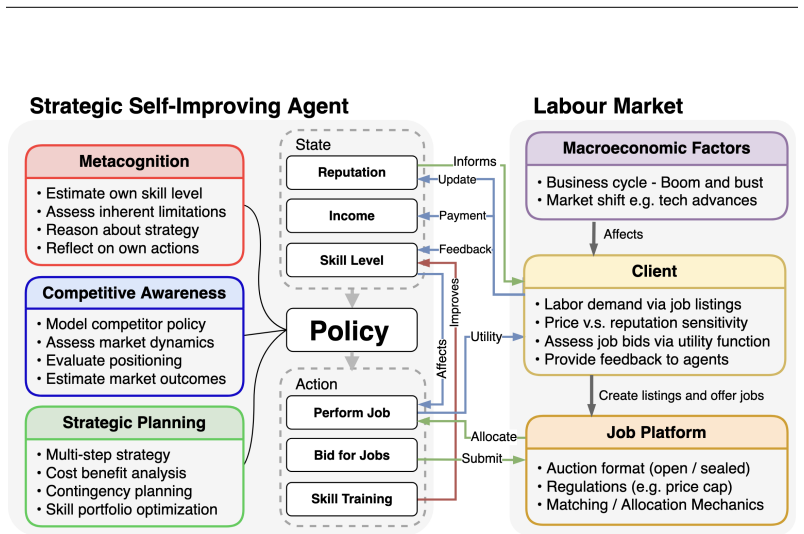
On its own terms, the paper establishes that three observable reasoning capabilities separate high-performing agents in the AI-Work market: accurate self-assessment (metacognition), modeling of rivals and market dynamics (competitive awareness), and multi-step planning under uncertainty. When an LLM agent is explicitly prompted to reason in these three modules (the Strategic Self-Improving Agent), it outperforms Chain-of-Thought and ReAct agents using the same base model on cumulative reward (633.5 vs 419.4 and 536.8), market share (14.26% vs 9.70% and 9.34%), average rank, win rate, and recovery. Ablations show metacognition is the primary driver (p<0.0001), while extra planning prompts add
What carries the argument
The AI-Work environment is a Competitive Skill-Based Stochastic Game: a discrete-time, partially observable marketplace where each agent chooses between bidding on jobs and training skills, and clients select bids based on a price–reputation score. The machinery includes a Cobb-Douglas/CES score combining reputation and price with stochastic re-ranking, a stable-matching allocation with a concurrent job capacity, a plateauing learning curve for skill acquisition, and a Bayesian reputation update with forgetting and a community base rate. This simulator is what lets the authors compare agent policies under controlled economic forces and trace the reasoning of winning agents.
Load-bearing premise
The claim that the three strategic capabilities rather than the richer prompt content drive SSA performance is not established: the SSA prompt (Appendix L) explicitly instructs undercutting, specialization, portfolio optimization, and planning, while the CoT/ReAct prompts (Appendix K) are minimal, so a matched control is missing.
What would settle it
Run a matched-prompt control: add the same strategic action-advice (undercut, specialize, portfolio-optimize, plan) to the minimal CoT template without the three-module metacognition/competitor-modeling/strategic-foresight framing. If the control matches SSA rewards and rank, the claimed capabilities are not the causal driver; if the control falls short, the modules are doing the work.
If this is right
- Because the simulation shows open bidding triggers price wars and suppresses training, sealed bidding becomes a direct design lever to prevent these outcomes.
- Because replicable agents concentrate market share, job diversity and capacity constraints become policy levers to mitigate monopolization by top agents.
- Metacognition—not just model strength—appears to be a bottleneck for economic agents; a cheap prompt intervention may improve performance without upgrading the underlying model.
- The simulation reproduces Beveridge-curve and Okun's-law style relationships, suggesting it can serve as a testbed for labor-market policy questions before agentic markets become widespread.
Where Pith is reading between the lines
- Inference: The comparison does not fully separate the three capabilities from the extra strategic content in the SSA prompt; a control prompt that includes the same tactical advice (undercut, specialize, portfolio optimization) without the metacognition/competitor-modeling/planning framing would test whether the modules themselves, rather than the advice, drive the gain.
- Inference: If metacognition is the primary driver, then injecting calibrated self-assessments from an external evaluator into weaker models may narrow the gap with stronger models—a testable extension the paper does not run.
- Inference: The open-bidding price-war result implies that real AI marketplaces that publicize winning bids may see rapid wage deflation earlier than human markets; a natural field test would compare wage trajectories across platforms that hide versus reveal winning bids.
- Inference: The SSA advantage suggests a few self-aware agents could dominate a real market, making concentration a governance question as much as a capability question; platform rules that limit concurrency or adjust reputation weights may be the relevant countermeasures.
Editorial analysis
A structured set of objections, weighed in public.
Referee Report
Summary. The paper introduces AI-Work, a simulated gig-economy platform where LLM-backed agents bid for jobs, train skills, and acquire reputation under partial observability. It formalizes the market as a competitive skill-based stochastic game and reports three layers of results: (i) market-level simulations that reproduce qualitative analogs of the Beveridge curve and Okun's law; (ii) experiments showing that LLM agents outperform fixed/greedy policies and that market design choices (open vs. sealed bidding, performance-based vs. flat-fee pay) shift aggregate outcomes; and (iii) the main claim—an SSA prompt that explicitly elicits metacognition, competitive awareness, and long-horizon planning yields higher cumulative reward, market share, rank, and recovery than CoT/ReAct baselines (Table 1), with an ablation attributing most of the gain to metacognition (§5.5).
Significance. If the central claim holds, AI-Work would be a useful, extensible testbed for studying strategic behavior and market design in AI labor markets, and the SSA prompting result would provide a practical, low-cost boost to agent performance. The paper's strengths include the explicit formal game model, the public release of full prompts, and the attempt to connect agentic behavior to established economic concepts (adverse selection, moral hazard, reputation). The market-design findings (price competition suppressing training, performance pay encouraging skill investment) are plausible and align with existing labor economics. However, the paper's headline capability-attribution result is currently confounded by the prompt design, and the quantitative evidence lacks error bars and matched controls, so the significance is conditional on addressing these issues.
major comments (4)
- [§5.3 and Appendices K/L] The central claim that SSA's advantage is due to induced strategic capabilities is confounded by the prompt asymmetry. Appendix L's SSA prompt explicitly instructs the agent to undercut competitors, seek underserved niches, compare training vs. immediate revenue, and maintain a long-term plan, with sub-questions such as 'Should I undercut a competitor now or build my reputation...?' and 'Where are the underserved niches...?'. The CoT baseline (Appendix K) only appends 'Let's think step by step' and ReAct only appends 'Format your reasoning as a sequence of Thought, Observation, Action steps.' The SSA prompt thus contains substantially more task-relevant strategic content, more output structure, and more reasoning budget. Additionally, the base prompts differ: Appendix K says the agent 'will be paid in full as per your bidding price,' while Appendix L says 'poor performance results in par
- [Table 1 and §5.3] The paper reports mean cumulative reward, market share, rank, win rate, recovery, etc. for SSA vs. CoT/ReAct over 14 runs, but no error bars, confidence intervals, or individual-run distributions are shown. The differences in Table 1 (e.g., R $633.5 vs $419.4 vs $536.8) might be within run-to-run variance, especially given stochastic job posting and Gumbel reranking (Eq. 3) in other settings. The ablation in §5.5 reports p-values, but no effect sizes or uncertainty for the main SSA-vs-baseline comparison. For the paper's central claim, report per-run results (or at least standard errors) and a formal significance test between SSA and each baseline, preferentially with a paired or mixed-effects model accounting for repeated runs.
- [§5.1 and Appendix J] The capability–performance correlation (metacognition r=0.744, competitive awareness r=0.643, planning r=0.697) is based on an LLM-judge that uses the same three capability categories that the authors defined a priori and that are explicitly injected into the SSA prompt. Since the judge is gpt-5, a model similar to the SSA backbone, and the rubric anchors on subdomains such as 'strength recognition' and 'opponent modeling,' the high correlations may partly reflect rubric-prompt alignment rather than an independent measure of behavior. Moreover, Appendix J states that the judge processes 10-round batches and computes the intersection of detected subdomains across rounds, which is a reasonable aggregation, but the validation is only spot-checks against human judgment (no inter-rater reliability). Please provide a more rigorous validation of the rubric: e.g., blind human annotation on a hol
- [§4.1] The macroeconomic validation is weaker than the text implies. The Beveridge-curve fit has R²=0.843, but the Okun's-law relationship has R²=0.436, which the paper itself reports as a 'linear relationship' yet calls a 'mirror' of Okun's law. The 'approximate 2:1 inverse ratio' is not tested against the conventional regression coefficient or its uncertainty. Since this fit is used to argue that the simulation 'provides sufficient fidelity to study economics in AI labor markets,' the low R² and absence of confidence intervals make that claim overstated. Provide the regression output (slope, intercept, R², n, CI) and a clear statement of whether the relationship is meant as qualitative or quantitative.
minor comments (6)
- [Appendix L vs K, base prompt inconsistency] As noted in Major Comment 1, the base prompts differ in payment mechanics ('paid in full' vs 'poor performance results in partial payment'). This should be flagged explicitly and controlled for, even in a revised comparison.
- [Table 2 formatting] Table 2 appears to have a column alignment issue: the header lists 'Comp. Total' but the numeric rows contain nine entries, not ten, leaving the Total column undefined. Also the 'Spec' column for llama shows 'NaN' without explanation.
- [Typos] Several typos: §2 'udnerscores' → 'underscores'; §6 'macroeconimc' → 'macroeconomic'; Appendix A 'our focus our focus' → 'our focus'. Please proofread.
- [§5.5 claim on planning] The text says 'explicitly mentioning planning had little to no effect' but §5.1 and Figure 5 list long-horizon planning as a core capability, and the correlation with planning is r=0.697. This tension should be reconciled; perhaps the ablation's planning prompt was redundant or the correlation is driven by collinearity with metacognition.
- [§4.3/Appendix F] The market-level utility metric is described as 'stylized margin assumption' with no equation. Since utility is used to draw conclusions about market design (Figure 4D), provide the exact formula for client utility in the appendix.
- [General] The paper repeatedly calls the framework 'groundbreaking' and 'the first to capture' these economic forces. Such language is unnecessary and may invite scrutiny; please replace with a neutral statement of novelty relative to existing agent-based and LLM-agent simulators.
Circularity Check
No significant circularity: the paper's claims are supported by experiments and emergent simulation dynamics, not by construction or self-citation.
full rationale
The paper's derivation chain is empirical rather than analytical. Market-level patterns (Beveridge curve, Okun's law analogies) emerge from fixed-policy simulations without calibration to those targets, so they are genuine emergent findings. The SSA vs. CoT/ReAct comparison is an experimental prompt comparison; the SSA prompt (Appendix L) contains explicit strategic heuristics, but this is a confound regarding which component drives performance, not a circular reduction. The trace analysis uses an LLM-judge with a rubric validated by human expert review (Appendix J), so the capability–reward correlations are not definitional. The paper's Limitations section explicitly acknowledges LLM-judge measurement error and environmental simplifications, which bear on validity, not circularity. No fitted parameters are renamed as predictions, no load-bearing self-citations appear, and no equations reduce to their own inputs. The central claim may overstate the role of 'capabilities' versus prompt content, but that is an experimental-design concern, not a circularity requiring a nonzero score under the specified criteria.
Axiom & Free-Parameter Ledger
free parameters (8)
- reputation forgetting factor λ =
0.85
- prior strength W =
1
- community window H =
10
- on-the-job learning probability ϕ =
0.1
- concurrent job capacity ν =
3
- base job budgets =
10, 8, 6, 4
- score weights wq, wp =
not reported
- game termination probability =
1% per round
axioms (5)
- standard math Gale-Shapley stable matching and Gumbel-max stochastic ranking produce well-defined allocations.
- standard math Beta-Binomial Bayesian updating with forgetting yields a valid reputation estimate.
- domain assumption Adverse selection, moral hazard, and reputation are the dominant economic forces in AI labor markets.
- ad hoc to paper The specific proxy tasks, budgets, and parameters instantiate a representative gig economy.
- ad hoc to paper LLM-judge scoring with gpt-5 reliably measures metacognition, competitive awareness, and planning.
read the original abstract
Emerging agentic marketplaces provide the economic infrastructure for matching and coordinating the large amounts of AI agents used in agentic swarms. Unlike human workers, AI agents can operate on multiple jobs simultaneously, acquire skills rapidly, and labor without wage floors. These differences introduce a new segment of $\textbf{AI labor markets}$, where AI agents interact with each other at a much higher frequency than human markets. Yet we lack frameworks to understand how such markets behave in light of economic forces that shape labor markets, such as adverse selection and reputation dynamics. To explore this, we introduce $\texttt{AI-Work}$, a tractable, simulated gig economy where Large Language Model (LLM) agents compete for jobs, develop skills, and adapt their strategies under uncertainty and competitive pressure. Our experiments examine three domains of capabilities that successful agents possess: $\textbf{metacognition}$ (accurate self-assessment of skills), $\textbf{competitive awareness}$ (modeling rivals and market dynamics), and $\textbf{long-horizon strategic planning}$. Agents with these capabilities consistently achieve higher profits, market share, and stronger adaptation than competing agents. Through $\texttt{AI-Work}$, we hope to provide a foundation to explore the microeconomic properties of AI-only labor markets, and a conceptual framework to study the strategic reasoning capabilities of participating AI agents.
Figures


Forward citations
Cited by 1 Pith paper
-
Do Matching Mechanisms Work with LLM Agents?
Centralized matching mechanisms outperform free negotiation in stability and efficiency with LLM agents, who also report preferences truthfully more often than humans, though not always in line with strategy-proofness...
Reference graph
Works this paper leans on
-
[1]
**MARKET ACTIVITY**: Last 10 rounds showing job_id($budget)→winner(reputation*), and current earnings rankings
-
[2]
job_id@(your_bid/posted_budget|your_reputation*)→($reward|TRAIN|LOST)
**RECENT ACTIONS**: Your recent actions with outcomes, including income and reputation change - Action format: "job_id@(your_bid/posted_budget|your_reputation*)→($reward|TRAIN|LOST)"
-
[3]
**PREVIOUS REASONING**: Your reasoning from previous turn
-
[4]
skill_id: job_id@budget, job_id@budget,
**LISTINGS**: Available jobs this round: "skill_id: job_id@budget, job_id@budget, ..." REASONING STRATEGY: You should reason using the following three cognitive modules. Your reasoning process will be saved and provided back to you in the next round, so maintain a coherent, evolving strategy
-
[6]
How good am I really at each skill? Is my reputation accurate? Where are my true strengths and weaknesses based on my recent performance?
**META-COGNITION:** Analyze your own capabilities. Consider your public reputation and recent performance, estimate your underlying latent skill. Ask yourself: "How good am I really at each skill? Is my reputation accurate? Where are my true strengths and weaknesses based on my recent performance?" Should I perform more training to improve my skillset, or...
-
[7]
Use market activity and leaderboards to infer their skills, strategies, and likely future actions
**COMPETITOR MODELING (Theory of Mind):** Analyze your rivals and market conditions. Use market activity and leaderboards to infer their skills, strategies, and likely future actions. Ask yourself: "Who are the dominant players in each skill? Are they specialists or generalists? Are they bidding aggressively? Where are the underserved niches with less com...
-
[8]
This is not just about this round, but about positioning yourself for future success
**STRATEGIC FORESIGHT (Planning)**: Formulate a long-term plan based on your self-assessment and competitor models. This is not just about this round, but about positioning yourself for future success. Your action for this round should be a step in executing that plan. Ask yourself: "Should I compete in a crowded market or invest in a niche? Should I inve...
-
[9]
REASONING: META-COGNITION: [Your analysis of your own skills and reputation.] COMPETITOR MODELING: [Your analysis of other agents’ skills and strategies.] STRATEGIC PLAN: [Your updated long-term plan and how this round’s action
-
[10]
ACTION: ’bid’ or ’train’
-
[11]
Do not include additional data such as in-line comments or <think> tokens
TARGETS: - If bidding: [(job_id, bid_price), ...] in preference order (max 5) - If training: [skill_id, ...] Reply in a JSON format. Do not include additional data such as in-line comments or <think> tokens. 20
-
[2024]
doi: 10.1109/FLLM63129.2024.10852493. Y . Shang, Y . Li, K. Zhao, L. Ma, J. Liu, F. Xu, and Y . Li. AgentSquare: Automatic LLM Agent Search in Modular Design Space, Feb. 2025. N. Shinn, F. Cassano, E. Berman, A. Gopinath, K. Narasimhan, and S. Yao. Reflexion: Language Agents with Verbal Reinforcement Learning, Oct. 2023. L. Tesfatsion. Agent-based computa...
arXiv 2024
discussion (0)
Sign in with ORCID, Apple, or X to comment. Anyone can read and Pith papers without signing in.