REVIEW 2 major objections 6 minor 3 cited by
Neutral atoms can implement a native iSWAP gate and the full exchange family from dipole-coupled Rydberg states, reaching above 99.9% fidelity in 88Sr under realistic noise.
Reviewed by Pith at T0; open to challenge. T0 means a machine referee read the full paper against a public rubric. the ladder, T0–T4 →
T0 review · deepseek-v4-flash
2026-08-03 18:27 UTC pith:FVD37RRL
load-bearing objection Useful optimal-control design for a native iSWAP gate, but the headline 99.9% fidelity claim rests on a model that omits the van der Waals shifts the abstract itself calls a significant challenge. the 2 major comments →
Expanding the Neutral Atom Gate Set: Native iSWAP and Exchange Gates from Dipolar Rydberg Interactions
The pith
A machine-rendered reading of the paper's core claim, the machinery that carries it, and where it could break.
Core claim
The paper's central claim is that the resonant dipole-dipole exchange interaction between two Rydberg states |r⟩ and |r'⟩—with the two-atom pair states |rr'⟩ and |r'r⟩ degenerate by construction—provides a native physical resource for exchange gates U_XY(θ) in the computational subspace. The authors show that a single time-continuous pulse, found by gradient-based optimal control with smoothness regularization, can simultaneously move population between ground and Rydberg manifolds and accumulate the exchange phase, replacing a fragile three-step Ramsey sequence. They demonstrate noiseless gate infidelities below 1e-10 for two driving schemes (direct excitation of both qubit states, and a la
What carries the argument
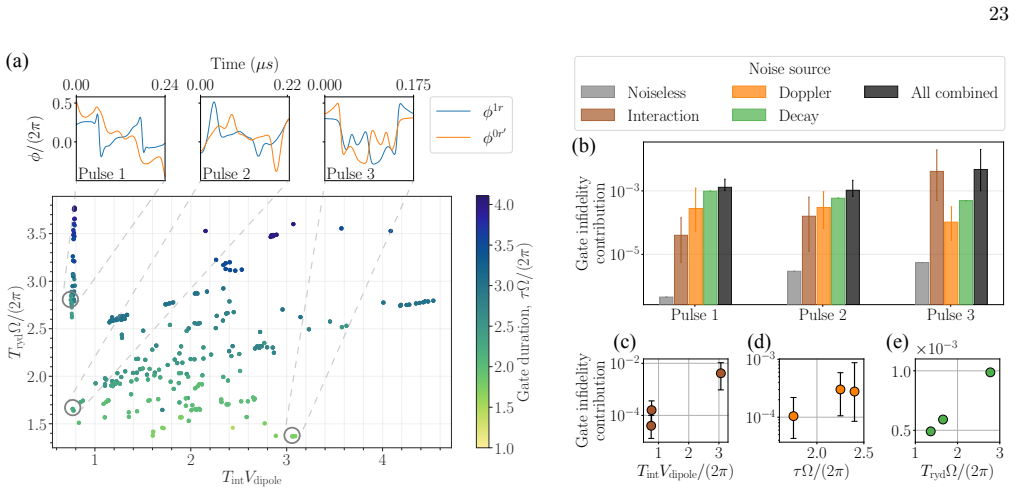
The central mechanism is the off-diagonal exchange Hamiltonian H_exchange = C3/R^3 (|rr'⟩⟨r'r| + h.c.), which swaps the Rydberg states of two atoms when the pair states are degenerate. The key objects are the optimal-control pulses that transfer this interaction into the qubit manifold; they are constructed for two global driving schemes and two modulation types, with smoothness regularization to make them experimentally feasible. The paper also defines three noise-relevant scalar metrics—T_ryd (total time spent in Rydberg states), T_int·V_dipole (accumulated exchange phase), and the gate duration τ—and uses them to select pulses that are least sensitive to atomic motion, decay, and laser no
Load-bearing premise
The load-bearing premise is that the only relevant Rydberg-pair interaction is the resonant exchange term C3/R^3, with all van der Waals shifts and off-resonant channels omitted; if these neglected shifts are significant at R≈6 µm for n=61–65 strontium Rydberg states, the optimized pulses acquire extra phase errors and the 99.9% fidelity claim no longer follows.
What would settle it
Compute or measure the C6 van der Waals shift for the chosen strontium Rydberg pair (e.g., 5s61s 3S1 / 5s61p 3P0) at R≈6 µm and compare it with the exchange coupling C3/R^3 (~2π×5–10 MHz). If the vdW shift is comparable to or larger than the exchange or Rabi frequencies, the noiseless gate infidelity will exceed the reported ~1e-10 and the noise budget must be recomputed. A direct two-atom interferometric measurement of the exchange oscillation frequency versus distance would reveal any additional diagonal shift.
If this is right
- Neutral-atom QPUs can natively run iSWAP and arbitrary-angle exchange gates U_XY(θ) with only one additional Rydberg state and a microwave or laser drive, complementing the standard diagonal CZ gate.
- For strontium-88, the optimized scheme-A pulse reaches 99.92% iSWAP fidelity under realistic noise (99.81% at standard parameters, 99.95% for a phase-modulated variant in the appendix), giving a concrete error budget for an experiment.
- The exchange gate family U_XY(θ) is obtained by continuously deforming the iSWAP pulse, so a single calibration family can serve multiple angles.
- Because the exchange interaction scales as R^-3 while the van der Waals interaction scales as R^-6, native exchange gates can operate at larger interatomic distances than CZ gates, potentially increasing connectivity without sacrificing speed.
- Reduced gate counts follow in circuits that need swap or XY interactions: quantum Fourier transform implementations, parity-architecture optimization, and error-correction schemes using iSWAP all benefit from a native non-diagonal gate.
Where Pith is reading between the lines
- Inference: The R^-3 vs R^-6 scaling suggests a quantitative distance-fidelity tradeoff the paper does not compute; a natural extension is to map the maximum interatomic separation at which 99.9% exchange-gate fidelity holds for a given C3, which would test the connectivity promise directly.
- Inference: Since the pulses form a continuous one-parameter family in the gate angle, analytic or interpolated pulse families over the full range (0, π] could remove per-angle optimal-control runs; the paper notes the continuous deformation but does not develop such a parameterization.
- Inference: The fidelity-response framework could be inverted to co-design laser filters and pulses: given a pulse's response function, one could shape the laser PSD (e.g., cavity-filtering) to minimize overlap, beyond simply choosing among precomputed pulses.
- Inference: Native iSWAP could change compiler cost models: replacing the standard three-CZ SWAP construction with a single iSWAP plus single-qubit rotations would cut entangling-gate count in routing-heavy circuits, which matters for neutral-atom QEC architectures.
Editorial analysis
A structured set of objections, weighed in public.
Referee Report
Summary. The paper proposes a native implementation of iSWAP and parameterized exchange gates U_XY(θ) for neutral atoms using two dipole-coupled Rydberg states with vanishing Förster defect, combined with optimally controlled global drives. The authors consider two driving schemes (A and B) and both Rabi- and phase-modulated pulse ansätze, reporting noiseless gate infidelities below 1e-10 for optimized pulses. For a 88Sr architecture they construct a noise budget including atomic motion, Rydberg decay, and laser phase/intensity noise modeled by PSDs, and use a noise-aware pulse selection strategy to identify a pulse ('Pulse 2') that reaches 99.81% fidelity with standard parameters and 99.92% with an 'optimal' parameter set (Table I). They also optimize the full exchange gate family U_XY(θ) and apply fidelity response theory to analyze laser-noise sensitivity.
Significance. If the central claim is established, the paper offers a useful extension of the neutral-atom entangling gate set beyond the usual diagonal CZ-type gates, with potential circuit-depth reductions in optimization and QEC settings. The strengths include a transparent optimal-control pipeline (JAX/AD, smoothing regularization), an extensive noise model with experimentally motivated PSDs, the FRT-based pulse selection analysis, and the extension to a continuous exchange gate family. However, the headline fidelity claim rests on a model Hamiltonian that omits van-der-Waals interactions that the abstract itself flags as a significant challenge; without a quantitative justification of that omission, the 99.9% claim is not yet supported.
major comments (2)
- [Sec. II, Eq. (3); Sec. IV; Table I] Eq. (3) omits all van-der-Waals (vdW) shifts: only the resonant exchange term C3/R^3(|rr'><r'r|+h.c.) is kept, while diagonal C6/R^6 terms for |rr>, |r'r'>, |rr'>, |r'r> and off-resonant Förster channels are dropped. The abstract calls vdW interactions a 'significant challenge', yet no C6 estimate is given for the 88Sr states used in Sec. IV/Table I (n=61, R=6.8 µm; 'optimal': n=65, R=6.0 µm). During Scheme A both atoms can occupy the same Rydberg state, so these shifts act on populated states. With C3=2π×1570 MHz µm^3 at n=61, plausible C6 values produce shifts 0.01–10 MHz at R≈6 µm—comparable to or exceeding V_dipole=2π×5–10 MHz. This introduces phase errors absent from the 10^-10 noiseless infidelities and the noise budget. Provide quantitative C6 bounds and include them in the model/noise analysis; otherwise the >99.9% claim is unsupported.
- [Secs. IV–V, Table I] The reported 99.92% fidelity is an in-sample prediction. 'Pulse 2' was selected from the noise-free landscape using the same noise model that later evaluates it, and the 'optimal' experimental parameters are chosen to minimize the total infidelity predicted by that same model. No cross-validation on independent noise realizations or parameter sets, and no Monte-Carlo uncertainty estimate, is reported. A more robust statement would provide error bars on 1−F from the MC sampling (App. B4) or test the optimized pulse under a different PSD/trap model.
minor comments (6)
- [Throughout] Typos and formatting issues: 'dephts' in the Introduction, 'Kleéber' in the affiliation, and garbled axis labels in several figures (e.g., 'V dipoΩeφΩ'). These should be cleaned up.
- [Appendix D, Eq. (D5)] In the phase-noise derivation, the second line should contain |a⟩⟨b| rather than |a⟩⟨1|; as written it is inconsistent with the preceding expansion.
- [Appendix E] The scaling formula 'Ω new = Ω Ω 1,˜r(n)/Ω1,r(61)' is unclear; it should read Ω_new = Ω × Ω_{1,˜r}(n)/Ω_{1,r}(61) with definitions of the matrix elements.
- [Table I and Sec. IV] The 'Optimal' column entry 'Laser wavevector k_x^eff –' is ambiguous; the text implies k_x^eff is fixed at 3×10^6 m^-1 for the standard analysis. Please clarify whether it is held fixed in the optimization.
- [Sec. IV, Eq. (6) and Eq. (11)] The fidelity metric in Eq. (6) is used also for the noisy, non-unitary evolution generated by Eq. (11). Please clarify how the trace fidelity is normalized for non-trace-preserving dynamics and why this equals the standard gate fidelity in the noiseless limit.
- [Sec. VI / Note added] The related work [65] is acknowledged only in a note. A brief comparison of the proposed approach with Ref. [65] (e.g., Förster-resonant vs. ΔF=0 exchange) would help readers place the contribution.
Circularity Check
No significant circularity: the optimal-control and noise-model derivation is self-contained; the 99.9% figure is an in-sample simulation result and the self-citations are motivational, not load-bearing.
full rationale
The paper's chain is: adopt the two-atom exchange-plus-drive Hamiltonian [Eq. (3)], numerically optimize control pulses to maximize the fidelity to U_XY(theta) [Eqs. (5)-(6)], then evaluate the selected pulses in a noise model using external PSD data [43] and independently computed Sr decay rates. The noiseless F≈1 values are the optimized objective, not predictions; the noisy fidelities are model outputs, and the 'optimal' parameters in Table I are chosen by minimizing that same model's infidelity in Sec. V. This in-sample selection is a potential optimistic-bias/validity caveat for the headline 99.9%, but no target result is used as an input, and no equation is defined in terms of the result it derives. Self-citations (Refs. [15], [38]-[40]) occur only in background/motivation and are not load-bearing. The main unaddressed issue is physical completeness: Eq. (3) omits van der Waals shifts on pair states, which the abstract itself calls 'a significant challenge,' and no C6 bound is supplied. That is a correctness risk for the stated fidelity, not circularity.
Axiom & Free-Parameter Ledger
free parameters (4)
- Optimal pulse controls {Ω_ab(t), φ_ab(t)} =
piecewise values not published
- Smoothness regularization λ =
not stated
- Optimal experimental parameter set =
Ω=2π×20 MHz, ω_xy=2π×50 kHz, n=65, V_dipole=2π×10 MHz, R=6.0 µm
- Pulse candidate selection ('Pulse 2') =
N/A
axioms (7)
- domain assumption Two Rydberg states |r⟩,|r'⟩ have exact Förster resonance ΔF=0 and the only relevant DDI channel is |rr'⟩↔|r'r⟩; all other pair states and vdW terms are neglected.
- domain assumption Global drives act on the two target atoms only; spectator atoms in a multi-qubit array are absent from U(τ).
- domain assumption Frozen-gas approximation: atomic positions and velocities are constant during each gate and sampled shot-to-shot.
- domain assumption Non-Hermitian decay model with effective rates Γ_r, Γ_r' adequately describes Rydberg decay.
- domain assumption Laser phase and intensity PSDs taken from Ref. [43] are representative, and identical PSDs are used for all drives.
- domain assumption Quantum-defect wavefunctions with chosen integer parameters I(l) reproduce the needed dipole matrix elements and lifetimes.
- domain assumption Black-body radiation induced Rydberg transitions can be neglected.
read the original abstract
We present a native realization of iSWAP and parameterized \textit{exchange} gates for neutral-atom quantum processing units. Our approach leverages strong dipole-dipole interactions between two different dipole-coupled Rydberg states, employing optimal control techniques to design high-fidelity, time-efficient gate pulses. To minimize experimental complexity, we utilize global driving fields acting identically on all atoms and apply pulse smoothing techniques. While detrimental van-der-Waals interactions pose a significant challenge, we demonstrate that for both $^{133}$Cs, as a representative alkali atom, and $^{88}$Sr, an alkaline-earth species, high-fidelity pulses can nevertheless be obtained over a broad range of parameters. We identify candidate protocols with reduced susceptibility to noise and analyze their performance under realistic conditions, accounting for atomic motion, Rydberg decay, and experimentally motivated laser frequency and intensity noise. Crucially, we demonstrate that in both Alkali and alkaline-earth-based systems, we can obtain fast iSWAP gates with fidelities of $99.9\%$ under realistic experimental conditions. These results pave the way for expanding the neutral-atom gate set beyond conventional Rydberg-blockade-based entangling gates.
Figures



Forward citations
Cited by 3 Pith papers
-
Entangling gate performance and fidelity limits with neutral atom F\"orster resonances
A two-eigenstate model near Förster resonances bounds neutral-atom gate fidelity by F ≤ 1 - (π/2)/(V τ_R) and supplies a saturating protocol that improves the prior limit by ~40%.
-
Entangling gate performance and fidelity limits with neutral atom F\"orster resonances
A two-eigenstate model near Förster resonances yields a gate fidelity bound F ≤ 1 - (π/2)/(V τ_R) saturated by a new protocol that improves prior limits by ~40%, with common protocols showing up to 100x higher fidelit...
-
Routing Codes: High-Rate Quantum LDPC Codes with Short, Parallel Non-Local Connectivity
Routing codes are high-rate qLDPC codes with short parallel non-local couplings that achieve BB-code rates while cutting qubit overhead by a factor of ~8 versus surface codes in circuit simulations.
Reference graph
Works this paper leans on
-
[1]
standard
= 0for our selected pulse [c.f. Fig. 7(a)], increasing Ωmoves the peaks inI ϕ(f) to largerf. Given that the PSDS ϕ(f)strongly decreases withf, this leads to the observed decay of the laser phase induced noise whenΩ is increased. Laser intensity noise, by contrast, leads to larger contributions to gate infidelity with increasingΩ, as expected. This can als...
2021
-
[2]
F. Gyger, M. Ammenwerth, R. Tao, H. Timme, S. Snigirev, I. Bloch, and J. Zeiher, Continuous op- eration of large-scale atom arrays in optical lattices, arXiv:2402.04994 (2024)
Pith/arXiv arXiv 2024
-
[3]
M. A. Norcia, H. Kim, W. B. Cairncross, M. Stone, A. Ryou, M. Jaffe, M. O. Brown, K. Barnes, P. Battaglino, A. Brown, K. Cassella, C.-A. Chen, R. Coxe, D. Crow, J. Epstein, C. Griger, E. Halperin, F. Hummel, A. M. W. Jones, J. M. Kindem, J. King, K. Kotru, J. Lauigan, M. Li, M. Lu, E. Megidish, J. Marjanovic, M. McDonald, T. Mittiga, J. A. Mu- niz, S. Nar...
Pith/arXiv arXiv 2024
-
[4]
H. J. Manetsch, G. Nomura, E. Bataille, K. H. Leung, X. Lv, and M. Endres, A tweezer array with 6100 highly coherent atomic qubits, Nature647, 60 (2025)
2025
-
[5]
N.-C. Chiu, E. C. Trapp, J. Guo, M. H. Abobeih, L. M. Stewart, S. Hollerith, P. Stroganov, M. Kalinowski, A. A. Geim, S. J. Evered, S. H. Li, L. M. Peters, D. Bluvstein, T. T. Wang, M. Greiner, V. Vuletić, and M. D. Lukin, Continuous operation of a coherent 3,000-qubit system, arXiv:2506.20660 10.48550/arXiv.2506.20660 (2025)
-
[6]
Bluvstein, H
D. Bluvstein, H. Levine, G. Semeghini, T. T. Wang, S. Ebadi, M. Kalinowski, A. Keesling, N. Maskara, H. Pichler, M. Greiner, V. Vuletic, and M. D. Lukin, A quantum processor based on coherent transport of en- tangled atom arrays, Nature604, 451 (2022)
2022
-
[7]
S. J. Evered, D. Bluvstein, M. Kalinowski, S. Ebadi, T. Manovitz, H. Zhou, S. H. Li, A. A. Geim, T. T. Wang, N. Maskara, H. Levine, G. Semeghini, M. Greiner, V. Vuletić, and M. D. Lukin, High-fidelity parallel entan- gling gates on a neutral-atom quantum computer, Nature 622, 268 (2023)
2023
-
[8]
J. A. Muniz, M. Stone, D. T. Stack, M. Jaffe, J. M. Kindem, L. Wadleigh, E. Zalys-Geller, X. Zhang, C.-A. Chen, M. A. Norcia, J. Epstein, E. Halperin, F. Hum- mel, T. Wilkason, M. Li, K. Barnes, P. Battaglino, T. C. Bohdanowicz, G. Booth, A. Brown, M. O. Brown, W. B. Cairncross, K. Cassella, R. Coxe, D. Crow, M. Feldkamp, C. Griger, A. Heinz, A. M. W. Jon...
2025
-
[9]
Finkelstein, R
R. Finkelstein, R. B.-S. Tsai, X. Sun, P. Scholl, S. Di- rekci, T. Gefen, J. Choi, A. L. Shaw, and M. Endres, Universal quantum operations and ancilla-based readout for tweezer clocks, Nature634, 321 (2024)
2024
-
[10]
R. Tao, O. Lib, F. Gyger, H. Timme, M. Ammen- werth, I. Bloch, and J. Zeiher, Universal gates for a metastable qubit in strontium-88, arXiv:2506.10714 10.48550/arXiv.2506.10714 (2025)
-
[11]
Jaksch, J
D. Jaksch, J. I. Cirac, P. Zoller, S. L. Rolston, R. Côté, and M. D. Lukin, Fast quantum gates for neutral atoms, Phys. Rev. Lett.85, 2208 (2000)
2000
-
[12]
Isenhower, E
L. Isenhower, E. Urban, X. L. Zhang, A. T. Gill, T. Henage, T. A. Johnson, T. G. Walker, and M. Saffman, Demonstration of a neutral atom controlled- not quantum gate, Phys. Rev. Lett.104, 010503 (2010)
2010
-
[13]
Levine, A
H. Levine, A. Keesling, G. Semeghini, A. Omran, T. T. Wang, S. Ebadi, H. Bernien, M. Greiner, V. Vuletić, H. Pichler, and M. D. Lukin, Parallel implementation of high-fidelity multiqubit gates with neutral atoms, Phys. Rev. Lett.123, 170503 (2019)
2019
-
[14]
S. Jandura and G. Pupillo, Time-Optimal Two- and Three-Qubit Gates for Rydberg Atoms, Quantum6, 712 (2022), arXiv:2202.00903 [quant-ph]
Pith/arXiv arXiv 2022
-
[15]
Fromonteil, D
C. Fromonteil, D. Bluvstein, and H. Pichler, Protocols for rydberg entangling gates featuring robustness against quasistatic errors, PRX Quantum4, 020335 (2023)
2023
-
[16]
Kazemi, M
J. Kazemi, M. Schuler, C. Ertler, and W. Lechner, Mul- tiqubit parity gates for rydberg atoms in various config- urations, Phys. Rev. Res.7, 033269 (2025)
2025
-
[17]
Barredo, S
D. Barredo, S. de Léséleuc, V. Lienhard, T. Lahaye, and A. Browaeys, An atom-by-atom assembler of defect-free arbitrary two-dimensional atomic arrays, Science354, aah3778 (2016)
2016
-
[18]
Barredo, V
D. Barredo, V. Lienhard, S. de Léséleuc, T. Lahaye, and A. Browaeys, Synthetic three-dimensional atomic struc- tures assembled atom by atom, Nature561, 79 (2018)
2018
-
[19]
Browaeys and T
A. Browaeys and T. Lahaye, Many-body physics with individually controlled Rydberg atoms, Nature Physics 16, 132 (2020)
2020
-
[20]
D. Bluvstein, S. J. Evered, A. A. Geim, S. H. Li, H. Zhou, T. Manovitz, S. Ebadi, M. Cain, M. Kalinowski, D. Hangleiter, J. P. B. Ataides, N. Maskara, I. Cong, X. Gao, P. S. Rodriguez, T. Karolyshyn, G. Semeghini, M. J. Gullans, M. Greiner, V. Vuletić, and M. D. Lukin, Logical quantum processor based on reconfigurable atom arrays, Nature 10.1038/s41586-02...
-
[21]
B. W. Reichardt, A. Paetznick, D. Aasen, I. Basov, J. M. Bello-Rivas, P. Bonderson, R. Chao, W. v. Dam, M. B. Hastings, A. Paz, M. P. d. Silva, A. Sundaram, K. M. Svore, A. Vaschillo, Z. Wang, M. Zanner, W. B. Cairncross, C.-A. Chen, D. Crow, H. Kim, J. M. Kin- dem, J. King, M. McDonald, M. A. Norcia, A. Ryou, M. Stone, L. Wadleigh, K. Barnes, P. Battagli...
Pith/arXiv arXiv 2024
-
[22]
D. Bluvstein, A. A. Geim, S. H. Li, S. J. Evered, J. P. B. Ataides, G. Baranes, A. Gu, T. Manovitz, M. Xu, M. Kalinowski, S. Majidy, C. Kokail, N. Maskara, E. C. Trapp, L. M. Stewart, S. Hollerith, H. Zhou, M. J. Gullans, S. F. Yelin, M. Greiner, V. Vuletic, M. Cain, and M. D. Lukin, Architectural mechanisms of a univer- sal fault-tolerant quantum compute...
-
[23]
M. Cain, C. Zhao, H. Zhou, N. Meister, J. P. B. Ataides, A. Jaffe, D. Bluvstein, and M. D. Lukin, Correlated de- coding of logical algorithms with transversal gates, Phys- ical Review Letters133, 240602 (2024)
2024
-
[24]
P. S. Rodriguez, J. M. Robinson, P. N. Jepsen, Z. He, C. Duckering, C. Zhao, K.-H. Wu, J. Campo, K. Bag- nall, M. Kwon, T. Karolyshyn, P. Weinberg, M. Cain, S. J. Evered, A. A. Geim, M. Kalinowski, S. H. Li, T. Manovitz, J. Amato-Grill, J. I. Basham, L. Bern- stein, B. Braverman, A. Bylinskii, A. Choukri, R. DeAn- gelo, F. Fang, C. Fieweger, P. Frederick,...
2025
-
[25]
Saffman, T
M. Saffman, T. G. Walker, and K. Mølmer, Quantum information with rydberg atoms, Rev. Mod. Phys.82, 2313 (2010)
2010
-
[26]
Pelegrí, A
G. Pelegrí, A. J. Daley, and J. D. Pritchard, High-fidelity multiqubit Rydberg gates via two-photon adiabatic rapid passage, Quantum Science and Technology7, 045020 (2022)
2022
-
[27]
D. F. Locher, J. Old, K. Brechtelsbauer, J. Holschbach, H. P. Büchler, S. Weber, and M. Müller, Multi- qubit Rydberg Gates for Quantum Error Correction, arXiv:2512.00843 10.48550/arXiv.2512.00843 (2025)
-
[28]
Barredo, H
D. Barredo, H. Labuhn, S. Ravets, T. Lahaye, A. Browaeys, and C. S. Adams, Coherent Excitation Transfer in a Spin Chain of Three Rydberg Atoms, Phys- ical Review Letters114, 113002 (2015)
2015
-
[29]
C. Chen, G. Bornet, M. Bintz, G. Emperauger, L. Leclerc, V. S. Liu, P. Scholl, D. Barredo, J. Hauschild, S. Chatterjee, M. Schuler, A. M. Läuchli, M. P. Zale- tel, T. Lahaye, N. Y. Yao, and A. Browaeys, Continuous symmetry breaking in a two-dimensional Rydberg array, Nature616, 691 (2023)
2023
-
[30]
Sbierski, M
B. Sbierski, M. Bintz, S. Chatterjee, M. Schuler, N. Y. Yao, and L. Pollet, Magnetism in the two-dimensional dipolar XY model, Physical Review B109, 144411 (2024). 14
2024
-
[31]
de Léséleuc, V
S. de Léséleuc, V. Lienhard, P. Scholl, D. Barredo, S. We- ber, N. Lang, H. P. Büchler, T. Lahaye, and A. Browaeys, Observation of a symmetry-protected topological phase of interacting bosons with Rydberg atoms, Science365, aav9105 (2019)
2019
-
[32]
Z. Yue, Y.-F. Mao, X. Liang, Z.-X. Hua, P. Ge, Y.-X. Chao, K. Li, C. Jia, M. K. Tey, Y. Xu, and L. You, Obser- vation of average topological phase in disordered rydberg atom array, arXiv:2505.06286 (2025), arXiv:2505.06286 [cond-mat.quant-gas]
Pith/arXiv arXiv 2025
-
[33]
Y. Chew, T. Tomita, T. P. Mahesh, S. Sugawa, S. de Léséleuc, and K. Ohmori, Ultrafast energy ex- change between two single rydberg atoms on a nanosec- ond timescale, Nature Photonics16, 724 (2022)
2022
-
[34]
Giudici, S
G. Giudici, S. Veroni, G. Giudice, H. Pichler, and J. Zei- her, Fast entangling gates for rydberg atoms via reso- nant dipole-dipole interaction, PRX Quantum6, 030308 (2025)
2025
-
[35]
D. M. Abrams, N. Didier, B. R. Johnson, M. P. da Silva, and C. A. Ryan, Implementation of the XY interaction family with calibration of a single pulse, Nature Electron- ics3, 744 (2020)
2020
-
[36]
E. C. Peterson, G. E. Crooks, and R. S. Smith, Fixed- Depth Two-Qubit Circuits and the Monodromy Poly- tope, Quantum4, 247 (2020)
2020
-
[37]
Križan, J
C. Križan, J. Biznárová, L. Chen, E. Hogedal, A. Osman, C. W. Warren, S. Kosen, H.-X. Li, T. Abad, A. Ag- garwal, M. Caputo, J. Fernández-Pendás, A. Gaikwad, L. Grönberg, A. Nylander, R. Rehammar, M. Rommel, O. I. Yuzephovich, A. F. Kockum, J. Govenius, G. Tan- credi, and J. Bylander, Quantum SWAP gate realized with CZ and iSWAP gates in a superconducting...
2025
-
[38]
Z. Wang, N. C. Rubin, J. M. Dominy, and E. G. Ri- effel, $XY$-mixers: analytical and numerical results for QAOA, Physical Review A101, 012320 (2020)
2020
-
[39]
Drieb-Schön, K
M. Drieb-Schön, K. Ender, Y. Javanmard, and W. Lech- ner, Parity Quantum Optimization: Encoding Con- straints, Quantum7, 951 (2023)
2023
- [40]
-
[41]
F. Dreier, C. Fleckenstein, G. Aigner, M. Fell- ner, R. Stahn, M. Lanthaler, and W. Lechner, Connectivity-aware Synthesis of Quantum Algorithms, arXiv:2501.14020 10.48550/arXiv.2501.14020 (2025)
-
[42]
Eickbusch, M
A. Eickbusch, M. McEwen, V. Sivak, A. Bourassa, J. Atalaya, J. Claes, D. Kafri, C. Gidney, C. W. Warren, J. Gross, A. Opremcak, N. Zobrist, K. C. Miao, G. Roberts, K. J. Satzinger, A. Bengtsson, M. Neeley, W. P. Livingston, A. Greene, R. Acharya, L. Aghababaie Beni, G. Aigeldinger, R. Alcaraz, T. I. Andersen, M. Ansmann, F. Arute, K. Arya, A. As- faw, R. ...
2025
-
[43]
G. P. Gehér, D. Byfield, and A. Ruban, Direc- tional Codes: a new family of quantum LDPC codes on hexagonal- and square-grid connectivity hardware, arXiv:2507.19430 10.48550/arXiv.2507.19430 (2025)
-
[44]
R. B.-S. Tsai, X. Sun, A. L. Shaw, R. Finkelstein, and M. Endres, Benchmarking and fidelity response theory of high-fidelity rydberg entangling gates, PRX Quantum6, 010331 (2025)
2025
-
[45]
T. G. Walker and M. Saffman, Zeros of Ryd- berg–Rydberg Föster interactions, Journal of Physics B: Atomic, Molecular and Optical Physics38, S309 (2005)
2005
-
[46]
Ravets, H
S. Ravets, H. Labuhn, D. Barredo, L. Béguin, T. Lahaye, and A. Browaeys, Coherent dipole–dipole coupling be- tween two single Rydberg atoms at an electrically-tuned Förster resonance, Nature Physics10, 914 (2014)
2014
-
[47]
A. L. Shaw, R. Finkelstein, R. B.-S. Tsai, P. Scholl, T. H. Yoon, J. Choi, and M. Endres, Multi-ensemble metrology by programming local rotations with atom movements, Nature Physics20, 195 (2024)
2024
-
[48]
Khaneja, T
N. Khaneja, T. Reiss, C. Kehlet, T. Schulte-Herbrüggen, and S. J. Glaser, Optimal control of coupled spin dy- namics: Design of NMR pulse sequences by gradient as- cent algorithms, Journal of Magnetic Resonance172, 296 (2005)
2005
-
[49]
Bradbury, R
J. Bradbury, R. Frostig, P. Hawkins, M. J. Johnson, C. Leary, D. Maclaurin, G. Necula, A. Paszke, J. Vander- Plas, S. Wanderman-Milne, and Q. Zhang, JAX: Com- posable transformations of Python+NumPy programs (2018)
2018
-
[50]
N. Maskara, S. Ostermann, J. Shee, M. Kalinowski, A. M. Gomez, R. A. Bravo, D. S. Wang, A. I. 15 Krylov, N. Y. Yao, M. Head-Gordon, M. D. Lukin, and S. F. Yelin, Programmable Simulations of Molecules and Materials with Reconfigurable Quantum Processors, arXiv:2312.02265 (2023), arXiv:2312.02265 [cond-mat, physics:physics, physics:quant-ph]
Pith/arXiv arXiv 2023
-
[51]
de Léséleuc, D
S. de Léséleuc, D. Barredo, V. Lienhard, A. Browaeys, and T. Lahaye, Analysis of imperfections in the coherent optical excitation of single atoms to rydberg states, Phys. Rev. A97, 053803 (2018)
2018
-
[52]
Pagano, S
A. Pagano, S. Weber, D. Jaschke, T. Pfau, F. Meinert, S. Montangero, and H. P. Büchler, Error budgeting for a controlled-phase gate with strontium-88 rydberg atoms, Phys. Rev. Res.4, 033019 (2022)
2022
-
[53]
Scholl, A
P. Scholl, A. L. Shaw, R. B.-S. Tsai, R. Finkelstein, J. Choi, and M. Endres, Erasure conversion in a high- fidelity rydberg quantum simulator, Nature622, 273 (2023)
2023
-
[54]
Katori, M
H. Katori, M. Takamoto, V. G. Pal’chikov, and V. D. Ovsiannikov, Ultrastable optical clock with neutral atoms in an engineered light shift trap, Phys. Rev. Lett. 91, 173005 (2003)
2003
-
[55]
A. D. Ludlow, T. Zelevinsky, G. Campbell, S. Blatt, M. Boyd, M. H. de Miranda, M. Martin, J. Thomsen, S. M. Foreman, J. Ye,et al., Sr lattice clock at 1×10–16 fractional uncertainty by remote optical evaluation with a ca clock, Science319, 1805 (2008)
2008
-
[56]
M. D. Swallows, G. K. Campbell, A. D. Ludlow, M. M. Boyd, J. W. Thomsen, M. J. Martin, S. Blatt, T. L. Nicholson, and J. Ye, Precision measurement of fermionic collisions using an 87sr optical lattice clock with 1×10- 16 inaccuracy, IEEE Transactions on Ultrasonics, Ferro- electrics, and Frequency Control57, 574 (2010)
2010
-
[57]
N. D. Lemke, A. D. Ludlow, Z. W. Barber, T. M. Fortier, S. A. Diddams, Y. Jiang, S. R. Jefferts, T. P. Heavner, T. E. Parker, and C. W. Oates, Spin-1/2optical lattice clock, Phys. Rev. Lett.103, 063001 (2009)
2009
-
[58]
P. G. Westergaard, J. Lodewyck, L. Lorini, A. Lecal- lier, E. A. Burt, M. Zawada, J. Millo, and P. Lemonde, Lattice-induced frequency shifts in sr optical lattice clocks at the10 −17 level, Phys. Rev. Lett.106, 210801 (2011)
2011
-
[59]
Bishof, M
M. Bishof, M. J. Martin, M. D. Swallows, C. Benko, Y. Lin, G. Quéméner, A. M. Rey, and J. Ye, Inelastic collisions and density-dependent excitation suppression in a 87sr optical lattice clock, Phys. Rev. A84, 052716 (2011)
2011
-
[60]
Heinz, A
A. Heinz, A. J. Park, N. Šantić, J. Trautmann, S. G. Porsev, M. S. Safronova, I. Bloch, and S. Blatt, State- dependent optical lattices for the strontium optical qubit, Phys. Rev. Lett.124, 203201 (2020)
2020
-
[61]
Meinert, T
F. Meinert, T. Pfau, and C. Hölzl, Quantum comput- ing device, use, and method eu patent application no, EP202141875(2021)
2021
-
[62]
Pucher, V
S. Pucher, V. Klüsener, F. Spriestersbach, J. Geiger, A. Schindewolf, I. Bloch, and S. Blatt, Fine-structure qubit encoded in metastable strontium trapped in an op- tical lattice, Phys. Rev. Lett.132, 150605 (2024)
2024
-
[63]
Unnikrishnan, P
G. Unnikrishnan, P. Ilzhöfer, A. Scholz, C. Hölzl, A. Götzelmann, R. K. Gupta, J. Zhao, J. Krauter, S. We- ber, N. Makki, H. P. Büchler, T. Pfau, and F. Meinert, Coherent control of the fine-structure qubit in a single alkaline-earthatom,Phys.Rev.Lett.132,150606(2024)
2024
-
[64]
Poole, T
C. Poole, T. M. Graham, M. A. Perlin, M. Otten, and M. Saffman, Architecture for fast implementation of qLDPC codes with optimized Rydberg gates, Physical Review A111, 022433 (2025)
2025
-
[65]
Jiang, J
X. Jiang, J. Scott, M. Friesen, and M. Saffman, Sensitiv- ity of quantum gate fidelity to laser phase and intensity noise, Physical Review A107, 042611 (2023)
2023
-
[66]
M. Bergonzoni, R. R. Riso, and G. Pupillo, Fast Quantum Gates for Neutral Atoms Separated by a Few Tens of Micrometers, arXiv:2511.20437 10.48550/arXiv.2511.20437 (2025)
-
[67]
de Keijzer, J
R. de Keijzer, J. Snijders, A. Carvalho, and S. Kokkel- mans, Pulse family optimization for parametrized quan- tum gates using spectral clustering, Academia Quantum 1, 7374 (2024)
2024
-
[68]
Froese-Fischer, T
C. Froese-Fischer, T. Brage, and P. Jonsson, Computational atomic structure: an MCHF approach (Routledge, 2022)
2022
-
[69]
M. Y. Amusia,Atomic photoeffect (Springer Science & Business Media, 2013)
2013
-
[70]
V. A. Kosteleck` y and M. M. Nieto, Analytical wave func- tions for atomic quantum-defect theory, Physical Review A32, 3243 (1985)
1985
-
[71]
Couturier, I
L. Couturier, I. Nosske, F. Hu, C. Tan, C. Qiao, Y. Jiang, P. Chen, and M. Weidemüller, Measurement of the stron- tium triplet rydberg series by depletion spectroscopy of ultracold atoms, Physical Review A99, 022503 (2019)
2019
-
[72]
Armstrong, J
J. Armstrong, J. Wynne, and P. Esherick, Bound, odd- parity j= 1 spectra of the alkaline earths: Ca, sr, and ba, Journal of the Optical Society of America69, 211 (1979)
1979
-
[73]
Schymik, S
K.-N. Schymik, S. Pancaldi, F. Nogrette, D. Barredo, J. Paris, A. Browaeys, and T. Lahaye, Single atoms with 6000-second trapping lifetimes in optical-tweezer arrays at cryogenic temperatures, Phys. Rev. Appl.16, 034013 (2021)
2021
-
[74]
Pichard, D
G. Pichard, D. Lim, E. Bloch, J. Vaneecloo, L. Boura- chot, G.-J. Both, G. Mériaux, S. Dutartre, R. Hostein, J. Paris, B. Ximenez, A. Signoles, A. Browaeys, T. La- haye, and D. Dreon, Rearrangement of individual atoms in a 2000-site optical-tweezer array at cryogenic temper- atures, Phys. Rev. Appl.22, 024073 (2024)
2000
-
[75]
Kunze, R
S. Kunze, R. Hohmann, H. J. Kluge, J. Lantzsch, L. Monz, J. Stenner, K. Stratmann, K. Wendt, and K. Zimmer, Lifetime measurements of highly excited ryd- bergstatesofstrontiumi,ZeitschriftfürPhysikDAtoms, Molecules and Clusters27, 111 (1993)
1993
-
[76]
Camargo, J
F. Camargo, J. Whalen, R. Ding, H. Sadeghpour, S. Yoshida, J. Burgdörfer, F. Dunning, and T. Kil- lian, Lifetimes of ultra-long-range strontium rydberg molecules, Physical Review A93, 022702 (2016)
2016
-
[77]
Rubbmark and S
J. Rubbmark and S. Borgström, Rydberg series in stron- tium found in absorption by selectively laser-excited atoms, Physica Scripta18, 196 (1978)
1978
-
[78]
J. A. Muniz, D. J. Young, J. R. Cline, and J. K. Thomp- son, Cavity-qed measurements of the sr 87 millihertz op- tical clock transition and determination of its natural linewidth, Physical Review Research3, 023152 (2021)
2021
-
[79]
Derevianko, Feasibility of cooling and trapping metastable alkaline-earth atoms, Physical Review Letters 87, 023002 (2001)
A. Derevianko, Feasibility of cooling and trapping metastable alkaline-earth atoms, Physical Review Letters 87, 023002 (2001)
2001
-
[80]
Scheme A
B. Kaulakys, Consistent analytical approach for the quasi-classical radial dipole matrix elements, Journal of Physics B: Atomic, Molecular and Optical Physics28, 4963 (1995). 16 10□14 10□13 10□12 Infidelity 1 − F 0.0 2.5 5.0 7.5 10.0 Ω 1r(t)/(2π) (MHz) 0.0 0.5 1.0 Angle θ/π 0.4 0.6 0.8 1.0 1.2 Duration τ (µs) 0.0 0.5 1.0 t/τ 0.0 2.5 5.0 7.5 10.0 Ω 0r′ (t)/...
1995
discussion (0)
Sign in with ORCID, Apple, or X to comment. Anyone can read and Pith papers without signing in.